
Tag: Gitpod

  • Gitpod Looks to Drive Application Development Into the Cloud

    Gitpod Looks to Drive Application Development Into the Cloud

    Gitpod today revealed it will add an application programming interface (API) to make cloud development environments (CDEs) more extensible. Gitpod also said Johannes Landgraf assumed the role of single CEO for Gitpod, as the previous co-CEO, Sven Efftinge, becomes the company’s first technical fellow.

    Fresh from raising an additional $25 million in funding, Gitpod’s Landgraf said that API will make it easier to build plug-ins for CDEs. In time, Landgraf said, CDEs will become as accessible as any development environment running on a local desktop.

    Software engineers typically waste five hours a week maintaining application environments, noted Landgraf. Via an open source development platform, Gitpod automates the provisioning of secure workspaces in the cloud that provide the added benefit of making it easier for multiple developers to collaborate, he added.

    Capabilities added to the GitPod product roadmap include dramatically faster startup times, improved resiliency and a Gitpod Cloud offering for larger companies as well as a preview environment and workflows that foster collaboration. Gitpod also announced it passed a SOC2 Type II security audit.

    Today, the Gitpod platform is being used by more than 750,000 developers at organizations such as Shopify, Stripe and Slack, noted Landgraf.

    One of the longstanding issues that has always been problematic when building software is that code that runs on a local desktop doesn’t always work when deployed in a production environment. The Gitpod API will make it simpler to spin up various platforms and tools whenever a developer accesses a CDE. The goal is to make it possible to more closely replicate the production environments on which developers will ultimately deploy their applications, noted Landgraf.

    In addition, a CDE should reduce the amount of data that developers routinely move between laptops and cloud computing environments as they build more complex applications, he added.

    In the wake of the economic downturn, there is a lot more focus on developer productivity these days, especially as organizations look to accelerate their of digital business transformations. DevOps teams are also keen to find ways to centrally manage developer experience at a time when many of those developers continue to work from home, said Landgraf.

    It’s not clear to what degree CDE will replace integrated development environments (IDEs) running on a local machine, but all the major cloud service providers are encouraging developers to build applications in the cloud where their applications will run. The challenge is that many of those offerings tend to lock developers into a specific cloud platform, noted Landgraf. Most developers today are building applications that need to be deployed across multiple clouds, he added.

    One way or another, software development is increasingly shifting to the cloud. Most organizations will likely try to find a balance between the amount of code developed on a local machine that developers can just fire up when the mood strikes and the amount of code developed in the cloud. The most immediate challenge is to make sure the CDE experience is every bit as good as the existing local IDE.

  • Gitpod Revamps Dev Automation Tool

    Gitpod Revamps Dev Automation Tool

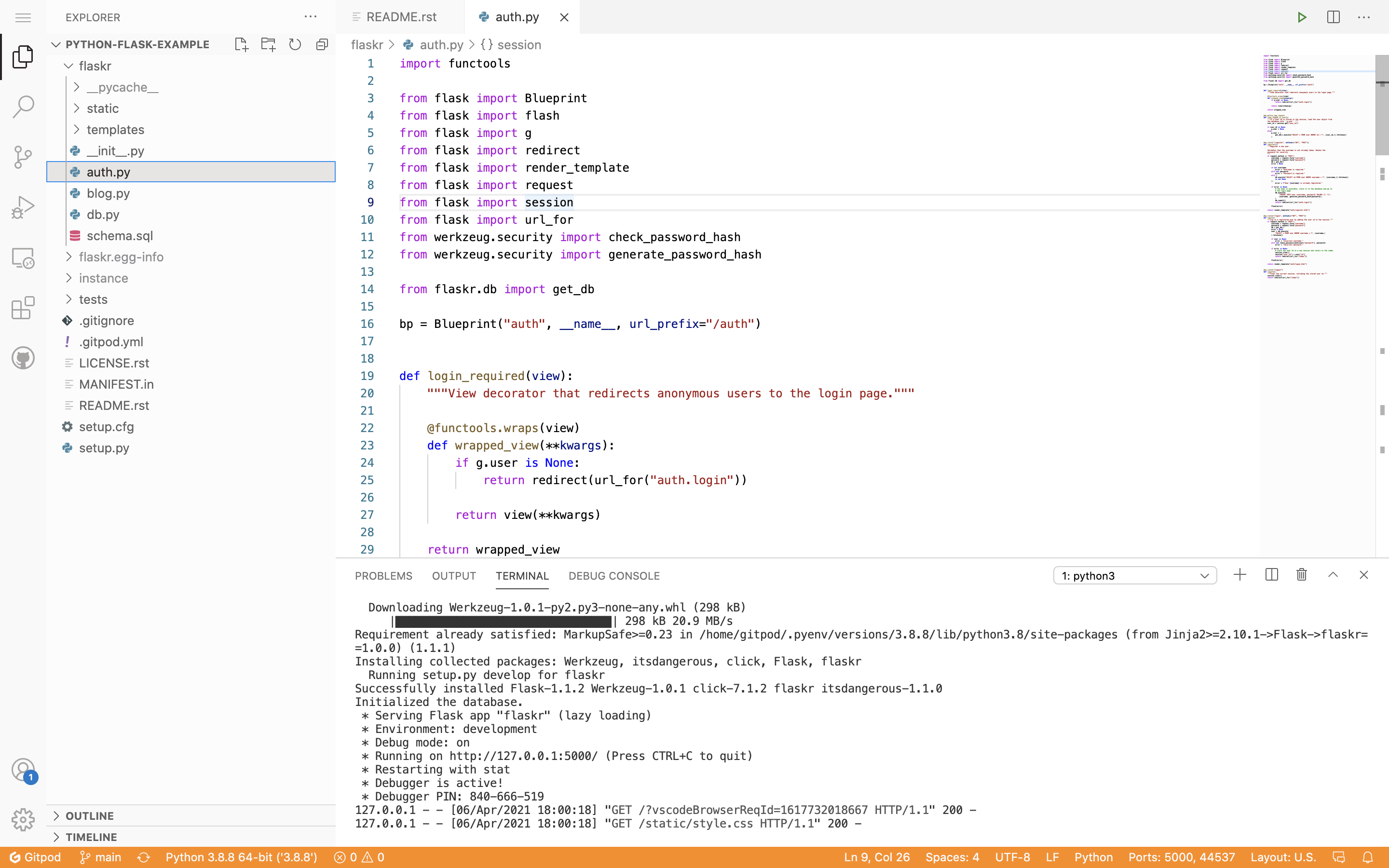
    Gitpod announced today it refreshed the dashboard for its namesake open source tool for automating the deployment of development environments, in addition to making Microsoft VS Code its default tool for editing code.

    In addition, Gitpod has included support for sudo privileges and Docker images using an advanced user namespace to map and limit access to workloads using a built-in Supervisor capability.

    Fresh off raising an additional $13 million in funding, Gitpod CEO Sven Efftinge said now that it’s clear developers will be working from anywhere for the foreseeable future, the need for a tool to automate setting up a developer environment on a local machine outside of an office has become more apparent.

    Gitpod claims there are now more than 350,000 developers using its tool that creates a Kubernetes pod on each developer machine to deploy a complete application development environment, including the integrated development environment (IDE), plugins, compilers, build tools, code generators, databases and application servers. Gitpod makes use of the version control systems provided within, for example, a continuous integration/continuous delivery (CI/CD) platform as the single source of truth for configuring an application development environment.

    The overall goal is to eliminate the time developers waste setting up application development environments so they can write code on their own machines. That approach also makes it simpler for developers to collaborate around the same application development environment regardless of where they happen to be physically located.

    Efftinge said Gitpod provides DevOps teams with a tool to automate setting up development environments across any Git repository that is the equivalent of the Codespaces tool that GitHub recently made available. Rather than having that capability for only one repository, Efftinge noted that most developers work on projects that span multiple types of repositories.

    Automating that process also makes it simpler to align development environments with production environments. One of the reasons why code doesn’t work in a production environment when it is first deployed is because the local development environment has been manually configured in a way that doesn’t accurately reflect the production environment. That issue can become even more problematic when developers are working on multiple projects involving, for example, separate microservices constructed using different repositories.

    In the wake of the COVID-19 pandemic and the acceleration of multiple digital business transformation initiatives there’s naturally a lot more focus on automation and developer productivity. Most developers will be working outside the office for the foreseeable future. Of course, most developers have been writing code outside the office for years. The challenge now is enabling teams of developers to develop applications as efficiently as possible, no matter where they are in the world. In fact, now that development teams have become more distributed, organizations are becoming more comfortable hiring developers wherever they find them.

    Eliminating inefficient manual tasks, such as maintaining development environments, is, of course, going to be a prerequisite for making it possible for those developers to, over time, navigate multiple application development projects without ever having met their colleagues in person.

  • Gitpod Raises $3M USD Seed Funding, Announces Native Integration with GitLab

    Native integration allows developers on GitLab to automatically spin up ready-to-code development environments via Gitpod’s open source platform


    KIEL, GERMANY – October 8, 2020 — Gitpod, the first open source developer platform to automate the provisioning of ready-to-code development environments, today announced $3M USD seed funding from Crane Venture Partners, Speedinvest, and Vertex Ventures US, as well as a partnership and native integration with GitLab, the DevOps platform delivered as a single application. Gitpod is an open source GitOps solution that leverages the version control system as the canonical source of truth to automate everything a developer needs to start coding. Gitpod frees engineering teams from the friction of manually setting-up local dev environments, saving dozens of hours and enabling a new level of collaboration to create applications much more quickly than ever before.
    “This is an exciting time in Gitpod’s history teaming up with experienced investors in the world of developer tools and open source software as well as working together with GitLab to provide developers with critical cloud-based dev environment automation,” said Sven Efftinge, Co-Founder and CEO of Gitpod. “Gitpod’s first mover advantage and vibrant open-source community enables developers today to treat development environments as automated (yet customizable) resources they can spin up whenever they need them and close down and forget about when they are done with their task.”


    Setting up and maintaining dev environments is tedious and requires lots of time. With Gitpod’s integration into GitLab, code reviews, bug fixes, building new features and exploring new projects is frictionless while increasing development productivity, efficiency and velocity. Developers can easily launch fresh dev environments for each new task directly from the GitLab interface via a new dropdown option from any project or merge request.


    Gitpod is a true open source solution powered by the community, spins up magically fast, can be self-hosted and is the only solution that works with almost any cloud provider and code-hosting platform including GitLab, GitHub Enterprise, and Bitbucket.


    “GitLab is excited to build a partnership with Gitpod,” said Brandon Jung, vice president of alliances at GitLab. “Gitpod’s expertise in automating cloud-based dev environments on GitLab combined with their focus on cloud native development workflows makes them a great fit for our customers helping enable them on their digital transformations.”


    Gitpod’s $3M USD seed round was led by Speedinvest with participation from Crane Venture Partners and Vertex Ventures US. Previously bootstrapped, this marks Gitpod’s first fund raise. The funding will be used to further refine the leading platform for development environment automation, as well as to expand Gitpod’s open source community and relevant ecosystem partnerships.


    “As a developer, I am more than excited to team-up with Gitpod. Moving the last missing piece in the DevOps pipeline into the cloud is the logical next step to streamline software development,” said Dominik Tobschall, Principal at Speedinvest. “The push towards remote work will only accelerate this.”


    “Gitpod’s developer-centric obsession has enabled them to build the best-of-breed technology in the rapidly growing market around dev environment automation. We are proud to back this exceptional team building a category defining company,” said Krishna Visvanathan, Co-Founder and Partner at Crane Venture Partners.


    “Gitpod’s team has a track record of creating multiple open-source developer tools used by millions of engineers. With software engineering moving to remote but collaborative work, we see Gitpod securely allowing multiplayer mode for developers while saving VPs of Engineering hundreds of hours of tool setup-time. This will be an integral part of any professional software delivery pipeline.” said Sandeep Bhadra, Partner at Vertex Ventures US.


    Gitpod is available today as an open source solution free to any developer seamlessly integrating with different cloud-providers and git-hosting-platforms. Visit https://www.gitpod.io/docs/gitlab-integration/ for more information about Gitpod’s native integration on GitLab or email contact@gitpod.io.


    About Gitpod
    The team at Gitpod.io is driven to enable all professional development teams to immediately start working and collaborating in a fully prebuilt, secure dev environments on any project, any branch and any device. Gitpod invented the notion of prebuilds allowing developers to describe dev environments as code and get an immediately productive development environment for any GitLab, GitHub and Bitbucket project. The company is founded by experienced developer tools experts that worked together for 10+ years creating programming languages and growing open source communities (Xtext, Theia). Gitpod operates a flight-proven product and leads the pack of fully-functional Cloud Dev Environments with more than 250k registered developers. www.gitpod.io


    About Crane
    Crane is a London-based VC firm focused on early-stage investments in European start-ups that are solving real problems for the enterprise and enterprise workers. We back ambitious founders building category defining companies who are redefining the enterprise stack. Crane’s portfolio includes 7Bridges, Axiom, Foundries, Harbr, Onfido, Shipamax, Tessian and Virtuoso.


    About Speedinvest
    Speedinvest is a European venture capital fund with €400M+ AUM and more than 40 investment professionals working from Berlin, London, Munich, Paris, Vienna and San Francisco. Employing a sector-focused investment structure, we fund innovative early-stage technology startups in the areas of Fintech, Digital Health, Consumer Tech, Network Effects, Deep Tech and Industrial Tech. Speedinvest actively deploys its global network and dedicated team of in-house operational experts to support our 150+ portfolio companies, including with US market expansion. Learn more: www.speedinvest.com


    About Vertex Ventures US
    Vertex US is an early-stage venture capital firm that backs companies transforming industries through software and data. With investments including LaunchDarkly, PerimeterX, and Desktop Metal, Vertex US brings pioneering experience to pioneering enterprises. In Sik Rhee and Jonathan Heiliger co-founded Vertex US in 2015. For more information, visit vertexventures.com.


    Third-party trademarks mentioned are the property of their respective owners.