Tag: funding

  • Neo4j Will Use Funds to Expand Managed Cloud Database

    Neo4j Will Use Funds to Expand Managed Cloud Database

    In July 2021, Neo4j announced a large round of fundraising—its largest to date. Philip Rathle talked with Alan Shimel about how the capital will be used to further Neo4j’s go-to-market strategy and what that means for DevOps professionals. The video of the conversation is below, followed by a transcript.


    Announcer: This is Digital Anarchist.

    Alan Shimel: Hey, everyone, welcome to another Tech Strong TV segment. My guest right now is Philip Rathle. Philip is with Neo4j, VP Product. Hey, Philip, welcome to Tech Strong TV.

    Philip Rathle: Thanks, Alan. Pleasure to be here.

    Alan Shimel: Absolutely. Philip, we’ve interviewed folks from Neo4j before, but I don’t know if everyone in our audience is familiar with the company. So, why don’t we start there? Why don’t you give us a little company background, maybe a little bit of your own background as well?

    Philip Rathle: Sure. Let me start with the second and tie it in. The thing that really attracted me to this company when I joined a bit over nine years ago was the idea that the most valuable thing in data, in my opinion, has always been the model and what’s built into the model. It’s how things are related, and what this company was doing was leaning into that some more at a time where the data space—and you look at everything that happened in NoSQL was about really simplifying the data model so that you could do this very, very high level volume and scale, but very simple data problems, store and retrieve. And in order to do that, you can lighten up on certain of the more technically complex requirements like, you don’t need acid if you’re not doing complex relationships and store and retrieve of shopping cart data at a massive scale.

    And so, what Neo4j’s been doing for more than a decade now is solving the problem of how to understand context and causality in your data through looking at how things are related. So, if you look at my relationship with—I don’t know, let’s look at an insurance scenario—with my car, other people who drive my car, other vehicles I might own, other things that I might own like a house and then line on that, and a business and lines on that and then bringing that together, suddenly, you’re into these complex kinds of enterprise data scenarios that have always been a challenge, persistently. And I lived through a lot of those as a consultant trying to fix those, kind of on a one-off basis.

    And so, what Neo4j did was something that, in the database space at the time was a bit crazy is build an engine ground up that assumed that you could do random I/O really well. Because if I’m going to understand relationships, a query can go any which way through the data, potentially very, very deep if I’m in a 20-level deep supply chain, for instance, following an item or a big payment network and looking for fraud detection, the fraud patterns or money launderings so that I can catch those. Those are all about patterns in the data, so Neo4j is a company that’s built a database from the ground up, looking to help users understand the relationships and the data so that they could understand context, causality, second order, third order, fourth order effects more deeply.

    Alan Shimel: Got it, got it. What about a little of your own background?

    Philip Rathle: I did consulting for the first half or third of my career, and a lot of that culminated in ending up as the person between the business and the IT problem. I really liked understanding what problems were being solved and then using new technology and seeing what we could bring to bear to solve the business problems.

    And I ended up working a lot with data and databases and a lot of large systems. I started at Accenture back when it was Anderson Consulting, then went into kind of a boutique company that worked on high end, large database deployments called Tanning Technology. And there, I realized I was doing—I later realized this was a step towards product management or I guess today you would call it product management. And ultimately, co-founded a startup, tried that for a few years around master data management, customer data integration; wrong market, wrong time—that’s maybe a story for another day. And then got into Embarcadero Technologies, which makes database tools.

    Alan Shimel: Mm-hmm.

    Philip Rathle: So, I worked there for about seven years, ended up heading up the database product portfolio, about a dozen tools for managing databases as well as a database interface database. Then learned about Neo4j, so, all of the cool stuff that was happening in data about 10 years ago, and thought, “I wanna be a part of this, kind of ground up, creating new ways of managing data.” And yeah, the rest is history. I’ve been heading up Product Management since then. I was employee number 30, and we’re at 550 growing way past 600 this year.

    Alan Shimel: Excellent. Very cool. So, I think we’ve laid a lot of the ground work, here. Phil, recently Neo4j announced a rather large raise. Why don’t you give us—a capital raise—why don’t you give us some information on that?

    Philip Rathle: Yeah, we did. So, as a company, you know, those of you who, probably every listener knows how it works with startups, right? You raise money, you put that money into primarily R&D, improving the product, and other areas of the business, and then you grow and, you know, at some point, there’s some kind of exit for us. We’re looking to be a big, independent company, and for that, databases are highly capital intensive, very complex technologies. It’s not enough to have just the database, you need tooling around it, especially when it’s a new kind of model.

    So, we just made a massive fundraise. We had already raised over $100,000,000.00 over the course of the years. This single fundraising event is $325,000,000.00, it’s the biggest fundraise ever for any database company in history. So, we’re pretty excited about it.

    Alan Shimel: For good reason—congratulations. You know, I’ve been involved in companies that have raised money, significant money over the years—that’s a lot of money, man. [Laughter] That’s a really big raise.

    Now, of course, you know, our audience says, “Whew, another big number.” We’re hearing a lot of big numbers lately. What does it mean for them? What does it mean for them, what does it mean for Neo4j to have that kinda capital? What’s the payoff, here?

    Philip Rathle: Yeah, I mean, it’s pretty much product, product, product with a little bit of a dash of regional expansion. So, on the product side, Neo4j recently launched—so, late 2019, we launched a self-serve version of the database as a service. So, it starts at $65.00 a month, credit card swipe. You can get a fully managed Neo4j database in the cloud and turn it on, it runs. You don’t need to worry about managing the database. And we launched an enterprise tier last year. Right now, it runs on, you can choose between GCP, AWS, of course, Azure and others are coming, and Work in Progress. 

    So, one area is to really keep improving the cloud product since the preferred way of consuming databases these days has flipped to cloud very, very fast over—you know, whereas just in the last couple years. Another one is graph data science. So, last—a bit over a year ago, we entered the, we expanded what Neo4j can do, which typically has been a developer oriented database with database drivers and more for transactional operational applications. 

    What we’ve been seeing over the last few years is that a lot of the kind of next step in machine learning and data science and AI is getting information about the connections in the data and in the network into your machine learning algorithm. And that whole art and science is graph data science, and we have a graph data science for a Neo4j offering, which is a graph data science library, together with a database, together with Bloom, which is a visualization and exploration tool. And that offering has really taken off in the last year, both in terms of demand, customers, and also, it’s become really mature in a short time. But there’s still a long way to go; it’s a brand-new space. 

    So, those are the two primary areas, and then I’ll add the third is just continuing to mature the database, continuing to make it scale, handling larger and larger amounts of data. By the way, as part of our announcement at our annual conference, we also a trillion-relationship graph.

    Alan Shimel: Wow.

    Philip Rathle: Just showing how, across 1,000 machines like—actually, trying to spin up this many machines on AWS, Amazon couldn’t provision the machines fast enough. [Laughter] We’ve never seen this kind of error.

    Alan Shimel: Right.

    Philip Rathle: But there’s no end to performance, scalability, security, more features, more richness, et cetera. So, those are the main areas, and like I said, a dash of regional expansion, really growing beyond—our primary markets have been U.S. and Europe with some customers in other parts of the world, but this will help us expand more in other parts of the world.

    Alan Shimel: Excellent. You know, I think one lesson that I learned during my career, and I think it’d be wise to share with the audience is—you know, there’s a latency time between the time you raise money and the time that money finds its way into products that are released, right?

    Philip Rathle: Yeah, that’s very true.

    Alan Shimel: Because, okay, now we’ve raised money, we gotta go hire people. We have the idea of what we wanna do, right? But, you know, we gotta flesh out those plans, we gotta get the people power, the technology process in place.

    When do you think we’ll see some of these great things that you’re talking about that, you know, this money raise has enabled actually come out to market?

    Philip Rathle: That’s a great question. So, prior to the fundraise, we were close to maxed out in hiring. And when I say close to maxed out, there’s a certain rate at which you can efficiently hire, and then beyond that, you kind of need to have people on their own off in the background, but that can’t contribute to the code base, because it’s not even structured to be able to have more than a certain number of people contribute. So, we’re—and that’s less true with new areas that we’re growing out. So, we’ve seen this one coming now for a few months, and so, we—that, plus just early in COVID, like, last April, we actually froze hiring for a bit and said we don’t know where things are going and we don’t wanna be in a position where we have to lay people off, that would just be horrible. Let’s just pause hiring.

    And then our business kept, you know, fortunately, doing well. And so, we started to wrap up, but I’d say—so, two answers, maybe. One answer is, you’re already starting to see the results of a really aggressive ramp in product and engineering. My team is doubling this year, and it’s close to doubled already. The engineering team is growing by about 50 percent. But what this also means is, we can keep hiring and we can keep—and whenever we have new products, new areas, we can form entirely new teams there. 

    So, I’d say the answer is now, but it also means that, on a steady state, continued basis, you’re gonna continue to see some really significant product releases from quarter to quarter, year to year.

    Alan Shimel: I would imagine. I would imagine—and beyond, with raising that kinda money, beyond. Anyway, Philip, we’re running out of time. You know what, did we mention the website?

    Philip Rathle: The website is Neo4j.com.

    Alan Shimel: That’s N-E-O—

    Philip Rathle: The number 4 and the letter J.

    Alan Shimel: Letter J—dot com.

    Philip Rathle: And you’ve got all kinds of info, resources for getting started. We’re huge on open source, we’re huge on education. And I should mention that our vocation has been not just making our own company successful—first of all, it’s about making users successful and making an impact in the world. But then not just making an impact in the world by making our product succeed, but making the category succeed. Because this is something that our founder penciled out on a napkin once upon a time. 

    So, we see ourselves in some ways as helping to grow the graph database space and just, you know, we celebrate when other companies go launch graph databases, because that means it’s good for the world. We’ve done a lot of work in the standards area and so on to make it more mature and better. So, you’ll see an open source version, there’s a free sandbox you can get started with, there’s a free version of our cloud product. Or, both on the developer side, on the data science side, lots of docs, good community out there, a Discord group, questions, QA on ________, you name it, it’s all out there. We’d welcome any and all of you listeners to check it out.

    Alan Shimel: Cool. Alright, we’re out. Philip Rathle, Neo4j—thanks for joining us on Tech Strong TV here today. Congratulations to you and the whole team on an outstanding raise, and now, let’s see you put it to work.

    Philip Rathle: Thank you.

    Alan Shimel: Alrighty. Be well. This is Alan. We’re gonna take a break here on Tech Strong TV. We’ll be right back with our next guest.

    [End of Audio]

  • build.security Leverages OPA to Shift App Authorization Left

    build.security Leverages OPA to Shift App Authorization Left

    build.security today announced it has raised $6 million to launch a platform that promises to make it simpler for developers to centralize the management of authorization controls across multiple applications.

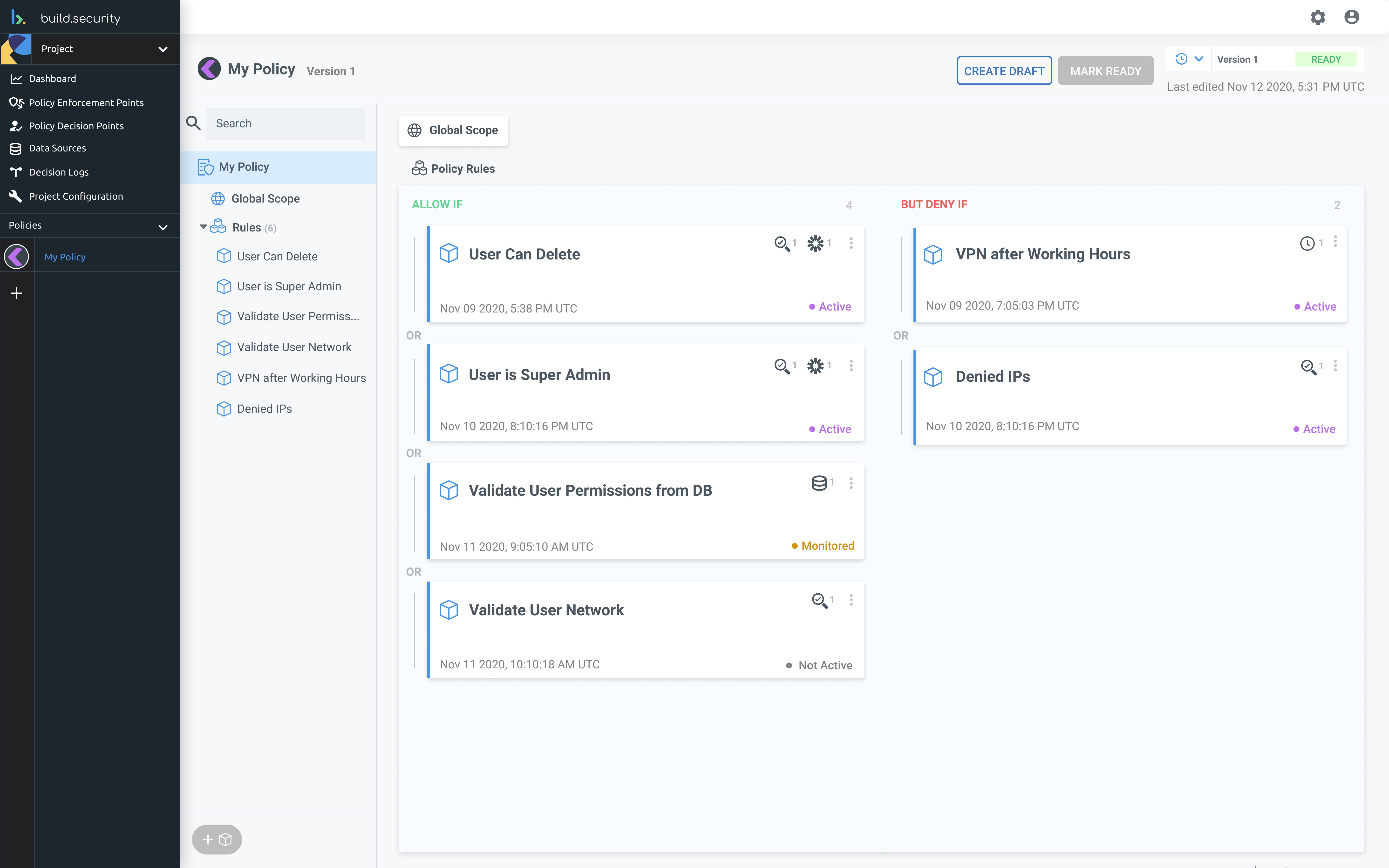
    The goal is to enable DevOps teams to shift control over application authorization further left to advance adoption of best DevSecOps practices using a platform based on the open source Open Policy Agent (OPA) software, which enables developers to create policies that manage authorization as code.

    Company CEO Amit Kanfer said every application deployed today requires its own unique set of authorization requirements based on roles, permission models and complex hierarchies along with relevant identity, resource and context attributes. Streamlining that process requires a platform that provides a uniform approach to managing that process that is more flexible than existing approaches based on either role-based access controls (RBAC) or attribute-based access controls, said Kanfer.

    Otherwise, developers are required to build an array of complex authorization models, policy engines and enforcement points themselves to manage identities, resources and attributes. Those tasks are not only time-consuming but also highly prone to errors that leave applications vulnerable to cyberattacks. he said.

    OPA makes it easier for developers to implement fine-grained access controls using a drag-and-drop interface that decouples authorization policy from code. That approach makes it easier to declaratively make changes and updates to applications over time as more end users are added or removed, Kanfer said.

    Designed to be deployed on-premises or in the cloud, the authorization platform also provides integrations with identity providers, databases and other services that expose application programming interfaces (APIs). It will also automatically generate policy suggestions based on the runtime interactions between services.

    Historically, authorization to access applications has been poorly managed because it’s been difficult to manage manually. Business leaders are supposed to inform IT organizations when to add and delete end users. In practice, they often forget, resulting in end users still having access to applications long after they have left the company. Even when IT is informed that an end user has left a company, it can take a day for the end user to be deleted from all the applications they have been granted access over the span of their career at that organization. Shifting control over authorization left toward developers creates an opportunity to automate a process that is often haphazard at best.

    It also should allow organizations to reduce their dependency on Microsoft Active Directory (AD), which many organizations have employed to manage access to applications and files in Windows environments in favor of a centralized approach that can be more broadly applied to multiple applications.

    Authorization management may not always be at the top of the IT management agenda. However, at a time when cybercriminals are stealing credentials with more abandon than ever, the time may have finally come for IT organizations to reconsider how those credentials are managed and updated. After all, based on the number of data breaches involving stolen credentials, current approaches are clearly not working.

  • GitLab Outlines Scope of DevOps Ambitions

    GitLab Outlines Scope of DevOps Ambitions

    At the GitLab Commit event in New York today, GitLab launched an ambitious effort to extend the scope of its DevOps platform to provide a view into the software development life cycle for not just developers but also designers, product managers and business leaders.

    Fresh off raising an additional $268 million in funding, GitLab now plans to create different ways to view a common pool of metadata and metrics generated by the GitLab DevOps platform.

    It may be a while before GitLab can deliver on that promise, but the core concept builds on the dashboards the company already has built for IT operations and cybersecurity teams. Rather than requiring each team participating in the software development process to acquire a separate platform, GitLab should be viewed as a DevOps platform delivered as a single application that can now be applied to everyone, said Mark Pundsack, vice president of product strategy for GitLab, in speaking with conference attendees.

    As part of that commitment, Pundsack noted GitLab is expanding its DevSecOps capabilities to include auto remediation. The scanning capabilities built into GitLab will be extended not only to detect issues based on the cybersecurity policies of an organization, but also, when allowed, automatically remediate routine issues, Pundsack said, adding GitLab also will automatically roll back applications if necessary. Once in place, GitLab will have pushed application cybersecurity much further left than anyone might have expected when DevSecOps was first broached as a concept, he said.

    At the conference, GitLab demonstrated a pipeline graph capability that will provide a foundation for many of these promised offerings. GitLab already can be employed to accomplish tasks such as code quality scanning, container scanning, dependency scanning and licensing dependencies.

    All these features are an extension of GitLab’s existing strategy that aims to rationalize the number of tools organizations need to stitch together to drive a set of best DevOps processes. However, other DevOps platform providers have similar ambitions.

    Thanks to its latest round of funding, GitLab—which also announced its plans to go public next year—is now valued at $2.75 billion. The company has not released any revenue results but does claim to support more than 100,000 organizations using its platform, including Ask Media Group, Charter Communications, Delta Air Lines, Goldman Sachs, Ticketmaster and Nvidia. GitLab also claims to have more than 4,800 active contributors to its open core platform. The company now has more than 800 employees in more than 55 countries across the globe, and there currently are 222 open GitLab jobs posted.

    It remains to be seen how much $268 million will enable GitLab to fend off rivals such as GitHub, which was acquired by Microsoft, and CloudBees, which has built a large DevOps community around the open source Jenkins continuous integration/continuous deployment (CI/CD) platform. Whatever the outcome of this arms race, the massive amount of funding pouring into the platforms soon should take DevOps platforms to places many might not have ever imagined possible.

    — Mike Vizard

  • CollabNet VersionOne Picks Up $500M to Fuel Value Stream Management

    CollabNet VersionOne Picks Up $500M to Fuel Value Stream Management

    CollabNet VersionOne today announced it has picked up an additional $500 million in funding to help fuel what is rapidly becoming an arms race to drive adoption of value stream management in DevOps environments. TPG Capital, the private equity arm of TPG, signed a definitive agreement to acquire CollabNet VersionOne. Terms of the acquisition were not disclosed, but TPG pledged to invest up to $500 million to take value stream management to the next level.

    CollabNet VersionOne CEO Flint Brenton said part of the funding will be used to fuel both organic and inorganic investments in value stream management, a rapidly growing segment of the IT market that is just now coming into its own. Value stream management represents a holistic effort to align application development and delivery with strategic business objectives. In effect, IT leaders are now looking to apply advanced analytics to determine how a delay to one aspect of a development project might impact the revenue goals of the business.

    Brenton said now that more organizations are viewing themselves as software companies that make a product or deliver a service, they need tools to manage application development projects in much the same way software companies operate. Rather than building those tools, many of those companies are looking to vendors such as CollabNet VersionOne to provide those tools within a unified platform.

    CollabNet VersionOne is, of course, not the only IT vendor pursuing that opportunity. However, rather than viewing value stream management as an extension of a specific development platform, CollabNet VersionOne is pursuing an approach that makes it possible for an organization to manage software investments across multiple platforms.

    Brenton said organizations should expect CollabNet VersionOne to focus on value stream management. As part of that focus, the company will look to fill in gaps in its portfolio by investing in product development, partnering with providers of complementary applications such as providers of business intelligence (BI) tools or acquiring smaller companies.

    In effect, there is now an arms race underway when it comes to building the next generation of value stream management platforms. Much of the investments in this area will be focused squarely on advanced analytics infused with machine and deep-learning algorithms that will enable organizations to begin applying artificial intelligence (AI) to the management of software delivery.

    It’s not clear to what degree CollabNet VersionOne may one day be a target for acquisition itself as the entire DevOps vendor community continues to consolidate. As DevOps processes increasingly are embraced by enterprise IT organizations, many vendors are concluding they need to “go big or go home.” In fact, Brenton noted the acquisition of CollabNet VersionOne was initiated by TPG Capital, which was looking to find an attractive investment in the DevOps sector.

    It may be a little while longer before every enterprise has mastered the nuances of value stream management, but the one thing that is clear is there will be no shortage of options as investment dollars continue to pour in.

    — Mike Vizard

  • Armory Looks to Drive Enterprise Adoption of Spinnaker

    Armory Looks to Drive Enterprise Adoption of Spinnaker

    Armory this week committed to advancing adoption of the open source Spinnaker continuous delivery (CD) platform in enterprise IT environments after revealing it has raised an additional $28 million in funding.

    Company CEO Daniel Odio said Armory will add proprietary tools to a curated distribution of Spinnaker that will make it easier for the average IT organization to deploy and manage Spinnaker. Developed by Netflix, Spinnaker is gaining traction as a CD platform in the wake of becoming one of the four projects being managed under the auspices of the Cloud Delivery Foundation (CDF), an arm of the Linux Foundation.

    Spinnaker is designed to be a CD platform that includes all the management tools required to manage that process. While continuous integration/continuous deployment (CI/CD) platforms such as Jenkins have addressed aspects of CD, most of the daily usage of those platforms has been squarely focused on continuous integration. As part of an effort to meld CI/CD platforms and Spinnaker, the CDF has accepted both Spinnaker and Jenkins as part of the first four projects that will be developed under its auspices. The other two are Jenkins X, a CI/CD platform specifically designed for building microservices-based applications on top of Kubernetes, and Tekton, a set of pipelines also designed specifically for Kubernetes.

    Odio said there are already more than 500 organizations using Spinnaker, and each one is not standardized on a specific CI/CD platform. Armory is part of the CDF but also sees a need for a curated instance of Spinnaker that is optimized to meet the needs of enterprise IT environments, he said.

    In general, Odio said a “flywheel effect” manifests once an organization launches roughly its eighth project using Spinnaker. From that point on, adoption of Spinnaker starts to accelerate to the point where an organization sees the need to standardize on a single curated instance of Spinnaker, he said.

    The bigger issue as far as adoption of Spinnaker and other DevOps tools remains cultural, Odio added. Many organizations still don’t accept the fact that CI/CD platforms are intended to foster a level of accelerated development that makes it more feasible to experiment and innovate. There are, of course, inherent risks to that approach in the sense that many of those projects might fail. Many enterprise IT organizations are still coming to terms with the need to accept higher levels of failure as the price of learning, he noted.

    In the meantime, many organizations that have embraced DevOps now find themselves on the cusp of a major transition as the shift toward cloud-native applications increases. Most CI/CD platforms today were designed to accelerate development of monolithic applications. Now what’s needed is a new generation of CI/CD platforms that are designed to accelerate development of microservices-based applications based on containers. As a result, many organizations will end up employing multiple CI/CD platforms. Armory is betting many of them will try to delineate where CI leaves off and CD begins.

    — Mike Vizard

  • Harness Invests in Automating Continuous Delivery

    Harness Invests in Automating Continuous Delivery

    Fresh off raising an additional $60 million in funding, Harness plans to make more investments in machine learning algorithms to advance continuous delivery through automation.

    Harness CEO Jyoti Bansal said the startup, which he co-founded with Rishi Singh, a former DevOps platform architect at Apple, is now in a position to invest more aggressively in additional engineering and sales resources needed to expand adoption of the cloud-based service, which provides a level of abstraction through which much of the continuous delivery process can be automated using drag-and-drop graphical tools. Bansal and Singh co-founded Harness after AppDynamics, provider of an application performance management (APM) platform Bansal also co-founded and served as chairman of the board, was sold to Cisco Systems.

    Bansal said Harness takes advantage of YAML files and machine leaning algorithms to present DevOps teams a set of visual tools accessed via a cloud service that enables them to build sophisticated pipelines as quickly as 10 minutes. That approach promises to significantly advance DevOps adoption by making it easier for IT operations teams to set up those pipelines as part of continuous delivery process without needing deep programming expertise.

    While there’s been a lot of progress made in terms of driving adoption of best continuous integration practices among developers, the continuous delivery side of the DevOps equation has proved much more difficult to achieve. Most IT organizations rely on multiple platforms that have their own unique attributes. As such, IT operations teams typically have created their own scripts or rolled out automation frameworks such as Ansible to allow them to automate some aspects of the application deployment process.

    However, Bansal noted, custom scripts typically don’t scale very well and usually have not been well-documented. What’s more, frameworks such as Ansible are still too low-level to enable DevOps teams to build pipelines in minutes. The approach Harness has designed enables DevOps teams to describe their intent using a set of visual tools, which then employs machine learning algorithms to automate the deployment process regardless of the underlying platform, he said.

    That approach is further augmented by a set of rules that can be added to make sure security and compliance requirements are met, he noted, adding Harness also provides views into how processes are being automated to provide DevOps teams with the confidence required to trust a highly automated platform.

    Bansal said the goal is to not just make it simpler to build and deploy pipelines, but also maintain them in what have become highly dynamic IT environments where there is simply too much data that needs to be tracked for human administrators to effective manage relying on low-level tools and frameworks. Rather than having to build and deploy the framework needed to achieve that goal, he said, Harness is making it possible to automate the continuous delivery process using a cloud service on demand.

    It may take a while for IT organizations get comfortable with the level of automation being enabled by machine learning algorithms. But like it or not, it’s already becoming apparent the ability to dynamically manage IT at scale is clearly on the cusp of making another significant leap forward.

    — Mike Vizard

  • Dataloop.IO Raises $5 Million Series A Round From Battery Ventures and Open Ocean

    As Software Seeps Into More Facets of the Enterprise — and Into the Cloud — Dataloop.IO’s Next-Generation Monitoring Tools Keep Infrastructure Running

    SAN FRANCISCO, CA–(Marketwired – Jun 20, 2016) – Dataloop.IO, an innovator in cloud IT-monitoring whose products help organizations save time and money, has raised $5 million in Series A financing from Battery Ventures and Open Ocean, a European early-stage venture capital firm.

    Dataloop.IO — whose product is already in use with customers such as Moz.com, BBC Worldwide and Criteo — will use the funds to ramp up product development, sales and marketing. The company is also opening a new headquarters in San Francisco to attract talent and build on its sales momentum in the U.S.

    What separates Dataloop.IO from other IT-monitoring tools — which are critical in today’s highly complex datacenters — is its focus on making cloud monitoring a self-service platform that many people in an organization can use. Other solutions still require a central operations team to set up a monitoring function, which can be difficult to scale as the organization grows or moves to new IT architectures like microservices. Dataloop.IO enables its customers to standardize and consolidate all their monitoring functions into one solution, while staying agile by empowering individual teams to set up the monitoring they need in minutes.

    “Today, organizations and DevOps teams are managing data and building applications more quickly than ever with new methods, at huge scale, both on- and off-premise,” said Dataloop.IO Co-founder and CEO David Gildeh. “In this world, you need to provide monitoring as a self-service solution, or risk losing agility as the number of teams relying on your monitoring solution grows. Dataloop.IO is the only solution designed to solve this problem from the ground up.”

    Dataloop.IO was founded by three colleagues from Alfresco, an open-source company specializing in online document management. Gildeh, Steven Acreman and Colin Hemmings identified the need for a service like Dataloop.IO’s when they helped Alfresco build its first cloud service. They saw firsthand how existing IT-monitoring tools were designed for old IT models and couldn’t adequately handle complexity of cloud environments.

    “Dataloop.IO is at the forefront of some of the biggest trends shaping IT today, such as the rise of cloud computing and microservices,” said Richard Muirhead, the general partner leading Open Ocean’s investment. Muirhead previously founded and/or was active with companies including Orchestream, Tideway Systems and Automic Software.

    He added: “As every business becomes a software business, the need for more-modern, and self-service monitoring tools becomes even more acute. I am convinced Dataloop’s team is the right one to tackle the problem.”

    “As our architecture becomes increasingly complex, accurate monitoring is an absolute must,” said Scott Ehnert, VP of TechOps at Moz.com. “Dataloop.IO enabled us to standardize and consolidate all our monitoring across the teams with a self-service solution, saving us time, money and a lot of headaches.”

    Dataloop.IO previously raised $1.2 million in seed capital.

    About Dataloop.IO
    Dataloop.IO is an emerging software company on the cutting edge of major IT-infrastructure trends including cloud computing and microservices. The company, founded in the U.K. but now based in San Francisco, is developing the next generation of cloud monitoring required for microservices and DevOps.

    CONTACT INFORMATION

  • Loggly Closes $11.5M of New Financing

    Cloud-based log management solution follows 2,000 customer milestone with funding round led by True Ventures

    SAN FRANCISCO, CA—June 14, 2016—Loggly, the leading cloud-based, enterprise-class log management solution provider, today announces an $11.5 million funding round. Led by True Ventures, the new round enables Loggly to continue to innovate as well as to expand sales and marketing activities. Additional investors include Matrix Partners, Cisco, Trinity Ventures, Harmony Partners and Data Collective Venture Capital.

    “Following record growth and customer adoption, including reaching the 2,000 paid customer accounts milestone in Q1 2016, this next round of funding marks continued momentum for Loggly. True Ventures – and all Loggly investors – have set the stage for us to build on these achievements,” said Charlie Oppenheimer, CEO, Loggly. “This funding enables Loggly to further accelerate innovation in powerful analytics, alerts, search capabilities and other key areas so our customers can find root causes faster, spot anomalies earlier and monitor the health of their applications and infrastructure.”

    Loggly has become increasingly cash efficient as a result of significant growth in recurring revenues, gross margin and reduction in customer acquisition costs. Combined with record revenue growth from both new and existing customers, the company expects to achieve cash-flow positive operations during 2017.

    “True Ventures believes in taking bold risks and supporting our companies through their entire lifecycles,” said Puneet Agarwal, Partner, True Ventures. “We are excited to lead this next stage with Loggly and look forward to the continued innovation and growth.”

    Customers in the gaming and entertainment industry, consumer services, technology as well as marketing and finance platforms, use Loggly as their cloud-based log management service to aggregate all logs in one central place and turn large amounts of log data into valuable insights in real-time.

    About Loggly
    Loggly aims to empower the creators and operators of cloud-based services to operate flawlessly and deliver great user experiences by knowing what’s going on with their applications and why. Our cloud-based log management solution shows you what matters by crunching through huge volumes of log data that no human could possibly read. Loggly is the world’s most popular cloud-based, enterprise-class log management solution. Founded in 2009 and based in San Francisco, the company is backed by True Ventures, Matrix Partners, Cisco, Trinity Ventures, Harmony Partners, Data Collective Venture Capital, and others. Loggly is an official AWS Config partner and a Docker Ecosystem Technology Partner. Visit us at www.loggly.com or follow @loggly on Twitter.

    Press Contact:
    Matt Trocchio
    SHIFT Communications
    512.792.2555
    loggly@shiftcomm.com

    ###