Tag: fintech DevOps

  • How DevOps Helps Banks Optimize Their Services

    How DevOps Helps Banks Optimize Their Services

    A world-renowned bank’s CEO was recently quoted as saying that while there are thousands of manual banks now, the future will see only a handful of digital banks. Along with the rest of the world’s critical business sectors, an overwhelming number of banks are also shifting to virtual platforms. This migration is being orchestrated by some of the best DevOps resources that the global FinTech sector has to offer.

    The convenience of personalized services that are always on-demand has incentivized the banking sector’s reliance on DevOps workflows. When the COVID-19 pandemic struck and limited physical banking services, the migration of enterprise banking systems onto the cloud had been in full swing. Most bank employees had to shift to a work-from-home setup, accelerating the use of virtual service delivery.

    As per an estimate by the IBM Institute for Business Value, about 59% of the companies surveyed are in various phases of their digital migration and the banking sector is naturally following suit. DevOps teams are tasked with writing software extensions for connecting digital banking services to the end customer in an agile manner.

    This article explores why DevOps is slowly becoming an essential foundation for any successful banking institution. We will also discuss how traditional institutions cope with these changes and what benefits they can look forward to once they make the leap to DevOps.

    Agile Processes Facilitate Digital Transformation

    Most banks these days have been adopting agile processes to stay ahead of the competitive curve. The main motive behind this is to keep up with frequent business requirements that come with efforts to improve clients’ banking experiences. Fine-tuning the project planning and execution processes that drive this improvement are what the DevOps teams would be mainly doing.

    Under the Agile methodology, banking applications would be created in small, controllable steps known as sprints. Each step is tested meticulously before it can be considered executable or complete. Before continuing to build on the delivered component, proper channels are followed for real-time feedback and course correction. The end goal is that the customer must get a product that is of value in a much shorter timeframe than is possible through any other development process.

    More than even the process and the rules governing it, the DevOps teams involved and their collaboration is a top priority as well as the eventual outcomes. Agile projects behind the most optimal banking services and products must involve continuous planning, testing and integration of finished components.

    Faster Success for DevOps Teams in Banking

    To successfully drive new digital banking services, large banks need billions in assets and need to gain millions of new customers along the way. It all boils down to shifting their processes to a more granular process and continuously improving upon it.

    In situations like these where DevOps practices need to be adopted proactively, the client’s line of business (LOB) teams move to Agile planning strategies fairly quickly. They use a variety of tools to implement Agile and DevOps practices to tackle growing customer demands for their improved digital banking services.

    But for this to work seamlessly, the developer experience for both the LOB and IT teams needs to be streamlined. The LOB and IT teams’ efforts can be integrated if the DevOps platform is automated with built-in Agile capabilities and bi-directional integration. This ensures seamless collaboration, faster DevOps implementation and the speedy delivery of banking services and products.

    Focused Insights and Better Predictability

    Large banks can standardize the internal IT development team on an engineering life cycle management platform, simultaneously providing support to the LOB team via the Agile issue tracking dashboard. Agile life cycle management tools extend an integrated solution for banks. Using these tools, the DevOps teams can be provided with full transparency and traceability of developer data.

    Developer-specific capabilities such as source code management, build automation, continuous integration and delivery and Agile planning are more accessible this way. The IT developer community considers Agile workflow management platforms as the benchmark for efficient and continuous business flow. Workflow management platforms and issue tracking portals are the places where most of the Agile planning takes place.

    Agile life cycle integration adaptors then link the LOB-defined Agile stories with specific developer tasks in easy-to-manage packets. The developer changes to the application code are tracked within the workforce management tool to draw useful and quantifiable insights from the data. The speed of application delivery is accelerated further because of the connections established between the projects, teams and tools.

    Minimizing Service Delivery Mishaps

    Using workflow management tools, the team can provide continuous build and integration functionalities. They can deploy automated integration builds on dedicated cloud or on-premises environments which minimizes errors in service delivery. A software bill of materials (SBOM) is generated for each build in the final audit trail which lets developers resolve errors retroactively as well.

    A broad picture is created of which new tasks and pieces of code went into the build and what software assets were created. DevOps implementation ensures continuous delivery of the banking application across test and production environments. Errors are reduced throughout the production life cycles of each banking service or product. This reduces the time taken from development to production. A fully automated and auditable delivery pipeline is created to make future deployments even faster.

    Reduce Banking Product Release Cycles

    DevOps provides a very robust and reiterable foundational environment for the bank’s business to thrive while reducing release cycle time with every iteration. This means every time a new banking service is delivered, the development life cycle is improved bit by bit. In some cases, the release cycle can be reduced by more than half the original time taken.

    While service delivery is improved, this also frees up release engineers for urgent tasks crucial to the deployment window. More deployments occur while still keeping the bank or financial institution in accordance with regulatory guidelines.

  • The Evolution of Technology Driven Banking

    The Evolution of Technology Driven Banking

    History repeats itself with every technological revolution, sparking the same old fears about job loss and human redundancy. Much of this is unfounded because each time, when routine and repetitive jobs got mechanized, those who were displaced often were elevated into bigger, better roles. The pattern was consistent across industries; whether it was manufacturing, retail, entertainment or banking, the technology of the day – from the steam engine to the mainframe – augmented and amplified, rather than eliminated, the work of human beings.

    This time around, the debate is about cloud-driven banking shaking up employment in the financial sector. But the reality is the same, as always.

    A Look at Banking Functions

    To understand what is happening, let us segregate various banking functions from an inside-out perspective. Strategy definition occurs at the top, at the level of the board and senior management. Lower down the order, the strategy is converted into plans, which are then executed by various teams. All these activities involve data operations such as collection, comparison, tracking, monitoring and course correction. There is no interaction with the end customer just yet.

    The second set of functions is aimed at achieving strategic and financial goals. These functions relate to business execution – expanding the corporate, retail or investment banking business, adding branches, acquiring customers and so on. The desired outcomes are defined as KPIs for individual managers, expressed as growth targets and budgets.

    The moment of truth is when these internal functions flow out of the bank to the last mile – in other words, when a frontline employee, such as a branch manager or relationship officer, comes in contact with the end customer. Not much has changed in the way banking has been transacted since 14th century Greece. The counter has been replaced by the teller window, but the interactions are still about facilitating lending, borrowing and payments. What has changed, however, is the number and type of participants. In addition to the money lenders and joint stock companies of old, today there are banks, of course, but also fintech firms and big tech companies. The mode of service delivery also has changed (perhaps beyond recognition) to include branches, mobile phones, websites, wearable devices and even social media applications.

    The Role of Machines

    Let us examine the role of machines (which includes software and digital technology, including cloud) in each set of functions. Strategy visioning and implementation clearly need human intelligence; however, machines can provide rich, accurate and timely data so the people in charge can make better decisions. Similarly, while planning activities – involving interpretation, visualization and application of past experience – too cannot be handed over to machines, they can certainly leverage machine learning to do what-if analyses and simulate various scenarios in real-time.

    Business execution functions offer more potential for humans and machines to actually work together, by farming out repetitive and routine work, such as data collection, comparison and analysis, to the latter. Following that, the human workers will apply their wisdom to machine-generated insights to take course-corrective actions to, say, improve revenue, lower cost, enter new markets, etc. In each case, far from taking over the role of human workers as feared, the machines are actually elevating them.

    Several operational goals are set up as part of business functions, with managers at the head office, zonal or branch level assigned responsibility for achieving them. While the managers make the decisions – for example, which channels to employ – implementing those decisions at scale is only possible with the help of machines – think origination, onboarding, document verification, KYC checks, credit rating analyses etc. This is how Paytm onboarded 200 million customers when India announced demonetization, and RBL acquired massive digital deposits during the pandemic lockdown. Without support from machines, their human employees would only have been able to handle a fraction of the business volume.

    That being said, there are some jobs that can, and should, be given to machines. A good use case is technical resolution – attending to issues in databases, networks, servers or applications – that can be performed proactively, preemptively and efficiently by AI-driven systems at a scale that is out of reach of human workers. What’s more, the systems will continue to learn and improve over time, so humans need only step in to resolve complex or exceptional issues. When a customer calls a contact center, call tracking, tracing and auditing, as well as caller identification, are best left to the machines, which will also route the call to the best available agent; the system can also suggest the best solution based on past history. Note that while the machines take over these jobs, no roles are actually lost. The agent remains in charge of making the final decision and communicating it to the customer.

    Cloud-Driven Banking

    Now let’s look specifically at the impact of cloud-driven banking on human workers. When it comes to lowering cost while improving agility, the cloud is unbeatable. Today, when banks are under immense pressure to reduce cost from both a low-interest environment and new competitors operating at half their cost-to-income ratios, it is unviable for them to maintain expensive physical infrastructure, such as data centers. Cloud service providers and hyperscalers are the answer for managing everything from servers and systems to databases and data centers. Outsourcing these functions relieves the banks’ operators but does not make them redundant, because they can be redeployed in higher roles, such as planning for growth. This means that instead of providing services to the business organization, they will demand services from the cloud providers; in other words they will become “service seekers” instead of “servicers.” In this role, they will require higher-level skills like negotiation, critical thinking and decision making.

    To sum up, whether it is artificial intelligence or machine learning, when technology takes over a routine banking function, it always opens the doors for human workers to elevate themselves into a more rewarding role. Cloud-driven banking is no different.

  • Winning DevOps in the Finance Industry

    Winning DevOps in the Finance Industry

    DevOps is making its impact on almost every software-powered company these days. Companies in the finance domain, however, have been perhaps the slowest to embrace DevOps because of concerns regarding governance, security, compliance and regulatory regulations. But it is safe to say that they are currently leading the digital innovation in this era of cloud-native technology.

    Why DevOps for the Finance Industry?

    Higher customer engagement and continuous transactions make the finance industry one of the busiest and naturally requires uninterrupted infrastructure. DevOps implementation helps companies develop fast, fail fast and learn fast so they can fulfill customer expectations and deliver features faster to market than their competitors. Technology in the finance sector has not evolved much, as many companies have assumed it is too risky to embrace DevOps because of the amount of legacy code and old methodologies still in practice. As a result, digital innovation has lagged.

    Challenges of Implementing DevOps in Finance

    Unlike other industries, regulated industries imply several challenges:

    • Strong restrictions on secured networks.
    • Fine-grained audit trails.
    • Strong ACLs models.
    • Full lifecycle governance.
    • Integration with third parties.

    Security and compliance are top concerns in financial companies, and DevOps practices are, in fact, viewed as risk factors to security. Plus, the increased frequency of software releases in DevOps is seen as a threat to governance and regulatory controls.

    Is the Needle Moving Toward DevOps?

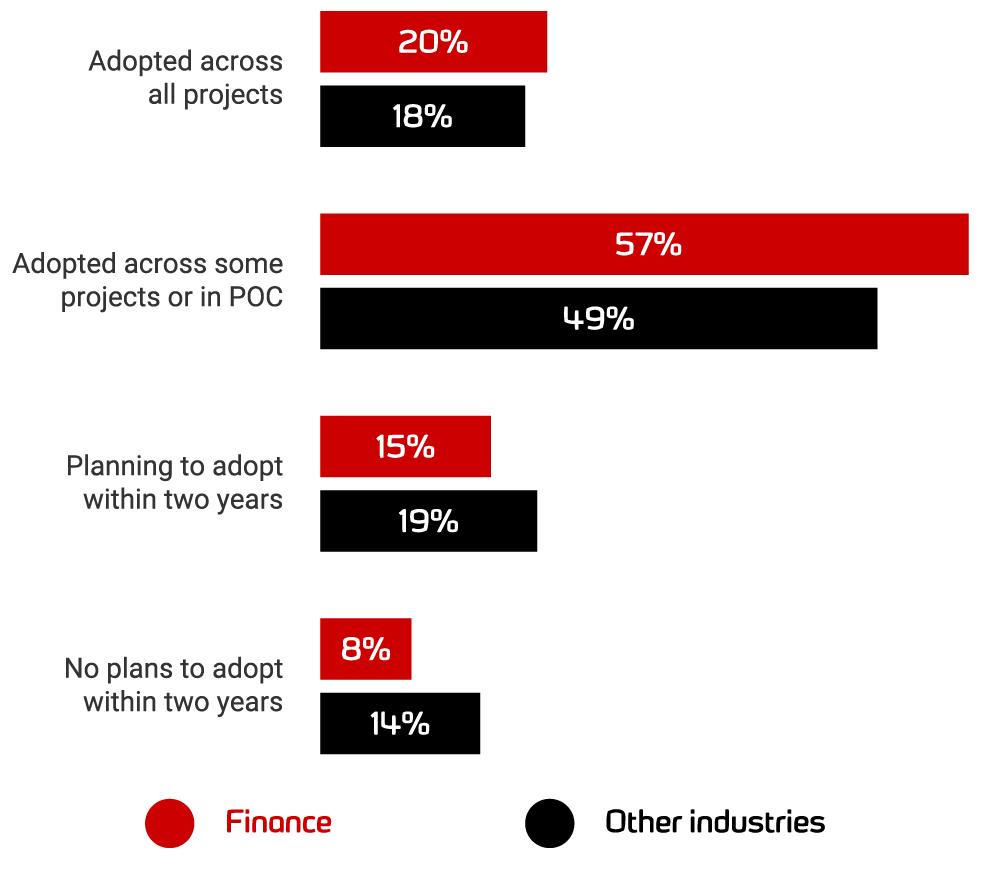
    According to the “2020 State of Database DevOps report“ by Redgate, financial services organizations report the highest levels of database DevOps adoption this year, with proportionally higher rates than any other sector. That shows financial sector maturity in terms of digital innovation. 

    Image source credit: Redgate

    Case Studies of Financial Companies and Their DevOps Journey

    Barclays DevOps Adoption

    In 2015, Barclays announced it was adopting DevOps for its digital transformation journey. Barclays processes payments that equate to around 30% of the UK’s gross domestic product. The developers’ morale and quality of code increased because of DevOps and the leadership team at Barclays credited DevOps with significantly reducing the complexity of its codes, which has allowed the company to reduce delivery risk and ultimately, improve the quality of services.

    DevOps the Lunar Way

    Lunar Way’s journey shows you don’t have to be big to use Kubernetes. The company started its cloud-native DevOps journey by splitting its massive monolith application into smaller microservices. To spin up these microservices, Lunar Way used Ansible, Terraform and Jenkins and to deploy these microservices as a whole unit. 

    Then Lunar Way started to experience scaling issues with microservices and didn’t experience any of the microservices benefits. 

    The company started looking for ways to move past this complexity by shifting its focus from machine-oriented to application-oriented architecture. It chose Kubernetes as the abstraction layer along with AWS, not worrying about where the containers are running, and this is how it was able to manage and unlock the velocity of microservices. Lunar Way also chose Kubernetes from a security perspective and to specify how the applications should run. Now the company runs around 80+ microservices in production with the help of Kubernetes. Watch and learn how Lunar Way did it: “Two years in production with Kubernetes.”

    Italy’s Biggest Bank Embraces DevOps

    A conventional bank running its real business on such a young technology? No way, are you kidding me? Nope, I am not kidding. 

    Italy’s banking group, Intesa Sanpaolo, has made this transition. Banks still run their ATM networks on 30-year-old mainframe technology, so embracing the hottest trend and tech is nearly unbelievable. 

    Even though ING, the banking and financial corporation, changed the way the banks were seen by upgrading itself with Kubernetes and DevOps practices very early in the game, there was still a stigma attached to adopting Kubernetes in highly regulated and controlled environments including health care and financial services. The bank’s engineering team came up with an initiative strategy in 2018 to throw away the old way of thinking and started embracing microservices, container architecture and migration from monolithic to multi-tier applications. Today, the bank runs more than 3,000 applications. Of those, more than 120 are now running in production using the new microservices architecture, including two of the 10 most business-critical for the bank. 

    HSBC Going the DevOps Way

    HSBC is changing the way typical banking works with cloud-native technology and DevOps, as an early user of Google’s Cloud Services Platform to provide core banking services to its business customers. 

    HSBC plans to build its all-new business banking service to run on a Kubernetes-managed container infrastructure using Google’s toolset. HSBC also has excellent partnerships with AWS and Microsoft, favoring the multi-cloud strategy. The company’s engineering team believes that moving to a container model under the umbrella of Kubernetes is significant because it means the environment is similar across different clouds. HSBC also hired people from outside of the banking sector because it wanted to change its culture from within. HSBC is said to have invested $10 million so far in its DevOps initiative.

    Capital One’s Agile to DevOps Journey

    Capital One’s Agile journey started in late 2011, with just two teams, which expanded slowly as more teams were trained in Agile development. The developers at Capital One were following the Scaled Agile Framework (SAFe). Initially, since the teams were new to the automation methodologies, integration testing, security testing, unit and performance testing were all done outside of development sprints by separate test teams. Later, once they understood how important it is to have a collaborative culture, they integrated testing into the dedicated DevOps teams and automated it well. Then slowly, they moved all testing into development sprints, adopting a culture of DevOps and uniformity and wiring integration, security and performance testing into a continuous delivery pipeline. As of 2016, the company had more than 700 Agile teams following continuous delivery.

    DevOps at Bank of America

    Bank of America is one of the world’s biggest financial institutions following DevOps practices, and its digital enterprise operations support nearly 4,300 retail financial centers and approximately 16,600 ATMs worldwide. The award-winning digital bank has nearly 38 million active users and approximately 29 million mobile users.

    Automating Security and Compliance

    As DevOps continues to evolve and become mainstream, it will continue to be of interest for many senior managers across financial services. The above case studies show they are already making DevOps a priority. But security and compliance remain barriers slowing the innovation in the financial companies. 

    Organizations should start small and keep security high priority, first using continuous integration and then adding continuous delivery and deployment using the available tools in the market. Over time, the more a company automates, the higher return on investment it can achieve.

    Automating security permissions and controls will help financial companies remove some of their most common software barriers and get their releases out quicker than before, while still maintaining the necessary governance and compliance. 

    Take a Step Forward

    Financial services companies need complex and rigorous software development processes to meet intense corporate and regulatory requirements. Yet, they are expected to release software faster than ever to meet expectations and beat the competition. By starting small and keeping security and compliance in mind, DevOps in finance can be achieved with great success.