Tag: financial sector

  • The Role of DevSecOps in Finance App Dev

    The Role of DevSecOps in Finance App Dev

    DevSecOps is critical in developing apps successfully in the rapidly changing and highly regulated finance environment

    One of the most important shifts of the past few years in finance and banking was the movement from primarily branch-based banks to mobile-first banks. While these innovative products simplify the end user experience, they also bring up more security concerns, since digital channels expose a number of vulnerabilities. These apps deal with sensitive user data, such as private financial or personal information, which means that the prevention of any type of breach is of utmost importance.

    The level of security of a finance app is judged primarily on how well digital transactions and personal data are protected online. Even the smallest security concern can mean that users lose confidence in the app and immediately switch to another provider, often leaving negative reviews in the app stores and damaging the reputation of the company. It does not come as a surprise that the finance industry is one of the most regulated industries in the world: finance apps are required to fulfill the strictest security requirements and offer the latest functionalities at the same time.

    Regulatory Concerns in the Finance and Banking Industry

    Not only do finance app companies have to comply with traditional finance regulations, but they also are subject to international and local privacy laws. One example is the EU’s General Data Protection Regulation (GDPR), which came into effect in May 2018 and requires companies with ties to the European market to update their data and privacy policies. This affects the finance and banking industry in a number of ways, especially when it comes to getting consent before processing the personal data of users, the right of the clients to request their data to be erased, and additional penalties for data breaches and for failing to comply with such regulations.

    Another recent example of changing regulations affecting the finance and banking industry in Europe is the Strong Customer Authentication requirement (SCA), implemented in September 2019. According to this regulation, a secure finance app requires at least two forms of independent authentication elements from its users. These can either be a knowledge element: something only the user knows, such as a password; a possession element: something only the user possesses, such as their smartphone; or an inherence element: something the user is, such as their fingerprint.

    Meanwhile, in the United States, the number of potentially applicable regulations make this an even more complex issue. Here, finance app companies might be subjected to a plethora of federal or state licensing or registration requirements and thereby may have to adhere to laws and regulations on both levels, depending on their activity. Providing fintech services in the United States often requires licensing and registration with multiple state regulators including consumer lending, money transmission and virtual currency licenses.

    These examples show the additional challenges finance app companies are facing throughout the already challenging mobile development process. Things can be further complicated when developers have to build an app for a global audience with different requirements per country or region. Such companies often have codebases running in multiple different countries; having to manage this complexity while following a variety of regulations can even cause delays in important product releases.

    Growing Customer Expectations Require a New Approach

    Continuously improving features, maintaining app quality and responding to constantly changing requirements can be a daily challenge for product managers and developers. To tackle these issues, it’s necessary to implement a set of security processes from as early as the planning phase all the way to release—in other words, to create a DevSecOps environment. This can be facilitated by integrating regular information security checks and core security tasks into the software development life cycle to remove previously existing bottlenecks between developers, the security team and the rest of the organization. This approach also helps mitigate risks and allow all contributors to take more ownership and avoid security-related failures.

    A DevSecOps environment in the finance or any sector also enables teams to have full control over their stacks and access management and to be able to monitor any and all access within and outside of their environment at all times. Another step forward is shifting the responsibility of security maintenance from the team to a secure and scalable cloud-based CI/CD platform. Automation early on helps developers focus on what matters the most: optimizing their product and developing new features without having to worry about security-related maintenance tasks. It also leaves more time for parts of the process that are essential for safeguarding quality, such as checking code dependencies, threat modeling and detecting flaws before a release.

    Building the future’s successful apps in this rapidly changing and heavily regulated space will require adopting an agile, technology-forward mindset and organizational change at the same pace. In the finance industry, it’s especially important to make not only DevOps but also DevSecOps integral parts of the software development life cycle. Only this way can vulnerabilities be minimized across all applications and the different parts of the organization. Fintech, finance and banking apps can only remain competitive if they have solid structural support that enables them to securely connect to—and protect—their users.

  • Why Financial Companies Should Embrace Automated Testing

    Why Financial Companies Should Embrace Automated Testing

    The drive to deliver new functionality to customers faster is being felt across every industry, and especially so for financial markets that are under pressure from new market entrants. Adopting agile development and continuous delivery can help financial institutions gain an edge and beat competitors to market, but it’s vital that quality is not forgotten.

    Financial institutions are accelerating to update software and release new products in days or weeks instead of months. That means software must be tested rigorously and quickly. Manual testing simply cannot compete with automated testing when it comes to speed, accuracy and the ability to perform functions repeatedly over time. However, it can be challenging to implement successfully. 

    The Customer is Always Right

    Customer power is forcing banks to improve customer experience. Accustomed to slick, efficient website experiences from such leaders as Amazon and Google, customers now are demanding similar experiences from their banks and credit card companies. Millennials expect easier access to banking, precipitating a shift to self-service, which presents all kinds of new IT challenges for banks.

    When customers don’t like their online banking experience, they will simply choose another provider. A full 18 percent of millennials switched their primary bank in the last 12 months, according to a recent Accenture survey. When failed or flawed software gets into the customer domain, the fallout can be very damaging and expensive. Think: lost sales, disgruntled customers, bad PR and a massive price tag to fix the problems.

    Test Automation a Solid Foundation

    Introducing test automation isn’t just about finding defects more quickly and efficiently, though it will do that. It’s also about shifting the burden of regression testing and freeing manual testers to focus on issues such as exploratory testing, usability and penetration testing, where they can add the most value.

    To implement automated testing successfully, financial institutions must devise a long-term plan that dovetails with their business objectives. Having a plan—and sticking to it—outweighs the importance of getting C-level support and winning a huge budget for automated testing. Without a plan, the most well-intentioned objectives can get rejected by senior management, stalled by other forces and, ultimately, forgotten.

    Automated Testing Misconceptions

    The plan should include a robust dismissal of two popular misconceptions about automated testing. The first—and bigger—one is that automated testing will produce instant cost savings, as fewer resources (mainly of the personnel kind) will be needed to perform testing.

    Over time, automation will cut costs. But cost should never be the main factor when considering automated testing. Applying test automation greatly outweighs all the negatives of manual testing (time-consuming), but it also opens new doors for more sophisticated testing and, hence, the competitive advantage.

    The second misconception is that automated testing is a one-time only exercise. Reality proves that automation is always going to be an ongoing process. Automated testing should be treated as (yet) another development activity: You write the production software and you write the software that tests the production software.

    Overcoming the Challenges

    Financial institutions face a threat from newcomers to the market, unencumbered by legacy system baggage and physical branches. They are offering disruptive products and new business models. How can existing financial institutions compete?

    It obviously makes sense to include the business and marketing teams in the development process to develop new solutions for customers. Extend the DevOps mindset to break down those silos. A united team that includes test and marketing alongside developers can ensure that automated tests are well-designed and focused on business aims.

    Pulling together to design and test new ideas can enable financial institutions to reinvent themselves and innovate. Embedding test automation in everything mitigates risk and increases velocity and quality. It can deliver the data businesses need to make the right next move.

    Long-Term Vision, Short-Term Plans

    Fast feedback is paramount to make the right business decisions, but financial institutions must cater to existing legacy systems and integrate new software deliveries from a range of vendors. Without test automation in place, it’s simply not possible to integrate deliveries, test them and reject them as quickly as possible if they are wrong.

    The reality is that organizations must be able to quickly introduce new tools and technologies, because agility and innovation go hand in hand, but the impact on legacy systems must be repeatedly gauged. Test management tooling should be fluid and extensible to cater to this diversity. To accurately measure quality and risk in real time, test automation must be dynamic and flexible.

    Failure to embrace automated testing will leave traditional financial institutions exposed and in danger of being swept away by the new wave of lean, agile, IT-focused competitors.

    About the Author/Viktor Clerc

    viktorViktor Clerc is product manager for testing applications at XebiaLabs, a provider of automation software for DevOps and Continuous Delivery helping companies to accelerate the delivery of new software. You may reach him at vclerc@xebia.com.

  • Enterprising DevOps in Banking sector

    Enterprising DevOps in Banking sector

    “Shift left” is common in project life cycle management where the risks are mitigated early in the cycle by involving QA team early in the planning & development phase. In the  IT support systems, shift left empowers support staffs with enough tools, processes & knowledge base so that the issues get resolved at a point closest to the customer. The purpose of this process is to create a leaner organization and increase customer satisfaction. DevOps is a continuous shift left that helps in high velocity product delivery and enhance the quality of the deliverables.

    Why DevOps is crucial to Banking Sector?

    a.       Multi-channel delivery

    Traditionally banks have been offering products & services that were physically distributed through branches/ATMs in a brick-and-mortar fashion. But with the rapid increase in the use of smartphones & tablets, the banks are challenged to transform their distribution channels and trend towards drive-to-digital. The study from eMarketer.com shows the distribution of banking channels used by various US Internet users. The distribution of banking channels increases the need for multi-channel interactions, a consistent UX across different channels like mobile/internet/TV banking, ATMs etc and an integrated channel to offer a seamless user experience. This in turn requires a transformation in the way the applications are developed & deployed, while adhering to high level of security & compliance. Now considering that each of the banking product is managed by a separate division with its own operations team, offering an integrated delivery channel is extremely difficult.

    b.      Security updates and hot fixes

    It is not long since the outbreak of the Heart Bleed vulnerability. It not only impacted the websites but also the banking applications using OpenSSL technology. Hackers could impersonate the banking services and steal user credentials. Banking Applications using OpenSSL were patched. Similarly, Zero-day-attacks pose a serious risk to banking applications as the hackers take advantage of the time before the vulnerability is publicly announced and a patch is available & applied. In early Feb 2014, a zero-day-attack by name IE “Operations SnowMan” [ CVE-2014-0322] could steal banking credential if the user uses IE 9 or 10. DDoS (Distributed Denial-Of-Service) & Man in the browser (MitB) attacks are some of the other top vulnerabilities that can threaten the security of the banking applications. This urges the banks to test & release the hotfixes / patches at the earliest without breaking the existing functionalities and most often make live patches while the customers are still using the banking applications.

    c.       Regulatory and legislative pressures

    US Patriot Act (Providing Appropriate Tools Required to Intercept and Obstruct Terrorism Act of 2001) has changed the way the banks identify their potential customers. All US banks and other oversees banks that have their correspondent account in US need to get certified under this act. As stated here the banks need to have teams & processes in place to ensure that it complies with these regulatory requirements. This mandates a risk management framework and a reporting mechanism. This increases process overheads, which inturn slow down innovation and product delivery.

    DevOps to the rescue

    DevOps philosophy is similar to Toyota’s Kanban / JIT (Just-In-Time) production. Banks are familiar with Agile & XP processes for product development, ITIL/ITSM for Operational efficiency, yet they are not JIT production ready. Let us pick the two major aspects that gear up the banks to be DevOps ready.

    a.       Organizational Structure in Banks

    We all acknowledge the fact that there is a huge gap between R&D and IT Operations. But, bridging the gap between R&D & IT can be complex based on the magnitude of the size of the organization, geographical distribution, compliances and processes. In 2011, Citi bank initiated a multi-billion dollar project named “Project Rainbow” to consolidate its IT platforms across different product portfolios like mortgages, credit portfolios etc. The focus was to move away from product-centric strategy to a more customer centric strategy and improve communication between the teams. In similar terms, RBI [Reserve Bank of India] recommends aligning the IT Development, Quality Assurance & Operations. The above picture is a recommendation of the organizational structure by RBI. This greatly improves the collaboration within the teams and help them move towards a common goal.
    b.      Automation

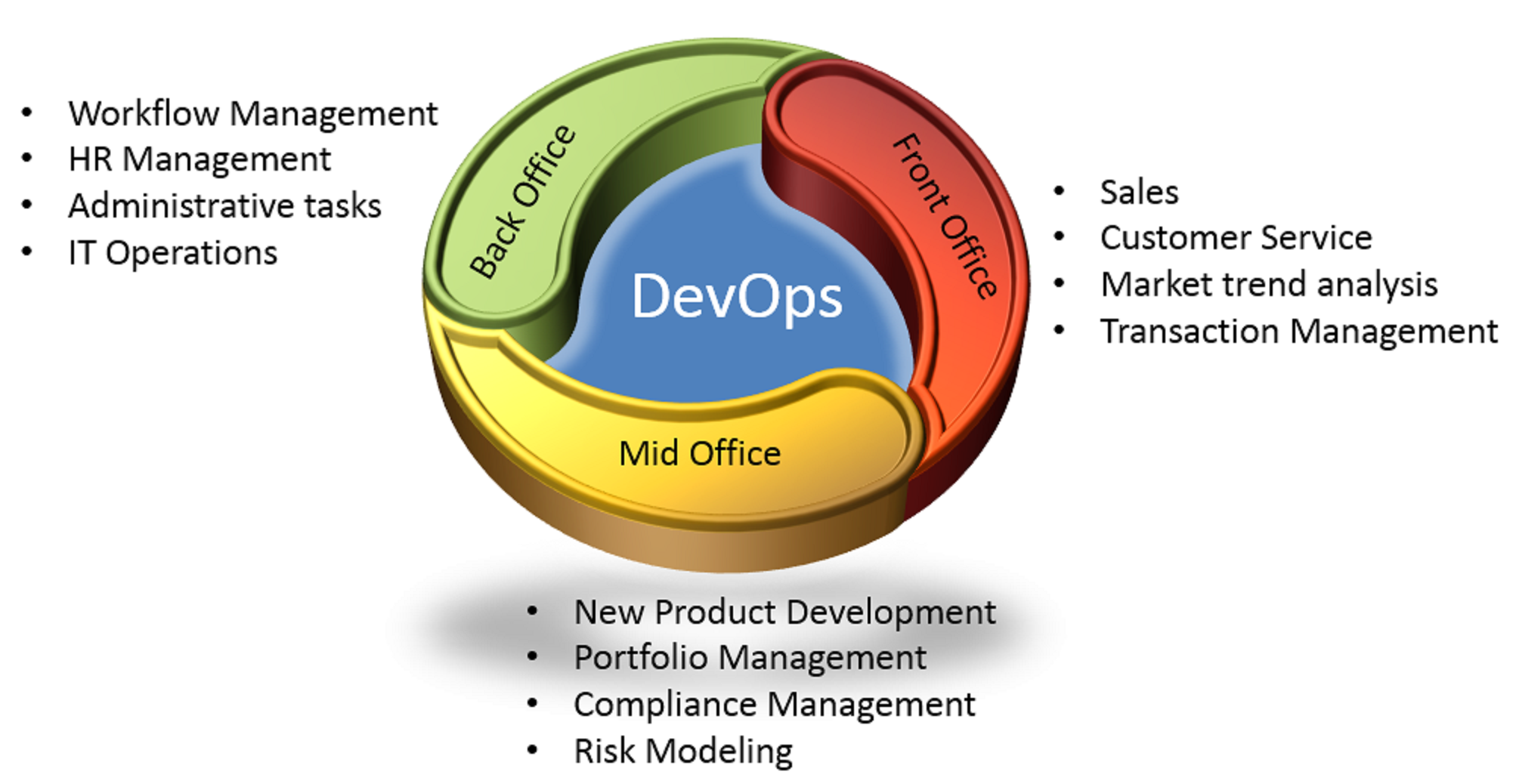
    Banking business processes are typically split as back office, mid office and front office processes. Back office processes are those that do not require direct customer interaction but involve a lot of data processing. Typically, banks have around 300 – 500 back office automation processes, some of them are repeatable and highly structured. These back office processes like HR management, administrative tasks & IT operations are good candidates for optimization and cost reduction. devops Mid office processes provide the necessary decision support system. Analytical reports, collaboration tools that foster communication and process unstructured data fall under this category. IT systems monitoring and reporting automation can identify the systems usage and reduce IT sprawls. Front office process are customer facing and requires constant up to date information from the mid and back office tools for quick response times. When these front, mid and back office processes are automated and integrated, it greatly increases the velocity of product delivery and increase customer satisfaction.

    Success stories like Loyld, show that banks can reduce cost and operational complexity by automating server configurations and release automation. Automating software testing can greatly improve defect containment and testing efficiency. Thus the banks can make consistent software deliveries across multiple delivery channels, apply hot fixes quickly or accommodate new regulatory needs, once they are DevOps ready.