Tag: finance

  • Vega Cloud Commits to Reducing Cloud Costs

    Vega Cloud Commits to Reducing Cloud Costs

    Vega Cloud today made a commitment to save customers at least 10% on their cloud infrastructure spending or it won’t charge for its software. Vega Cloud’s software automates cloud infrastructure management.

    The Vega Cloud platform enables IT teams to connect, automate, manage and optimize new and existing networks, applications and other multi-cloud IT environments from a single console. As part of those capabilities, the company includes cost allocation and cost identification tools using a curated set of data to surface daily recommendations for cost improvements.

    Vega Cloud CEO Kris Bliesner said the goal is to provide a financial operations (FinOps) capability within the context of a platform capable of acting on those recommendations that, on average, reduces cloud costs by 15% to 25%.

    During uncertain economic times, IT leaders are under more pressure than ever to reduce costs. FinOps has emerged as a discipline for applying a set of best practices for specifically reducing cloud costs. In addition to reducing cloud costs, Vega Cloud is also making a case for reducing the total cost of IT by relying on a single automation framework to manage multiple clouds.

    In the cloud era, many organizations have found themselves employing multiple clouds, each of which requires a separate set of tools to manage. IT teams then need to hire additional staff to manage each of those tools. As a result, the total cost of IT increases with each additional platform added to the overall IT estate.

    Many organizations, of course, have allowed the number of platforms they manage to proliferate. This is because many application deployment decisions were driven by developers who can easily provision cloud infrastructure on their own. However, as concerns over the cost of cloud computing continue to rise, many organizations are revisiting how cloud infrastructure resources are used. Many of those reviews are being driven by finance teams that want cloud costs to become more predictable as cloud computing continues to account for a much larger percentage of the IT budget, noted Bliesner.

    In fact, one of the challenges IT leaders have is finding a way to make sure developers and DevOps teams are more motivated to reduce costs rather than focusing entirely on how fast they can build and deploy applications, he added.

    The reality is the average developer doesn’t need application build infrastructure running 24/7, so application development and testing is a great place to focus on cutting cloud costs initially, noted Bliesner. There’s also plenty of opportunity to better schedule workloads to reduce costs by relying more on lower-cost instances of cloud infrastructure, he said.

    DevOps engineers, by nature, don’t want to be inefficient, so the issue comes down to providing them with the tools needed to identify resources that are being wasted, added Bliesner.

    Most cloud service providers, of course, provide tools that enable IT teams to optimize spending, but Bliesner said those tools don’t go deep enough in terms of exposing issues. As a provider of an independent management framework, Vega Cloud is more committed to providing cost optimization capabilities that can be applied to multiple clouds, he added.

    In general, interest in controlling cloud costs has risen sharply. Vega Cloud has been engaged with more customers researching this issue in the last four weeks than in the last three years, said Bliesner. The challenge—and the opportunity—is to not just cut cloud costs but also identify patterns that make it easier to predict them, noted Bliesner.

    At this juncture, cloud costs are coming down. The only issue left to be determined is whether that goal will be accomplished with precision versus a fiat that adversely impacts an organization’s ability to continue to build and deploy software.

  • Elevating Agile With Financial Discipline

    Elevating Agile With Financial Discipline

    A corporate axiom is changing, shifting from “Big eats small” to “Fast eats slow.” But change doesn’t happen overnight.

    While Agile and lean methods continue to chip away at the status quo, making gains and increasingly moving beyond pockets of teams to the portfolio and then enterprise-wide adoption levels, waterfall approaches to delivery persist.

    Rumors of waterfall’s demise, it seems, have been somewhat exaggerated. A survey conducted by the Scrum Alliance (2017) of Scrum practitioners revealed that 78% of respondents said they used Agile-Scrum practices in parallel with waterfall practices. Mixed waterfall/Agile environments are complex. For many large companies, this is the norm. This is when the cohabitation challenges of agile and traditional workstyles become more glaring.

    Importantly, as IT finance management (ITFM) leaders know, becoming “more agile” doesn’t give you a pass when it comes to financial discipline and oversight. Agile organizations are still responsible for their ROI and saying you’ve adopted lean methods doesn’t automatically make you lean. Or fiscally responsible. Or well-governed. Or profitable.

    ITFM Leaders are Under Pressure

    Technical organizations are in the midst of evolving from being project-centered to product-oriented solution delivery and scaling Agile from the team level up to the portfolio/enterprise. In these evolving, hybrid working environments, faced with larger and more vocal agile communities, ITFM managers are facing increasing process dissonance between traditional and agile methods, wreaking havoc with their reporting, planning, budgeting and oversight.

    In a blended traditional/agile financial portfolio, understanding the true cost of projects, portfolios, value streams and OKRs helps companies make better use of their financial resources to drive profitable outcomes.

    And with interest in the value of IT spreading beyond the CIO to the rest of the C-suite, integrated reporting and decision-making that combine Agile work with traditional IT projects, the ITFM role itself is even more essential.

    Technology Business Management: Accurately Measuring the Cost of IT

    For many ITFM leaders, a focus on the discipline of technology business management (TBM) has improved their ability to better understand IT costs and influence governance and behavior through targeted analysis of real-time reporting (and chargeback) for IT resources. TBM provides a decision-making framework to help leaders understand the true costs involved in the delivery of products and services to customers. That has worked well, particularly in industries where project-centric, traditional waterfall projects are the norm. As it turns out, it works very well for supporting Agile, too.

    As agile gains momentum, finance is where it collides with P&L statements, budget dollars and fiscal quarters. With the seemingly irreconcilable Agile release trains and program increments, story points and cycle times, it can be difficult to see an integrated path forward. Fortunately, for teams that have embraced it, TBM provides a well-tested, proven framework that is easily extended to support enterprise Agile transformation.

    Agile transformation and scaling initiatives occur as teams of teams seek to reap the rewards of end-to-end enterprise agility.

    And, as enterprise agility expands, ITFM leaders will likely encounter process improvement initiatives that are key to an Agile transformation and that directly influence IT finance. Central among them are lean portfolio management (LPM) and value stream management (VSM). Due to their direct influence on ITFM and their intertwined agile characteristics, these two especially deserve early focus. And, while there are certainly more dimensions to enterprise agility, this is a good place to start.

  • How to Respond to Rising Cloud Costs

    How to Respond to Rising Cloud Costs

    As organizations ascend to the cloud, their cloud expenses are floating to the same lofty heights. But are all cloud costs necessary? The answer is a resounding no — there’s a lot of waste.

    In 2020, organizations wasted $17.6 billion on idle cloud resources and cloud overspending, according to ParkMyCloud. Data egress, upgrades and subscriptions to SaaS tools also crowded the cloud invoice inbox. With digital innovation a pressing concern, cloud spend is forecasted to rise significantly in the coming years. Without the right fiscal discipline in place, companies face escalating fees.

    I recently met with Eugene Khvostov, VP of product management at Apptio, to discover how organizations can rein in cloud and SaaS spending. According to Khvostov, IT departments require increased visibility, optimization and responsibility if they are to curb the cloud checkbook. Below, we’ll see what he means and discover useful tips for reducing unnecessary expenditures. Following these general guidelines could help right-size your cloud offerings across AWS, GCP, Azure and other cloud-based tools.

    Where We Are With Cloud Costs

    The pandemic has ushered in significant growth in the cloud computing and SaaS space. We’re also seeing a multi-cloud fracturing effect, as cloud service providers like GCP and Azure reach parity with AWS offerings.

    Cloud tooling grants extraordinary flexibility, elasticity and scalability. Being able to spin up or wind down an instance on a whim has permanently altered how software architecture is built. Yet, with great cloud power, comes great responsibility. “How do I make sure I’m not wasting money in the cloud?” Khvostov asked.

    According to Khvostov, as more organizations move to hybrid and decentralized multi-cloud models, more and more questions arise: What is the total cost per service? Who is spending what? Is cloud spend actually driving growth, and, if so, how much? How are new tools being procured?

    Three Cloud Financial Management Strategies

    To address these concerns and plan for cloud spending increases, Khvostov recommended three general strategies. These three phases can be thought of as research, remediation and prevention.

    1. Access and Visibility

    “You’ve got to have access and visibility,” said Khvostov.

    First, companies require access to their spending data. In this case, large, general invoices are not granular enough. You need breakdowns by service, said Khvostov, to access more fine-grained spending habits.

    Second, you need to equate those spending habits to team usage. This requires improved visibility into your organizational structure and service usage tracking at a team-by-team level.

    2. Optimize

    Next comes optimization. Ensure cloud footprints are appropriately sized for each application, and ensure you don’t have any idle resources, Khvostov said.

    Where do you have the opportunity to optimize? Well, it could be as simple as shuttering an orphaned volume, such as an Amazon Elastic Block Store (EBS), which could persist even after an EC2 instance is terminated.

    “BS volumes tend to persist unless you select the Delete on Termination,” AWS explained. So, check your configurations. Amazon provides a way to detect this using OpsCenter.

    3. Responsibility

    Once things are optimized, you need to maintain standards. “You must ensure teams drive responsibility for spend management and optimization,” said Khvostov.

    But how do you instill an optimization mindset and empower engineers to take action? Khvostov said it’s all about demonstrating a measurable return on investment (ROI) and continuing discussions between stakeholders.

    A recent report from A Cloud Guru found that 90% of organizations plan to expand their cloud services over the next one to three years, but 44% lack a plan to upskill their workforce. Most groups have their work cut out for them if they are to assign accountability for cloud costs ownership.

    Specific Cloud Costs That Bite

    So, what are some other particular areas we should be watching? Well, arguably, the most common cost is hidden data transfer fees. Surprise ingress and egress fees can be costly — take the story of Chris Short, whose personal site was charged $2700 for an unexpected 30.6 TB data transfer.

    Watch out for other cloud costs around:

    • Services automatically launching or autoscaling.
    • Idle resources due to “orphan” instances or overprovisioning.
    • Price lock on granular commitments. You could be stuck in a savings plan on an Amazon EC2 R5 instance, which would be lost upon upgrade to R6. (Khvostov acknowledged that AWS has remedied this situation, to an extent).
    • Legacy, less-efficient code can rack up cloud costs, The Information reports.

    The Cloud Economist Role Is Trending

    To unearth these costs, some believe a brand new role is required. A cloud economist is a cloud financial manager that helps spot fees, directs further cloud optimizations and calculates overall ROI from cloud investments.

    The rise of cloud financial offers is an accelerating trend, Khvostov said, one that requires the right tools and practices within an organization to become a trusted ally. “It’s definitely a legitimate role in the sense that it’s critical to organizations,” said Khvostov. “It’s specialized enough that it requires technical and financial skills.”

    Hiring a cloud economist, or building a cloud financial center of excellence, could provide a lot of value. Yet, gauging the ROI of this role isn’t immediately obvious. Some optimizations could take time to visualize, Khvostov said. A certain change could instantly invoke 20% cost savings, but you may not register that impact for 30 days or more.

    “It’s not just about cloud infrastructure — it’s about your SaaS spend, as well,” Khvostov added. He believes companies desperately need a window into what infrastructure-as-a-service (IaaS) and automation, like Chef or Jenkins, cost, along with the time savings and dollar ROI their usage equates to — because, he said, “You can only right-size what you know.”

    Trimming Cloud Spend and Cloud Costs

    Some IT folks simply fail to understand the implications of their cloud resources. Surprisingly, a recent survey by SoftwareONE revealed that 30% don’t realize that everything in the cloud is metered. To rectify this knowledge gap, organizations could use better awareness into their cloud holdings.

    The cloud is the future, and we must prepare responsibly. Yet, having fiscal discipline in a world where every software function is commodified “as-a-service” is tricky — teams require financial visibility into their cloud holdings. To rein in costs, Khvostov recommended treating it as a continuous process: access and visualize spending data, optimize your existing cloud footprint and disseminate responsibility among teams.

    Once you have a better frame of reference, you can begin to right-size cloud, right-size SaaS and appropriately right-size the team. Eventually, with the right multi-cloud and SaaS financial management strategies, perhaps that cloud bill will start to feel a little lighter.

  • Why PR, Legal and HR Matter for Continuous Delivery

    Why PR, Legal and HR Matter for Continuous Delivery

    By most definitions, DevOps involves making developers and IT Ops teams work better together. But integrating other parts of an organization, such as legal and public relations, into DevOps is also important. Here’s why.

    DevOps has become popular because it helps to speed the delivery of software. The goal is to reach continuous delivery, which means code is changed, tested, staged and delivered to users on a (nearly) continuous basis.

    If you think only from a technical perspective, then getting to continuous delivery of software involves only technical people. Developers, IT Ops admins and software testers are all you need.

    DevOps in the Big Picture

    Yet, to deliver software continuously on a reliable basis, you need to think beyond just technical processes and personnel. Effective DevOps workflows have to involve all of the other parts of the organization that play a role in creating software, delivering it to users and maintaining it once it is in production.

    For example, PR teams need to be plugged into the software delivery chain so they know when new features are coming down the pipeline and can prepare to promote them. Legal professionals should play a role as well, since they’ll know when code changes require tweaks to licensing, compliance procedures and so on.

    The list can go on. In most organizations, human resources has a role to play in DevOps, since personnel changes can affect the continuous delivery chain. Supply chain managers should be involved, too, since they have a hand in provisioning the infrastructure on which DevOps teams rely.

    To be sure, these various non-technical teams don’t need to be as plugged into the DevOps workflow as deeply developers and admins do. Code can be written and tested without their perpetual involvement. Still, at a minimum, all parts of the organization should at least be aware of the state of the delivery chain. Otherwise, visibility and communication break down.

    Taking this big-picture approach to DevOps is important because ultimately, despite the relatively narrow purview implied by the term DevOps itself, the value of DevOps lies in adding efficiency and promoting better communication across the entire organization in ways that optimize software delivery.

    So, if you want to make the most of DevOps, start thinking beyond just Dev and Ops.

    — Chris Tozzi

  • Enterprising DevOps in Banking sector

    Enterprising DevOps in Banking sector

    “Shift left” is common in project life cycle management where the risks are mitigated early in the cycle by involving QA team early in the planning & development phase. In the  IT support systems, shift left empowers support staffs with enough tools, processes & knowledge base so that the issues get resolved at a point closest to the customer. The purpose of this process is to create a leaner organization and increase customer satisfaction. DevOps is a continuous shift left that helps in high velocity product delivery and enhance the quality of the deliverables.

    Why DevOps is crucial to Banking Sector?

    a.       Multi-channel delivery

    Traditionally banks have been offering products & services that were physically distributed through branches/ATMs in a brick-and-mortar fashion. But with the rapid increase in the use of smartphones & tablets, the banks are challenged to transform their distribution channels and trend towards drive-to-digital. The study from eMarketer.com shows the distribution of banking channels used by various US Internet users. The distribution of banking channels increases the need for multi-channel interactions, a consistent UX across different channels like mobile/internet/TV banking, ATMs etc and an integrated channel to offer a seamless user experience. This in turn requires a transformation in the way the applications are developed & deployed, while adhering to high level of security & compliance. Now considering that each of the banking product is managed by a separate division with its own operations team, offering an integrated delivery channel is extremely difficult.

    b.      Security updates and hot fixes

    It is not long since the outbreak of the Heart Bleed vulnerability. It not only impacted the websites but also the banking applications using OpenSSL technology. Hackers could impersonate the banking services and steal user credentials. Banking Applications using OpenSSL were patched. Similarly, Zero-day-attacks pose a serious risk to banking applications as the hackers take advantage of the time before the vulnerability is publicly announced and a patch is available & applied. In early Feb 2014, a zero-day-attack by name IE “Operations SnowMan” [ CVE-2014-0322] could steal banking credential if the user uses IE 9 or 10. DDoS (Distributed Denial-Of-Service) & Man in the browser (MitB) attacks are some of the other top vulnerabilities that can threaten the security of the banking applications. This urges the banks to test & release the hotfixes / patches at the earliest without breaking the existing functionalities and most often make live patches while the customers are still using the banking applications.

    c.       Regulatory and legislative pressures

    US Patriot Act (Providing Appropriate Tools Required to Intercept and Obstruct Terrorism Act of 2001) has changed the way the banks identify their potential customers. All US banks and other oversees banks that have their correspondent account in US need to get certified under this act. As stated here the banks need to have teams & processes in place to ensure that it complies with these regulatory requirements. This mandates a risk management framework and a reporting mechanism. This increases process overheads, which inturn slow down innovation and product delivery.

    DevOps to the rescue

    DevOps philosophy is similar to Toyota’s Kanban / JIT (Just-In-Time) production. Banks are familiar with Agile & XP processes for product development, ITIL/ITSM for Operational efficiency, yet they are not JIT production ready. Let us pick the two major aspects that gear up the banks to be DevOps ready.

    a.       Organizational Structure in Banks

    We all acknowledge the fact that there is a huge gap between R&D and IT Operations. But, bridging the gap between R&D & IT can be complex based on the magnitude of the size of the organization, geographical distribution, compliances and processes. In 2011, Citi bank initiated a multi-billion dollar project named “Project Rainbow” to consolidate its IT platforms across different product portfolios like mortgages, credit portfolios etc. The focus was to move away from product-centric strategy to a more customer centric strategy and improve communication between the teams. In similar terms, RBI [Reserve Bank of India] recommends aligning the IT Development, Quality Assurance & Operations. The above picture is a recommendation of the organizational structure by RBI. This greatly improves the collaboration within the teams and help them move towards a common goal.
    b.      Automation

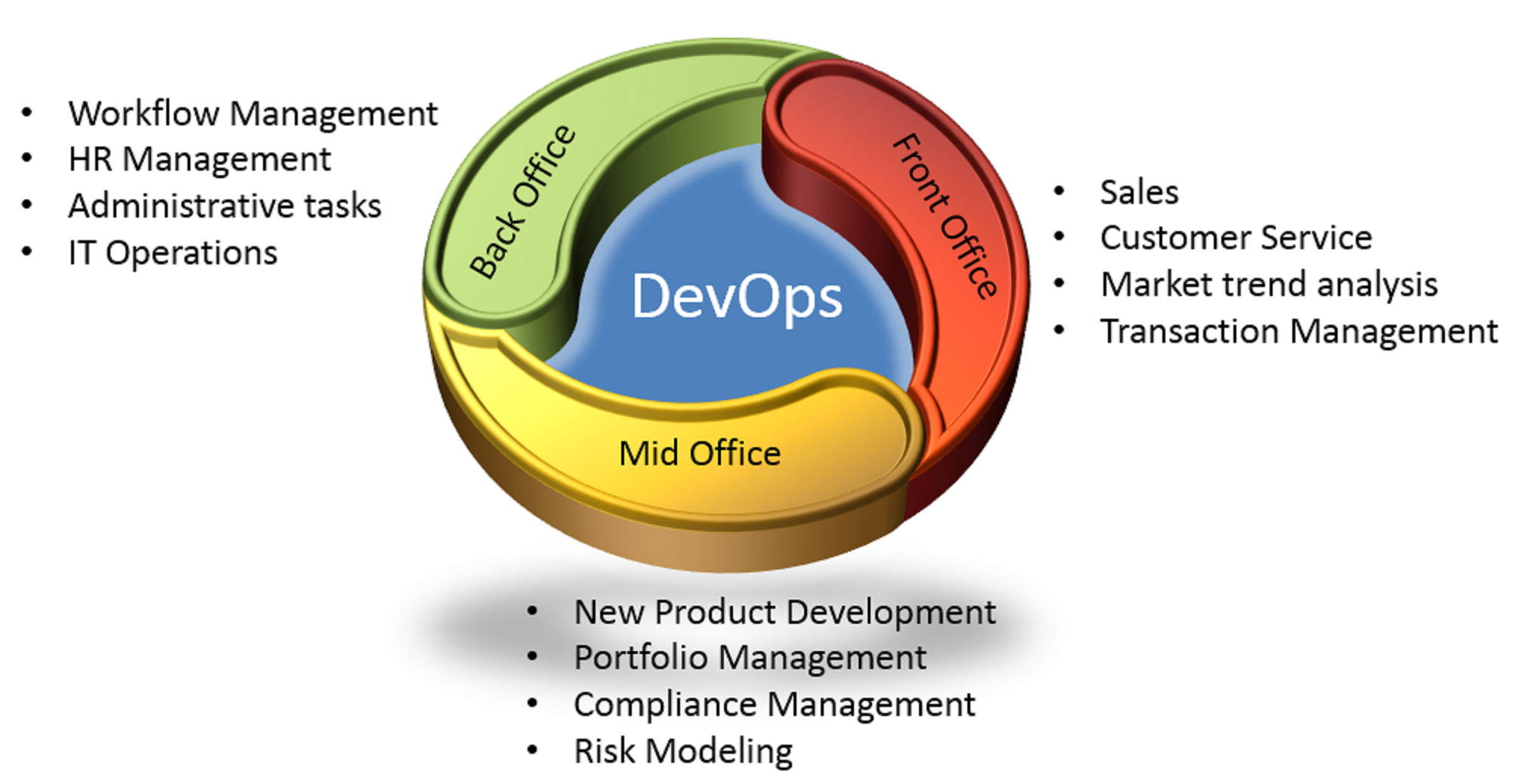
    Banking business processes are typically split as back office, mid office and front office processes. Back office processes are those that do not require direct customer interaction but involve a lot of data processing. Typically, banks have around 300 – 500 back office automation processes, some of them are repeatable and highly structured. These back office processes like HR management, administrative tasks & IT operations are good candidates for optimization and cost reduction. devops Mid office processes provide the necessary decision support system. Analytical reports, collaboration tools that foster communication and process unstructured data fall under this category. IT systems monitoring and reporting automation can identify the systems usage and reduce IT sprawls. Front office process are customer facing and requires constant up to date information from the mid and back office tools for quick response times. When these front, mid and back office processes are automated and integrated, it greatly increases the velocity of product delivery and increase customer satisfaction.

    Success stories like Loyld, show that banks can reduce cost and operational complexity by automating server configurations and release automation. Automating software testing can greatly improve defect containment and testing efficiency. Thus the banks can make consistent software deliveries across multiple delivery channels, apply hot fixes quickly or accommodate new regulatory needs, once they are DevOps ready.

  • Chef(TM) Growth Soars in 2013

    SEATTLE, WA–(Marketwired – Feb 12, 2014) –Chef™, the leader in IT automation, today announced surging adoption of its Chef™ IT automation platform. In 2013, the company’s total sales grew 188 percent year over year, while recurring revenue quadrupled. The number of new customers adopting Chef reached record levels in 2013, with nearly 70 percent of sales coming from Fortune 1000 organizations. The company’s European operations also achieved significant momentum, with total sales growing more than 400 percent, compared to 2012.

    Interviews with a range of Fortune 1000 brands detailing their use of Chef to solve today’s hardest IT challenges can be viewed here.

    “Our continued, strong sales and revenue growth coincides with the acceptance of Chef as the de facto standard for delivering speed and scale for both web innovators and forward-leaning enterprises,” said Barry Crist, CEO, Chef. “This is a special time for Chef and our community; as our business grows larger, our growth rate is also accelerating.”

    Leading Industry Research Spotlights Transformative Shift in Enterprise IT

    Recent research points to massive change and upheaval, as well as vast new opportunities, in enterprise IT. The Gartner Research document entitled, “Taming the Digital Dragon: The 2014 CIO Agenda,” (Dave Aron, Graham Waller), Dec. 31, 2013, states:

    “Now we are entering a third era of enterprise IT, where these new trends are not only improving what businesses do with technology to make themselves faster, cheaper and more scalable, but fundamentally changing businesses with information and technology, changing the basis of competition and the portfolio of businesses people are in, and in some cases creating new industries.”

    Today, the enterprise is rapidly adopting IT automation in response to these immense pressures. The Gartner Research document entitled, “Predicts 2014: Automation Brings Promise to IT Operations Management, but at What Cost?” (Jarod Greene, Ronni J. Colville, Ian Head, George Spafford, Jeffrey M. Brooks, Robert Naegle), Dec. 12, 2013, states:

    “By 2015, 75% of large enterprises will have more than four diverse automation technologies within their IT management portfolio, up from less than 20% in 2013.”

    Meanwhile, the continued adoption of cloud computing across businesses of all sizes is helping drive a new wave of automation platforms. As a recent Forrester Research, Inc. report, “Predictions for 2014: Cloud Computing” (Dec. 4, 2013), states:

    “Chef and Puppet will usurp commercial automation solutions… Open source server configuration automation is quickly becoming the de facto cloud service automation approach and will dominate the management of elastic cloud workloads.”

    Enterprise Chef Sales Surge

    Chef’s sales in Q4 2013 alone nearly equaled sales for all of 2012. Fortune 500 companies in media, transportation, manufacturing, Big Web, retail, and financial services have all deployed Chef to maximize the benefits of DevOps strategies in accelerating time to market.

    Enterprise Chef™ models IT infrastructure and application delivery as code. Enterprise Chef provides the integrated automation platform needed to succeed in today’s customer-propelled economy. Chef delivers the power and flexibility to move faster in a complex world — from rapid provisioning and deployment of IT resources to the automated delivery of applications and services — at any scale.

    Chef Skills Footprint On the Rise

    The Open Source Chef community grew more than 200 percent across all primary metrics in 2013, including millions of Chef downloads, hundreds of thousands of monthly Chef Cookbook downloads, and thousands of individual contributors. With tens of thousands of registered users contributing code and solving IT challenges every day, the Chef community is building a new generation of skilled automation professionals worldwide.

    Continuing its commitment to the wider Chef community, Chef is sponsoring Ada Developers Academy, an intensive software developer training school for women. As part of its sponsorship, Chef will be providing an internship for an Ada Developers Academy student beginning in May. In the internship, the student will spend six months learning about and contributing code for the Chef IT automation platform. More information on Ada Developers Academy can be found here.

    “The Chef Community is all about helping each other solve complex IT automation challenges, while transforming traditional IT to something focused on automation, DevOps, and Continuous Delivery,” commented Nathen Harvey, Community Director, Chef. “The Chef Community has always been a very open, welcoming community. Our participation in the Ada Academy is one example of how we’re bringing automation skills to IT professionals everywhere.”

    #ChefConf 2014

    #ChefConf 2014 is taking place at the Hyatt Embarcadero in San Francisco, April 15-17, 2014. Chef’s annual user conference is the largest, most vibrant gathering of New IT andDevOps practitioners, featuring three days of inspired discussions, collaborative presentations, technical training, and hands-on labs focused on automating business to hyper-speed. View the agenda here and register now to take advantage of early bird pricing before February 28.

    #learnchef

    About Chef

    We are Chef — the leader IT automation. We give you a model for automating IT infrastructure and applications that drive self-reliance across your development and operations teams. We are the Chef community. We are tens of thousands strong. We are helping your businesses become faster, safer and more flexible, so you win in today’s 24×7 digital economy. Join our movement today. www.getchef.com