Tag: Features

  • How Can DevOps Teams Use Customer Intelligence Data?

    How Can DevOps Teams Use Customer Intelligence Data?

    Customer intelligence involves collecting and analyzing data about customers’ behaviors, preferences and needs. It helps businesses understand their customers better and tailor their products and services to meet customer demands. The data is gathered from various sources, such as customer feedback, web analytics, social media, purchase history and software usage metrics. The insights drawn from customer intelligence can be used to inform business strategy, product development and marketing efforts.

    The goal of customer intelligence is to create a detailed understanding of the customer’s needs, preferences and habits. This information can be used to predict future behavior, improve customer service and drive sales. For instance, if a software company knows that a particular customer segment mainly accesses their software on mobile devices, the organization can improve their mobile support or create dedicated mobile applications for that customer segment.

    How Can DevOps Teams Use Customer Intelligence Data?

    There are several ways that a DevOps team can leverage the data gathered from customer intelligence.

    Prioritizing Feature Development Based on Customer Feedback

    When developing new features, it’s useful to analyze customer feedback to understand what features customers find most valuable and prioritize those for development. For instance, if feedback suggests that customers want a more intuitive user interface, the team can prioritize UI improvements.

    By focusing on the features that customers find most valuable, DevOps teams can improve the usability and functionality of their products. This can lead to higher customer satisfaction and loyalty and, ultimately, increased sales. Additionally, prioritizing feature development based on customer feedback can help DevOps teams avoid wasting time and resources on features that customers don’t value.

    Tailoring UX and UI Design Based on Customer Preferences and Behaviors

    By analyzing data on how customers interact with their products, teams can identify pain points and areas for improvement. For example, if data shows that customers are having difficulty navigating the website, the team can redesign the navigation to make it more user-friendly. 

    Alternatively, if customers abandon their shopping carts at a certain point in the checkout process, the team can investigate and make necessary improvements.

    Using Customer Data to Drive Personalization and Customization Features

    Personalization is about tailoring the customer experience to the individual user, while customization is about giving customers the ability to tailor the product or service to their specific needs.

    For instance, by analyzing data on a customer’s browsing and purchase history, a team could develop a feature that recommends products based on the customer’s past behavior. Or, if a customer frequently purchases a certain type of product, the team could create a feature that allows the customer to customize that product to their liking.

    Leveraging Predictive Analytics to Forecast Future Customer Needs and Trends

    Predictive analytics involves using historical data to predict future events. In the context of DevOps, this could mean using customer data to forecast future customer needs and trends.

    For example, if data shows a growing interest in eco-friendly products, the team could anticipate this trend and start developing more eco-friendly products. Predictive analytics can also help teams identify potential issues before they become problems, allowing them to address those issues and improve the customer experience proactively.

    Best Practices for Effectively Using Customer Intelligence in DevOps

    Here are some best practices that DevOps teams can use to make the most of their customer intelligence data.

    Integrate Customer Feedback Early and Often

    Customer feedback from surveys, social media, and customer service interactions provides invaluable insights into what customers need, their pain points, and their preferences.

    By integrating this feedback into the DevOps process, teams can better understand customer needs and develop products or services that address those needs effectively. Early integration of customer feedback allows teams to pivot and make changes more swiftly, thus saving time and resources.

    It’s also important to obtain feedback regularly. Customers’ tastes and preferences evolve continuously, and their feedback reflects those changes. Feeding frequent customer intelligence into the development process ensures the DevOps team’s work stays aligned with the shifting customer landscape.

    Leverage Analytics Tools

    Analytics tools can help DevOps teams sift through large volumes of customer data and extract actionable insights. These insights can then be used to inform decision-making and drive innovation.

    Some tools excel at data visualization, helping teams understand complex datasets through graphs and charts. Other tools excel at predictive analytics, helping teams forecast future trends based on historical data.

    Choosing the right analytics tool depends on the specific needs of the DevOps team and the nature of the customer intelligence data they have at their disposal. The key is to leverage its capabilities fully to extract the most value from the customer intelligence data.

    Ensure Data Quality and Relevance

    Not all data is created equal, and if it is poor quality or irrelevant, it can lead to misguided decisions and wasted resources.

    Data quality refers to the accuracy, completeness, consistency, and reliability of the data. DevOps teams should implement robust data quality checks to ensure that the customer intelligence data they’re using is of high quality.

    Data relevance, on the other hand, refers to the data’s applicability to the task at hand. Not all customer intelligence data is relevant to every DevOps project. Teams need to carefully select the data that is most relevant to their specific project and ignore the rest.

    Balance Quantitative with Qualitative Data

    While quantitative data provides hard numbers and concrete facts, qualitative data offers deeper insights into customer attitudes, perceptions and behaviors.

    Quantitative data can help DevOps teams identify trends, measure performance, and track progress over time. However, it often fails to explain why certain trends are occurring or why performance is changing. 

    It also can help DevOps teams understand the reasons behind the numbers. It can provide insights into why customers behave the way they do and what they truly think and feel about a product or service. Balancing quantitative with qualitative data gives DevOps teams a more holistic view of the customer landscape, enabling them to make more informed decisions.

    Cross-Functional Collaboration

    Customer intelligence data is valuable for all teams across the organization, not just DevOps. By collaborating with other teams, such as marketing, sales and customer service, the DevOps team can gain additional insights and perspectives. 

    Cross-functional collaboration also fosters a culture of data-driven decision-making across the organization. When all teams use customer intelligence to inform their work, the organization as a whole becomes more customer-centric, agile and innovative.

    Conclusion

    Successfully using customer intelligence data in software development allows teams to remain responsive to customer needs and increase the value of their products. DevOps teams need to integrate customer feedback early and often, leverage analytics tools, ensure data quality and relevance, balance quantitative with qualitative data,and foster cross-functional collaboration. By following these best practices, DevOps teams can use customer intelligence data to drive innovation and create products and services that truly resonate with customers.

    Image source: Josh Sortino via Unsplash  

  • Features or Quality? App Survey Shows Surprising Results

    Features or Quality? App Survey Shows Surprising Results

    Software is an essential part of our everyday lives, but that doesn’t mean that people are always happy with the app experiences that they’re having.

    We at DeepCode conducted a survey to learn more about what people really think about software quality today. Is it getting better or worse? How important are bugs and security vulnerabilities to the average user? The results are interesting, whether you’re building or managing software.

    I’m going to highlight the data from the eight questions contained in the survey, provide some analysis on each question, and then summarize the key points that we can learn from the overall results.

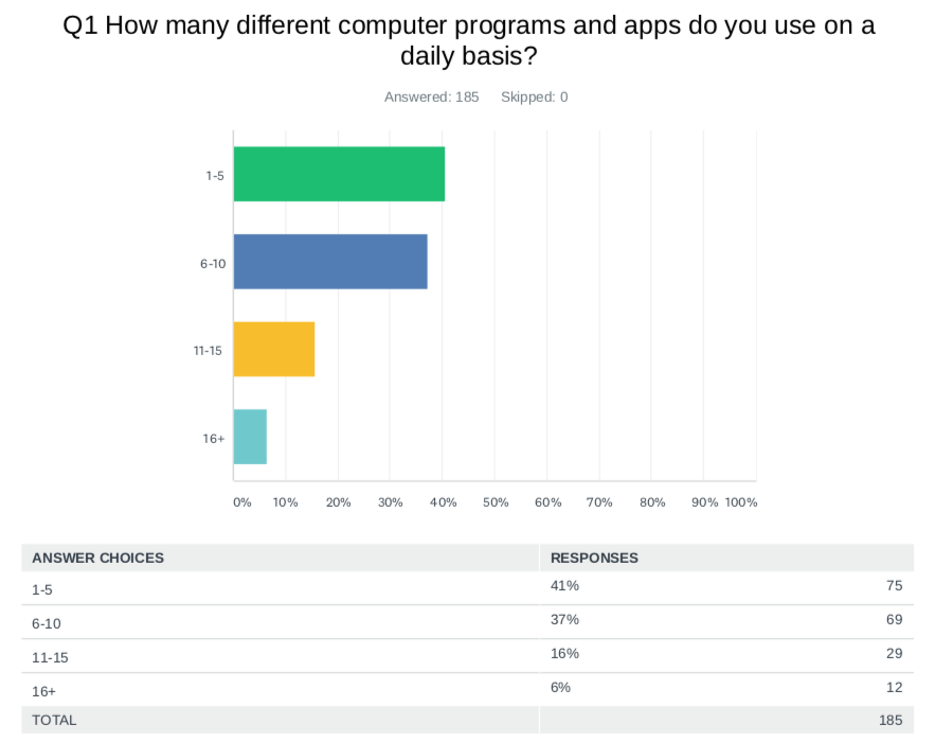
    People’s habits are baked in for a core group of apps: 78% use 10 or fewer apps each day, and 41% use five or fewer apps on a daily basis. When you consider the apps that we all use for activities such as email, web browsing, messaging, social media, entertainment and work, you can see that there’s only so much room for people to bring extra software into their daily routines.

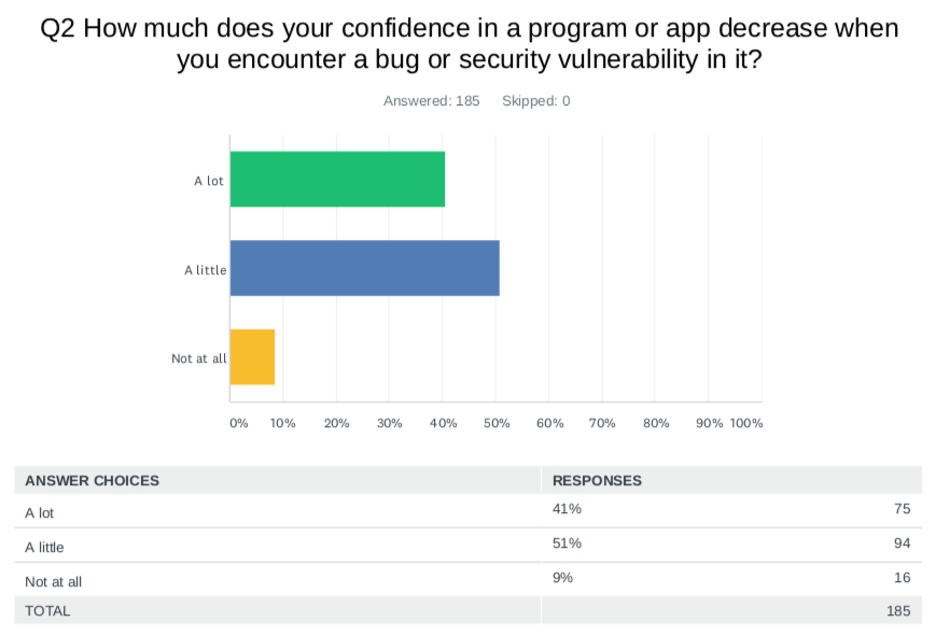
    Bugs and security vulnerabilities clearly have consequences: 92% of users lose confidence when they encounter them. People have high standards and they’re not willing to ignore issues.

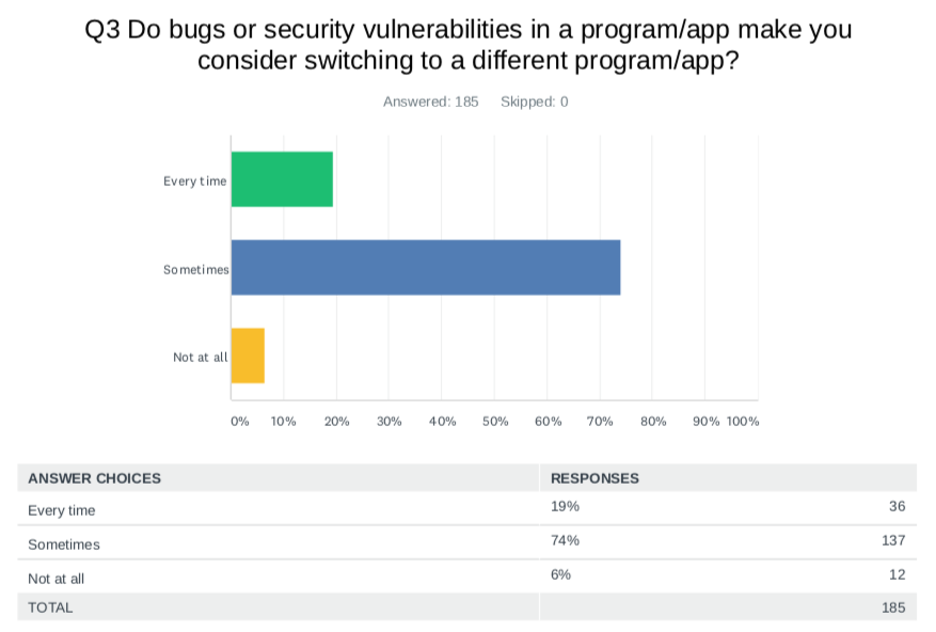
    Not only are software issues taken seriously, but they cause 93% of users to consider switching to a different app. With so many options available today that share a lot of similarities, software companies have to be careful not to push people in a different direction.

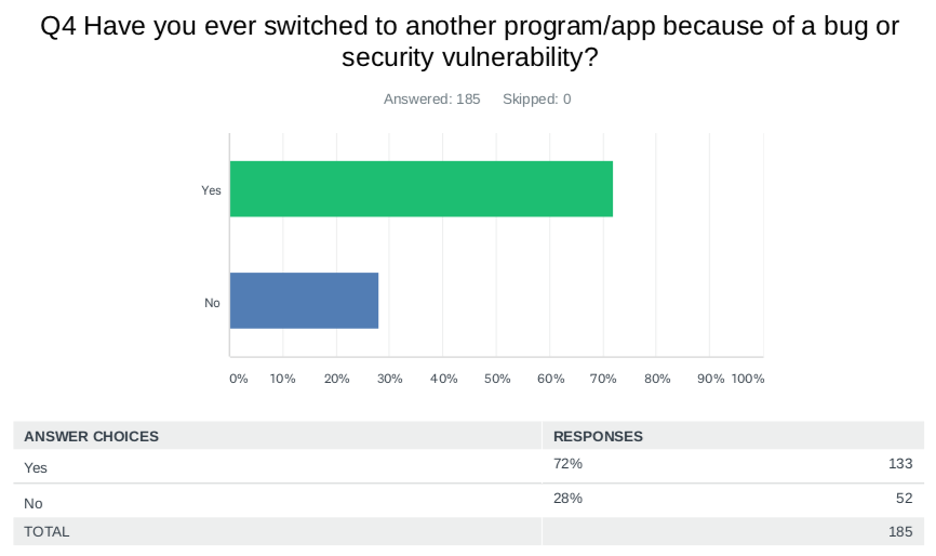
    Considering making a change to different software is one thing, but 72% have actually done it because of bugs and security issues. User loyalty doesn’t always last forever.

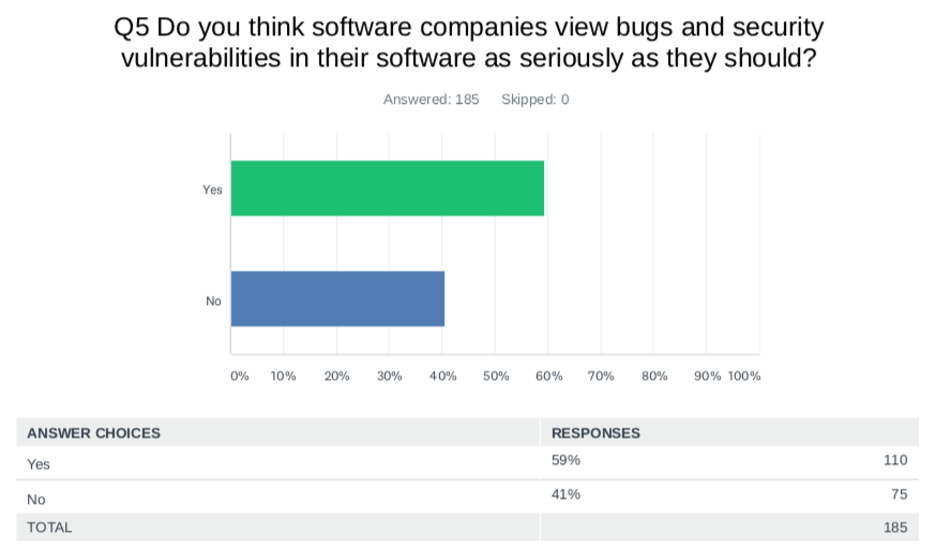
    A nice majority believe that software companies take quality issues as seriously as they should. Users know developers have a lot to deal with and are doing their best, but as we’ve seen so far, that doesn’t change the fact that they’ll have a negative reaction when your software lets them down.

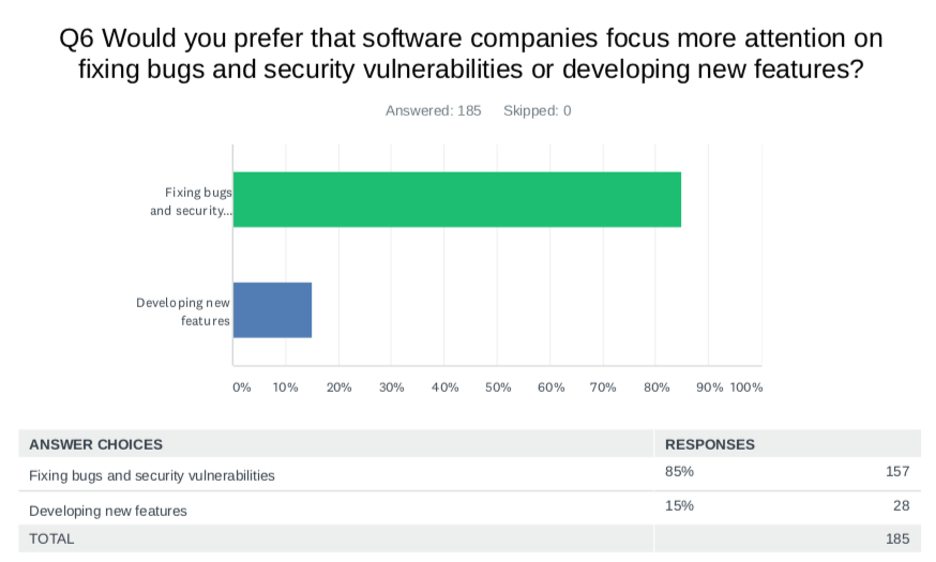
    There’s still a perception out there that all users care about are big, new features. Because of that, many times you’ll see software companies downplay bug fix releases as if they’re not worth mentioning. With 85% preferring bug/security fixes over new features, your best feature in any release is improved quality.

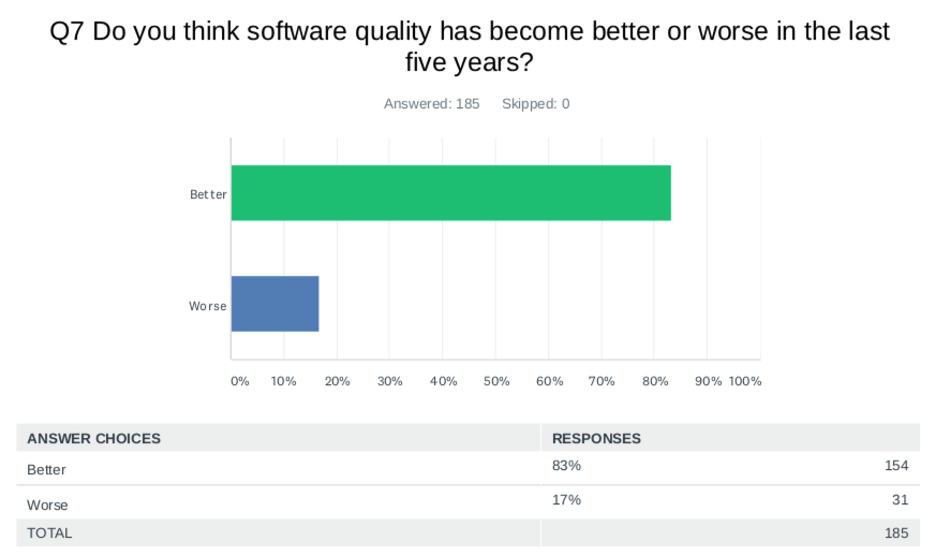
    The earlier statistic about software companies taking quality seriously carries over to this question because 83% think it’s improving. It’s encouraging to see that extra attention on bugs and security issues is directly resulting in better software.

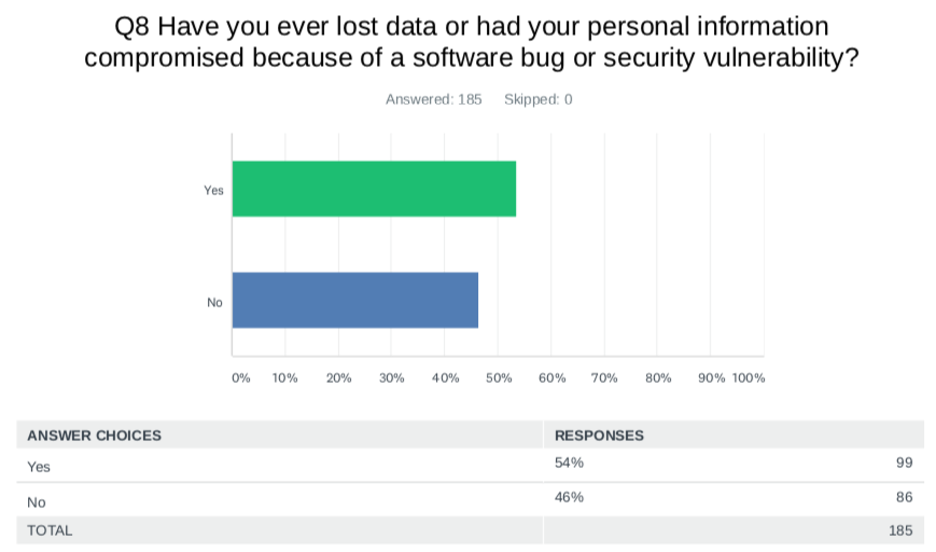
    This one is rather evenly split, but if software quality is indeed getting better, then hopefully the percentage of those impacted will trend downward over time. It’s important to be cautiously optimistic here, however, because as software gets more ingrained in our lives through the internet of things and beyond, we’re opening ourselves to data and privacy threats that none of us are properly prepared for.

    Quality Is Key

    The results of this survey prove that quality software matters. Our brains may be telling us that, but if we’re honest, sometimes our hearts convince us that new features are the most important thing—no matter the cost. Users prefer bug/security fixes, and if they encounter software problems, they’ll consider switching. It’s really that simple.

    Smaller software companies may not have the resources to innovate on the same level as some of the bigger players, but they can focus on improving the quality of what they offer. When a user has a bad experience with a competitor, your company can be known for quality and provide a safe haven for anyone comparing different options.

    The users have spoken: You’ll be rewarded for building quality into the software development process.

  • Humans in the Machine of Release Orchestration

    Humans in the Machine of Release Orchestration

    Let’s face it: Most organizations are still struggling to achieve the Nirvana of full gated automation. At first, we automate the core of our DevOps services, the build and the deployment disciplines. Over time, we realize that a templated or framework (or pick your similar terminology) approach toward automation allows for scale as well as predictability, lowering costs. It is here where the lion’s share of variability can be reduced and scalability achieved.

    The next culprit to hit the radar is usually test automation, but this tends to be where the rubber meets the road for the level of work it takes to automate process. So generally minimal work gets done, ascribing to the 80:20 rule that 80 percent is quickly attainable and should be sufficient, the remaining 20 percent is just too hard. But having gotten this deep in the DevOps maturity scale, release orchestration (RO) is usually next up in our continuum of services.

    The automation of release orchestration is a different animal than the core of build, deployment or even test automation. Release orchestration is more about automating our process of change management. Invariably the spreadsheets or SharePoints of yesteryear are intended to give way to our preferred vendor’s methodology of reinventing the release wheel in their proprietary toolset (albeit with better results expected). But usually this is the wrong approach as well.

    Changing Human Thinking About RO Construction

    As I continually repeat, DevOps is about thinking differently about “how we innovate.” (If you need more strategic leadership help in this regard let me know, I am looking.) Consider that our spreadsheets and SharePoints, while impressive, constricted us to thinking about release and change management within the architectural constructs or limitations of the spreadsheet and SharePoint tools. They were task-oriented, less interactive, top-to-bottom lists of what we thought we needed to do in any given release. If we were to truly go back to the drawing board and thought about creating a release without those constraints, or just with the idea of parallel tracking, what might we accomplish?

    Digesting the release process with a lean mentality breaks down large sections into more manageable subsections. This reduces risk, and increases speed, particularly if it is coupled with parallel execution. If there truly is a sequential dependency in our tasks, let’s call it out, but when we do, we must ask ourselves whether that dependency is a go/no-go for all activities, or for only some of them. If it is the former, so be it; if it is the latter, then perhaps we can adjust our sections to account for this and run more of them in parallel. Just implementing a parallel mindset can radically reduce the time it takes to run a release from end to end. But we must also ask ourselves, What other key features of any preferred release orchestration toolset can alter how we think?

    Changing Human Thinking About RO Execution

    The other axis upon which to digest release orchestration is in its real-time interactivity. Consider for a moment that some tasks either cannot or will not ever be fully automated. Some tasks will remain in the province of a human to fulfill. For example, (and I cannot imagine why, but humor me), if we needed to install additional hard drives in bare metal servers during a release, the physical installation would always require a human to do so. With old release orchestration technology we must wait for shared spreadsheet files to be updated by the engineer when he/she completes this task (or any other manual task example you can think of).

    With new mobile release orchestration technologies, the engineer could mark them complete (or percentage complete) in real time on his/her mobile device while still in the data center, standing in front of the hard drives/server. How much time does this save, in pure walking to his terminal, logging in and updating a file, emailing it to the change manager, merging it with the current one, etc.. A simple swipe and done. The engineer is now able to provide a great deal more information to the team in real time, and with minimal effort. This gives real-time visibility to the release manager such as has never existed before.

    It can also grant them a level of direct interactivity. Imagine the hard drives’ physical installation has been completed, but manual testing is failing. If the engineer has no good way to share the information with the team, risk for overall on-time completion cannot be properly assessed. Proper tooling avoids the scenario where change and release managers are waiting on a task, and drill-down activity is unavailable (picture a spinning icon, rather than a percentage complete on specific task item). Add the dimension of red-yellow-green to track the completion of tasks, whether parallel or not, and we have a dashboard that calls our attention to the problems impacting a release in real time. This is far less possible with older RO technologies until somebody checked their watch and started making phone calls.

    Changing Human Thinking About RO Valuation

    Now every organization dreams of a release containing nothing but virtualized full-stack deployment for every app (even the legacy ones), where everything from bottom to top is automated during the deployment process. However, some of us living in the real world, still have a few database scripts that must be run manually during a production deploy (don’t ask me why). Or pick your poison in the real world you are contending with, often infrastructure and platform tasks are the last to be fully automated.

    So during a release, engineers need to be on hand and ready to go when called upon. If however, we now all subscribe to a tooling solution that acts as a common backbone for our release orchestration … the engineers know exactly when to do something, if they can do it early, and when they can go home afterwards. There is the value proposition for the engineer, less time spent doing tedious work during a weekend, when they would otherwise prefer to be at home.

    The value proposition to the release manager is real-time insights into all this activity during a release. The automated tasks flow through just as you would expect them to, with up-to-the-minute status of their progress until completion is reached. The remaining manual tasks provide as-good-as-it-gets status updates, also in real time, and serve as the next target of opportunity for automation prior to future release(s).

    Changing Human Thinking About RO Perspective

    One thing that always seems to be missing from a number of vendor’s offerings I have reviewed in the release orchestration marketplace, is a view from human centricity. Most release orchestration tooling is obsessed with task management, integrating it with calendar scheduling and designing it for maximum efficiency in getting the next step done. If however, our vendor community would embrace the idea of intelligent calendaring a bit more (a future article will discuss this characteristic more in detail), the offerings could form a more human-centric view of the release orchestration process.

    Imagine what it would be like for either an engineer or a change manager to log in to the release orchestration toolset and have a personalized dashboard outlining the tasks that need to be approved, worked on or completed to support the all pending releases for that user (based on integrated workflow and intelligent scheduling). An automated red-yellow-green attention draw, for work that may be behind, on schedule or completed early, would greatly improve the human experience of release orchestration. And an integrated departmental or team-focused view of the work effort from manager or employee-centric views would add to job performance critiques—proof of superior, or inferior performances over time.

    This represents only a simple recognition that humans should not be stuck in the machine of release orchestration tooling, slave-to-a-machine-centric view of actions to be completed. Instead, a vendor could recalibrate a more human perspective—a subtle alteration in perspective adds an exponential lift to the value of this release orchestration toolset, and it seems to me, any vendor could be there first … if they wanted to.

    To continue the conversation, feel free to contact me …