Tag: f5 networks

  • F5 Networks Planning Open Source Projects Beyond NGINX

    F5 Networks Planning Open Source Projects Beyond NGINX

    F5 Networks today revealed plans to launch multiple projects in the months ahead that will extend its commitment to open source beyond the NGINX proxy software the company acquired in 2019.

    The announcement was made during an online NGINX Sprint event; two of the projects are extensions of NGINX that will address networking requirements between microservices-based applications in addition to the management of fleets of NGINX instances. The third project is a platform-agnostic open source developer tool for building modern applications that does not necessarily require NGINX proxy software.

    At the same time, F5 Networks also unveiled an open source NGINX Modern Apps Reference Architecture that gives IT teams access to a complete, fully operational microservices-based application that can be deployed in minutes on a Kubernetes cluster. Based on a modular approach made up of open source components that come pre-wired and pre-integrated, F5 Networks is committing to extending this framework in collaboration with multiple third-party vendors and organizations.

    F5

    Rob Whiteley, general manager for the NGINX product group at F5 Networks, said the company is also committing to modernizing its NGINX proxy software to leapfrog rival open source Envoy proxy software being advanced under the auspices of the Cloud Native Computing Foundation (CNCF). NGINX is still more widely employed than Envoy largely because it is lighter-weight and easier to deploy, but Whiteley conceded that Envoy has more advanced capabilities.

    Envoy, of course, is at the core of the Istio service mesh. F5 Networks supports both Istio as well as a service mesh it has developed on top of NGINX. Depending on the number of application programming interfaces (APIs) that an organization needs to support, an IT team might make use of proxy software, ingress controller or an API gateway for a service mesh to manage them.

    Finally, F5 Networks said it will participate in the Kubernetes ingress project and that it is joining the gateway API community as its implements its own NGINX-based gateway controller to ensure its proxy software and Kubernetes remain tightly aligned in the future.

    In general, Whiteley said F5 Networks also is making a commitment to be clearer about where the line between the open source and commercial editions of its offerings is drawn. As a rule, the open source editions are designed for developers and small teams while the commercial version is designed to scale within enterprise IT environments. The overall goal is to promote innovation without enabling cloud service providers to reap all the revenue benefits of F5’s research and development by creating a service based on that open source software, said Whiteley.

    As part of that effort, F5 Networks is expanding the number of open source projects it supports to make it easier for developers to contribute code beyond the core NGNIX proxy software, said Whiteley.

    It’s not clear to what degree F5 Networks will be able to rally the open source community to advance additional projects beyond NGINX. The company is promising to provide additional details at an unspecified future date. However, Whiteley said there is still plenty of room for innovations not only in emerging technologies such as service meshes but also proxy software that is already widely employed within many enterprise IT organizations. Especially since most of them are embracing microservices-based applications that will ultimately change every aspect of IT.

  • F5 Networks Launches Next-Gen ADC Based on NGINX

    F5 Networks Launches Next-Gen ADC Based on NGINX

    F5 Networks this week launched version 3.0 of its NGINX application delivery controller (ADC) that adds application programming interface (API) management tools, analytics and monitoring tools, a service mesh, a certificate manager, a developer portal and integrations with multiple continuous integration/continuous deployment (CI/CD) platforms.

    Ken Bocchino, director of product management for NGINX at F5 Networks, said as the first major update to the NGINX Controller since F5 Networks acquired NGINX last year, the 3.0 release represents a concerted effort to reduce the total cost of DevOps by bundling many capabilities that previously would have needed to be acquired separately.

    In addition, NGINX Controller 3.0 reduces the complexity associated with building DevOps workflows because all the components that make up NGINX Controller have been pre-integrated, said Bocchino.

    Based on the open source NGINX proxy server, NGINX Controller is the mechanism through which commercial capabilities are provided and supported as part of the NGINX Plus subscription service offered to enterprise IT customers. Previous iterations of ADCs were much more infrastructure-centric than application-centric, noted Bocchino.

    While F5 Networks naturally would prefer IT organizations to consume all those services, Bocchino said the ADC has been designed in a modular fashion to enable organizations to consume services exposed as REST APIs as they see fit. A future version of the NGNIX proxy server will be able to support multiple types of service meshes, including the lighter-weight offering created by the NGINX team that will become available later this year as part of NGINX Controller 3.0, he said.

    Bocchino noted F5 Networks envisions the NGINX Controller playing a major role in driving further convergence across network operations, security and DevOps teams. NGINX Controller 3.0 facilitates that goal by providing a self-service portal along with role-based access controls and modular workflows that eliminate the need for tickets to be issued to achieve every IT task.

    It’s not clear at what rate that convergence is occurring. However, F5 Networks last year published a survey of DevOps and NetOps teams that suggests there is still a wide gap between NetOps and DevOps teams. The survey found only a little more than a third (38%) of DevOps teams cited the “integration of toolsets across vendors/devices” as a challenge to network automation. In contrast, almost half of NetOps respondents (47%) noted a lack of integration as a problem, second only to a lack of automation expertise (49%).

    F5 Networks by acquiring NGINX is betting than most organizations that have already embraced NGINX proxy server software would rather extend those existing capabilities versus replacing their ADC with a new stack of software based on, for example, the rival open source Envoy proxy server being developed under the auspices of the Cloud Native Computing Foundation (CNCF).

    How the proxy server war and associated ASC platform wars will play out is still anybody’s guess. What is clear is that DevOps teams will need to access a wide range of programmable networking and security services easily to take DevOps to the next level.

    — Mike Vizard

  • F5 Networks Acquires NGINX to Meld NetOps with DevOps

    F5 Networks Acquires NGINX to Meld NetOps with DevOps

    As part of an effort to better align DevOps and network operations (NetOps), F5 Networks plans to acquire NGINX, a provider of widely employed open source loading balancing software.

    The two companies revealed in a call with financial analysts that the primary goal of the $760 million deal is to meld the two companies’ combined expertise to develop application delivery controllers (ADCs) that are optimized for modern applications based on microservices.

    F5 Networks CEO François Locoh-Donou said F5 Network plans to continue operating NGINX as an independent brand in addition to maintaining support for the NGINX open source community. NGINX CEO Gus Robertson will become general manager of the NGINX business unit. NGINX founders Igor Sysoev and Maxim Konovalov also plan to stay on.

    Locoh-Donou also disclosed that while NGINX software is employed today at more than 375 million sites, the company only generated $26 million in revenue in 2018, mostly by providing commercial support to enterprise customers. F5 Networks will move to combine investments both companies have been making in containers to deliver a next-generation ADC optimized for microservices-based applications spanning multi-cloud computing environments, he said.

    As part of that strategy, however, both companies will need to come to terms with Envoy, an open source load balancing project led by the Cloud Native Computing Foundation (CNCF). Envoy is already providing the foundation for multiple service mesh projects that make load balancing a feature of a higher-level mechanism for managing services running on a Kubernetes cluster. Obviously, F5 Networks hopes to fulfill an opportunity to manage multiple instances of service meshes running on multiple Kubernetes clusters that.

    In fact, Locoh-Donou cited industry research that forecasts by 2022 there will be more than 198 million workloads running on some form of a microservices-based architecture. In contrast, 44 million workloads are expected to be running on legacy platforms.

    Locoh-Donou said F5 Networks also expects to leverage NGINX to expand its presence in application programming interface (API) management and associated web application services, which he noted collectively represent multibillion-dollar market opportunities.

    The decision to acquire NGINX reflects the inevitable melding of NetOps and DevOps, he added, noting that inconsistent approaches to managing application service across emerging microservices-based environments are a recipe for creating unstable IT environments.

    While it’s still a little too early to determine to what degree NetOps will be subsumed into DevOps processes, Locoh-Donou said F5 Networks plans to advance adoption of NGINX software by educating its core base of NetOps administrators on how microservices applications are deployed across extended networks and the rigors of the DevOps processes required to manage them.

    Both F5 Network and NGINX made a name for themselves by interconnecting IT environments made up largely of virtual machines. While virtual machines are not going away anytime soon, so-called cloud-native applications built using containers running on Kubernetes clusters require a different approach to delivering infrastructure services. The challenge facing the combined company is finding a way to deliver those services in a way DevOps teams want to consume.

    — Mike Vizard

  • NetOps vs. DevOps: New Data is Enlightening

    NetOps vs. DevOps: New Data is Enlightening

    Traditionally, we have seen development—and, by extension, DevOps—as having a less-than-cordial relationship with network operations (NetOps). Since the goals of the two groups are sometimes at cross purposes—DevOps wants access to make everything run automated, and NetOps wants to control a production environment so that it is stable—we’ve naturally talked in those terms.

    I’m a developer who learned other skills, including operations, along the way. I can manage to get things done on F5 Networks or Cisco Systems gear, but I’ve sat with true experts while they worked their magic and have a lot of respect for the NetOps crowd. So this topic has always been of interest to me.

    Now, according to a recent survey conducted by F5 Networks, we can see that the animosity we have all been lead to believe is there really isn’t. There is also a press release here, and surprisingly, it offers more information from the survey than the blog does.

    There is a ton of interesting data about rate of automation, views of other teams and deployments in the survey results, making it well worth a read-through.

    While DevOps and NetOps remain at odds regarding how much pipeline access should be available via self-service and automation, for the most part both groups view the other as on the right track. Eighty-two percent of DevOps and 76 percent of NetOps agree that each other prioritizes “the right things.” Clearly, there is common ground across the digital divide in at least goals and focus, if not always in the organizational chart.

    This, to me, says that DevOps is having the proper impact on the organization. That what’s important is getting prioritized on both sides of the pipeline. Or it says that this was always the case, and DevOps has had little impact. Historical surveys, however, seem to indicate that there was not always this level of belief between the two groups.

    Interestingly enough, there has been a lot written about whether your DevOps methodology should be operations- or development-driven, but networking has always been a bit off to the side. Not the type of operations that historically is discussed in DevOps; it sat with teams such as Security and QA working with DevOps but not generally a part of the DevOps teams.

    The results here would indicate that network automation is occurring at a healthy clip (makes a guy want to look at vendor APIs again, and see what’s changed to enable this fact), and if the majority of DevOps people are saying the NetOps team is focused on what’s important, likely the integration into DevOps is further along than pundits have portrayed.

    Though the results indicate that many DevOps teams want more access and control of network operations than they have, this is likely the natural outgrowth of the different views these teams have always had. Network operations’ goal is rock-solid infrastructure. DevOps’ goal is speedy delivery. These two things can be at odds relatively easily.

    I’m hoping that F5 offers us more access to data than a blog and a press release, but honestly what is in those two is enough to get you pondering about the state of NetDevOps (or whatever we’re calling it this week) versus the perception.

    Disclaimer: I am a former F5 employee, and have a positive view of the company and its products. My wife is also F5’s Principal Technical Evangelist, and had a hand in this survey. While this doesn’t impact writing about survey results, you’ve been informed.

    — Don Macvittie

  • F5 Networks’s State of Application Delivery, 2017

    F5 Networks’s State of Application Delivery, 2017

    For the last three years, F5 Networks has surveyed its users and presented the “State of Application Delivery” report. This year’s report is already a couple of weeks old, and I’ve had the opportunity to read through it. There is good information in there for “NetOps” people—those who are focused on the network but want DevOps-style management. The report discusses the trends and what its customers—which lean to the larger, more established organizations—are doing.

    DISCLOSURE: I’m a former F5 employee, and overall, I loved the company. Its upper management has managed to navigate bad times and thrive in good times, and the direction of the company was generally excellent while I was there. My reasons for leaving had nothing to do with top-level management or product. In short, I’m a fan of F5. Also, my wife is still an employee of the company and—worse than that—had a hand in creating both the survey and the resulting document. And Lori sometimes also writes for devopsy.kinsta.cloud. Thus, any criticisms I offer here I will have to be willing to defend on social media, at editorial meetings and at the dinner table.

    With all that said, since readers can download the report and form their own opinions, I’m comfortable writing about this report. And I’ll even risk doing battle over the steak fries for my loyal readers.

    F5 asked nearly 2,200 users of its gear from a variety of industries a series of questions regarding how they use application services—those things such as load balancing, web application firewalls or DDoS protection that exist for an application but aren’t part of it. Included also were DevOps questions and automation questions outside the realm of DevOps.

    While much of the report is of general interest for any IT practitioner, some of it is specifically of interest to DevOps practitioners. So, with the exception of a few sweeping statements, I’ll restrict myself to the DevOps-relevant portions of the report.

    Insider side note: Lori has mentioned F5 has a metric ton of data it was unable to squeeze into this report, and she would be talking about off-and-on for a while at her F5 blog. If this topic interests you, it might be worthwhile to follow her.

    The first thing to visit is the overall list of takeaways. The report offers four “Key Findings” and, interestingly enough, three of them are relevant to DevOps. When you dig into the fourth (security-related) key finding, you discover that it, too, is at least tangentially related to DevOps.

    While I don’t want to give away the entire report, I will mention the three items directly related to DevOps:

    1. Digital Economy drives application services adoption.
    2. Cloud is growing and skills are needed.
    3. Cost savings are the primary driver for DevOps in their survey base.

    An increase in application services that can be automated kind of strongly implies DevOps, while cloud and DevOps go hand in hand, and the last point explicitly is DevOps.

    The report is packed with information about what F5’s customers are doing, what’s important to them moving into 2017 and what they plan to implement soon. Overall, it is a great read, and might bolster your appeals for executive backing or increased funding.

    There are some oddities in the report, though. I’m not a fan of the editing; some sentences seem clunky (using the same word twice in a sentence with different assumed context, for example); and one list of percentages is for some reason organized least to greatest, while all others are organized greatest to least.

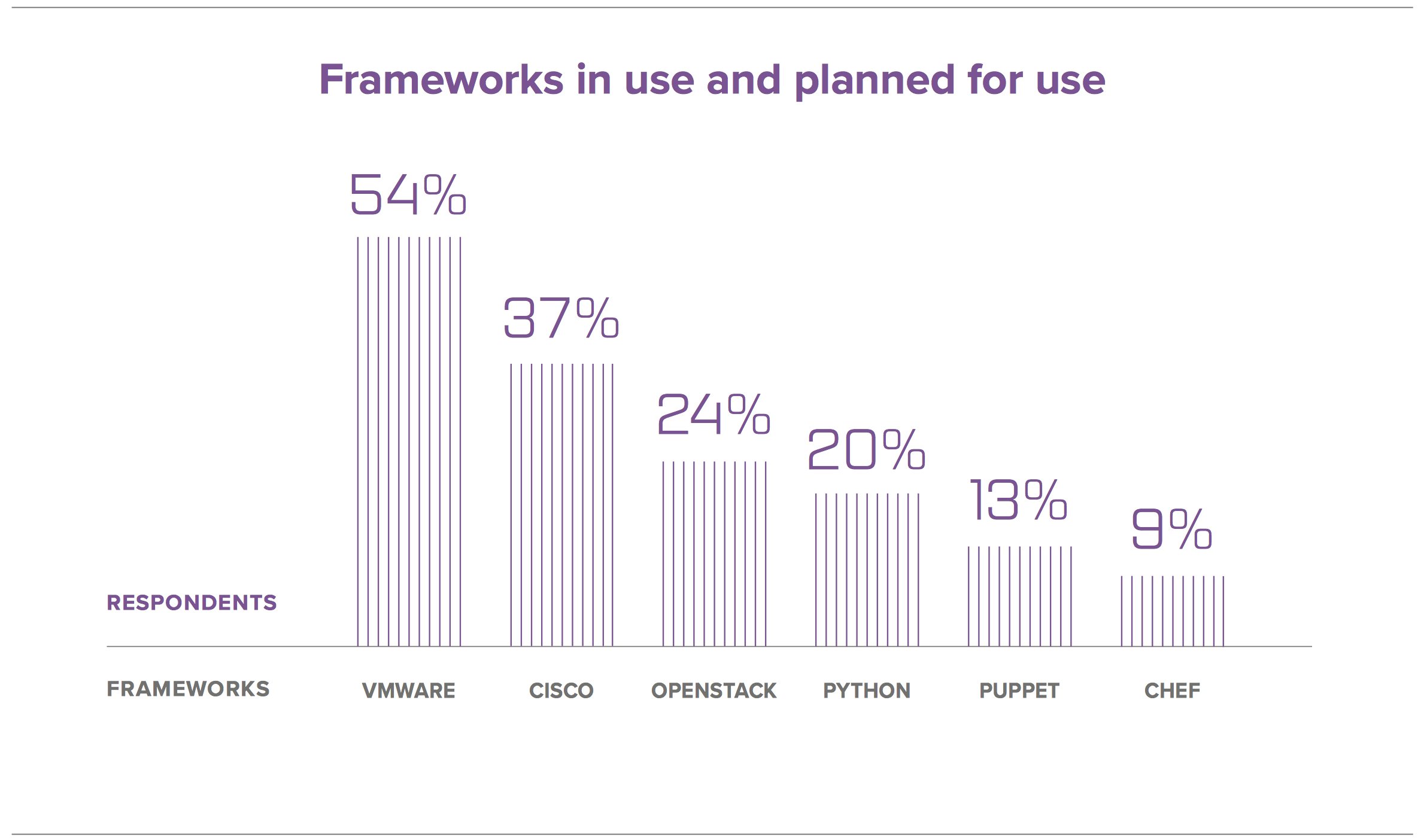
    While editing errors are distracting, the biggest issue I had with the report was the inclusion of Python as a “framework” (along with VMware, OpenStack, Puppet, Chef …). The assumption is made in the accompanying text that this indicates the level of homegrown automation, but since there are many ways to implement homegrown automation, this is at best a low point indicator of that. Overall, it feels out of place in the list:

    DevOpsTools
    DevOps tools as surveyed by F5 Networks.

    But honestly, there is enough other information about trends and number of these “frameworks” in use per org packed into this section that I’m willing to view inclusion of a language as a simple oversight that can be explained away because lots of organizations are using python for automation (I have, at more than one organization).

    The report also talks about the average application having double digits of application services deployed for it. This seems high to me, but it is data from a survey of F5’s customers, and if you’ve already paid for this bundle of services, perhaps you are more likely to make use of as many as possible. What this points to, for me, is an automation of the overall application environment. Considering the commentary F5 received in response to skills questions, it makes sense that automating solutions that can easily be automated would be an easy choice for their respondents.

    Note that in the graphic above, the company did not restrict users to “What frameworks are you using for network configuration?” It might be a reasonable assumption to think it did, as F5 is primarily a networking company (don’t tell the execs I said that—they seem to be repositioning as an application services company these days), but I asked, and the company put no limits on responses. That shows uptake of Puppet among its customers to be far smaller than I would have expected, personally, considering the core of its customer base should be Puppet’s sweet spot—traditional enterprises in a variety of industries.

    The weighting of respondents across roles might have some play in how these are ranked, though. There is a preponderance of networking and management types in the response list, with fewer security, dev, architecture and DevOps types. This could skew results, even if the organization list is relatively balanced across industries.

    Overall, take a look. It’s solid information, with some interpretation available and more commentary on verticals and use cases. It’s definitely a document worth having on hand when explaining the value of what you’re doing, or attempting to expand what you’re doing.

    — Don Macvittie

  • New F5 Software Advances Application Security, Management, and Orchestration

     Industry-leading service programmability promotes flexible deployment capabilities, policy-based controls, and hybrid cloud support

    VIENNA, AUSTRIA, MAY 17, 2016 – F5 Networks (NASDAQ: FFIV) today introduced software-based solutions that enable customers to seamlessly integrate availability and security services, simplify device management, and better orchestrate IT infrastructure. To lower costs and boost efficiency, organizations are evolving toward more dynamic infrastructure models that combine physical, virtual, and cloud components. Supporting this transition, F5’s innovative, versatile solutions give customers the ability to take advantage of the benefits provided by traditional data center, cloud, and hybrid architectures.

    Today, F5 is introducing:

    • BIG-IP® 12.1 software, delivering leading application services with enhanced public cloud integration and more sophisticated security policies for on-premises and hybrid cloud environments
    • BIG-IQ® Centralized Management 5.0, providing expanded management for F5’s BIG-IP solution portfolio with significant scalability and performance advances
    • iWorkflow™ 2.0, enabling the orchestration of F5 services with SDN-focused solutions like Cisco ACI and VMware NSX, as well as continuous deployment scenarios using DevOps tools from vendors such as Ansible, Chef, and Puppet

    Programmable Application Services for Ultimate Flexibility

    With the release of BIG-IP version 12.1 software, no other Application Delivery Controller (ADC) vendor offers F5’s level of programmability across traditional, cloud, and hybrid architectures. F5’s new iRules LX™ technology marks a substantial advance in programmability, providing the ability to manipulate and selectively deploy service capabilities via Node.js, and includes easy access to over 250,000 community Node.js packages. These capabilities are especially important in delivering advanced functionality for web applications that require optimized throughput, scalability, and unique traffic steering services. In addition, a new plug-in for the Eclipse Integrated Development Environment (IDE)—commonly supported by other enterprise technology vendors (e.g., CA, Google, IBM, Oracle, Red Hat, and SAP)—enables the rapid delivery of reusable code that drives advanced functionality.

    Strong Policy-Based Security with Protection for Applications Everywhere

    The proliferation of Internet-facing applications has led to pervasive threats on business-critical web services, along with an increase in the sophistication of attacks. F5’s security enhancements allow organizations to more effectively ensure application availability and performance, resolve critical app protection gaps, and strengthen overall defenses. Today’s announcement reflects a number of new security capabilities, with highlights including:

    –          BIG-IP 12.1 enhances industry-leading web application defense via BIG-IP Application Security Manager™ (ASM) with unique, customizable bot detection methods that enable detailed analysis and extensive device ID tracking.

    –          BIG-IP ASM accelerates the blacklisting of malicious IPs in hardware at high rates for layer 7 threats, providing coverage until feed lists are updated.

    –          F5 gives visibility into HTML 5 WebSocket connections for comprehensive policy protection where other WAFs fail.

    –          BIG-IP Advanced Firewall Manager™ now offers enhanced capabilities that automatically mitigate L3–7 attacks upstream in the ISP realm and control SSH channel user-initiated actions with simple custom policy enforcement.

    Tight Integration with Leading Public Cloud Environments

    Application architects and developers must rapidly implement apps and services as part of a continuous deployment pipeline, while ensuring that they remain fast, highly available, and secure throughout. F5 solutions are designed to let customers use the same services in the cloud that they can in the data center. New technologies offer expanded support for AWS and Azure environments, including integration with AWS autoscale to dynamically scale app services, active/standby high availability across availability zones, and added F5 WAF capabilities for Azure Security Center.

    Powerful Management and Orchestration Capabilities for Simplified Operations

    For network architects and administrators, F5 has updated its BIG-IQ Centralized Management solution. The platform provides visibility, reporting, licensing, and management capabilities that simplify operations for F5 BIG-IP products, and now includes support for F5’s award-winning BIG-IP Access Policy Manager®. F5 is the only vendor that combines centralized, role-based management for application delivery, security, and identity management into a united framework. In addition, with this new version of BIG-IQ, customers can now simultaneously manage, update, and configure application services for up to 200 physical and virtual devices, and handle up to 5,000 BIG-IP licenses.

    F5’s new iWorkflow platform accelerates the deployment of applications by enabling the orchestration of network services, such as traffic management and security. Available as a virtual appliance, iWorkflow™ is a multi-tenant solution for deploying application delivery policies with BIG-IP solutions to support a variety of IT environments, including hybrid clouds. Using smart templates, policies can be deployed directly via the iWorkflow GUI, via third-party management solutions such as Cisco ACI or VMware NSX through connectors, or via other orchestration technologies such as Ansible, Chef, and Puppet with an SDK.

    Supporting Quotes

    “To better meet the needs of customers, we have made significant investments in security, management, and orchestration, along with the feature-rich software that supports our flagship BIG-IP product line,” said Karl Triebes, EVP of Product Development and CTO at F5. “Giving organizations the ability to integrate F5 with vendors and solutions such as AWS, Azure, Cisco, and VMware is certainly a priority, but we also have an eye toward making sure our offerings resonate with those using open source technologies like OpenStack, and agile infrastructure from emerging ‘born in the cloud’ companies.”

    “As application services and resources are abstracted across increasingly diverse environments, the ability to easily unify functionality and enforce policies throughout vendors’ offerings becomes essential,” said Brad Casemore, Research Director, Datacenter Networks, IDC. “Similarly, the ability for enterprise IT to programmatically tailor performance and orchestrate services is a necessity for organizational success with multi-vendor SDN and cloud deployments.”

    Availability

    BIG-IP version 12.1 software, BIG-IQ Centralized Management 5.0, and iWorkflow 2.0 will be available in the second quarter of calendar year 2016. Please contact a local F5 sales office for additional product and service availability information pertaining to specific countries.

    Additional Resources

    About F5

    F5 (NASDAQ: FFIV) provides solutions for an application world. F5 helps organizations seamlessly scale cloud, data center, telecommunications, and software defined networking (SDN) deployments to successfully deliver applications and services to anyone, anywhere, at any time. F5 solutions broaden the reach of IT through an open, extensible framework and a rich partner ecosystem of leading technology and orchestration vendors. This approach lets customers pursue the infrastructure model that best fits their needs over time. The world’s largest businesses, service providers, government entities, and consumer brands rely on F5 to stay ahead of cloud, security, and mobility trends. For more information, go to f5.com.

    You can also follow @f5networks on Twitter or visit us on LinkedIn and Facebook for more information about F5, its partners, and technologies.
    F5, BIG-IP, BIG-IQ, iWorkflow, iRules LX, Application Security Manager, Advanced Firewall Manager, Access Policy Manager, and DevCentral are trademarks or service marks of F5 Networks, Inc., in the U.S. and other countries. All other product and company names herein may be trademarks of their respective owners.

    This press release may contain forward looking statements relating to future events or future financial performance that involve risks and uncertainties. Such statements can be identified by terminology such as “may,” “will,” “should,” “expects,” “plans,” “anticipates,” “believes,” “estimates,” “predicts,” “potential,” or “continue,” or the negative of such terms or comparable terms. These statements are only predictions and actual results could differ materially from those anticipated in these statements based upon a number of factors including those identified in the company’s filings with the SEC.

  • F5 Releases 2016 ‘State of Application Delivery’ Customer Survey Results

    SEATTLE–(BUSINESS WIRE)–F5 Networks (NASDAQ: FFIV), today released the results of its second annual State of Application Delivery customer survey. Expanded to include feedback from more than 3,000 customers worldwide, this year’s report details how they are delivering applications successfully, how they keep data and users secure, and how hybrid cloud, software-defined networking (SDN), and DevOps are changing IT. In addition, F5 executives will host a series of live panel sessions and a webinar that will offer attendees deeper insights into the data. The first live panel session is on January 28, 2016, and will be hosted by F5’s CTO and EVP of product development, Karl Triebes. Sign up for the panels and webinar, and download the full report at: http://f5.com/SOAD.

    Survey Highlights

    This year’s report goes bigger and broader with input from F5 customers in the Americas (AMER); Europe, the Middle East, and Africa (EMEA); and Asia-Pacific (APAC) regions. A variety of industries are represented, with the widest participation from customers in finance, technology, telecom companies, and government entities. Key takeaways include:

    • Application services are essential and pervasive: Ten or more application services are used by well over half of respondents, who recognize that slow, unresponsive, and unsecured applications can have a substantial negative impact on revenue and operations.
    • Hybrid cloud is the new normal: The vast majority of respondents (81 percent) are moving toward a hybrid cloud environment to leverage the flexibility and potential cost savings it offers, especially for small and mid-sized organizations.
    • Security focus is on protecting users, data, and applications:Security professionals who have the highest level of confidence in their ability to ward off attacks are protecting clients, requests, and responses—the critical points at which data can be easily compromised.
    • DevOps and SDN are key to improving operational efficiency:Because DevOps and SDN enable automation and orchestration, they are both seen as key factors for reducing operating costs and improving time to market.

    “Applications are vital to business success. Used by every employee, applications contribute to greater efficiency, lower costs, and increased margins,” said Triebes. “Without the correct services to support applications, they won’t be available, secure, or fast enough to meet companies’ needs. The results of this year’s State of Application Delivery survey offer valuable insights into how customers are managing and implementing their application services within dynamic and complex IT environments.”

    Additional Resources

    The following items are available at: http://f5.com/SOAD

    • Download the full 2016 State of Application Delivery report
    • Summary infographic
    • Register for the free online live panel sessions and webinar

    About F5

    F5 (NASDAQ: FFIV) provides solutions for an application world. F5 helps organizations seamlessly scale cloud, data center, telecommunications, and software defined networking (SDN) deployments to successfully deliver applications and services to anyone, anywhere, at any time. F5 solutions broaden the reach of IT through an open, extensible framework and a rich partner ecosystem of leading technology and orchestration vendors. This approach lets customers pursue the infrastructure model that best fits their needs over time. The world’s largest businesses, service providers, government entities, and consumer brands rely on F5 to stay ahead of cloud, security, and mobility trends. For more information, go to f5.com.

    You can also follow @f5networks on Twitter or visit us on LinkedIn and Facebook for more information about F5, its partners, and technologies.

    F5 is a trademark or service mark of F5 Networks, Inc., in the U.S. and other countries. All other product and company names herein may be trademarks of their respective owners.

    Forward-Looking Statements

    This press release may contain forward-looking statements relating to future events or future financial performance that involve risks and uncertainties. Such statements can be identified by terminology such as “may,” “will,” “should,” “expects,” “plans,” “anticipates,” “believes,” “estimates,” “predicts,” “potential,” or “continue,” or the negative of such terms or comparable terms. These statements are only predictions and actual results could differ materially from those anticipated in these statements based upon a number of factors including those identified in the company’s filings with the SEC.

    Contacts

    F5 Networks
    Nathan Misner, 206-272-7494
    n.misner@f5.com
    or
    WE Communications
    Holly Luka, 415-547-7054
    hluka@we-worldwide.com