Tag: ElectricFlow

  • Electric Cloud Aims to Make DevOps More Accessible

    Electric Cloud Aims to Make DevOps More Accessible

    Electric Cloud today unfurled the Winter 2019 edition of the ElectricFlow platform for managing DevOps, which makes it easier for different classes of users to tailor the platform to meet their specific needs.

    Sam Fell, vice president of marketing for Electric Cloud, said the latest release of ElectricFlow allows end users to choose from different personas based on their role in the organization, and each persona has a user interface crafted to surface the level of detail they most likely require. That approach is intended to make the company’s DevOps platform more accessible to wider variety of end users, he said.

    The latest edition of ElectricFlow also adds a customizable customer login experience that is more task-oriented. Users can now add bookmarks/favorites to access specific pages faster.

    Finally, Electric Cloud is now including release and pipeline templates that make onboarding easier, based on user created events/triggers and code check-ins in a Git repository.

    Fell said that while DevOps platform such as ElectricFlow increasingly have incorporated higher levels of automation by relying more on machine learning algorithms, humans should not be left behind. Electric Cloud has been focusing more of its development effort on making it easier for DevOps professionals of all skill levels to derive value from the platform, he said, noting current DevOps platforms tend to make available far too much information than the average IT professional can ingest, added Fell.

    Less clear is how the complexity inherent in DevOps processes extends the time it takes for an organization to employ DevOps pervasively. While DevOps platforms are undoubtedly powerful, they also can be intimidating. In many instances, it’s simply easier for IT administrators to continue to rely on tools they already know to manage a specific task even when that tool is not as robust or rich as what might be accessible in a more modern DevOps platform. What often is ascribed to cultural IT inertia may have its roots in the simple fact that IT professionals are not always equally excited about having to learn and master new tools.

    The number of IT organizations that have been able to employ DevOps processes across their entire organization are still a comparative minority. Most organizations today have what can best be described as pockets of DevOps processes, usually driven by a small, cross-function team that is highly motivated to update a specific set of applications continuously. IT organizations are, of course, hoping to replicate the success of those teams across the rest of the organization. However, the rest of the IT organization doesn’t always have the same level of engineering skills—the spirit may be willing, but the initial DevOps hurdles needed to be overcome are simply too high.

    It may be a while before IT organizations sort this all out. More accessible tools are only one part of the equation. But IT leaders almost inevitably find that giving their teams access to easier tools will, at the very least, start moving their organization in the right direction.

    — Mike Vizard

  • Electric Cloud Extends Continuous Delivery Platform

    Electric Cloud Extends Continuous Delivery Platform

    Electric Cloud is making available a software-as-a-service (SaaS) pricing option available for its ElectricFlow application release management and continuous delivery (CD) platform.

    In addition, version 8.5 of ElectricFlow adds support for a Kanban-style pipeline view, object tagging for custom reporting and improved searchability and a continuous integration (CI) dashboard to track and analyze build processes, failures and successes.

    The SaaS option doesn’t fundamentally change the existing Electric Cloud pricing model as much as it does provide a different location to host ElectricFlow, said Electric Cloud CTO Anders Wallgren. Pricing for ElectricFlow is still based on nodes and the number of users rather than consumption.

    The CI dashboard, meanwhile, provides organizations that have one or more types of CI platforms being employed with visibility into, for example, Jenkins, Git and Bamboo pipelines using a single dashboard. Many organizations today have multiple CI pipelines in place largely because of the preferences of individual developer teams, Wallgren noted.

    The Kanban-style pipeline also provides a mechanism for managing multiple application development projects based on a just-in-time process originally developed by Toyota that is employed to identify bottlenecks in car manufacturing. That same issue, of course, applies to software development, where the number of dependencies between various modules is increased exponentially. That issue is becoming even more pronounced as organizations move to build and deploy cloud-native applications based on various types of runtimes. DevOps teams now can approve and observe release progress and deployment status within ElectricFlow in near real time, Wallgren said.

    Finally, tagging functionality on all objects allows release managers and product owners to create more granular, real-world reports quickly and easily. Universal data segmentation replaces code-based report creation and can be applied across any object type.

    Wallgren noted that adoption of DevOps best practices generally continues to advance at uneven rates. Electric Cloud is now working closely with the DevOps Institute on an online training and certification program dubbed Electric Cloud University. The goal is to increase the number of IT teams that are exposed to modern CD processes at whatever pace they choose. Electric Cloud is making four certifications available: Build Accelerator, Test Accelerator, Administrator and Agile Master.

    Wallgren said the next major frontier when it comes to continuous delivery will be applying deep- and machine-learning algorithms to tame what has become an exceedingly complex management challenge. DevOps toolchains continuously create vast amounts of data originating from numerous tools, and machine learning algorithms can harness that data to automate a range of DevOps processes in a way that is not only makes those processes more accessible, but also easier to demonstrate how an application release meets a specific compliance mandate. To achieve that goal, Electric Cloud has been embedding more algorithms into every release cycle of ElectricFlow, says Wallgren.

    It may take a while longer for algorithms to minimize all the complexity associated with continuous delivery today. But as DevOps continues to evolve, it’s apparent that many of the manual tasks that have often conspired to limit adoption of DevOps will one day soon disappear.

    — Mike Vizard

  • Electric Cloud Introduces ElectricFlow 8.5, Unveils Industry-First Support for Both SaaS and On-Premises Delivery

    Flexible Enterprise SaaS Delivery Model, Kanban-Style Pipeline View and Object Tagging with a Continuous Integration Dashboard Allow Teams of Any Size to Start Fast and Adapt Easily

    SAN JOSE, Calif., Oct. 18, 2018 – Electric Cloud (https://electric-cloud.com/), the leader in Adaptive Release Orchestration and Continuous Delivery, today announced a new SaaS consumption option for the industry’s first Enterprise SaaS and on-premises Application Release Orchestration (ARO) offering, ElectricFlow. ElectricFlow now includes a Kanban-style pipeline view, object tagging for custom reporting and enhanced searchability, and CI dashboarding capabilities to track and analyze build processes, failures and successes.

     For more information about ElectricFlow and to download the free Community Edition, please visit: (https://electric-cloud.com/products/electricflow). 

    ElectricFlow SaaS allows DevOps teams of all sizes to get up and running without incurring on-premise implementation costs, and gives teams developing cloud-native or serverless applications a way to keep all their development pipelines and tools in the cloud. Most enterprises also have on-premise assets that they need to manage. ElectricFlow SaaS seamlessly connects to on-premise servers and tools to enable deployment automation, pipeline and environment management, and release orchestration inside and outside of the firewall.

    “More and more, large enterprises are exploring ways to include cloud-native applications and tool chains in their on-premises digital transformation projects,” said Torsten Volk, managing director at Enterprise Management Associates. “It’s important for DevOps tools vendors to make their offerings available on a variety of platforms to support those efforts. I’m glad to see Electric Cloud getting ahead of the market with this new release of ElectricFlow.”

     DevOps Your Way

    The new Kanban view in ElectricFlow 8.5 provides a familiar, easy-to-use management and execution view of pipelines, stages and individual tasks on one screen. Connected directly to the automation and orchestration, users can approve and observe release progress with real-time pipeline and application deployment status. 

    “Moving to a DevOps culture and adjusting to a new pace, new processes, and new toolsets has been a challenge for many of our people,” said Gary McKay, Scrum Master at global toll-free registry service Somos. “ElectricFlow’s new Kanban view coupled with comprehensive pipeline-as-code means everyone on the team gets exactly the kind of working environment they need to help us accelerate our digital transformation.”

    New tagging functionality on all objects allows release managers and product owners to quickly and easily create more granular, real-world reports. Universal data segmentation is now possible across any object type (applications, pipeline stages, environments, etc.) and replaces code-based report creation.

    New CI Dashboarding creates data-driven visibility into CI processes and bottlenecks, so that architects and application teams have clear understanding of builds from within the release pipeline. ElectricFlow works with all CI tools, including Jenkins, Bamboo and Git to give teams unprecedented insight into the value, cost and risk associated with every release, eliminating the need for difficult, extensive custom coding with tools like Hygeia.

    “This release further solidifies our position as the de facto standard for ARO by doubling down on giving customers the flexibility to unleash the power of ElectricFlow for anyone – wherever and however they need it,” said Carmine Napolitano, CEO of Electric Cloud. “This allows us to meet our customers where they are, and simply ‘plug-in’ unified governance and orchestration across an ever-changing array of tools, stacks, and processes. Adapting to change more quickly than your competition is a competitive advantage, and ElectricFlow eliminates much of the anxiety associated with releasing software when adopting new processes or trying new technologies.”

    Share This: .@electriccloud’s Adaptive Release Orchestration Platform, ElectricFlow, Now Available as #SaaS with new #Kanban view, Tagging functionality and #CI Dashboard to let you Do #DevOps Your Way! https://electric-cloud.com/blog/2018/10/electricflow-8-5-devops-your-way/ 

    About Electric Cloud, Inc.
    Electric Cloud’s Adaptive Release Orchestration platform helps organizations like E*TRADE, HPE, Intel and Lockheed Martin confidently release new applications and adapt to change at any speed demanded by the business, with the analytics and insight to measure, track, and improve their results.  

  • Enterprise Management Associates Selects Electric Cloud’s ElectricFlow as a Top Product for Artificial Intelligence (AI) and Machine Learning (ML) in DevOps

    Enterprise Decision Guide for AI and ML identifies and profiles top enterprise software solutions to optimize DevOps, datacenter operations and digital transformation initiatives


    SAN JOSE, Calif., October 2, 2018 — Electric Cloud (http://electric-cloud.com/), the leader in Adaptive Release Orchestration and Continuous Delivery, today announced its flagship product, ElectricFlow, has been selected by EMA Research as a Top 3 enterprise software product in its new report, “EMA Top 3 Enterprise Decision Guide for Artificial Intelligence (AI) and Machine Learning (ML).” The report provides pragmatic guidance to enterprises on how to optimally benefit from AI and ML and continuously release better software. This is the second year in a row Electric Cloud has been recognized by EMA Research, previously selected as a “Top Three” in the 2017 report, “Ten Priorities for Hybrid Cloud, Containers and DevOps in 2017.”

    Download the EMA Top 3 Enterprise Decision Guide for Artificial Intelligence (AI) and Machine Learning (ML): https://bit.ly/2NJXAHu

    EMA research has found that AI and ML is the number one strategic enterprise IT investment priority in 2018, followed closely by container management and orchestration, and DevOps pipeline automation. At the same time, most enterprises are still struggling to understand the basics of how to successfully evaluate AI and ML solutions, how to put project performance metrics in place, and how to handle key limitations of AI and ML technologies today.

    “As organizations expand DevOps initiatives to include more and more applications and application teams, getting visibility into and balancing the risk-reward for each release becomes much more difficult,” said Torsten Volk, managing research director of containers, DevOps, Machine Learning and Artificial Intelligence at EMA. “Electric Cloud ElectricFlow has automated the data collection and analysis of DevOps toolchain data, and is leveraging AI/ML to provide recommendations that ensure valuable software can be released at the shortest possible time with the lowest possible cost and risk.”

    DevOps toolchains continuously create vast amounts of data originating from numerous tools across the entire software delivery process. AI and ML can now help companies continuously learn from the massive amounts of data generated, which could ultimately result in a recipe for achieving universal DevOps success across all of the diverse teams and roles within the enterprise. According to the report, compliance is the number one pain point in DevOps today. By gathering all customer, team and project specific data in the DevOps toolchain, the ability to leverage AI and ML to help companies continuously take risk, cost and anxiety out of software releases is a game changer.

    ElectricFlow, the leading application release orchestration platform, uses deep learning to identify patterns in release pipelines and gauge the likelihood of software release success. By applying machine learning algorithms to the massive amounts of data generated by tool chains, ElectricFlow DevOps Foresight provides predictive analytics to develop a risk score metric that predicts the outcomes of releases before they head into production. Taking predictive analytics even further, the platform is also able to illustrate where to improve pipelines based on developer influence, code complexity influence, and more.

    “It is an honor to be recognized by EMA as a leading provider of actionable DevOps insight for development and operations teams through the use of artificial intelligence and machine learning techniques,” said Carmine Napolitano, CEO of Electric Cloud. “We pride ourselves in helping customers save hundreds of hours of work and relieve unnecessary anxiety related to releasing new products to market. By enabling data-driven insights about their software delivery toolchains and processes, they have the foresight to know a release’s success rate by looking at past successes and failures, build complexity, author profiles and more.”

    To arrange a demo of ElectricFlow DevOps Foresight, visit: (http://electric-cloud.com/solutions/devops-foresight/)

    Some of the key benefits of artificial intelligence and machine learning as identified in the research include:

    • Freeing up 30 percent of developer time used to support infrastructure
    • Eliminating operational silos as the root cause of cost, quality, and speed bottlenecks in DevOps
    • Proactively addressing operational issues and minimize mean time to repair (MTTR)

    Share This: ElectricFlow named by @ema_research as a Top 3 Enterprise Software solution leveraging #AI & #ML in #DevOps https://bit.ly/2NJXAHu #ContinuousDelivery #Analytics

    About Electric Cloud, Inc.
    Electric Cloud’s Adaptive Release Orchestration platform helps organizations like E*TRADE, HPE, Intel and Lockheed Martin confidently release new applications and adapt to change at any speed demanded by the business, with the analytics and insight to measure, track, and improve their results.


  • Electric Cloud and the Deployment Dashboard

    Electric Cloud and the Deployment Dashboard

    As my regular readers know, I started a series on companies that I found intriguing who were going to Jenkins World both late (a couple weeks before the event started), and ad hoc. That meant that companies I talked to on a regular basis came to mind, simply because I knew what they were up to, and whether or not they were going to Jenkins’ World.

    It turned out to be a popular few blog posts, both with readers and customers, but I was only able to fit three in before it was late enough in the event that publishing more would not achieve the goal of the series: telling you all about interesting bits to check out.

    But as these things go, the more I paid attention, the more interesting stuff I found. So I’m going to do a few “What you might not have seen at Jenkins’ World” posts to kind of get a chance to talk about other ideas that hold interest.

    Today, I’ll focus on a vendor I’ve followed but never actually used. That’s rare for me; generally speaking, if I’m writing about the product, I’ve used it. And no doubt I’ll snag a free license and put it through the paces, or have one of my coworkers do so. But for now, I’m covering them because I find what they’re doing to be of interest.

    The vendor is Electric Cloud. For those unaware, its ElectricFlow tool is in the same application release automation/continuous delivery (ARA/CD) market space that XebiaLabs (which I also wrote about at Jenkins World) XL Deploy is in. But the point of this blog is not to compare; since I have used both of XebiaLabs’ mainstream products and not Electric Cloud’s, a comparison would be unfair. I only mention XebiaLabs to help those just starting to research understand where Electric Cloud fits.

    dashboard
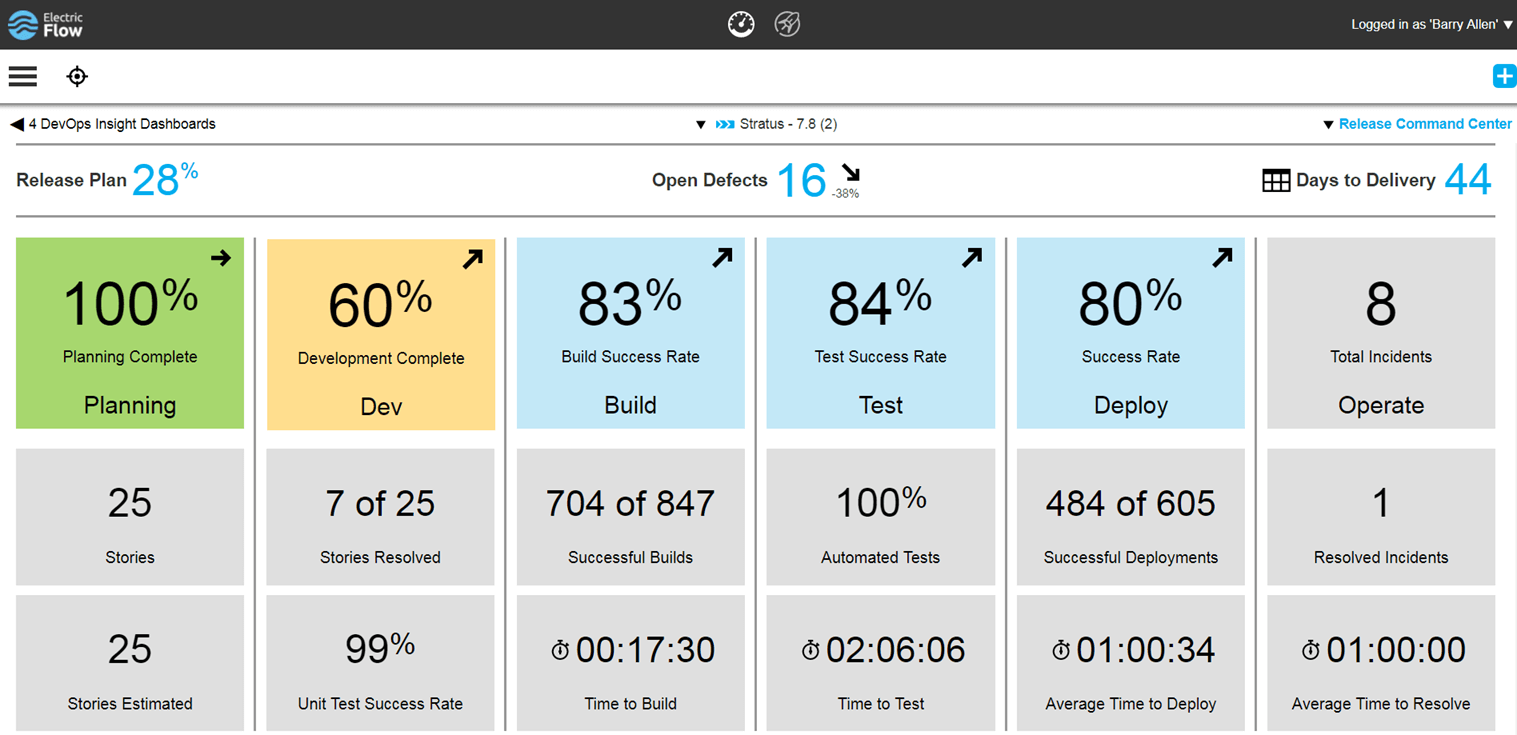
    Electric Cloud’s new dashboard

    Electric Cloud’s big bit at Jenkins’ World that intrigued me was its updates to ElectricFlow to allow better reporting. We all know when a build breaks, we have great systems on the AppDev side to notify the source of the breaks and project management of the issue. But as has traditionally been the case within IT, getting that information out to business leaders who have an interest in the application is spotty, at best. Combine that with the fact that what and how it is reported can vary project to project, and there always is a bit of confusion among the business about status of projects. This confusion translates to asking IT management about status and then, when IT management is wrong and a deadline is either missed or features are dropped from release at the last minute to meet the deadline, bad blood is created between AppDev/IT and the business. Since everyone at an org should be one team pulling toward success of the business, this bad blood is not good for anyone.

    It appears, from its release (I really wish I’d been at Jenkins’ World to poke the corners of this), that Electric Cloud has begun the process of bridging that gap. The growing number and complexity of toolchains means inputs are coming in from several vectors that can give indication of the status of a project. Instead of having IT management (or business management, at some orgs) run around and try to collect these disparate datasets and determine tracking for a project, Electric Cloud has begun the process of automating status collection/aggregation.

    The dashboard pictured above is a critical piece of this solution. Imagine giving business leaders access to a dashboard that doesn’t just cover the current step of a project, but tries to aggregate status from all of the steps in the DevOps life cycle. Basing this information upon release means that, over time, a library will build up that business leaders can reference to gauge this projects’ status against that of other projects, and make their business decisions based upon standardized inputs.

    This data already exists across IT, but this is the first solid attempt I have seen of a vendor tying it all together and presenting it in a manner that IT and the business can discuss with an eye to delivering. The more involved business leaders are in the process, the less friction will result, and this effort seems to be getting them more involved. While there is still much to do—note that unit test success rate is shown in the above screen capture, but unit test coverage isn’t, for example—this is a good solid start to setting up an easy-to-reference dashboard to show the business side what is going on with the project.

    There is also an API that can be used to set inputs to the dashboard that are not yet directly supported. While DevOps teams have plenty to do—and don’t really need to be developing plugins for tools that are supposed to improve quality while reducing workload—the ability to plug in whatever you need is useful for those shops where it is a priority.

    If you’re looking for a toolset that can give more information about what’s happening in your toolchain, it’s worth checking out the changes Electric Cloud has implemented, and I’ll be trying to make time in the next few weeks to give the tool a run and see how it works out. Though I see it as inevitable that the other ARA vendors will continue to increase their offerings also, sometimes it is worth checking into the early bird.

    — Don Macvittie