Tag: edge computing

  • AWS Adds GUI to Snow Edge Computing Family

    AWS Adds GUI to Snow Edge Computing Family

    Amazon Web Services (AWS) this week announced it has added a graphical user interface (GUI) tool dubbed AWS OpsHub for Snow Family to provide an alternative to the command-line interface (CLI) tool it makes available to manage its family of Snow appliances deployed in on-premises environments.

    At the same time, AWS announced it is making available additional Snowball storage appliances that are 25% faster than previous generations thanks to additional memory, support for more virtual CPUs and 100GB networking.

    Finally, AWS is also making it possible to control access to Snow appliance via AWS Identity and Access Management (IAM) and the ability to automate tasks using AWS Systems Manager.

    Bill Vass, vice president of technology for AWS, said organizations can now build storage clusters that are now as large as 1.4PB using Snow appliances.

    AWS originally rolled out Snow appliances to provide an easier way to upload massive amounts of the data to a public cloud. Once an organization loads data on to an appliance, it is physically shipped to AWS. Once there, AWS personnel transfer that data on to the AWS cloud.

    However, with the rise of edge computing, AWS is now also employing Snowball appliances to drive hybrid applications in internet of things (IoT) and other environments. AWS now makes available a Greengrass framework for building hybrid cloud applications. The Snow appliance family provides a more efficient and secure alternative to the rival edge computing platform from Dell Technologies, said Vass.

    The GUI from AWS is intended to make it easier for the average IT administrator to provision Snow appliances, which previously would have been accessible only to IT professionals who had mastered the Snow CLI. AWS is even going so far as to include cartoons that demonstrate how to provision its appliances.

    While AWS clearly dominates the public cloud, it is not clear to what degree it will be able to extend that dominance to edge computing. AWS is counting on the fact that large numbers of edge computing applications will need to be tightly integrated with application workloads running on its public cloud. Providers of traditional data center platforms are also vying to become the providers of those same platforms, all of which now can be centrally managed via the cloud.

    Edge computing platforms will, of course, vary widely in size depending on the use case. However, there may come a day soon when the total number of workloads deployed at the edge exceeds the number of workloads in the cloud. The amount of compute and storage horsepower at the edge will be crucial as organizations look to deliver next-generation applications that process and analyze data real-time, especially as 5G wireless computing networks simultaneously make more network bandwidth available.

    AWS may not be the first IT vendor that comes to mind when it comes to edge computing platforms, but it is signaling its intention to be a lot more than just a provider of cloud computing services.

  • Survey Finds More Data Disruption Occurring

    Survey Finds More Data Disruption Occurring

    A global survey of 1,000 IT decision-makers with more than 250 employees conducted by Dell Technologies finds on average organizations managed 13.53 petabytes (PB) of data in 2019, a nearly 40% increase since 2018.

    The same survey also finds that as the amount of data has increased, so, too, has the cost of downtime. Those costs increased by 54% in the same period, resulting in an estimated total cost of $810,018 in 2019.

    The survey also notes 82% of respondents suffered a disruptive event in the last 12 months, with the total cost of a data loss now on average exceeding $1 million.

    Not surprisingly, the survey finds that a lot of the data that organizations are trying to protect resides in the cloud, thanks mainly to the rise of a variety of application use cases. The top five areas of investment cited by survey respondents include cloud-native applications (58%), artificial intelligence (AI) and machine learning (ML) (53%), software-as-a-service (SaaS) applications (51%), 5G and cloud edge infrastructure (49%), and Internet of Things/endpoints (36%).

    Nearly, three-quarters of respondents (71%) noted these emerging technologies create more data protection complexity and 61% said they increase risks. The survey also finds 81% of respondents said their existing data protection solutions will not be able to meet all future business challenges.

    Specific areas where existing data protection platforms are expected to fall short include being able to recover data after a cyberattack (69%), recover data from a data loss incident (64%), comply with regional data governance regulations (62%), and meeting backup and recovery service level objectives (62%).

    Among organizations that have adopted these emerging technologies the percentage of organizations struggling with adequately protecting data is as follows:

    • 5G and cloud edge infrastructure (67%)
    • AI and ML platforms (64%)
    • Cloud-native applications (60%)
    • IoT and endpoint (59%)
    • Robotic process automation (56%)

    The survey also finds organizations prefer public cloud/SaaS (43%), hybrid cloud (42%) and private cloud (39%) as deployment environments for new applications. In the case of edge computing deployments, 62% cited private clouds as being the platform that will be relied on most to protect data.

    Bob Ganley, senior marketing consultant for cloud at Dell EMC, said the biggest challenge for organizations will be finding a way to centrally manage backup and recovery across multiple cloud computing platforms. Those platforms inevitably will span multiple types of public and private clouds accessed as a service and deployed in local data centers. Most organizations are relying on a “mash-up” approach to cloud computing where there is no unified control plane, so as they add each new cloud platform their total cost increases, he said Ganley, noting it’s now only a matter of time before IT organizations start to centralize the management of those multiple clouds to rein in those costs.

    It’s not clear to what degree that centralization effort will revolve around IT automation enabled by application programming interfaces (APIs) and best DevOps processes versus traditional data protection tools based on graphical user interfaces (GUIs). However, given the amount of data involved, it is more than likely that existing approaches to data protection are not going to scale, so a fundamental change in how backup and recovery is managed is now all but inevitable.

    — Mike Vizard

  • Survey Finds IT More Challenging to Manage Than Ever

    Survey Finds IT More Challenging to Manage Than Ever

    A survey of 415 IT executives published today shows IT teams are struggling to keep up as the number of platforms that need to be managed continues to expand rapidly.

    Conducted by Propeller Insights on behalf of Volterra, a provider of a distributed computing platform, the survey finds 97% are planning to distribute workloads across two or more clouds. The top three reasons cited for adopting multiple clouds were the need to maximize availability and reliability (63%), meeting regulatory and compliance requirements (47%), and leveraging best-of-breed services from each provider (42%).

    At the same time, the survey finds 70% of survey respondents said it’s “very important” to have a consistent operational experience between the edge and public and private clouds.

    The survey, however, also makes it clear IT leaders understand that achieving the goal will be a significant challenge. The top issues identified when employing multiple clouds are establishing secure and reliable connectivity between providers (60%), employing different support and consulting processes (54%) and navigating different platform services (53%).

    The rise of edge computing is going to further exacerbate those challenges. The survey finds the difficulty in managing apps across multiple edge locations (44%) and an inability to accommodate the IT infrastructure needed to host and operate at the edge (38%) as the two major edge computing issues identified by survey respondents. In terms of specific technical challenges identified, integrating cloud-native workflows such as automation, continuous integration/continuous delivery (CI/CD) and performance management (69%) and trouble installing a full set of application infrastructure spanning compute, storage and network and security (67%) top the list of issues.

    As far as lifecycle management at the edge is concerned, the two biggest long-term issues identified are the lack of resources or time to keep applications and infrastructure up to date (37%) and managing silos of distributed clusters (26%).

    Mark Weiner, chief marketing officer for Volterra, said the survey makes it clear there soon will come a day when IT organizations will need to centralize the management of an increasingly extended enterprise. IT organizations may have adopted public clouds aggressively, yet 70% to 80% of all workloads still run in an on-premises IT environment. At the same time, the number of workloads that will be distributed to edge computing platforms is set to explode. The survey identifies the primary reasons more workloads will be deployed on the edge as the need to control and analyze data locally (54%) and the amount of latency experienced when sending edge data to public cloud-based apps (47%).

    Ultimately, the goal is to have a hybrid cloud computing environment through which the management of IT is as centralized as possible. While the cost of deploying workloads in a public cloud is comparatively inexpensive, it turns out the total cost of IT continues to increase as IT teams find themselves managing more distributed platforms than ever. It may be a while before IT teams have the tools and processes in place to rein in those costs. However, at this point, it’s more a question of how and when that goal will be accomplished, not if.

    — Mike Vizard

  • Extending Cloud to Enable Intelligent Edge

    Extending Cloud to Enable Intelligent Edge

    In the last few years, with the emergence of 5G, IoT and AI, cloud providers have recognized the value and the importance of edge, and started building the infrastructure technologies to provide computing and connection between cloud and edge, as well as edge based intelligent services as part of their total cloud value proposition. However, this is a relatively new area of cloud computing with great opportunities as well as challenges.  

    Top Scenarios of Cloud-Edge Computing 

    The new set of applications such as 5G, IoT and AI, and maximizing cloud computing resources have been driving the development of edge computing as extension of cloud.

    Here are the major scenarios for such cloud-edge computing development: 

    1. Low latency: For latency sensitive services such as 5G and IoT, running on the edge provides much lower latency and faster response time. We have seen more and more latency sensitive services being built around the public cloud ecosystem.
    2. Massive data: With the rapid growth of devices and users, we’re generating massive amount of data every day. It is very costly to move device or user generated data for services to run on the cloud in real time or on a regular basis. Instead, it is more efficient to run services on the edge and to perform local data processing. In some cases, it is the only viable option and can save tremendous network cost.
    3. Privacy/security: For some businesses or regions, it is required to store sensitive and/or confidential data locally on the edge (without moving to cloud) to comply with privacy law and/or security regulations.
    4. Distributed cloud architecture: At the same time of adopting public cloud services, many enterprises have needs to run part of their business on locally edge servers, which challenge cloud providers to design and provide a distributed cloud architecture to their users. 

    Top Use Cases: Edge Analytics and Edge AI 

    One of the top cloud-edge computing opportunities is edge analytics, which allows data analysis and decision making closer to where the data is generated such as IoT devices, edge and gateways while the cloud is still responsible for the overall service life cycle management, service scheduling, data storage or warehousing, and more comprehensive service or data analysis such as big data analytics. The key benefits of edge analytics are reduced latency and increased security of the analytics, and hence, quick business decision making and so on.

    Similarly, edge AI enables applications such as autonomous navigation, remote monitoring using NLP or facial recognition, video analytics, and etc. by embedding AI algorithms in AI devices connected to distributed, low-latency and reliable AI services on the edge, while cloud resources can be pulled in for more in-depth analysis. Here is an image recognition example using both edge and cloud resources and technologies: The edge renders the initial image collected from the device, performs initial analysis and determines it is a dog in the image, then the edge sends the extracted dog image, rather than the whole original image file, to the cloud for further analysis. The cloud then utilizes a bigger data set and determines the breed of the dog and sends the information back to the edge as a more detailed description of the image. 

    Top Challenges 

    Cloud-edge computing obviously brings many technical challenges to cloud providers, especially in support of heterogeneous computing, network instability and security on the edge.

    Here are top challenges we have seen:

    1. Limited amount of resources on the edge. The services deployed on the edge need to be more lightweight and less resource intensive.
    2. The IoT devices on the edge can be massive and diverse, which can lead to device management challenges for the edge.
    3. The connectivity between the cloud and the edge can be unstable. It is important to implement well thought-out network protocols to ensure the reliability of data transmission between the cloud and the edge.
    4. There needs to be a streamlined security strategy connecting IoT to the edge, and to the cloud.
    5. Since this is still a relatively new area with great promises and competing visions, there are many disconnected technologies, point solutions and fragmented communities addressing this space. This can be challenging for users to determine the best architecture and solution stack for their edge cloud computing use case.   

    KubeEdge and Volcano, Cloud Native Projects that Extend Kubernetes to Edge and AI

    Cloud native computing has been considered as the de facto approach for the cloud, edge and AI application and service development, and Kubernetes has been proven to be the cornerstone of cloud native computing today. KubeEdge, a CNCF Sandbox project launched in July 2018 with increasing user and developer support, extends Kubernetes to the edge. KubeEdge 1.2, just released in February 2020, includes many reliability features that addresses the cloud-edge network challenges and improves the cloud-edge connectivity. Volcano is an open source project that extends Kubernetes to meet the AI and deep learning workloads. Volcano has recently received the CNCF Runtime SIG approval, and is currently applying for CNCF Sandbox status.

    Please join KubeEdge and Volcano, and let’s work together to complete cloud-edge-IoT streamlined solutions to meet the opportunities that 5G and AI can bring us today and in many more years to come.

    — Anni Lai

  • Lenovo Looks to Automate Edge Computing

    Lenovo Looks to Automate Edge Computing

    Lenovo is extending its IT automation framework for provisioning IT infrastructure out to edge computing platforms.

    Charles Ferland, vice president and general manager for networking and communications service providers at Lenovo Data Center Group, said the Lenovo Open Cloud Automation (LOC-A) framework provides a single pane of glass through which IT teams can not only provision IT infrastructure but also invoke other frameworks to automate, for example, the deployment of virtual machines on top of that IT infrastructure.

    Ferland said while there are plenty of frameworks for automating the deployment of virtual machines, many IT teams will spend weeks manually provisioning IT infrastructure. LOC-A provides a mechanism to reduce the time and effort required to minutes. However, rather than completely reinvent the IT automation wheel, Lenovo decided to also integrate LOC-A with frameworks such as Ansible, Puppet and Chef, he said, noting that approach makes it possible for IT teams to adopt LOC-A without having to replace any of the IT automation frameworks they already might have in place.

    LOC-A can also be extended to edge computing platforms other than ones provided by Lenovo, he added.

    Beyond simply reducing the amount of time required to provision IT infrastructure, Ferland noted LOC-A also serves to reduce errors that typically occur when IT teams manually provision IT infrastructure. In many cases, those configuration errors can lead to cybersecurity issues later. Of course, many IT teams have developed custom scripts to automate the provisioning of IT infrastructure. However, most of those scripts don’t scale and are poorly documented, noted Ferland. When a member of the IT team that wrote the script leaves the company, often the IT team left behind must develop another script. In many cases, IT personnel view the scripts they develop as a tool that belongs to them rather than the company that hired them. Ferland said the primary goal is to provide a scalable IT automation framework that helps IT teams further advance the adoption of best DevOps practices.

    Ferland said Lenovo developed LOC-A to provide a cloud-like experience for on-premises IT infrastructure that is similar to what IT teams experience when provisioning IT infrastructure on a public cloud computing platform. LOC-A is currently being employed by telecommunications carriers including T-Systems.

    It’s no coincidence Lenovo’s decision to extend LOC-A to the edge comes at a time when carriers are creating 5G networks that require applications to be processed in real-time as close to where data is created. Those edge computing platforms are going to be deployed in, for example, locations that IT teams are not going to be able to physically reach easily.

    It’s unclear to what degree IT automation frameworks might induce IT teams to standardize on IT infrastructure at the edge. Lenovo, however, clearly views providing this capability as a means to differentiate its platforms at a time when there is currently very little standardization at the edge. The challenge, of course, is the less standardization at the edge there is, the more difficult it becomes to manage.

    — Mike Vizard

  • Dell Pushes Computing to the Edge

    Dell Technologies today set its sights on becoming a major edge computing player with the launch of a Dell EMC PowerEdge XE2420 server optimized for space-constrained environments and a smaller version of a pre-integrated Dell EMC Modular Data Center Micro 415 (MDC Micro) ruggedized platform.

    In addition, Dell launched the Dell EMC Streaming Data Platform, a streaming analytics platform based on open source Kafka software. Dell is using Kafka also to provide an embedded management capability known as the Dell Remote Access Controller (iDRAC 9 Datacenter) for its edge computing platforms.

    Matt Baker, senior vice president for Dell EMC strategy and planning, said edge computing applications require a different approach to IT infrastructure because data is being processed and analyzed in real-time. Dell expects that eventually 75% of all data will be created and processed outside of a data center, he said.

    A primary driver of that transition will be the rise of wireless 5G networks, which will make it feasible to build and deploy real-time applications on edge computing platforms.

    Dell, of course, is making a case for distributed IT environment made up of its platform, contending will be easier for IT organizations to deploy and manage.

    The iDRAC 9 Datacenter platform, for example, provides a remote deployment capability that Dell claims can reduce administrator-attended time by up to 99.1% per server after initial setup. The streaming analytics capability, meanwhile, makes it possible to discover trends, fine-tune operations and create predictive analytics to help ensure peak performance and reduce downtime. Dell has also made available an automated certificate enablement tool to enable zero-touch security at the edge and in central locations.

    All told, Dell claims to be collecting nearly 2.9 million data points per server that can be surfaced in as many as 20 different types of reports.

    Baker said Dell has no plans to extend its data streaming analytics capabilities to other platforms, so IT teams will have to decide to what degree they want to standardize on Dell infrastructure versus setting up a streaming analytics platform of their own that is capable of supporting edge computing platforms from multiple vendors.

    Whatever the approach, the one thing that is certain is the way applications historically have been built and deployed is fundamentally changing. Rather than relying primarily on batch-oriented applications that often require large amounts of data to be transferred across networks to either a data center or public cloud, a lot more data is going to be processed at the edge because of application latency requirements. Edge computing applications, for example, will need to process analytics in near real-time to optimize a process or end user experience in milliseconds.

    Naturally, that shift will have profound implications for the management of IT going forward as IT environments become even more distributed than they are today. In fact, the real issue isn’t so much how computing platforms will be deployed at the edge so much as it is how they will be managed, at a time when most IT organizations are already short-staffed.

    — Mike Vizard

  • Edge Computing and ITOps: Opportunities and Challenges

    Edge Computing and ITOps: Opportunities and Challenges

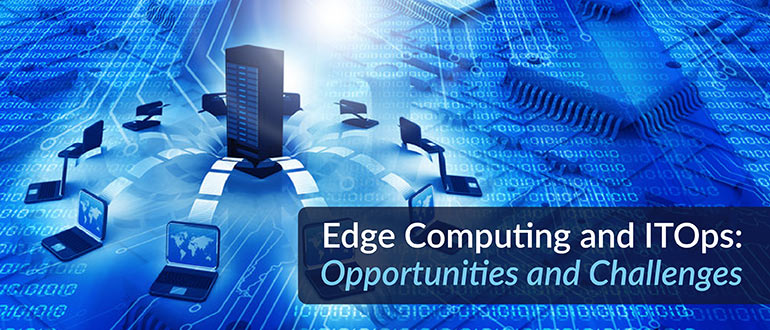
    Edge computing is growing quickly, but IT operations need to evolve as well to effectively monitor and manage new devices, sensors, applications and data. Growing enterprise edge ecosystems should integrate and become part of centrally managed ITOM systems.

    Edge computing is hard to define and is running high on the hype scale. But, research and surveys continue to indicate that this trend of processing data where it’s collected for better latency, cost savings and real-time analysis is an innovation with legs.

    There will be 75 billion IoT devices by 2025, according to Statista. According to Spiceworks’ 2019 State of IT report, 32% of large enterprises with more than 5,000 employees are using edge computing, and an additional 33% plan to adopt it by 2020. Tied to the growth of edge computing is the advent of 5G wireless: 51 operators globally will start 5G services by 2020, according to Deloitte Global research from 2019.

    The major cloud companies are also investing in the edge. The AWS Local Zones service allows single-digit latency connecting to computing resources in a metro environment, while Microsoft offers the Azure Stack Edge appliance and Google Cloud IoT is a “complete set of tools to connect, process, store and analyze data both at the edge and in the cloud.”

    It’s safe to say that edge computing is becoming mainstream, and CIOs and their ITOps leaders should plan appropriately for it in 2020 and beyond.

    Benefits of the Edge for ITOps

    We’ve read plenty about the business benefits from edge computing: oil rig operators need to see critical sensor data immediately to prevent a disaster, marketers want to push instant coupons to shoppers while in the store, video security monitoring can catch a thief in the act and medical device alerts that ensure patient safety. Edge computing may save IT money on cloud and network bandwidth costs as data volumes keep exploding and the need to store every data point becomes harder to justify.

    There are also implications for IT management and operations. Local processing of high volume data could provide faster insights to manage local devices and maintain high-quality business services when seconds make a difference—such as in the event of a critical server performance issue threatening the e-commerce site.

    Today, ITOps teams are inundated with data from thousands of on-premise and cloud infrastructure components and an increasingly distributed device footprint. The truth is, only an estimated 1% of monitoring data is useful, meaning that it provides indications of behavior anomaly or predictions about forthcoming change events. With edge monitoring, we can potentially program edge-based systems to process and send only that small sliver of actionable data to the central IT operations management system (ITOM), rather than transmitting terabytes of irrelevant data daily to the cloud or an on-premise server where it consumes storage and compute power. 

    The job of filtering out the highly-contextual data on the edge, where business occurs, can support real-time decisions for successfully running ITOps at speed and scale—regardless of what combination of on-premise, public cloud or private cloud infrastructure is in place. At the same time, ITOps will need to be a leader when it comes to minimizing the risk of edge technology from a performance, security and privacy perspective. However, as detailed below, we are in the early stages of determining how to make this work in practice.

    ITOps Realities for Edge Computing 

    Edge-Specific Security Needs Are Still Unknown: Edge devices are often small and infrequently designed with security in mind. More than 70% of edge devices don’t mandate authentication for third-party APIs, and more than 60% don’t encrypt data natively. So the attack surface in IoT and edge environments is now larger, and less secure. This is particularly worrisome when considering edge devices that collect personally identifiable information such as email, phone numbers, health data or financial formation such as credit card data. ITOps will need to work closely with security and legal teams to map out the company-specific risk, governance and compliance requirements around managing edge data.

    Edge Monitoring Tools Are Immature: Companies need platforms that can instantly monitor and analyze edge-generated data. In the connectivity of tomorrow, billions of connected devices will be communicating machine-to-machine, and the addition or subtraction of connected devices will be possible at an unprecedented scale. In this environment, the ability to manage large volumes of connected devices and the information being exchanged between them will be critical. 5G acts as the unifying technology, bringing flow of information and the density of scale. We will see an influx of innovation in edge monitoring in the coming years.

    New Environments Call for New Rules: As organizations move more data and application assets to edge computing environments, IT will need to devise new policies and thresholds for central processing and alerting of all this data. Applying AI-based automation is essential here, as manual efforts will have zero chance of keeping up with the volume of data filtering, analysis and response. We are entering the age of nano satellites, vis-à-vis SpaceX and OneWeb. These edge devices will transform the future of agriculture, energy, mining, transportation and finance due to their capabilities for sending insightful data in real-time to customers, wherever they are at any moment. ITOps will have its work cut out to understand and properly manage this evolving edge infrastructure.

    DevOps Processes Will Become Even More Paramount: If you haven’t already realized that DevOps is taking over software development and IT management, just wait for when edge goes mainstream. There will be no other way to manage change and deployments of edge technology without the agile, continuous integration and continuous delivery methodology of DevOps. It will be imperative for ITOps to adopt DevOps practices and tools to manage, monitor and deploy edge resources.


    ITOps is at a crossroads, determining how much of the past is still relative and how much they will need to change to adapt to a distributed, hybrid cloud world that will soon include edge as a fundamental pillar of their digital strategy. Security, machine intelligence and DevOps will be crucial areas of expertise for ITOps teams looking to help drive better business value and customer experiences from the edge.

    — Bhanu Singh

  • Predictions 2020: Key Trends that Will Shape the Autonomous Digital Enterprise

    Predictions 2020: Key Trends that Will Shape the Autonomous Digital Enterprise

    As 2019 comes to an end, and we look toward trends driving innovation in 2020 and beyond, technology advancements in hyper automation, AIOps, edge computing and the convergence of IT service management and IT operations management will be at the forefront. 

    Autonomous Digital Enterprise

    In order to thrive in the 2025 futurescape, organizations will need to evolve to Autonomous Digital Enterprises (ADE), a state where intelligent, integrated, value-creating functions can operate with minimal (ideally zero) human involvement or interference, across every facet of the organization, and its ecosystem of partners.

    This concept is based on the notion that every company today is being disrupted by technology and that’s fundamentally changing their business model. The notion of every company being a technology company means that software becomes more than just a system of record to be the system of action, the system of insights and the system of engagement.

    Edge Computing and IoT

    Over the next couple of years, partnerships will prove to be the pathway to success in realizing value from edge computing and IoT solutions. By using seamlessly integrated, multi-vendor, commercial off-the-shelf solutions, enterprises will experience more success than they would with single-vendor niche products. At the end of the day, what we need is an ecosystem of integrated solutions as opposed to a single silver bullet. This ecosystem will be able to harness data and look at it in meaningful ways and translate information into insight that then translates into actions that businesses can take to optimize the use of IoT assets.

    Convergence of IT Service Management and IT Operations Management

    As IT service management and IT operations continue to converge in 2020, CIOs will rely on AI. More than ever, CIOs will need to address this convergence and work to break down silos between these departments. To obtain a comprehensive view of the IT landscape, CIOs will begin to adopt AI, cognitive and robotic process automation. This will bring end-user support and managed back-end infrastructure more closely together. 

    If we look beyond traditional IT and service management, in the near future we will have the ability to go to market with fully integrated solutions that enable boundary-less operations across AppDev, SecOps, ITOps and service management. This will further enable the use of DevOps in organizations using the power of AI to improve existing capabilities and create new capabilities. This doesn’t mean companies have to start from the ground up on AI efforts, rather they need to look for software solutions that can offer prebuilt AI/ML solutions that drive change.

    AIOps

    The demand for AIOps in the enterprise will continue to rise as AI and machine learning have taken the industry by the jugular. Due to an expansion in the number of workloads—both in public cloud and on-premises—and an increase in application complexity, investment in AIOps will increase and ultimately lead to better business outcomes. Today’s challenges place a premium on differentiated vendor solutions powered by AI/ML and big data analytics techniques that can help modern IT operations evolve from traditional monitoring to observability to actionability.

    All of these trends open realms of possibilities for what businesses can achieve in 2020—as long as they can harness the massive amounts of data enterprises have access to and the technology that will allow them to unlock those insights.

    Want to learn more about what to expect in 2020? Join us Jan. 23 for our Predict 2020 Virtual Summit  featuring discussions from some of the industry’s best and brightest offering up their visions for the future. Sign up today for this free daylong virtual event.

    — Ram Chakravarti

  • The Real-Time Innovation Dividend

    The Real-Time Innovation Dividend

    Time is compressing. The attention span of individuals and organizations is becoming ever shorter. There are only brief windows that can be devoted to any given transaction.

    Expectations around situational knowledge, updated in real-time, are compounding. Customers expect the applications they interact with know where they are, what they are looking for and what their preferences are in terms of price, value, design and timeliness of delivery. If the proper options aren’t provided immediately, the customer will move on to another provider.

    While the time available to an algorithm or application is contracting, the complexity of the tasks for successful interactions is increasing. Digital businesses must do more in ever shorter time windows. Differentiation in the digital world has a lot to do with a deep understanding of the customer based on multiple data streams and driving decisions that provide a deeply personalized experience.

    In business, we need to have a current picture of our situation. We build models and analytic dashboards, but these fall short in allowing us a real-time view. The latency of these models may be measured in seconds, minutes, hours, even days and weeks. As latency expands, the picture is not of the moment and that difference defines operating risk. The phrase “time is money” has never been more accurate.

    Brokerages require as close to a real-time view of positions allowing them to manage risk more closely, in terms of their aggregate position, based on a transactionally correct view of precisely what they have on their books to respond in real-time to global market changes.

    For retailers, it means knowing the content a customer has seen and the environment where they encountered it. Did they just come from a brick and mortar store? What digital journeys have they been on? What online content have they been perusing? Continually adaptive models use the answers to these questions to select active customers and recommend options that address what they are searching for.

    The digital shopping experience is composed of multiple linked processes, working in concert to continually understand the customer experience. Different system elements–user profiles, decisioning, recommendation engines and machine learning and AI–require data across different time windows. Some of these systems deal with terabytes of data and some petabytes. Some require absolute consistency and for some eventual consistency is good enough. In many of these systems, there is a demand for hyperscale within tight time windows.

    The ability to take in more data within a given time window feeds the currency of the context. It is not enough to have a lot of data, but you also need the most current view of that data. Operating at hyperscale enables an organization to deliver exponentially more data than traditional databases. This makes models more accurate and, by extension, more valuable.

    Scale Plus Speed Equals More Time

    In some sense the combination of scale with speed creates time, giving you the ability to do more within a given time window. Consider this a dividend, allowing the use of more data or allowing the process to be completed in less time.

    The systems that interact directly with either customers, employees or clients are edge computing systems, pulling in and processing data within relatively tight time windows. Edge systems may have expiry windows where data is deleted after a given time window where it is deemed to be stale.

    The data collected and processed at the edge may be moved to a system of record or core transactional store and kept for longer periods providing historical context. These data sets may grow to petabytes in size while still needing to support response times measured in milliseconds. Meeting these requirements requires hyperscale capability, where the performance of data access does not degrade as the repository of information grows.

    Here’s a real-life example. We must match the information collected regarding devices, identity and patterns that establish context against our database of user profiles. We want to run more sophisticated recommendation engines based on these patterns to ensure we are putting the closest thing to what the customer wants in front of them. We also want to make pricing decisions in real-time, to gain the largest basket at the best margins. We may have established a model that tells us customers with this profile are likely to make additional purchases after this transaction, so our analysis and optimization boundaries go beyond just this transaction. We will want to log this so we can track this behavior to validate the model. We have these processes going on, some in parallel, others in sequence:

    • Establish an identity profile of the customer.
    • Match that profile against a database of profiles that models likely desires and behaviors.
    • Based on that match, determine the products and/or services to recommend.
    • Select the content and media types based on the user profile.
    • Determine pricing based on the user profile and the transaction profile.

    The last element, real-time pricing, is something we want to modify to take into account the margin and profitability of the customer over time. We also know that if this impacts the overall window of the transaction the customer has a higher likelihood of abandoning the transaction and we can lose out on not just this transaction, but a whole set subsequent to this one.

    Doing Better for Both the Customer and the Business

    By building models based on hyperscale capability, 10 milliseconds are saved here, another 20 milliseconds there. This creates the time bandwidth in the overall process to add the notion of optimizing pricing around not just this transaction, but the value of this transaction profile and the relative margins of the various components in this sale and other subsequent sales that are likely to happen. We have created time to do this additional processing and do better–better for our customers and better for our business. And we know that as we add more data points to our profiles and scale up to include more data overall, we won’t experience performance degradation. These time benefits will remain. This is the real-time innovation dividend.

    — Lenley Hensarling

  • 5 Ways Wireless Technology Will Evolve in 2019

    5 Ways Wireless Technology Will Evolve in 2019

    2019 will be a transformative year for the wireless world, with landmark developments in 5G, cloud computing and hardware. From stadiums and retail buildings to airports and even street corners, there’s no place that won’t be affected by the rapid evolution of wireless technology. And if you’re not up on the edge, you’re sleeping on the biggest story of the year.

    As CEO of Packet, I’ve experienced firsthand the latest advances in edge computing, 5G and hardware, all of which will integrate technology into our lives more than ever before.

    Below are my five predictions detailing how wireless technology will evolve in 2019—and how these breakthroughs will impact our everyday lives:

    Software Will Eat the Wireless World

    It’s understood that in our internet-enabled world, technology equals software, even though the reality is more nuanced. And even the cloud, the grand enabler of the latest software wave is itself being eaten alive by the software movement it spawned; cloud-native ecosystems such as Docker and Kubernetes are devouring the value of verticalized cloud providers and offering a portable software experience across any infrastructure substrate, spanning architectures, providers and form factors. This multi-billion dollar industry hasn’t been disrupted, and it is growing increasingly important by the day. In short, it’s a good time to be in software!

    Hardware Technology Isn’t a Commodity

    The influence of hardware is growing steadily, and it will really hit its stride in 2019. We believe that powerful, customizable hardware in collaboration with state-of-the-art software is the next big thing in cloud computing. This trend will help drive investment in everything from accelerators to offloads to alternative processor architectures, especially as the worth of custom-built hardware grows.

    Real Estate is Becoming Digitized

    The leading enterprises of the world are looking to deploy their technology opinion quickly and at global scale. From 5G to mobility to mobile gaming, this ambition requires a go-anywhere model that enables cloud-style infrastructure in hundreds or thousands of locations. In 2019, large real estate owners will move beyond traditional data centers to digitize assets such as co-working, stadiums and retail buildings with cloud and infrastructure.

    5G Technology Is Really All About Private Networks

    Two-thirds of organizations plan to deploy 5G by 2020, according to Gartner. However, as security and control are becoming increasingly important in the wireless world, large industrial companies are being led to explore the implementation of private 5G wireless networks. By deploying private LTE networks using technologies such as Citizens Broadband Radio Service (CBRS), enterprises will be able to efficiently deliver connected experiences from the sports stadium and airports to the urban street corner.

    Edge Computing: The Buzzword of 2019

    In case you haven’t heard of the already buzzy tech phrase, edge computing is computing that takes place at or near the source of the data, rather than relying on faraway cloud data centers to do the work. Edge computing is a flexible model that can be dropped in literally anywhere, allowing developers to think–and develop–on a much larger scale than they already are. In 2019, the edge will become the most exciting frontier in the cloud.

    — Zachary Smith