Tag: DOES16

  • IT Revolution Announces Program for 2016 DevOps Enterprise Summit San Francisco, Opens Discounted Registration for Limited Time

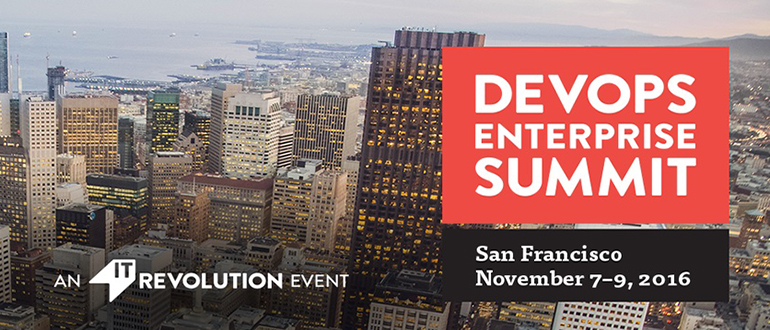
    PORTLAND, Ore., Aug. 29, 2016 – IT Revolution (http://itrevolution.com), the industry leader for advancing DevOps, today announced the conference program for the 2016 DevOps Enterprise Summit (DOES16). The event, which aims to identify and amplify DevOps best practices for technology leaders of large enterprises, will be held in San Francisco from November 7-9 (http://events.itrevolution.com/us/).  For a limited time only, attendees can receive a 20 percent discount when they register to attend with the promo code: VOTEDEVOPS (http://bit.ly/votedevops). The discounted registration period endsSeptember 14, when registration rates will return to full price.

    “We have another fantastic program for attendees at DevOps Enterprise Summit San Francisco,” said Gene Kim, founder of IT Revolution and co-author of “The Phoenix Project” and upcoming “DevOps Handbook.” “Attendees will have the unique opportunity to learn from other technology leaders who are transforming their organizations, as well as some of the best experts in topics that the community has expressed interest in.”

    The next round of speakers added to the DOES16 conference program include:

    • John Allspaw, Chief Technology Officer at Etsy
    • Matthew Barr, Architect at Akamai Technologies
    • Aimee Bechtle, Sr. Manager Card Technology Advanced Engineering at Capital One
    • Ed Blankenship, Product Manager for Visual Studio Team Services at Microsoft
    • Dominca DeGrandis, Director of Training & Coaching at LeanKit
    • Damon Edwards, Co-Founder and Managing Partner at DTO Solutions
    • Kevina Finn-Braun, Director of Product Infrastructure and Service Management at Intuit
    • Jayne Groll, President of ITSM Academy
    • Sam Guckenheimer, Group Product Planner at Microsoft
    • Kaimar Karu, Head of Product Strategy and Development at Axelos
    • Rosalind Radcliffe, Distinguished Engineer and Chief Architect for DevOps for z Systems at IBM
    • J. Paul Reed, Managing Partner at Release Engineering Approaches
    • Brian Timmeny, Sr. Director Card Technology Advanced Engineering at Capital One

    The full program is available online and can be found here:  (http://events.itrevolution.com/us/schedule/).

    IT Revolution and founding partner Electric Cloud have coined the DOES16 conference theme as “Leading Change.” Attendees can expect to gain a clear understanding of the intricacies of large-scale DevOps implementations and best practices for leading IT transformations at scale. In addition, on November 8, there will be a special DOES16 party and cocktail reception centered on the theme of “Vote DevOps” for attendees to network and celebrate.
    Join the #DOES16 Conversation
    DOES16 organizers will be hosting several online events in September featuring many of the presenters and offering insights into the topics and questions at the core of this year’s conference:

    For more information about DOES16, please visit: (http://events.itrevolution.com/us/).
    Share This: DevOps Enterprise Summit 2016 Finalizes #SFO program  http://events.itrevolution.com/us/schedule/ @DOESsummit #DOES16 #DevOps

    About IT Revolution
    IT Revolution (www.itrevolution.com) researches and amplifies the best practices of high-performing technology organizations. Founded by Gene Kim, the company publishes books, hosts events and supports the adoption of DevOps practices in the IT community.

  • Separate but Equal: Not Equal and Not the Right Way

    Separate but Equal: Not Equal and Not the Right Way

    The DevOps Enterprise Summit in London provided another opportunity to speak to many clients about their organizations’ DevOps transformations. The key message is, “It’s all about people and culture,” but how do you make those changes? In session after session it was clear the source code manager (SCM) is central to this transformation. All clients included the SCM as a key part of the solution. SCM’s key value is as a common place to version all the artifacts from the source code to the system configuration. As such, it must provide visibility to all to allow for sharing and collaboration.

    So how can z/OS participate in this transformation if its source code is locked away in some host-based SCM? The answer is, It doesn’t. In my interview with devopsy.kinsta.cloud editor Alan Shimel, we discussed this issue and he related it to the idea of separate but equal, which we all know does not work. What’s worse is separate but equal was really never equal, and the same is true for the host-based SCM to which the z/OS source code is relegated. I have asked many companies if they would move their distributed source to those host-based SCMs, and the answer is always, “Of course not; it does not provide what the distributed teams need.” How can it provide what the host teams need? It doesn’t.

    Separate but equal does not work; it’s never equal and it isolates people. That’s not the way we should be looking at our z/OS source code. It’s critical to the business and should have the best support and capabilities, not the least. Now is the time to move to modern tools and processes and stop isolating the z/OS environment from the rest of the development environment.

    The key is to focus on collaborative management solutions that do not separate, but bring teams together by providing one environment that all teams can use together for cross-platform collaboration. Various solutions include all the capabilities companies need to provide the modern agile development environment including z/OS.  No separation—the z/OS code is in the same repository as all the rest. In these tools, the modern dependency-based build provided for z artifacts is based on Ant technology, so it can be extended just like existing build tools. With this tooling you can use your existing continuous integration pipeline and plug z into it.

    It’s time we move z/OS development into the 21 century.

    Read the thought leadership paper on DevOps for Enterprise System POV to know more on the essential tools and process that can enable disruptive technologies and an innovation at the speed the business requires.

    About the Author / Rosalind Radcliffe

    Rosalind
    Rosalind is a Distinguished Engineer within the IBM Rational organization. She is Chief Architect for CLM and DevOps. She is responsible for driving the DevOps for multi-platform architecture. This includes System z and Power system. In addition, she is responsible for the architecture for the Collaborative Management capability for Enterprise solutions. This includes UrbanCode Deploy and Rational Team Concert’s support for standard Mainframe development activities. She is a member of the IBM Academy of Technology and a Master Inventor. Prior to Rational, she was in Tivoli responsible for the SOA Management Strategy for IBM. Connect with Rosalind on LinkedIn / Twitter.

  • What to Expect: DevOps Enterprise Summit London

    What to Expect: DevOps Enterprise Summit London

    After the success of the first two years of the U.S. DevOps Enterprise Summit, people have been asking us to host a similar conference in other locations, specifically in Europe. This summer, we’re hosting our first DevOps Enterprise Summit in London!

    This conference is for technology leaders who are driving transformations in large, complex organizations. These are successful enterprises that have been around for decades (and, in some cases, for centuries!), with thousands (or tens of thousands) of employees, and billions of dollars in annual revenue. These are organizations with massive and complex daily operations, and all the resulting processes and bureaucracies that come with it. In many ways, these complex operations and bureaucracies are the very things that create the worst-case conditions for DevOps transformations!

    We’ve heard amazing case studies from Barclays Capital, GE Capital, Disney, Marks & Spencer, Bank of America, Capital One, Telstra and many more, where leaders have created amazing DevOps outcomes that are more typically associated with organizations such as Google, Amazon, Facebook and so forth.

    For this inaugural year of DevOps Enterprise Summit London, we’ll be bringing some of our “greatest hits” from the United States, but the rest of the programming will feature DevOps transformations in organizations residing in the U.K. and continental Europe. (And we’re still holding the DevOps Enterprise Summit in San Francisco, so feel free to join us there as well!)

    New World and Old World DevOps

    The speakers at DevOps Enterprise are pioneering the practices of how large, complex organizations transform and deliver software. It’s my belief that these principles are universal, regardless of what continent or country the organization resides in.

    One of the biggest surprises from co-authoring “The Phoenix Project” has been how many people have told me that the book describes their organization, seemingly independent of company size, industry vertical, for-profit or nonprofit or the continent they’re writing from. This validates that the problems that result when Dev and Ops can’t get along are universal.

    The good news is that the DevOps solutions we deploy to fix the problems also have lots of commonalities!

    It’s always inspiring to hear how these leaders have overcome the challenges they faced. I see our speakers as genuine heroes who have put themselves in personal jeopardy, often risking their careers and livelihoods, to achieve something they believe is genuinely important. They  possessed the clarity and conviction that the capabilities they were creating for their organizations were needed to win in the marketplace—or maybe even just to survive.

    I think one of the interesting statistics is that more than 25 percent of DevOps Enterprise speakers have been promoted in the last two years—some more than once! It’s a fantastic testament that the organization values the contributions they have made, and their risk-taking and heroism paid off.

    The DevOps Movement Matures

    Every year at the DevOps Enterprise Summit, I have asked all speakers to share what problems they didn’t know how to fix or the problems that they were looking for help on. What I’ve found is that the answers have evolved. From year to year, we are seeing trends on the obstacles facing the DevOps Enterprise community.

    In 2014, attendees’ stated problems were about needing better strategies and tactics for creating automated tests for legacy applications, as well as the culture and leadership aspects during transformation, information security and compliance practices and identifying metrics to best improve performance with DevOps initiatives.

    In 2015, the problems were focused on people and organizational design. Examples included the need for effective strategies and methods for leading change in large organizations. Speakers and attendees also wanted to know what the organization charts looked like for organizations successfully adopting DevOps. What were the respective roles and responsibilities, and how had they changed from more traditional IT organizations?

    Now, as we approach DevOps Enterprise Summit 2016, we are seeking to address the next phase of challenges facing the community: What are the modern architectural and technical practices that every technology leader needs to know about? What are the technology practices for managing infrastructure, environments and automated testing? And what are the transition patterns to get there?

    From the HR perspective, how do you go about reskilling the workforce and employing these new design patterns? Lastly, we are seeing compliance and security discussed more often, including: What are concrete ways for DevOps to bridge the information security and compliance gap to show auditors and regulators that effective controls exist to prevent, detect and correct problems?

    The programming committee always invites a handful of speakers to return from year to year. While to some this might appear redundant, it’s actually quite fascinating to witness their journeys unfold. It’s like an episode of, “Where Are They Now,” and the speakers never cease to amaze!

    Solving Problems Together

    As a vendor-neutral conference, DevOps Enterprise Summit curates stories that are from the enterprise point-of-view. Most of the presentations follow a very specific “experience report” structure—speakers describe their organization and their industry, the business problem they faced, where they started their transformation, what they did and the business outcomes. It’s a simple format but very powerful because it helps other people facing the same problems learn how other people solved the problem, and it often reveals practices that can be used in other contexts.

    I’m so excited to share some of the initial speakers we have slated for DOES London:

    • Chris Jackson, Director of Cloud Product Engineering at Pearson
    • Robin Hughes, Head of Development Services at LV=
    • Justin Dean, SVP, Platform and Technical Operations at Ticketmaster
    • Jeremy Waite, Chief Digital Strategist at Salesforce
    • Gareth Rushgrove, Senior Software Engineer at Puppet Labs, Inc; ex-UK GDS
    • Antony Collard, Deputy Director at HMRC
    • Finbarr Joy, Group CTO at Lebara
    • Amy Philipps, Head of Test at Songkick
    • Jason Cox, Director, Systems Engineering at The Walt Disney Company
    • Rosalind Radcliffe, Distinguished Engineer, Chief Architect for DevOps for Enterprise System at IBM

    What also amazes me about DevOps Enterprise is the concentration of talent in the technology leaders who attend—they’re all people who are passionate about technology and helping teams win, and willing to do disruptive things to get there.

    Ross Clanton from Target (a large U.S. retailer) told me he valued being surrounded by people who were not only trying to solve the same problems that he was facing, but were the best in the game—and there’s a huge intrinsic value of being surrounded by those kind of people. I can definitely relate; I learn something in every one of my interactions at the conference, and I have no doubt that the practices this group is pioneering will be commonplace within a generation.

    Like in any aspect of life, peers are important. As Buzz Aldrin said, “Show me your friends, and I will show you your future.”

    DOES is a unique opportunity to meet some very talented and inspirational new friends who can help shape your career path. We hope you’ll join us in London.

    DevOps Enterprise Summit London

    June 30 & July 1, 2016

    Hilton London Metropole

    225 Edgware Road, London, UK

    @DOESsummitEU

    Early Bird £600 +VAT (ends May 2)


    DevOps Enterprise Summit San Francisco

    November 7–9, 2016

    Hilton San Francisco Union Square

    333 O’Farrell Street, San Francisco, CA

    @DOESsummit

    Early Bird $1,450 (ends May 16)
    Check out videos from previous DevOps Enterprise Summits on YouTube.

  • Submit your proposal for DevOps Enterprise Summit San Francisco!

    Submit your proposal for DevOps Enterprise Summit San Francisco!

    The theme for this year’s #DOES16 San Francisco conference is Leading Change.

    We want to hear stories from the leaders of large, complex organizations implementing DevOps principles and practices.

    The submission deadline is midnight PDT, May 2, 2016.

    All submissions will be notified by June 17, 2016.

    Get details >>>

    DevOps Enterprise Summit keynote

    DevOps Enterprise Summit


    DevOps Enterprise Summit

    DevOps Enterprise Summit


    This year’s programming will be based on a series of survey questions about the biggest issues IT professionals continue to work with. Several universal topics emerged, and we will be selecting talks that address them:

    People and Culture:  We’re interested in the strategies and methods you employed to successfully lead change and to enable DevOps outcomes in large organizations. How did your approach to leadership and organizational design differ from those used in more traditional IT organizations? How is the workforce different, both for employees as well as contractors and outsourcers? And what have been your results?

    Process and Technology: We are interested in the practices you have adopted to integrate change into your workforce and build on changing relationships with your vendors. What are modern architectural and technical practices that every technology leader needs to know about?

    Compliance and Security: We’re interested in concrete ways you have helped DevOps bridge the information security and compliance gap, showing auditors and regulators that effective controls exist to prevent, detect, and correct problems.
    Submit your proposal >>>

    For the full news release, click here.

    EARLY BIRD TICKETS ON SALE NOW!

    If you missed the Blind Bird tickets, don’t fret.

    We are offering a discounted Early Bird rate for  $1,450 (ends May 16). That’s a savings of more than 25% off the full-price ticket.

    We encourage you to act quickly as the past two years have sold out.

    Get tickets >>>