Anders Wallgren | Chief Technology Officer, Electric Cloud
Attend Anders’ talk at DOES15: Continuous Delivery of Microservices: Patterns and Processes, and a panel discussion with Gary Grver, Jez Humble and others on DevOps and Continuous Delivery for Embedded and IoT.
We discussed how some of the largest enterprises in the world are addressing the biggest challenges facing the DevOps community: from fostering a DevOps culture and leading the transformation, automated testing of legacy applications, security and auditing requirements, managing burnout, fostering an internal consulting capability, and more. Take a look at some highlight tweets and then watch the full recording below.
The importance of avoiding burnout during a DevOps transformation:
The ones who have automated everything leave on time. The ones that don’t sit at their desks through the weekends. #DOES15 — DOES Summit (@DOESsummit) September 11, 2015
Caution over extending your key #DevOps heros. Being sent to solve every problem vs. be productive can lead to burnout #DOES15
Security is coming to the front of attention because software is now an integral part of everyone’s lives & people take notice. #DOES15 — DOES Summit (@DOESsummit) September 11, 2015
Lots of organizations *think* they’re secure. Once you start really talking about security, the actual amount of risk become clear. #DOES15
It was such a pleasure to discuss these topics with the best minds guiding DevOps transformations in large, complex organizations. Watch the full recording and hope you join me at DevOps Enterprise Summit 2015 to discuss more!
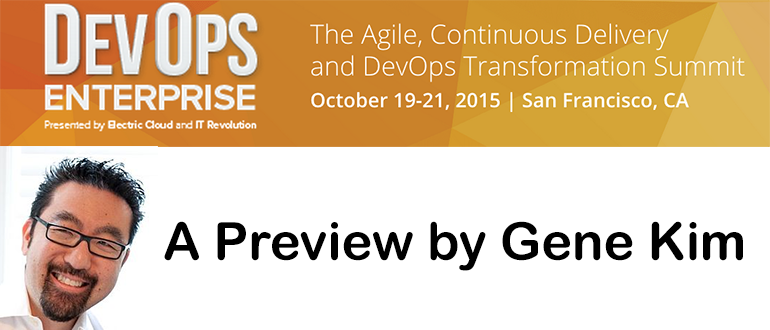
The Agile, Continuous Delivery and DevOps Transformation Summit
October 19–21, 2015
Hyatt Regency, San Francisco, CA
Last Friday, I was delighted to spend an entire hour with seven leaders of DevOps transformations, discussing the practices and patterns they see for leading a DevOps transformation in large, complex organizations. It was an honor to have them share their lessons learned and tips for how large organizations address some of the challenges of DevOps: from automated testing for legacy environments, getting leadership buy-in and fostering a DevOps culture, DevOps roles and responsibilities, and security and compliance.
Each of these experts also shared what they will be presenting on at this year’s DevOps Enterprise Summit, taking place October 19–21 in San Francisco.
Chivas Nambiar | Director – Systems Engineering, Verizon
Cornelia Davis | Director of platform engineering, Cloud Foundry team at Pivotal
After quick introductions, I summarized the top five problems facing the DevOps community today – which also form the key focus areas for this year’s DevOps Enterprise Summit. At last year’s Summit, I asked that every speaker end their presentation with a slide addressing one of the two following titles: “Here’s what I don’t know how to do” or “Here’s what I’m looking for help with.” We wanted a glimpse into what the top challenges were that the entire community was facing, which we could then use as a research roadmap.
Each speaker shared how their organizations are addressing these challenges, and gave a taste of what to expect from their talk at DevOps Enterprise Summit.
How to address culture and leadership issues, particularly around transitioning and transformation
Cornelia Davis suggested starting small, perhaps with sending some select members to work on pair programming, then have them return to bring the skills back in-house. “It’s one of the best ways of learning new programming. It’s more of a grassroots process,” elaborated Davis.
Heather Mickman agreed, adding, “We started doing our own internal DevOps Days where we could start building momentum and showing results quickly. To accelerate adoption, we’ve created an internal DevOps dojo to help coach teams on tools and processes.”
Chivas Nambiar suggested, “Find the leader who shares a common belief, who is close to the work and is aware of these types of technology trends. The second piece of it is you can’t do this [transformation] overnight. We’re entering our fourth year of transformation. Find your key partners, give them what they need to be successful, then share their successes.”
When I asked, “How do I get my boss’s boss to care about DevOps?” Ralph Loura listed ways to counteract “corporate antibodies” who doubt and resist change: “The top things you need are trust, trust and trust,” he said. “To create this trust, we provide transparency through collaborative tools and pairing people together; we create and embed evangelists to help the next wave of teams succeed and spread knowledge, and help when something goes wrong; and we need data and evidence of success.
The group discussed the balance of grassroots efforts with getting leadership buy-in, and everyone discussed the value of teams needing to create small successes in order win doubters over. Loura brought up the metaphor of the campfire: “If you start a campfire and you put too much fuel too soon, it can smother the fire. It’s important to keep it shielded at first, until the fire has enough heat to it.”
How to deal with automated testing issues, specifically for legacy environments
The conversation moved on to experiences we’ve all had with software products or services where we gave development, testing, operations, etc. to a different sourcing partner, thinking we would get better outcomes that way. Heather Mickman shared what the transition was like to go from that model to their current one, “The way we used to do software development in Target was handing off each function to different teams and centers of excellence. There were handoffs to 10–15 different teams. There was no end-to-end accountability for these once-per-quarter releases. So, as we started building out the team that creates APIs for Target, we decided we wanted end-to-end accountability, so we broke down those silos so everyone cares about the end product.” This was just one example of emergent patterns that are coming out of these complex organizations.
How to address IT security and compliance issues – to get your Security team on board with your DevOps plans
All these presenters are from large organizations who are publicly traded, and have numerous regulatory measures that they must comply with. I wanted to know more about how they work with security and compliance.
Neil Manvar suggested that DevOps practitioners be completely transparent. He says, “Show the security teams the value, so they can get on board and that you’re not just trying to give them a hard time. Give them access to the change log and very nicely format it or link to the commit. Giving more information about what’s going on really helps with getting everyone on board. Any concerns that are raised, kind of create some automation around it and integrate that into the pipeline.”
What metrics should organizations be using to track their DevOps implementation and performance.
Organizational design, roles and responsibilities
Holy cow, we didn’t even get around to discussing this last two problem areas. We will be revisiting this and the other problem areas with another group of DevOps experts in another live chat.
When I asked for any concluding remarks with our last two minutes, Tom Limoncelli responded, “Everyone I know who’s been through this kind of transformation has said the same thing. That when you were done, when you looked back, they said ‘I never want to go back to the other way and in fact in future job hunting, the first questions will be do you have this environment?’ Having a DevOps environment can be one of your biggest recruiting tools.”
Join the next live chat:
How do Large Enterprises do DevOps?: Video chat with Gene Kim & the #DOES15 speakers
Friday, September 11
10:00 a.m. PDT
Watch the replay of the video chat:
To hear more from these great speakers and other DevOps luminaries, I invite you to join us at DevOps Enterprise Summit next month.
I am unbelievably excited about DevOps Enterprise Summit 2015. As amazing as last year’s event was, it will be even better this year. I wanted to share with you what you can expect this year at the conference and give you a behind-the-scenes look inside the programming committee goals and how they informed the overall conference organization.
The Programming Committee
The programming committee comprises some of my favorite people in the world, and all have made incredible contributions to our field: Adrian Cockcroft (Battery Ventures), Dominica DeGrandis (LeanKit), Cornelia Davis (Pivotal), Damon Edwards (DTO Solutions), Anders Wallgren (Electric Cloud), John Willis (Docker), and advising member Jez Humble (Chef).
As Damon Edwards once quipped, “Over our careers, we’ve all become professional conference attendees, so we have strong opinions on what makes for a great conference.”
The Format of the Conference
The quality of the speakers is a major contributing factor to the success of a conference — after all, why bother spending three days somewhere if there are no remarkable people there in the first place?
The DevOps Enterprise Summit is a three-day conference, featuring 14 keynote sessions and about 36 other sessions in concurrent tracks.
Last year, all talks were 30 minutes, which we thought worked very well. Even though this can be challenging for speakers to put everything into a half-hour, what TED Talks have shown us is that even the most complex ideas can be conveyed in a short amount of time.
As an attendee, I personally love the shorter talks because it allows me to experience many ideas and concepts within a short amount of time.
As a conference organizer, it’s also fantastic, because it allows us to put more speakers on the schedule. This is super important, because there are so many worthy talks that we want to showcase. This year, we had over 220 submissions. I can’t express the amazing quality of the submissions, and we would have accepted more if it were possible.
More Experience Reports
We want to hear the firsthand accounts of DevOps transformation in large, complex organizations, at all stages of the journey, so we structure the conference around experience reports delivered in a very specific form. We ask the experts to tell us about their
organization,
specific business process or application that they were focused on,
problems they experienced, ideally with metrics around deployment lead time,
followed by
what they did about it,
and the business value that was created.
In addition to a whole new batch of experience reports, we’ll be hearing from numerous DOES14 alumni, complete with updates on what has transpired on their journeys over the past year, including Heather Mickman and Ross Clanton from Target, Jason Cox from Disney, Carmen DeArdo from Nationwide, Courtney Kissler from Nordstrom, Tapabrata Pal from Capital One, Terri Potts and Michael W. Smith from Raytheon Software, and Scott Prugh from CSG.
I’m also excited that Ralph Loura and Olivier Jacques from HP will be presenting. As the CIO of HP, Loura serves the needs of over 300,000 employees (and that’s even after the October scheduled split of the company), making them the largest organization to share their story at this conference.
Based on my conversations with these folks, I’m super excited about what they’re going to be sharing, which includes how they’ve accelerated and expanded their DevOps initiatives, new engagement models with the rest of the organizations, the role of leadership, and more.
This year, we will have 35 speakers presenting experience reports, down from last year’s 50. Why? To make room for expert talks.
Amazing Expert Talks in the Top Five Problem Areas
I asked that every speaker at DevOps Enterprise 2014 end with a slide addressing one of the two following titles: “Here’s what I don’t know how to do” or “Here’s what I’m looking for help with.” We wanted a glimpse into what the top problems were that the entire community was facing, which we could then use as a research roadmap.
The top issues stated in 2014 were:
Better strategies and tactics for creating automated tests for legacy applications
Addressing culture and leadership aspects during transforming
Top approaches to organizational design, roles, and responsibilities
Information security and compliance practices
Identifying metrics to best improve performance with DevOps initiatives
This year, we reserved 15 talks specifically to address those areas. On the programming committee, we put our heads together, reached out to many in the DevOps community, and invited the most renowned experts in each area.
I’m extremely excited that some of these expert talks will include the following, where they will share their lessons learned:
Steven Spear from MIT, is one of my personal heroes, credited for “Decoding the DNA Of The Toyota Production System,”[https://hbr.org/1999/09/decoding-the-dna-of-the-toyota-production-system] with H. Kent Bowen. He also helped create the amazing Alcoa management system with their CEO Paul O’Neill.
Elisabeth Hendrickson helped pioneer quality engineering practices for the last twenty years, and is someone who Jez Humble and I have admired for years. She presented last year on “Care and Feeding of Feedback Loops,” has since been promoted to VP of Engineering for Pivotal’s Big Data Suite, and will discuss her journey around creating great engineering organizations with a culture of quality.
Josh Corman is a longtime researcher in information security and John Willis is equally renowned in the DevOps community. They will be presenting their work on software supply chains, immutable infrastructure, and how they both impact DevOps productivity and security.
Ed Bellis was former CISO of Orbitz, and will share his experiences on how information security should ideally integrate into the DevOps value stream and how it impacts compliance and reporting.
Rosalind Radcliffe has made significant contributions to our profession over her entire career as a Distinguished Engineer at IBM, and she’ll be sharing amazing strategies and tactics of how organizations can improve the state of automated testing on mainframes. John Willis says, “From green screens to GUI’s, Tivoli to SOA, then showing up on the DOES 2014 stage presenting on mainframes and Devops at IBM. Unlike most people she is one of those rare individuals that has transcended four decades and always seems to be on the bleeding edge.”
We will have two talks on how automated testing and other DevOps practices were put into practice at famous Yahoo! properties. Neil Manvar, solutions architect at Sauce Labs and former software engineer at Yahoo!, and Chris Riley, founder and DevOps analyst at Fixate.IO will talk about how Yahoo! implemented automated testing for Yahoo! Mail. Automated testing enabled the software quality team to spend more time on important user-facing product code and helped them introduce exciting new strategies for building higher quality apps faster. Jim Stoneham will present on his experiences as the general manager of Yahoo! Communities division in 2009, including his first-hand observations of the Flickr “10 deploys per day” culture, and how many of those practices were replicated in Yahoo! Answers to increase their deployment cadence from once every six weeks to daily deploys.
Representation of Women
One of the other important programming objectives of the conference was to have the composition of speakers match the technology community population as a whole, especially around representation of women and minorities.
Last year, we were pleased that 41% of speakers were women. The complete roster of speakers is still being finalized, but we’re hoping to match or exceed that number this year.
We received much positive feedback about the representation of women at last year’s conference.
See the Speakers in Action
In short, I have never learned as much as I did in any three days than at DevOps Enterprise Summit 2014. They were some of the most courageous and exciting transformation stories I had ever seen, and this year’s conference is going to be even better. I hope you’ll agree that we have an amazing conference in store for you at DevOps Enterprise Summit 2015! I look forward to seeing you there!
To see some of the speakers in action and learn about what you’ll experience at DevOps Enterprise Summit 2015, go here: