From big data to storage to security, the DevOps concept is being applied to every field of IT operations under the sun today. This “Everything Ops” movement reflects the popularity of DevOps—but is it also diluting DevOps’s significance?
DevOps itself focuses on software delivery. It’s about designing, building, testing, deploying and managing software applications.
If you follow the DevOps conversation, however, you know that DevOps principles are now being extended to lots of niches that don’t have much or anything to do with software delivery chains. Consider these examples:
DataOps: DevOps principles for data analysts.
ChatOps: The idea that chat tools should be integrated into workflows.
SecOps (or rugged DevOps, or DevSecOps, or whatever else you want to call it): DevOps practices for security teams.
Storage Ops: The insertion of DevOps practices into storage.
The list could go on. Taken together, these many flavors of DevOps reflect what I like to a call an “Everything Ops” tendency. Fans of DevOps want DevOps to take over the entire world of IT.
Benefits and Drawbacks of ‘Everything Ops’
If you believe that DevOps represents a better way to deliver software, then the Everything Ops movement is a positive thing. It’s a way to help people who work in areas of IT other than software delivery to innovate as well by taking cues from their DevOps colleagues.
But there is also a danger that Everything Ops can be applied too broadly. You can’t fit every single thing in the IT universe into the DevOps mold. For example, CloudOps (the DevOps-related way of managing cloud infrastructure, not the company of the same name) just doesn’t make a lot of sense. It’s basically just a reiteration of the ideas that are already at the core of cloud computing: Scalability, agility and location-agnosticism.
Concepts like ChatOps can also be problematic because they refer to a specific way of using a particular type of technology, whereas DevOps is about cultural practices. ChatOps is a fundamentally different sort of thing from DevOps.
Conclusion
In short, by overextending the DevOps conceptual framework, you run the risk of diluting the importance of DevOps itself—and of losing your focus on software delivery, which is the area that DevOps benefits most.
This is not to say that we shouldn’t extend DevOps to other fields. We certainly should. But we should be careful when doing so. Don’t try to make DevOps eat the entire IT world, because that just doesn’t make sense.
One again this year, devopsy.kinsta.cloud, Sonatype and RSA Conference are teaming up to bring a Security/DevOps day of learning and networking to RSA Conference 2017 in San Francisco on February 13, 2017. The event is DevSecOps @ RSA Conference 2017. Building on the previous two years of great events, this yearsevent promises to be even better. Some of the confirmed speakers are below and you can see for yourself what an amazing array of sessions there are. The best part is attending all of the RSA DevSecOps events are free.
DevSecOps Sessions
The line up for DevSecOps includes DevOps and DevSecOps pioneers, John Willis, Damon Edwards, Jez Humble, Dr. Nicole Forsgren, J. Paul Reed, Josh Corman, Shannon Lietz and more. Check out the site page for full details on speakers and topics.
Attending the full day event (10am to 4pm) is free, but you need to register with RSA Conference. If you are already attending RSA, you need to modify your registration to indicate you are attending DevSecOps (or Rugged DevOps). If you are not already registered you can do so and receive a free expo pass to RSA Conference, which will allow you to register and attend the DevSecOps conference. You can use the code: 1U7DEVOPSXP and register here.
DevOps Wine-ing (No Whining) Party
In addition to the full day of amazing speakers, we will host the annual DevOps Wine-ing (no whining) cocktail party, immediately following the sessions. You need to be registered separately for the Wine-ing event. There is a link to the eventbrite registration here.
The wine-ing event is from 4:30 to 6:30 and should once again be a great time for the security and DevOps tribes to intermingle. A tip of the hat to Josh Corman who is speaking at DevSecOps for starting the DevOps Wine-ing party 4 years ago.
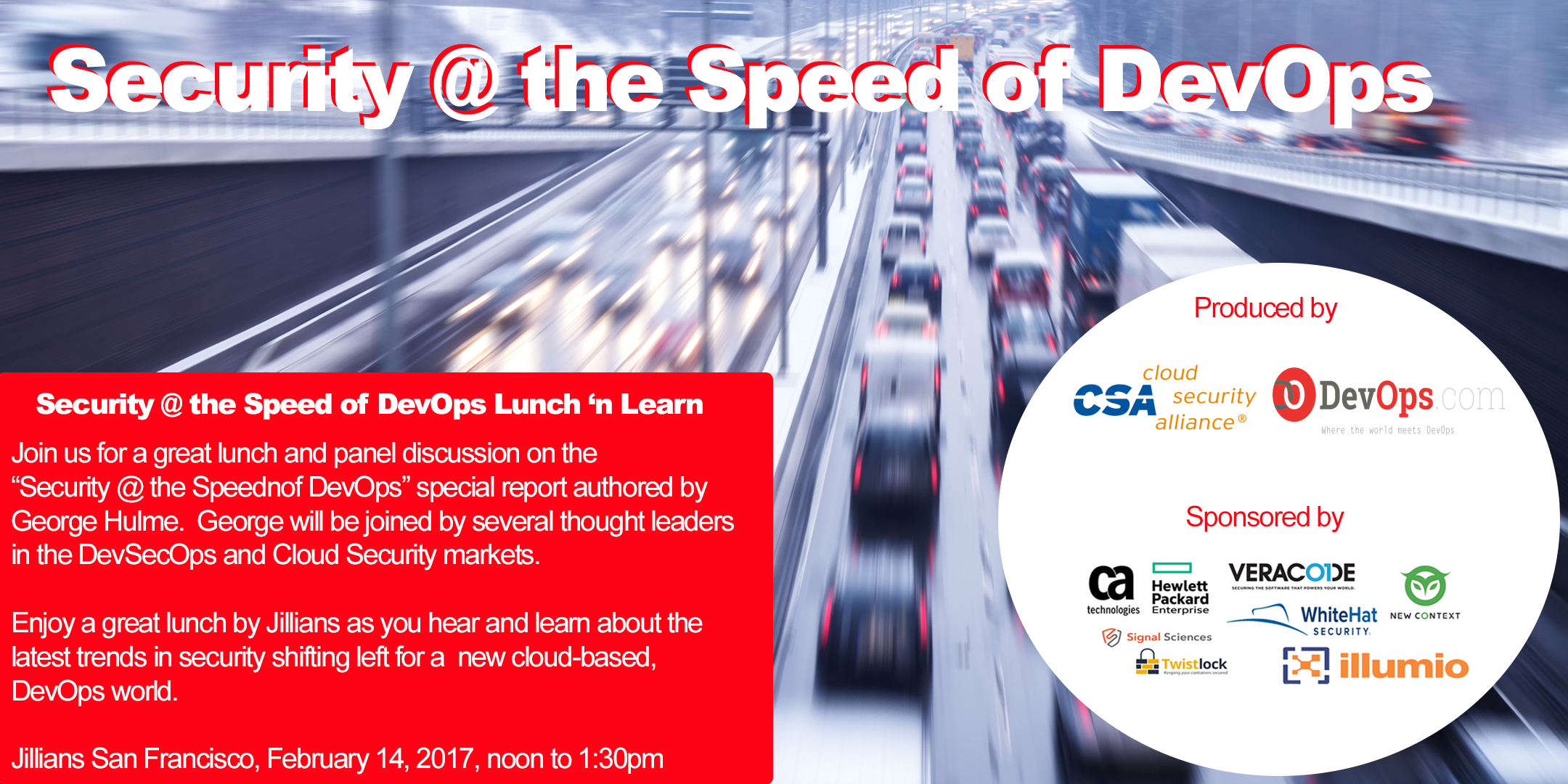
Security @ the Speed of DevOps Lunch ‘n Learn
On the following day, Tuesday we will host a lunch-n-learn on the “Security at the Speed of DevOps” report we are co-producing with the Cloud Security Alliance. We will have a panel including George and some leading DevSecOps and Cloud Security experts discussing the findings over lunch at Jillians. Again this event is free but you need to register for it here.
The report is being written by George Hulme and is based on a survey co-produced and distributed by devopsy.kinsta.cloud and the Cloud Security Alliance. You can participate in the survey (we need your help here, so please do) by taking a few minutes at https://www.surveymonkey.com/r/RSACSADEVOPS. Feel free to tell your friends about it as well.
We will be distributing copies of the report at RSA Conference, as well as digitally via devopsy.kinsta.cloud. We will also be distributing several other surprise giveaways at the event as well.
Yes, this years RSA Conference will feature lots of DevSecOps and you can partake in all of it for free. Of course this wouldn’t be possible without the help of a great bunch of sponsors who have stepped up this year to support the events. In addition to RSA Conference, Sonatype and devopsy.kinsta.cloud, sponsors for the event are:
Gold Sponsors
CA Technologies, HPE, White Hat Security, Veracode, Cloud Passage, New Context and Illumio
The last most of us heard from Lance Crosby we thought he was riding off to an island sunset, to bask in the glow of a very successful exit from SoftLayer. The company he founded was bought by IBM for a few billion dollars to serve as the centerpiece of their cloud strategy. Many would have been content with that as their career. But Crosby isn’t done yet. His new vision is StackPath, whose mission is to bring scale, speed and security to developers.
I had a chance to catch up with Lance recently and talk about StackPath. The company just emerged from stealth in July but already has over 100 employees and over thirty thousand customers. This is due to acquiring three companies pre-launch, “MaxCDN, a leading NextGen CDN company, Fireblade, an Israel-based company with patented cloud based WAF technology, and Cloak, a leading VPN technology company.” On top of this StackPath has developed some patented new DDOS mitigation technology. Of course DDOS attacks are all the rage now with everyone’s camera, refrigerator and any other connected device in on the action.
From a DevOps point of view what I find interesting is that Crosby and StackPath have clearly targeted the developer, rather than the security admin or the Ops team with this offering. Even in the title of their press release announcing the StackPath platform and CDN they target developers, “StackPath Announces General Availability of Its Global Security Platform for Developers.”
This is an interesting approach and one I spoke to Lance about. In Lance’s view there is a gap between those who build and design applications and those who operate and secure them. Empowering developers with a friction-less security solution is what StackPath’s mission is. It is the developers who need to be thinking about security and more importantly making it part of the equation. This idea is one that many in security have espoused, but usually because they feel developers have larger budgets than the security team. But I don’t think that is the case here. Crosby knows both the security and developer markets from SoftLayer. He is trying to fill a need he saw while still at SoftLayer that he wasn’t able to offer then.
The CDN service they announced wraps up the three technologies they acquired along with their DDOS mitigation. To me it seemed like a Cloudflare kind of offering. Crosby agrees that there are similarities, but the plan is to build out the platform far beyond what it offers now or what Cloudflare offers. Threat analysis and artificial intelligence are part of the future, as well as more.
The company already raised a large first round led by ABRY Partners, a multi-billion dollar private equity fund. Of course Crosby has his own money available as well as no shortage of VC/private equity funds who would like to invest in his next adventure based on the success of SoftLayer.
The security industry has been looking for cloud native, next generation solutions and StackPath could be one of these. At some point though you need to please multiple masters. In this case if you are going to sell developers security, at some point you need to get the security people on board as well. It will be interesting to see how StackPath continues to grow and expand in the market. Certainly a mix of organic solutions with a sprinkling of acquisitions appears to be the recipe Crosby and team are following.
Over the past year, I have traveled to and delivered presentations at 18 DevOps events. I’ve also heard that over the past several years, John Willis has participated in more than 200 DevOps events. But not all of us have the time or budget to get ourselves and our teams out to these events where we can learn from other practitioners.
All Day DevOps will deliver 57 practitioner-led sessions over 15 hours and 15 time zones. No vendor pitches are allowed. To break the travel and budget barrier for you and your teams, we are delivering every session live, online and free of charge. Every session will also be recorded. We are doing this because we want to share global DevOps expertise with everyone.
DevOps Brains
More than 3,500 people have now registered for the conference. We have an awesome speaker lineup covering three tracks: Modern Infrastructure, CI/CD and Automated Security. Here is a sample of some of the great sessions being delivered:
CI/CD
Meta Infrastructure as Code: How Capital One Automates our Automation Tools with an Immutable Jenkins, by George Parris (Master Software Engineer at Capital One)
Speaking for the Dead: Critical Positive Lessons from Waterfall and Monolithic Architectures, by Michael DeHann (Former CTO & Founder of Ansible)
I, For One, Welcome Our New Robot Overlords, by Mykel Alvis (DevOps Computational Demonologist at Cotiviti)
AUTOMATED SECURITY
Stop Changing Your Password, by Chris Swan (CTO Global Infrastructure at CSC)
System Hardening using Ansible: Application Deployment + Configuration Management + Continuous Delivery, by Akash Mahajan (Lead at OWASP Bangalore)
Building Codes for Building Code, by Josh Corman (Director of Cyber Statecraft at Atlantic Council)
MODERN INFRASTRUCTURE
Terraforming Your Infrastructure: From Beginner to Semi-Pro in 30 Minutes, Britt Treece (Production Engineer at PhishMe)
DevOps Friendly Doc Publishing for APIs & Microservices, by Mandy Whaley (Director of Developer Experience at Cisco)
Monitoring, Hold the Infrastructure – Getting the Most out of Lambda, Michael (DevOps Evangelist at DataDog)
Don’t Just Listen, Talk DevOps
One of the big pieces of input we have received from the community is that everyone wants an opportunity to interact. This is why we are building a dedicated team room in Slack for you. Every attendee will have the chance to interact with the speakers in the Slack room. Q&A will be live, online and freely accessible. We will also have Birds-of-a-Feather channels set up for those with questions to be helped by those with answers.
If you would like to join us, can you register for free. A big thanks goes out to Alan and his team at devopsy.kinsta.cloud for helping us spread word of the event here. We are really excited to have teams from North America, Europe, Asia, and Australia joining us for the event!
We’ve all been there … A new application or feature needs to be deployed yesterday and the last thing anyone wants to do is address security requirements. On the flip side, the very last thing anyone wants to address later is a security breach or a cost associated with non-compliance. Not only is it a massive headache but also it’s extremely expensive. According to the IBM X-Force Threat Intelligence Report 2016, the average cost of a data breach in 2015 was $154.20 per record ($363 per healthcare record) with the average total cost of a breach estimated at $3.79 million.
Not only is a breach expensive in terms of cost that can be easily quantified, but there are also costs that are harder to quantify such as the impact to branch image and customer loyalty. According to a new FireEye research report, 76 percent of respondents would likely take their business elsewhere due to negligent data-handling practices. In an incredibly competitive technology space, none of us can risk turning a blind eye to security if we want to attract customers with cool new features and then keep those customers with trust and reliability.
Security seems to be one of those topics that you either love or hate. I’m personally interested in it; however, I realize it’s not an interest shared by all. In the land of unicorns, we want all developers (infrastructure and application) to have more ownership in security, but tight schedules combined with the lack of expertise and reliable controls often can make that strategy unreliable. To make matters worse, a secure system and application isn’t something that is always glaringly visible to an end user or product owner. As a result, security may easily get deprioritized as something that “can be fixed later.” The “fix it later” strategy can be a dangerous decision, as many cybercriminals now are actively taking advantage of those that deploy quickly without adequate controls. How do you balance the customer’s desire to have new features delivered quickly with the fact that they need secure systems protecting their data against malicious threats?
Several common DevOps practices inherently lend themselves to providing a development and delivery pipeline that can improve your overall security posture. DevOps combined with SecOps includes practices that shift operational and management aspects of a system to the left to ensure we are able to reliably delivery and manage secure systems.
5 Security Practices Worth Considering
Below is a list of the top five DevOps practices and tooling that can help improve overall security when incorporated directly into your end-to-end continuous integration/continuous delivery (CI/CD) pipeline:
Collaboration
Security test automation
Configuration and patch management
Continuous monitoring
Identity management
If you iteratively build in security practices as you move infrastructure and application code through the deployment pipeline, it greatly increases your security posture as well as decreases the cost of future rework.
Collaboration and Understanding your Security Requirements
Many of us are required to follow a security policy. It may be in the form of a corporate security policy, a customer security policy and/or a set of compliance standards (ex. SOX, HIPAA, etc). Even if you are not mandated to use a specific policy or regulating standard, we all still want to ensure we follow best practices in securing our systems and applications. The key is to identify your sources of information for security expertise, collaborate early and understand your security requirements early so they can be incorporated into the overall solution.
Security Test Automation
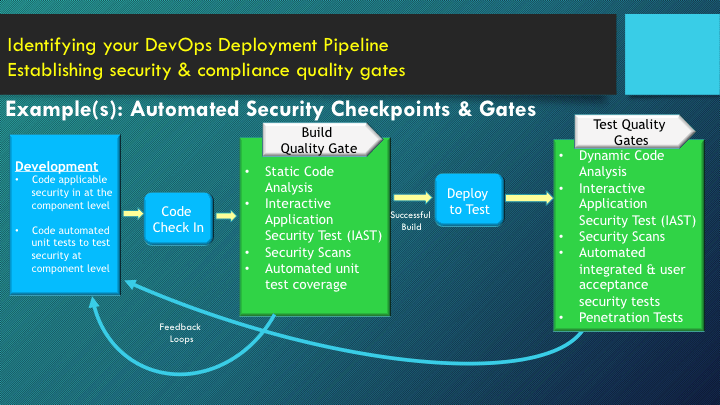
Whether you’re building a brand new solution or upgrading an existing solution, there likely are several security considerations to incorporate. Due to the nature of quick and iterative agile development, tackling all security at once in a “big bang” approach likely will result in project delays. To ensure the project keeps moving, a layered approach often can be helpful to ensure you are continuously building additional security layers into your pipeline as you progress from development to a live product. An example of building gates in as you progress through your pipeline is shown below. Security test automation can ensure you have quality gates throughout your deployment pipeline giving immediate feedback to stakeholders on security posture and allowing for quick remediation early in the pipeline.
Configuration Management
In traditional development, servers/instances are provisioned and developers are able to work on the systems. Sometimes there is a “golden image” developers use to provision that can ensure that the provisioned servers/instances have a hardened operating system. However, as soon as any additional development and configuration activities happen on those servers, that server is no longer golden. To ensure servers are provisioned and managed using consistent, repeatable and reliable patterns, it’s critical to ensure you have a strategy for configuration management. Your strategy may include Chef for one situation, Salt for another situation, immutable infrastructure, or a combination of practices. The key is ensuring you can reliably ensure and manage consistent settings across your environments.
Patch Management
Similar to the concerns with configuration management, you need to ensure you have a method to quickly and reliably patch your systems. Missing patches is a common cause of exploited vulnerabilities including malware attacks. Being able to quickly delivery a patch across a large number of systems can drastically reduce your overall security exposures.
Continuous Monitoring
Ensuring you have monitoring in place across all environments with transparent feedback can alert you quickly of potential breaches or security issues. It’s important to identify your monitoring needs across the infrastructure and application, and then take advantage of some of the tooling that exists to quickly identify, isolate, shut down and remediate potential issues before they happen or before they become exploited. Part of your monitoring strategy also should include the ability to automatically collect and analyze logs. The analysis of running logs can help identify exposures quickly. The collection and analysis of security logs can identify issues that require remediation as well as provide automatic collection of compliance evidence. Compliance activities can become extremely expensive if they are not automated early.
Identity Management
DevOps practices help allow us to collaborate early with security experts, increase the level of security tests and automation to enforce quality gates for security and provide better mechanisms for ongoing security management and compliance activities. While painful to some, it has to be important to all if we don’t want to make the headlines.
We are all busy keeping up on everything that is emerging in technology and it’s difficult to keep up on all of the latest issues, so relying on reputable tools and reliable sources of information can be extremely beneficial. Some of my favorite resources in this area are The OWASP and SC Magazine. IBM X-Force is another great reliable resource to check out for the latest threat research and services. There are also a slew of tools out there to help with different areas of security in each of the practices covered in this blog. I’d love to hear about some of your favorites at @Shelbee_SE.
About the Author / Shelbee Smith-Eigenbrode
Shelbee Smith-Eigenbrode is a senior software engineer/IT architect at IBM and has been in IT for 19 years. She has worked across varying roles spanning the software development life cycle. Her experience across functional roles as well as performing that work deeply inside traditional silos has contributed to her passion for embracing the DevOps culture and transforming the way teams are delivering technologies by adopting DevOps practices. She is a member of the IBM Academy of Technology committed to driving innovation and technical advancement.
News Reports vArmour CEO Eades Nabbed $41 Million Ahead of Trump Presidency
In May, Gartner named 2016 Cool Vendors in several security categories. Given the focus of this column, I was interested in several of the companies chosen for the designation, especially those named in the Cool Vendors in Cloud and Emerging Technology Security 2016 report. Interestingly enough, only vArmour, one of the new-era cloud security and visibility providers, was noted for supporting security in DevOps environments.
In the report, analysts Joerg Fritsch and Brian Lowans wrote:
Supporting the vision of a software-defined data center, all of the capabilities of the vArmour platform are exposed and consumable programmatically via APIs, providing support for highly automated and DevSecOps-type development workflows.
The analysts also noted vArmour enables application-aware microsegmentation anywhere, from the data center to the cloud and all hybrid points in between. They also highlighted its capabilities that extend security to virtualized environments and containers—security anytime and all the time. Pretty cool, indeed.
The report provides deep validation for a message vArmour has been pushing since its emergence from stealth—visibility. While many security vendors have interlaced the keyword into their marketing content, this report makes the claim for vArmour all the more true. According to the report:
vArmour’s distributed security platform combines a scalable fabric with advanced security analytics that offer full visibility from a deep packet inspection engine. This deep visibility enables other cool use cases, such as network-based threat detection and the visualization of workload traffic. This is required in environments where the workload, the network and the security policies are interacting much more closely than we have been used to in traditional environments.
Validation from firms such as Gartner can carry heavy weight among buyers, especially among deep-pocketed enterprise influencers. I’ve had conversations with C-level security execs at numerous mega corporations in the past who have stated point-blank that they won’t approve expenditures for any technologies that aren’t noted in recognized industry reports.
vArmour also announced recently the closing of a $41 million round led by Redline Capital and Telstra. This D round lifts the software-defined security provider’s total investment to $83 million.
In the official company release, vArmour stated it will use the capital for “global expansion and to accelerate worldwide software distribution of its Distributed Security System (DSS) through strategic partners in Asia-Pacific, EMEA and in North America.”
Although the Presidential race wasn’t mentioned in the release, it was reported by CNBC’s Ari Levy that the real reason CEO Tim Eades sought funding now was in anticipation of a Donald Trump presidency. Eades was quoted in the CNBC story as having said:
It really does matter what people think of the U.S. as we lead up to the election,” said Eades, a native of the U.K. who moved to the U.S. 18 years ago. With Trump, “the conversation he’s had around Mexico, trading abroad, his position on immigration — everybody outside America looks in and says, `What’s going to happen?’
Levy continued:
With Trump having closed the gap on Clinton in the polls less than six months before the election, Eades said it’s definitely time for start-ups to be padding their cash positions. He isn’t comforted by the fact that Trump is a businessman himself.
To most reading this, vArmour being named a Cool Vendor and handily raising $41 million likely isn’t coming as a surprise. Starting with Eades, the company has an impressive cybersecurity and business leadership pedigree, especially when it comes to startups that are shaking up security thought and practices around the data center, cloud and DevOps movement. Eades is even viewed as a thought leader—likely one of the reasons why he is an occasional guest on global news shows such as Fox and Bloomberg, where he has been called to provide expert analysis on everything from cyberwar to breaches to investment.
His vision to extend security to the rapidly growing trends of DevOps, cloud, containers and automation is certainly smart, as these are directions most enterprise IT organizations are headed. Said Eades in a company issued release on the funding:
It has been an amazing 18 months since we launched our company. We now have hundreds of customers adopting the vArmour Distributed Security System on a global scale, including some of the world’s largest telecom companies, banks, healthcare, retailers and U.S. government agencies. We believe Gartner’s ‘Cool Vendor’ recognition further validates the positive impact and true value we’re providing our customers. We’re offering them the industry’s simplest, integrated data center and cloud security solution to prevent, detect and remediate advanced persistent threats inside their network.
I recently had a chance to sit down with Pete Cheslock and Chris Gervais of Threat Stack to talk DevOps and Security. Both of these guys are dialed in on both topics so as you can imagine it was a great conversation. Here is the audio file with the transcript underneath.
Pete Cheslock, Senior Director of Ops and Support – As the head of Threat Stack’s operations and support teams, Pete is focused on delivering the highest level of service, reliability, and customer satisfaction to Threat Stacks growing user base. An industry veteran with over 15 years’ experience in DevOps, Pete understands the challenges and and issues faced by security, development and operations professionals everyday and how we can help. Prior to Threat Stack, Pete held senior positions at Dyn and Sonian where he built, managed and developed automation and release engineering teams and projects.
Chris Gervais, VP, Engineering – As Threat Stack’s head of Engineering, Chris is passionate about building, not only a rock solid, high-performance product, but also a team of elite engineers, industry best processes and a culture that attracts the best talent. Prior to Threat Stack, Chris held senior positions at lifeIMAGE, Enservio, Partners Healthcare, Inc., Inflexxion, Inc. and VIS Corporation, where he was responsible for engineering, technical operations, and technology strategy for cloud platforms.
Alan: Hi, this is Alan Shimel from devopsy.kinsta.cloud for another DevOps chat. Happy to be joined today by two special guests, both from Threat Stack. First is a gentleman pretty well known within the dev ops and security space, Pete Cheslock. Pete, welcome.
Pete: Yeah. Thanks for having me.
Alan: Thank you. And joining Pete and I is, he’s kind of Pete’s partner in crime here, Chris Gervais. Chris, welcome.
Chris: Thanks so much.
Alan: Great. That was our audio check, guys, and we’re good. So Pete and Chris, why don’t – our audience may not be familiar with Threat Stack. Can you give briefly a little background on the company?
Pete: Yeah. Absolutely. So Threat Stack is a company that’s been around for a few years now, and what we’re doing is we have a cloud security platform that is basically designed to work with all kinds of different workloads that are running, whether in the cloud or in your own data center, to analyze for internal/external threat, to analyze for data loss prevention, or – and basically just auditing the kind of, answering the question of who did what when on your system.
So if you’re someone who is on a security team and you need to follow various auditing rules, PCI, or HIPAA, or things like that, you can use Threat Stack to basically comply with those policies. And also if you’re just an operations team and just trying to understand, you’re doing, kind of doing the dev ops. You’re giving people broader access to your systems a you’re trying to understand what they’re doing with that access, trust but verify, you can use Threat Stack to basically determine and answer those questions for you.
Alan: Fantastic. And Pete, is this delivered as a service, or is it – not an appliance any more, but and not even a on prem. But is it a service?
Pete: Yep. It’s a SaaS app. We have a very lightweight agent that runs on the system, and what we do is right now we support Linux systems. We’re capturing events from the Linux kernel, so it’s that source of truth of all activity on a system. And we also do some integration with if you’re on Amazon we do some integration with the cloud trail so that we can alert on not only your system-level events, but also for Amazon users to _____ on cloud trail events, so events that are happening at a higher kind of EPI level.
Alan: Great. And guys, I don’t – I didn’t mention your titles. I apologize. Chris, what’s your role at Threat Stack?
Chris: So I’m the VP of engineering here.
Alan: Okay. Excellent. And Peter?
Pete: So, I run the operations and support teams, the technical operations.
Alan: So we’ve got tech ops and engineering? Excellent. So guys, and we were talking a little bit before we started the recording here about this whole – the evolution, if you will, of security, you know, security tribe merging or at least joining into this larger dev ops tribe, if you will. I don’t know if it’s larger. But the merger of security and dev ops. Chris, I know this is something that you followed now for a few years. What’s kind of your take on it?
Chris: You know, I think it’s, like there’s a couple things here, one of which is, especially for folks who are building in the cloud and trying to take advantage of all of the sort of speed and velocity you can get with software to find everything and all that stuff is you can’t adhere to the model the security is the domain of the few any more, and that it’s a walled-off thing over in the corner, or that it lords over your software development engineering process, roll-out process, infrastructure process.
Like, all that stuff has to get baked in, right? And it has to get baked in at the earliest possible point that it can. And one of the best ways to do this, and it’s a thing we’ve done at Threat Stack is, it’s not just about the tools. It’s about making sure that your entire team is involved with this from the start, and that it’s not just a person who’s got to sit there and be a gateway and a worrier about this, but everybody is focused on it, right?
Just like today, you’ve got, whether you’re a software engineer or infrastructure engineer, you’re an engineer. You’re sitting together, and you’re solving problems together of how do I get my stuff out? What kind of systems do we need? What do my work loads look like? You’ve got to take that same approach with security and make it just part of that flow. And so in some ways, like if you think about the democratization of this stuff, it’s really about – and this is one of the things behind Threat Stack is make this inclusive, not exclusive, because you can solve problems better that way.
Alan: Amen. Pete, you and I first met, I think it was shortly before I even launched devopsy.kinsta.cloud. And so I know you’ve dealt with this and have been dealing with this issue for years. My impression in speaking to a lot of people is that the developer and even ops community seems much more open, if you will, to welcoming the security folks into the meeting, into the tribe, and giving them the seat at the table. Where too often I’m afraid to say, because I come from the security side of the house, it’s the security guy who’s digging in his heels and saying, “No. We can’t have that. We need to maintain control. We need to maintain independence. We need to have our own kind of thing.” But the good news is I see that kind of hard headedness softening and I do see us, the security folks coming in. What’s your impression?
Pete: Yes. I remember. We were actually doing a – it was like a kind of roundtable dev ops discussion, and what I thought was most interesting is a lot of the _____ were all tilting more towards the security side. And yeah, that was a couple years ago at this point. Yeah. So I definitely agree. The conversation that I see in attending a lot of the different kind of web operations and dev ops related conferences is much more on the side of operators and developers who have essentially kind of figured out how to work well together and deliver value for businesses are realizing that security is much more important than it ever was.
The kind of joke is it was always important. It’s just a lot of people just didn’t really care about it. But now it’s affecting so much of what we’re doing and more and more issues and vulnerabilities and open-source software are kind of coming to light that I think more operations and dev teams are realizing that this is something that we really need to deal with now versus having some sort of company-ending event. And so I think what’s happening is that especially smaller start-up companies, even companies that get up into a few hundred engineers don’t even have a dedicated security team, so they kind of have to do it themselves.
In more legacy teams, I see it as well where they want to, more legacy companies, they want to build _____ they bring in security engineers for that organization. And you find a lot of the same thing where, like you were saying is, they want to slow things down and they want the control. The problem is is that that model doesn’t work any more. And we’ve seen it. It’s the concept of shadow IT, right? The security team up there constantly saying, “Nope. Can’t use Amazon,” because of whatever reason. It doesn’t stop anything. The company will end up having ten Amazon accounts under ten corporate credit cards.
Chris: Yeah. That’s such a good point, too, because I think one of the things, like the fundamental shifts you have to make is, right, a lot of that old security thinking was rooted in prevention, right? And so if you really think that you can use that model in sort of the modern era, God bless ya. But, man, that’s going to be tough. Versus if you can now focus on detection and involvement, you’re going to be – and then, right, you’re dev opsing the things because you want to go fast. You can now put changes into effect super fast by connecting your information sources to the things that allow you to take, allow you to make change quickly. That’s how you get – I think you really make some progress. And that’s where we see a lot of folks fall down when they think they can take the sort of legacy enterprise IT approach and just bring that to the cloud, including the type of people that are involved.
Alan: Absolutely. So, guys, let me bring this back to Threat Stack, if I can for a moment. Your customers, you think they come from the dev and sys admin or ops space? Or are the security people your customer, as well?
Chris: It’s both, and as our company’s grown and as our customer base had grown and we go up market more, we’ll start having more and more folks who have info sec and other titles like that in discussions with us. Where we kind of started was with the dev ops community, right? We’re a very dev ops friendly tool in terms of getting our agent deployed. And like Pete did an awesome job of building cookbooks and templates that people could use to get Threat Stack running really quickly so that it wasn’t a pain in the ass to get started. It was really, really simple. But that is going to sort of start to change over time, but what we hope is that we’ll continue to see the folks who are dev opsing and infrastructuring involved in that conversation and it doesn’t just turn into the domain of just the security people.
Pete: Yeah. In a lot of cases, too, what happens is you have a CTO or a head of engineering for some company, and maybe they’re running 200, 300, 400 servers on Amazon. Not trivial number of systems, but still not kind of enterprise scale of thousands of systems. But they’ll have their head of engineering come to them and say, “We’re about to close this deal. It’s with this company. They are going to require us to get our PCI compliance, or HIPAA compliance,” or some sort of audit _____. And so as an operations person, I’ve been in this scenario before at a previous company. I was running an operations team and we were about to sell it to the US government, which required us to go through a thisba audit, which was very intensive audit. And this was years ago, and we ended up having to build a lot of the tools. And I always kind of joke here. It’s like I love working at Threat Stack in operations because I get to use Threat Stack on my platform that I run. It’s awesome that way.
Chris: I have to go build tools like I used to.
Alan: Yeah.
Alan: Exactly.
Chris: Yeah. And to that point, it’s actually one of the reasons why I joined Threat Stack was that in previous roles where I delivered – my teams delivered – stuff into health care and other regulated industries and something like Threat Stack didn’t exist, so I had to stitch together stuff painfully from other types of tools to answer like all these security requirements being dumped on my desk from larger enterprises who weren’t used to dealing with sass companies. And thrown into the world of print security. And having a tool for me like Threat Stack, and frankly getting the opportunity to help build it out, was such a huge opportunity and attractive for me to come here because you could just instantly see the problem that this was going to solve.
Alan: Absolutely. So, guys, we’re running low on time because these things always go quickly – too quickly. But I’m doing a webinar next month with a couple of companies called New Frontiers in Cloud Security. I’m going to ask each of you, what do you see as sort of the biggest new threat, if you will, on the horizon for cloud security?
Pete: Yeah. That’s a really good question. I think what we’re finding is that as people move to the cloud, there was a long time a lot of thud around the cloud is not secure. You can’t move to the cloud. It’s not secure. And in reality, the cloud is just as or can be more secure than your existing environment if you use kind of the right tools to manage and monitor the systems, especially for Amazon users. They have a whole suite of tools that can really assist you to secure your system well.
What I regret it’s, and especially as someone who runs an operations team for a security company, we do everything we can to lock down the front door, to make sure that it is extremely hard to get onto systems to do things. Like we have a lot of checks and balances in order to do so. But honestly the biggest fear I have is people coming in from the back door, essentially, and trying to get in through some sort of malware on their systems, or through some sort of fundamental breakage in an open-source code where like Heartley had happen last year.
Alan: Yeah.
Pete: So that’s where I’m glad to have tools here via Threat Stack and other tools that we have that I can continually monitor my systems for these anomalies. Because it’s going to be nearly impossible to know of what the next zero day kind of critical bug is. But if I can monitor for anomalous activity, that can give me a heads up in advance.
Chris: Right.
Alan: Perfect. Chris, how about you?
Chris: So, I think one of the biggest threats, actually, is, and just adding to what Pete said, is people thinking they can solve cloud security like they solve on-prem security. And I can just worry about things at the ingress and egress point of my network. And I used this appliance thing at my last place that had, you know, it was co-load or my own data center, and I just want to replicate that model in the cloud, right?
Which, I just think is – you have to look at the work load and the host as that’s the, right, that’s the battle ground, and if you’re thinking you can solve this at a network layer, it’s going to be really tough because that doesn’t tell you what’s happening on your systems, which is, again, these things are coming and going, right? You’ve got probably more cattle than pets. You’re able to build up and burn down really quickly.
Are you able to really identify what was anomalous on those work loads over time? And if you can and if you think you can just solve it like you solved stuff five, ten years ago, it’s just like a rude surprise. To me, that’s one of the biggest threats out there.
Alan: I don’t disagree, guys. Hey, I’d love to sit and chat all day, and maybe we will in the future. We’ll get together at some dev ops days or something. But I’m going to need to wrap up here. We’re kind of at the end of our time limit. So Pete Cheslock, Chris Gervais, Threat Stack. Thank you so much for appearing in this segment of DevOps chat, and we’re looking forward to hearing more about Threat Stack and dev ops and security working together to make the cloud better for everyone, and continued success.
The unfortunate reality for today’s organizations is the fact that a security breach is bound to happen. Major breaches are happening with alarming frequency and fill the news headlines almost daily. And behind many of these major breach stories is a software vulnerability that has been exploited. There is a silver lining, however. Addressing security at the development stage can help organizations “get upstream” of certain issues, which goes a long way toward alleviating potential breaches.
Now there are always two sides to every coin, and this is where companies need to weigh the costs of not taking a proactive approach to making security a key part of their software development process. Is the upfront time and effort worth it when it comes to developing software and ensuring bugs and vulnerabilities are addressed before it is put into the wild? The simple answer is, yes! We are already seeing this in certain industries such as financial services, which learned the hard way that it is a critical component of software development—mitigating risks and significantly lowering the financial burden associated with a major breach.
In fact, security should have been more central to software development a long time ago. As software, and more broadly technology, continues to evolve and permeate our lives from more angles, it is crucial that security be a consideration—a “use case” as developers call it—from the earliest conceptual stages of a project. The costs of not doing so are simply too painful to imagine otherwise.
Shifting to Security-First
To build more secure software, organizations typically must implement a software security initiative. You can break it down into four steps:
Assess your current software assurance posture
Define the strategy your organization should take to ensure a viable posture
Formulate a road map of how to achieve that posture
Implement your strategy
The above steps are simple and when you think of the alternative to not doing this, adding security as a pivotal part of the software development process seems like a no-brainer. To better understand what I mean, you need only look at the cost the average breach has on an organization. According to the 10th annual “Cost of Data Breach Study” independently conducted by Ponemon Institute, the average consolidated total cost of a data breach in 2015 was $3.8 million, an increase of 23 percent from 2013. The study also reported that the cost incurred for each lost or stolen record containing sensitive and confidential information increased 6 percent, to a consolidated average of $154 from $145. Depending on how much data has been compromised, the financial fallout can be staggering, if not crippling, to an organization.
Conversely, the cost to repair a single vulnerability in an application during the design phase is less than $500, according to the IEEE Computer Society. The fact that the financial impact of not addressing security during the development process can quickly become cost prohibitive, is a clear indication that secure software development practices can no longer be overlooked. Breaches are now a boardroom issue and require a seat at the development table.
As we can see from the stats above, the economic fallout for organizations is obvious, but with the Internet of Things coming to a house near you, this issue is suddenly becoming more personal and painful for the average person. Whether an attacker takes over your thermostat from Russia or finds a way to monitor your home via your baby camera, vulnerabilities are making it easier for malicious actors to corrupt corporate, government and now individual networks like never before.
We are well beyond the “it will never happen to me” phase. Breach stories that used to happen to so called “other” people are more likely to happen to you if software defects continue to be ignored and are not fixed when they should be. No matter how you crunch the numbers, if security isn’t addressed at the software development level, the result will always end in a costly lesson learned.
About the Author/John Dickson
John B. Dickson is an internationally recognized security leader, entrepreneur and Principal at Denim Group, Ltd. He has nearly 20 years hands-on experience in intrusion detection, network security and application security in the commercial, public and military sectors.
Dickson is a popular speaker on security at industry venues including the RSA Security Conference, the SANS Institute, the Open Web Application Security Project (OWASP) and at other international conferences. He is a sought-after expert and regularly contributes to Dark Reading and other publications. A Distinguished Fellow of the International Systems Security Association, he has been a Certified Information Systems Security Professional (CISSP) since 1998.
As a Denim Group Principal, he helps executives and Chief Security Officers (CSOs) of Fortune 500 companies and government organizations launch and expand their critical application security initiatives.
If you ever wanted to learn about Rugged DevOps (some call it DevSecOps), sit down for a spell with Shannon Lietz, Ian Allison and Scott Kennedy from Intuit. We discussed a number of important topics including internal war games, culture hacking, gamification of Rugged DevOps and starting as a small team. There are 100 gold nuggets in this conversation for novices and experts alike.
Derek Weeks: I have some of the Intuit DevSecOps team here with me today. We’re going to talk to them a little bit about Rugged DevOps and how things work over at Intuit. Let’s start with some introductions.
Allison: I’m Ian Allison. I help run the Red Team at Intuit, which is, I guess you’d say, an interesting way of taking control of security at our company. We try to get ahead of the attackers by basically being the attackers. We’re essentially ethical hackers. We go after all of our own stuff to make sure we can find where the deficiencies lie in all of our software.
Lietz: I’m Shannon Lietz. I’ve been working at Intuit 3 1/2 years and helped to found the 24×7 DevSecOps capability at Intuit, leading the Red Team, our security operations capability, our cyber SOC, and what we also consider “blue teaming”: being able to hunt for defects.
The organization has really had to transform how we do software development because we’re a 30-year-old software company. We are now seeing the traditional way of putting together software really embracing DevOps. For us, it’s been exciting to really work in the industry with Rugged DevOps, trying to help build security into the DevOps movement.
Kennedy: I’m Scott Kennedy. I run the forensics and threat intelligence part of cyber work.
Weeks: Shannon (@devsecops), tell me a little bit about software supply chains and how that vision of software development has impacted the way you see things at Intuit.
Lietz: That’s really a great question. It was interesting when Josh Corman and I first talked; we had a lot in common. One of those things was the software supply chain. What I really love about the concept is being able to have processes driven a certain way so that you can reduce defects.
Having worked for Toyota in the past and understanding the supply chain mentality, you get a sense of how you could put something together better, incrementing on it, figuring out how to share that process, and then really figuring out what things are important. Having that notion of fewer, better suppliers was really a core concept.
I love the idea of transparency, building things a certain way, and really getting into continuous improvement. You need to look at things from an opportunities perspective—making sure you’re not just looking to make things perfect. You’re looking for those opportunities to improve over time.
https://www.youtube.com/watch?v=nRaURhaTH9o
Weeks: As we think about Rugged DevOps within your security team, how do you measure the success of what you’re doing? What kind of metrics are you looking at that matter to the business?
Lietz: We measure everything. For example, mean time to remediation (MTTR). Once somebody finds a defect, we analyze that defect from the time it got into the supply chain to when it actually gets resolved. We track everything from mean time to remediation to when the ticket was created, to being able to look at when the code actually got published, to when it actually got found, and then we work on those things over time. We really try to uplift.
____
Once somebody finds a defect, we analyze that defect from the time it got into the supply chain to when it actually gets resolved.
____
We leverage JIRA [Software] just like a software development team does. We register our defects and figure out how to get development teams to take responsibility for those ideas. It goes through their process of release and regression testing. As part of that, we look back to see where our opportunities are.
As an example, we started out where things may have taken weeks. We then reduced it down to days and ultimately got it down to hours. We’ve seen defect resolution where it’s now minutes. When it’s something we’ve discovered that was just a mistake by an engineer, we realize “mistakes do happen.” We found that our cycle times also help us to find fault stack vulnerabilities in real time because we get to do end-to-end testing more aggressively utilizing this method.
Weeks: How has consistency in your operations helped with Rugged DevOps and has it fragility within the organization?
Allison: One of the things we do is to utilize a golden image for all of the AMIs (Amazon Machine Image) we use, for all of our customers, and we require everybody to use these AMIs. We’ve also built some really interesting automation around scanning these AMIs. So one thing we realized quickly when we first started native U.S., when we try to do full vulnerability scans against another system, if it’s set up to autoscale, we all of a sudden have 50 systems. Right? We can’t … it’s really hard to do a full vulnerability scan right against the system, so we came up with a way to share back all of the AMIs with a special account. Then we bring those up and we scan them. Then we grade them.
Based upon the vulnerabilities that are found, you’ll get a letter grade, like A through F, based upon the system you have. While we always strive to have our base image be an A, people continue to run on older images. But they get graded, and those grades get pushed up, so everybody in their org structure gets to see what the grade is for their account. I think by being a little standardized, basically with these images, lets us know what’s in everything, and we have a grade for everyone. It helps everyone have a really good idea of where they stand when it comes to a security standpoint.
____
Based upon the vulnerabilities that are found, you’ll get a letter grade, like A through F … so everybody in their org structure gets to see what the grade is for their account.
____
Weeks: That’s not only a grading but a policy enforcement governance kind of role that grading plays. How rapid is the feedback loop in that grading system for the teams that you’re working with?
Lietz: It’s really quick, and we’ve discovered through some science that having component-based resources like AMIs provides us with an advantage when doing things like remediating vulnerabilities. Using AMI-based resources, we have seen that when there’s a defect in it, we can find and remediate all of the defective AMIs quickly. That improves everyone’s security across the company.
So if you’re just picking out really good components, keeping track of those components and adding security into them, then you’ll actually see a different effect across our pipeline. A single change can actually have a dramatic effect on reducing the problems within the pipeline.
Allison: It’s really interesting. This morning I got an email from somebody that said, “Why did our baseline AMI go from an A to a C today?”
We had just received notice of a new vulnerability. Our stuff caught it, we scanned it, and we pushed the grade out to our portal where all our customers go to look at the grades. Our customers were able to see that change quickly.
They could now say, “Wow, it changed from an A to a C in less than 12 hours.” I think the feedback is really important. The other important thing is that we have people going and looking. I wouldn’t be getting emails about why has this changed if people aren’t actually looking and wanting to make their grades better.
Weeks: You mentioned customers. Are these internal customers?
Allison: Internal.
Lietz: Yeah, for our development teams, we as a security team really have changed how we think about things. It used to be that the security team would go out and govern. Basically, you got the fear of the security team coming in, descending upon you.
We’ve really changed how that happens within our organization. We grade our resource components, and we grade the way in which our applications come together. That changes how developers want to operate because they really want to figure out how to get better grades in security. And it creates a learning dynamic that incentivizes somebody to improve continuously.
___
That changes how developers want to operate because they really want to figure out how to get better grades in security. And it creates a learning dynamic that incentivizes somebody to improve continuously.
___
Weeks: Does it create a competitiveness or gamification of who has better grades?
Lietz: Absolutely, which is why we did it in the first place. To your point there, gamification is something where when you start to grade components like that, you can actually start to leverage a leaderboard concept. We do have leaderboards as part of this. We have APIs where you can actually pull down your grades and include them in your automation. With these, you can make governance decisions.
If you sort of have that “game afoot,” right, your leaders can then ask for specific grades within their pipeline. That up-levels the system, and you just see a continuous improvement lifecycle come to bear. Ultimately, you see fewer defects, and ultimately, you get to the notion of Six Sigma in our way of thinking. DevOps is really about continuous improvement and embracing automation. Embracing that concept allows us to get to fewer defects faster.
___
DevOps is really about continuous improvement and embracing automation. Embracing that concept allows us to get to fewer defects faster.
___
Weeks: As you embraced continuous practices and DevOps practices, were there points when you realized certain old ways of doing things weren’t going to enable you to move forward?
Kennedy: In looking at the progression of what we’ve been doing, one of the decisions that was made in Intuit and one of the things that I saw was really unique was the way they decided we were going to migrate into AWS. Our idea was to have the chaos team be the first people out, and that’s the security team. So the security team was the one that was going out and finding out how to use each of the products that AWS has and creating the concept of whitelisting. Each product was rated as to whether or not it met security’s requirement.
Therefore, no team can go ahead and pull down this new cool tool that AWS released yesterday and use it in production because it’s not been “whitelisted.” That can go into their scoring. Their scoring is not only used by the development teams but also is useful when reporting to the board. When the board asks, “How are we doing as a company across the entire organization?” we can say that product A got a lower score than product B, and then they turn to the VP in charge of it and say, “Well, why?”
___
When the board asks, “How are we doing as a company across the entire organization?” we can say that product A got a lower score than product B, and then they turn to the VP in charge of it and say, “Well, why?”
___
We decided to not rush into the cloud but to take a careful, considered approach and migrate in a very intelligent and well-thought-out way. At the same time, we gave the chaos team the ability to make the mistakes and grow and learn, so they can immediately turn around and share the mistakes with everyone else. They could say, “Hey, these are the things that didn’t work for us. We came across a lot of problems, especially when you look at things like accounts and account roles.”
How do you control when you have thousands of accounts and you need to have some sort of administrative control?
You can either have a gigantic effort to force your namespace and your Active Directory to be the source of control. Or you can use the vendor-specific tools like IAM and have each account have their own separate islands, but with the concept of cross-account roles, you can then do remote administration from a centralized account. You have it locked down. You have the capability to have a restricted group and be able to remotely go in and do the necessary actions.
That also gives you an audit trail. That also gives you multifactor built in because the AWS products get those things added to them.
Lietz: I think when it comes down to it, I think culture-hacking your environment can have a profound effect, especially when you’re going through a DevOps transformation.
Weeks: What is culture hacking?
Lietz: That’s a great question. We use it when really trying to figure out how we as a security team can change and transform. A lot of the things that take place in a company are really based on traditional processes: What has worked before, and why would we change something that is working, right? If you’re really going to go into an innovative frame; if you’re really going to get into that next-generation innovation; if you are trying to figure out what’s going to work in that … it’s never going to be the thing that is working. It’s going to be the thing that you’re going to learn as you go to that next step.
Culture hacking is really about looking at the people who are operating right now and trying to figure out how you’re going to help them go from A to B, making that change. What is that the experience going to be like?
What we have done, to Scott’s point, is we’ve forced our security team to have empathy for the DevOps teams. We go through the process of developing something in the cloud, utilizing it as a method of taking their paranoia and trying to balance the notion of getting something done within a specific time frame. We try to really wrangle what it takes to do those things securely and safely but, ultimately, still be able to deliver for the business.
I think that culture hacking really comes into play when you’re trying to figure out how to move somebody from the rock they’re on to the rock you need them to be on and trying to figure out what those mechanisms are.
___
Culture hacking really comes into play when you’re figuring out how to move somebody from the rock they’re on to the rock you need them to be on.
___
Weeks: Part of your security practice is looking at open source and third-party components and your own binaries. Can you shed some light on how Intuit is using Sonatype solutions to better manage those vulnerabilities?
Lietz: Yeah, Sonatype Nexus is a fantastic platform. We love the Nexus repositories. We love how you guys put together a community. We learn a lot.
A lot of our DevOps practice is working together with it. We’ve put together our Nexus repositories to do code signing and figuring out how to really secure our pipelines a certain way. We are taking advantage of the fact that we can pick up components, track them and then scan them [for known vulnerabilities].
That’s allowed us to reduce the defect count that goes to production. Actually scanning and looking for vulnerabilities within our components and our open source libraries allows us to make better decisions about what we’re including in our software.
Weeks: When you govern what open source, third-party or proprietary components are being used by developers, is there any kind of feedback from the teams saying, “Hey, you’re restricting my behavior, not improving my innovation”?
Lietz: What we’ve found is that the notion of security approvals, exceptions and gates really doesn’t work. Quite often, you just create a culture where developers are going to go out and do it, and then you’re going to find out about it. When it comes to really partnering and being boundary-less about how you think about security in your business, it’s all about transparency. It’s all about benefits. It’s creating things like a security markdown file within your repository manager. It’s about taking responsibility and accountability for the things that you’re doing from a security perspective in your development process. It’s ultimately having an attacks.md file, keeping track of what’s out there, keeping track of your open source, understanding what components you’re leveraging, and why you made the decisions that you made to bring those things into your project.
___
It’s about taking responsibility and accountability for the things that you’re doing from a security perspective in your development process.
___
At a top level, all of those things work. But really having tools that can help the decisions that were made by some of the other open source programmers that you’re getting contributions from is really necessary. All of the things that they might be deciding are also part of your decision tree, and ultimately, you’re rolling all of that and bundling it together. The attack surface is not just the decisions that your team is making, but the ones that you share across the code base that you’ve got.
Weeks: Your practices are very mature. You’ve clearly developed them over a long time, and some people watching this might think, “Well, Intuit’s a huge organization,” and it may be daunting to them if they haven’t started down the path of Rugged DevOps. Can you be a small team and have success in these kind of practices?
Lietz: We’re not exactly a huge organization, but we are relatively large in size now. When we got started, I believe I was one of maybe three people that started this, only a couple years ago. We have hired into our group pretty extensively to help grow it, and some of the things that we’ve done have really allowed us to operate differently, to bring in people and have them immediately be successful. Our practices allow someone “day one” to be able to work with the environment, to be able to develop code, to be able to contribute code that week.
We do things like weekly demos, where we actually do video demos. A person has to come in, program something, secure something, operate it and create a demo, all within their first week. So having the right bar for those folks is really important, but more importantly, our Red Team leader here (points to Ian), he came in and just is amazing, has created a Red Team pretty much out of thin air. So is having somebody from forensics, who’s just done an incredible job to help us, to make it so that we have a life cycle where we can snapshot something and be able to learn from it when it’s actually offline.
___
A person has to come in, program something, secure something, operate it and create a demo, all within their first week.
___
Those are the types of practices where you start to extend yourself past the normal baseline practices of processes today and really think past that about how you’re going to support innovation. You get into it very quickly. You get a learning culture. You get people who know that making mistakes—and figuring out how to learn from them—is okay. That’s a really important part of that actual culture that you’re putting in place.
Allison: Yeah, I was going to say, it’s all about iteration, right? We started small, and we just continually iterate on what we’re doing to try to get better and be better at what we all do.
When I first started this journey, I was a security guy—a pen tester. It was always the developer’s fault. Developers always made the mistakes. I always had to clean up after them. But after six months of developing Ruby APIs and Ruby and working my butt off in code, the empathy was there.
I really understand what the developers are going through and why they make the choices they do. But I think by allowing us to help them, by creating tooling that allows them to self-serve, to understand it without making them … helps them make themselves more secure without them having to become a security professional. I think that’s kind of our ultimate goal.
Shannon: Being friendly hackers, right? Basically going out and attacking them so their applications don’t get attacked by external attackers is really part of that frame.
Kennedy: The Red Team shift at the company has been profound because you see how people react. When the Red Team started, it was not as well shared, and a lot of people suddenly were very upset that they were attacked by the Red Team. But when it was pointed out, “Well, what would you rather have happen? Would you rather have somebody in China do this to you, that didn’t work with you, didn’t sit next to you and help you fix the product, or would you like to have a friend who, by the way, their job is to attack?”
When we went through several drills and actually practiced the muscle of defending the company against an attack, people were upset. “Oh, I had to do all this work.”
My response to them: “Well, you did the right work.”
“You did the right thing. You saw something bad. You did it. You did good. You practiced the muscle. Now when it happens again and it’s not the Red Team, I know that you’ll know what to do. You know that the process works, and we can actually defend the company faster and more securely.”
___
You know that the process works, and we can actually defend the company faster and more securely.
___
Weeks: Yeah. That’s an incredible story. Thank you for sharing it.
My final question: If you could pick a superpower in dev, security or ops that you would have in the organization, what would it be?
Allison: To me, they’re all alike; they’re the same, right? That’s what we do, DevSecOps, right? We try not to actually separate them out because I think once you start to separate them out, you start to lose perspective.
Kennedy: Yep.
Allison: There’s a good thing about having them all be one thing, so I’d choose them all.
Kennedy: It’s been pretty consistent. DevSecOps is the answer. What was the question? (Laughter)
Lietz: I think the reason we went out and created DevSecOps was just simply to change how we thought about doing development and technology—and to really to get ahead of it, to realize that attackers weren’t setting up appointments or meetings to help you figure out how they were going to attack your software, and so then why were we? Why were we operating at a fragile level?
I think that the superpower that I would like to have is DevSecOps because I know that we are going through the process of creating a less-fragile capability in security that will allow us to get ahead of attackers, make it much harder for them to go after the software that gets built, and we’re seeing those improvements. That’s actually a great thing.
Weeks: It sounds really exciting, and it’s very cool, so thank you all very much. I really appreciate it.
All: Thank you.
If you loved this interview and are looking for more great stuff on Rugged DevOps, I invite you to download this awesome research paper from Amy DeMartine at Forrester, “The 7 Habits of Rugged DevOps.”
As Amy notes, “DevOps practices can only increase speed and quality up to a point without security and risk (S&R) pros’ expertise. Old application security practices hinder speedy releases, and security vulnerabilities represent defects that can leave a company open to cyberattacks. But DevOps practitioners can leap forward with both increased speed and quality by including S&R pros in DevOps feedback loops and including security practices in the automated life cycle. These new practices are called Rugged DevOps.”
Enterprise security and DevOps teams have traditionally operated separately with little to no engagement, often making it difficult to quickly identify and respond to potential vulnerabilities in applications and software. In my last column, I highlighted the value of introducing security to the DevOps process to reduce bugs and vulnerabilities before code hits production. By moving security as close as possible to the code and data, coupled with tight feedback loops, organizations will be in a better position to support the growing complexity of building software.
DevOps emphasizes an agile infrastructure that can change rapidly as new code is deployed, making it a breeding ground for bugs and vulnerabilities when security isn’t taken into consideration. So how do you close the DevOpsSec gap within your organization? The secret is to start simple, take small steps and earn easy wins. Below are five tips:
Build a development team that cares about its code in production. Your developers must care about their code during development when they’re writing it, when adding new features, how it performs in production and when they create fixes for issues. The team should have complete ownership of the code, what I like to call “code love,” and be able to defend it as if it were their child.
Implement peer code reviews. The initial way to encourage “code love” is through peer code reviews, which allow developers see what others are writing, encourages them to work together and fosters discussions among the team on how to improve processes. Additionally, with these review processes, teams will be able to identify bad practices early on and improve them.
Introduce a test-driven development environment. Test-driven development environments mean reproducible testing and can then leverage a continuous integration (CI) server to encourage the team to run security tests every time code is submitted. Many organizations inconsistently do this, don’t do it well or bypass this step entirely. By having developers do more testing and reviews, you can more tightly integrate DevOps and security within the organization.
Extend the automation. Once establishing the above, it’s time to extend the automation. Encourage your team to do code style and quality testing, which are additional tools to automate “code love”. Good clean code that is easy to read will always have fewer bugs. Additionally, introduce static security analysis to your CI server to help identify low hanging fruit and early-on implementation issues. Another option is to introduce abuse cases by having your team write malicious user stories. These are a great way to ensure the same issues don’t regress, and simultaneously serve as training material for new team members.
Build firefighting teams. To ensure that everyone across the board cares about this process, pull members of the DevOps and security team and put them on-call together on a weekly basis. This collaboration will allow each team member to see the issues other teams face and how their needs overlap, building a deeper understanding of each others’ roles and processes. After “code love,” this is the second most important feedback loop you can introduce to your organization.
To successfully initiate DevOpsSec within an organization, developers need to have clear parameters to work within to include the security team in the software development lifecycle (SDLC). By breaking down organizational silos and encouraging the cross-pollination of DevOps and security teams, they’ll be able to gain a better understanding of the issues they each deal with and naturally introduce joint solutions.










 John B. Dickson is an internationally recognized security leader, entrepreneur and Principal at Denim Group, Ltd. He has nearly 20 years hands-on experience in intrusion detection, network security and application security in the commercial, public and military sectors.