Tag: devsecops

  • GitLab Survey Surfaces Major DevSecOps Challenges Ahead

    GitLab Survey Surfaces Major DevSecOps Challenges Ahead

    A report based on a survey of 4,071 software professionals published this week by GitLab, a provider of a continuous integration and continuous deployment (CI/CD) platform, found that while appreciation of the potential value of DevSecOps best practices is high, the ability to implement those practices is uneven at best.

    According to the survey, half of the respondents reported that security vulnerabilities are discovered mostly by the security team rather than developers after code is merged and in a test environment. And, when cybersecurity professionals participate in a DevSecOps process, the survey found those organizations are three times more likely to discover bugs before code is merged. In addition, a full 90% of those organizations are more likely to have tested between 91% and 100% of their code early in the development process.

    Obviously, that’s better than discovering them after they’ve been deployed in a production environment. On the downside, however, nearly half of security professionals participating in the GitLab survey (49%) said they struggle to get developers to make remediation of vulnerabilities a priority. That challenge may reflect the overall maturity of the DevSecOps practices in place. For example, only 25% of developers participating in the survey rated their security practices as being good. That compares to only 20% of security professionals who rated their processes as good. Only 14% of respondents said they are relying on application security tools to test more than 91% of their code. A full 44% are using these types of tools to test less than a third of their code.

    Priyanka Sharma, director of technology evangelism for GitLab, said the survey makes it clear that DevSecOps is now officially a thing in the enterprise. However, only 44% of the survey respondents said that security vulnerabilities are a performance metric for developers in their organizations. As such, it’s clear there is still a long way to go before anything approaching DevSecOps nirvana is likely to be achieved. In fact, Sharma noted building and deploying more secure applications may require organizations to slow down the rate at which applications are being built, at least initially.

    The GitLab survey makes it clear most organizations are still struggling with mastering DevOps. Only 28% of developers said they feel good about their organization’s level of DevOps sophistication, while less than half (45%) said they have been able to implement continuous code deployment at least somewhere in their organization. That level of adoption suggests there still is plenty of opportunity to refine DevOps processes that are not fully ingrained. In fact, it appears most organizations are still trying to master agile development methodologies—more than half of the respondents said they employ Scrum (54%) as their application development methodology, followed by Kanban at 37% and DevOps at 36%.

    Ultimately, most organizations will have no choice when it comes to embracing DevSecOps. There simply are not enough cybersecurity professionals available to secure every application on their own. That means developers will need to assume more responsibility for cybersecurity, regardless of whether they like it. DevSecOps processes will be required to validate whether developers have implemented all the security patches and controls required. Anything less than that going forward will be deemed as nothing short of reckless—which, as any lawyer will gladly share, means much higher penalties for everyone involved.

    — Mike Vizard

  • Transforming the Security Team Into a DevOps Partner

    Transforming the Security Team Into a DevOps Partner

    Securing DevOps environments is an increasingly important concern for chief information security officers (CISOs) and security teams. While developers often recognize security is important, it is not their top priority. More typically, the DevOps team prioritizes delivering new capabilities and features to the business and customers, often as part of a larger digital transformation initiative. And, developers often view security as something that will slow down deployments.

    Security teams usually have limited DevOps knowledge or expertise. Too often the result is that DevOps adoption begins and even takes hold inside an organization before the security team gets involved. Consequently, security vulnerabilities are not always adequately addressed in DevOps environments and can drive unnecessary risk.

    Integrating Security in DevOps

    The priority is for the security team to take the lead in integrating security into the DevOps processes before poor practices become entrenched. But as both teams are often siloed and don’t tend to work collaboratively, how can security teams better engage, energize and collaborate with their DevOps counterparts to strike the right balance? In a nutshell, how can organizations bring their DevOps and security teams into alignment and establish collaboration for stronger overall security?

    There are a few crucial steps to take to achieve true integration of security and DevOps.

    1. Establish the Requisite Skills to Get in the Driver’s Seat. Effective collaboration requires effective communication. While developers write the actual code, it’s important for security teams to gain knowledge about programming languages along with how applications are built, tested and deployed automatically. This will help them have more meaningful discussions and credible conversations. Security professionals can start by learning some of the fundamentals: PowerShell, Python and Rust, as well as how DevOps tools use REST calls and containerization technologies–particularly Docker and Kubernetes.
    2. Make it Easy for Developers to Do the Right Thing. You can’t be the manual cog in their completely automated process. Make it easy for developers to do the right thing by training them in secure coding practices and implementing a self-service model for security capabilities. For example, you could provide security policy as code that can be integrated into the developers’ automated processes.
    3. Establish Effective Ways to Collaborate. Set up formal systems to ensure DevOps practitioners understand security risks and implement good security practices across the organization. Consider how best to deploy security resources into existing or new organizational models and structures. This includes establishing centers of excellence, community leaders, security champions and embedding security team members inside development teams.
    4. Get Developers to Think Like Attackers. Educate DevOps teams on specific attacker tactics, show how sample code modules could expose secrets and provide examples as user stories. For example, “As an attacker, I would scan the organization’s code repositories looking for secrets.” Take the team through a penetration testing exercise or engage a red team to demonstrate how an attacker would compromise a CI/CD pipeline.
    5. Adopt Agile and DevOps Methods. Security should begin utilizing agile and DevOps methods within their own teams, not only to gain a deeper understanding of DevOps methodologies but also to achieve greater efficiency by automating tasks or delivering capabilities in smaller increments more frequently.

    The bottom line is, it is crucial to understand how other enterprises approach secrets management challenges across DevOps and cloud environments. This can help encourage collaboration and help fast-track the security team’s own efforts. Ultimately, this will ensure agility is not just implemented for the sake of innovation, but companies reflect on their processes and prioritize security to make the most of their transformation.

    — Josh Kirkwood

  • DevOps Chat: Mayhem Testing With ForAllSecure

    DevOps Chat: Mayhem Testing With ForAllSecure

    Secure software depends on people finding vulnerabilities and deploying fixes before they are exploited in the wild. This has lead to a world of security researchers and bug bounties directed at finding new vulnerabilities.

    As dedicated as security researchers are, there is a vast ocean of software in existence, waiting for someone to find and exploit the next security vulnerability for profit or nefarious uses. With autonomous vehicles on the horizon, is there an autonomous solution to finding and fixing software vulnerabilities?

    Enter DARPA Cyber Grand Challenge winner “Mayhem,” created by a team of researchers from Carnegie Mellon University who spun out security startup ForAllSecure. And they have a BHAG (Big Hairy Audacious Goal). “Our vision is to check the world’s software for exploitable bugs so they can be fixed before attackers use them to hack computers.” Mayhem has moved on from capture the flag contests to observing and finding vulnerabilities in DoD software and is working its way to corporate systems.

    In this episode of DevOps Chats we talk with David Brumley, For All Secure co-founder and CEO, and CMU professor about the technology behind Mayhem, how it observes software as it executes and injects changes to effect and observe new and potentially exploitable behaviors. More information about Mayhem is also available at www.forallsecure.com.

    As usual, the streaming audio is immediately below, followed by the transcript of our conversation.

    Transcript

    Mitch Ashley: Hi, everyone, this is Mitch Ashley with devopsy.kinsta.cloud, and you’re listening to another DevOps Chat podcast. Today, I’m joined by David Brumley, CEO at ForAllSecure. David is also a professor at CMU. He’s currently on leave. The topic that we’re talking about today is called Mayhem behavior testing—it ties back to David’s work at CMU. So, David, welcome to DevOps Chat.

    David Brumley: I’m happy to be here.

    Ashley: Great, we’re happy to have you on the podcast. Would you start by just introducing yourself a little more fully—your background, maybe a little bit about some of the research and how that led you to form ForAllSecure?

    Brumley: Yeah, absolutely. When I got out of undergrad, I was a computer security officer. My job was to chase intrusions on the Stanford network and try to help people fix them. And at the time, I got pretty frustrated with the idea that we were always behind attackers, that I couldn’t find vulnerabilities first or get the fixes deployed.

    I actually went back to grad school, got a Ph.D. and really made that my work since 2003 on how do we go about finding vulnerabilities before attackers and just as importantly, how do we get those fixes fielded? Because it’s not just about finding the vulnerabilities, it’s about how quickly we can get those in place.

    I’ve been working on that, I’m a tenured professor at Carnegie Mellon, and for the last three years, been working on commercializing it.

    Ashley: Excellent. Well, an entrepreneur and a professor, and it’s great to see that your research has led you to kinda bring this out to market. That’s exciting. So, tell us, what is Mayhem? What is Mayhem or behavioral testing?

    Brumley: Yeah, what Mayhem does, we call behavioral testing. So, behavioral testing is about watching an application as it executes and learning from that execution and then trying to come up with a new input that would cause the application to do something different. And you do this again and again and again, like hundreds of times per second, with the idea that if you can learn the behaviors of a program and you can start driving it to new behaviors, you’ll, one, come up with a test suite for the program, that’s important for the DevOps part and how you get things out quickly, and second, things like vulnerabilities and exploits that trigger vulnerabilities are just triggering a particular behavior. So, you can automatically generate inputs that trigger these. At one point, people were saying we were automatically generating exploits with this technology.

    Ashley: Interesting. I’m pretty sure that it’s not the same thing, but it sounds like a more thoughtful and learned approach to what we know as chaos testing from the Chaos Monkeys from Netflix, et cetera. But you’re really picking specific behaviors, building a profile of the application, and then looking for new behaviors that you can test against it?

    Brumley: That’s what we’re doing, and so, there’s really kind of two technologies people may have heard of. One is called fuzzing. So, fuzzing is about running the application again and again and again. And it uses heuristics to pick those inputs, and one of the things we built is a way to monitor that application as it runs and to inform the fuzzer on how to come up with new inputs that would get different behaviors.

    The second that we did is, we really took a page from surprisingly formal verification. So, the formal verification was trying to prove a program was safe. What we tried to do is use those same techniques to prove where a program is unsafe, and our proof creates an input that triggers the unsafe property.

    So, we use these two techniques—fuzzing, symbolic execution and a few others and a portfolio approach to try to come up with behaviors that are exploitable.

    Ashley: Interesting. Do you do this in a production environment, in a test environment, in both? How do you approach this?

    Brumley: For a product, we always do it in testing. We think it’s important to have these techniques out there in testing so that you can find them before attackers. We have done some simulations in production. One of the things we participated in was, DARPA had a big autonomous Cyber Grand Challenge. So, we fielded it there, but we think the market would be in the testing environment.

    Ashley: Mm-hmm. It would definitely make sense—makes more sense there. Say a little bit more about fuzzing and how that exactly works. Is it the software that’s doing the variations, or are you introducing variations to that from what you learn?

    Brumley: We’re introducing the variations, so the idea is, an exploit for a program is just an input.

    Ashley: Mm-hmm.

    Brumley: And, you know, test cases are just inputs. So, you run the program on an input and you watch how it executes. Like, you see it executes this system call, that system call. It covers these branches. And you use that to learn a new behavior or guess a new input. And then the fuzzer will use a heuristic to pick that new input, with the idea it should trigger a new behavior.

    Ashley: Step back just for a moment, you’ve talked a little bit about Mayhem and the technology behind it. You’ve stepped out of CMU to set up this company, ForAllSecure. How did you get that started? Are you working with a particular private sector, government sector? Sounds like something that might be interesting to the government side of things, too.

    Brumley: Yeah, we got started by really participating in this, as I said, DARPA project. So, they have Grand Challenges every so often. One was the self-driving car contest. This was, like, a self-driving car for a computer security contest. We won that and that gave us our first $2 million, so that was, like, seed funding from the government.

    Ashley: Excellent! Wow, that’s awesome.

    Brumley: Yeah. And so, we’ve been working to bring it into the government so it’s used in pretty much every service and in the IC right now to try to look for vulnerabilities in weapons platforms as well as in software the government might be using to try to fix it before attackers can break into it.

    Ashley: Mm-hmm.

    Brumley: About, oh, six months ago, we then went and raised money from NEA to help transition this from just a government tool to something in the enterprise section as well.

    Ashley: Mm-hmm, so you’re also beginning to work with the private sector, then?

    Brumley: Yeah, we’re working—starting to work with the private sector. It’s really kind of an interesting difference between the two.

    Ashley: Oh, there’s a lot of difference. [Laughter] Yes. Highlight what you see the difference as. I have some experience with both, also.

    Brumley: Well, I think that the private sector, it’s harder for them to put a value on finding a vulnerability and fixing it quickly while, in the DoD, it’s really easy. That mission didn’t succeed, which is a big deal.

    Ashley: Mm-hmm.

    Brumley: So, I think that’s one difference. I think the second difference as we see going to market is, in the DoD, they care a lot about checking legacy systems, because they still have to maintain them. And if you think about it, lots of vehicles, airplanes, trains—things like that. And in an enterprise, they care about things that were developed in the last two or three years only. And so, they’re just kind of products in different parts of the life cycle.

    Ashley: Yeah, interesting. You also have many layers of different parties involved in the government sector—contractors, subcontractors, primes, et cetera. So, you’re dealing with lots of layers of companies that are working as part of the government team.

    Brumley: Yeah, working with the government is definitely, it’s a chore until you get into the groove and you realize a lot of the, what you perceive are barriers, are actually just regulations put up to protect taxpayers from complete abuse. So, it takes a long time, it takes about nine months to get anything really going from start to scratch in the government. But once you kind of get that cycle, it goes forward pretty quick.

    Ashley: Yeah, that was my experience, too. It’s an investment, but once you get going, it’s great.

    Brumley: Yeah.

    Ashley: So, talk a little bit about where you are in the product life cycle? Do you have product in the market? Is Mayhem publicly available? Are you alpha, beta? Give us an idea of that.

    Brumley: Yeah. So, within the DoD space, we have Mayhem that you can buy starting in July this year—so, pretty close. So, we have a number of beta installs, people are happy, and we’re gonna be switching over to general availability pretty quick.

    Ashley: Mm-hmm.

    Brumley: In the commercial market, we’re taking it a little bit slower, because some of these differences I’ve discussed. They use different application stacks, they’re often concerned with much newer software than old software, they often use different languages.

    And so, that, we’re looking for design partners. People who wanna take Mayhem, what’s working in the DoD, what’s working in places like aerospace, and see if it works for them and figure out what we need to do to make it a really good fit.

    Ashley: Mm-hmm. So, you’re spending a lot of time with customers and potential customers really learning what the commercial sector is looking for or can benefit from.

    Brumley: We’re learning what they’re looking for. We’re also trying to understand, like you said, when you go to market, it’s kind of interesting in the DoD who the buyer and who the user are and trying to understand that in the commercial space. Like, it’s kind of fascinating to me in DevSecOps, it’s almost always the security team that’s the buyer but it’s the development team that’s the user.

    Ashley: Mm-hmm. Yeah, exactly. And that’s an interesting dynamic there, it’s, you know, the DevSecOps conversation, one that we helped facilitate bringing together through a lot of the activities at devopsy.kinsta.cloud.

    I’d love to hear a little bit about, so you said you’re not commercially available yet in the commercial or private sector, but you are entertaining companies to work with? Is that true?

    Brumley: That is. So, we’ve worked with a large aerospace vendor that makes airplanes. Can’t say much about that. We’ve been able to really help them find some flaws in some software that they use as well as build up test suites for them so that when the developer does push a fix, that can be more rigorously tested, working with a Fortune 100 company, and then some IT infrastructure people.

    Ashley: Mm-hmm. I could see, for example, data center providers being another place that it’s gonna really benefit from.

    Brumley: Oh, absolutely. Anyone who has something that’s extremely high value like a web server that, if it gets compromised, your entire business is at stake.

    Ashley: I’d love to hear your thoughts about how you fit this into the DevOps or the DevSecOps pattern or cycle. How does this happen? Where do you build it into?

    Brumley: Yeah, so, from what we can see in research right now in a lot of DevSecOps, it’s really kind of a primitive stage where people want to run a scan before they field software. To me, this is insane. I don’t know any attacker who runs a commercial product and a scan and then says, you know, “Here’s the new zero day” or, “Oh, better not go after that, the scan was okay.”

    Instead, what they do is, they’re always trying to break into that software. They’re always trying to learn from what hasn’t succeeded and come up with attacks and succeed. So, Mayhem is like that. So, the idea is, it’s more of asynchronous testing. You’re gonna push as part of your DevOps cycle through, you know, things like making sure you’re not using old versions of libraries. But then, you’re gonna launch a process that, for the lifetime of that product, tries to hack it in the background.

    I think that’s really kind of the conceptual shift that we think needs to be made is to stop thinking of security as a scan you do once, and actually expect it to work, to something that’s always going on in the background.

    Ashley: I’m gonna shift just like we do with testing, we’ve moved into continuous improvement, continuous testing do the same for DevSecOps where this is running maybe on multiple versions of the product and test environment all the time.

    Brumley: Absolutely, as well as all the dependencies. If you look at Google—so, Google runs fuzzing, one of the technologies that I talked about earlier, on Google Chrome. And they found 12,000 new vulnerabilities in the last three years, and each one was accompanied by a test case, so zero false positives. And one of the things this has allowed them to do is get ahead of attackers, because they’re finding those flaws so quickly with their automated, always on infrastructure that I’ve talked to people who try to participate in bug bounties. And by the time they report it, it’s already fixed.

    Ashley: Mm-hmm. I mean, aren’t the bad guys also doing fuzzing themselves, so you’re at a disadvantage if you’re not?

    Brumley: Absolutely. Every top notch hacker I know uses fuzzing extensively as one of their techniques. I mean, this is assuming you kind of do the base, like, did the person forget to set a password? Always check for that first, right? But after that, after that base level, you’re gonna do fuzzing, especially after high value targets.

    Ashley: Talk a little bit about where you see things going next. You’re kinda testing with the commercial market, you’re heavily engaged with the federal market. What happens next in terms of the product roadmap?

    Brumley: Well, the next question that we have in terms of the product roadmap is, how do we close that life cycle from finding a vulnerability to having a fix fielded. So, some app site companies, what they wanna do is always add on that next language support so that they can support a larger and larger set of languages.

    Ashley: Mm-hmm.

    Brumley: For us, we’re really looking at C, C++, Java, Python—the core languages used by infrastructure Go and Rust. And we want to be able to do deep analysis in these languages and then be able to help automatically suggest fixes and actually, for DARPA, we proved that the computers could automatically patch. So, it could automatically patch binary programs, and it could assess whether that patch would have any business impact, and field it, if not. And so, that’s really what we’re trying to do, and we’re going language by language as opposed to trying to cover all the languages at once.

    Ashley: Interesting. What’s your top pick in terms of languages you’re looking at first?

    Brumley: So, the top one that we started with is C and C++. And that’s been a bit surprising to people, because it’s an older language. I can tell you why we picked it.

    Ashley: Okay.

    Brumley: The reason that we picked it is, regardless of what language you choose, you’re gonna be calling out to C and C++ code. In Java, you have JNI calls. In Python, you have, you know, as part of TensorFlow, if you’re doing machine language, everyone goes to C/C++ or a compiled language when they want performance.

    And so, if you wanna analyze these applications completely, even if it’s Java or Python, you have to be able to analyze those components as well. So, we’re kind of working our way up.

    Ashley: Yeah, I was gonna say, it sounds like you’re working way up the stack into the scripting languages.

    Brumley: Absolutely. The second reason is, when you look at really critical infrastructure out there, it’s still primarily developed in C and C++. So, you know, I, like many people, have probably put up a Flask or Python website, it’s really quick to do, it’s online—you definitely don’t want it hacked. But when you start talking about a car or an airplane or a power plant—these are also on C/C++. And so, just from a safety point of view, you have to cover those.

    Ashley: Interesting. Do you foresee, looking kinda down the road—I’m not asking you to announce anything officially, but do you see that you might be working with either the patch management companies, the vulnerability scanning companies as a complement to them? Would this be something that potentially displaces them? How do you see that future unfolding?

    Brumley: Yeah, I think people who detect known vulnerabilities are complementary to us. So, the way I think of it is, there’s really two types of security companies out there. There are those who find new vulnerabilities, and there’s those who check for old vulnerabilities.

    So, you have, for example, Tenable, which is a network scanner that goes and looks for known vulnerabilities. You have software component analysis, which looks for known vulnerable versions of libraries and other things, right? So, those are pattern matchers in some sense.

    We’re not one of those companies. That’s someone that you would partner with. What we’re doing is, we’re finding new vulnerabilities. And so, this is more like a typical SaaS or DaaS type solution.

    The other sort of people that we’re looking to partner with are the patch management. So, one of the cool things that we can do is, when we find a vulnerability, we automatically are building a test suite as well, just part of the process. So, when there’s a patch we can replay it, and we can tell you things like, “Hey, have any of the previously passing test cases stopped working? Has performance dropped?” as well as, of course, where the bug’s fixed.

    Ashley: I definitely can see the partnership alignment there. If you had to paint a future of what success looks like for, both for you and ForAllSecure, what would that be?

    Brumley: I think we’re really motivated by this vision that we wanna automatically protect and check the world’s software. And so, we wanna close that cycle and make it autonomous. And we’re making, actually, pretty careful design decisions as we do that.

    So, I think a lot of people talk about, you know, big startups, billion dollar businesses—that’s not really our goal. Our goal is, we want to make it so the time from when we detect a vulnerability to there’s a patch that’s tested and ready to field is seconds. That, to us, is success.

    Ashley: The billions will come later, right? [Laughter] That’s if you’re passionate about that core problem.

    Brumley: I think so. Because this problem, we were talking about DevSecOps. Like, DevSecOps, the problems facing DevSecOps face every system administrator if we go back in the world. In Silicon Valley, we think of SREs and DevSecOps, but there’s this huge nation full of just system administrators who wanna know, “If I update it, is it gonna break? Do I need to update it?” And solving those problems for those people is what’s important for us.

    Ashley: Do you have any demonstrations coming up, either online or you’re gonna be at some conferences? Is there a way for folks to see this yet?

    Brumley: Yeah, so, we’re gonna be at Black Hat and we’re happy to demo it there. We’ll have a booth and a room. We also have a number of online videos. If you want to see the fully autonomous, in its splendor system, there’s definitely videos of the DARPA Cyber Grand Challenge as well.

    Ashley: Going back to the original challenge.

    Brumley: That was the original vision. I mean, when I talk to people about this technology, what really lights up their eyes is not finding security bugs, it’s that there’s not enough people to do the work. And by being autonomous and focusing on that value proposition, you’re really focusing on the pain point, which is, how do I do things that there’s just not enough highly skilled people to do.

    Ashley: Well, I applaud you for what you’re doing. You know, there’s yet another scanner, yet another anti-virus something. It’s great to see folks that are really doing some innovation, kinda thinking about the problem differently and really trying to solve it in a more systemic way, and that’s one of the things that I see that you’re doing. It isn’t just, we’re trying to test for these kind of behaviors, but it’s also in this ecosystem of how patches happen and things can happen dynamically, automatically.

    Brumley: Absolutely. I mean, we’ve had a number of customers who want us to support 10 different languages, but there’s no product in the world that can add 10 languages to support and also be really good at each one of them. For us, our main value proposition is, for everything we do, can we have zero false positives, can we make sure it’s actionable before we report it at all?

    Ashley: Awesome! Well, we’re—[Laughter] the time always flies by on these podcasts. Is there any last parting thoughts that you wanna share with us before we wrap up?

    Brumley: Well, thank you for having me and, as I said, we’d love to talk to you at Black Hat 2019.

    Ashley: Great, great. Well, I’ll be there as well, so we’ll get to meet up there. We’d love to have you on a future podcast as things develop and hear more about how things are moving along for you and ForAllSecure.

    Brumley: Thank you very much. Have a great day.

    Ashley: Well, another DevOps Chat podcast has flown by, as they always do. I’d like to thank David Brumley, CEO, at ForAllSecure for joining us today. Thank you, David.

    Brumley: Thank you.

    Ashley: And I’d like to thank you—you, our listeners—for joining us, of course. This is Mitch Ashley with devopsy.kinsta.cloud. You’ve listened to another DevOps Chat. Thank you for joining us today.

    — Mitchell Ashley

  • DevSecOps Survey Finds Failure to Communicate

    DevSecOps Survey Finds Failure to Communicate

    While it’s generally agreed that shifting more cybersecurity responsibility onto the shoulders of developers is a good idea, a failure to communicate across application development and cybersecurity teams has contributed to little progress in achieving DevSecOps.

    A survey of 1,310 IT decision-makers conducted by the market research firm Vanson Bourne on behalf of Trend Micro finds that while nearly three-quarters of respondents (74%) said integrating developer, IT operations and cybersecurity processes has become more important over the past year, more than one-third (34%) said these silos are making it more difficult to create a DevOps culture in the organization. A full 89% said software development and IT security teams needed to be in closer contact, while 77% said the same for developers, security and operations.

    Greg Young, vice president of cybersecurity for Trend Micro, said the two biggest challenges in achieving DevSecOps historically are the lack of trust between developers and cybersecurity professionals and a lack of tooling to foster collaboration and communication across teams.

    The rift between developers and cybersecurity is well-known: Application developers have been known to give short shrift to cybersecurity guidelines to make a deadline, only to have that application breached in a production environment. However, developers can counter that cybersecurity professionals can slow things down too much, in the name of being overly cautious.

    Young said organizations need to find tools that make it easier for those two teams to establish trust within the context of an integrated DevSecOps process. Rather than just relegating cybersecurity teams to defining policies, cybersecurity professionals need to find a way to provide input during all stages of the application development process without compromising the overall agility of the development team, he said.

    In fact, survey respondents identified fostering greater integration between teams (61%), setting common goals (58%) and sharing learning experiences across teams (50%) as the best ways to achieve DevSecOps. The trouble is, 78% of respondents said their organization needs to improve in all these areas.

    Unfortunately, nearly half of respondents (46%) said they have only partially developed their DevOps strategy, with only a third of respondents (33%) saying DevOps today is a shared responsibility between software development and IT operations.

    Regardless of how organizations achieve DevSecOps, the one certain thing is most organizations have no alternative. The rate at which applications are being developed today generally exceeds the ability of short-handed cybersecurity teams to keep pace. The only way to make sure applications are more secure than they have been historically is to make implementing security controls part of the application quality assurance process. That said, cybersecurity teams most likely will take a “trust, but verify” attitude toward developers to ensure the right controls have been put in place.

    Of course, none of this is going to happen of its own accord. Senior leaders need to make DevSecOps best practices a requirement. Otherwise, DevSecOps will always remain one of those many aspirational IT goals that go unfulfilled.

    — Mike Vizard

  • 6 Traits That Define DevSecOps

    6 Traits That Define DevSecOps

    How do we define DevSecOps? A combination of DevOps and security is readily apparent, but the philosophy goes much deeper. In a recent eBook, The State of DevSecOps, we asked industry experts to define what DevSecOps meant to them. Below, we’ve condensed their answers into five core attributes.

    Following these principles, CIOs or CTOs now have a DevSecOps doctrine applicable to nearly any software development and release environment.

    Security Automation

    DevSecOps emphasizes security objectives within the automation processes. Ben Newton, director of product marketing and evangelism at Sumo Logic, defines DevSecOps as first making security requirements and objectives a clear part of the continuous integration (CI) and continuous deployment (CD) cycle.

    Culture of Security

    DevSecOps establishes a team culture that embraces security concerns. As stated by Ben, a security team must provide “clear guardrails for developers as to what is fair game and what is not appropriate from a security perspective.” Building security expertise to integrate security into the entire DevOps lifecycle is critical.

    De-Siloing IT

    DevSecOps is about eroding boundaries. Just as DevOps has eroded the traditional separation between software engineering and IT operations teams, “DevSecOps further erases the walls between the DevOps team and IT Security,” said Tim Jarrett, senior director of product management at Veracode. “DevSecOps is about building a bridge between the security and DevOps teams,” echoed Dan Hubbard, chief product officer at Lacework.

    Security Shifts Left

    DevSecOps places security earlier on in the development process. IT security is traditionally viewed from a risk avoidance and compliance standpoint. Rather than viewing security as a gate, Tim noted that within DevSecOps, “security is better positioned to integrate earlier in the development cycle where they can actually make a difference.”

    Security Enables, Not Stalls

    DevSecOps supports, not stalls, agile development. DevSecOps doesn’t have to be sluggish. As Dan described, DevSecOps must “support the need for DevOps to move fast, but in a way where security is not ignored.” By embracing a security-as-code mindset and involving practices such as automated threat detection, agility is not sacrificed.

    — Bill Doerrfeld

  • VMware Adds Cloud Automation for DevOps

    VMware Adds Cloud Automation for DevOps

    Those who follow my blog will recall that I covered (and did some work for) CloudCoreo, a cloud security and compliance start-up. What the company was working on was intriguing to me because it pulled many things into the realm of DevOps through automation at a time when cloud security was a big issue.

    It’s still a big issue, and the former CloudCoreo product has been enhanced and integrated into VMware’s growing DevOps infrastructure as VMware Secure State. I hopped on a call with Jason Needham, senior director of product management, multicloud security at VMware, to get an idea of what was new and how the product was integrated with VMware’s other offerings.

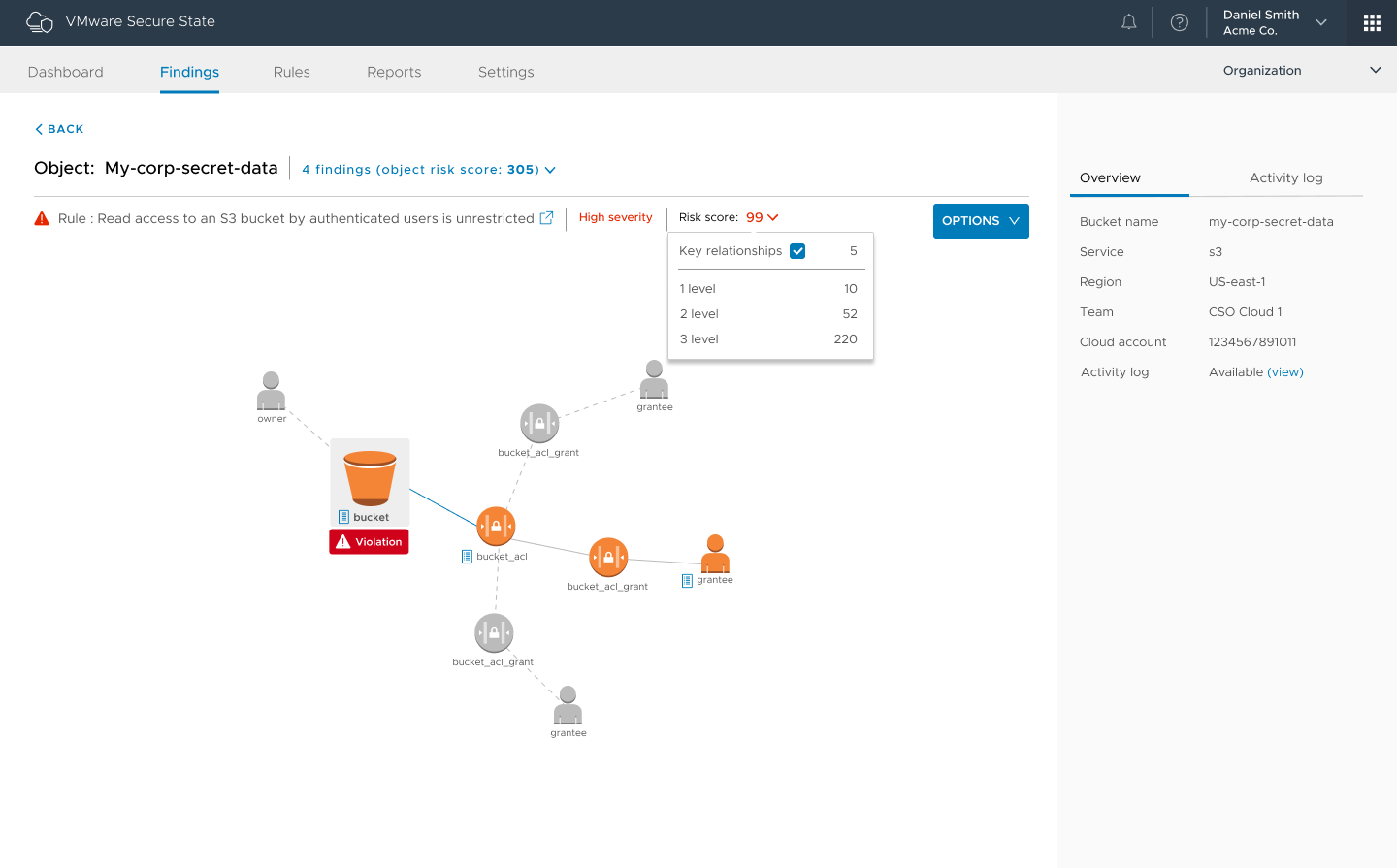
    We’ll get the thing that will interest every risk manager out of the way first. Secure State can tell you about buckets and their current security settings. It can tell you how to fix them. Considering the number of high-profile leaks caused by insecure buckets, I figured I’d mention that even before I talked about how Secure State fits with other VMware offerings. You’re welcome.

    Figure 1: Of the many violation chains available in the product, “authenticated user” buckets are one of the coolest, IMO.

    Secure State is part of VMware’s Cloud offering (grouped with CloudHealth and WaveFront), bringing security and compliance to multicloud. The cool bit is the level of automation, which allows teams to include cloud infrastructure security and compliance with DevOps efforts. That is where the world is headed, and VMware Cloud sees a greater level of DevOps automation than most alternatives just because it was conceived with APIs aimed at automation in the first place. Adding checks for rights and security settings, even compliance, into the DevOps cycle is breaking down one last wall (now we’re basically waiting for someone to do something astounding for cloud storage).

    Part of Secure State is near real-time reporting on status/state. This is big in environments that have real-time reporting for everything else, adding in the one missing piece. It is far better to be told, “There is a problem right now with instance X,” than to be fighting attackers. One of the examples Needham offered was of a project that was used via a small subset of tools: One day a report came in that it was being accessed via JVM instead of the normal methods. In this case, it turned out to be a new developer trying to get work done, but you can imagine such a warning being a heads up that you had an attack going on.

    The other interesting bit is risk scoring, officially known as Smart Risk Scoring. The ability to get a prioritized risk list allows DevOps teams to focus on what is most important. When there is so much for security to get done, this is a huge benefit.

    Disclaimer: I haven’t used this version of the product. That means I can’t say “This rocks!” but if Secure State delivers, it certainly will.

    Anything that adds automation and visibility is a welcome addition to the DevOps stack, making life easier and helping you to rock it.

    — Don Macvittie

  • GitLab Expands Scope of DevOps Ambitions

    GitLab Expands Scope of DevOps Ambitions

    GitLab, with the release of its 12.0 update, is extending the reach of its namesake continuous integration/continuous delivery (CI/CD) platform to include both cybersecurity professionals and traditional IT operations staff.

    John Jeremiah, senior product marketing manager at GitLab, said the goal is to provide organizations with a single CI/CD platform that unifies the management of everything from source code to best DevSecOps processes.

    To address that latter requirement, GitLab 12.0 adds a dashboard designed specifically for security personnel along with the ability for cybersecurity teams to approve merge requests and automatically apply patches for vulnerabilities detected. Those capabilities complement existing support for scanning and secrets detection.

    New capabilities embedded in the platform for IT Operations professionals include an operations dashboard and an embedded incident management capability that makes it easier to create a coordinated response to a specific event.

    GitLab 12.0 also adds support for feature flags to better manage the application delivery process, along with a platform-as-a-service (PaaS) environment to provision and maintain the infrastructure needed for developing and launching an application.

    Jeremiah said the new and existing capabilities in GitLab will make it possible for organizations to unify their DevOps tool chains in a way that also enables IT operations teams and cybersecurity professionals to be included in the process.
    At the same time, GitLab is making DevOps more accessible by eliminating many of the silos between various tools that have emerged over the years, including, for example, built-in support for feature flagging versus requiring organizations to acquire and maintain a separate tool, he noted.

    Because those capabilities are embedded in the platform, organizations will be able to make the cultural shift required to adopt DevOps more easily, he added. IT teams don’t always know what other tools they will need as their DevOps skills mature. With all the tools embedded in GitLab readily available, it becomes easier for organizations to expand their DevOps processes as the organization starts to implement more sophisticated processes, Jeremiah said.

    That approach is starting to resonate with the 100,000-plus developers actively using the GitLab platform and more than 2,000 contributors actively contributing code to the underlying open source platform, he added. GitLab in March saw its millionth merge request.

    It’s too early to tell how broadly any CI/CD platform might be able to consolidate the DevOps toolchain. Developers are notorious for adopting new tools as they see fit. Internal IT teams, of course, are not always excited to be asked to support yet another tool. The right level of balance between ultimate flexibility and the need for a standard set of processes that can be implemented across multiple application development teams must be determined by each organization.

    In the meantime, DevOps processes are starting to expand beyond traditional development team to now include IT operations staff and cybersecurity personnel. The challenge now that they’ve been invited to the proverbial DevOps party is making them feel welcome and appreciated.

    — Mike Vizard

  • Building a Security Feedback Process for DevOps

    Building a Security Feedback Process for DevOps

    The last few years have seen some major slip-ups in the security space among all major cloud providers, resulting in uncertainty and speculation. That’s understanding; cloud security is an extremely complicated subject as enterprises build and deploy applications faster than ever before to keep up with business requirements. Most of the security issues that occur in the cloud today are around compromised accounts, identity theft, malware apps and, of course, data breaches, which are business-critical and showstoppers, in many cases.

    Given the dynamic environment of DevOps and the nature of the cloud, it’s a complex problem to address and fix. The most effective way is to embed security, or what is usually talked about as the shift-left of security, in the IT pipeline. If DevOps is the culture of collaboration to reduce risk by the size of change, DevSecOps is the automated security control built into each point to build a sort of self-defense mechanism.

    DevOps is not about tools; it’s about philosophy and process. One of the most important processes to include to succeed at DevOps is a feedback loop that reinforces constant collaboration.

    This is certainly true when it comes to security-related information. In a healthy DevOps organization, security problems that are detected at any point in the delivery pipeline are communicated quickly to all stakeholders, who can, in turn, respond accordingly.

    In this post, we will look at the steps involved in building a security process that will ensure the right information reaches the right people quickly and that teams collaborate without duplicating efforts.

    Automate Your Way to Better Feedback

    Automation is the first step, and a no-brainer when it comes to DevOps. Without automated security tools for code analysis, configuration management, access control, vulnerability management and secrets management, it is very difficult to scale security in a dynamic DevOps environment. Manual efforts in the cloud are doomed to fail in many cases, as environments change rapidly. Hence, automate. The recommendation is to automate every security control and the entire feedback process as much as possible.

    Manage Roles Right and Control Their Accesses

    Identity and access management has become the linchpin in cloud security. Since it’s very easy to give people the wrong access, it becomes important to figure out who can access what resources. Access to information and resources must be secure, yet easy to obtain. All access should be given to a group rather than an individual. Mapping security access to the organization’s hierarchy is an effective way of establishing a communication loop. The right information reaches the right group of people. It is important to be able to answer questions such as the following to ensure the communication loop is efficient:

    • Who can delete this VM?
    • What are the resources a certain user has access to?
    • Who has service accounts access?

    Tools that show a relationship between users, groups, roles, permissions and resources help answer these questions.

    Encrypt Secrets, Manage Their Keys

    Another important step to building an effective communication cycle is controlling access to application-level secrets. Security can be improved by tightening information flow between relevant groups, which can be accomplished through creating and controlling access to secrets using principles of least privilege. Access keys to those secrets can be kept in a centralized secrets management tool or a key management tool. The rotation of these keys can be automated as often as required.

    Designing for Failure and Proactively Managing Vulnerabilities

    Though security personnel may cringe at the mention of the word “failure,” designing for failure means thinking ahead and having a plan B. The cloud is dynamic by design and things happen at an incredible pace, often resulting in issues of elasticity, configuration and cloud power.

    Context becomes an important parameter for managing vulnerabilities because there are multiple vulnerabilities at any given time. Automated vulnerability management and configuration management solutions are available to take the complexity out of protecting cloud environments. Automation capabilities and continuous monitoring provide deep insight, intelligent recommendations and continuous protection of the cloud, thus ensuring effective management of information in the feedback cycle.

    Log Everything — Everything

    Just embedding security to shift left is not enough to ensure security. It is important for all relevant collaborating groups to know the status when some code is deployed. The primary source of visibility and feedback comes from logs. Effective logging strategy is the paramount attribute of security design. Logging should be enabled everywhere possible: data access logs, identity logs, admin activity logs, logs within the cloud environment, OS, network platforms, etc. Logs, though cumbersome and volume-heavy, are non-intrusive and a critical visibility tool. You need to know what’s going on before deciding to do something with the event itself, which brings us to the next step: monitoring.

    Monitor Those Events

    Testing departments often seem paralyzed with too many flags, which prevent them from prioritizing critical issues. Having log and event data is an important first step, but the absolutely necessary next step is to relay them into an automation strategy that will separate the unimportant, voluminous issues from business-critical priorities. Automated monitoring for events triggered makes the feedback cycle more effective. Otherwise, logs can become noise—a copious amount of noise.

    Alerts and Notifications

    We embed security in the code. We manage access and roles. We turn on the logs and monitor them. An event occurs. Now, who do we alert? An effective alert notification policy will ensure that notifications are sent to the right group of individuals, depending on the notification filters—the level of criticality and relevance of the issue type. Notification policies specify the conditions that trigger a notification that will be sent to the recipient. Notifications can be sent by email, SMS, voice, push messages, etc. A recipient can then acknowledge the alert, which indicates to other users that someone is working on the issue, thus avoiding duplication of efforts.

    Conclusion

    To conclude, automating security controls and feedback cycles enables a productive DevOps ecosystem by exposing vulnerabilities early in the product life cycle. Automation, streamlined communication and appropriate response to priorities ensure availability, network connectivity and resilience. At the same time, they reduce the possibility of a data breach and duplication of efforts. At the heart of everything is the ability to deliver code in a secure and reliable way to meet ever-evolving business needs with agility.

    To see how Symantec can help maximize security in a DevOps environment, check out a free trial of Symantec Cloud Workload Assurance.

    This sponsored article was written on behalf of Symantec.

    — Twain Taylor

  • 4 Things Developers Should Know About Security in the Age of DevSecOps

    4 Things Developers Should Know About Security in the Age of DevSecOps

    If you’re a developer, most of your experience when it comes to security probably centers on designing and writing secure code. You know how to prevent buffer overflows, architect your microservices in a way that helps mitigate the impact of a breach and otherwise churn out secure application code.

    But the fact is that today, knowing how to keep the application itself secure is not enough—even if you are a developer. We’re living in the age of DevSecOps, and developers everywhere are being asked to play broader roles in security at all stages of the application delivery pipeline, from code implementation through to production release and management.

    With that reality in mind, here’s a look at four things developers should know about security today.

    What is DevSecOps, and What Does It Mean for Developers?

    Before diving into four critical things for developers to know in the age of DevSecOps, let’s take a look at what DevSecOps means.

    You’ve probably heard of DevOps, an approach to software delivery that emphasizes constant collaboration between developers and IT teams.

    DevSecOps extends that concept by adding security to the equation. For organizations that have embraced DevSecOps, the entire software delivery team becomes responsible for helping to secure the application. Security is no longer the exclusive domain of security engineers.

    In practice, DevSecOps includes work such as integrating vulnerability scanning into the build process using tools such as Packer and ensuring that images used for deployments meet GSO guidelines. Applying OWASP’s “Security by Design” principles is also a good best practice.

    What that means for developers (to put it simply) is that being a security-minded developer means more than just writing secure code. Developers must now understand security challenges and best practices at all stages of the software delivery pipeline, starting with the design and implementation of code—developers’ traditional domain—and continuing through with testing, staging, deployment and post-release management—all of which traditionally were not areas in which developers played much of a role.

    This isn’t to say that developers now have to bear primary responsibility for all of the things that happen after code is written. They don’t. Their main job is still to write code. But developers should have a solid understanding of the security implications of everything that happens once they hand off code to other members of the software delivery team, to ensure they are doing their best to write code that will stay secure as it travels down the pipeline.

    DevSecOps Security Lessons for Developers

    If you’re a developer, the DevSecOps trend means you should now have some expertise in the following:

    Microservices Security is Difficult (and Developers Can Make it a Little Easier)

    Microservices architectures, which have become very common because of the agility they provide to applications, create extra security challenges that were not present in monolithic architectures. The main reason why is that microservices add many more moving pieces to an application. As a result, there are more potential security vulnerabilities within the application, and detecting those vulnerabilities can be more difficult because there is more activity to monitor.

    Developers can help to address this challenge, and one way is to think about security monitoring complexity when they are deciding how many microservices to create. If developers can reduce the total number of microservices in an application without sacrificing agility, they can simplify security monitoring and enable a more secure application overall.

    Developers also can make sure the microservices they write log security-related information sufficiently and clearly. You don’t want to make it more difficult for your colleagues who are monitoring an application to keep track of security events because the application doesn’t log authentication information in sufficient detail, for example.

    You Can No Longer Count on Firewalls

    In the days when most software ran on-premises, firewalls were a handy way of isolating applications from most security threats.

    Today, organizations face a string of cloud security challenges that didn’t exist when firewalls were designed. Firewalls can still be helpful in some circumstances, but in many cases, you can no longer neatly segment applications or services off from the public internet, because you need the internet for services that are spread across a hybrid infrastructure to communicate with each other.

    For developers, the lesson here is that it’s especially critical to design and write code that can resist threats that originate from the internet. Even if you don’t expect a particular part of the application to be exposed to the public internet, assume it might be, either because deployment patterns change in the future or the component is exposed without anyone realizing it.

    To put this another way: Developers can’t and shouldn’t expect the IT team to be able to erect firewalls that will keep applications secure. More of the burden has shifted to developers to write applications that can resist network-based security threats because the IT team can no longer deploy firewalls like it used to.

    Shift Security Testing Left

    DevSecOps goes hand in hand with the mantra of shift-left testing. The latter term refers to the practice of performing tests earlier in the software delivery pipeline, rather than waiting until just before deployment to do the tests.

    Shift-left testing can apply to any type of software testing, including security tests. For developers, taking advantage of shift-left security testing is a useful way of identifying security flaws within newly written code early, when they can be fixed with less effort because they have not yet been integrated into the broader application code base.

    Security testing at later stages of the delivery pipeline is important, too, especially because you won’t be able to detect all security flaws until you can monitor all of your microservices as they interact with each other. But the time developers have to spend rewriting code to address security issues will be reduced greatly if their organization takes advantage of shift-left security testing.

    Don’t Be Afraid to Ask for Compliance Help

    A final point worth mentioning relates to compliance. Compliance is becoming ever-more challenging. And so is creating applications that meet the security requirements of compliance frameworks.

    In the past, developers were often left on their own to figure out how to address compliance needs. Given the spirit of collaboration that DevOps and DevSecOps champion, however, developers should no longer feel like they have to go at it alone when it comes to interpreting and addressing compliance requirements. And indeed, they shouldn’t. If you are a coding expert, you’re probably not an expert in figuring out what complex compliance frameworks require.

    The point here is that developers should not be afraid to ask for help—from legal experts, management or the IT team (which is more likely to have some experience with the compliance issues that arise once the software is in production) to make sure that the applications they design and write meet compliance requirements.

    Conclusion

    The developers’ main job is still writing code. But by having a greater awareness of the types of security risks that can arise within the code as it is pushed down the delivery chain, developers can do much to improve the security of the applications they write. They might even save themselves some time and headaches by reducing the number of complicated security issues they end up having to address by rewriting code.

    This sponsored article was written on behalf of Symantec.

    — Chris Tozzi

  • Portable Security Policies: A DevSecOps Primer

    Portable Security Policies: A DevSecOps Primer

    Protecting critical data and applications is a challenge under any circumstances, but it’s especially daunting when resources reside in the cloud. Most organizations today operate a significant portion of their workloads in the cloud, which adds to the complexity of the security problem—a security team can’t fully control cloud environments but is responsible for securing workloads and applications running there.

    Cybercriminals are exploiting the situation. They’re becoming more aggressive and ingenious in their efforts, taking advantage of the fact that there is confusion about who is responsible for which aspects of security under the Shared Responsibility Model. Adding to the chaos is the differentiation between cloud providers’ security offerings and capabilities. Quite simply, in most cases, cloud providers are responsible for the security of the cloud and consumers are responsible for security in the cloud, meaning that security and networking teams still need to ensure their organizations’ workloads and applications are free from malware or other tampering.

    To accomplish this, security and networking teams can’t rely solely on firewalls, threat detection and vulnerability patching to secure vital digital assets. Security tools developed for traditional data centers are not effective at securing workloads in the cloud due to the cloud’s dynamic nature. Security and networking teams must rethink their approach.

    Unfortunately, many organizations are still relying on old and ineffective strategies—further hardening the perimeter, investing in additional threat detection and adding new tools and controls that focus on identification rather than prevention. This security approach has its place, but it does nothing to prevent malicious actors from moving laterally across the network once they achieve a foothold, which leaves cloud-hosted apps and workloads extremely vulnerable.

    Instead, security teams need to enable zero trust in cloud environments, which treats all internal communications as untrusted by default. With zero trust, only authorized applications and services are allowed to send and receive communications, and only in specific ways governed by the principle of least privilege.

    The Second Layer

    Traditional tools aren’t effective in enabling zero trust in the cloud because security and ops teams have a very limited ability to manage all layers of the cloud’s open systems interconnection (OSI) model. Specifically, the lack of Layer 2 controls in infrastructure-as-a-service (IaaS) environments makes tools developed for discrete networks all but useless for locking down ports and controlling or scrutinizing IP addresses.

    Even if an organization manages to implement these tools in the cloud, it cannot provide the level of granularity required to stop malicious lateral movement. For example, when on-premises tools are repurposed for cloud environments, they usually rely on subnets to define the boundaries of communication. Because cloud subnets are designed to handle elastic workloads, they need to be far larger than those in on-premises environments. As a result, cloud workloads are more exposed than is necessary.

    Securely migrating workloads and applications to a cloud environment is a huge and cumbersome job when relying on traditional tooling. The best way to make workloads portable and secure is to decouple workload protection from the underlying infrastructure. In this way, organizations can be certain that any policies applied on-premises can migrate to the untrusted environment of the cloud, without the complexity of mapping changing network addresses, writing policy exceptions or losing fine-grained control during the process.

    Decoupling workload protection from the network requires abandoning a network address-based approach in favor of one based on identity. By using the immutable properties of workloads, security teams can create cryptographic identities for applications and services, which then can be used to determine what is allowed to send and receive communications. Not only does this model provide stronger security, but it also works regardless of where applications are located, because these identities are unaffected when network elements change. What’s more, they can be constructed to tolerate upgrades. By building identity-based policies, security teams can create microperimeters around applications that follow workloads wherever they go, and the policies verify communication across boundaries every time an application attempts to communicate.

    Implementing network-agnostic policies doesn’t just harden security. Software developers benefit as well. Without the roadblock of translating application-speak to network-speak, developers can build software and applications in any environment favorable to their workflow while defining policies to protect their work. Once the software is built, they can securely deploy the finished product to the production environment—even if it is hosted by a third party.

    No organization should have to compromise security to benefit from the efficiencies offered by the cloud and ephemeral auto-scaling containers. Building identity-based policies that enable zero trust and are independent of the underlying network ensures that companies never have to consider making that trade-off.

    — Tom Hickman