Tag: devsecops

  • AWS Extends Cloud Security Reach to Include DevSecOps Tools to Scan Code

    AWS Extends Cloud Security Reach to Include DevSecOps Tools to Scan Code

    Amazon Web Services (AWS) this week made Amazon Inspector, a code scanning tool for surfacing vulnerabilities that is designed to be natively integrated with GitHub and GitLab platforms, generally available.

    Announced at the AWS re:Inforce 2025 conference, Amazon Inspector combines a static application security testing (SAST) tool for analyzing application source-code with a software composition analysis (SCA) tool for evaluating third-party dependencies and an ability to scan infrastructure as code (IaC) for valid definitions.

    Findings from these scans are then surfaced both in the Amazon Inspector console and within the source code management platform as fast feedback for the developers.

    Mitch Ashley, vice president and practice lead for software lifecycle engineering at The Futurum Group, said the expansion of the DevSecOps capabilities provided by AWS into code, dependencies, and IaC enable a critical ‘shift left’ for cloud security, fundamentally embedding vulnerability management earlier into the development lifecycle. That unified approach addresses a long-standing challenge for DevOps teams by accelerating feedback and fostering truly secure-by-design applications, he added.

    Additionally, AWS also revealed it has made available under an open source license a software package, dubbed @verifiedpermissions/authorization-clients-js, that enables developers to implement authorization in Express.js web application APIs in minutes. That approach reduces the custom authorization code that developers would have previously needed to create on their own.

    Finally, AWS demonstrated how it is internally using Amazon Q Developer, an artificial intelligence (AI) agent framework, to identify vulnerabilities in code as it is being developed.

    George Argyros, applied science manager of AWS, told conference attendees Amazon Q Developer makes it possible to “squash bugs” early in the application development process in a way that ultimately serves to improve the quality of the code being created. The overall goal is review code at the time a pull request is made and then surface recommendations to mitigate any issue, with Amazon Q Developer also being used to create and test any patch required.

    It’s not clear how widely the DevSecOps tool and platform being provided by AWS have been adopted, but it’s clear the cloud services provider is now moving well beyond securing infrastructure. It’s still the responsibility of organizations to secure the applications deployed on the cloud, but AWS is making the tools and services needed to achieve that goal more accessible.

    Hopefully, there will even come a day soon when application development teams are routinely using AI tools to prevent vulnerabilities and misconfigurations from being created in the first place.

    In the meantime, however, DevOps teams need to be sure to review the code being generated by AI tools that have been trained using examples of code that is of varying quality. In one instance, that code might be better than what some developers might write on their own. In other cases, segments of code with known vulnerabilities might have been copied multiple times over. In fact, about the only thing that is for certain is that there will soon be more code than ever to scan and review as developers continue to lean on AI tools to create code that they are becoming less inclined to write themselves.

  • DevEx Got You This Far: What’s Next for True DevSecOps Maturity?

    DevEx Got You This Far: What’s Next for True DevSecOps Maturity?

    The journey toward integrating security into the fast-paced world of DevOps has seen significant strides, largely thanks to a much-needed focus on the developer experience (DevEx). 

    Collectively, the AppSec community and industry have moved mountains in making security tools less intrusive, integrating them into developer workflows, and acknowledging that developers need security as a help, not a hindrance. A focus on DevEx has been crucial, acting as the bridge to bring security considerations earlier into the development lifecycle while simultaneously enhancing the developers’ daily work.  

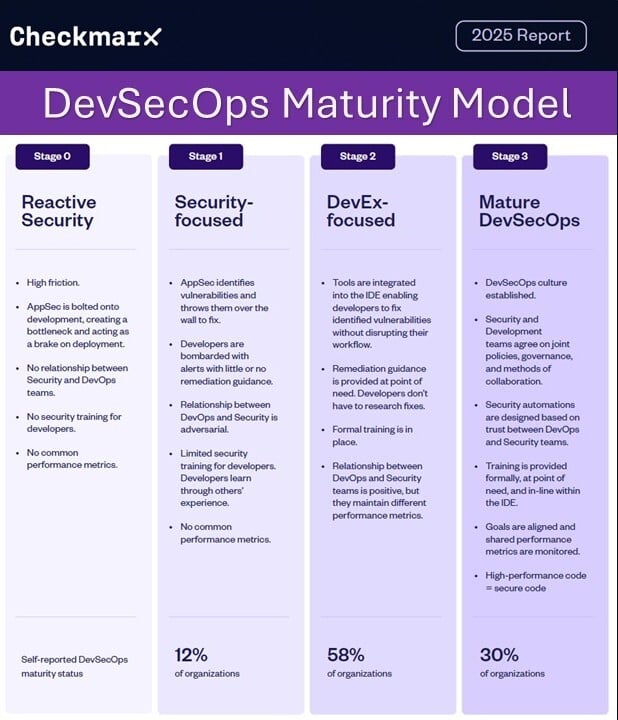
    The numbers don’t lie: Checkmarx’ recent DevSecOps Evolution 2025 report reveals that a majority of the organizations we surveyed—58% to be exact—are at Stage 2 maturity, a transition stage primarily focused on DevEx: They’ve integrated tools into IDEs, offer formal training, and the relationship between security and development teams is generally positive. While these developments signify important progress, this DevEx-focused stage represents a critical foundation rather than the ultimate destination in achieving mature DevSecOps.

    DevEx Isn’t the Destination

    Organizations haven’t yet achieved true DevSecOps maturity. They haven’t yet embedded security through shared culture, governance and aligned goals.

    And while developer experience is essential, it’s just one brick of the DevSecOps foundation. To achieve the ultimate goal—high-performing, secure code delivered at the pace of business—organizations need to move beyond DevEx to a true culture of shared responsibility and trust.

    Despite better tools and training, developers still report spending a significant chunk of their week—often over 17 hours—on security tasks. Trust in tool results is often hampered by false positives impacting velocity, and a lack of shared goals that align development and AppSec priorities means security can still feel like a separate concern rather than a shared objective. We’ve improved the experience; but haven’t fully embedded security seamlessly and at scale.

    The Scale – and Stakes – Are Growing

    The need to mature beyond DevEx is especially urgent given the accelerating complexity and scale of modern application development. Enterprises are managing sprawling codebases and adopting tools that increase both speed and risk. Checkmarx alone scans over 450 billion lines of code every month, and that figure is only rising. 

    At the same time, the software supply chain is expanding at an unprecedented pace: approximately 700,000 new NPM package versions are introduced monthly, each one a potential point of exposure.

    Add to this the growing adoption of AI-assisted coding tools and agentic AI systems that generate or modify code autonomously, and the attack surface multiplies further. 

    On the other hand, development productivity requirements have never been higher, with organizations tracking DORA metrics and looking for AppSec solutions like Checkmarx’ that deliver on security while optimizing MTTR and other DORA metrics.

    Achieving truly mature DevSecOps—Stage 3, where only 30% of organizations currently reside—requires moving beyond just making security palatable for developers. It demands a deeper, more strategic integration built on shared culture, robust governance, trusted automation, and aligned success metrics.  

    Checkmarx’ Five Pillars of DevSecOps Maturity

    At its heart, DevSecOps is a cultural evolution. It’s about merging the “move fast” ethos of development with the “protect everything” mandate of security to achieve a common goal of delivering secure, high-performance code at the speed the business requires. To progress from Stage 2 (DevEx-focused) to Stage 3 (Mature DevSecOps), organizations need to build on their DevEx foundation with five key elements:

    1. Shared Metrics

    You can’t improve what you don’t measure, yet our research shows a surprising lack of consensus on DevSecOps metrics. While many organizations we surveyed track top vulnerable applications (52.1%) and mean time to detect vulnerabilities (51%), only 28.3% measure mean time to remediate—arguably the most critical metric for balancing security and velocity.

    True DevSecOps maturity requires security and development teams to align shared metrics that measure how effectively they work together, not just how many vulnerabilities they find.

    2. Collaborative Governance

    In mature DevSecOps, security and development teams jointly establish policies, standards and processes. Our data shows this remains rare—when asked to describe the relationship between security and development in one word, respondents most frequently chose “trust,” “policy,” and “risk,” indicating an evolving but not yet fully collaborative relationship.

    For 88% of organizations, the absence of shared metrics, policies and governance suggests security and development teams are aligning but are still struggling to form a fully collaborative governance.

    3. Advanced Security Education

    While essentially all developers have access to training according to our study, the model needs to evolve. Traditional formal training programs still have value, but the premium on developer time makes standalone training challenging.

    Mature DevSecOps organizations are pivoting toward just-in-time training that delivers contextual guidance when and where developers need it. Providing a step further is in-the-moment training with inline feedback from within the IDE, allowing developers to learn while maintaining their workflow.

    4. Trusted Automation

    Our study showed that one in five (20%) of the organizations we surveyed have no AppSec automation in place. Even among the remaining 80%, adoption of key automation capabilities remains low—only 32% have automated security testing during change management, and just 30% auto-populate security tickets with remediation guidance.

    The far-from-optimal adoption rate of automation cannot be attributed to a lack of technological solutions but rather appears as a matter of trust and culture gaps between security and development teams. Without shared governance and metrics, attempts to “automate everything” typically fail because there’s no foundation of trust on which to build automations that both teams will embrace.

    5. Velocity-Security Balance

    The ultimate goal of DevSecOps is to deliver high-performing, secure code quickly. Yet 66% of developers report that false positives impede their velocity, and 28% say their AppSec teams lack the tools or resources to help them fix security issues efficiently.

    Mature DevSecOps organizations recognize that speed isn’t just about how quickly tools scan—it’s about how quickly developers can remediate issues without disrupting their workflow. This requires prioritized, actionable results with clear remediation guidance, not just faster scanning. 

    The Role of Leadership

    Making the transition to DevSecOps takes more than just good tooling—it requires strong leadership. Security leaders must be willing to trade control for collaboration and build systems based on partnership, not policing. Engineering leaders must recognize that security is essential to velocity, not an obstacle.

    This shift requires executive buy-in and strategic commitment. It means moving beyond budget conversations centered on compliance and instead investing in the long-term health of your codebase and your teams.

    The Road Ahead

    As the DevSecOps Evolution 2025 report shows, most organizations are still in the middle of the journey. That’s not a failure. It’s an opportunity. DevEx helped bridge the gap between developers and security, and now it’s time to build the foundation that inspires them to run together. By moving beyond DevEx as the sole focus and embracing these pillars of mature DevSecOps, we can finally embed security seamlessly at scale, achieving the ultimate objective of delivering high-performing, secure code without compromising speed.  

    The transformation won’t happen overnight. It requires sustained investment in building trust between security and development teams. But organizations that successfully make this journey will gain the significant competitive advantage of more secure and advanced applications built with less friction and lower costs.

    As we look to 2026 and beyond, the most successful organizations will be those that move beyond seeing security as just another feature of the development process. Instead, they’ll embrace it as an integral, collaborative aspect of delivering high-quality software in a digital world with ever-rising security risks.

    At Checkmarx, we believe the future of software development is secure by design—and it starts with mature DevSecOps. Let’s keep moving forward.

  • DevOps: More Than a Buzzword—A Mindset of Continuous Evolution

    DevOps: More Than a Buzzword—A Mindset of Continuous Evolution

    In recent years, the term DevOps has become one of the most talked-about buzzwords in the technology world. You’ll hear it in boardroom discussions, IT conferences, job postings, and even startup meetups. Companies want to “go DevOps,” developers want to work in DevOps environments, and recruiters are constantly looking for DevOps Engineers. But despite all this hype, DevOps is often misunderstood. Many think it’s a tool or a new kind of job title. In reality, DevOps is not a technology—it’s a mindset.

    This article explains what DevOps really means, why it’s important, and how it embodies a cycle of continuous practices—like continuous integration, continuous deployment, continuous testing, continuous monitoring, continuous security, continuous improvement, and continuous feedback. We’ll explore these concepts in simple language and explain how they align with business strategy and team collaboration.

    What Is DevOps, Really?

    DevOps stands for Development and Operations. It brings together software developers (who write the code) and operations teams (who deploy and manage the code in production). Traditionally, these two teams worked separately. Developers would build software and hand it over to operations to release. This handoff model caused delays, confusion, and sometimes even system failures.

    DevOps aims to break down these silos. It promotes collaboration, shared responsibility, and faster delivery of high-quality software. DevOps is not a product you can buy or a process you can install. It’s a cultural shift—a new way of thinking about how teams work together to deliver value to customers.

    Why DevOps Is a Mindset, Not Just a Tool

    Many companies start their DevOps journey by adopting tools like Jenkins, Docker, Kubernetes or Terraform. While these tools help automate tasks, they don’t make an organization “DevOps-ready” by themselves. A DevOps culture is built on principles such as:

    • Shared goals between development, operations, and business teams
    • End-to-end accountability for software quality and performance
    • Fast, safe, and frequent delivery of new features
    • Embracing failure as a learning opportunity
    • Continuous improvement and feedback

    These principles require changes in how people work, how they communicate, and how they measure success. In other words, DevOps is a people-first approach, supported by tools—not the other way around.

    Strategic Alignment: Connecting DevOps to Business Goals

    One of the biggest benefits of DevOps is its ability to align IT efforts with business goals. When development and operations teams work closely with product managers and business leaders, they can prioritize features that deliver real value to customers.

    For example, instead of spending months developing features that may never be used, a DevOps team can release small updates frequently, gather user feedback, and adjust the roadmap. This approach supports agile decision-making, reduces risk, and increases customer satisfaction.

    DevOps also emphasizes metrics that matter to the business, such as:

    • Deployment frequency
    • Lead time for changes
    • Mean time to recovery (MTTR)
    • Customer feedback and satisfaction

    These metrics help teams measure their performance and make data-driven decisions.

    The Pillars of DevOps: A Culture of Continuity

    DevOps is powered by a series of continuous practices. Let’s walk through each one and understand how they fit together.

    1. Continuous Integration (CI)

    Continuous Integration is the practice of automatically merging code changes into a shared repository several times a day. Every time a developer writes new code, it is tested and integrated with the existing codebase. This helps catch bugs early and ensures the software always stays in a working state.

    Key benefits:

    • Faster development cycles
    • Reduced integration issues
    • Early bug detection

    CI tools: Jenkins, GitLab CI, CircleCI, Travis CI

    2. Continuous Deployment (CD)

    Once the code passes all the tests, it is automatically deployed to production or staging environments. This is known as Continuous Deployment. It removes manual intervention and allows teams to release features to users quickly and reliably.

    Key benefits:

    • Shorter release cycles
    • Faster feedback from users
    • Reduced manual errors

    CD tools: Spinnaker, Argo CD, AWS CodePipeline

    3. Continuous Testing

    Continuous Testing ensures that the software is tested at every stage of the development lifecycle. This includes unit tests, integration tests, performance tests, and even security tests. Automated testing tools help identify defects early and prevent bugs from reaching the end user.

    Key benefits:

    • Improved quality
    • Faster bug detection
    • Increased confidence in releases

    Testing tools: Selenium, JUnit, TestNG, Postman, SonarQube

    4. Continuous Monitoring

    After the software is released, it’s important to monitor its performance, availability and user behavior in real time. Continuous Monitoring helps detect issues early, prevent downtime, and understand how users interact with the application.

    Monitoring also provides telemetry data, which can be used to improve future versions of the product.

    Key benefits:

    • Better uptime
    • Real-time alerts
    • Insights into user experience

    Monitoring tools: Prometheus, Grafana, Datadog, New Relic, ELK Stack

    5. Continuous Security (DevSecOps)

    In the past, security was often added at the end of the development process. In DevOps, security is integrated from the beginning. This practice is called DevSecOps—short for Development, Security, and Operations.

    Security checks are built into the CI/CD pipeline, and developers are trained to write secure code. Automated tools scan for vulnerabilities in real time.

    Key benefits:

    • Early detection of security flaws
    • Lower risk of breaches
    • Compliance with security standards

    Security tools: Snyk, Aqua, Clair, Fortify

    6. Continuous Feedback

    Continuous Feedback means collecting real-time input from customers, end-users, and stakeholders. This feedback is then used to improve the product in the next cycle. It could come in the form of bug reports, customer reviews, surveys, or usage analytics.

    Feedback is also encouraged within teams. Retrospectives, peer reviews, and performance metrics help teams learn and grow continuously.

    Key benefits:

    • Better user experience
    • Product features that match real needs
    • Faster response to change

    Feedback tools: Jira, Slack, UserVoice, Microsoft Teams

    7. Continuous Improvement

    DevOps teams strive to improve with every sprint, release, and incident. This involves reviewing past performance, identifying bottlenecks, and experimenting with new ideas.

    Key aspects include:

    • Regular retrospectives
    • Automation of manual tasks
    • Process optimization
    • Team learning and training

    Continuous improvement is what turns a good DevOps team into a great one.

    Benefits of a DevOps Mindset

    Organizations that adopt a true DevOps mindset report several business and technical benefits:

    1. Faster Time to Market
      Teams can deliver features, updates, and fixes faster and more frequently.
    2. Better Collaboration
      DevOps breaks down silos, encouraging communication and shared responsibility.
    3. Higher Quality and Reliability
      Frequent testing and monitoring improve the quality of software.
    4. Stronger Security
      Security is integrated into every step, reducing risks and vulnerabilities.
    5. Improved Customer Satisfaction
      Faster updates and quicker fixes enhance the customer experience.
    6. Happier Teams
      Empowered teams that can deploy safely and frequently feel more motivated.

    Challenges in Adopting DevOps

    Adopting DevOps isn’t always easy. Some of the common challenges include:

    • Cultural resistance: Changing mindsets takes time.
    • Legacy systems: Old infrastructure may not support automation.
    • Tool overload: Choosing and integrating the right tools can be complex.
    • Lack of skills: Teams may need training in automation, cloud, and testing.
    • Fragmented processes: Without a unified strategy, DevOps can become chaotic.

    The key is to start small, show quick wins, and scale gradually.

    DevOps Success Stories

    Many companies have transformed their development culture through DevOps:

    • Amazon deploys code thousands of times a day using DevOps automation.
    • Netflix built its world-class streaming platform on DevOps principles.
    • Etsy recovered from deployment issues by investing in a DevOps culture.
    • Toyota (where I’ve had the honor to lead) leverages DevOps to enhance reliability, performance, and cost-efficiency in enterprise data platforms.

    Final Thoughts: DevOps Is a Journey

    DevOps is not a one-time project—it’s a journey of continuous transformation. It’s about creating a culture where development, operations, business, and security teams work together with shared goals, automated processes, and customer-centric thinking.

    Yes, the tools matter. But more important is the mindset. When teams truly embrace DevOps, they move from delivering code to delivering value—faster, safer, and with greater impact.

    So next time someone calls DevOps a “buzzword,” remember this: it’s not a trend, it’s a transformative philosophy—one that’s changing how the world builds and delivers technology.