Tag: devopsdays

  • Cuba Embraces DevOps, Despite Infrastructure Challenges

    Cuba Embraces DevOps, Despite Infrastructure Challenges

    A few weeks ago I had the pleasure of speaking at the second DevOpsDays event in Cuba alongside some great technologists from across the United States, Europe and Latin America. The conference was held in a beautiful hotel in Varadero overlooking a marina right by the beach. Varadero is approximately two hours by car from Havana.

    The first thing I noticed is that Cuba is full of anachronisms. This became evident as soon as I walked out of Havana Airport and realized that the whole “they have some old cars” thing was real. It was fascinating to see that every single car was pre-1950s, some perfectly maintained with great paint jobs and others in worse condition yet still capable of doing their core job as a mode of transport.

    Talking technology in Cuba was eye-opening, to say the least. Do not expect to have 3G or 4G data on your cellphone. Do not expect to have WiFi in most hotels (you can purchase prepaid internet credit, but the speed will be slower than what you are used to) and definitely do not expect to have WiFi in a private home. These are luxuries.

    But here’s the surprising part: There are companies in Cuba with fully automated CI/CD pipelines achieving 10 to 12 deployments per day and solving real problems, such as the team working under Anesto del Toro at Datys. Cuba even has its very own Docker Captain, who gave a superb demonstration on the value of Docker in front of the DevOpsDays audience.

    Now let me remind you, these guys are not working with stable internet connections and they manage to get the job done on a daily basis.

    Why am I Rambling on About Cuba?

    Engineering is about solving problems. No matter how big or small, it’s about looking at a problem and finding the solution. Now, this is part of Cuban life. If something is broken, they don’t throw it in the trash and buy a new one; they fix it. Their 80-year-old car breaks down two hours outside of town? They get out of the car to fix it and—take my word for this—their friends, family and neighbors will come outside to fix the problem, too. This creates a mindset of solving the problem at hand without fail. This is easily demonstrated when you talk to Cubans about software development: They won’t say they are a Python engineer, a Java engineer or any other choice of language—they are software engineers who understand how development works as a whole. They will use the language required to get the job done to the highest standard.

    Like everywhere else in the world, there were huge differences in levels of DevOps adoption between the various organizations in the country. In contrast to the companies mentioned earlier, there also are organizations that have only just heard of these methodologies or are now considering setting up their first CI pipelines. Like many of us, they are still figuring out how to solve their technical debt and modernize their IT Infrastructure, but the key point is that the stakeholders, C-level executives, junior engineers and everyone else in between want to learn. They are open-minded to the principles of DevOps. Every person in the room at DevOpsDays Cuba was focused and listening to what we had to say. This excited me as a speaker and everyone else in attendance. We could see people who really did want to change and transform the cultures within their technology teams and overall businesses to start adopting these modern and proven practices.

    The journey ahead is a long one. The infrastructure challenges remain in place and there is much to be learned, but it was great to see such positive energy and eagerness to adapt. I want to thank everyone who attended DevOpsDays Cuba for making it such an amazing experience. An even bigger thanks to the organizers Enrique Carbonell, Rudy Gevaert, Yadier Perdemo, Manuel Oliver, Mike Rosado, Manuel Morejon and anyone I’ve missed. The event couldn’t have been better and it was a genuine pleasure to visit Cuba, I hope to return soon and reconnect with as many of you as possible!

    About the Author / Conor Delanbanque

    conordelanbanque

    Conor Delanbanque has been recruiting and leading recruitment teams in the DevOps space for the past few years. As well as being exclusively responsible for growing some of the most innovative DevOps & SRE teams in the US and Europe as an external consultant and recruiting partner, Conor also founded the Future of DevOps Thought Leaders Debate, sponsors DockerNYC Meetup on a regular basis and co-hosts ServerlessNYC. You can tweet him at @ConorDevOps, find him on LinkedIn or at events, expos and writing articles on devopsy.kinsta.cloud.

  • DevOpsDays and Diogenes: Thoughts from a First-Timer

    DevOpsDays and Diogenes: Thoughts from a First-Timer

    I went seeking honesty at a DevOps conference and met Diogenes.

    Diogenes of Sinope was a controversial figure in ancient Athens who was known for walking around the famed ancient city—some say in the nude— during daytime with a lamp in his hand. He parried inquisitors who questioned his strange habit of using a lamp by day by insisting that he was looking for an honest man. At the recent DevOpsDays Boston, I actually met Diogenes. True story. See picture below. (Thankfully, he was wearing clothes.) But, as you probably guessed, this was not the man with the lamp, but rather one of the many conference organizers looking to help less-acquainted individuals find their way around the many meetings and speakers that filled the two-day conclave. Indeed, my Diogenes was instrumental in organizing the conversations and lectures that proved both honest and helpful.  Rather than a self-congratulatory summit, the two-day meeting was an honest conversation highlighting the advantages as well as many of the stresses befalling organizations that have adopted DevOps.
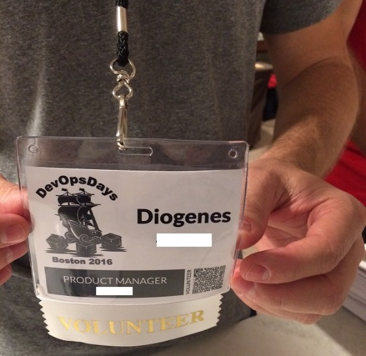
    DiogenesI found the most honest discussions were a floor up and a bit removed from the topics discussed in the main ballroom. These discussions were given the informal title of “Open Spaces” and were run in a typical un-conference format. These conversations were the real opportunities to learn about the stresses of implementing the modern portmanteau of DevOps.

    Tensions Between Dev and Ops: Why Can’t We All Get Along?

    One of the most interesting discussions in the Open Spaces looked at the dynamics between Devs and Ops. Like with any two groups that need to work together to accomplish larger organizational goals (think Sales and Marketing or Design and Engineering), there are inherent tensions that need to be overcome. The tensions between Dev and Ops are based on the different mission each pursues. Dev is striving to get software out the door as quickly as possible and push software updates forward. Ops is guided by the need to keep the ship as steady as possible, which often means limiting updates, as every update opens the door to potential bugs and deployment challenges. Starting with this premise of conflicting motivations, issues of trust and respect further complicate the relationship as each sees the other as trying to control the process.

    Yet, participants in this Open Spaces discussion were hopeful that tensions could be dissolved if management played an active role in creating cross-functional teams and managing workloads better. It was suggested that by essentially seeding Ops with Devs and vice versa, a greater community of understanding could be created. By promoting this cross-pollination, there would be greater understanding on both sides the implications (from the Dev side) of pushing software over the wall to Ops too quickly. From the Ops side, there would be greater understanding that 100 percent uptime is incompatible with dynamic product cycles that encourage innovation. A common and acceptable level of uptime needs to be agreed upon by both sides.

    For example, creating demos and code walk-throughs so both Dev and Ops can comment on potential problems and issues allows both Dev and Ops to see issues at the beginning rather than at the time of deployment.

    Blameless Post-Mortems in DevOps: Can They Exist?

    Another fascinating discussion in the Open Spaces focused on blameless post-mortems. Postmortems first and foremost suffer from an image problem. I believe it starts with the root word “mort” and it doesn’t get much better. To be clear, there was a lot of back and forth during this Open Space about the difference between a “postmortem” and a “retrospective.” Retrospectives are usually a weekly or bi-weekly event that bring to light the multiple root causes that are leading to defects or causing success through a review of RCA. In typical DevOps, one-week sprints are followed by a retrospective. Usually, the more data you can bring to a retrospective, the better. Post-mortems, on the other hand, result from an incendiary incident that was unexpected and undesired.

    Since post-mortems inevitably occur due to human oversight or lack of planning, there is no amount of thinking or planning that can prevent a crisis and thus prevent a post-mortem. As such, effective management will make post-mortems as painless as possible. The goal is to have blameless post-mortems balanced with accountability. According to one participant,

    “No one wants central casting to send in a screaming manager in a time of crisis who is only interested in assigning blame. That doesn’t help anything.”

    Importantly, you cannot fire yourself out of a post-mortem. Post-mortems are a necessary instrument to get at the root causes of issues. And while several different events can cause one issue, the post-mortem will at least begin to look at the process which caused the chaos. By not making the goal of post-mortems to find a scapegoat, the participants in one of these sessions can actually work on effective problem-solving.

    The goal of post-mortems needs to be effective problem-solving with the intent of committing the lessons learned to an actual document. It is not enough to let the lessons learned remain as an informal corpus that lives only in the heads of the engineers involved. Instead, documentation is required and it has to be in accessible place. Furthermore, it needs to be summarized and presented to management in either a lunch-and-learn or seminar so that the lessons learned then become actionable.

    Furthermore—and this was perhaps the most interesting part of the discussion on post-mortems—effective post-mortems are about getting Dev and Ops out of silos. There is no automation tool that will make Dev and Ops work together. Dev and Ops cannot just be about finding another automation tool. Instead, management needs to step in to help the process. Management needs to take engineers out of their silos and get them to work together if post-mortems are going to be really effective.

    Are You Feeling the Burnout Yet?

    After so many hours of interesting discussion in the DevOpsDays Open Spaces, I too was beginning to tire a bit. So perhaps it was well-planned to move on to a discussion on avoiding burnout.

    The artifacts of burnout are seen throughout the DevOps world as engineers constantly change jobs. This might be the phenomena of the “shiny orb,” where engineers always feel that there is a better, higher-paying job on the other side of the fence. However, as much as that might be true, it is equally the case that engineers are trying to escape burnout.

    According to the kanban methodology, which is woven into DevOps, you only pick up work as you can process it. Yet, DevOps practitioners often pick up work because they want to feel like they are team players or invincible or because they underestimate the work’s demands. They also fear the “imposter syndrome,” whereby colleagues seem less genuine if they don’t accept a piece of work offered to them. Inevitably, because the work is more than the engineer can handle, he or she becomes overwhelmed and is too proud to reach out for help.

    In a well-managed workplace, admitting overwork would not be an admission of failure. Instead, there would be a supportive culture to help the engineer or better mentoring on how to get through a challenging issue. “One-on-ones,” where the manager and individual contributor sit down together, would effectively solve the issue.

    But given the idiosyncrasies of workplaces, good management is not a given and engineers are often left to find their own coping techniques to help avoid burnout. The participants in this particular Open Space came up with the following gems:

    • Brain dumping. Empty your brain by putting all the thoughts and tasks that remain on your list and in your brain at the end of the day onto post-it notes. This helps avoid burnout because you are able to clear your brain prior to leaving work.
    • Create a Slack-based or bullet journal as a way to write yourself notes and create a list of priorities.
    • Follow the Pomodoro technique. Take a five-minute break every 25 minutes and a 15-minute break every two hours to better monitor how much time you are devoting to an issue and also to ensure you don’t forget to get a bit of movement into your day.
    • Learn how to say ‘no’ to requests. It’s a very simple word, but uttering ‘no’ once in a while will ensure that you mark boundaries and don’t take on more responsibility than you can handle.
    • Enlist management to make them aware of time you are spending beyond the normal working day and try to figure out ways to better manage the schedule and avoid burnout.

    The participants of this Open Space left with some new techniques to consider in avoiding engineer burnout. Hopefully, they will be implemented to practical advantage.

    Conclusion

    My first DevOpsDays conference was a true eye-opener.  I was lucky to get my education among such thoughtful and well-spoken individuals. I look forward to future opportunities to learn at the foot of Diogenes.

    About the Author / Orlee Berlove

    orlee_berloveOrlee Berlove is the Marketing director at OnPage Corporation located in Waltham, Massachusetts. OnPage is a cloud base incident alert and management system that elevates notifications so they continue to “ALERT-UNTIL-READ” so it’s not confused with email, SMS or phone calls. Incidents can be programmed to arrive to the person On-Call and can be escalated if they are not attended to promptly. Follow OnPage on Twitter and LinkedIn.

  • DevOpsDays DFW to Kick Off with an All-Star Speaker Lineup!

    GRAPEVINE, TX – ­ September, 2016 – DevOps Days will be coming to the Dallas–Fort Worth metroplex, September 15 and 16, at the Grapevine Convention Center in Grapevine, TX. The speaker lineup for this event promises to bring an eclectic mix of thought-provoking ideas.

    DevOpsDays is a self-organizing, community-organized, not-for-profit conference series for DevOps practitioners, enthusiasts, and evangelists. It began in Ghent, Belgium with one conference in 2009, and has grown to more than 30 events planned worldwide for 2016.

    One of the keynote presenters, creator of PowerShell, Jeffrey Snover, will share the news of his exciting discoveries and latest ventures in the “devopsification” of Windows Server. The other keynote presenter, Nathen Harvey of Chef, will give tips of the trade for how to get the most out of DevOpsDays in hopes that the event promotes a stronger DevOps base in the DFW area. Topics by other speakers cover encouraging women in tech, casting vision for a future in DevOps, inspiring leadership, and more!

    Each day of the event also features open space sessions in which attendees can gather to discuss the topics of their choosing in smaller groups of others interested in the same topics.

    As the DFW area is vastly spread out both in ideas and geography, DevOpsDays promotes unity and synergy within the DevOps community. The event will take place the two days before the well beloved wine festival on Main St in Grapevine, Grapefest. Attendees are welcome to partake of the Grapefest festivities as an extension of that community building.

    Event Details:

    Early registrants include professionals from organizations such as NCR, GM Financial, Match.com, PepsiCo, VMWare, Sabre, AWS, UNT Health Science Center, Intuit, Microsoft, IBM, Texas Instruments, CBRE, American Airlines, Toyota Financial Services, Thoughtworks, and many more!

    For More Information

    organizers-dallas-2016@devopsdays.org


  • DevOpsDays Silicon Valley is Coming!

    DevOpsDays Silicon Valley is Coming!

    DevOpsDays Silicon Valley is coming, so mark your calendar! DevOpsDays events are a global phenomenon, bringing together practitioners across roles for two days of scheduled presentations and networking in a community-organized event. You won’t want to miss this year’s conference!

    The 7th annual DevOpsDays Silicon Valley is scheduled for June 24-25 at the world-famous Computer History Museum. Silicon Valley is the oldest of the U.S. events and was originally the third DevOps Days ever. The conference, which started in 2010 as a low-key event hosted on the campus of LinkedIn, has grown into a major event.

    This year’s lineup includes talks from a variety of perspectives including security! Jennifer Davis, co-author of “Effective DevOps,” will open the conference up with “Devops is for Everyone.”

    DevOpsDays Lineup

    Here is the 2016 speaker lineup:

    Keynotes:

    • Troubleshooting Troubleshooters: Debug Your Colleagues for Fun and Profit, by Bethanye McKinney Blount, CEO/Co-Founder
    • From Divided to United – Aligning Technology & Business Teams, by Dominica DeGrandis, Director, Learning & Development
    • Cost versus Performance: Analytics for Walking the Tightrope, by Elizabeth (Betsy) Nichols, Chief Data Scientist
    • The Future of Automation, by Adam Jacob, CTO and Founder of Chef

    Presentations:

    • Behind Closed Doors: Managing Passwords in a Dangerous World, by Noah Kantrowitz
    • At the Intersection of Happy and Healthy: DevOps Meets IoT, by Gail Ferreira
    • Heresy in the Church of Docker, by Corey Quinn
    • DevOps Army of N – Recovering From Being a Human SPOF, by Jonathan Disher
    • (Parental) Leave Actually, by Dave Dash, Nicole Grinstead, Melissa Sandgren
    • How to Onboard Entry-Level Talent to a DevOps Culture, by Angel Tian and Sophia Castellarin
    • Autoscaling Containers … with Math, by Allan Espinosa
    • How I Learned to Change My Mind and Became a Better Engineer, by Ramin Khatibi
    • Removing the Stigma of P0w3rship, by Ed Anderson

    Ignites Include:

    • How Do You Measure Availability? Performance and Availability and SLMs, oh my! by Warren Turkal
    • Feature Feature, by Linda Goldstein
    • The Elements of Developer Experience (DX) Design, by Stephen Boak
    • Reflections of an Operations Burnout, by Jamie Dahl
    • Breaking Brooks’ Law with DevOps, by Jason Yee
    • A DevOps Team is a Daft Idea and You Should Feel Bad! by Caedman Oakley
    • How Can You Scale It If You Don’t Trust It? by David Blank-Edelman
    • From WWW to GGG, by Anne Ahola Ward
    • How I Learned to Stop Worrying and Love the Protocol, by Pete Sclafani

    Following the inspiring talks, each afternoon is dedicated to Open Space, where the agenda is dedicated to small-group, participant-led discussions chosen on the fly. This is the chance to dive into specific topics, ask for help, discuss what you’ve done, find like-minds or just be a fly on the wall and take it all in.

    If you are in the San Francisco Bay/Silicon Valley area, get your tickets for the June 24th and 25th DevOpsDays Silicon Valley ($199) before they sell out. We also have a limited number of education tickets for faculty, staff and students ($100). If you live elsewhere, be sure to keep an eye on the main DevOpsDays site for upcoming events. Also, check out DevOpsDays Silicon Valley recorded talks from 2015.

    About the Author / Damon Edwards

    41368124db43a27257c31df174a61357_400x400Damon Edwards is the co-founder and managing partner of the DTO Solutions, a DevOps and automation engineering consultancy whose clients include leading SaaS, e-commerce, gaming, and financial services companies. Damon Edwards is also the co-founder and vice president of SimplifyOps, a provider of support and services for the users of the Rundeck open source project. Damon has spent over 14 years working on both the technology and business ends of IT operations. Damon is also a frequent conference speaker and writer who focuses on DevOps and operations improvement topics. Damon is active in the international DevOps community, including co-organizing the DevOps Days conference series, co-hosting the DevOps Cafe podcast, and a co-author of the DevOps Cookbook from IT Revolution Press.

  • DevOps Days London: The Human Factor

    DevOpsDaysLondon16logo

    Day 2 of DevOpsDays London 2016 kicked off with a presentation from the legendary Gene Kim. The theme that dominated today’s proceedings was the “human factor,” (fitting, as we finished Day 1 with #humanops) nicely started by Gene’s quote from Nathan Shimek: “We need DevOps to make our work humane.”

    The second day delved beyond what makes people happy, posing questions regarding what it is to be human, and why automation is not everything when it comes to DevOps. As Gene said, “DevOps transcends the technology stack we are working with.”

    DevOps aims to supplant pain with joy and help people find autonomy, mastery, purpose and deep satisfaction in their working lives in technology. Werner Vogel, CTO at Amazon, is often quoted as saying: “You build it, you run it.” But Gene took this further as he explained how a developer had described his most satisfying working experience as coding something and deploying it and monitoring it and fixing it, too. He also touched on the power of shifting left, using Test Driven Development—and its demand that we write the test script in before we even start to code—as an example. That’s building quality in. That’s cross-skilling and cooperation.

    It resonated with the audience when Gene said there was one single question that, when answered, tells us everything we want to know about an organization’s DevOps maturity: “To what degree do you fear deployments?”

    We came back to this question later in Jeromy Carriere‘s talk about his experiences of scaling at Google. Going the gym for the first time is painful—we have to build muscle memory, he said. We need to practice these processes until they are like breathing.

    Gene made a book recommendation:  “The High Velocity Edge,” by Steven J Spear. When we do DevOps we are aiming to transform into a dynamic learning organization. We should not expect but be required to talk about problems. No fear, no blame. Everyone in an organization should be trained to run a blameless post-mortem—or a healthy retrospective, if you prefer. As Claire Agutter put it: “Improving daily work is more important than doing daily work.”

    Gene then outlined the DevOps Enterprise Summit London event coming up at the end of June and the extraordinary stories of experiences people share about their DevOps journeys during DOES events. He said: “Often the transformation leader was putting themselves in personal jeopardy.”

    I can testify to that. It takes courage, optimism, conviction and tremendous amounts of energy to be a change agent.

    The human theme continued into the panel discussion as the COO of Technology at Barclays explained how its command and control structure, waterfall-ruled development and volume of changes resulted in total gridlock. He said that the big challenge is trying to re-engineer the organization to behave differently: “Changing HOW we do our work is the hardest thing.”

    Changing human behavior is very challenging indeed; as Joanne said, measurements have to change and we have to focus on customer value. Gareth Rushgrove also majored on the human angle in his talk on DevOps and microservices. He said: “Microservices are as much about people as technology,” and, “Which comes first: the software or the team?”

    Essentially, DevOps and microservices help us to make lots of small bets—spreadbetting, if you like—spreading risk and accelerating feedback. And we need small teams to be able to do microservices and move away from monolithic applications.

    One particular Ignite talk stood out from the rest, and won the hearts and minds of the audience: @coldclimate from Server Density. Through a personal story of a back injury brought on by prioritizing work over looking after himself, the #humanops message: “You are not immutable, you are not highly available!” struck home hard.

    So there we have it. My key takeaway from DevOpsDays London 2016? DevOps is less about technology and automation and more about happy, healthy humans.

  • DevOpsDays London 2016: Making Happy

    DevOpsDaysLondon16logo

    We haven’t had a DevOpsDays event in London since 2013. The audience size was about the same at this year’s event, held April 19-20, as I remember from last time, but about 85 percent of the audience were attending a DevOpsDays event for the first time. It was great to see so many new faces, and I guess the high proportion of first-time visitors could be a sign of the maturing and proliferation of DevOps thinking.

    I’m delivering a webcast April 26 titled, “DevOps for Architects,” so on the way to the event I read this book in preparation. At Ranger4 we ask people a lot: “Are you having a good day?” or, “How do you know you are having a good day?” Something has always discomfited me slightly about this, in the same way that “What does good look like?” and, “Just good enough,” trouble me. Can’t we aim higher? What does “great” look like? In the book, the authors talk about “happy days,” and this makes me happy. And this was the theme I took away from the first day at DevOpsDays London 2016—DevOps makes happy.

    Here are a few reasons how:

    First up on the stage was Bridget Kromhout, a DevOpsDays organizer I last saw speak at the DevOpsDays five-year anniversary in Ghent in 2014. Her talk was titled, “Cloudy with a Chance of DevOps”—a succinct introduction to DevOps as it looks today with some key takeways:

    • “Automation is not everything.” Most people get this now, but we meet a lot of people who started with automation and realized they’d skipped to the end. Start with culture.
    • “DevOps is practiced, not purchased.” You might be surprised to find us supporting this, since we make a living out of selling DevOps. But we don’t. We believe that the best way to help organizations transform using DevOps principles is to partner with them—to coach, motivate, guide, challenge and help them move through their journey. This is what we do.
    • “It is not necessary to change. Survival is not mandatory.” This is a quote from the “Godfather of Lean,” Deming.

    Bridget was followed by Joanne Molesky, the co-author of “Lean Enterprise,” a frequently cited must-read for DevOps enthusiasts.

    Key messages from Joanne’s talk were her assertion that technology is no longer the bottleneck, particularly now that conventional business models are under attack. Joanne also cited quantum computing as the key disruptor she sees coming through in the near future. It was particularly interesting to think about what she said about Tesla disrupting not because the company has designed a better, more affordable electric car, but because it is changing the game in terms of how individuals will access the power grid.

    Following on from Bridget’s recognition that not all companies are any where near delivering on the velocity promise of DevOps and the subsequent happiness, key barriers Joanne identified include slow decision-making processes and conflicting goals embedded into many enterprises that have been around for a significant amount of time. She described “process madness” and how most enterprises “plan, do” and forget the “check, act” part of the PDCA cycle. She explained how many organizations have created walls of “no’s”—effectively, “Culture says no”; a sentiment shared by many individuals we spoke with after her session.

    A popular quote that was tweeted multiple times from Joanne was: “You only fail when you fail to learn.”

    Speaking with organizations that are moving to agile and DevOps, many of them talk about their difficulties moving from project-centric thinking to product-centric thinking, a point reiterated by Joanne. She recommended the three horizons framework as a useful tool to plan and enact change while managing the current state. She also had some very useful advice for organizations trying to tackle regulatory requirements: “Understand the intent.” Organizations have a habit of misconceiving and conflating what the regulations say.

    “The best code is that which you don’t write”—a bit like the advice to writers: “kill your darlings.” This is about being lean, planning properly and removing extraneous effort.

    Close to our own hearts, Joanne also emphasized the importance of measuring the things that matter. Similarly, she pointed out that organizations that have a classic “command and control” structure have no hope of being able to do DevOps. When organizations perform cultural change, they must amplify their feedback loops at all levels. By using principles like holacracy, organizations can understand who the sensors are in their business and learn to hear ideas, how to make the process madness sane and let ideas germinate and blossom.

    I frequently quote John Willis:

    “DevOps finally proves how IT can be a strategic advantage that allows a business to beat the pants off the competition. This is the moment we’ve all been waiting for.”

    For far too long IT has been seen as the guys in the dungeon, (ever seen the IT Crowd?) but as John said, these are exciting times for us in IT. As Joanne put it, we used to say IT supports the business, then we said IT is aligned to the business, now we say IT is integrated to the business or, even better IT is the business. This should make us all happy.

    Kris Saxton followed Joanne with a talk we were anticipating highly: “Bi-Modal IT and other snake oil.” We’ve been challenging this term recently, too, so I was happy to find more support that this is an oversimplification of the situation organizations are in and is counterproductive, undermining the type of culture we are trying to create by creating more silos, more “them and us-es.” Put succinctly, Kris said: “Bi-modal IT is poison.”

    As Jez Humble recently said:

    “Gartner’s model rests on a false assumption that is still pervasive in our industry: that we must trade off responsiveness against reliability… This assumption is wrong.”

    Kris said there is a “happy place” where we can have both responsiveness and reliability, velocity and quality, speed and stability. DevOps helps us do this by shifting left, having multi-disciplinary teams, a people-focused culture working to small, scalable scope—and more.

    The rest of day one was filled with slots from the many sponsors of the event, a demo from Pivotal, Ignites and Open Spaces. The last three thoughts I’ll leave you with though were:

    1. Sponsor ServerDensity used its pitch to highlight health and well-being in IT; #hugops. The company is setting up a MeetUp group in London for HumanOps, emphasizing that DevOps is not just automation and it’s here to make humans happy
    2. Microsoft’s Thiago Almeida shared stats on how DevOps initiatives at Microsoft have positively influenced employees’ work/life scores
    3. John Clapham spoke on how he set fire to his car and what this taught him about the currency of empathy and how this can be used to improve life at work

    Check back for coverage of Day 2 of DevOps London.

  • DevOpsDays Returns to Washington DC

    DevOpsDaysDC returns to Washington DC June 7 and 8, 2016. Come share ideas on high velocity IT with peers in private sector and government; Call For Presentations on Continuous Improvement Extended to April 18.

    WASHINGTON, DC (PRWEB) April 14, 2016

    DevOps Days will return to the DC metro area, June 7 and 8, at the United States Patent and Trademark Office (USPTO) in Alexandria, Virginia. This event will bring together a diverse audience of professionals and industry leaders from the public and private sector who are adopting DevOps practices and principles.

    The deadline for proposals to present on Continuous Improvement and better collaboration has been extended to Monday April, 18, 2016, just like the Federal Tax filing, to give you three days to get your returns filed and talks submitted.

    “A house divided against Itself cannot stand,” this year’s theme, will be exemplified through two days of scheduled presentations, ignite talks, and open space conversations. This event is designed for executives, program managers, and engineers considering or actively implementing DevOps at their organization.

    The second annual two-day event is sure to invite many in­-depth discussions on how to continuously improve DevOps practices across the businesses and missions of attendees serving both private and public sector. Organizers are encouraging attendees, speakers, and sponsors of the event to openly discuss the successful milestones and changes their organizations are implementing along their path to DevOps.

    DevOpsDays events bring unbelievable value for the $100 ticket price that covers both days and evening social events. Its aim is to bring together practitioners to share immediately useful insights and practices. What’s it like to attend DevOpsDays? See last year’s talks online at:http://www.devopsdays.org/events/2015-washington-dc/program.

    “Last year had over 400 amazing attendees and DC area companies and federal agencies have continued to adopt the faster, more collaborative, delivery-oriented DevOps culture. We are really excited to see and share the latest developments in this adopt or be left behind space.”, stated Nathen Harvey, Conference Chair, DevOpsDays DC and Community Director, Chef Software, Inc.

    Event Details:

    ● Dates: June 7 and 8

    ● Location: United States Patent and Technology Office (USPTO), Alexandria, VA

    ● Registration is open at http://www.devopsdays.org/events/2016-washington-dc/

    ● Call for Presenters (CFP) is open through April 18, 2015

    https://devopsdaysdc2016.busyconf.com/proposals/new

    ● Follow us online at @DevOpsDaysDC, #DODDC

    ● Additional sponsorships are available at:

    https://devopsdaysdc2015.busyconf.com/bookings/new?discount=SPONSOR

    Early registrants include professionals from organizations such as the US Patent and Trademark Office (USPTO), Fannie Mae, CSC Global, and US Department of Justice (DOJ). DevOpsDays DC is honored to have these sponsors: USPTO, Excella Consulting, Pivotal, GlobalTech, Capital One, Cloud Passage, Netuitive, Solar Winds, Chef, CSRA, Docker, Comcast and Sonatype.

    About DevOps and DevOps Days

    DevOps (a portmanteau of “development” and “operations”) is a software development method that stresses communication, collaboration (information sharing and web service usage), integration, automation and measurement of cooperation between software developers and other information­ technology (IT) professionals. DevOps acknowledges the interdependence of software development, quality assurance, and IT operations, and aims to help an organization rapidly produce software products and services and to improve operations performance.1

    DevOpsDays is a technical conference, aimed at developers, sysadmins, architects and anyone else involved in technology, whether expert or beginner. The term “DevOps” was popularized through a series of DevOps Days starting in 2009 in Belgium. Since then, there have been DevOpsDays conferences held in many countries worldwide.2http://www.devopsdays.com

    About USPTO

    The United States Patent and Trademark Office (USPTO) is the federal agency for granting U.S. patents and registering trademarks. The USPTO advises the president of the United States, the secretary of commerce, and U.S. government agencies on intellectual property (IP) policy, protection, and enforcement; and promotes the stronger and more effective IP protection around the world. The USPTO furthers effective IP protection for U.S. innovators and entrepreneurs worldwide by working with other agencies to secure strong IP provisions in free trade and other international agreements. http://www.uspto.gov

    For More Information

    Nathen Harvey

    (202) 368-7264

    nharvey(at)chef.io

  • DevOps Luminary, Ernest Mueller Set to Return to DevOps Days Austin Stage

    DevOps Luminary, Ernest Mueller Set to Return to DevOps Days Austin Stage

    Ernest Mueller, the Agile Admin has been part of the DevOps scene almost since the very beginning. He was one of the founders and still a leader of the Austin DevOps scene. Ernest after many years of speaking at DevOps Days Austin had announced that he was “semi-retired” from speaking at DevOps Days Austin and would no longer appear there.  devopsy.kinsta.cloud in an exclusive, is now reporting that Ernest Mueller, the Agile Admin is back!

    Via unnamed confirmed sources we have verified that Mueller will be reprising his “State of DevOps” presentation at this year DevOps Days Austin on May 2nd and 3rd. If this is indeed true, what a great turn of events for the DevOps community.

    Our unnamed confirmed sources also tell us that the his fellow organizer crew for DevOps Days Austin crew is ecstatic that Ernest has reconsidered. Just on the rumors alone ticket sales for the event have immediately picked up.

    Will this be Mueller’s swan song? Will this years presentation rekindle his burning desire to present at DevOps Days Austin? Only time will tell. We hope to confirm details with Mueller shortly and will have a follow up story shortly. For now though the news is that Ernest M is back!

  • DevOpsDays MSP 2015: Minneapolis is a Tech Hub?

    DevOpsDays MSP 2015: Minneapolis is a Tech Hub?

    I stopped in the Minneapolis Airport to make a connection earlier this year. I never spent much time thinking about Minneapolis given its reputation for snow and ice. I hadn’t ever planned to go there nor had I explicitly made plans to avoid it. That was until the lineup for devopsdays MSP came out.
    I remembered seeing videos from the previous year and being mildly surprised they had such a seasoned lineup. When the speakers were announced I wasn’t expecting to see such a solid group of presenters taking the stage again. I like going to events in cities with a thriving tech industry. It always makes for a good hallway track when a lot of sharp folks are in the area and can easily attend. So what were all these people doing in Minneapolis?
    It ends up a lot of tech heavy companies are in the area. Target, US Bank, Cargill, General Mills, Best Buy, Land O’ Lakes, and 3M are among them. None of these are pure tech companies like I would expect to find around San Francisco, but any company that’s competitive these days is probably leveraging a lot of technology in an effort to better serve their customers and keep things running smoothly behind the scenes. If you know anything about what I’ve been doing with CookieOps it should be no surprise I was thrilled to see technology applied to traditional business models so enthusiastically.
    Target not only sponsored the event but had employees show up in force, fully engaged. 2nd place highlight for this event was discussing devOps, agile, and lean principles with Mary and Tom Poppendieck, authors of Lean Software Development: An Agile Toolkit, along with a group of folks from Target. Mary’s talk, “The New New Software Game” focused on techniques that make it possible for small teams to deploy small changes to large systems very rapidly and very safely. More specifically, this was a talk on how to break monolithic systems into micro services. I really appreciated how her talk highlighted human interaction and how it incorporates with technology.
    Getting to listen to Mary and Tom talk shop with Target was incredible. They mentioned the shelf life of software on more than one occasion, and I may have gotten a little light headed when Mary used a cookie company as an example of a manufacturing process that’s deeply concerned with time to market.
    The top highlight of the event for me had to be Daniel Willis’s ignite talk, “Sports Stats 101: Putting the R in Sports”. As a mathematician and a father I think getting kids into technology early is one of the best things we can do for them. When I saw Daniel was giving a talk on baseball stats in R at the age of 12 I had no choice but to make plans for Minneapolis. Daniel didn’t disappoint either, cracking standard deviation jokes in his bow tie in front of a crowd of about 400 people.
    Colleen Velo’s talk, “Rolling Your Own vs SaaS” covered the tradeoffs between internally coding solutions, using open source software, and running infrastructure in the public cloud. Bloom Health, another Minneapolis business, is in the high risk environment of healthcare. I found Colleen’s perspective and experience on this subject to be extremely relevant given the new security challenges we’re facing in our industry and the trouble that higher risk sectors are having with innovation as a result of it. I wasn’t surprised to hear Bloom is moving to SaltStack giving the risk associated with the industry where they operate.
    I also encourage you to take a look at Josh Zimmerman’s presentation on “Why You Should Care about DevOps in the Public Sector”. Public sector IT employees face a different set of problems with respect to structure, motivation, and funding. DevOps has moved from startups towards the enterprise, but there’s still a lot of good these practices can do to solve problems in the public sector where much of the resistance can be attributed to the need for a cultural change. Josh and I had a chance to talk about the cultural perspective of libraries, and how they’re viewed as places to keep books instead of places to keep information. I try to check out a library when I’m in a new town and see if they have anything interesting in the archives. This trip landed me in the Minneapolis Central Library where I was able to look at an early edition of Walden that included signed letters from Henry David Thoreau. There’s a lot of good stuff at the Hennepin County Central Library including a Dunn Bros Coffee on the first floor, a Teen Tech Center sponsored by Best Buy, art exhibits, and even a sound proof piano room. I stayed in Special Collections the entire time  I was there, but if you’re in Minneapolis it’s definitely worth stopping by.

    thoreau
    I really appreciated Jason Clifford ignite on GameOps, volunteering it as an Open Space, and coaching a group of us through a few rounds of The Resistance at the evening reception, which was sponsored by Target. Games like The Resistance and Werewolf help us learn how to interact and reinforce the low trust commensalism environment I’ve spent a good bit of time promoting this year and will be presenting this October at Lean Agile Scotland. If table top gaming isn’t low trust commensalism I don’t know what is. You literally have to share a table.

    I also introduced the group to The Drawing Game during the open space. You start with a random doodle on a blank page and pass the paper and pen around to each person so they can add something to the picture. We made it around our open space twice before stopping and ended up with the picture below. This game is a life saver for any group stuck waiting to eat, especially if there are kids with you. A spare place mat and a pen borrowed from the staff have warded off more toddler meltdowns for me than I can count. It’s still fun for older kids and adults too, even if you’re just watching the scene unfold.

    drawingGame

    So how did all this awesomeness end up in Minneapolis? As far as devopsdays MSP is concerned I’d give a lot of the credit to Bridget Kromhout. It’s obvious she puts a lot of time into the devOps community at large and hasn’t forgotten to help build a strong community in her own backyard. The food, shirts, event communications, AV, and even the slides and videos on the website for the event can all be traced back to her and the rest of the amazing staff. Bridget promised an awesome event while in New York but I was skeptical she might be partial when she started talking about the wonderful warm weather in Minneapolis. I can confirm first hand it doesn’t snow year round in Minneapolis, and devopsdays MSP happens during the perfect time of year for a visit.
    We’re only two weeks out from devopsdays Pittsburgh, and I’m looking forward to attending the event, visiting this town for the first time, and meeting some new faces while visiting with some more familiar ones. My expectations are pretty high thanks to Minneapolis, Bridget, and the entire MSP crew. Is Pittsburgh a tech hub too?

  • DevOps TLV June &  July Updates

    DevOps TLV June & July Updates

    Ahoy there – so here are a few quick updates from the DevOpsphere in Tel Aviv

    Events

    DevOps Days Tel Aviv 2015 is officially announced…join us on October 7-8th in sunny Tel Aviv for yet another excellent two days of all things Dev, Ops, culture, psych and more.  We’re looking for awesome talks, you can pitch your ideas here, and if you’d like to support the cause, you can find sponsorship information here.

    Join us for the first ever StatsCraft conference taking place July 30th at Google Campus Tel Aviv, spearheaded by my own DevOps Days co-organizer (and devopsy.kinsta.cloud contributor Nir Cohen) – an event on all things monitoring – with great sessions on Riemann, Graphite, ELK – with hands-on workshops you won’t want to miss.

     Meetups

    If you missed the June Docker meetup on Docker in Production, you can find the recording here, the slides from the last AngularJS meetup here, and stay tuned for some hot DevOps Israel meetups already in the works.

    If you’re in the area and would like to get involved in the community be sure to reach out – @shar1z, would love to hear from you.