Tag: DevOps

  • Managing Endpoint Compliance-as-Code

    Managing Endpoint Compliance-as-Code

    The rapid pace of modern software delivery and increasing fleet sizes have transformed how organizations see and handle security strategies. Compliance-as-code is required for today’s organizations that need security as a fundamental part of business processes. It is no longer possible to manually manage compliance with dedicated security teams.

    Balancing security with growing infrastructure needs means IT security and compliance are non-negotiable. There is no room for more uncomfortable trade-offs between risk and an organization’s ability to deliver market-ready solutions quickly and efficiently.

    Complying with growing security and compliance regulations in today’s world of rapid innovation is a constant challenge that affects all organizations, large and small. Organizations are implementing automated solutions to eliminate reliance on traditional, slow, error-prone manual processes because of tighter regulations in the industry and greater risks associated with security attacks and compliance violations.

    What is Managing Endpoint Compliance-as-Code?

    Compliance-as-code is the codification of compliance controls to automate their adherence, application and remediation. It includes the tools and practices that enable DevOps and developer teams to incorporate the three key compliance activities:

    1. Detect: Discovering non-compliance through automated estate scanning and notifying stakeholders when offending infrastructure is discovered.
    2. Remediate: Correcting non-compliance by implementing immediate infrastructure changes to ensure the highest level of compliance at scale.
    3. Automate: Avoid non-compliance by automatically verifying that planned changes comply.

    There are many important use cases for managing the compliance of endpoint state as-code including confidential data protection, detecting shadow IT resources, network security, data exposed to public access and code licensing compliance.

    The Importance of Compliance-As-Code

    Most organizations still struggle to stay secure and comply with regulatory standards. Many organizations lack visibility across heterogeneous infrastructure and applications. They also possess inconsistent language for communicating requirements between development, security and operations (dev, sec and ops) teams and are unable to remediate findings.

    Compliance-as-code enforces a comprehensive compliance strategy that involves a robust set of controls; for example, managing data storage locations and access control management.

    Ensuring that these are followed at scale is critical to the success of a digital business as more organizations shift to the cloud, there are more possibilities of non-compliance. Reports suggest that a regulatory compliance violation can cost businesses $15 million on average.

    This violation is avoidable if DevOps, development and DevSecOps teams can automate compliance by adopting a different mindset and writing understandable code. The adoption of the “as-code” strategy led to infrastructure-as-code (IaC) which is one of the success factors in DevOps teams. Audits are streamlined and allow individuals to focus on higher-value activities.

    The Challenges of Managing a Fleet Through Compliance-as-Code

    Managing a fleet through compliance-as-code is not without its challenges. First, teams must bridge the talent gap as endpoint compliance is typically managed by IT admins, who are not inherently comfortable with an as-code approach.

    Typically, compliance requirements are dense and difficult to comprehend by other stakeholders. Understanding the compliance requirements of the organization and collaborating with other stakeholders to convert them to as-code is the biggest hurdle to getting started.

    Developer teams must find the right set of tools and integrate them into DevOps and DevSecOps workflows. This is not just a process change but a culture change. A boil the ocean approach will not just be painful but success will be close to impossible. Taking small steps and continuously improving is the mindset one has to adopt.

    Visibility Throughout the Ecosystem

    Whether you are talking about end-user devices like desktops, laptops or mobile devices or non-server edge devices like point of sale (POS) or IoT devices, endpoint devices are extremely vulnerable to exploitation from bad actors. Thus, it is necessary for organizations to bring them under the organization’s security policy and governance requirements just like server-side devices.

    There are a number of advantages to adopting an endpoint compliance-as-code approach:

    • Users can easily understand what is going on across the organization in terms of compliance status at any time.
    • The organization can keep an audit log of everything that occurred throughout the development life cycle and calculate an appropriate risk acknowledgment rating.
    • Organizations can evaluate any deviations from fundamental compliance requirements.

    The Continued Prioritization of Compliance-as-Code

    Managing diverse IT infrastructure fleets through compliance-as-code ensures that endpoint devices meet a variety of security standards. The IT team is empowered to create rules that can enforce compliance and establish security baseline standards within the organization. Compliance checks are validated and more visible at each stage of the software development life cycle.

    This guarantees detailed visibility and thorough compliance standards throughout the IT ecosystem.


  • 1Password Launches Developer Tools to Enhance Experience and Productivity

    New features will help developers code and deploy safer software to production with less friction

    Toronto, ON, March 15, 2022 – 1Password, the leader in human-centric security and privacy, today launched Developer Tools – a set of features created to help developers easily and securely generate, manage and access secrets within development workflows, starting with Git. Developer Tools will help simplify complex processes and improve security practices to ensure data is protected, without slowing down the development pipeline. It will also provide developers with secure access to the secrets they need wherever they are, regardless of the device they are using.

    “Developers encounter a lot of complexity when building and deploying secure software, and it can often seem like security and convenience are irreconcilable,” said Akshay Bhargava, Chief Product Officer and GM of Emerging Solutions at 1Password. “1Password Developer Tools aims to make their lives easier by making complex security processes more convenient, and making doing the secure thing, the easy thing.”

    Findings from our ‘Hiding in Plain Sight’ research report found that one in four (25%) employees at IT/DevOps companies have secrets in ten or more different locations and have shared them with colleagues via insecure channels, such as email and Slack. Additionally, 61% of projects are delayed due to poor secret management, and one in three (36%) IT/DevOps workers say they will share secrets over insecure channels to increase productivity and speed.

    Cutting corners for the sake of efficiency can be tempting, but doing so can expose individuals and businesses to potential security breaches. In addition to protecting personal passwords and information, Developer Tools will enhance developer productivity, enabling quick generation of SSH keys, seamless access to data via the command line interface (CLI) using biometric authentication and secure secrets management in one app. 1Password customers who tested these features during beta had positive feedback to share:

    • “All the hassle of exchanging keys on different machines, adding and removing keys from the agent, entering passphrases from keys, is now just one biometric authentication. This is the way SSH should be, awesome!” – Marcel Kersten, Software Developer at ComLine GmbH

    • “The new 1Password CLI allowed our web development team to save time synchronizing passwords and API keys in a much more secure manner than previously possible. I’d strongly recommend any web development team look into using the 1Password CLI tools to boost security and efficiency.” – Craig Haseler, Project Manager at TechSource

    • “SSH key management is the 1Password feature I’ve been asking for for years! Thank you team!” – Christina Warren, Senior Cloud Advocate

    SSH Key Management

    Developers can generate, store and use SSH keys with just a few clicks. To help avoid errors, 1Password for the browser will autofill their public keys into popular sites, including GitHub, GitLab, BitBucket and Digital Ocean. Then, with a built-in SSH agent, users can push code to GitHub and authenticate other SSH workflows in a terminal by simply scanning their fingerprint, increasing security with less effort. Developers no longer need to remember or type key passphrases, manually copy keys to new devices, or store files on their disk, thereby avoiding weak encryption of SSH keys and other security risks.

    CLI 2.0 with Biometric Unlock

    With a revamped CLI (including improved syntax) and new biometric unlock capabilities, developers can quickly manage secrets, provision users or automate workflows in a terminal without switching from their development tools or manually typing passwords. Developer Tools also simplifies key management with CLI inject and run commands, allowing developers to code with secret references that are substituted for actual API keys from their vault at runtime.

    Secrets Management

    Instead of hardcoding secrets or storing them in unsecure plaintext, configuration files or spreadsheets, developers can manage and access their secrets in one place within their preferred tools and workflows. Storing secrets in encrypted vaults, and as one of several default item types – including API credential, AWS account, database, server, or SSH key – will help prevent breaches caused by leaked secrets. Developer Tools also facilitates collaboration by providing secure access to secrets across a team. For organizations looking to automate infrastructure secrets, these tools continue to build on Secrets Automation.

    To learn more about Developer Tools and the included feature sets, visit our website. You can also visit our new Developer Documentation portal for more information.

    About 1Password

    1Password’s human-centric approach to security keeps people safe, at work and at home. It’s the only solution built from the ground up to enable anyone – no matter the level of technical proficiency – to navigate the digital world without fear or friction. The company’s password management and credentials security platform is trusted by over 100,000 businesses, including IBM, Slack, Snowflake, Shopify, and Under Armour. 1Password protects the most sensitive information of millions of individuals and families across the globe, helping consumers and businesses get more done in less time – with security and privacy as a given. Learn more at 1Password.com.

  • OpenMetal Creates a New Cloud Segment with the First On-Demand, OpenStack Private Cloud

    OpenMetal, a division of InMotion Hosting (IMH), launches a disruptive new platform that transforms the risk and pain of private clouds by enabling IT teams, regardless of size or cloud expertise, to deploy private OpenStack clouds in under 45 seconds.

    Virginia, VA, March 15, 2022 — OpenMetal is seeking to transform the IaaS and cloud landscape by rolling out OpenMetal On-Demand Private Clouds (powered by OpenStack) designed to deliver a true “as-a-service” private cloud that is accessible and affordable to small teams and enterprise organizations.

    Incubated from InMotion Hosting’s Flex Metal Cloud solution, this next-generation OpenMetal platform challenges OpenStack’s common perceptions of setup complexity, mass IT staff resource allocation for operation, and high risks of failure. OpenMetal On-Demand Private Clouds start off with a 3 server hyper-converged cloud core already warmed up and ready to be deployed for service in under 45 seconds and billed on an hourly basis. This makes builds and deployments, even very small clouds on OpenStack, trivial to deploy and easy to scale up and down on-demand.

    “When it comes to choosing cloud, private clouds have always been the gold standard for greater control over security and costs, but complicated to set up,” said Todd Robinson, President of OpenMetal. “When these setups fail, it weakens the open source community around OpenStack. To drive greater adoption of open source systems, we felt it was imperative to simplify setup and ease the adoption of OpenStack. With OpenMetal, any company, regardless of size or skill, can now spin up on-demand private clouds with no risk or wait.”

    OpenMetal’s commitment to the open source community includes a Silver Foundation Membership in the Open Infrastructure Foundation, and serving as an Infrastructure Donor to support projects like Zuul, a Project Gating System. OpenMetal will continue collaborating with the open infrastructure community to add new features and functionality. Together we plan to further simplify private cloud deployments, increase infrastructure flexibility, and ensure it remains as a cost-effective open source choice over the mega public clouds.

    “The mission of the Open Infrastructure Foundation is to build the next decade of open infrastructure software, through a community of more than 100,000 members who know how to build software like OpenStack that runs in production,” says Mark Collier, COO, OpenInfra Foundation. “Solving the problem of making dedicated infrastructure available to smaller organizations that might lack the confidence to deploy on their own is something OpenMetal has designed these on-demand private clouds to address, and we’re excited to learn about their experiences implementing OpenStack Ironic as a service for bare metal, and bring those learnings back to the community.”

    Experience OpenMetal On-Demand Private Clouds for Yourself
    Experience the ease and speed of building an OpenMetal On-Demand Private Cloud on OpenStack. Request an online test drive and limited-time trial at: https://openmetal.io/free-trial/.

    Looking for a Custom Open Source Private Cloud? 
    OpenMetal offers large deployment and private pod solutions, customized to meet unique needs of your organization by our engineering team. Explore the broader business benefits of OpenMetal by requesting a consultation and/or demo with our Customer Success team at https://openmetal.io/schedule-meeting/.

    Learn more about OpenMetal at openmetal.io and on LinkedIn and Twitter.

    About OpenMetal
    OpenMetal, a division of InMotion Hosting (IMH), is an infrastructure-as-a-service (IaaS) company delivering cloud and cloud-based technology services that enable easy use of complex open source options to provide greater performance, productivity, and profitability for companies of all sizes. As a strategic member of the Open Infrastructure Foundation (OIF), OpenMetal is committed to empowering individuals – by themselves or within teams – to meaningfully contribute to the larger open source community to foster innovation that benefits all.

  • What Does AIOps Mean for SREs?

    What Does AIOps Mean for SREs?

    It seems SREs are of two minds when it comes to AIOps. On one hand, AIOps’ potential is pretty exciting. By automating complex workflows and troubleshooting processes, AIOps could make your life as an SRE much easier.

    But on the other hand, some SREs may choose to view AIOps with disdain and distrust. They might think of AIOps as just another trendy buzzword that doesn’t live up to the hype and that can become a distraction from the SRE tools that really matter.

    Which perspective is right? Should SREs embrace AIOps with open arms, or should they resist marketers’ efforts to position AIOps as the latest, greatest tooling innovation in the IT industry?

    Those are subjective questions that we can’t answer definitively, but let’s at least gain some perspective by examining what AIOps means for SREs.

    What is AIOps?

    If you keep up with IT buzzwords, you’ve probably at least heard the term AIOps—which is short for artificial intelligence for IT operations—and that it refers to the use of AI and machine learning (ML) to help automate IT operations workflows.

    The big idea behind AIOps is that, by using AI and ML to perform advanced analysis of large volumes of data from IT systems, IT and SRE teams can solve complex problems more efficiently than they could using a traditional, manual approach.

    AIOps can, for example, help to surface the root cause of a performance issue in a complex, multilayered environment like Kubernetes. Or it could make recommendations about how best to resolve an incident.

    AIOps entered the IT lexicon in 2016, when Gartner coined the term. Now, six years later, it’s a relatively well-established tool domain.

    How SREs View AIOps

    Despite the fact that AIOps has been around for some time, it doesn’t yet appear that many SREs have bought into the AIOps revolution. Catchpoint found in a 2021 survey that just 7.5% of SREs reported that AIOps tools delivered high value to their organizations.

    It’s unclear exactly why there are such low rates of excitement about AIOps, but we’d speculate that there are a few key factors at play:

    • AIOps is a new term for an old idea: Many monitoring and observability tools have included at least basic AI and ML analytics features for a long time, even before tool vendors slapped the AIOps label on their products. SREs probably realize this and, to some extent, view AIOps as an effort by marketers to rebrand functionality that is not actually new.
    • AIOps is hard to implement: Setting up an AIOps tool requires integrating it with diverse data sources and customizing it to fit your workflows and environment. It’s possible some SREs view this setup work as requiring more effort than it’s worth.
    • AIOps can’t replace human insight: While AIOps tools may be useful to a point, it would be unwise to place blind trust in AIOps-based analyses or recommendations. For this reason, some SREs may believe that AIOps encourages organizations to rely too heavily on automated tools at the cost of the expert analysis and perspective that only SREs can provide. (This is similar to the fact that it sometimes makes sense to prioritize human intuition and expertise over playbooks.)

    From an SRE’s perspective, then, AIOps may appear over-hyped, overly complicated and underperforming compared to traditional approaches to SRE.

    What SREs can Gain From AIOps

    SREs’ wariness toward AIOps is valid—but only to a point. It’s important not to let suspicions about the limitations of AIOps turn into excuses not to use AIOps at all. AIOps has some value to offer to SREs, even if it’s not perfect.

    For example, AIOps can play a role in reducing toil. To the extent that AIOps tools can recognize complex patterns or discover interrelated data sets more quickly than human engineers, AIOps reduces the time SREs have to spend manually troubleshooting problems or poring over complicated information.

    AIOps also helps to enable a more proactive approach to monitoring and incident management. If AIOps tools can alert SREs to emerging issues before they would otherwise recognize them, AIOps can help the SREs to get in front of the problems before they turn into true incidents. That’s better for SREs and end users alike.

    There is also an argument to be made that AIOps can help SREs do more with fewer engineering resources. If you can use AI to automate some aspects of monitoring and incident response, you can maintain the same levels of availability and performance with fewer human engineers on hand.

    Conclusion: AI Won’t Replace SREs—But it can Help

    None of the above is to say that AIOps can replace SREs, or that it magically solves every problem SREs face. Anyone who believes AIOps is a silver bullet has bought into the marketing hype to an unhealthy degree.

    Nonetheless, AIOps tools do offer value to SREs by making their jobs easier in some respects and improving reliability outcomes.

    So, while it’s wise to maintain a healthy perspective about the limitations of AIOps, SREs shouldn’t rule out AIOps tools as one way to improve reliability engineering.

  • OneLayer Steps Out of Stealth with $8.2M Seed Round to Protect Private 5G Networks

    With more companies implementing their own LTE/5G networks, providing robust cyber defenses for these networks is becoming a foundational piece of enterprise security

    Tel Aviv, ISRAEL, March 15, 2022 — OneLayer, a pioneer in securing private LTE/5G networks for enterprises, announced today its launch out of stealth along with an $8.2 million seed funding round led by Grove Ventures and Viola Ventures. Additional investments were made by angel investors from leading cyber and cloud companies, including Avi Shua, founder and CEO of Orca Security, Ariel Zeitlin, founder of Guardicore, Gonen Fink, Head of Palo Alto Networks Israel R&D Center and the founders of Epsagon, Nitzan Shapira, CEO and Ran Ribenzaft, CTO, among others. OneLayer will use the funds to build its product suite for the desired enterprise-grade security and deploy it for customers internationally. Additionally, the company will create a cyber risk assessment and validation lab based on private LTE and 5G technology in collaboration with tier 1 players.

    For enterprises, the establishment of private LTE/5G networks enables a true connectivity revolution, providing significant benefits such as a jump in connectivity reliability, a dedicated bandwidth with capacity and range and connectivity of IoT devices across vast areas. Over the last several years, increasing numbers of enterprises have begun implementing private LTE/5G networks, a number that is expected to increase significantly over the upcoming years. Security for these networks, however, has lagged significantly behind. While traditional enterprise security tools have evolved over the last decade to achieve their desired standard, most of those tools are not applicable to the cellular domain as they tend to overlook the changes and advancement of the relevant standards and protocols that different cellular networks demand.

    OneLayer was built to provide organizations with enterprise-grade security on par with the standards of protection that IT and OT networks have access to, but without requiring them to become cellular experts. The company’s technology enables network administrators to limit device exposure to those registered on the network by exploring and listing the enterprise domain’s existing security tools, integrating them with the enterprise’s authorization, authentication and accounting tools (AAA) and extending their capabilities to the organization’s cellular domain. By doing so, OneLayer provides a simple, LAN-like way to control their private 5G networks.

    “OneLayer combines our deep knowledge of both cybersecurity and cellular technology and was formed with the mission to help enterprise companies close a significant vulnerability in their networks,” said Dave Mor, co-founder and CEO of OneLayer. “Our solution efficiently and effectively addresses the unique challenges facing cellular security for enterprises, giving our customers the ability to build expansive private networks with the highest levels of security tailored for their specific needs and, and beyond the current standards and capabilities of IT and OT networks.”

    “Until the advent of private LTE/5G networks, enterprise security and cellular security have existed in parallel, but different, orbits,” said Renana Ashkenazi, General Partner at Grove Ventures. “That reality is now changed and it demands a new solution. OneLayer is taking on an incredible challenge in addressing this gap in enterprise and cellular security and is building a solution for a very large addressable market. By approaching security challenges from a cyber perspective as well as with the team’s collective cellular expertise, OneLayer delivers a solution that will protect organizations from attacks while allowing them to operate within their LTE/5G networks. OneLayer is giving organizations the ability to safely leverage the benefits of a private 5G cellular network.”

    “We strongly believe that the emergence of private cellular networks will play a major role in the future of wireless technologies for enterprise connectivity,” said Zvika Orron, General Partner, Viola Ventures. “Along with providing enterprise companies the flexibility and control to design networks best suited to their specific business needs, private cellular networks also shift the responsibility for protecting those networks to the enterprises themselves. This requires a unique security solution to address the new attack surfaces, which is what makes us so excited to partner with OneLayer. The company is addressing a growing market while approaching the challenge with a deep understanding of both the cybersecurity and cellular industries, perfectly positioning it as a partner for enterprise companies building private networks.”

    ###

    About OneLayer

    OneLayer provides enterprise-grade security for private LTE/5G networks. Its platform and IoT security toolkit can be implemented in private cellular networks to provide better visibility and protect organizations from security attacks, creating one identity, one policy rule, and one security approach which covers every IoT device in an organization. The company was founded by Dave Mor and Or Turgeman, world-class cybersecurity experts with a deep understanding of both cellular protocols and IoT security needs, and veterans of the IDF’s 81 intelligence unit. OneLayer’s founding team includes a strong bench of cyber experts from Israel’s 8200 and 81 units and is backed by industry-leading advisors from both the cybersecurity and the telecom industry. To learn more about OneLayer please visit one-layer.com.

  • Paxos Secures In-Principle Approval for Major Payments Institution License from the Monetary Authority of Singapore

    NEW YORK & SINGAPORE, March 10, 2022 — Paxos, the leading regulated blockchain infrastructure platform, announced it has received in-principle approval from the Monetary Authority of Singapore (MAS), a premier financial regulator in Asia-Pacific, to operate digital payments token services under the Payment Services Act 2019. With this license, Paxos becomes one of the first blockchain services providers to meet the highest standard of regulation in both New York and Singapore.

    MAS introduced the Payments Services Act as a framework for financial services companies to safely expand into the digital asset ecosystem, and with its Major Payments Institution License, Paxos is now able to offer its leading digital asset and blockchain products and services to customers domiciled in Singapore. Paxos is one of the earliest digital asset operators to secure this licensing, underscoring the company’s commitment to operating with transparency and integrity for its customers. The license will also help Paxos to support its current partners in expanding their services into Asia.

    MAS’ in-principle approval follows Paxos’ success in securing the first limited purpose Trust charter for digital assets from the New York Department of Financial Services in 2015. This achievement represents the company’s latest efforts to expand its global regulatory stack.

    Rich Teo, co-founder and CEO, Paxos Asia, commented, “We founded Paxos in Singapore in 2012 because of this jurisdiction’s forward-thinking approach to innovation and oversight. Since then, we’ve distinguished ourselves globally as the most trusted blockchain infrastructure provider because we’ve relentlessly pursued regulatory oversight. We believe it’s the only way for consumers and financial institutions alike to truly experience the benefits of the blockchain and digital assets. We’re excited to have MAS as our regulator, and with their oversight, we’ll be able to safely accelerate consumer adoption of digital assets globally by powering regulated solutions for the world’s biggest enterprises.”

    About Paxos

    Paxos is the leading regulated blockchain infrastructure platform. Its products are the foundation for a new, open financial system that can operate faster and more efficiently. Today, trillions of dollars are locked in inefficient, outdated financial plumbing that is inaccessible to millions of people. Paxos is replatforming the financial system to enable assets to instantaneously move anywhere in the world, at any time, in a trustworthy way.

    Paxos uses technology to tokenize, custody, trade and settle assets. It builds enterprise blockchain solutions for institutions like PayPal, Interactive Brokers, Meta, Mastercard, MercadoLibre, Bank of America, Credit Suisse, Societe Generale and Revolut. Paxos is a top-funded fintech company with more than $540 million raised from leading investors including Oak HC/FT, Declaration Partners, Founders Fund, Mithril Capital and PayPal Ventures. With offices in New York, London and Singapore, Paxos takes a global approach to modernizing the financial system.

  • Radware Report: Malicious Web Application Attacks Climb 88%

    Other findings: Enterprises face increasingly “professional” attackers taking charge of the cloud environment

    Mahwah, NJ, March 10, 2021—Radware® (NASDAQ: RDWR), a leading provider of cyber security and application delivery solutions, today released its 2021–2022 Global Threat Analysis Report. The report findings underscore 2021 as the year of the web application attack. Between 2020 and 2021, the number of malicious web application requests climbed 88%, more than double the year-overyear growth rate in distributed denial-of-service (DDoS) attacks, which were up 37% over 2020.

    The unprecedented increase in web application attacks did not, however, prevent DDoS from making a name for itself in 2021. The report details how last year saw multiple record-breaking DDoS attacks and ransom denial-of-service (RDoS) earn its place in the threat landscape. At the same time that big attacks were making headlines, the volume of micro floods, attacks which often go undetected, rose nearly 80% compared to 2020.

    “The statistics tell a story about bad actors. They are getting smarter, more organized, and more targeted in pursuing their objectives — whether that be for money, fame, or a political cause,” said Pascal Geenens, director of threat intelligence for Radware. “In addition, cybercriminals are shifting their attack patterns — from leveraging larger attack vectors to combining multiple vectors in more complex-to-mitigate campaigns. Ransomware operators and their affiliates, which now include DDoS-for-hire actors, are working with a whole new level of professionalism and discipline — something that we have not seen before.”

    Radware’s 2021-2022 Global Threat Analysis Report reviews the most important cyber security events in 2021 and provides detailed insights into DDoS and web application attack developments as well as unsolicited network scanning trends. Key takeaways from the report include:

    • Cloud-Scale DDoS Attacks are in the Forecast: As more businesses migrate critical resources and applications to the public cloud, attackers are adapting their tactics and techniques to match the scale of public cloud providers. While enterprises should not be immediately alarmed by reports of huge attacks, they do need to be aware that DDoS attacks are a part of their threat landscape, irrespective of their geography or industry. Companies hosting services in the public cloud need to be prepared for cloud-scale attacks.
    • Ransom DoS (RDoS) Gangs Take Charge: In 2020, there was an uptick in DDoS attacks against organizations that did not pay a ransom demand on time. In 2021, RDoS confirmed its pervasive presence in the DDoS threat landscape with several campaigns. This included attacks targeting VoIP providers worldwide, which sparked concern for critical infrastructure.
    • Ransomware Operators Turn to Triple Extortion: In 2021, more sophisticated and better organized operators advanced their tactics, adding more extortion capabilities to their arsenal. To bring reluctant victims back to the negotiating table, they launched triple extortion campaigns by combining not only cryptolocking and data leaks, but also DDoS attacks. As a result, the flourishing underground economy supported by ransomware operators is seeing a new demand for DDoS-for-hire services.
    • Micro Floods Make a Big Showing: While the number of large attack vectors (above 10Gbps) declined 5% between 2020 and 2021, micro floods (less than 1Gbps) and application-level attacks rose nearly 80% higher. By shrewdly combining a large number of micro floods over longer periods of time, attackers put organizations at greater risk of having to constantly increase infrastructure resources, such as bandwidth, and network and server processing, until the service can become cost prohibitive.

    Other key results from the 2021-2022 Global Threat Analysis Report include:

    DDoS Attacks 

    In 2021, the number of malicious DDoS events increased by 37% per customer compared to 2020. Europe, the Middle East, and Africa (EMEA) and the Americas each accounted for 40% of the attack volume in 2021, while the Asia Pacific region accounted for 20%.

    Average 2021 DDoS attack volumes per customer grew by 26% in 2021 compared to 2020.

    The top attacked industries in 2021 were gaming and retail, each accounting for 22% of the attack volume on a normalized basis. These two industries were followed by the government (13%), healthcare (12%), technology (9%), and finance (6%).

    Web Application Attacks 

    The number of malicious web application requests grew 88% from 2020 to 2021. Broken access control and injection attacks represented more than 75% of web application attacks.

    The most attacked industries in 2021 were banking and finance, along with SaaS providers, together accounting for more than 28% of web application attacks. Retail and high-tech industries ranked third and fourth, each with almost 12% of the web security events, followed by manufacturing (9%), government (6%), carriers (6%), and transportation (5%).

    Radware’s complete 2021-2022 Global Threat Analysis Report can be downloaded here. The report leverages intelligence provided by network and application attack activity sourced from Radware’s Cloud and Managed Services, Global Deception Network, and threat research team.

    About Radware

    Radware® (NASDAQ: RDWR) is a global leader of cyber security and application delivery solutions for physical, cloud, and software defined data centers. Its award-winning solutions portfolio secures the digital experience by providing infrastructure, application, and corporate IT protection, and availability services to enterprises globally. Radware’s solutions empower enterprise and carrier customers worldwide to adapt to market challenges quickly, maintain business continuity, and achieve maximum productivity while keeping costs down. For more information, please visit the Radware website.

    Radware encourages you to join our community and follow us on: Facebook,  LinkedIn, Radware Blog, Twitter, YouTube, and Radware Mobile for iOS and Android.

    ©2022 Radware Ltd. All rights reserved. Any Radware products and solutions mentioned in this press release are protected by trademarks, patents, and pending patent applications of Radware in the U.S. and other countries. For more details, please see: https://www.radware.com/LegalNotice/. All other trademarks and names are property of their respective owners.

  • What is MLOps? DataOps? And Why do They Matter?

    What is MLOps? DataOps? And Why do They Matter?

    Let’s look at three distinct disciplines—DevOps, MLOps and DataOps. In 2011, Marc Andreessen famously proclaimed that software was “eating the world.” A little more than a decade later, it’s all but impossible to argue with his premonition as software has embedded itself into virtually every industry. 

    But now another shift is underway and AI is gobbling up software as we know it. Our emails can finish our sentences for us, connected cars are helping us stay safer on the road and predictive technology is helping minimize supply chain disruptions caused by COVID-19. In the near future, almost every piece of software we interact with will have intelligence built-in, and as AI gains acceptance and new use cases are rolled out, applications will only continue to become more intelligent. The widespread move toward ML-enabled software has the potential to be as transformative and far-reaching as what Andreessen predicted. 

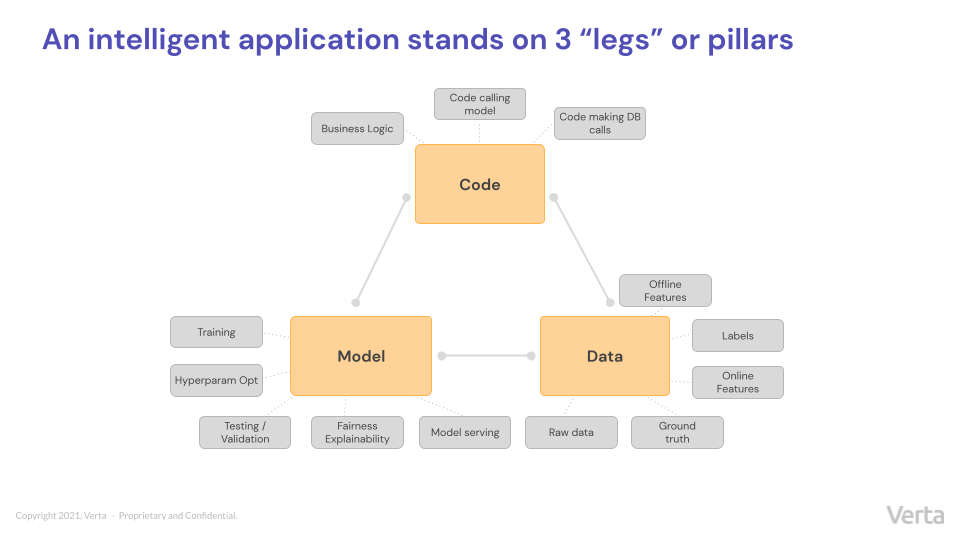
    But innovation is rarely easy or simple—and intelligent applications are no exception. While conventional software involves one thing—code—and not much else, intelligent software relies on a complex relationship between three interconnected variables or legs of a three-legged stool.

    A Three-Legged Stool: DevOps, MLOps and DataOps

    Model:  The one or more AI/ML models (e.g., linear regressions, rules, deep neural networks, etc.) trained to recognize patterns in data and make decisions are what makes an application “intelligent.” 

    Data: Most often, a model is trained on historical data and programmed to emulate it. As a result, an application’s behavior depends heavily on the data—the raw input data, labels and features, as well as the new data to which the model is applied and ground-truth for this data.

    Code: Code is the language an application uses to function. When used in the context of intelligent applications, the code pillar might refer to business logic, calls to models, receiving outputs, decision making and calls to other data systems. 

    A Real-World Example

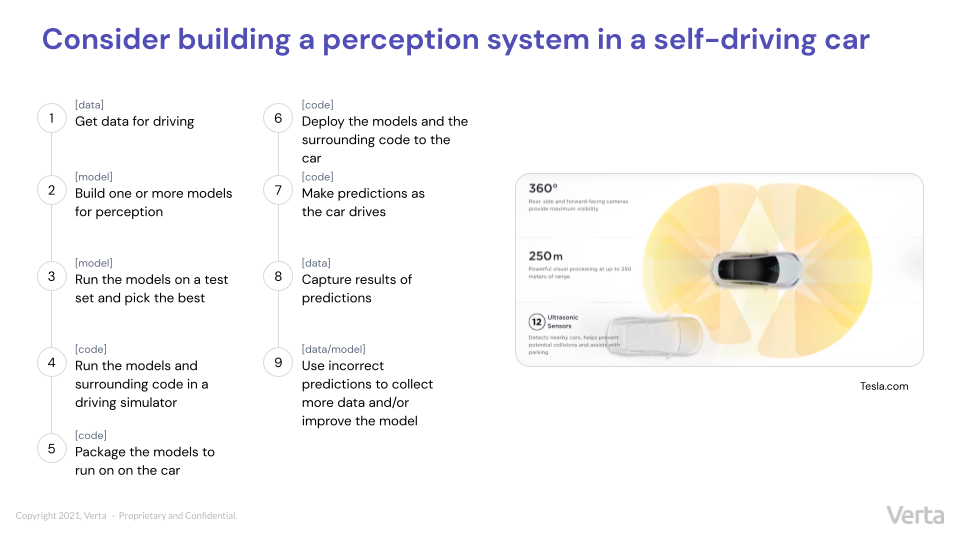
    To see how these pillars play out in real life, consider the example of a perception system for a self-driving car. Such systems use data (provided by offline sources and real-time cameras and sensors), models and code to determine myriad ever-changing variables (for example, if there are obstacles on the road, what lane markings look like, how fast a car can safely travel, etc.) While the following illustration is greatly simplified, it outlines the basic steps needed to build and deploy such a system and indicates which pillar each step belongs to. 

    Regardless of application type, the legs that intelligent applications stand on are always the same: Model, data and code. And if you try to remove any one of them, the application will topple over.

    With the three distinct pillars that make up intelligent applications, three distinct disciplines have emerged to keep each individual pillar functioning as efficiently as possible: DataOps, MLOps and DevOps. The rest of this post examines the details that make each discipline distinct and necessary to the model life cycle.

    DevOps

    Once upon a time, companies used waterfall processes to develop software. The process often moved so slowly that products didn’t realize their potential before they died or were replaced. In 2000, Agile was introduced, allowing developers to work quickly and iteratively in tight sprints where they were constantly delivering. By 2009, Flickr, for example, was the envy of the industry, routinely performing 10+ deploys per day. Companies seeking to increase their own productivity combined software development with established operations principles—and the term “DevOps” was coined. 

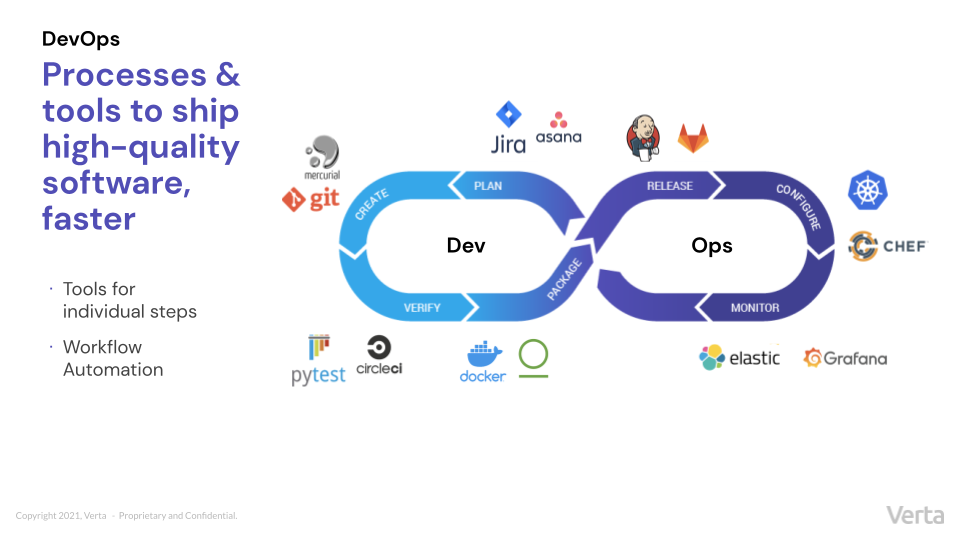
    As the familiar loop graphic below illustrates, the DevOps cycle goes from the planning stages to the creation, testing/verification, packaging, release, configuration, monitoring and then starts over again with planning. Over the past two decades, a host of unique tools have emerged to support individual steps in the DevOps life cycle—helping developers ensure quality by building in continuous integration and continuous testing from the start and helping speed up time-to-market with workflow automation. The DevOps ecosystem is robust, well-thought-out and always iteratively improving.

    MLOps

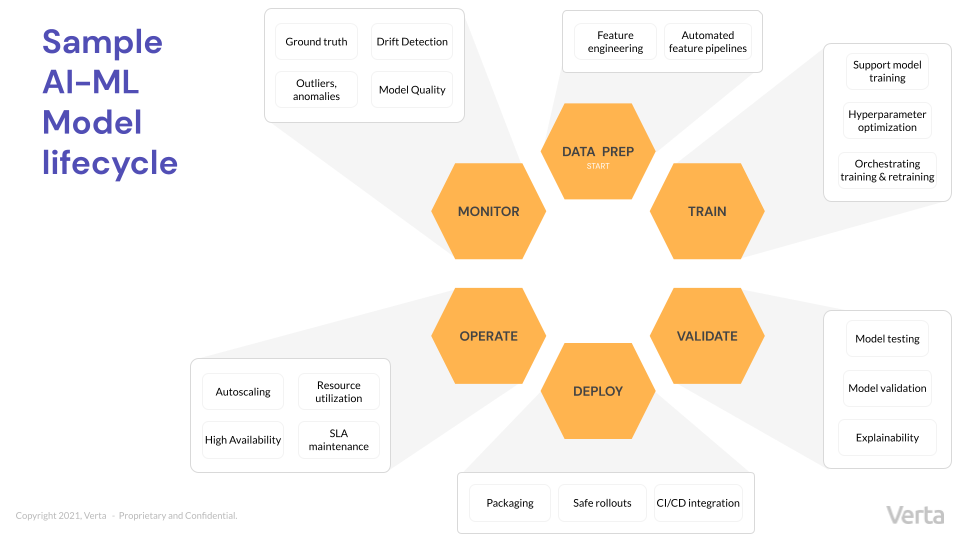
    MLOps helps teams move more quickly and efficiently through the model life cycle—a loop that involves six distinct steps, each of which contains unique considerations. 

    Since MLOps is related to DevOps, businesses sometimes try to adapt the processes used to write conventional software to execute the unfamiliar task of machine learning operationalization. But the approach doesn’t work, as the two disciplines are actually quite different.

    MLOps primarily deals with models, not code—and models are quite different from code. For example, model training and testing look very different from code building and testing. (What does “test case” even mean for a model?) And monitoring model performance is completely different than monitoring traditional software. (DevOps looks at things like CPU utilization, latency and throughput, while MLOps looks at model quality, drift and data quality.)

    Furthermore, the people that MLOps engineers are building for are quite different than their DevOps counterparts. As one might expect, the primary users of models are data scientists while DevOps generally serves software developers. Most often, MLOps engineers come from a background in ML and data science or software engineers who picked up ML. 

    As with DevOps, no single all-inclusive MLOps platform exists. Rather, different tools support different individual steps in the model life cycle and provide some amount of workflow automation to speed up processes. Different tools support specific pieces of the ML life cycle—but the ecosystem is still somewhat fragmented. Ideally, MLOps will evolve to offer more DevOps-like tools that work well together and offer more automation. For companies looking to build an MLOps platform, build a suite of supporting tools with speed, safety and automation in mind.

    DataOps

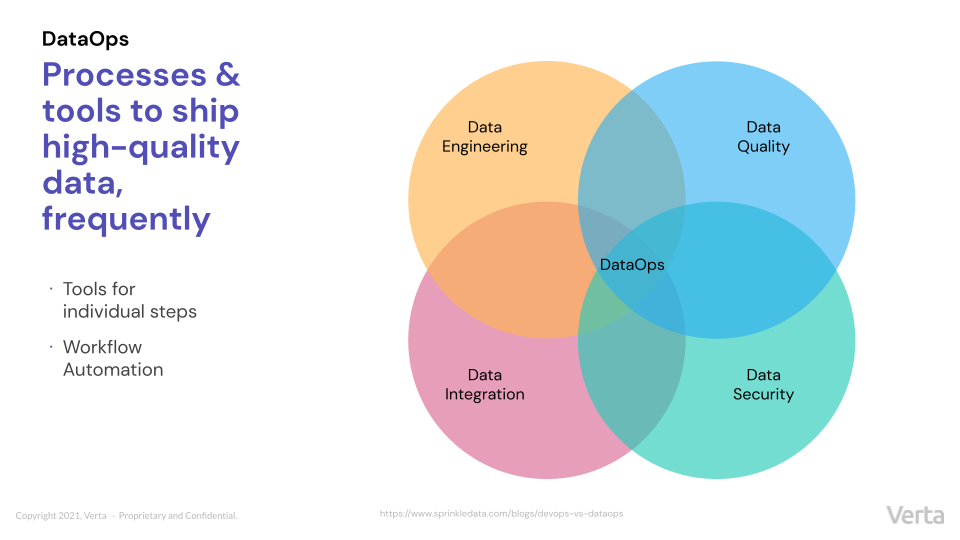
    We’ve seen very well-defined life cycles for the other two pillars discussed above; however, when it comes to DataOps, the life cycle is still being defined. But the overall objective of DataOps should sound familiar: DataOps involves processes and tools to ship high-quality data frequently—which requires a combination of data engineering, data quality, data security and data integration. 

    As with DevOps and MLOps, what the DataOps platform or DataOps engineer is doing is supporting the tools that help perform one of these activities and help build workflows. For example, a workflow may take data from a database, apply some transformation to it and then make it available for a business intelligence (BI) tool. That’s the kind of automation that is involved in DataOps. 

    As you might imagine, the skillset and the tools required for DataOps are quite different from the ones needed in MLOps and DevOps—so expecting a DevOps engineer to also be an expert in DataOps seems a bit unrealistic. While MLOps requires a much tighter integration with data than DevOps historically has required, MLOps is not the same thing as DataOps. More so than the other pillars that support intelligent applications, DataOps tends to be quite separate and distinct. 

    Conclusion

    From perception systems to enterprise-scale fintech software, every intelligent application depends on three distinct disciplines: DevOps, MLOps and DataOps. And therein lies the complexity of developing intelligent products. Each of these fields is distinct, dealing with a different set of questions and objectives within the ML life cycle and requiring different kinds of people and tools. However, they are all fundamentally united by a common goal: Optimizing quality and speed of iteration of the ML life cycle. The tools, practices and organizations that will rise to the top are the ones that will enable more seamless collaboration between different ML teams, helping them move through the ML life cycle quickly and efficiently. 

  • Noetic Cyber and Rumble Partner to Provide Complete Visibility into Organizations’ Cyber Assets and Attack Surface

    Joint solution delivers unique insights into cybersecurity asset management and cyber risk across cloud and on-premises

    Boston, MA, March 9, 2022 — Noetic Cyber, a cloud-based continuous cyber asset management and controls platform, today announced an integration with Rumble Network Discovery, a network discovery and asset inventory solution for IT and OT environments. This partnership gives security teams a complete view of all assets in the organization, across on-premises networks and the cloud, revealing the current security state of all their assets and mapping the critical cyber relationships between them.

    Cyber asset discovery and inventory is a critical building block for any cybersecurity program. As new assets and devices come online, organizations need to employ solutions that provide greater context to the ever-changing nature of today’s digital infrastructure. Noetic’s partnership with Rumble delivers an end-to-end cybersecurity asset management solution that provides security teams with complete asset visibility and automation to address the issues they uncover.

    Rumble is an asset inventory and network visibility solution that can identify managed and unmanaged devices on the network with precision. Co-founded by HD Moore, best known as the creator of Metasploit, Rumble can accurately fingerprint assets–without requiring credentials, agents, or SPAN ports.

    “Cyber risk management is based on having a solid asset inventory, and most companies struggle to discover unmanaged and rogue devices,” said Chris Kirsch, CEO and Co-Founder of Rumble. “Noetic’s integration with Rumble ensures that cyber risk takes into account not only managed devices, but also unmanaged ones that typically have a higher risk factor.”

    Noetic’s powerful automation and workflow engine empowers security teams to drive corrective action. By leveraging Rumble’s unauthenticated active discovery capabilities, Noetic has access to high-fidelity data to combine with other sources help security teams generate a map of the cyber relationship of all their assets, prioritize workload based on cyber risk, correct technical drift and close security coverage gaps.

    Key integration features include:

    • Rapid time-to-value – The Noetic and Rumble connector comes with preconfigured workflows, functions and queries to help accelerate usage.
    • Increase visibility across your environment – Rumble’s unique scanning capabilities uncover unmanaged devices, including orphaned assets and IoT/OT. The Noetic platform uses these insights, together with other security and IT management tools, to uncover policy drift and security coverage gaps across the cloud and on-premises.
    • Find problems once, continuously remediate – Noetic’s comprehensive automation workflow engine makes ongoing asset inventory and remediation simple and less resource intensive.
    • Optimize existing IT and security tools – Updated metadata uncovered by the Rumble and Noetic integration can feed into relevant security and IT management tools to improve efficacy and drive value from existing investments.

    “We believe that this partnership with Rumble will provide our joint customers with the complete cyber asset coverage they need in today’s threat environment,” said Paul Ayers, co-founder and CEO of Noetic Cyber. “By combining proactive network scanning with the correlated insights provided in the Noetic platform, we are able to deliver highly accurate information on the total state of cybersecurity asset management across organizations.”

    For more information on the partnership between Noetic Cyber and Rumble, you can register for the upcoming webinar on March 31st at 12:00pm EST – https://go.noeticcyber.com/rumble-webinar.

    About Noetic Cyber
    Noetic provides a proactive approach to cyber asset and controls management, empowering security teams to see, understand, fix and improve their security posture and enterprise ecosystem. Our goal is to improve security tools and control efficacy by breaking down existing siloes and improving the entire security ecosystem. Founded in 2019, Noetic is based in Boston and London. For more information, visit www.noeticcyber.com, or follow us on LinkedIn or Twitter.

    About Rumble, Inc.
    Rumble was founded in 2018 by HD Moore, the creator of Metasploit, to provide a modern, active discovery tool that finds and identifies everything on a network–without credentials. Rumble is a network discovery and asset inventory platform, purpose-built to help organizations definitively know the networks in use and every device connected to those networks. The company is backed by Decibel Partners, a global venture capital firm backed by Cisco. To see what Rumble can do, try Rumble Professional free for 21 days or sign up for the free Starter Edition.

  • LogicGate Advances Audit Solution, Creating Ultimate Visibility for Holistic GRC

    Risk Cloud’s Audit Applications eliminate silos between risk, compliance, audit teams 

    Chicago, IL, March 9, 2022 — LogicGate®, a leading provider of transformative risk and compliance solutions through its Risk Cloud® platform, upgrades its audit capabilities with bundled Applications and features. LogicGate’s audit upgrade puts the right tools in the hands of internal auditors so they can save time, eliminate redundancy, and collaborate seamlessly across risk, compliance and internal audit functions for smarter decision-making. Internal auditing is an essential part of a holistic GRC program and, with these enhancements, Risk Cloud connects audit to other key areas of a risk management program.

    “With our expanded audit capabilities, we want our customers to be able to tell the full audit story — not just part of it — as audit is critical to a holistic GRC program,” said Jon Siegler, Chief Product Officer at LogicGate. “With these improvements, LogicGate customers have access to a one-stop-shop for all things audit. We’ve automated time consuming tasks and provided more in-depth reporting capabilities. These all equip our customers to better align audit with all risk-related initiatives, adding to the entire GRC story.”

    Internal auditors need to identify problems and correct lapses in compliance workflow and processes before they’re discovered externally and ensure their company meets ever-changing compliance standards. To make that happen, they need agile, personalized functionality that keeps up with the speed of risk. Risk Cloud’s powerful audit solution is built to be customized, with an easy-to-use, drag-and-drop interface so auditors can define granular permissions and roles for each Application, quickly format and pull robust reports, and enable cross-functional collaboration. Furthermore, Risk Cloud critically enables auditors and LogicGate customers to automate mundane tasks while maintaining a single source of truth for controls, assessments, risks, and mitigation.

    Internal auditors rely on software to validate internal processes and meet increasingly complex industry governance standards. This is accomplished through LogicGate’s Risk Cloud Applications and its Risk Cloud Exchange (RCX), an ecosystem designed to inspire risk programs by providing LogicGate customers with a holistic look into the interconnected world of GRC. Customers can utilize the following Risk Cloud Applications for their audit processes:

    • Internal Audit Management Application

    • SOX Control Testing Application

    • CMMC Self-Assessment Application

    • Controls Management Application

    • SOC 2 Compliance Application

    • HITRUST Controls Management Application

    • NIST CSF Assessments Application

    • SCF Control Assessments Application

    To learn more about how Risk Cloud can support internal audit as part of a holistic GRC program, visit LogicGate.com and download LogicGate’s new ebook, How to Make Your Work Life Exponentially Easier With a Holistic GRC Program.

    About LogicGate 

    LogicGate®, creator of the Risk Cloud® platform and Risk Cloud Exchange (RCX), is redefining the way businesses think about risk. Through the proactive management of governance, risk and compliance (GRC) processes via the no-code, agile Risk Cloud, hundreds of customers have improved organizational efficiency, reduced costs and enabled revenue generation and retention. In addition to earning recognition for its technology innovation from Gartner, Forrester and G2, the global company has received accolades from Crain’s Chicago Business, Built in Chicago and the Chicago Tribune for its company culture and was recognized in Inc. 5000 2021.