Tag: DevOps

  • Ahana Announces Additional $7.2 Million Funding Led by Liberty Global Ventures and Debuts Free Community Edition of Ahana Cloud for Presto for the Open Data Lakehouse

    Only SaaS for Presto now available for free with Ahana Community Edition; Additional capital raise validates growth of the Open Data Lakehouse market

    San Mateo, CA, June 16, 2022 — Ahana, the only Software as a Service for Presto, today announced an additional investment of $7.2 million from Liberty Global Ventures with participation from existing investor GV, extending the company’s Series A financing to $27.2 million. Liberty Global is a world leader in converged broadband, video and mobile communications services. This brings the total amount of funding raised to date to $32 million. Ankur Prakash, Partner, Liberty Global Ventures, will join the Ahana Board of Directors as a board observer. Ahana will use the funding to continue to grow its technical team and product development; evangelize the Presto community; and develop go-to-market programs to meet customer demand.

    Ahana also announced today Ahana Cloud for Presto Community Edition, designed to simplify the deployment, management and integration of Presto, an open source distributed SQL query engine, for the Open Data Lakehouse. Ahana Community Edition is immediately available to everyone, including users of the 100,000+ downloads of Ahana’s PrestoDB Sandbox on DockerHub. It provides simple, distributed Presto cluster provisioning and tuned out-of-the-box configurations, bringing the power of Presto to data teams of all sizes for free. Instead of downloading and installing open source Presto software, data teams can quickly learn about Presto and deploy initial SQL data lakehouse use cases in the cloud. Community Edition users can easily upgrade to the full version of Ahana Cloud for Presto, which adds increased security including integration with Apache Ranger and AWS Lake Formation, price-performance benefits including multi-level caching, and enterprise-level support.

    “Over the past year we’ve focused on bringing the easiest managed service for Presto to market, and today we’re thrilled to announce a forever-free community edition to drive more adoption of Presto across the broader open source user community. Our belief in Presto as the best SQL query engine for the Open Data Lakehouse is underscored by our new relationship with Liberty Global,” said Steven Mih, Cofounder and CEO, Ahana. “With the Community Edition, data platform teams get unlimited production use of Presto at a good amount of scale for lightning-fast insights on their data.”

    “Today we’re seeing more companies embrace cloud-based technologies to deliver superior customer experiences. An underlying architectural pattern is the leveraging of an Open Data Lakehouse, a more flexible stack that solves for the high costs, lock-in, and limitations of the traditional data warehouse,” said Ankur Prakash, Partner, Liberty Global Ventures. “Ahana has innovated to address these challenges with its industry-leading approach to bring the most high-performing, cost-effective SQL query engine to data platforms teams. Our investment in Ahana reflects our commitment to drive more value for businesses, specifically in the next evolution of the data warehouse to Open Data Lakehouses.”

    Details of Ahana Cloud for Presto Community Edition, include:

    • Free to use, forever
    • Use of Presto in an Open Data Lakehouse with open file formats like Apache Parquet and advanced lake data management like Apache Hudi
    • A single Presto cluster with all supported instance types except Graviton
    • Pre-configured integrations to multiple data sources including the Hive Metastore for Amazon S3, Amazon OpenSearch, Amazon RDS for MySQL, Amazon RDS for PostgreSQL, and Amazon Redshift
    • Community support through public Ahana Community Slack channel plus a free 45 minute onboarding session with an Ahana Presto engineer
    • Seamless upgrade to the full version which includes enterprise features like data access control, autoscaling, multi-level caching, and SLA-based support

    “Enterprises continue to embrace ‘lake house’ platforms that apply SQL structures and querying capabilities to cloud-native object stores,” said Kevin Petrie, VP of Research, Eckerson Group. “Ahana’s new Community Edition for Presto offers a SQL query engine that can help advance market adoption of the lake house.”

    Supporting Resources:

    Get Started with the Ahana Community Edition

    Join the Ahana Community Slack Channel

    Tweet this:  @AhanaIO announces additional $7.2 million Series A financing led by Liberty Global Ventures; debuts free community edition of Ahana #Cloud for #Presto on #AWS https://bit.ly/3xlAVW4

    About Ahana

    Ahana is the only SaaS for Presto on AWS with the vision to be the SQL engine for the Open Data Lakehouse. Presto, the open source project created by Meta and used at Uber, Twitter and thousands more, is the de facto standard for fast SQL processing on data lakes. Ahana Cloud delivers the easiest Presto SaaS and enables data platform teams to provide high performance SQL analytics on their S3 data lakes and other data sources. As a leading member of the Presto community and Linux Foundation’s Presto Foundation, Ahana is also focused on fostering growth and evangelizing open source Presto. Founded in 2020, Ahana is headquartered in San Mateo, CA and operates as an all-remote company. Investors include GV, Leslie Ventures, Lux Capital, Third Point Ventures, and Liberty Global Ventures. Follow Ahana on LinkedIn, Twitter and Presto Slack.

  • How to Securely Manage Secrets Within Jenkins

    How to Securely Manage Secrets Within Jenkins

    The continuous integration and continuous delivery (CI/CD) pipeline is a fundamental component of the software delivery process for DevOps teams. The pipeline leverages automation and continuous monitoring to enable seamless delivery of software. With continuous automation, it’s important to ensure security for every step of the CI/CD pipeline. Sensitive information like access credentials is often necessary at various stages of the pipeline. Securing this information is vital to maintaining a strong security posture. This post discusses how to secure secrets within Jenkins CI/CD pipelines.

    Using Secrets in CI/CD Pipelines

    As previously mentioned, CI/CD pipelines often need access to sensitive information like passwords and API keys. Hardcoding them in plaintext represents a critical security risk and violates auditing guidelines in most compliance frameworks. A mechanism to make use of these credentials without exposing them unnecessarily is important for automating software delivery.

    The collection of tools and techniques used to store, manage, and access these credentials securely is known as secrets management. Secrets are broadly used in IT, DevOps, and cloud environments.

    Secrets include:
    ● App-generated passwords
    ● System-to-system passwords
    ● API keys
    ● Private encryption keys
    ● One-time passwords
    ● Certificates
    ● Privileged account credentials

    CI/CD pipelines integrate multiple configuration management platforms, requiring secrets to enable service-to-service communication. These platforms also need secrets to authenticate entities requesting access to SSH servers, databases, HTTP services and other resources.

    The Purpose of Secrets in CI/CD

    Secrets are used to manage access permissions for entities within the CI/CD pipeline. Some use cases include source control management, infrastructure connection, collaboration providers and verification. Let’s discuss each of these use cases in more detail.

    1. Source Control Management
    Version control systems, such as Git, foster collaboration between multi-personnel teams. These systems help maintain cohesive application development by managing and storing code contributions from multiple developers. Since source code can comprise some of an organization’s most valuable assets, it is important to properly authenticate and manage access permissions for Git repositories.

    Secrets management systems are important in securing credentials used to connect contributors’ machines to the repositories. The secrets themselves are not stored within version control, as malicious users can access them and orchestrate security attacks. Instead, they are stored in special, sensitive files that are designed to be excluded from the repository’s storage and logs.

    2. Infrastructure Connection
    CI/CD pipelines are often composed of different services residing on multiple hosts distributed across a disparate infrastructure. These hosts constantly communicate with each other, as well as with services through API calls, to achieve the required application functionality. Secrets such as API keys and system-to-system passwords enable a secure connection between the infrastructure running these services, allowing for multi-tenant and multi-cloud CI/CD pipelines.

    3. Collaboration Providers
    CI/CD pipelines encompass collaborative activity across multiple development, operations and quality assurance environments. These teams rely on multiple tools and frameworks to collaborate and share information. Using secrets for collaboration helps teams ensure secure communications and provides a layer of trust between both parties.

    4. Verification
    Identity verification is a crucial element of CI/CD and application security. Secrets are used to ensure security and privacy for CI/CD pipelines by connecting applications to identity and access management (IAM) solutions. These solutions provide an external database of user roles and permissions, letting users log in to the applications without exposing their credentials within the CI/CD pipeline.

    Examples of Secrets Usage in CI/CD

    To set the stage for improving secrets management, it’s helpful to understand some simple use cases. In this section, we’ll provide some basic examples of CI/CD configuration that requires access to sensitive credentials or other data for functionality.

    1. AWS Credentials
    As one of the leading cloud SaaS platforms, AWS is a common choice for most cloud-based infrastructures. Interacting with the AWS API to provision and query resources typically requires the use of a secret key/access key credential pair. Protecting these credentials is critical to maintaining the security of an AWS account.

    2. Infrastructure-as-Code (IaC)
    Modern application architecture often depends on infrastructure as code (IaC) to deploy the underlying systems that the workloads run on. Codifying this configuration makes it much easier to maintain a repeatable, scalable and secure infrastructure. In the course of provisioning this infrastructure, engineers will often need to deploy sensitive information to the nodes, such as SSH keys and API credentials. Automating infrastructure provisioning via IaC and CI/CD is a common pattern and managing secrets is an important component of that workflow.

    3. Environment Variables
    Environment variables, a common convention for configuring processes on a computer, see consistent usage in most CI/CD pipelines. The ability to dynamically set values and retain them for consumption by other processes and scripts is a powerful abstraction when dealing with CI/CD workflows. In many cases, sensitive values will need to be passed via environment variables, again highlighting the need for effective secrets management.

    Securing Secrets Within Jenkins

    Jenkins requires access to a large number of credentials to interface with all the platforms and applications that make up a complete CI/CD pipeline. Jenkins ships with a default credentials plugin that offers a built-in secrets store. It also comes with the credential binding plugin which enables the binding of credentials to environment variables.

    Storing secrets in the Jenkins controller enables applications in the pipeline to reference secrets multiple times, even when they’ve only been created once. While the Jenkins credentials plugin offers a simple way to store and manage secrets, any Jenkins administrator and pipeline author can access them. Therefore, DevOps teams should ensure proper configuration of access rights to keep the CI/CD pipeline secure.

    This section discusses some of the available options for securing secrets in Jenkins.

    Types of Secrets Jenkins Accepts

    Credentials supported by the Jenkins secrets plugins include: Secret text, username/password pairs, secrets file, SSH username and certificates. For a limited number of secrets, these can be stored individually, whereas a large number is typically best managed with a credentials file.

    Managing Secrets in Jenkins

    If you’re ready to inject secrets safely into your Jenkins pipelines, follow these best practices.

    1. One-Time Passwords (OTPs)
    One-time passwords help prevent user account takeovers by ensuring that a username-password combination can not be used more than once. While the account retains the username throughout, the user is sent an OTP every time they log in. This keeps Jenkins administrators’ and users’ accounts safe, preventing secrets from being exposed to unwanted individuals.

    2. Avoid Hard-Coding Secrets
    Remove any secrets that have been hardcoded into CI/CD configuration and Jenkinsfiles. This keeps sensitive credential information away from the pipeline, making it inaccessible to malicious actors.

    3. Reduce Attack Surface by Storing Secrets in Multiple Jenkins Files
    Storing secrets in multiple files helps enforce the principle of least exposure for credentials. This makes credentials available to the minimum number of applications and users possible.

    4. Use Authorization Controls to Manage Secrets Permissions
    Developer teams should configure security checks to ensure the application requesting resource access has the properties of a valid application. These applications should be able to access various resources based on permissions assigned in RBAC policies.

    5. Follow the Principle of Least Privilege
    Only grant permissions to applications that absolutely need access to secrets within the pipeline. Teams should consistently audit permissions to maintain the principle of least privilege throughout the pipeline’s lifecycle.

    Managing and Storing Secrets

    This section walks through three basic examples of actually using Jenkins with secrets and the Akeyless secrets management platform.

    ● The first example will highlight a completely insecure example: Using plaintext environment variables to store sensitive credentials.
    ● The second example will focus on using native Jenkins features and plugins for secrets management.
    ● The third example will show some of the benefits of using a third-party tool for secrets management.

    Plaintext example
    To get started, we’ll create a basic “freestyle” project in Jenkins, and connect it to a GitHub repository:


    Figure 1: Project creation

    Regardless of how we choose to manage our secrets in code, it makes sense to use the Jenkins built-in mechanism for credentials to access the GitHub repository:

    Figure 2: Configuring GitHub credentials

    Our actual code will be a very basic Python application that makes an API call. The API requires a simple API key in the form of a text string for authentication:

    #!/usr/bin/env python
    import os
    import requests
    api_key = os.environ[‘API_KEY’]
    response = requests.get(“https://thedogapi.com/v1/breeds?api_key={}”.format(api_key))
    print(response)

    Jenkins provides the ability to configure environment variables; however, without additional plugins, they can only be set globally to the Jenkins environment or instance:
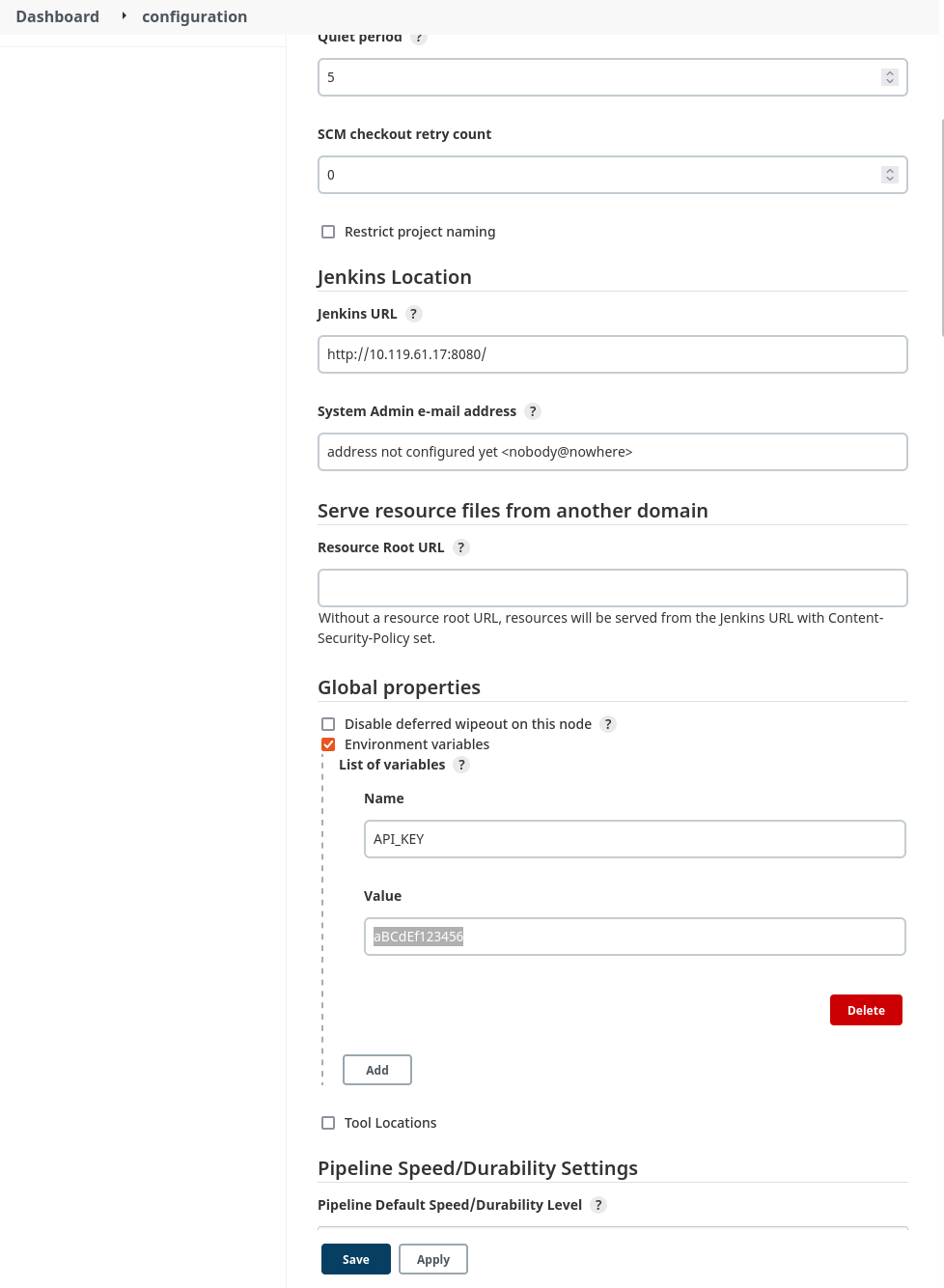
    Figure 3: Configuring a global environment variable

    The code will read the API key from the environment variable that was just configured. Here’s the configuration for the build steps:
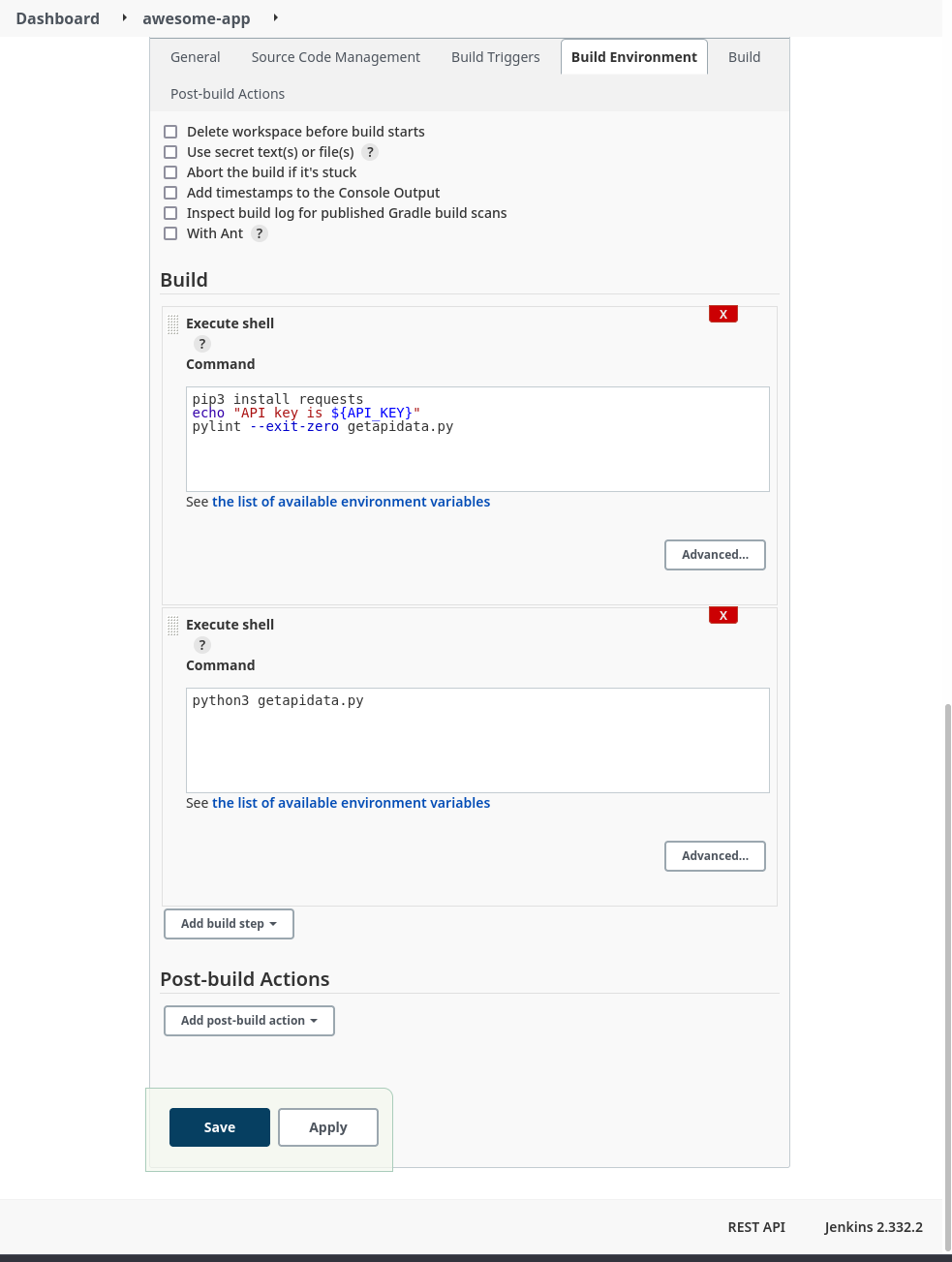
     

    Figure 4: Build configuration

    The build steps run some simple linting and then actually execute the code. Here’s a look at part of the log from a successful build:


    Figure 5: Build log with exposed secret

    The API key has obviously been exposed in a plaintext log with a simple directive in one of the build steps. A minor misconfiguration could potentially cause a breach or compromise.

    Jenkins Secret Text Example

    Now we can try to improve the security of our build environment by using the built-in credentials handler:


    Figure 6: Configure build environment to use secrets

    In this example, we’ll use a simple “Secret text” credential binding to store the API key:


    Figure 7: Adding a secret credential

    Next, we configure our build job to use the new credential variable:


    Figure 8: Updated build configuration

    Now, after running another build job, we check the build logs again:
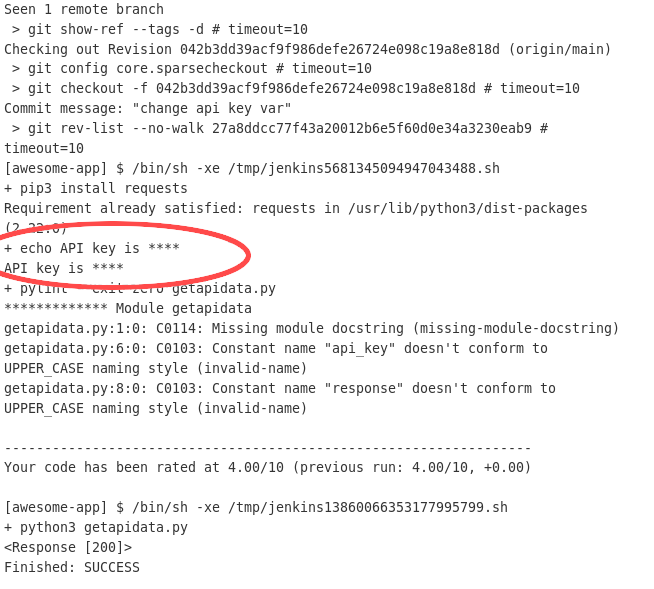
     

    Figure 9: Build job with obfuscated secret

    Even though we configured the build step to print the variable contents to the log, the Jenkins credential handler knows that the value is sensitive and obfuscates the actual value in any log or output.

    Although this measurably improved the security of the build, there are some caveats. While this works well enough for a small Jenkins deployment with a limited number of users, managing access and correct permissions scoping for multiple users and teams across a large, distributed Jenkins architecture quickly becomes complicated and difficult to manage effectively. In addition, the secret value stored in the credential variable is still accessible to every Jenkins instance in the cluster, as well as any user with the appropriate permissions.

    If any node is compromised, secrets across multiple deployments and contexts could be at risk. Users still have to manually secure and configure Jenkins infrastructure that now doubles as secrets storage. What if there were a way to use sensitive credentials without ever having to store them in Jenkins itself?

    Secrets Management Tool Example

    Let’s try using Akeyless to manage our secrets. Since we’re integrating with a Jenkins deployment, we can follow the documentation for working with Jenkins. Akeyless integrates with the publicly available Hashicorp Vault plugin, so it’s simple to get Jenkins set up.

    Next, we’ll create a free account with Akeyless, and configure a secret:

    Figure 10: Creating a secret in Akeyless

    Figure 11: Creating a secret (cont).

    The next step is to create an Access Role that has permission to access the secret that was just created:

    Figure 12: Create a role

    Now we need to give our Access Role the correct permissions to view the secret:

    Figure 13: Giving the role permissions

    The last thing we’ll need to create on the Akeyless side is an authentication method. This is how we can give external entities, like our Jenkins deployment, the ability to make API calls to Akeyless and retrieve secrets:

    Figure 14: Create an auth method

    Once the authentication method has been created, be sure to save the Access ID and key by downloading the CSV file; the values will not be displayed again otherwise. Finally, we need to associate our newly created role with this access method:

    Figure 15: Associating the auth method with the access role

    The next step is to configure the Jenkins build environment according to the Akeyless documentation referenced in a previous step:

    Figure 16: Jenkins build configuration with Akeyless

    Now we’ll run another build, this time configured to utilize the Akeyless vault we’ve configured:

    Figure 17: Build log with Akeyless configuration

    In the logs, there is now a step present where Jenkins retrieves the secret from the Akeyless Vault. The credential value is also still obfuscated in the build log. We’ve now got a working, third-party secrets management platform integrated with our Jenkins instance.

    It may seem like extra steps just to achieve the same outcome, but an external tool focused entirely on secrets management is a powerful abstraction. Jenkins is a CI/CD tool first and foremost, with secrets management provided as an add-on. In that context, it will never be able to provide the first-class features, management capabilities, and security guarantees that a dedicated secrets management platform can:

    ● Managed infrastructure with SLA guarantees
    ● Zero-knowledge encryption
    ● Intuitive, accessible secrets management and organization
    ● Integration with industry-standard DevOps tools and platforms

    A tool like Akeyless also does away with having to manage complex, self-hosted infrastructure. We were able to have a working secrets endpoint in just a few clicks.

    Conclusion

    Since security is a top consideration for CI/CD pipelines, it is important to follow best practices when using secrets in Jenkins. Jenkins pipelines rely on secrets for identity verification, collaboration, and infrastructure management. CI/CD secrets management presents a challenge for most teams because of how complex it is to implement access control at a granular level.
    With a secrets management tool, Jenkins users get a centralized and secure resource to manage the many credentials that are required to operate CI/CD pipelines. They benefit from using a simplified, standardized approach to access all secrets they need, without worrying about security. Simply put, a secrets manager accelerates DevOps workflows.

    Meanwhile, security teams benefit by gaining full visibility into where secrets are, and how they are used. With automated processes and centralized access policies, a secrets management platform helps security teams stay compliant with security regulations as well.

  • Indoor Robotics Raises $15 Million in Series A to Revolutionize Building Monitoring and Security Practices

    Tel Aviv, ISRAEL, June 15, 2022 – Indoor Robotics, an indoor drone technology company that recently launched Tando™ drone, announced the closing of a $15 million in series A funding. The round of funding was led by Pitango and included Target Global, European Innovation Council Fund, and Spider Capital. This round enables Indoor Robotics to boost product development and enable intelligent indoor security worldwide.

    Developing an autonomous indoor security robot has challenged robotics designers for years. While some ground-based robots are commercially available, ordinary items like a chair or a step can prevent them from fully securing an area. Indoor Robotics’ Tando™ uses multiple sensors and proprietary algorithms to accurately map and navigate in any indoor space, allowing it to autonomously navigate above or around any items in its path, enabling it to secure and monitor large areas.

    “We reimagined what a drone was capable of and combined human-like capabilities with AI tools to enable next-generation security and monitoring,” said Doron Ben David, co-founder, and CEO of Indoor Robotics. “Tando has already been deployed by the world’s leading enterprises and security monitoring companies and is making a tangible impact on safety and security.”

    Tando™ docks on the ceiling and functions as a security camera when not in flight. In addition to office buildings, it is currently being used to secure and monitor warehouses, data centers, malls, and retail establishments by well-known enterprises.

    These funds will enable Indoor Robotics to move into full production and develop its go-to-market strategy. “We seized the opportunity to increase our investment in Indoor Robotics following the successful launch of Tando™ and the team’s demonstrated ability to surpass critical milestones,” said Rami Kalish, managing partner at Pitango. “Indoor Robotics’ proven capabilities have generated exciting demand from the market, which the investors are excited to facilitate.”

    In addition to security functions, Tando™ drives significant safety and operational improvements. It is capable of collecting thermal imaging data and environmental data, as well as recording temperatures of rooms and identifying leaks. It also enables preventive maintenance, identifying areas in buildings that require care.

    Doron Ben David and Amit Moran founded Indoor Robotics in 2018. Ben David had left his role as CTO of Israel Aerospace Industries’ Space Division when he began to collaborate with Moran, former Head of Robotics Innovation at Intel. They set their attention to drones, looking for areas where they could outperform human beings. They recognized that drones were ideal for security, an industry that suffers from 300% employee turnover, is vulnerable to fatigue and human error, and pays minimum wage to guards tasked with protecting valuable assets.

    The drone fits in line with the company’s mission to boost the quality of life by enabling a seamless, comfortable indoor experience through task-oriented robots.

  • Zebrium Launches Root Cause as a Service Enabling Popular Observability Tools to Automatically Find the Root Cause of Software Problems and Outages

    RCaaS Slashes Mean-Time-to-Resolve by 90 percent and has a validated accuracy rate of over 95 percent

    Santa Clara, CA – June 15, 2022 – Zebrium, the leader in the use of machine learning to automatically find the root cause of software problems, today announced that it has launched Zebrium Root Cause as a Service (RCaaS), a new solution that adds the capability for monitoring and observability tools such as Datadog, New Relic, Elastic, Dynatrace, Grafana, AppDynamics, ScienceLogic, and others to automatically find the root cause of software and infrastructure incidents. 

    When an incident with production software occurs, Zebrium RCaaS automatically finds the root cause and presents a summary of the problem directly on existing monitoring dashboards, alongside other charts showing metrics, traces and APM data. This allows Site Reliability Engineers (SREs), DevOps personnel and developers to reduce the Mean-Time-to-Resolve (MTTR) software or infrastructure problems by 90 percent. 

    Today, when technical teams encounter a new service outage or problem, they typically rely on observability tools to facilitate the troubleshooting process. Without Zebrium, this involves looking at metrics to determine “when” the problem started, drilling-down on traces or APM data to narrow down the source of the problem (the “where”), and finally combing through large volumes of logs from the application and infrastructure stack to determine the root cause (the “why”). This process can take many hours and requires extensive team resources while critical services remain impacted. Now with Zebrium RCaaS, the painstaking process of digging through logs is automated. The end-result is that RCaaS quickly uncovers the root cause indicators that technical teams would have eventually found by manually combing through logs. 

    RCaaS has a validated accuracy rate of finding the correct root cause in over 95% of incidents. “The Cisco Technical Assistance Center (TAC) spends thousands of hours each month analyzing software logs to find the root cause of customer incidents,” said Koree Mires, Director, Global TAC Innovation, Automation and Disruption at Cisco Systems.  “We had been investigating ways to help automate this process for many years. When we came across Zebrium, we were immediately impressed. In order to validate its effectiveness, we tested RCaaS with four product lines and 192 actual customer incidents. We were astonished to find that RCaaS correctly found the root cause automatically over 95 percent of the time. We are now leveraging the technology to speed-up customer incident resolution and will continue rolling it out to more product lines throughout the year.”

    Zebrium RCaaS is designed to make the details of root cause available in the same tools and workflows that SREs, Devops engineers and developers are already using. RCaaS has complete “out-of-the-box” integrations with popular observability and monitoring tools, including Datadog, New Relic, Elastic, Dynatrace, AppDynamics, Grafana, ScienceLogic and others. It also natively integrates with incident management and response platforms including PagerDuty, Opsgenie, Victorops, Slack, Teams and email systems. Additional 3rd party tools can also easily be integrated through a set of open-APIs.

    “The cost of downtime keeps rising, and throwing engineers at the problem is not a scalable solution,” said Ajay Singh, CEO, Zebrium. “Since speed and accuracy are essential when software teams need to resolve application incidents, the only way forward is an automated approach to Root Cause Analysis (RCA). Zebrium RCaaS is a proven way to do this. Since our platform does not require any manual training or rules, customers can get started in just a few minutes, and leverage RCaaS almost any kind of observability tool already in place.”

    Zebrium RCaaS is now available for purchase directly from Zebrium or in the Datadog and AWS marketplaces. For more information or to sign-up for a free trial, visit https://www.zebrium.com. 

    Supporting quotes from Zebrium partners:

    Alex Vetras, Senior Product Manager at Datadog.

    “We are thrilled to have Zebrium as a Marketplace partner. Zebrium’s native Datadog app helps organizations identify the root cause behind outages by analyzing ingested logs to detect anomalies. Together with Datadog’s Watchdog capabilities, DevOps and SRE teams can now be notified of what went wrong and why, automatically.”

    Peter Pezaris, SVP, Strategy and User Experience at New Relic:

    “Application issues are frequently discovered in production and require all hands on deck to triage and resolve the problem. When an outage occurs, engineers also need to be able to get to the root cause of why, when, and where the service failed in order to prevent future incidents. With the Zebrium quickstart for New Relic, we’re providing our customers with a valuable tool that helps them avoid manually searching for root cause indicators in logs, and surfaces the root cause right in their New Relic dashboard. This helps engineers reduce their MTTR and find the root cause of software incidents faster.”

    Erik Rudin, Vice President of Technical Alliances and Ecosystems at ScienceLogic:

    “The Zebrium integration for ScienceLogic complements our AIOps and monitoring platform by automatically finding the root cause of incidents that would otherwise require manual log analysis.”

  • 5 Tips If You’re the First SRE Hire

    5 Tips If You’re the First SRE Hire

    Site reliability engineers (SREs) have a considerable set of tasks to juggle no matter where they work or how long their company has had an SRE practice. But if you’re the very first one to join an organization—as many SREs are these days, given that the trend is trickling down into smaller and smaller companies—you face a special group of challenges.

    You may find it difficult to get buy-in for SRE from other technical teams. You may struggle to know how to convince your boss that the company’s decision to hire an SRE is paying off. You probably worry that you’ll end up being overextended because you are the only SRE. And so on.

    These five tips are for site reliability engineers who find themselves in the position of being the pioneer at their companies. Whether you’re an experienced SRE who has just been hired at a company that had none previously or you’re brand-new to SRE and your first job happens to be at a company that is also brand-new to the SRE role, the following best practices will help you make the transition as smooth as possible for all involved.

    Collect SRE Metrics Early and Often

    For starters, you’ll want to be prepared to justify the business’s investment in your new role as soon as a boss or fellow engineer asks.

    Do this by collecting metrics about the technical and business impact of SREs starting as early as you can. Your goal should be to quantify how you are benefitting the organization so that you can encourage more support for yourself and any others who may be hired after you.

    On top of this, collecting metrics is also important for establishing early feedback about which SRE strategies are succeeding and which could be improved. Since you’re building an SRE practice from scratch, getting this insight early and often is critical.

    Treat Devs and IT Engineers Equally

    As you start the role, you may find some uncertainty among existing engineers about whose ‘side’ you are on. Are you there to support developers or IT engineers?

    The answer, of course, is both. Although SREs tend to borrow from software engineers’ playbooks more than they do from those of IT Ops, an SRE’s goal should be to empower and support both of these teams. So, unless you’re given explicit instructions to interface with only one group or the other, make yourself everybody’s buddy within the IT organization.

    Introduce Yourself to Non-Technical Teams

    SREs spend most of their time doing technical things with technical tools. But ultimately, the only reason they are doing what they do, in most cases, is to support non-technical users by improving the reliability of the systems they use.

    As the first SRE at a company, it may be well worth your time to get to know these non-technical stakeholders and ask them what they see as the greatest reliability issues in the organization. Building these relationships early on will help you communicate the value of your role across the organization. It’s also likely to come in handy during incident management routines, when you may need to interface with non-technical stakeholders as well as other engineers.

    Build Your SRE Tool Set

    Deciding which tools to use is an obvious early step for any SRE who is building a practice from scratch. But we didn’t put it first on this list because it’s important to get to know the rest of the organization before committing to a particular set of tools.

    As you meet the rest of the organization, ask detailed questions about which tools they use to address needs like observability, security and incident management. Then, by factoring in feedback about which tools work well and which don’t, choose which tools you’ll deploy to support SRE. Be prepared for those tools not to match your own personal preferences perfectly. You may need to prioritize the preferences of the rest of the organizations.

    Plan to Grow the Team

    Unless you have been hired at a very small company, it’s likely that the business plans to hire more SREs over time (assuming that you prove the value of the position, of course).

    Toward that end, plan for how the team will expand. Think about things like whether to use embedded SREs or create a dedicated SRE team. Think, too, about how you’ll document your company’s SRE practice and ensure it keeps operating smoothly as individual engineers come and go.

    Conclusion

    The job of a newly hired SRE is not an easy one, especially if you’re the first person at your company to fill those shoes. But by being deliberate and strategic about how you work, which data you collect and how you introduce the company to SRE, you set yourself – and your future colleagues – up for success.

  • Why is Security Still in the Way? A Look at DevSecOps Right Now

    Why is Security Still in the Way? A Look at DevSecOps Right Now

    According to industry trend reports for 2022, DevSecOps is now considered to be one of the most effective approaches to building software quickly and securely. This effort, of course, means development, security and operations teams commit to addressing security as early as possible in the software development life cycle (SDLC). The goal of the shift into DevSecOps revolves around the need for more automation, streamlined CI/CD pipelines, less friction among teams and plenty of time for productive innovation. Incorporating DevSecOps practices into an organization unites security, compliance and development issues into a collaborative concern, one that allows DevOps to move fast without jeopardizing code quality. 

    As we approach the middle of 2022, it’s worth looking back and considering why security is still standing in the way of smooth software development. Security vulnerabilities have always been present in the process, and yet these pesky bugs continue to be the biggest threat to software performance. The question is, why?

    The Truth About Security

    Software has always been deployed and shipped with some existing bugs. But as software and services continue to dominate our everyday lives, the reality of this statement continues to plague both businesses and the end user. On some level, software development has yet to evolve into the next phase of security. Code is still rolled out regularly, only to discover security vulnerabilities in production. Some say the way software is developed today actually lends itself to defects, mostly because the pace of work required supersedes best practices around AppSec. 

    While the larger cybersecurity industry—and every DevSecOps team in the world—is striving to make software more secure, many organizations still prioritize speed and productivity over digital risk. This means the state of security (and, to some extent, the DevSecOps world) has become somewhat lopsided, with some enterprises making great efforts while others embrace a more lackadaisical approach. To make matters worse, many professionals today believe there has been a general under-investment in cybersecurity over the past several decades. 

    The Next Phase of DevSecOps

    The shift to remote and hybrid work models has led to mass adoption of cloud technologies and digital transformation, across all sectors and industries. As a result of this evolution, organizations today need to bear in mind that the more services they use, the more digital threats and overall risk they face. As this exposure to vulnerabilities increases, so does the need for new approaches to security. 

    The majority of modern enterprises do, in fact, have a security process in place, as well as other risk management solutions. But with the cybersecurity reckoning of 2021 and the stakes of cloud computing being higher than ever, businesses right now are feeling the pressure to think long and hard about why security still isn’t a guarantee. The trend of slowing down software development to address security more thoroughly, also known as the secret sauce of DevSecOps, is not free from roadblocks—but it is also far from optional. For many organizations, the implementation of DevSecOps practices feels less like security and more like speed bumps that just slow down the shipping of software. 

    Even so, the effort to improve security is happening now. Organizations do not need several solution platforms or tools to get started. They can begin right away; evolving their security tools and practices as they grow the business. With this growth comes one of security’s biggest challenges—scalability. Because toolchains across the cloud have become more and more complicated, setting policies and/or workflows in one tool is challenging. While these issues can be largely addressed by the adoption of an end-to-end security solution, organizations must continue to focus on strengthening supply chains, improving security oversight, and bolstering their approach to DevSecOps. Some ways to make this happen include:

    • Making sure CI/CD pipelines are integrated with DAST and SAST testing in development
    • Ensuring developers and DevOps teams complete vulnerability scanning before commit or merge, as they write code
    • Minimize manual security as much as possible with automated AI/ML tools to support more effective scanning and monitoring
    • Invest in management solutions that improve security in a multi-cloud environment

    Addressing the Supply Chain

    According to an industry survey, 60% of companies have decided securing the software supply chain should be a top priority for 2022. When we think about software supply chain attacks, we need to think about better controls to validate its integrity through all stages of the SDLC. Obviously, DevOps and automation have provided considerable help in this area; however, they cannot pull all the weight of security without proper governance and guardrails. 

    With a secure supply chain comes better security, as well as compliance, privacy and transparency. When a supply chain is secure, it can automatically enforce policy requirements for things like instrumentation, testing and architecture. As a result, software development and deployment become a repeatable process that is also reliable. Teams across the organization can rest assured that the products and services they are building comply with security expectations, such as validating code before production with static analysis and scanning tools. 

  • When DevOps-as-a-Service (DaaS) Meets Security

    When DevOps-as-a-Service (DaaS) Meets Security

    One of the most recent IT methodologies to be offered as a service is DevOps, a cultural and practical approach that brings development and operations teams together under one umbrella of work. DevOps-as-a-Service (DaaS) ensures that everything related to the selection, management and maintenance of DevOps tools and infrastructure, including all policies and procedures, are addressed through a centralized team who are able to provide this service to development teams across the organization. 

    From a 30,000-foot view, DaaS represents DevOps capabilities made accessible to practitioners through portals and APIs. Because DevOps capabilities vary among organizations, there is no standardization of these services. For the business, DaaS enhances competition. Application users and developers find DaaS improves overall software development, while specialized DaaS teams say it improves the management of DevOps capabilities.

    What Are the Other Benefits of DaaS?

    DaaS offers many benefits, especially to development teams who no longer want to spend all their time configuring and deploying the necessary security tools to run DevOps pipelines. This means it’s no longer necessary to understand all the differences between DevOps tools and the underlying infrastructure, as the appropriate tools and technologies are automatically deployed for development teams. As a result, developers are able to focus their efforts on creating innovative software at the speed of business. 

    Further, Daas delivers clear business and operational benefits in the form of a more streamlined process for facilitating DevOps across the enterprise. Daas supports governance while also enabling centralized oversight and visibility into development workloads and productivity. As we know, this shift leads to increased accountability among teams and an overall optimization of business processes. Add on resource efficiency and cost savings through tool selection, and it’s easy to see why DaaS has found a home in the world of software development. 

    But despite the benefits, Daas also presents new security challenges that can’t be fully addressed by traditional management solutions. These approaches are often sluggish, expensive, and/or incredibly complex to manage.

    What About Security and DevSecOps?

    Because the principles of DevSecOps proactively address the risks and threats associated with DevOps processes, it has seen rapid adoption in recent years. By integrating AppSec tools and strategies within a DevOps pipeline, developers are able to find and fix security vulnerabilities earlier within the software life cycle—not after the fact. This ability is what allows developers to generate secure and high quality software from the beginning, while also preventing any deployment delays stemming from last-minute security checks in production. With DevSecOps processes in place, AppSec testing becomes seamless and transparent for developers, who need a frictionless experience to facilitate steady and reliable software development and deployment. 

    DevSecOps is a  natural fit for the as-a-service delivery model. Similar to DevOps, AppSec involves various tools, policies and processes that demand a certain degree of professional expertise—not to mention the time and resources it takes to to select, maintain, and deploy them to drive DevSecOps practices. Security and development teams looking to  implement and manage DevSecOps can reap major benefits from a centrally defined and managed process, to be administered by a specialist team and delivered “as a service” to those in charge of DaaS.

    Standardizing AppSec through a DevSecOps-as-a-Service offering would guarantee security is applied evenly across all DevOps activity, thereby allowing businesses to produce secure and high-quality software consistently while also supporting AppSec compliance demands. This shift also establishes a foundation where a holistic and homogenous view of AppSec can be found, one that is critical to the assessment and management of application and business risk. 

    Developing DaaS Metrics

    First, don’t try to boil the ocean by measuring all applications at the same time. Instead, choose an application that’s supported by DaaS processes and appoint a specialized team to develop metrics for the application. This team can look many ways—but would likely include stakeholders, developers and other DaaS-supporting roles. Service-level indicators (SLIs) and service-level objectives (SLOs) are also baked into this model, which are chosen to best suit the requirements of an individual application. 

    Once the most valued SLOs of DaaS are determined, the service can be tailored to identify the most critical SLIs. With this knowledge, things like instrumentation, telemetry and analysis requirements can be identified and used to design alerts, dashboards, analyzers and more. Next, setting up policies and procedures around accountability establishes a complete solution. And once the solution for the chosen application is tested, confidence kicks in and creates an easier process for adapting and expanding the process around other applications. 

    This means DaaS can provide many key capabilities to both the organization and the teams who rely on them. A specialized DaaS team can then figure out the best metrics for larger implementation on any application. As a result, SLOs can be evolved for other future applications, to be used as a baseline for future improvements. 


  • The Risks of Shadow Code

    The Risks of Shadow Code

    As the economy struggles to recover after the last two years of the COVID-19 pandemic, we have all learned a thing or two about supply chains—and what happens when they break down. But many people do not realize that modern websites also have digital supply chains, third-party ones that can be compromised in myriad ways. And just like the disruption of the physical supply chain affects things like pricing, availability and inventory, digital supply chains found on today’s websites play a big role in critical areas like site performance, customer experience and overall analytics. As a result, businesses today need to be aware of how the digital supply chain can introduce significant risk, especially when third parties do not adhere to their own set of stringent standards around security and compliance.

    According to a recent study by Source Defense, organizations that collect and use sensitive data—such as health care, finance, travel and online retailers—need to strengthen their focus on third-party risk management. As a result of mandates like GDPR and PCS DSS, these companies are now bound by compliance requirements to ensure their client-side threats are avoided and/or mitigated. This effort means recognizing more than just how to protect private data—it means understanding the properties of malicious code known as “shadow code” on modern websites and how it generates risk from dynamic and unpredictable scripts. Companies dealing in data today need to be aware of the different ways shadow code can affect their security, as well as the productivity and integrity of their DevOps teams.

    Third-Party Scripts and Shadow Code

    Shadow code refers to code that is baked into an application without proper vetting by the website’s IT department. This malicious code thrives in the cloud landscape, primarily because it allows for ease of deployment through CI/CD automation.

    When a web page calls in a third-party script, it loads directly into the browser from a remote server, which means general security controls such as firewalls and network monitoring tools are bypassed. And if one of these scripts has been compromised by a bad actor, shadow code can be embedded within. Sometimes these scripts include open source software that hasn’t been tested well—or at all. Other times, the code may be pulled from another layer of the organization where malicious code is hiding.

    Shadow code presents an array of threat opportunities, including the ability to mount an attack through digital supply chain partners. When these compromised scripts are used to steal data, redirect web traffic,or any other malicious activity, a clear path is essentially created into thousands of different websites, in almost every industry that collects data or deals in digital transactions. When a third-party script with shadow code enters a system, it gains the ability to:

    • Record keystrokes
    • Redirect visitors to malicious websites
    • Monitor clicks and track website activity
    • Change content on websites, including images and text
    • Steal credentials, such as personal logins and social security numbers

    As we know, these digital activities can lead to big consequences, like data breaches, fraud, theft, compliance violations, loss of reputation and hefty fines. Although code reviews can provide some software quality assurance, the process is not effective against shadow code, mostly because these scripts are constantly altered by third-parties. And when the threat is underestimated and unattended, these malicious scripts have the potential to permeate every area of a company’s web property.

    Because the benefits of using these types of third-party scripts are considerable, it can be hard to find a modern enterprise or agency that does not rely on at least a few to run web applications. In fact, many enterprises and government agencies today are running third-party scripts on every page of their sites. Even though these organizations are technically not responsible for this harmful code, regulators can (and do) hold web property owners accountable for any digital maleficence on their sites.

    DevOps Teams and Shadow Code

    Websites can provide rich experiences to visitors largely because developers use client-side JavaScript to improve the look and feel of these digital properties—all without the need for ongoing maintenance. Today, DevOps professionals can access vast libraries of these free and low-cost scripts from many different sources, such as allied coder groups, open source organizations, social media companies, web analytics firms, content delivery networks and more.

    But the reality is, code libraries accessed by DevOps teams are not always secure or trustworthy. Considering these packages often contain code from fourth and fifth parties, DevOps folks face the unavoidable possibility of tainted code—hard to identify and dangerous to use. In fact, the Source Defense report revealed that one in four scripts represented fourth- or fifth-party code, on average. Because developers tend to focus on keeping their code updated and as capable as possible, they often pull from the dynamic library from their repository. If there is a CI/CD process happening, DevOps teams will pull their library from that point. This is where shadow code introduces new vulnerabilities for developers.

    Shadow code also jeopardizes the integrity of DevOps work. Most developers take pride in what they do and are not interested in creating unsecure or low-quality code—not purposefully, anyway. And given that speed, productivity and constant innovation are all business goals for DevOps teams, it’s important to recognize how problematic shadow code can be for those in the business of building secure and high-quality software.

  • DevOps/Cloud-Native Live Boston: Get Certified, Network and Grow Your Career

    DevOps/Cloud-Native Live Boston: Get Certified, Network and Grow Your Career

    DevOps and cloud-native technologies are changing the application development landscape, accelerating the pace of innovation and transforming the way organizations develop, deploy and employ modern software. The DevOps/Cloud-Native Live! event is coming to Boston on May 25 to provide attendees with all the knowledge and tools they need to succeed in the world of DevOps and cloud-native computing.

    This in-person event will bring together DevOps luminaries and cloud-native experts to discuss some of the hottest topics in the industry today, share valuable insights and offer hands-on training to all attendees to help them future-proof their careers and stay ahead of the competition.

    DevOps/Cloud-Native Live! Boston features a stellar lineup of speakers, including:

    • Tracy Bannon, software architect and DevOps advisor at Mitre Corporation
    • Andi Mann, CTO at Qumu
    • Joshua Corman, former chief strategist, CISA COVID-19 task force and founder of I am the Cavalry
    • Elizabeth Lawler, founder and CEO at AppLand
    • David Owczarek, former SRE manager at Adobe Sign
    • Daniel (Dan) Kirsch, managing director and principal analyst at Techstrong Research

    At the conference, attendees will have the opportunity to meet these leaders and speakers, exchange ideas and information with like-minded peers, attend educational sessions and get certified by completing upskilling sessions. These upskilling sessions are designed to help both new and seasoned engineers hone their skills, adapt for future growth and improve operational efficiency.

    Joshua Mazgelis, cloud architect and senior sales engineer at Progress will be conducting a hands-on training session on “Cloud Agility with Chef.” In this session, attendees will learn how they can improve cloud security and compliance without sacrificing agility and how to use Chef software to detect, correct and automate remediation of security vulnerabilities across the infrastructure.

    Check out our interview with Joshua Mazgelis below for a sneak peek of what to expect from the “Cloud Agility with Chef” upskilling session.

    [videopress oyeKYTnR]

    The agenda for DevOps/Cloud-Native Live! Boston features a mix of topics, including technical sessions, lively discussions and case studies covering digital transformation, DevOps principles, Kubernetes, cloud-native tools, DevSecOps, API security, monitoring and observability, ITIL v4 and more.

    There will also be two amazing onsite giveaways:

    • Attendees will have a chance to win a pair of tickets to a Red Sox versus Yankees game (Terms and conditions apply).
    • Attendees will get a chance to snag free tickets to a pre-release private viewing of “Top Gun: Maverick” (First come, first served).

    By visiting the expo hall, attendees will also be able to interact with sponsors and receive valuable content. Breakfast, lunch and coffee will be offered to all attendees as well.

    To see the full agenda and to register, please visit the DevOps/Cloud-Native Live! Boston website.