Tag: DevOps ROI

  • The Surprising Secret to DevOps ROI

    The Surprising Secret to DevOps ROI

    As a result of my many years of DevOps consulting, I have discovered a simple, but not well-understood, secret ingredient that drives ROI for all the Three Ways of DevOps.

    Measuring and optimizing return on investment (ROI) for DevOps is not well-understood. It is a proven fact that DevOps, when engineered well, delivers tremendous value to organizations by way of continuous delivery practices. Reduced lead time, more frequent releases, lower failure rates and faster time to restore services are well-accepted indicators of DevOps value. It is not a secret that the combination of engineering DevOps practices for people, processes, and technologies around the Three Ways of DevOps – continuous flow, continuous feedback and continuous improvement – gets results. As valuable as these things are, they are not a measure of ROI, and do not tell you what to do to improve the return on your DevOps investments.

    How Do You Calculate and Optimize DevOps ROI?

    First, it is important to understand that ROI for DevOps is best measured using a simple ratio of return (R) divided by investment (I). (OK – for the accounting purists out there; I know the real ROI formula is actually (((R-I)/I)*100%) but that is a technicality that we don’t need for this argument.)

    The “return” of DevOps value is the important factor in the numerator of the ROI ratio. While there are many values that can be attributed to DevOps, the most direct value that can be measured and justified for legitimate comparison purposes is the cost savings associated with accelerating software delivery value streams. Application developers, and others, can get more applications released faster because of DevOps, which has a dramatic effect on valuable cost reductions. The “investment” in DevOps projects is the denominator of the ROI ratio. To optimize ROI, simply increase return by getting more application releases out faster, while reducing the investment required for a DevOps project. Sounds easy enough. But wait! How do you do that?

    The primary factor in the return is derived from reducing bottlenecks. I have found, in more than half of the thousands of DevOps value streams I’ve studied, that the biggest bottleneck is testing! It is a myth that continuous testing is just the execution of automated tests. I am talking about the whole range of ‘testing things,’ including test strategy, test planning, test resource scheduling, test design, test implementation, test environment management, test execution, test results reporting, test result analysis, troubleshooting, fix, retest and test management. That is a lot! In fact, testing things are a source of bottlenecks for every stage of a DevOps pipeline, for all three ways of DevOps. The point is that ROI can be greatly improved by improving testing.

    As it turns out, the primary factor in reducing investment costs also has to do with testing! Putting ‘testing things’ in place is expensive in terms of labor and capital costs for both people and systems. The primary factor to reduce total investment cost is to standardize, share and use ‘testing things’ with as many application pipelines and stages as possible.

    What is the secret ingredient that I have discovered? After all, the importance of testing itself is not much of a secret. I have isolated the key ingredient that is the heart of all ‘testing things.’ The purpose of a test is to determine a verdict. A test verdict is the codified representation of a pass, fail or inconclusive result state of a test, assessed relative to the purpose of the test. Test verdicts are essential, no matter what kind of test it is; no matter the stage in the pipeline a test is used. Without a verdict, all the ‘testing things’ in the world are not valuable.

    So – the secret ingredient for optimizing DevOps ROI is to optimize test verdicts. Those that know how to optimize test verdicts hold the key to optimizing DevOps ROI.

    As I indicated in this eBook I authored for the DevOps Institute, verdicts from properly engineered testing at each stage in the pipeline are essential for assessing the artifacts produced in each stage.

    How Can You Optimize Test Verdicts?

    As I have pointed out in prior articles, well-engineered DevOps requires balancing the nine pillars of DevOps.
    Surprisingly, test verdicts play a crucial role in optimizing all nine pillars of DevOps, and are vital to accomplishing the best return for the least cost investment in DevOps. Here are some examples of how this works for each pillar:

    Leadership – Leaders tend to underestimate the importance that ‘testing things’ have on DevOps ROI, and that the central ingredient of test effectiveness is the optimization of test verdicts. By sponsoring DevOps projects and training programs that drive improved test verdicts, leaders will have a direct and lasting impact on ROI.

    Collaborative Culture – How often have you seen people wasting time arguing over the meaning and importance of a test? Collaboration between application developers and QA and Ops teams is more effective when test verdicts are clear and based on a common understanding of the purpose and importance of each test.

    Design – The creation of excellent tests, designed to efficiently resolve to clear verdicts during the design phase, makes for reusable test assets in all subsequent stages and releases, and can be reused with other applications.

    Continuous Integration – The validation of builds is faster when all integration tests are arranged to get clear verdicts quickly during the build process.

    Continuous Testing – Test verdicts associated with each test are the key information ingredient that test management systems can key off to optimize test selection and test execution for each stage in the continuous delivery pipeline.

    Elastic Infrastructure – Test environment management (TEM) systems can optimize the orchestration of test resources better when test verdicts are clearly understood. Knowing a history of verdicts for a group of tests indicate which resources and how much of each resource are needed to run each test. This knowledge is essential to drive test environment management systems that have scaling algorithms for optimizing the use of ephemeral test environments, and to ensure test resources are used optimally.

    Continuous Monitoring – Reporting and analysis of test results can be a major bottleneck in the pipeline, but can be dramatically accelerated when the test verdicts are clearly defined.

    Continuous Security – Security tests are not much use without a clear verdict. While there is no such thing as 100% security assurance, the aggregate set of security test verdicts helps to profile security for applications and releases.

    Continuous Delivery – Algorithms that govern the ‘doneness’ of an application release candidate, and decisions to promote a release to production, depend on analysis of service level objectives (SLOs) derived from service level indicators (SLIs), including test verdicts. The fidelity and quality of those verdicts is essential for operations and site reliability engineering (SRE) teams to be confident enough to not bottleneck an application release.

    What This Means

    Measuring and optimizing DevOps ROI requires strategies that deliver value by improving returns through reducing bottlenecks and reducing investment costs. ‘Testing things’ are a dominant factor contributing dramatically to both the return and investment components of the ROI equation. A comprehensive strategy for optimizing test verdicts is the secret ingredient for optimizing and leveraging investment in ‘testing things,’ which, in turn, has a dramatic effect on improving DevOps ROI.

  • How to Calculate ROI on Infrastructure Automation 

    How to Calculate ROI on Infrastructure Automation 

    Infrastructure and cloud automation. You know you want it. Infrastructure as code and programmable infrastructure are hot topics these days. The possibilities opened by applying software development practices to infrastructure make the vision of transparent infrastructure closer than ever.

    But before you start automating, you may want to look at the value you get from your investment and make sure your plan makes sense. After working in automation for over a decade, I’ve seen the importance of having a clear understanding of the value of automation time and again. It’s about time I write about calculating the return on investment (ROI) on infrastructure automation. But before getting to the specifics of infrastructure and cloud automation, it may be wise to start with the value of automation in general.

    The Value of Automation

    The equation is simple. You have a long, manual process. You figure out a way to automate it. Ta-da! What once took two hours now takes two minutes. And you save sweet 118 minutes. If you run this lovely piece of automation very frequently, the value is multiplied. Saving 118 minutes 10 times a day is very significant. Like magic.

    The Value Formula

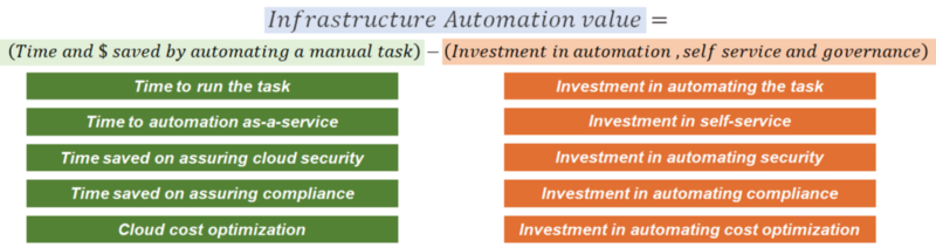
    The formula for the value from automation can be very simple:

    Time or Money Saved by Automating a Manual Task

    Time or money saved by automating a manual task should include any benefit you can attribute to the automation. Here are some examples:

    1. The time saved by automation to accomplish a complex task (this process took eight hours. Automation does it in eight minutes. Now we can do it more often).
    2. The time saved for the person who used to do it manually (the person who used to do it manually now has eight free hours, while automation does the work).
    3. The time saved for a person who was waiting for the task to be completed (the person who used to wait eight hours for the task to be done, now waits eight minutes; they can do more).
    4. The time saved by not making human errors (the person who used to spend 10 hours troubleshooting after the eight-hour person finished saves 10 hours).
    5. The time saved by not having to document a manual process (the two people who spend five hours a month teaching other people how to do the eight-hour thing …).

    Investment in Automation

    Investment in automation is often naively calculated as the investment in building automation, but the real investment in automation also includes maintaining and supporting what you have built. So, if someone tells you it took five minutes to whip up this little Bash script, ask yourself what it would look like to update it and support it forever (and when there are 300 more of these scripts). Your calculation of the investment in automation must include building, maintaining and supporting your automation.

    What Should I Automate?

    The formula makes it easy to decide what your automation targets should be—or, in other words, where you would find the most value in automation.

    A good start would be to look for tasks that take a long time to do manually or tasks that are done very often, as automating them will save more time and money. But you need to make sure the investment in automating them would justify the gain.
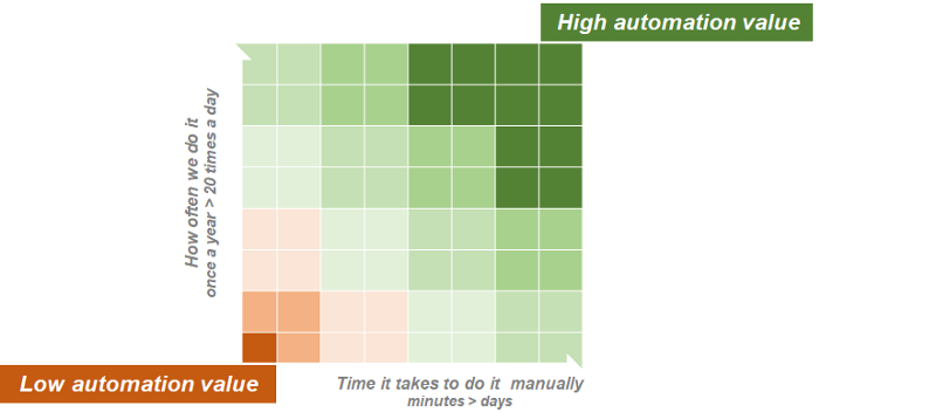
    I wish I had a dollar for every time I talked to someone who wanted to automate the “most difficult task” to prove the value of automation. This follows the logic, “If you can do the hardest thing, you can also do the simplest thing.”—a bit like making it in New York City. But this is not how automation works. Why? Because automation is very much like software development.

    In the software development world, one of the most common answers product teams gets from developers when they ask, “Is it possible to implement feature X?” is: “Everything is possible. It’s just a matter of effort.”

    Well, automation works the same (and that’s not the only similarity to software product development).

    Pretty much everything can be automated. The question is whether it’s worth it.

    If you automate something that takes a whole day to do manually, but you only need to do it once a year ,  it may not be worth automating.

    You could be automating the stupidest thing, and only save 20 minutes, but this thing happens 2,000 times every day, so that may very well be worth it. And the more stupid it is to automate, the better.

    Real Life Infrastructure Automation

    Back to the value formula. In real life, there are more facets to this formula. One of the factors that affect the value you get from automation is how many people have access to it.

    You can automate something that can potentially run 2,000 times a day, every day; this could be a game-changer in terms of value. But if this is something that 2,000 different people need to do, there is also the question of how accessible your automation is.

    Getting your automation to run smoothly by other people is not always a piece of cake (“What’s your problem?! It’s in git! Yes, you just get it from there. I’ll send you the link. You don’t have a user? Get a user! You can’t run it? Of course, you can’t, you need a runtime. Just get the runtime. It’s all in the readme! Oh, wait, the version is not in the readme. Get 3.0, it only works with 3.0. Oh, and you edited the config file, right?”).

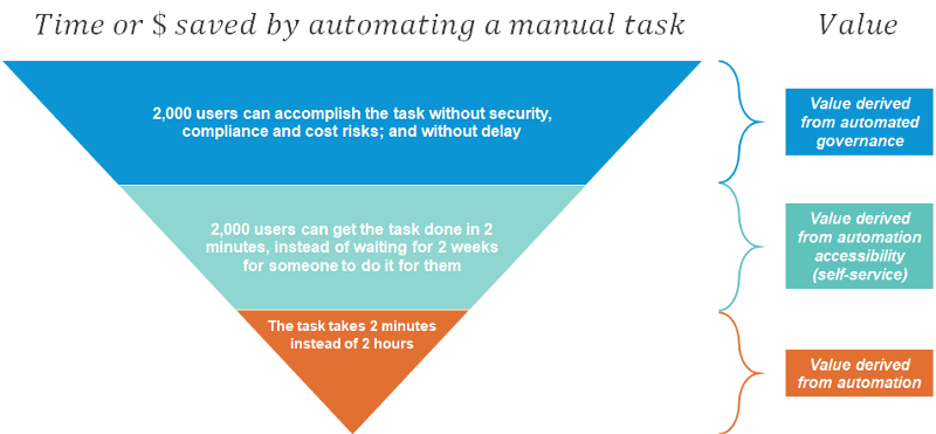
    Your calculation of the time or money saved by automating a manual task needs to consider the value derived from automation accessibility:
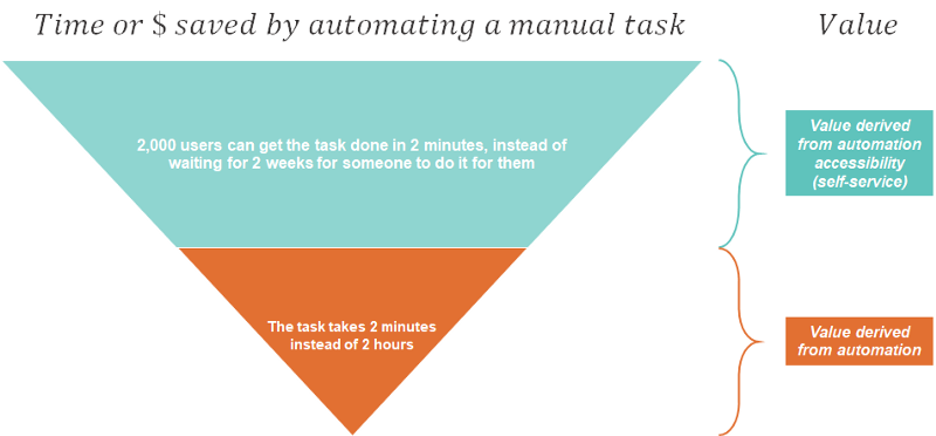
    The more people involved, and the more distributed they are, the more difficult it is to achieve accessibility. Your calculation of the investment in automation should therefore also include the investment in self-service:

    Adding Self-Service

    The self-service part of the equation is often neglected when looking at the value of automation, especially when the focus is very technical. It’s very easy to show a promise of value if you can automate a task, and by the time the question of self-service surfaces, it may be too late.

    This is very common with grassroots automation. In my field, I see this time after time, with teams that adopt free infrastructure automation tools (Ansible, Terraform, Cloudformation, ARM, you name it). In 2020, most people understand that there are no free lunches and that it takes precious time to develop and maintain this automation. Most already get that supporting it over time results in an automation team that is often too swamped to do much else.

    But I dare say that few properly estimate how difficult it is to provide this automation as a service to other teams. I don’t blame them. For an engineer, the thought “This is too slow! I will automate it” comes very naturally. It’s much more difficult to imagine as a developer a user who doesn’t understand the beautiful capabilities of Terraform; someone who freezes when they hear, “It’s in GitHub”; someone who isn’t as fascinated by the elegance of the code and has no #$$%$@ idea what to do with code.

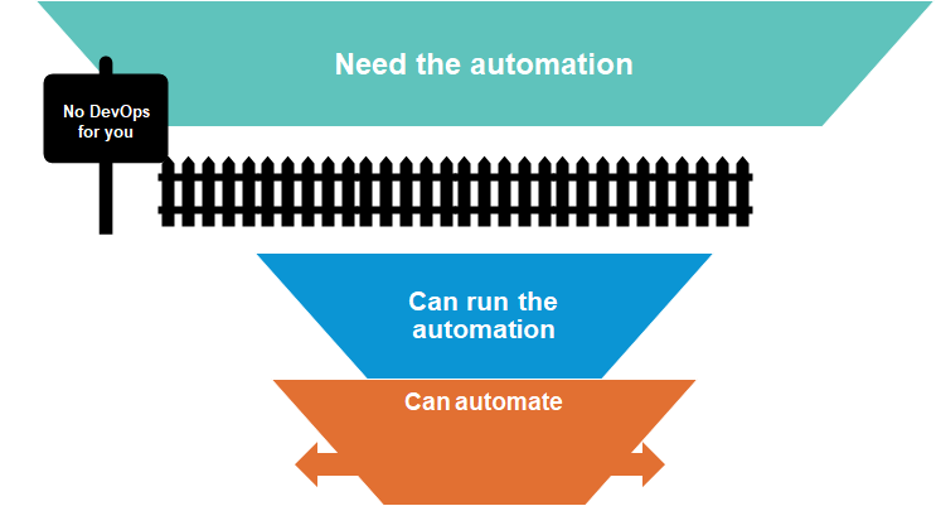
    In a company with multiple teams, the gap between the people who can automate to the people who need the automation can be huge. And if you ignore it, your automation value formula can be very skewed.
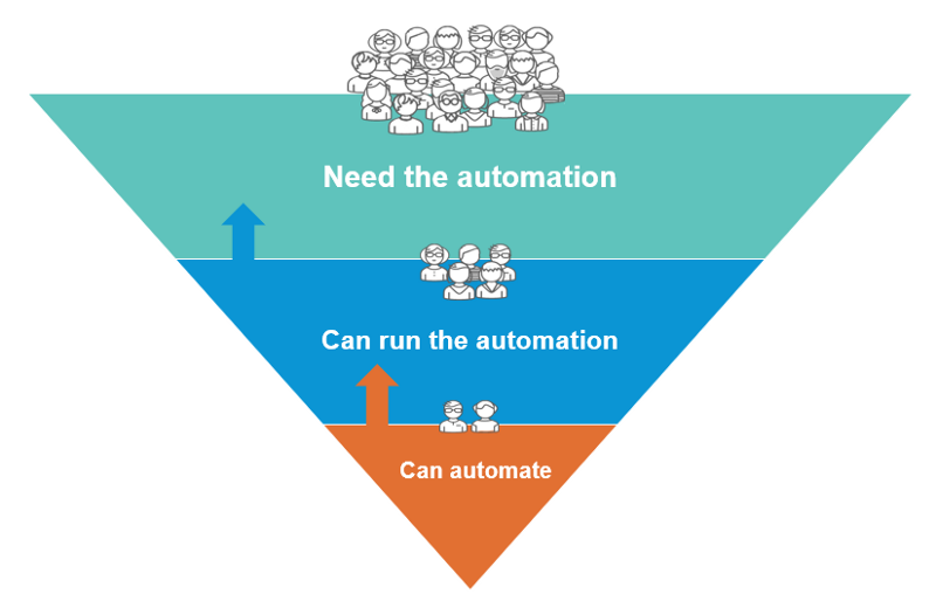
    Can Everyone Run This Automation?

    When you consider automation, the technical question, “Can it be automated?” is not enough. How efficient the code will be, or how much time it would take to build the automation, is also not enough.

    The question, “Can all relevant users run it as a seamless part of their workflow?” has to be asked and weighed in. You may be surprised, but highly accessible yet technically mediocre automation can actually win in some cases.

    How the Value Equation Works in RPA

    Robotic process automation (RPA) is a great example. RPA systems typically provide users with lists of automated actions by recording tasks that the user performs on a graphical user interface.

    For many coders and automation professionals, this approach is almost sacrilegious. You can automate fast, but scaling the technology is extremely limited. It gives a wide audience access to automating tasks without enforcing coding best practices (we already know the masses can’t be automation experts). But RPA can offer high ROI in some cases. If we return to the value formula, this quick-and-dirty type of automation is highly accessible, and therefore the investment in self-service is low. If using RPA means x100 or x1000 people can benefit from automation, compared to high-code tools that only a few can use, we may be able to get impressive ROI.

    Does this mean we should use RPA for DevOps automation? Not really. RPA is not always the right tool for the job, and it won’t always provide the best value in automation. RPA works well when you want to eliminate toil in small tasks (e.g. it is very popular for accounting tasks that a person triggers manually), but the value is lower when you have strict scale, efficiency and reliability requirements, which is typical in DevOps.

    In the case of DevOps, with machine-to-machine heavy interfaces, the investment you will have to make in scaling and maintaining RPA can be very high and the ROI would eventually be very low. RPA may therefore not provide the greatest value in this field, and it makes sense to opt for more scalable options. But this doesn’t mean you should focus solely on good engineering and the question of accessibility and self-service must be addressed in your ROI calculation.

    Infrastructure Automation in DevOps

    In the past years, there has been a growing awareness of self-service in traditional infrastructure automation. Often led by IT and Ops, some of it started with simple means, such as connecting ticketing systems (JIRA, Service Now) to automation tools.

    However, in DevOps infrastructure automation, accessibility of automation is often an afterthought. DevOps automation initiatives usually start with developers. The natural tendency is to invest in high-code automation and to focus on value derived by the time saved on the execution of a task rather than the multiplication of the value through the enablement of a broader user base. Existing self-service mechanisms are thrown aside,  and for good reasons: they are too slow and they don’t seamlessly fit into the DevOps process.

    Ignoring self-service is one of the reasons why DevOps initiatives show great value-promise in small-scale and fail in larger scales.

    Moreover, since DevOps spans so many areas of subject matter expertise, the chances of leaving critical expertise outside the coders’ silo is very high—especially expertise in operations, security and finance. Ignoring these experts’ accessibility to automation leaves them outside the DevOps loop.
    I was very happy to see Gartner’s “Market Guide for Infrastructure Automation Tools,” published in April. If you don’t have access to the gated content, I recommend taking a look at Manju Bhat’s post on the topic. Gartner finally highlights self-service as a critical capability for infrastructure automation:

    “Infrastructure automation tools provide DevOps teams with on-demand, self-service access to standardized environments. Adopting these tools enhances their ability to deliver customer-focused agility and velocity improvements while consuming new technology platforms with limited disruption.”

    I see this acknowledgment in the importance of customer-facing accessibility as a crucial milestone on the way to realizing value in larger-scale DevOps initiatives.

    Additional Value Factors in Infrastructure Automation

    Unlike general automation, infrastructure automation is a field in which there are additional factors in the value formula, which fall under the Infrastructure Governance category:

    1. Cloud security.
    2. Cloud cost.
    3. Compliance with industry standards.

    These elements need to be taken into consideration when addressing the value derived from automation. Infrastructure automation, especially in public cloud, involves sensitive assets: compute, network, storage, data and security elements. These elements can be expensive, and they could be very vulnerable to attacks.

    If ignored,  these three factors can diminish value. But handling them properly in automation can also generate value.

    The “time/money saved by automating a manual task” could, therefore, include an additional value segment:
    And the investment calculation should also include embedded governance:

    Build Your Value Formula

    If you are working on an automation initiative, don’t forget your value formula. It will help you build a business case, get management buy-in and achieve a better understanding of value factors you should focus on.

    The TLDR version:
  • Webinar: ROI is the True Measurement of DevOps Success

    Webinar: ROI is the True Measurement of DevOps Success

    RECORDING

    SLIDES

    [seoslides embed_id=”68ea17c4e993″ script_src=”https://devopsy.kinsta.cloud/embed-script/17871/17900/” overview_src=”https://devopsy.kinsta.cloud/slides/17871/” site_src=”https://devopsy.kinsta.cloud” site_title=”devopsy.kinsta.cloud” title=” ” /]

  • Iterative Indicators: Measuring DevOps ROI

    Iterative Indicators: Measuring DevOps ROI

    It’s well-established that application of ROI measurements to IT investment remains an imperfect science, and the same goes for ongoing adoption of DevOps methodologies.

    The fuzzy math of vendor-driven ROI calculators aside, even the most respected industry watchers have long struggled to create concrete parameters for assessment of technology spending. This, in large part, has been related to the fact that the requirement for continued investment has outweighed the value of short-term metrics.

    At the same time, it’s hard to put a price on the influence that paradigms including mobility, virtualization and the cloud are having on today’s business world. The scope of the so-called Applications Economy is only truly beginning to be realized.

    For in-depth discussion of DevOps ROI, register today for the upcoming webcast “Maturity Metrics – Analyzing the 2016 State of DevOps Report” with noted industry expert Gene Kim.

    With DevOps, the challenge of ROI measurement evokes similar characteristics as with these other bellwether movements. The affect that leveraging DevOps to become more agile and respond adeptly to changing customer expectations will have, long-term, ultimately will be realized as much in organizational viability as in any immediate cost-savings or other factors.

    That said, the recently published 2016 State of DevOps Report, assembled by the researchers at DevOps Research and Assessment (DORA), goes further down the path toward creating meaningful ROI metrics than any other such previous effort.

    For starters, the 2016 report builds on previous year’s conclusions that so-called “high-performing organizations”—those already deeply engaged in DevOps practices—are “decisively outperforming their lower-performing peers in terms of throughput,” and this gap continues to widen.

    Moreover, DORA contends that high performers deploy applications code 200 times more frequently than slow performers and achieve 2,555 times faster lead times. Perhaps even more importantly, in particular as it relates to the ability to improve applications performance, the report estimates that leading DevOps practitioners lay claim to 24 times faster recovery times and three times lower change failure rates.

    The State of DevOps Survey, completed by roughly 4,600 technology practitioners, also found that high-performing teams spend far less time on so-called “unplanned work and rework”—most often required to address existing problems—allowing them to spend nearly 50 percent more of their time on new work. The latter brand of effort is typically aimed at adding or improving feature functionality—or, in simple terms, innovation.

    As increased software velocity and reduction of MTTR represent the most critical differentiators in today’s environment, where an end user may wait only seconds for an app to load before abandoning your brand altogether, these conclusions obviously carry impressive weight.

    Finally, based on a framework established by research analysts at IDC which suggests that hourly application downtime costs can range from $1.25 to $2.5 billion for a Fortune 1000 firm, and that the average cost of a critical application failure is $500,000 to $1 million per hour, the State of DevOps Report allows for the conclusion that high-performing organizations save an average of more than $91 million per year.

    Much of this advantage is found, the researchers note, in the form of lower applications change failure rates, or those updates to software code that result in subsequent performance issues or outages. While high-performing DevOps practitioners experience an average change failure rate of 7.5 percent, medium-performing organizations see that figure rise dramatically, to a whopping 38 percent.

    If the undeniable adage that “time is money” applies in today’s Applications Economy as much—if not more than ever—than these ROI calculations would appear to infer substantial meaning.

    Later this month, Gene Kim, one of DORA’s founders and a key contributor to the State of DevOps Report, will host a webcast with CA Technologies expert Aruna Ravichandran to discuss DevOps ROI and many other related topics. Register for that event today.

  • What is DevOps’ Business Value?

    What is DevOps’ Business Value?

    Intro: DevOps is About Business Performance

    It is important understand that DevOps philosophically has a system-level view of a business’ performance. You don’t hear this much—it’s more difficult to write about than, say, the latest tech, but it’s always there under the covers.

    Screen Shot 2016-05-25 at 5.35.08 PMAnd, granted, the frequent focus for DevOps grassroots discussions is about tooling, about tech, about software pipeline—the “IT” in “ITSM,” so to speak. That’s usually because all of the people in those discussions have Dev or Ops or related functions as a job and already know all-too-well the business runs on the work they’re responsible for. You’ll see this at any DevOps Days you ever go to.

    As should be clear to everyone: All businesses today are in the IT business. This is regardless of what business they think they’re already in. DevOps is born from a disruptive crucible where the world of business morphed from being “do X” to “do X via computing” (i.e., a bank is no longer a bank, it’s now an IT shop with a banking license).

    This is where newcomers can mistake the forest for the trees: The heart of the DevOps movement is unrelenting focus on the “SM” in “ITSM.”

    Yes, automation gets involved. And rightfully gets a lot of discussion because it is such a huge force multiplier. However, other DevOps 101 beginner’s basics such as, “Have the developer carry a pager,” clearly are about bigger issues than which configuration automation tool you use.

    The numbers I will be reviewing here aren’t new. They aren’t mine. I often get the feeling when discussing these numbers with people that they aren’t getting what these numbers mean, in business context. How huge a powerhouse DevOps drives. So I’m going to try to explain a bit and try to put it all in context.

    So What is the Value to Business from DevOps?

    I wanted to set the stage a little so that we can properly discuss DevOps return on investment (ROI) in context of every business is in the IT business. The fundamentals of business performance are pretty crisp. We all get lost in new shiny and new toys.

    New shiny toys are the best.

    Yet DevOps as a philosophy is bigger.

    To be blunt, practicing DevOps as a philosophy gets you the latest, actionable answers to fundamental business questions:

    1. How do we improve product delivery to our customers?
    2. How do we change product more quickly to better satisfy our customers?
    3. How do we recover after failing our customers?
    4. How do we get paid faster by our customers?

    All of these directly impact sales, revenue growth, profitability, product line and business viability, customer satisfaction—all of which hScreen Shot 2016-05-25 at 5.36.32 PMave direct correlation back to investment in the business.

    I’m going to use Puppetlabs 2015 industry survey and work from remarkable folks such as Gene Kim, Jez Humble (Continuous Delivery and Lean Enterprise), Nicole Forsgren, plus Mary and Tom Poppendieck. I’m pulling from these few for this ultra-specific focus on ROI, but there’s a lot of excellent other sources and material for potential ROI explanations out there.

    So let’s answer our questions.

    1. How Do We Improve Product Delivery to our Customers?

    The fact is, our product isn’t doing anything valuable until our customers are using it. It isn’t making us any money. It isn’t making them any happier. It only does and can do that when we’ve actually produced it, put it into production, and gotten it into the customers’ hands.

    And DevOps-practicing companies do this at the rate that is unparalleled. Some of this is a result of that strong DevOps tendency to use automation as a multiplier, and some of it is a holistic view toward facilitating hand-offs and team collaboration. All of it, however, is DevOps.

    Studies show these DevOps companies have an almost supernatural advantage of 30x the deploy frequency of their non-DevOps peers. Put it another way, if you’re not embracing DevOps against someone who is, they can on average do what you do but do it 30 times faster than you. 30x.

    That is, if your business is in a footrace, you’re up against The Flash. Good luck with that.

    2. How Do We Change Product More Quickly to Better Satisfy Our Customers?

    The best product features are the ones the customers actually use. So, you focus on features they like (or want to have) based on their usage and fit. This frequently involves a little A/B testing on a subgroup and increasing it to larger groups until it’s everyone. It involves speed of offering as a way of measuring improvements.

    Amazingly, as it turns out, companies that adopt current DevOps practices have radically positive advantages here on changing product.

    I’m going to cite the simplest metric I’ve heard of. There’s a truly nifty test devised by Mary Poppendieck. It’s super simple. It gets you instant insight into the velocity of your product development pipeline at your company.

    Answer this basic question: How long does it take your organization to put a single, new line of code into production?

    For many companies I know of, the answer will be in units of months. Months. For DevOps-practicing companies, the answer often is as long as a couple of weeks to as short as an hour. Months versus hours?

    That is a devastating difference in competitive advantage. If your competitor takes months to deliver something to its customer that you can deliver in an hour … But wait, what if it’s your company that takes the months and the competitor that takes the hour …

    They’ve even quantified the difference. The DevOps-enhanced companies have a 200x faster lead time over their non-practicing peers.

    So, not only do DevOps companies iterate in production far far more quickly, they can move to production even faster than that.

    3. How Do We Recover After Failing Our Customers?

    There’s always some joker in a crowd who will say, “Well, don’t fail the customer in the first place.” I’ve encountered this point-of-view in executives who haven’t ever programmed or really understood how computers compute. Those are the 100 percent-uptime folk and they don’t get it.

    That’s not real world. You will fail; your front-end systems will fail. Some failures will even be catastrophic. Focusing on the meantime between failure (MTBF) is an old hardware-oriented way of thinking. It’s out of date and dangerous in this new age. It’s how we measured the durability of car parts or hard disks or plumbing. (A handy ACM article from Facebook on Fail at Scale is always a good read.)

    Embracing the notion that you will fail—and that you should even practice failing—is a key mental step to focusing on meantime to recovery (MTTR). MTTR is how quickly are you back up and running after that failure that will occur has occurred.

    And DevOps-savvy companies are amazing here as well, averaging a 168x reduction. That is, on average they are 168 times faster at recovery than their non-DevOpsian peers.

    And what about those failures caused by changes, whether they be configuration or application related? The so-called “change success rate”?

    The number there for DevOps enabled is astounding, too. There is a 60x improvement in change success rates. So not only do these companies make changes faster, more frequently, with better recovery, they do so with a phenomenally better change record.

    4. How Do We Get Paid Faster by Our Customers?

    This last one is subtle because it’s the snowball-rolling-downhill accumulation of all the previous DevOps factors at play. Basically, the business life cycle at work.

    (I’m not going into “paid” versus “recognizing revenue,” as recognizing revenue means more than getting paid and there are a bunch of accounting rules around that in the software industry. Nor am I going into the difference between purchased versus SaaS/CapEx versus OpEx. It’s an important topic to understand around revenue models but outside the purview of this.)

    It basically is gated like this, reverse-chronological order of importance for an ongoing business:

    1. You get money after you bill.
    2. You bill after you deliver benefit.
    3. You deliver benefit after you ship.
    4. You ship after you’ve made the product.
    5. You get money to make product.

    DevOps-embracing companies iterate thru steps 1 thru 4 of this cycle day in and day out, as we’ve reviewed above, at a pace that will ruthlessly crush all competitive laggards. I mean, flatten.

    The rates of change allowed by DevOps practices support such rapid acceleration away from the old norm. It’s startling.

    So, I suppose I’m saying not only can your company adopt DevOps changes, I’m telling you that you must. Even better, adopt and you’ll probably thrive.

    And since I’m talking about modern business, a Deming tax:


    P.S.: What about those corporate tales of “DevOps failures” I hear about?

    Over the years I hear the odd pundit or company executive dismiss DevOps as a unicorn thing or something that older, established organizations with years of built-in (anti) patterns of behavior can’t adopt. Or they claim they are in a sui generis industry like ahem banking where, well, they’re going to claim they can’t change because … you know, stuff.

    At a big analyst conference a couple of years ago I heard how there are many examples of “DevOps failures” at clients’ firms. In every case I heard about, however, the failure turned out to be unrelated to anything DevOps. They turned out to be related directly to poor analyst advice, or woeful execution, or simple gross misunderstanding.

    I’m not going to name names or shame them. I’m just going to say it’s incorrect in every case I’ve seen to cite “DevOps” as “the failure.” When you hear anyone talk about a DevOps failure, dig into it. It won’t be there in the end; it’ll be something else that actually derailed the effort.

    Most businesses are still command-and-control model orgs where you find a range of managers, mostly process-oriented, who are micro- to macromanagers. And you have fiefdoms. And the customer is rarely in the room. Culture plays a big role here.
    If your culture is healthy, you optimize for your people, for your customers and for achieving good customer results with the teams of people who are organized to do that. Curiously, if you do this, based on surveys, your company gets great and also becomes a great place to work!
    Now, that’s DevOps thinking at work.

    Screen Shot 2016-05-25 at 3.34.32 PM