Tag: DevOps predictions

  • DevOps 2022: The Year That Was and Wasn’t

    DevOps 2022: The Year That Was and Wasn’t

    We will be wrapping up our DevOps coverage for the year by the end of this week. It’s hard to believe that another year has gone by. The gravitational lensing of COVID-19 makes it hard to see the progression of the last nine years here at devopsy.kinsta.cloud. Things seem to get a bit hazy looking back. However, 2022 was certainly one for the record books in ways both good and bad. 2022 saw DevOps, our community our countries and our world pushed and pulled in directions we would not have imagined just a few short years ago. To understand what happened in DevOps in 2022, we need to account for several macro factors that played outsized roles this year. They are:

    1. COVID-19: It’s still here; still killing hundreds of people every day. While some in the U.S. and Western Europe have “moved beyond” it, COVID-19 is still draining our resources, sucking the air out of the room and impacting not just the economy but how we interact with each other individually. In the next few months, I am afraid we will see the 1.4 billion people of China experience a backlash as they move away from zero-COVID policies. Not to mention the other viruses and diseases that are circulating.
    2. War: When I was a young boy, I remember a popular poster/sticker that said something like, “War is not healthy for children and other living things.” That’s still true; it’s not healthy for the economy, either (unless you sell ammunition). The human toll of the war in Ukraine is heartbreaking in the present moment, and the toll that this war will take on the once-healthy tech sectors in Ukraine, Russia and the rest of Eastern Europe also will be felt for a very long time.
    3. Inflation: Again, I am transported back to my youth as inflation rears its ugly head and puts its foot on the throat of our economy. Sometimes I wonder if the Fed and other central banks won’t stop raising interest rates until the economy is good and dead, but their fear of inflation is almost genetic. While recent signs point to a potential peak, we still have a long way to go and the possibility of more interest rate hikes ahead of us. These will continue to make it harder to raise money and put a crimp in companies’ budgets. That means layoffs and budget cuts; projects cut or pushed out. We haven’t seen disruption like this in tech for more than 10 years. But for those of my vintage, we have seen cycles like this before. This too shall pass.
    4. Hate: Is it me or has the whole world gone crazy with tribalism, nationalism, racism, antisemitism and a bunch of other “-isms”? We seem to be ripping ourselves apart from the inside out. I don’t have a clue how to combat this on a macro level, but I pray every day that things get better.

    With these four horsemen of the apocalypse riding among us, you may think that I am not very bullish on DevOps now and in the future. But you’d be wrong. Like the little boy in a room full of horse manure, I remain very excited because I know there must be a pony around here somewhere.

    DevOps has continued to evolve, continued to mature and has become an indispensable part of today’s modern software factories. Like their own version of Marvel’s Avengers or DC’s Justice League, DevOps, along with cloud-native, SRE, Agile, CI/CD, DevSecOps and dare I say it, platform engineering, are wielded by IT teams around the globe to continue to push forward as we digitally transform our businesses and the very fabric of our lives. That is what gets me up and out of bed every day and makes me excited to come to work.

    While some marketers are busy running around printing stickers and shirts proclaiming that DevOps is dead, nothing could be further from the truth. Look around—as far as the eye can see, DevOps is everywhere. As we explored in our DevOps Experience virtual event in October (the sessions are still there for you to watch on demand), DevOps is everywhere. It is at the edge; it is in the “connected things”; it is inherent in technologies like WebAssembly (Wasm) and DevOps is distributed.

    In 2023, I think DevOps at the edge, the DevOps of things and Wasm will be huge areas of growth. I realized that some of these folks claiming that DevOps is dead are trying to say platform engineers will replace DevOps engineers. But like Darth Vader trying to strike down Obi-Wan, all they are doing is making DevOps stronger than ever. You see, DevOps was never about DevOps engineers; it’s not about one role or one individual. In fact, some of my best friends helped kick off the DevOps movement and they’d react quite loudly when they heard the term DevOps engineers. DevOps is about building, maintaining and managing our software and applications. It’s a way of thinking about how we can go faster, be smarter and achieve better quality. It’s not about a particular tool you use or the role you play on the team, it’s about the fact that you have a team.

    So, what does 2023 have in store for DevOps? More of the same, I think. DevOps, along with all of the associated frameworks and technologies, will continue to allow us to do more and do it faster and better. As I think about the coming year, I am very excited about the potential for ML and AI and I think they are going to have an outsized role in allowing us to be more successful. I think the novelty of these technologies has worn off and we will get to the productivity phase. I remember interviewing Luke Kanies years ago; he told me that one day software would write software. I asked him when he thought this might happen, and he said maybe 2035 or so. I think we are on track. Much like ChatGPT and Jasper’s impact on copywriting, AI won’t take the place of developers. But it will free them of some of the mundane, repetitive chores they do now.

    I think we’ll also see an emphasis on feedback loops and iteration. I think automation, ML/AI will contribute to this in a big way. We have put so much of our DevOps emphasis on the development, integration and deployment of software. But observability allows us to see patterns and use cases as never before. We need to incorporate those findings into the next revision of our software. This is going to be a big story in 2023. That old infinity loop model for DevOps will rise to the top once again.

    Thank you for all of the support for devopsy.kinsta.cloud this year and over the past few years. I hope this holiday season finds you and yours healthy and happy. Merry, merry. Happy, happy. See you in 2023.

  • 2022 Predictions: AI, Security and Cloud

    2022 Predictions: AI, Security and Cloud

    It is difficult to find a single area of the technology landscape that isn’t incorporating artificial intelligence (AI) into products and services. As we move into a world where distributed computing is the norm for business operations, AI is a requirement given the increasing level of complexity in computing environments. While there are many different ways AI is penetrating computing, I think that there are a few specific areas where we will see a huge amount of growth in terms of innovation and investment. 

    AIOps will be at the forefront of monitoring and managing distributed computing environments.

    2022 will be a busy year for AIOps vendors and product offerings. Expect that, in 2022, you will see a massive number of large enterprise software companies bringing AIOps offerings to market—either as part of distributed computing management suites or as individual tools. In addition, there will be a flurry of well-funded startups entering the space. One of the first areas where AI models are productized is in the area of AIOps. AIOps provides the ability to apply machine learning models and automation based on data about the patterns and anomalies within IT operations. AIOps is an implementation of observability and helps businesses monitor and manage their IT environment based on collecting and managing data about operational patterns that are expected and correct. It also determines when there is an action that is outside of the norm, and provides either an automatic correction or offers IT operations management the ability to correct errors before they impact business operations. 

    Expect a year of consolidation in advanced analytics, security and solution clouds. 

    We’ve already seen 2022 kick off with a flurry of acquisitions. While we haven’t seen blockbuster buys, we have seen smaller acquisitions by big vendors that need more to sell their existing customer base. One exception is Alteryx, which purchased cloud-native analytics vendor Trifacta for $400 million in cash. In contrast, IBM recently purchased Envizi, an Australian data analytics firm focused on analytics for environmental, social and governance (ESG) requirements. This is just the beginning. We expect there to be a flurry of acquisitions in the hot observability market (solutions focused on analyzing how well the internal states of a system can be inferred from knowledge of its external outputs).

    As security continues to grow in importance, key emerging security vendors also will be hot commodities in the acquisition space. For example, Microsoft has acquired RiskIQ, a security software vendor focused on gathering threat intelligence about a wide range of cyberattacks across multiple public and private clouds. We also predict that many of the large cloud vendors will move aggressively to buy cloud business solutions.  

    Looking Forward

    It is easy to get caught up in the flurry of announcements and acquisitions coming at us fast and furious. However, the reality is that businesses need to know that whatever new shiny objects are introduced, these solutions need to be able to solve real customer problems that impact revenue and growth. It may sound obvious, but I think that vendors need to pay a lot more attention to customer pain. 

  • What Does the Future Hold for DevOps and CI/CD?

    What Does the Future Hold for DevOps and CI/CD?

    After such a challenging year, we have finally made it to 2021. Although a new year has started, we are still trying to figure out what the “new normal” will look like once the COVID-19 pandemic is finally over.

    While the pandemic has affected many businesses and our daily lives in general, it also had a major impact on software development. This past year we have seen rapid innovation and acceleration of digital transformation as a result of the pandemic. So, what does 2021 have in store for DevOps? How can DevOps teams improve productivity and become high performers in 2021?

    In this interview, CircleCI CEO Jim Rose joins Rebecca Auguste to talk about what 2021 has in store for DevOps and CI/CD, how the pandemic impacted software teams and what they can do to succeed in this new year.

    Jim is one of the distinguished speakers that will be sharing his knowledge and predictions for 2021 at this year’s Predict Virtual Summit. During his session, Jim will discuss what’s in store for engineering teams in a post-pandemic world, backed by anonymized team data from millions of DevOps workflows. Attendees will leave with insights and benchmarks to help teams build better software faster.

    Jim has led category-defining companies through economic crises, with COVID-19 being no exception. He is on a mission to provide everyone the ability to build and deliver software at the speed of imagination.

    To find out what the future of software looks like, attend Jim’s session at Predict Virtual Summit on Jan. 21. To check out the full agenda or to register for free, visit the Predict 2021 website.

  • Predict 2021: What Does the Future Hold?

    Predict 2021: What Does the Future Hold?

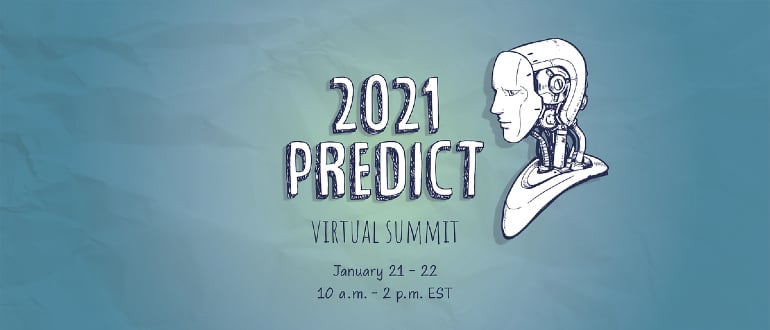
    While 2020 was a challenging year, it was also a year of resilience, innovation and rapid acceleration of digital transformation. So, what does 2021 have in store for us? At Predict 2021 Virtual Summit, taking place Jan. 21-22 at 10 a.m. ET, top industry leaders will share their speculations on what the future holds in the realms of DevOps, cybersecurity, digital transformation, cloud native and IT.

    Predict 2021 is a free, multi-track virtual event featuring a conference lobby, presentation theater, expo hall and more. Attendees will be able to interact with sponsors and peers, watch videos and download information. It will be a great opportunity for networking and learning about what the “new normal” will look like for DevOps.

    In addition to the great speaker sessions, there will be panel discussions, interactive Q&As with speakers, a scavenger hunt, giveaways and other interactive activities.

    This year’s event features outstanding sessions from industry leaders, including:

    • “Sustaining The Pace of Digital Change,” keynote by Emmet B. Keeffe III of Insight Partners.
    • “Digital Transformation Panel,” keynote by Flint Brenton of Centrify, Ashok Reddy of Digital.ai and Tracy Ragan of DeployHub.
    • “Welcome to the Data Care Industry,” keynote by Ron Gula and Cyndi Gula, Gula Tech Adventures.
    •  “What Does 2021 Hold for DevOps and CI/CD?,” by Jim Rose, CircleCI.
    • “Cloud Native Tech,” by Tracy Miranda of CloudBees, Tracy Ragan of DeployHub and Isaac Mosquera of Armory.
    • “Software’s Not Living Up To Its Cloud-Enabled Promise,” by Jen Grant, Appify.
    • “Observability and AI: Bringing DevOps Back to the Future,” by Adam Frank, Moogsoft.
    • “Increase in Cloud-Native Apps Drives Key Challenges and Opportunities in 2021,” by Ankur Singla, Volterra.

    On the second day of Predict 2021, MediaOps CEO and devopsy.kinsta.cloud Editor-in-Chief Alan Shimel will also be announcing the 2020 DevOps Dozen² Awards winners.

    To check out the full agenda and to register, please visit the Predict 2021 website.

  • Predict 2021: What Does the “New Normal” Look Like for DevOps?

    Predict 2021: What Does the “New Normal” Look Like for DevOps?

    2020 has been pretty tough for most of us, no doubt. It has been a year of uncertainties and unexpected changes, mainly due to the COVID-19 pandemic. However, the future is bright and 2021 is full of possibilities. What does next year have in store for us? At Predict 2021 Virtual Summit, taking place Jan. 21-22 at 10 a.m. ET, top industry leaders will share their speculations on what the future holds in the realms of DevOps, cybersecurity, digital transformation, cloud native and IT.

    Predict 2021 is a free, multi-track virtual event featuring a conference lobby, presentation theater, expo hall and more. Attendees will be able to interact with sponsors and peers, watch videos and download more information. It will be a great opportunity for networking and learning about what the “new normal” will look like for DevOps.

    Are you interested in sharing some of your predictions for the upcoming year? The call for speakers is currently open — for a limited time, as we are starting to get swamped with submissions from folks who want to share predictions and thoughts on the new year and beyond. Now is your chance to prove your special ability to foresee the future of IT.

    We invite all analysts, practitioners, venture capitalists and thought leaders to share their insights, best guesses and predictions for 2021. Abstracts must be submitted through this form by Dec. 11.

    For more information, please visit the Predict 2021 website. Sponsorship opportunities are also available. Predict 2021 sponsors include CircleCI, Harness, WhiteSource and more. For sponsorship opportunities please contact Deb Schalm at deb@mediaops.com.

  • DevOps Gets More Exciting in 2018

    DevOps Gets More Exciting in 2018

    As 2017 winds down and the IT industry prepares for 2018, there are a number of DevOps trends that everyone should be keeping their eyes on. It’s not so much that something incredible and explosive is expected in the new year. Rather, 2018 will be a time when DevOps starts to mature alongside other trends important to developers.

    These trends don’t guarantee organizations will be immediately successful with DevOps. Most still will struggle with the management aspects of DevOps, especially the need to keep feuding silos within IT working together as one happy group. Assuming developers, QA, and Operations can all learn to get along and act as a team, the technology supporting DevOps will continue to improve and the ecosystem will grow.

    Here are some of the DevOps trends that Amalgam Insights is following for 2018:

    Everyone Loves Containers and the Ecosystem Grows

    Containers have become a common technology in many IT departments. Although the majority of applications remain housed on single servers and virtual machines, container deployments are growing. Containers are an important enabling technology for DevOps—by creating small, transportable bits of applications, containers make it easy for IT silos to work from the same page.

    In 2018, growth in container deployments is expected to accelerate as large companies outside the software industry, such as those in financial services and health care, adopt microservices infrastructure. Containers that are especially suited to microservices will continue to expand rapidly.

    Increased container growth is also due to an expanding ecosystem. More companies have entered the market with products necessary to large-scale production applications. Products now exist for securing, managing, deploying and enhancing container services that weren’t available a few years ago. What’s more, containers are now available in all the major cloud services including Oracle Cloud, Microsoft Azure, AWS, IBM Cloud and Google Cloud. Containers are becoming enterprise-ready and large enterprises are feeling more confident using them.

    Takeaway: Growth in the ecosystem contributes to growth in container deployments while expansion of containers entices companies to enter the ecosystem. Containers have reached mainstream normalization and we expect to see fast expansion throughout 2018.

    Kubernetes Eats the Container Orchestration World

    In the container orchestration space, Kubernetes has become the tool of choice. Orchestration is the deployment and management of container clusters and is necessary to deploy them at scale. Kubernetes, originally a Google open source project and now managed by the Cloud Native Computing Foundation, has become the most popular orchestration tool available. That became obvious when Docker decided to distribute and support Kubernetes, despite having invested in its own orchestration system called Swarm. CoreOS, Microsoft Azure, Red Hat OpenShift, Docker and others have their own enterprise distributions as well.

    Kubernetes brings to the container ecosystem a relatively easy way to manage containers at scale. In large container deployments, containers are constantly being spun up, shut down, moved and copied. Once container clusters are in place, they must be monitored for security and service failure.

    During development, there will be a number of clusters that must be managed for development, test and final release to production. Doing this manually is close to impossible when even a moderate number of containers are in the DevOps pipeline. Kubernetes provides the tools and workflow to simplify these tasks.

    Takeaway: As container production clusters grow and as they are integrated into the DevOps pipeline, the need for orchestration becomes acute. Kubernetes has won the game and is now the tool of choice for orchestration. 

    The Pipeline is Getting More Integrated

    DevOps is often described of as a “pipeline,” In this context, a pipeline is a linear workflow that moves from build to test to release. As DevOps becomes more common in organizations, the pipeline grows to include additional test phases, monitoring and continuous improvement to create more of a cycle than a linear flow.

    One of the great impediments to making DevOps a reality is a lack of tools that support the entire pipeline. There are plenty of tools that help build applications, such as IDEs and code repositories from companies such as IBM, Microsoft, GitHub and Oracle, as well as dozens of open source products. Testing is well-supported with test data management and test plan management tools from companies such Atlassian, Informatica and Oracle. Release management and deployment products are widely available from Atlassian, Microsoft, IBM and many other companies. The problem lies not with the support for the individual steps in the pipeline, but with the integration of these tools to provide a complete end-to-end workflow. This creates a disjointed workflow, prone to errors and supportive of silos instead of collaboration.

    This is changing, however, and announcements late in 2017 herald toolsets that can provide a continuous DevOps pipeline. A great example of this is the newest versions of Microsoft’s developer tools that were debuted at Microsoft Connect(); in November 2017. Tying together the Visual Studio debugger with Kubernetes allows developers to test and debug as close to the production environment as possible and then deploy cluster to the test environment. That, plus the upgrades to Team Server, shows the commitment Microsoft has to creating integrated DevOps systems.

    Takeaway: While DevOps tools are still more or less disjointed, we are seeing a movement to fully integrated toolsets that enable the end-to-end DevOps pipeline.

    2018 is the Year of DevOps—Unless IT Management Gets It Wrong

    This coming year could be the year that DevOps truly takes off and becomes mainstream. Those who believe it is already mainstream now are fooling themselves. Management may believe their organization is implementing DevOps, but too many barriers still exist—especially management itself. IT departments remain heavily siloed and independent of each other, as do development tools. DevOps at scale requires, above all else, a collaborative and cooperative approach. Sadly, that does not yet exist in many IT departments. As tools reach maturity and best practices become common, managers become the inhibitors of DevOps. New management structures, incentives and thought processes need to be in place or the money spent on tools is wasted.

    Takeaway: All the DevOps pieces are in place except for the breaking down of functional silos that exist in IT departments. 2018 may be the year of DevOps if IT managers can create a new environment of cooperation.

    About the Author / Tom Petrocelli

    Tom Petrocelli is a contributing analyst with Amalgam Insights. His area of interest is collaboration and new ways of work, developer tools, IT project efficiency, governance and methodologies and DevOps. Most recently, Tom worked for a large, global banking corporation. Previously, he was the research director for Enterprise Social, Mobile and Cloud Applications at Neuralytix. He is an experienced marketing, technology and business executive with 30+ years in the computer technology industry. Tom’s background spans software engineering, systems architecture, IT, product management and marketing and general management. Connect with him on LinkedIn and follow him on Twitter.
  • DevOps Predictions for 2018

    DevOps Predictions for 2018

    The new year is upon us, and that can only mean one thing: outrageous tech predictions! This year, we have a few that are easy to believe and a few that are completely off-the-wall. See if you can pick them out.

    Serverless Overtakes Containers

    Serverless is the future and containers are dead. Some (or maybe even a majority) of the industry will come to realize this. Serverless is largely defined as using functions as a service (FaaS) as the backbone of your architecture. These services are a layer on top of containers that provide an opinionated way to run code that scales with demand and ties true compute usage to costs at sub-second billing increments. Much like virtualization in the data center was dwarfed by cloud providers doing opinionated virtualization a decade ago, serverless offerings will overtake the container market.

    DevOps Backlash Gets Loud

    DevOps has been happily spreading through the industry as an extension of Agile to the rest of IT. But in 2018, the pushback comes. In the early days of DevOps, there was a movement called “No-Ops.” It was championed by some, but then later, reversed back to DevOps. This year, we will see stories of failed digital transformations and DevOps attempts at conferences across the globe. At first, they will be marked as “not doing DevOps right,” but as more and more happen, they will be branded with the old-new stigma of No-Ops—and they won’t come back.

    Chaos Engineering Overtakes the Airwaves

    You remember the Chaos Monkey Netflix released to the IT world that captured the hearts and minds of software engineers everywhere? Well, this is the year when chaos reigns! We’ve already had a taste of it through the new open-source project ChaoSlingr on the Modern Security Series show at Signal Sciences, but my guess is that we are far from done. With the release of Nassim Taleb’s book “Antifragile” in 2014, this has been brewing for a few years. Expect to see more chaos-themed engineering books, conference talks and podcasts in the coming year.

    Software Flaws Mean Prison Time

    Unit testing used to seem like such a good idea, but this year it’s going to become illegal to release software without testing rigor applied. Congress has been on the edge of threatening software accountability legislation for years now, but at this point it looks unavoidable. Will this be the year that a landmark legal battle happens and an engineer who didn’t do proper testing gets thrown in jail? Don’t laugh. We have already seen the first signs of this with the VW diesel scandal; just imagine if it was a pacemaker failure. In 2018, lawyers make the new rules for software engineering.

    Promise Theory Finds New Adoption

    Mark Burgess brought physics to IT through his groundbreaking book on Promise Theory and its implications for the way our applications and infrastructure will be built over the coming years. Instead of making assertions of obligation from machine to machine, networks will be composed of voluntary agents making promises. At the time it was released, Promise Theory received a lukewarm reception. But with the new services-based architectures such as serverless and even the rise of container orchestration platforms, the industry is now ready to adopt Promise Theory thinking. Networks, applications and systems are already functioning as voluntary agents working together through promises. This year, we will see more and more mainstream adoption of the concepts and more examples of how to get it right. Get ready to learn how systems can be self-organizing.

    Application Security Becomes More About the Application

    The perennial web application security checklist is to avoid XSS, SQLi and all the rest of the OWASP Top 10. Application security will finally shift from language and framework vulnerabilities to more conversations around how applications are getting attacked. In the new year, the conversation hinges on account takeovers, fraud detection and abuse inside the application. This is good for the industry because we will move past fighting automatic scanning by adding real instrumentation to detect bad actors.

    Happy New Year!

    The next 12 months are certainly going to be an adventure, and I hope you have a happy new year.

    P.S. Please don’t get thrown in jail!

    — James Wickett