Tag: devops history

  • Why Did DevOps Become So Popular? 3 Theories

    Why Did DevOps Become So Popular? 3 Theories

    DevOps has now been a thing for a solid decade. As we look back at the history of DevOps, it’s worth asking: Where did DevOps come from, and why did it take off when it did?

    In honor of the 10-year anniversary of DevOps, I’d like to explore these questions.

    A Brief History of DevOps

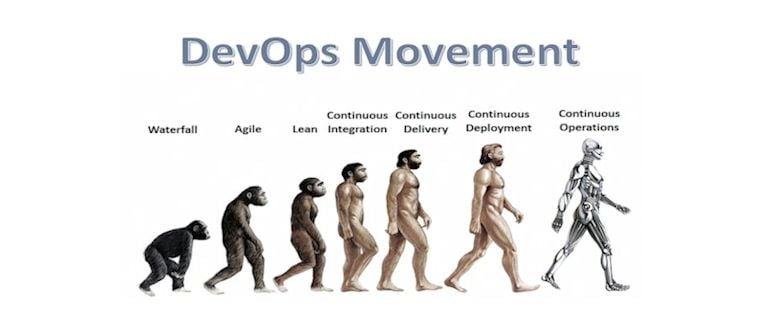
    The very basic history of DevOps goes like this: First, there was agile, an idea exemplified in the Agile Manifesto that gained prominence among software developers in the early 2000s.

    Then, in 2008, Patrick Debois, a developer from Belgium, conceived of DevOps as a way to improve upon the agile concept by encouraging developers to work more closely with ITOps teams. His ideas began spreading in 2009. By the early 2010s, they had gained a sizable following and the rest is history.

    That, again, is a really basic history of DevOps. For more detail, I recommend this DevOps history post by Steve Mezak.

    Why DevOps? Why Now?

    The narrative of how DevOps originated is one thing. Explaining why DevOps became so popular in a relatively short span of time is another.

    As I see it, there are three possible theories to explain the rise of DevOps over the past decade. The first is to argue that Debois simply happened to have some very good ideas, and he promoted them well. You could think of this as the great man theory of DevOps’ origins. This seems to me, however, to be an unlikely explanation. It’s very rare for highly influential ideas to be born from just a single mind, or to spread through the singular efforts of one person.

    The second possible explanation for why DevOps became popular is it is simply an evolved form of agile. This is like arguing that World War II was simply a continuation of sorts of World War I, and therefore the origins of World War II are ultimately the same as those of World War I. From this viewpoint, the history of DevOps is really the history of agile, and so DevOps itself doesn’t have a unique history at all. I’d find this argument compelling if I believed DevOps is really just agile by another name, but I don’t. DevOps is broader, and has a much stronger implementational and practical element.

    The third theory—and the one I find most persuasive—is DevOps was born out of a particular moment in the history of computing and IT. That moment, which started in the mid-2000s, was marked by several key features that helped give rise to DevOps, including:

    • The widespread adoption, starting circa 2007, of cloud computing.
    • The success of the open source software movement around 2010 in making open source the go-to licensing strategy for many popular software projects and in making collaboration around code easier.
    • The rise beginning around 2010 of microservices and containers, which made applications much more complex to design, deploy and manage.
    • The explosive popularity of mobile computing starting with the launch of the iPhone in 2007. The mobile revolution meant organizations increasingly had to deliver software for multiple target environments (PCs, Android phones and iOS, for example) at the same time, necessitating branched delivery pipelines.
    • The demand for ever-increasing speed in software delivery as a way to gain an edge in software markets which, by the late 2000s, had grown more competitive than ever.

    When you put these changes together, you end up with a need to manage much more complex, fast-moving software delivery pipelines. Powered by cloud infrastructure and microservices architectures, the software market starting around 2010 required more responsive, better coordinated management by IT teams. DevOps provided an answer by increasing efficiency, decreasing response times and making software delivery faster.

    I don’t think DevOps would have taken off if the idea had emerged in the 1990s, when there was much less demand for fast software delivery, most applications ran locally and codebases were relatively simple.

    Nor am I sure DevOps would prove as popular if it were first introduced today. At present, we have a litany of management tools (such as Ansible and Kubernetes, to name a couple of examples) that didn’t exist 10 years ago. Those tools make it easier to handle all of the complexity of modern software environments even if you don’t have a management strategy rooted in DevOps culture.

    To put it simply, DevOps resulted from the combination of several specific developments in the world of IT between the mid- and late-2000s. Debois may certainly deserve credit for helping to spread the idea, but it would not have spread so quickly if it had not emerged at that particular time.

    — Chris Tozzi

  • The Origins of DevOps: What’s in a Name?

    The Origins of DevOps: What’s in a Name?

    Depending on your frame of reference, DevOps will celebrate it’s ninth or 10th anniversary this year. In 2016, RightScale’s “State of the Cloud Report” estimated that 70 percent of SMBs were adopting DevOps methods. Every indication is that percentage has increased since then. As DevOps prepares for its second decade of existence, it might be worth a stroll down memory lane to revisit the origins of DevOps methods—and even the term itself.

    Pre-2007: A Perfect Storm of Events

    Prior to 2007, a series of circumstances came together that would eventually give birth to what we know today as DevOps.

    “Lean manufacturing” was already well-established as a set of best practices for manufacturing. Often branded as the “Toyota Manufacturing Method,” lean manufacturing strives for process optimization across the manufacturing floor. (Sidebar: Toyota leaders were originally inspired by the ingenious assembly line methods introduced by Ford Motor Company.) “Continuous improvement” is the mantra for lean manufacturing and practitioners continually evaluate ways to:

    • Keep inventory at a minimum. Lean manufacturing means minimal inventory on hand: raw materials (materials used to produce goods) and finished inventory (completed products waiting to be assigned to an order and/or shipped).
    • Minimize the queue of orders. Ideally, orders received should move immediately into fulfillment mode. A key metric of lean manufacturing will always be “order to ship” time.
    • Maximize efficiency in the manufacturing process. Process re-engineering and improved automation will marry into a goal to produce goods as quickly as possible. Each station of operation along the way (cut, weld, assemble, test, etc.) is evaluated for inefficiencies.

    In IT, traditional waterfall methods of application development were already giving way to rapid, iterative methods such as agile. “Speed” was the battle cry, even if quality output was occasionally compromised in the pursuit of rapid development and deployment. Similarly, on the operations and infrastructure side of IT, Cloud Computing and, in particular, infrastructure as a service (IaaS) and platform as a service (PaaS) were coming into their own as mature service offerings.

    Finally, a fledgling set of tools classified as “continuous integration (CI)” tools began to emerge. The notion of CI tools was birthed and branded by Grady Brooch back in 1991 in his Brooch Method.


    Related Content:

    DevOps: The Innovation Power Couple

    A Definition of DevOps for the Masses


    2007-2008: A Frustrated Belgian

    Belgian consultant, project manager and agile practitioner Patrick Debois took on an assignment with a Belgian government ministry to help with data center migrations. In particular, his role was in certification/readiness testing. His duties required him to straddle activities and relationships between the application development teams and the operations teams (server, database network). His experiences—and frustrations over the walls of separation and lack of cohesion between application methods and infrastructure methods—planted seeds of discontent for Debois. His desire for a better way would soon lead him to action.

    In 2008, at the Agile Conference in Toronto, Andrew Schafer posted an offer to moderate an ad hoc “Birds of a Feather” meeting to discuss the topic of “Agile Infrastructure.” Only one person showed up to discuss the topic: Patrick Debois. Their discussions and sharing of ideas with others advanced the concept of “agile systems administration.” In that same year, Debois and Shafer formed an Agile Systems Administrator group on Google, with limited success.

    2009: The Case for Dev and Ops Cooperation

    At the O’Reilly Velocity Conference, two Flickr employees—John Allspaw, senior vice president of technical operations, and Paul Hammond, director of engineering—gave a now-famous presentation titled, “10+ Deploys per Day: Dev and Ops Cooperation at Flickr.” The presentation had a dramatic flair to it, as Allspaw and Hammond would role-play the contentious interplay between representatives of  Development and Operations during a typical software deployment, along with all the finger-pointing/blame that goes on, such as, “It’s not my code, it’s your machines!” Their presentation made the case that the only rational way forward is for application development and operations activities to be seamless, transparent and fully integrated. Over time, this presentation has reached legendary status, and is historically viewed as the seminal moment in time for that called out to the IT industry for methods that we now know as DevOps.

    Unable to attend in person, Debois watched the Allspaw/Hammond presentation by video stream. He was inspired, and—at the prompting of others through social media—formed his own conference called Devopsdays in Ghent, Belgium. By this point in time, the term “DevOps” had officially landed in the history books.

    2010: DevOps in the United States

    With a growing constituency, a Devopsdays conference is held for the first time in the United States in Mountain View, California, on the heels of the Velocity annual conference. Fast forward to 2018: There are more than 30 Devopsdays conferences already scheduled for 2018, including dozens across the United States.

    2013: ‘The Phoenix Project’

    For many of us, another noteworthy moment in the history of DevOps was the publishing of the book, “The Phoenix Project,” written by Gene Kim, Kevin Behr and George Spafford. This fictional novel tells the story of an IT manager thrust into a seemingly hopeless situation, as he’s charged with salvaging a mission-critical ecommerce development project that’s gone off the rails. His mysterious mentor, a board member steeped in the disciplines of lean manufacturing, guides the main character into new ways of thinking about IT and application development, introducing the concept of DevOps along the way.

    (Sidebar: The Phoenix Project helped inspire us to write “Outsource or Else!” a similar business fable in which a VP of Software uses DevOps when outsourcing development of a major new product.)

    DevOps for the Future

    It’s reasonable to describe DevOps as a journey, or perhaps an aspiration, rather than defined destination. DevOps, like lean manufacturing, seeks continuous improvement, seeking higher output, greater efficiencies and even continuous deployment. Automated tools that support DevOps continue to evolve.

    Much has been accomplished since the inception of DevOps in the last decade and we expect to see even more in 2018 and beyond.

    — Steve Mezak

  • You Can’t Sell DevOps

    You Can’t Sell DevOps

    A few days ago, I made an introduction for colleague Jason Dixon (@obfuscurity) over email, and described Jason as “a leading supporter of the DevOps movement”. A mere 17 minutes later, Jason replies to me, “Are you trolling me?”.

    I was aghast. Granted, I haven’t known Jason terribly long (measured in months), but I’ve been well aware of his impact and contributions to the technical community (pulling together Monitorama , for starters). I couldn’t fathom the visceral reaction. But it did get me thinking… Why would someone so impactful want to distance themselves from the description?

    For Jason, and many like him, it’s a question of intentions. To explore that, we’ll have to go back to the beginning, and for me the beginning was 5:20pm PST on June 24, 2010, in the last session on the last day of Velocity CA… a “choose your own adventure” talk by Adam Jacob (@adamhjk ), answering the question “what is DevOps?”.

    I happened to have my flip cam handy…

    http://www.youtube.com/watch?v=Fx8OBeNmaWw

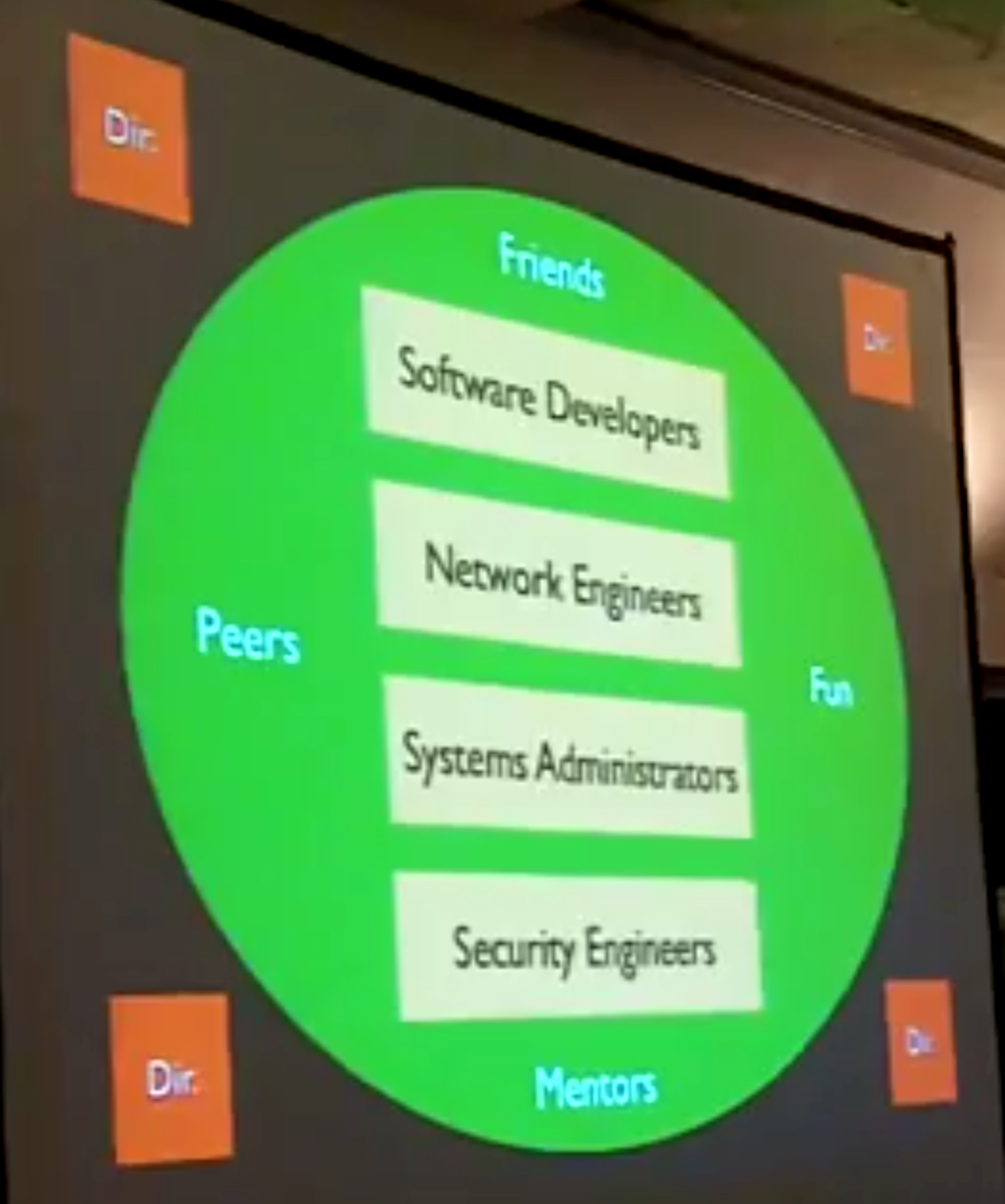
    “So here’s the thing: DevOps is a cultural and professional movement. Period. That’s it… There’s no technology, you can’t patent ‘devops’. Can you market a DevOps compliant toolset? You cannot.”Adam went on to describe the evolution of the system operation profession, and the challenges he personally found. Then came the org chart of a traditional silo approach to a technical organization hierarchy: software developers

    Adam proceeded to challenge this approach with an alternative. “So this is everybody in a big pile. What we are is peers, and friends, and mentors, and we are having fun!”. Hysterically live in one silo, reporting into a director who reports into a VP, network engineers live in a separate silo, reporting into a separate director, system administrators in a third silo, and security engineers in a fourth. Proverbial walls erected between technical contributors, isolated from one another through a formal hierarchy. Need to communicate across to a peer? Better go up the stack to go back down.

    Our hypothetical example continues of a conversation in the big pile: “Hey security dude, what’s that you’re doing?!?”, and he’s like “I’m breaking into the web site.” And you’re like “How’d you do that?!?”, and he shows you and the network engineer is like “I can stop you,” and you’re like “How?!?,” and he’s like “Firewall rules.” And you’re like “Whoa! Firewall rules?!?” and the security engineer is like “Why did you need to do that anyway, that’s a protected network”. And then everybody is having a good time. And the Directors. They’re just helping you out. They’re propping you up.” cory2

    While improvised, comical, and at best a generalization of an industry in a hypothetical example, one key point stuck in my mind from Adam’s talk: DevOps was about people, and how they were most effective and happiest working together. That was the point of the cultural and professional movement: to be more effective and happier as a team, embracing a “shared outcome.” Software developers, network engineers, system administrators, security engineers, directors, VPs, etc., we all succeed or fail together.

    That’s not something you can sell. (In this context, I’ve specifically referring to selling a tool or service.) Nor is it something you can pin down to one definition applicable everywhere. Nor is it something that you can transplant wholesale from one company to another and expect the same level of effectiveness and happiness. You can’t “bolt on” DevOps to your existing organization with only tools and services. You can’t buy a toolset and expect your challenges to be alleviated. You have to understand the role improved tooling has played for those that have found success in this field.

    Tools can certainly be enablers and facilitators, particularly when they free up person hours from manual tasks (assuming you can channel the new found time in an enabling direction), and particularly when they increase transparency as to where technical problems exist, helping to avoid the “It’s not my servers, it’s your code. It’s not my code, it’s your servers” blamefest. How we interact with them, and the patterns of behavior they impose on us as people, can lead to drastically different results from one organization to the next, even if those organizations have identical tools.

    When our tools look like the first silo org chart example above, with a different set of tools presenting different perspectives to different teams bound together by a shared outcome, the tools end up dictating and reinforcing the silo organization hierarchy for how people work together.  To break down the proverbial walls, our tools instead must help define how people should work together.

    Tools enabling configuration management, automation, improved monitoring, metrics collection, and source control won’t ensure success in isolation, because the DevOps movement isn’t ultimately about the tools. It’s about the people, and how they will work best together to succeed. The right tools can go a long way toward removing barriers, enabling the right conversations, and setting the stage for success.

    Part of the challenge is that the tools are one of the more tangible and visible aspects of how we work. In can be easy to take a stroll through a peer organization and take note of the different tools, and attribute their success accordingly. You might be sold on the idea that a tool they have has been the missing piece to your success all along. Fight this first impulse to the tangible and visible, and remember that it’s hard to see how folks really interact. It’s hard to see how well their people, processes and tools work together to produce results in sunny-day scenarios. It’s even harder to see when the sh*t hits the proverbial fan. That’s where the real test is though, and that’s where the real lessons are to be learned. 

    So let’s all be a little more focused on the lessons learned in ways to work together supported by tools than on the merits of one tool over another in isolation. No doubt, it’s a harder and deeper conversation to have, but the value is tremendously greater. If we keep it up, maybe we can make Jason proud to call himself a leading supporter of this professional and cultural movement.

    Or maybe I was trolling Jason Dixon all along.