Tag: DevOps experience

  • Why IT Teams Need Continuous Improvement

    Why IT Teams Need Continuous Improvement

    In the dynamic world of software delivery, an ‘if it’s not broke don’t fix it’ philosophy won’t get you very far—even when your software and systems are working as planned. 

    Software is more complex than ever and innovation is exploding across markets. To keep up with constant innovation from your competition in a global marketplace, you should always be thinking about how to improve your products and services. 

    The teams and organizations focused on continuous improvement simply outperform those who settle for the status quo and fear the unknown. Let’s look at why continuous improvement is important in IT organizations; how to avoid common mistakes when measuring success and tips for getting started. But first, let’s define what continuous improvement is.

    Defining Continuous Improvement

    Continuous improvement is incrementally improving a project or process several times based on feedback. Feedback can come from various sources, including users and automated testing.

    Advantages of Continuous Improvement

    Making small changes over time offers many benefits when compared to a “big bang” change. Often, a “big bang” change is made with little to no feedback until it is almost too late. 

    By making smaller changes, a team can try something, listen to feedback and adjust. If a change is poorly received by end users, little time was spent working on it, so it can more quickly be completely reworked or scrapped altogether. This encourages experimentation with the safety net of knowing nothing is permanent.  

    Think of it like swimming from one end of a murky lake to another. You could dive underwater and not come up until you hit land and, hopefully, you are in the right place. Or, you could periodically pop your head above water, check your bearings and adjust course.  

    Who Benefits?

    Today, it’s hard to imagine a situation where IT teams wouldn’t benefit from adopting a continuous improvement methodology.  Any IT team whose responsibilities include writing software and delivering it to users benefits from continuous improvement. Smaller, incremental changes generally mean a smaller risk of something going wrong. Making a small change to a piece of software or tweaking the software delivery pipeline to shave 30 seconds off the time it takes for each deployment environment adds up over time.

    What do IT Leaders Get Wrong?

    Continuous improvement is all about incremental changes over time to streamline workflows and cut back on waste. In the moment, those changes and improvements can be very subtle, making them harder to justify. When IT leaders don’t look at the big picture, it’s easy to miss how these small changes contribute to overall improvement.  

    For example, let’s say a team is completely focused on measuring deployment time. But the first fully automated deployment to production took just as long as a manual deployment. With a proper feedback loop, the team sees that it took just as long because there were a few misconfigured items. The next deployment takes less time, but only by a few minutes. 

    Each subsequent deployment takes less and less time. But it took several months and multiple attempts to go from two-hour manual deployments to 15-minute automated deployments. With an intensive focus on deployment time, this may not seem like a significant improvement given how long it took to get there. However, in this scenario, the team was so focused on deployment time that it missed other important measurements, such as the number of emergency fixes created after the team started automating the deployment. 

    If they examined those numbers before automation, they would have realized that they pushed out a handful of emergency fixes after a manual deployment—but, almost overnight, those emergency fixes stopped after introducing automation. Critical measurements and improvements like these are easily overlooked when leadership focuses too narrowly and avoids the “big picture” view.

    Getting Started

    When working in IT, there are many problems to solve with a finite number of people and limited time to fix them. It’s tempting to try and solve the problems at the same time. After all, you are only making small changes. 

    However, for real change to occur, you must make several small changes over time. Pick one or two problems to solve and focus on them until you reach a good stopping point; then, move on to the next problem.

    Also, know what and where to measure. With data in hand, you can take an informed approach to designing improvements. Never settle for thinking there are no further improvements because, inevitably, you will be proven wrong when your competition does it better and faster. 

    Ensure that your organization or team is dedicated to lifelong learning, perhaps by experimenting with chaos engineering to see how the system responds. This will spark important conversations and justification for improvement, as well as invaluable feedback. 

    Every IT organization benefits from adopting continuous improvement and will find that it promotes innovation and helps maintain a competitive advantage. It is easy to take too narrow a view of the small changes. But with a high-level, strategic view of continuous improvement, leadership will see the benefits. 

  • Is DevOps Dead? I Don’t Think So!

    Is DevOps Dead? I Don’t Think So!

    A lesson I have learned over my 30 years in the tech world is that technology and frameworks never truly die—they evolve and they grow. When I read a recent article proclaiming, “DevOps is dead!” and that we should all be embracing platform engineering, I had a chuckle.

    No, DevOps isn’t dead, and rumors of its demise have been greatly exaggerated. In fact, DevOps is more alive than ever and the truth is, it is going wherever software goes. When I went back and read the article again, I realized that it appeared on a website owned by a venture capital (VC) company and that the article itself was a sponsored post from a company promoting platform engineering. That’s a good reminder to take that article with a grain of salt. I also realized that the headline was meant to be controversial, if not downright clickbait.

    That said, I feel that the article demands a rebuttal. To be fair to the author of that article, I believe the point they were trying to make is that there is a major issue with DevOps—we have put too much on the developers’ plates, and that one more straw may break the proverbial camel’s back. Certainly, this is a valid point. We need to balance what we ask our developers to do in relation to the rest of the team. We see this with security in DevSecOps; we see it with testing and we certainly see it with operations. In fact, in many ways, the rise of the SRE has better defined the ops role thereby lessening the load on developers.

    I have no doubt that platform engineering will also lessen the load on developers and better define the role of a platform engineer. However, SRE did not kill DevOps and neither will platform engineering. At one time, it was very fashionable to talk about a full-stack developer. Today, many people think that the so-called full-stack developer is a myth and that role is not really what is needed in most organizations. The job of a developer, though, is never and will never be easy, even with the advent of AI/ML-generated code. The developer always has many plates spinning in the air at any given time. And to that point, the high levels of compensation they are paid is not unwarranted nor is it unearned.

    I look forward to seeing how the platform engineer role and platform engineering as a practice evolve and how they interact with SREs and DevOps teams as well as developers, security testers, etc., but I am fairly certain that no matter how the role evolves, it will not be the death knell for DevOps.

    As we proclaimed for our upcoming DevOps Experience event on November 16, 2022, it is going where no DevOps has gone before. We see DevOps-of-things; we see DevOps at the edge. We see distributed DevOps, too. DevOps has taken root in our software development life cycle and beyond. While the frameworks may change and evolve, DevOps changes and evolves with it.

    If you say DevOps is dead, I disagree. I say long live DevOps!

  • Why Distributed Cloud Is the Future of Cloud Computing

    Why Distributed Cloud Is the Future of Cloud Computing

    A distributed cloud is a public cloud service that allows you to run public cloud infrastructure in multiple physical locations while being centrally managed for performance and compliance. The most innovative companies are moving all their assets to a distributed cloud structure. It is safe to say that distributed cloud is the future of cloud computing.

    Lou Senko, senior vice president of IT and chief availability officer at Q2, will be speaking about distributed cloud, how it can benefit your business and why it is the next generation of cloud computing at DevOps Experience: The Roaring 2020s Virtual Summit, on Oct. 28 at 9:45 a.m. ET. Lou will explain how distributed cloud makes the most of multiple channels and how this emerging strategy can enhance your digital posture.

    During a quick interview with Lou, he explained some of the main benefits and advantages of distributed cloud and shared a sneak peek of his upcoming session. Check out the interview below to find out what to expect at DevOps Experience 2021.

    This year’s DevOps Experience will focus on DevOps and the use of the cloud to enable digital transformation. The two-day event, starting on Oct. 27, will bring together DevOps and cybersecurity luminaries from around the globe for a free, interactive learning experience.

    The agenda for the two-day virtual event features a mix of topics, including technical sessions, deep-dives and case studies covering digital transformation, DevSecOps, cloud-native, Kubernetes, AppSec, CI/CD, open source, value stream management and more. The virtual environment features more than 50 sessions by industry leaders and an expo hall lined with booths full of downloadable resources.

    To check out the full agenda and to register, please visit the DevOps Experience website.

  • What Does the Future of DevOps Look Like?

    What Does the Future of DevOps Look Like?

    During the past couple of years, we have seen a rapid acceleration of digital transformation. Many businesses have been leveraging the benefits of DevOps and the cloud to accelerate their digital transformation journeys. With so many changes going on in the industry, it is time to take a look ahead at what DevOps is becoming and how DevOps teams are managing change across the lifecycle.

    On October 27, DeployHub CEO and CDF Board Member Tracy Ragan will discuss the future of DevOps and the convergence of GitOps, event-based continuous delivery and the coming use of microservice catalogs at DevOps Experience: The Roaring 2020s Virtual Summit, during her session “Tomorrow’s DevOps Pipeline — A Radical Shift.”

    We sat down with Tracy Ragan to talk about some of the challenges that the DevOps community has been facing, how to overcome these challenges and how the role of DevOps is changing. Watch the interview below to take a sneak peek of her upcoming session at DevOps Experience.

    This year’s DevOps Experience explores how DevOps and the cloud are reinventing the path of digital transformation. The agenda for the two-day virtual event features a mix of topics, including technical sessions, deep-dives and case studies covering digital transformation, DevSecOps, cloud-native, Kubernetes, AppSec, CI/CD, open source, value stream management and more. The virtual environment features more than 50 sessions by industry leaders and an expo hall lined with booths full of downloadable resources.

    To see the full agenda and to register, please visit the DevOps Experience website.

  • The Sociotechnical Path to High-Performing Teams with Charity Majors

    The Sociotechnical Path to High-Performing Teams with Charity Majors

    Every DevOps team wants to be successful, but how can you measure this success? What exactly defines a DevOps high-performing team? How can you help your team function at an elite level?

    In this interview, Charity Majors, co-founder and CTO of Honeycomb, explains what it takes to be an elite performer, how DevOps teams can become more productive and how to effectively measure your team’s performance.

    Charity is one of the keynote speakers at this year’s DevOps Experience. During her session, she will walk you through the social and technical strategies that great teams all around the world are using to be happier and more productive.

    For more insights and tips on how to be an elite performer, attend Charity’s keynote session at DevOps Experience 2020 on Oct. 22. To check out the full agenda or to register for free, visit the DevOps Experience website.

  • Runtime Security and Incident Response with Loris Degioanni

    Runtime Security and Incident Response with Loris Degioanni

    By adopting DevOps, Kubernetes and containers you can accelerate innovation and deliver a better experience for customers and employees. While Kubernetes adoption simplifies application deployment, security needs to adapt and be cloud-first, open and frictionless as a new set of complexities may surface.

    Check out this interview with Sysdig Founder and CTO Loris Degioanni to find out how you can manage the health of your applications and learn more about runtime security and incident response.

    Loris is a security expert and an open source veteran, and he’s also one of the keynote speakers presenting at this year’s DevOps Experience Virtual Summit. During his presentation, Loris will share his perspective on where security is going and practical advice for managing security risk in a Kubernetes and DevOps world.

    For more insights and tips on Kubernetes security, attend Loris’s keynote session at DevOps Experience 2020 on Oct. 22. To check out the full agenda or to register for free, visit the DevOps Experience website.

  • Q&A: Implementing DevOps at Scale with Akash Tayal and Bob Vuong

    Q&A: Implementing DevOps at Scale with Akash Tayal and Bob Vuong

    Enterprises may be successful adopting DevOps initiatives but adopting DevOps at scale could become a challenge for some organizations.

    In this Q&A session, Akash Tayal, principal and U.S. cloud strategy and operating model leader at Deloitte Consulting, and  Bob Vuong, principal at Deloitte Consulting, discuss the benefits and challenges of adopting DevOps at scale.

    Akash and Bob are two of the keynote speakers presenting at this year’s DevOps Experience. During their keynote session “Scaling DevOps Across the Enterprise,” Akash and Bob will take a deep dive into the typical DevOps journey and the ingredients for success.

    What is the first step toward implementing DevOps at scale?

    In order to scale DevOps across an enterprise, we need to shift our mindset as the key driver. It begins with people creating value-driven capabilities. In our experience, this is based on four key areas: PACE (Process, Architecture, Culture and Engineering). An organization needs to shift to adopting flexible Process (ways of working) with tight guardrails, modular and loosely coupled application Architecture, Culture shift through cross-functional Product teams with aligned incentives and Engineering driving everything as code.

    What are some of the key benefits of scaling DevOps?

    In addition to frequent code deployments and lower time from concept to actual release, DevOps also puts more responsibility on developers, leading to lower failure rate. Scaled DevOps across the enterprise can shift IT from a cost center to a value driver for the organization

    What is the main challenge organizations encounter when scaling DevOps?

    The two primary challenges we see organizations encountering with scaling DevOps are: One, multiple tool choices available with each line of business preferring their own tools, causing fragmentation and proliferation which makes stitching the DevOps pipeline problem even harder. We see organizations adopting at scale focused on standardization of tools as one of the key drivers. Second challenge is a complicated software delivery lifecycle that further expands the problem due to security, compliance and multiple other processes required to release code to production. We see successful organizations managing CI/CD pipelines as a product in itself and engineering the pipelines to help developers focus the majority of their time on building business value code.

    What are the main takeaways from your DevOps Experience keynote session?

    Adopting DevOps is not just a technology transformation. It requires a process and culture shift as well. Whether you are starting your DevOps journey or have already been on the journey but facing challenges, this session should help you understand how organizations adopting DevOps have transformed their software delivery approach and delivered Better-Value-Sooner-Safer-Happier (BVSSH) to achieve their business goal.

    Akash, what advice would you give to organizations looking to implement DevOps at scale?

    Several organizations get bogged down in tools debate when focused on DevOps and building CI/CD pipelines. I suggest you focus on the business outcomes and create a single view across the pipeline to monitor the bottlenecks and address them. Driving aligned incentives across the delivery and release value chain is essential to ensure frequent releases of high-quality code versus stitching together fragmented tools across each line of business to make the pipeline work. A single view of the entire process and pipeline helps identify these bottlenecks and solve for them.

    Bob, what’s your advice for organizations looking to implement DevOps at scale?

    Tools are generally an easy place to start. The implementation of tools and developing a pipeline can be seen as a fundamental part of how teams will engage. Also they are measurable and show progress. You can see what tools are being implemented, and you can gauge how far along they are. However, too often the focus moves away from the people and process changes that need to occur. I would focus on the people dynamic and how to integrate and improve on the years of siloed IT divisions, expecting to work together toward common goals and objectives.

    For more insights and tips on how to implement DevOps at scale, attend Akash and Bob’s keynote session at DevOps Experience 2020 on Oct. 22. To check out the full agenda or to register for free, visit the DevOps Experience website.

  • Upcoming Event: DevOps Experience 2020

    Upcoming Event: DevOps Experience 2020

    The third annual DevOps Experience is just around the corner, and this year’s event will be out of this world.

    DevOps Experience 2020: The Builders Shall Inherit the Earth offers attendees the opportunity to gain inspiration, sharpen their skills and network with some of the best DevOps leaders and practitioners. The conference will take place in a virtual environment with a lobby, an auditorium and an exhibit hall on Oct. 22, at 10 a.m. EDT.

    This year’s event will focus on digital transformation and DevOps adoption from a “bottom up” model. It is the practitioners who are often the unsung heroes of successful DevOps implementations, choosing what tools to adopt, bringing teams together and contributing to the community.

    DevOps Experience 2020 will feature a stellar lineup of DevOps luminaries, including:

    • Kohsuke Kawaguchi, co-CEO and founder at Launchable (keynote speaker)
    • Akash Tayal, U.S. cloud strategy and operating model leader at Deloitte Consulting (keynote speaker)
    • Bob Vuong, principal at Deloitte Consulting (keynote speaker)
    • Loris Degioanni, CTO and founder at Sysdig (keynote speaker)
    • Tracy Ragan, co-founder and CEO at DeployHub
    • Orit Golowinski, senior product manager of progressive delivery at GitLab
    • Jayne Groll, CEO at DevOps Institute
    • Rob Hirschfeld, founder and CEO at RackN
    • Bryan Feuling, solutions architect at Harness
    • Bob Reselman, analyst at ASG
    • Maya Ber Lerner, CTO at Quali

    The breakout sessions and panel discussions will fall under four main tracks:

    • Humans in the DevOps World: DevOps is about more than just technology. Understand the important role that humans play in your organization’s DevOps journey.
    • CI/CD: Learn how to keep the factory running by setting up your CI/CD pipeline to automate software delivery.
    • GitOps: Find out the key principles and benefits of GitOps and best practices for continuous deployment and progressive security.
    • Observability: Insights demand much more than collecting and analyzing. Observability can help developers uncover issues that impede performance and derail customer experience.
    • SRE: What is SRE? Who are SREs? How do we get it? Where do we start? This track will explore the best practices and patterns associated with SRE.
    • Tools: Discover and learn the latest DevOps tools and services that IT teams are using to accelerate delivery, improve quality and get faster feedback.

    Take advantage of the valuable information provided in the educational sessions at DevOps Experience 2020 and learn how to adopt the right tools and practices to harness the full potential of DevOps. To infinity and beyond!

    To check out the full agenda or to register for free, visit the DevOps Experience website.

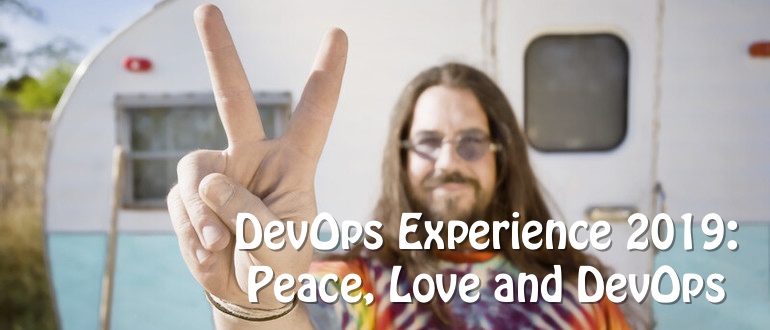
  • DevOps Experience 2019: Peace, Love and DevOps

    DevOps Experience 2019: Peace, Love and DevOps

    DevOps Experience 2019 is coming, and it’s gonna be groovy, man.

    This year’s virtual event is all about peace, love and DevOps understanding, with a heavy emphasis on understanding. As with last year’s event, DevOps Experience 2019, sponsored by devopsy.kinsta.cloud parent company MediaOps, is chock full of information and education for those in the DevOps space, presented in a virtual reality environment. DevOps Experience is a true virtual conference, complete with theaters to view the keynotes and presentations, a conference lobby to chat and socialize and a virtual trade show floor with virtual exhibitor stands equipped with videos, downloads and company representatives on hand to share information.

    And perhaps the greatest thing about DevOps Experience 2019? You don’t have to leave the comfort of your desk.

    DevOps Experience 2019 will feature keynotes from a lineup of DevOps luminaries including:

    • John Willis, CEO & Founder, Botchagalupe Technologies
    • Nicole Forsgren, Research and Strategy, Google Cloud
    • Jayne Groll, CEO, DevOps Institute
    • Gary Gruver, President, Gruver Consulting

    Additional speakers will include Alan Shimel, MediaOps Editor-in-Chief and Founder, devopsy.kinsta.cloud and Security Boulevard; and Chris Miller, Principal Security Program Manager, Veracode. In addition, the event will feature a number of Spotlight Sessions with topics designed to provide even greater value to attendees.

    This daylong virtual event is a great way to mix with others in the DevOps space without the hassle of traveling. It’s also a perfect excuse to wear your Grateful Dead t-shirt to the office.

    DevOps Experience 2019 is scheduled to be held Thursday, Oct. 10 at 10 AM EST, at a computer or mobile device near you. Visit the website for more information or to register for this daylong event. Registration—which is free, by the way—also includes access to the event on-demand.

    So pull on those bell bottoms, weave some flowers into your hair and join us for what’s sure to be an educational DevOps lovefest. Peace.

    — Charlene O’Hanlon