
Tag: development process

  • 5 Ways Traceability Is Changing to Bolster the Remote Workforce

    5 Ways Traceability Is Changing to Bolster the Remote Workforce

    Traceability has always been a useful tool in the development process, but it has become especially important since the COVID-19 outbreak and the increased remote workforce. 

    Where developers and engineers were once working side-by-side, with the ability to discuss their process and keep their team informed, they are now navigating a remote collaboration landscape. According to a 2017 study done by Stack Overflow, there is a correlation for developers between remote work and job satisfaction, and the highest job satisfaction ratings are seen from developers who work remote full time. As technology has grown to make this process easier, remote working is expected to become a norm. 

    Advanced traceability has the potential to hold teams together by allowing increased visibility into each move throughout an entire project. Without traceability, it would be nearly impossible to keep remote teams aligned and on schedule.

    Product development tools have continuously been forced to evolve to keep up with the multi-dimensional nature of requirement, test and risk management. For these processes to be successful, all related variables must work together continuously, at scale, and across teams. 

    We’ve only just started to see how traceability tools can use updated capabilities to streamline the product development process, but we know enough to discuss two things: what’s happening now and what the future may hold.

    Traditionally, traceability could be compared to a map. While not limited to a single view, maps exist to help you navigate your way to a destination. Similarly, traceability leads product developers through every step of their processes, eventually helping them reach their goal. If your map was constantly changing you’d never be able to figure out where you were going, but what if people ahead of you could update it as they went along? This would keep you in the loop of the upcoming twists and turns, and no one would feel blindsided. Traceability makes it easy to share similar production changes with your entire team, all at once.

    In the traceability process, links are built automatically which lets major decision points, reviews and approvals be captured in final documents and reports. This allows for faster and more informed decision making and these live references can exist across versions. 

    With the switch to remote work across the globe, and no immediate end in sight, developers don’t have the option of working side-by-side with their colleagues. Because of this, it is pertinent that they are able to streamline their work in every way possible, and increased traceability is expected to be a pillar of that transition. 

    At the end of the day, connecting the dots is all about making sense of everyone’s decisions. Why did they follow that process, and what factors led them to make the choices they made? 

    In the early days of traceability there wasn’t always room to include every piece of information that you might find relevant down the line. Legacy tools such as the act of manual reporting through Word documents left much to be desired. Today, that’s becoming less of an issue, as developers are allowed more meaningful accountability and insight into interconnections as they happen.

    As we look ahead, we can expect to see these capabilities grow in five different ways.

    Less Manual Effort

    Updating your traceability reports with as little manual effort as possible will be essential to a streamlined, remote workforce. As traceability becomes more advanced, the work to create and maintain it should not become more difficult. 

    More Nuance Captured, Related and Parsed for Meaning

    Improvements in software will make data gathering more precise, and increase the number of items a team can consider relevant, traceable information. This will take additional workloads off of the developers as more items are automatically traced and easily accessible.

    More Attributes Can Define and Predict a Project’s Success 

    If you have a more data-rich, detailed record of activities, it is possible to understand the past with more context and less reliance on costly manual documentation or memory. 

    Dispersed Systems Holding Relevant Information Will Start to Feel Closer and More Interconnected

    Through more dense integration and aligned processes, systems feel more controlled and connected, giving users a more seamless experience.

    Expansion of Communication and Review Capabilities for Stakeholders Who May Be Impacted by Changes

    The availability of a full audit trail of participation will make a big difference in the ease of the review process. The ability to easily see who is impacted by changes will allow teams to proactively manage the effects of said changes.

    In response to the COVID-19 pandemic, and the number of companies who are maintaining their remote work policies, we can expect to see more innovations related to product development workflows. These innovations will enable easier remote collaboration between colleagues and across teams, overall streamlining the product development process.
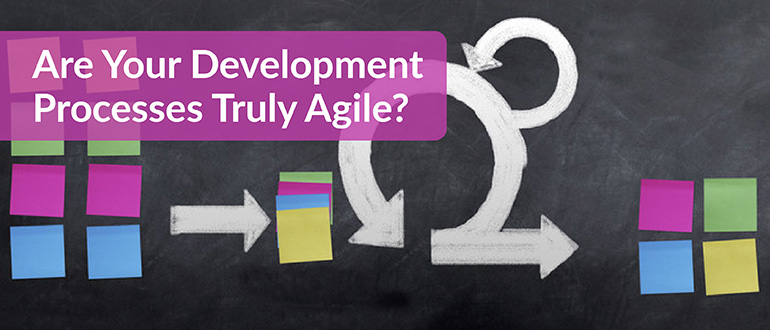
  • Are Your Development Processes Truly Agile?

    Are Your Development Processes Truly Agile?

    Many organizations are making a move to agile-powered environments, but agile development is more than a name. How do you determine if your organization is truly agile? The evaluation starts with the Agile Manifesto. If you’re following the principles laid out in the manifesto, that’s a good sign that you’re on an agile journey.

    For those not familiar with the manifesto, however, let’s review its points quickly. The Agile Manifesto’s core is simple—the primary points of the manifesto include the following:

    Individuals and interactions take precedence over processes and tools. This means the organization and its leaders place more value on people than they do on processes. People respond to business needs and they drive the development process within the organization.

    Working software takes precedence over comprehensive documentation. This is not about not providing any documentation at all, but you should streamline documentation. Any documentation that does exist should be necessary only for current and future development.

    Customer collaboration over contract negotiation. Engaging customers throughout the development process makes it easier for your people to meet the needs of your customers. Doing so means all business case features are clear and useful to customers.

    Responding to change over following a plan. This means change is welcome throughout the project, each project and allows for priorities to shift over time versus following a rigid or scripted development plan. 

    The Agile Manifesto 12 Steps

    Essentially, the core values of the Agile Manifesto can be fully detailed in 12 steps, or principles. These principles support the key points of the manifesto and provide additional detail as to how the practices can be followed in an agile environment. Again, for those who currently follow the Agile Manifesto, the following may be redundant. For those new to the concept, these steps provide clarification and direction to drive agile processes overall.

    • Self-organizing teams encourage great architectures, requirements and designs.
    • Regular reflections on how to become more effective.
    • Frequent delivery of working software.
    • Simplicity.
    • Support and trust for those involved in the process.
    • Enable face-to-face interactions.
    • Working software is the primary measure of progress.
    • Agile processes to support a consistent development pace.
    • Attention to technical detail and design enhances agility.
    • Collaboration between the business stakeholders and developers throughout the project.
    • Customer satisfaction through early and continuous software delivery.
    • Accommodate changing requirements throughout the development process.

    Based on these principles, there are three points—the final three listed here—that we often find the most compelling. A colleague of mine, Tobias Spöcker, scrum master and QA engineer, says these points naturally float to the top for an organization such as TOPdesk.

    The reasons for this are fairly obvious. We create products that are sold to thousands of customers around the world. To pinpoint any development problems, we look to the scrum process described by the scrum guide, with an emphasis on the last parts of the process. For example, the following illustration is edifying for explaining this process:

    Agile scrum process

    Notice in the “product release” phase illustrated above that the team listed here focuses on finished work for the development sprint. This portion of the model should be able to present a product incrementally to the stakeholders, including the customer. Ideally, these increments are released through a continuous delivery model. Here are two principles that further illustrate the point: Collaboration between the business stakeholders and developers throughout the project and customer satisfaction through early and continuous delivery of the software.

    There’s an additional consideration when providing value: Develop what is right; don’t simply develop something right.

    Adding Value

    At TOPdesk, providing the proper value to customers is a major goal for us. To achieve our organizational goals, we consider the impacts on our customers so when we start on a new product development project, we always work with some of our customers so they are involved in the development process, which makes the process and the product better for everyone. Those of our customers that have participated in our development processes usually tell us that they find the experience valuable and that being a part of the process also helps them when they use the solution. These same customers also express satisfaction in our efforts—as partners in the development process—and with us as an organization.

    Direct Feedback is the Key to Better Development

    The immediate and direct feedback we receive also helps to achieve another of our key operational principles: accommodating changing requirements throughout the development process. Through the partnership with our customers during the development phase, we’re able to receive regular, constructive feedback—even criticism—that leads to changes and evolutions in the product map and development stream. This feedback facilitates refinement of the most important processes and features, and moves them to the top of the priority list, leading to a project that’s undertaken with a focus on the most valuable areas so that development capacity (on the part of our organization) is spent the most wisely.

    Agile-Organization

    In Sum

    The agile mindset and the scrum framework are powerful tools if they are used in the right way. When considering following any development principles, don’t go in blindly. It is a good idea to see which parts of the toolbox help your organization be the most agile, efficient and customer-focused, and utilize the processes and principles that work best for your organization.

    Consider direct feedback from customers, which can be implemented immediately into the product scope. Provide simple-to-use customer communications vehicles, including metrics built into the software, surveys and feedback portals. Live demos of the product, when ready, can be extremely effective in helping you collect copious feedback efficiently. However, if your feedback loop is too big—meaning there are too many cooks in your kitchen—the whole process will quickly balloon beyond profitable, resulting in a less agile development process.

    The projects we develop using these principles are the ones that deliver the most value to our customers the most quickly. Including feedback from customers makes the development team more confident in what they are creating, and our customers tell us that they feel their needs and input have been heard, which they greatly appreciate.

    — Nancy Van Elsacker Louisnord

  • Boosting Time-to-Market by Improving Software Development

    Boosting Time-to-Market by Improving Software Development

    Today’s business environments require “agility” in terms of being able to quickly understand and adapt to information, trends and new developments. For example, a company might employ a business intelligence suite that provides them with real-time information on product sales, which allows them to dynamically adjust content or strategy.

    Set a Baseline

    You can’t measure improvement in a business process without first establishing a baseline. The first step in reducing the time-to-market for software development is to look closely at the current development process. Review the steps involved in turning an idea into a live product or product feature and identify any bottlenecks, inefficiencies and constraints. Once this review is complete, set realistic goals that reflect the current situation and the improvements you want to see within a certain time period.

    Eliminate and Optimize

    During the review and baseline phase, you might come across activities that do not add value and do not speed up the process. Perhaps there are some unnecessary meetings during the mid-phase of the development process that typically do not uncover any problems and hold no real value. Or, there’s a documentation step that is a drain on human capital and takes away valuable time from testing and innovation.

    Identifying problems and bottlenecks is vital, but the efforts will be wasted if there aren’t open lines of communication. Poor communication causes software release delays, so establish efficient processes, set up the right team structure and adopt tools and technologies that allow transparent and fast communication between cross-functional teams. When it comes to teams, you want to find the right balance of staff. Generally, a winning team includes the right analysts, marketing managers and DevOps resources who can work together towards a common goal.

    Streamlining and Developing Incrementally

    As the team moves into development, there are steps you can take to increase efficiency. Independent tasks should be performed in tandem; for example, test scenarios built while various features are defined. Do not wait until development is completed before creating test environments; encourage the team to split parallel tasks that best match with their individual talents.

    When it comes to enhancements for business apps, there’s an inclination to go for the “home run” by greatly changing the application and including many new features with every update. For reliability and speed to reaching the market, you instead want an incremental approach, by which you develop controllable enhancements and bug fixes that provide immediate value to the users. Prioritize the “wish list” of feature sets so you can better manage and plan the updates that will go into future releases. Get buy-in from other departments and then build and create an enhancements schedule.

    Test Often and Embrace Automation

    In addition to having testers test the application, you should actively engage with clients and select users early in the development process so they can provide input on the overall functionality and user interface as well as help discover bugs. Your time-to-market can be greatly impacted if bugs aren’t caught early on, and you might even need to pull a newly launched application if the glitches impact users adversely.

    Improving this process requires defined and repeatable testing procedures and, to reduce time-to-market, these procedures must be automated at least partially.

    Consider these other benefits of software testing that will improve your DevOps:

    • Discovering bugs and software errors can improve the system’s capacity
    • Testing can improve the security of your applications
    • Improve customer engagement and satisfaction through a high QoE score
    • Reduce the total cost of ownership
    • Better meet industry standards and compliance regulations

    Other automated processes should be introduced into the development cycle, including environment provisioning, data or API mocking; builds management; and standards enforcement. For instance, automated deployment solutions give DevOps a repeatable process so engineers have more time to focus on crafting new features. Another example is release automation tools that manage workflow as software moves between development, production and testing. These tools not only speed up the process, they also eliminate potential for human errors.

    The modern business relies heavily on applications to communicate, complete sales and operate more efficiently. Companies strive to bring these apps to the market quickly so they don’t miss opportunities and can adjust to market conditions. To accomplish these goals, companies must adopt the right software development processes and tools to improve their time-to-market speed and capture a competitive advantage.

    About the Author / Ajay Kaul

    Ajay Kaul is managing partner at AgreeYa, bringing more than 27 years of experience in sales, consulting and managing small to large IT projects worldwide. Kaul has led AgreeYa through 16+ years of success, leading the company in highly competitive and complex markets and driving significant profitable growth with global workforce of more than 1,500. Prior to founding AgreeYa, he was responsible for managing engagements for Deloitte serving private and public sector clients across United States. Connect with him on LinkedIn.