Tag: database devops

  • Achieving Business Maturity with Database DevOps

    Achieving Business Maturity with Database DevOps

    Companies have seen unprecedented change over the past year and a half, with IT teams trying to help businesses weather the storm by meeting customer demands for services and products to be delivered in new ways while adjusting to remote work. As more companies introduced hybrid approaches to their workplace, a particular trend began to emerge: DevOps adoption. 

    Many adopted DevOps to navigate the new landscape, boosting software delivery and operational performance with advanced application and database development practices. In fact, research from Redgate Software indicates that DevOps adoption reached its peak earlier this year, with 26% of enterprises leveraging DevOps across all projects—a significant increase from previous adoption rates.

    Although not all companies have been quick to adopt for fear of disrupting existing workflows, a technical skills gap or lack of buy-in from management, there is a strong case to be made for why adopting DevOps practices, including for the database, can help businesses better manage the evolving tech environment.

    Adopting Automated Deployments

    Companies everywhere migrated databases to the cloud over the course of the past year, and that trend shows no sign of slowing. Analysts at IDC predict that by 2022 more than 90% of enterprises will rely on a mixture of on-premises/dedicated private clouds, multiple public clouds and legacy platforms to meet their needs. One of the best ways to help maintain that data is to implement DevOps processes for those databases and automate deployments. This provides a host of benefits, including: 

    • Preventing software errors: Manual database migrations often come with a host of errors that lead to downtime, rollbacks and rework. It’s far better to rely on an automated process that is robust and repeatable and can be implemented across all databases to ensure they’re updated in the same, reliable way. 
    • Staying in the loop: Knowledge of how to release updates and changes is often limited to a handful of people or even just one person. If, instead, it is part of the system and development process, it ensures everyone is in sync with updates and developments and allows anyone on your IT team to handle deployments.
    • Guaranteeing quality and consistency: For companies with security and compliance concerns, the predictable and repeatable processes that automated database deployments introduce ensure nothing is left to chance, while providing an auditable record of exactly what was changed, when and by who.

    Although the research shows 20% of companies cite cost as a roadblock to automation, avoiding automation will leave businesses at a disadvantage as they prepare for the coming year. 

    Creating Communities of Practice 

    When asked how they decide the strategic direction and planning for DevOps, the most popular answer from respondents was communities of practice. This concept was proposed for the first time in the early 1990s, and the practice has seen increased popularity among IT teams recently. It’s described as groups of people who share the same passions or concerns for something they do and often learn how to do that task better based on their regular, frequent interactions. 

    These various communities—regardless of whether in-person or virtual, given the current environment—help foster intrinsic motivation in employees and improve overall decision-making and encourage innovation. According to Redgate’s research, over a third of respondents noted that a community of practice makes decisions, provides recommendations or is consulted before DevOps strategies and planning are put into place. Another interesting point from the research is that the adoption of communities of practice correlates with company size. Enterprise and medium-size companies reported adoption rates of 38% and 36% respectively compared to only 28% adoption in small companies.

    As companies grow and teams mature, these communities not only benefit the organization by bringing more diverse minds to the table when making decisions but benefit individuals by supporting development, enabling networking and improving recognition across the organization. 

    Managing Cross-Database Estates

    Redgate’s research found that 70% of organizations now have more than one database management system in use, and 48% have teams working on three or more different databases. One possible reason for this is the increased adoption of cloud databases. With a large range of cloud databases and platforms in use, each offering different advantages, teams are now making choices based on specific use-cases. There was an increase in the share of respondents using cloud-native databases such as Azure Cosmos DB, MongoDB and Snowflake compared to last year, for example.

    With cloud adoption accelerating due to the pandemic and the need for technologies that can be managed, operated and accessed remotely, the advantages of introducing DevOps processes to maintain database changes and ensure version control have never been clearer. Teams that have automation and advanced development practices in place can continue building and deploying software as smoothly as before the pandemic, even when working remotely.

    Instead of working to build up processes and procedures, mature DevOps teams can focus their efforts on solving problems and ensuring higher quality of code, without the need for laborious manual tasks or code reviews that automated systems perform more reliably. 

    Making the Case for Database DevOps

    When teams are physically separated, working disparate schedules and dealing with their own challenges at home, the more companies can do to reduce workloads and help them focus on value-added work creates a happier workplace and improves the chances for business success. The rise of DevOps for both application and database development helps mitigate many of the challenges organizations face as part of their digital transformation journeys. It’s going to help IT teams remain productive when working remotely and encourage them to explore new database platforms, both on-premises and in the cloud.

    With remote and hybrid work the new normal for the future, companies that set their sights on adopting DevOps across the company will only see these benefits increase. 

  • A New DevOps Database Platform is Needed

    A New DevOps Database Platform is Needed

    The diverse number of database platforms, deployment environments and data variants needed to support the plethora of applications and services required for rapid DevOps continuous delivery lead times, coupled with the challenges of integrating database changes for application pipelines, is a growing challenge for many organizations as they strive to accelerate their DevOps transformations.

    When you stand back and look at the bigger picture, an enterprise with many databases and various data requirements for DevOps continuous delivery presents a problem. At best, it makes things chaotic; at worst, it is a gross impediment to overall organization agility—which undermines the very purpose that DevOps is meant to serve.

    In my book, Engineering DevOps, I explained that databases offer several challenges for CI/CD pipelines.

    In the simplest case, when a database is used solely by one application or microservice, the database pipeline can be integrated with the application pipeline to ensure its changes use the same version management system and change controls to ensure the database changes are kept in sync with the application. However, many database platforms are not as responsive to changes as the applications themselves and become a bottleneck for the pipeline.

    If a database is used by several applications, each with its own DevOps pipeline, then changes to the database must be coordinated with all applications that depend on it. Maintaining a separate database pipeline linked to the application pipelines through CI/CD toolchains, as a strategy, is overly complicated and can often introduce additional bottlenecks and synchronization issues.

    Another challenge with database pipelines is the management of data in the database during the CI and CD stages. Data in production needs to be persistent and is ever-changing, even while the underlying database code is changing. During the CI process, sample data from production needs to be used to ensure testing is realistic, and new test data must be introduced to verify new database capabilities are working.

    During the CD stages, rollbacks to prior versions of database code must avoid rolling back to versions that are no longer compatible with production data. This is a key reason why database changes must follow a disciplined approach that fully tests database changes with applications prior to full deployment. Rolling deployments, in which applications and database changes are deployed gradually in separate clusters, can minimize the blast radius in case of problems. The required coordination of separate systems adds complexity and bottlenecks.

    So, why not simply integrate database changes as artifacts within the same DevOps pipeline as the application?

    Gilad David Maayan’s September 2020 article DevOps Database Strategies and Challenges: Automation, Scalability, and More explained some of the specific challenges that arise with integration of traditional databases with DevOps.

    Database tools were not designed for integration with DevOps tools. These tools tend to be database- and environment-specific, which can make it difficult to incorporate into pipelines designed for flexibility.

    Database performance and ease of management often do not perform well in DevOps environments where multiple applications need to use the database in a short time, such as in the accelerated lead times for DevOps continuous delivery. This is especially true with larger-scale databases. If an application change must sync with a database schema, changing the pipeline can become complicated especially if there is a need to sync across multiple application pipelines to meet continuous delivery goals.

    While DevOps processes are proven for continuous delivery of applications, incorporating database changes into the DevOps pipeline is hindered by large data sets, limited database automation and security concerns. As a result, database development and testing continue to rely on outdated processes, with fixed and often shared instances refreshed from backups. A new DevOps Database platform is needed to provide highly dynamic and efficient cloud-native database solutions for modern enterprise digital transformations, and that platform must include DataOps use cases for DevOps, DevSecOps, continuous testing and governance. This new kind of data repository must be designed to integrate seamlessly with DevOps CI/CD pipelines through flexible APIs and cloud-native architectures.

    Given the points above, traditional database solutions and parallel data pipeline strategies are not sufficient to meet the challenges of enterprise DevOps transformations. What is needed is a new kind of DevOps database platform that allows the database, and database changes, to be as agile as any other artifact in the DevOps pipeline.

    Paul Stanton, VP of product management at Windocks, in his June 2021 YouTube video Windock DevOps Data Repo, said, “Imagine terabyte class database environments managed as DevOps artifacts with entire versioned databases available in seconds.” That’s what we need.

    The following are examples of the capabilities required for such a new DevOps database platform.

    • Automated database provisioning
    • Distributed repositories support
    • Simple declarative builds
    • Dynamically scalable
    • Virtual hard drive images for a wide variety of DBs – Linux, SQL, Oracle and others
    • Distributed versioned database environments working on standard file systems and storage systems delivery writeable data at the speed of DevOps – in other words, in seconds.
    • Deploys equally to all operating systems and cloud environments, Docker containers and Kubernetes.
    • Many clones per virtual machine (VM)
    • Security features including access management, data masking and encryption
    • Compatible with and easily integrates with CI/CD platforms
    • Compatible with multi-cloud (AWS, Azure, GCS)
    • Built-in data security and governance into DevOps data.

    I will explain these more completely in a subsequent article.

    What This Means

    Digital transformations are imperative for modern enterprises and organizations if they are to remain competitive. However, the transformations of many enterprises and organizations are being seriously impeded by having too many database platforms and tools that do not integrate well and that bottleneck continuous delivery goals. A new kind of DevOps database platform, in which the database is treated as any other artifact, is needed to resolve technical problems with database integration to DevOps application pipelines. A new DevOps database platform solution is needed to accelerate time-to-value and realize efficient, safe operation for digitally transforming enterprises and organizations.

  • Survey: The State of Database DevOps

    Survey: The State of Database DevOps

    Enterprises are undergoing rapid changes. Throughout the past year, companies have been pressed to learn a diversified set of technologies and methods to remain agile in a changing economy. In this digital-first world, data plays a heightened role; in tandem, so does the delivery of data and the persistence of the database layer itself.

    Applying DevOps principles and automation throughout the software life cycle is critical to maintaining a high level of efficiency. As with application development, databases are not immune to the DevOps takeover. Database DevOps is a discipline that considers the processes used to automate database changes and deployments — a field growing in mindshare as databases diversify.

    Seventy percent of companies now use more than one database in their stack. Many organizations now use a blend of on-premises and cloud databases. Styles are diverging, too, as non-relational databases like NoSQL gain favor, and new open-source databases emerge to fit niche circumstances. All of this means database operators may require an increased emphasis on database DevOps to handle additional complexity.

    The 2021 State of Database DevOps report, conducted by Redgate, surveyed 3,200 database professionals on the general state of their DevOps adoption. The survey also inquired about database change automation and deployment and underlying database technologies. Now, five years in, the study continues to reveal shifts in practices across industries.

    Below, we’ll review the report’s main takeaways to see how companies implement database DevOps in practice.

    DevOps Adoption Increases Across Projects

    To meet pressing digital innovation needs, DevOps has surged in importance across all industries — 74% of organizations have adopted some form of DevOps, and 26% of respondents reported applying DevOps practices across all projects — a significant uptick from previous years. The report acknowledges a slight increase in DevOps adoption among larger company sizes.

    So, which DevOps practices are companies employing the most? Well, in terms of DevOps for application development, the majority of organizations (50% or above) have adopted version control, automated builds, monitoring, automated unit tests, static code analysis and semi-automated deployments in production. Only 41% of organizations surveyed have fully automated deployments to production. These methods can be viewed as a basic benchmark for modern DevOps.

    The study demonstrated that in most organizations, DevOps is a communal undertaking. More respondents reported adopting a community of practice, rather than relying on individual decision makers, to disseminate DevOps strategies and direct planning. According to the report, a community of practice is a group of people that “makes decisions, provides recommendations, or is consulted.”

    Lack of Skills Tops DevOps Obstacles

    The pressure is on engineers to produce to meet digital transformation demands. However, organizations experiencing a developer drought may not possess the talent to introduce DevOps practices. It’s no surprise that the common obstacle hindering DevOps adoption was a “lack of appropriate skills in the team.”

    Other cultural barriers to DevOps adoption include disruption of existing workflows and a lack of alignment between teams. Interestingly, a lack of executive support was cited as the lowest hurdle to DevOps adoption, indicating universal consensus on DevOps goals. If we consider what technical barriers prevent improved software delivery and operations, 41% noted insufficient automation in release processes and 39% expressed hindrances due to legacy code.

    Continuous Delivery For Databases Increases

    Database DevOps appears to be growing in production use too. For the purpose of this study, Database DevOps is defined as “automating the delivery of database changes.” According to the report, 51% of respondents are already automating some parts of their database deployment process.

    Though growing year after year, database DevOps is nowhere near ubiquitous. Compared to DevOps in application development, database DevOps has lower overall use. For example, only 36% are implementing automated builds. And, only 22% adopt continuous delivery (CD) for all databases. Nevertheless, this could quickly change, though, as 80% of respondents are working to implement CD for database changes or have already implemented it.

    Setting up a CD process for database changes could increase overall software delivery speed. The top two drivers for adopting database automation are increasing the speed of database changes and freeing up time for other work. The third top reason, minimizing application downtime, rose in rank this year — which makes sense, as the desire to create more reliable systems is an ever-present concern.

    However, to reap these rewards, organizations must overcome some significant challenges, like synchronizing application and database changes and maintaining high speeds for database automation, among other concerns.

    Organizations Adopt Hybridized Database Approaches

    Companies increasingly use a mix of different database technologies and styles. We also see an increase in cloud and hybrid database estates.

    In terms of database styles, relational databases still make up the majority of market share — 98% of respondents have at least one relational database. However, non-relational databases, like NoSQL, are gaining popularity. Forty-seven percent of database professionals have a NoSQL database in their enterprise. Interestingly, only 2% use non-relational databases exclusively, indicating it’s a niche use case.

    Enterprises are now using more databases than ever before. Seventy percent of database professionals reported having more than one database in their stack. This figure rose nearly 10% since last year. Database types are multiplying too — 45% have more than one type of database. In terms of database management systems, Microsoft SQL Server holds the most use, at an 82% usage rate. Others like MySQL, Oracle, PostgreSQL, and MongoDB trail behind.

    Enterprises are also increasing their use of cloud and hybrid database deployment models. Eighty percent of respondents host a cloud database, and 65% report a mix of cloud and on-premises estate.

    One possible explanation for the diversified database effect is an increase in public cloud provider usage, combined with the rise of multicloud strategies. Database options are increasing as well — many free, open-source databases can cater to unique project needs.

    This “polygot persistence” could also simply be a natural occurrence within large enterprises supporting many application nuances. As Martin Fowler describes, “… any decent sized enterprise will have a variety of different data storage technologies for different kinds of data.”

    Quality Database Ops = Quality Software Performance

    In summary, non-relational databases are gaining steam, cloud and hybrid database models are becoming more common, and large organizations are increasingly using multiple database types. The landscape is forecasted to diversify further, meaning database DevOps is stepping up to manage this complexity.

    The report indicates a correlation between quality database Ops and overall software quality, noting that organizations that release more frequently typically deploy database changes in much less time. To achieve these goals, “… the next area for database DevOps is in the data engineering and analytics space,” writes Pramod Sadalage, director, data & DevOps, ThoughtWorks.

    While it’s important to take a vendor-endorsed study with a grain of salt, it’s safe to say we will likely see more interest in database DevOps, especially as DevOps themes continue to permeate through the entire spectrum of software development and delivery.

    For more information, you can download The State of Database DevOps report behind an email gate here.

  • Financial Services Rise Above in Database DevOps

    Financial Services Rise Above in Database DevOps

    Financial services, pat yourselves on the back. A new study from Redgate shows financial services have superior database DevOps and database monitoring compared to other sectors.

    Financial IT appears to outperform other industries with high-quality database monitoring benchmarks consistently. For example, financial services on average are far quicker to detect and remediate failed deployments.

    Below, we’ll cover the main takeaways from Redgate’s latest 2020 State of Database Monitoring in Financial Services report, and bring in Grant Fritchey, Product Advocate at Redgate, to better understand why the financial sector is performing so positively in database DevOps.

    2020 State of Database Monitoring in Financial Services

    Redgate has released a special financial services edition of its 2020 State of Database Monitoring Report, a study that surveyed 971 database professionals across a wide range of sectors. This financial segment report highlights how database monitoring practices within banking, investment and insurance groups compare to other industries. Here are the main takeaways:

    Frequency and Remediation

    Financial services deploy more frequently and detect and resolve issues more rapidly.

    Financial services are quickly updating their databases. Sixty percent of financial services deploy once a week, whereas 43% of other sectors deploy once a week and some (10%) only update their databases once per year.

    Financial services are quicker to detect issues and respond. For example, 49% of financial institutions detect failed deployments within 10 minutes, compared to 39% across other sectors. The average Mean Time to Recovery (MTTR) is less than 10 minutes for 32% of financial services compared to 24% for different sectors.
    [su_note]Want to learn more about DevOps in Financial Services? Join us Thursday, Dec. 3, for FinConDX, a daylong virtual event dedicated to the latest in DevOps, DevSecOps and Digital Transformation practices and tools to help FinServ companies thrive. Register today![/su_note]

    It is impressive that financial services deploy more frequently yet still maintain higher Mean Time to Detection (MTTD) and MTTR than other sectors.

    Growth and Tools

    Financial services have a larger data footprint and a higher demand for database monitoring tools.

    The survey also demonstrates significant growth in overall database footprints, reflecting the sheer accumulation of data year after year. Whereas 26% of other sectors have 50 to 500 database instances, 36% of financial services have this many. Large financial data estates with more than 1,000 instances have grown 8 percentage points year over year.

    To help track these data estates, 66% of financial services use paid database monitoring tools. In other sectors, only 39% use paid database monitoring tools. The report predicts ongoing cloud migration and hybrid cloud modes will push these rates higher.

    Sixty-eight percent of customers report general satisfaction with database monitoring solutions. Yet, financial services cite a lack of features and time-consuming processes as top drawbacks, reflecting a need for financial services to utilize advanced functions and innovate quickly.

    Database Usage

    Financial professionals perform more tasks and grant more non-IT members database access.

    Working with more rigid security benchmarks, database professionals at financial services are often responsible for an increased number of tasks.

    Across all sectors, performance optimization and backups are the most common tasks performed by 70% and 60% of database professionals, respectively. However, if we look at financial services, tasks such as optimization, availability checking, user permissions management, patching and auditing are more common, all 8% to 11% higher.

    The report also found financial service databases, on average, are more widely accessed across the whole business, including database admins, management and business teams. According to the report, this could reflect a higher skill standard across the board at financial organizations.

    Issues

    Human error spikes moderately as financial IT innovates.

    Human error, capacity problems, bad deployments and software failure are top database issues across sectors. However, human error raises slightly within financial services, to 27% from 23%.

    “This spike [in human error] is just showing how fast our financial services institutions are changing to meet the needs of a changing business environment,” said Fritchey. Though there is a high demand to fill roles with data management skills, there is a talent shortage. “Recruitment is one of the biggest challenges,” he noted.

    That said, financial services do report fewer issues in other areas. For example, database access management is handled more efficiently at financial services. Whereas ad hoc user access issues have doubled in other sectors, financial services reported no significant change.

    Looking to the future, respondents indicate cloud migration, migrating to new server versions and improving performances as the top three impending challenges.

    Why Do Financial Services Outperform?

    Data demonstrates financial services on a superior overall curve when it comes to database DevOps. But why is this?

    “The answer is pretty simple,” said Fritchey. “Finance is driven by data. Therefore, they’ve always put the time and effort into protecting that information, and monitoring your systems is a fundamental aspect of data protection.”

    The financial sector is also prone to more security exploits and data privacy issues. Such concerns amplify the need for quality monitoring.

    “Organizations with good monitoring in place either also have better security or can spot vulnerabilities faster,” said Fritchey. With such measures in place, if a breach does occur, such organizations can react rapidly.

    International regulations such as GDPR or PSD2 mean financial services must meet stringent compliances. For Fritchey, active investment in quality database monitoring is part of this process.

    “The need to be able to operate across borders means that your systems must meet multiple compliance regimes. It simply makes sense to set the most stringent standards to ensure you can easily operate in the international sphere,” he said. “Monitoring is a fundamental aspect of meeting these compliance requirements.”

    The Future of Database Monitoring

    Financial services inherently require greater fault tolerance, and database monitoring is helping such services reach bank-grade security. As most respondents estimate their deployment frequency to increase in the next year, a greater focus on database integrity will be essential to keep pace.

    The financial services sector appears to be well-positioned for continued growth. With a shorter MTTD and a faster MTTR, financial IT is significantly more advanced than other sectors when it comes to database change frequency and issue remediation.

    “The fact that those with monitoring in place are also those who can more quickly deliver value through some type of DevOps process should cause people to pay attention,” added Fritchey. “All of this combines to make for a better overall organization who does more for their clients.”

  • DevOps Chats: InfluxDB Cloud 2.0 Managed Service for Time Series Data

    DevOps Chats: InfluxDB Cloud 2.0 Managed Service for Time Series Data

    We can’t seem to generate enough data. And as they say, you haven’t seen anything yet! Cloud-based managed services are a natural solution to ingest, store and access large amounts of data from a variety of sources across private and cloud locations. An enterprise solution hosted in the cloud is good, but a developer-friendly, API-based solution with non-enterprise usage-based pricing reaches an even broader audience.

    Enter InfluxDB Cloud 2.0. The name just about says it all. InfluxData VP Products Tim Hall joins DevOps Chats to discuss the company’s new cloud-based time-series database offering.

    InfluxDB Cloud 2.0 represents that shift to a cloud-based, developer-friendly offering with much greater accessibility. We discuss the use cases; the free and usage-based pricing; the new FLUX language for querying, analytics and data processing; common APIs; and that TICK stack. TICK stands for Telegraf, InfluxDB, Choronograf and Kapacitor. It is a feature-rich conversation, so join us.

    Also, check out InfluxData’s Oct. 16th webinar; Optimizing Time Series Performance in the Real World.

    Transcript

    Mitch Ashley: Hi, everyone. This is Mitch Ashley with devopsy.kinsta.cloud, and you’re listening to another DevOps Chat podcast. Today, I’m joined by Tim Hall, Vice President, Products, at InfluxData, and our topic is their new offering, InfluxDB Cloud 2.0. Tim, welcome to DevOps Chat.

    Tim Hall: Hey, Mitch. Thanks for having me.

    Ashley: Excellent. Great to have you on the podcast. Would you start by telling us a little bit about yourself, what you do at InfluxData and maybe for somebody who doesn’t know InfluxData does, give us a little bit about Influx.

    Hall: Sure. So, I’m the Head of Products here at Influx. I joined almost three years ago. I’ve got a background in big data open source technologies. I spent some time at Hortonworks running the Product Management Team there. They’re focused on the Hadoop space. Prior to that, I spent time at Product Management at Oracle addition HP, mostly in the monitoring and data integration spaces.

    So, Influx is a great opportunity to join a small company at the time. We’ve grown to almost 160 people now over the past 3 years, and it was sort of at the convergence of all the things I’d done in my career, from monitoring technologies to integration to big data. And so, it was great to be invited by Evan Kaplan, our CEO, and Paul Dix, our Founder, to join the team and see what I could do to help build a great product.

    Ashley: Fantastic. And tell us just briefly—InfluxData, what do you do?

    Hall: So, InfluxData is focused on providing a platform for time series data, which is about anything with a time stamp. Time series can be broken into two categories—regular series, which are things that you sample. Think of it like sticking a coffee cup in the river and pouring it into a bucket, and we’re the bucket, and you do that on a frequent basis—every 30 seconds, every minute, every 5 minutes, but it’s regular. It’s a regular time interval. And irregular series are also supported by Influx, which are things like events or logs, things that happen at any point in time that could be somebody doing key card access to a building, putting their ATM card into an ATM machine—those sorts of things. Those are all events.

    And so, we handle both of those two things and we have lots of folks using us, both in the open source community, on prem, or wherever they decide to play the software and now our cloud offering as well across a wide range of use cases, everything from DevOps monitoring use cases and building and assembling platforms for observability across to IoT use cases, both for consumer and industrial products.

    Ashley: Well, in a world where we just can’t seem to generate enough data, it sounds like you all are well positioned in the market. [Laughter]

    Hall: There’s more coming every day, right? So—

    Ashley: Yeah, it’s not getting less.

    Hall: Yeah, what do you do with it is really the question. And I think, again, we’re focused on providing a platform for developers. And our goal is really to drive developer happiness. And our motivation is trying to allow developers to solve problems quickly from the time of install to problem being solved. We call that the time to awesome. We want that to be as short as possible, and that’s not always the case with a lot of technologies out there. You’re fiddling with dependencies and other things and Influx comes out of the box with no dependencies and install it, get it running very, very quickly and get going and get your problems solved.

    Ashley: I do really appreciate your focus on the developer community. Actually, we—I just did a webinar a few weeks back with Tom Crow, your Community Manager, and he did an excellent job, by the way, of talking about how he worked with the developer community.

    So, let’s jump to InfluxDB Cloud 2.0. Is this your first SaaS online offering, is that correct?

    Hall: It actually isn’t, Mitch, but I’m glad you asked. So, previously, we’ve had InfluxDB Cloud 1.0, which was really taking our enterprise edition and providing a managed service on top.

    And the challenge we had with that is, we’ve seen good adoption and nice traction. We’ve had a large number of customers purchase and buy it, but the challenge is that it was a little on the expensive side, and it existed as a dedicated instance of our enterprise software that we ran and managed for them, but it was constrained on specific resources. And so, you would buy a plan, pay for it, and then if you continued to grow and use it, then you would have to upgrade, typically by contacting support, and we could do that in a matter of seconds, but it really required a lot more high level interactivity than maybe you might get from the vast majority of cloud services that you could think of, more consuming like a utility.

    And so, our focus with InfluxDB Cloud 2.0 was to deliver the first completely serverless time series platforms, deliver that elasticity for our customers to just adopt and go.

    Ashley: So, truly a cloud service, not just an application in the cloud, if you will.

    Hall: That’s right, that’s right. And all the capabilities we’re exposing in a multi-tenanted fashion, which means we’re obviously testing and validating across a large group of folks all at the same time, and keeping that platform up and available for everybody is our goal.

    Ashley: And I know you’re doing more than just storage in the cloud. You have visualization, UI—other capabilities? You wanna talk a little bit about that?

    Hall: Yeah, that’s right. So, you know, there’s sort of three parts to this story, right? Part number one is, you need to be able to feed the data in, and you need to be able to do that with velocity, and we need to store and land that data and we need to do that quickly and make it available for query and access and all the way through to visualization.

    And so, we have all those parts of the story together. The most recent addition also includes the ability to create monitoring checks that allow you to create queries against the data that you’ve stored and decide if they, let’s say, exceed a certain threshold or create a change of state in some way, shape, or form. And then from there, you can create a notification that can be sent to you through a variety of channels including HTTP POST, Slack—which is available in our free tier—and then, obviously, PagerDuty, which is a super popular mechanism for alerting your DevOps teams.

    Ashley: Mm-hmm. And I think, in addition to kind of integration level type functionality, you’ve also updated the API to InfluxDB in the cloud, correct?

    Hall: That’s right. Actually, one of the goals is, you know, through the 1.0 line of the TICK stack, T, I, C, and K, which many DevOps people might be familiar with, there were four parts—Telegraf, InfluxData (the database itself), Chronograf (which is our visualization tool) and Kapacitor (which was our anomaly detection).

    And we’ve really taken the I, C, and K portions of that stack and integrated them all together in our InfluxDB 2.0 offering. This is both open source as well as cloud. And what we wanted to do was bring together the language, first and foremost, that you use to interact with data, both from a query and a task perspective, and we’ve done that through a new language you’ve introduced called Flux—not surprising, the name of the company is Influx. So, Flux is the new language we’ve introduced. And then we’ve obviously kept Telegraf, which is our data collection agent that can be distributed and used to send data in.

    Now, one of the other things about T, I, C, and K is, each one of those elements had its own API. And so, if you worked with one, it didn’t necessarily translate to the other. So, we’ve unified and have created a common API as part of InfluxDB 2.0 that allows you to do everything from drive the creation of dashboard sales and dashboards themselves all the way through to submitting queries, checks, notification rules, et cetera, all behind a common API.

    And that API is consistent across the open source and the cloud editions. That allows [Cross talk]—yeah, sorry, that allows developers to essentially write an application, either against the cloud or against open source. And if they need to swap it around for any reason—for example, if your journey starts with the open source and you’re like, “Okay, now I need the scale and elasticity offered by InfluxDB Cloud 2.0,” they don’t have to make any changes to their application code. They can just change the end point and point out our cloud.

    Ashley: Very interesting. You know, we’re building applications that are API centric much more today versus let’s expose the application through an API. Did that change how you redesigned the API the way you’ve integrated all these components and does just kind of InfluxDB in the cloud more or less use its own APIs because it works together across these functions?

    Hall: It does. We’re actually consumers of our own APIs. And frankly, that’s been our philosophy for a while. The challenge had been previously that it was fragmented across the four components of the TICK stack and we’ve really tried to unify that and think about, again, delighting developers and giving a consistent API experience across them all.

    Ashley: One of the things you mentioned, too, about—and thanks for that information about TICK stack. I’ve got another question about that in a moment. But back to your 1.0 offering versus 2.0—have you changed kinda the pricing model, done anything to make that more accessible to either developers or enterprises

    Hall: Yeah, completely. In InfluxDB Cloud 2.0, it’s a completely usage based pricing model. We’re also starting developers off with a free tier, and so that free tier is rate limited, but you have access to most of the features and capabilities. We’ve obviously held off some of those things behind the paywall, but generally speaking, it’s now all pay as you go and we’ve got that pricing model published and up on the website as well as in the documentation that describes exactly how much you pay for reads, rights, storages, and so on, and you only pay for what you use.

    And that’s really the goal of providing that serverless offering. People wanna use it as a utility and, you know, compare and contrast with what we did with the managed service in the 1.0 line, you know, they were paying for things they weren’t using, right? It was a fixed price offering and so, you know, that’s why it looked a little more expensive. So, I think now, we’re, I think, price optimized for developers to grow as they’re successful.

    Ashley: And one of the things that probably in any developers mind listening to this podcast is thinking about developers definitely don’t like crippleware. So, you’re focused around data retention limitations, rate, that kind of thing. I’m sure you’ve heard that from your developer community about how to properly construct a free tier offering that’s still very usable to them.

    Hall: Yep, yep. I think we’ve got a pretty good mindset around that. On the data retention side, we’re currently allowing the storage of data for at least 3 days at 72 hours. That can be a lot of data in the world of time series. And the ingest rates are also, I would say, fairly reasonable exposed. Just to give you an insight, I actually am using the free tier myself. I haven’t arm wrestled by Product Manager to give me access to all of the features and capabilities, although I suppose that’s possible, but I wanted to see what I could do.

    Ashley: Mm-hmm.

    Hall: And so, one of the things I happened to do with my son recently is, we built a gaming PC for him. And, you know, one of the most expensive components, the two most expensive components in the machine are the graphics card and the CPU.

    Ashley: Mm-hmm, yep. I would’ve said the same thing. [Laughter] Do the same project with my sons, but yes.

    Hall: That’s right. And so, one of the challenges, of course, is that I wanted to make sure that we installed the CPU correctly and I was worried about it overheating. And so, we’ve got a nice, big, you know, heat sink on there. But I enabled the, what’s called the sensor’s plug in within Telegraf to basically give me access to the CPU temperature data. And I’m taking that and I’m actually sending it to Influx Cloud. And then what I’m doing is, I’ve created a check to check on the temperature and I’ve created warning and critical threshold levels, and then I send the notifications to myself in Slack.

    And so, generally speaking, it’s worked quite well, Mitch, but there’s been an interesting side use case and benefit that I’ve found, which is, my son comes home and decides not to do his homework.

    Ashley: [Laughter] Yep. I was just wondering.

    Hall: [Laughter] So, now I have a very uniquely tuned child monitoring service that allows me to recognize when he is gaming when he should be doing his homework. And he still hasn’t figured out how I’m doing it, so I’m definitely not sending him this podcast.

    Ashley: You’re too sneaky, dad. Parental controls and he doesn’t even know it. [Laughter] Too funny.

    Well, I’d like to touch back on the TICK stack, because I know you’ve been very active with providing open source software through the Telegraf and InfluxDB, Chronograf, Kapacitor. What’s the plan, then? You said you’ve kinda done a lot to the open source or to the code and built that into this cloud offering. What’s the plan with the open source going forward?

    Hall: Yeah, thanks for asking. I mean, one of the core values of our company is that we are strong believers in open source. And, as part of that, we’ve been working on the 2.0 offering for more than a year, and it’s gone through a series of alpha editions, and I think we’re currently up to alpha 18, which matches the features and capabilities that we have available as a GA instance for InfluxDB Cloud 2.0. And we may have some community members out there scratching their head, saying, “Um, so, what gives? How come this hasn’t gone GA?”

    And I wanna be really, really clear, because we have such a large community that we value their feedback, but I also value not giving them something that’s broken and something that’s not ready for prime time. And so, we’ve been very careful about labeling the 2.0 code line in our GitHub repository as alpha code as we work to complete the features and capabilities that we want to have within the 2.0 line.

    And so, the key things that are coming up for us next, there are sort of three things. Number one is, we’re moving towards sort of the feature completeness for Flux, our new language. We’re learning a lot of things about running Flux within the cloud environment and getting feedback from community members on that and there’s probably a handful of things that we’d like to finish there before we’re gonna call that sort of release one of Flux.

    Second is, we really need to create migration tooling, and there’s two things that we’re doing in that regard. Obviously, folks that want to land and store their data for longer periods of time will want to move their data from InfluxDB 1 to InfluxDB 2. And we’ve created sort of a new model inside of InfluxDB 2, which includes the notion of a bucket, which is where you place your data, and how to secure that bucket. And so, there are some migration tools that are required to bulk move that data across.

    And then last is, I mentioned, we’ve introduced a new primary language for working with data inside of InfluxDB 2, and it unifies the ability to both query that data for dashboard creation and report generation and these other use cases that people might build on top, but it also is the same language that’s used for tasks and sort of creating batch operations.

    And that was certainly not the case between InfluxDB and Kapacitor, let’s say. Kapacitor used something called TICK Script and Influx was using InfluxQL. And InfluxQL is a SQL like language and it was an easy onramp for gaining access to the data within InfluxDB. And we’re certainly not abandoning that, but what we’re doing is we’re going to create the ability for you to use InfluxQL, but behind the scenes and on the fly, we will transpile that into something that’s executable by the Flux engine, and then return the results to the customer. And this should allow for existing dashboards and queries just to work natively and seamlessly with InfluxDB 2.0 and obviously InfluxDB Cloud 2.0 when we offer it there. And when we reach that point, then we will declare beta, which means we’ll have feature completeness which include those migration tools and then that’s the time for the community really to start piling in and trying it out, and then we’ll be focusing more on performance and sort of user experience changes between the beta declaration and when we declare 2.0 GA.

    But in the meantime, we’ll continue to add features to the cloud edition, they will show up in the open source through our alpha cadence. But I would say that those three big things, you know, the migration tooling, InfluxQL support, and just completing Flux as a generally available language in version one is where we’re focused.

    Ashley: Okay, very good. Well, certainly a well thought out strategy and you’ve done a lot of work that we’d look forward to seeing in the open source path as well.

    You mentioned buckets, remind me to ask—what types of clouds are you offering the Cloud 2.0 service in?

    Hall: Yeah, great question, Mitch. So, currently, we’re available in AWS and there’s two regions we’re available in—U.S. West 2, which is up in Oregon, and we just started the beta process in Europe, which is available in Frankfort, and it’s currently using the same code, but we just haven’t turned on the ability for folks in Europe to pay us yet. But we’ll run that beta probably for four to six weeks in Europe before announcing GA there.

    In addition, we announced at Google Next earlier this year that we would be available on GCP. And so, our intent is to continue to drive forward. Most likely, that will appear in the U.S. East region, just to sort of fill out a geographic strategy, but we’re very excited about working with the team at Google. Some of my former colleagues from Oracle are now there, which is fun to reconnect with them.

    Ashley: Mm-hmm.

    Hall: And we’ll see that land hopefully by year end, and then we’ve been spending time with Azure on the Microsoft team, and so, I would look for that in Europe and Cuba.

    Ashley: Okay. Very good. I’m really tying back to the very beginning when you told us about your background—I’m really interested in what do you see are the differences in the approach with InfluxData takes with the developer community being such a focus for the company versus a more traditional database company like you worked at at Oracle? Not that they don’t have developer products, they do, but clearly, this is the center of the universe for you. What are some of the things that you’ve learned or maybe differences in the approach you’re taking now?

    Hall: I’d say it’s a mix, Mitch. Like, there are definitely some things in the Oracle landscape that were powerful and can apply to the open source community.

    So, for example, feature flag items—so, don’t ship a new version of the database with all your latest and greatest and coolest features turned on by default. That really prevents people from moving rapidly from, you know, from older editions to newer editions. So, we try to keep those things turned off and provide highlights to folks and release notes about how to activate them and turn them on. And it is a double-edged sword, because people who are new that come in, you’d like them to use the latest and greatest and best technology and we do try to highlight that. But we also want people to move and eliminate that sort of long tail of support as quickly as possible.

    So, a very smooth process. And this sort of came from Oracle—yeah, feature flag those new things, definitely highlight it so they can take advantage. But let the developers—they’re smart. They’ll take advantage of those new features if you just tell them where they live and how to turn them on.

    Ashley: Mm-hmm.

    Hall: On the flip side, on the community side, you know, listen to the community feedback. And I would say that’s one thing that’s been top of mind, if not totally obvious is, you know, the motivation behind introducing Flux as a new query language was not done lightly. But it really is in response to all of the outstanding query related questions and issues that were opened by our community members. They could not move certain workloads, they couldn’t do certain kinds of functions, they needed more flexibility with the language. And so, Flux is the genesis of listening to all that feedback.

    You know, unfortunately, some of those issues have definitely stood out in the community for, you know, now going on two or three years. In some cases, I finally feel like we’re at the point where we can deliver on those requests from our community members.

    Ashley: Very good. I feel like we’ve covered a lot of ground on our podcast today, certainly giving our listeners a great feel for what’s unique and new and also how to get started with Cloud 2.0 InfluxDB. I imagine on your website, there’s a pretty easy place to get started?

    Hall: Yeah, absolutely. I think it’s the primary call to action on the website today. If you go to InfluxData.com, it’ll pop up and say, “Get started with Cloud 2.0 immediately.” Also, you can get the open source by going to our Downloads page, or you can find us on GitHub.

    Ashley: Excellent. Well, Tom—Tim, [Laughter] I knew I would do that—Tim, thank you for being on the podcast today.

    Hall: [Laughter] You’re welcome, Mitch.

    Ashley: Okay. I owe you one. [Laughter] I’d like to thank my guest, Tim Hall, Vice President, Products, at InfluxData for joining us today—and, of course, thank you, our listeners, for joining us as well. This is Mitch Ashley with devopsy.kinsta.cloud. You’ve listened to another DevOps Chat podcast. Be careful out there.

    — Mitchell Ashley

  • 2018 Database DevOps Survey: Crises Still Prevalent, Mostly Avoidable

    2018 Database DevOps Survey: Crises Still Prevalent, Mostly Avoidable

    DevOps is not just a buzzword anymore, it’s a reality. With the unfolding evolution of automation and continuous delivery, DevOps practices have become an industry standard. Adopting technologies for rapid deployment has become essential for companies that wish to maintain their status as serious players in their industry, both from cost and production standpoints.

    But while DevOps is a significant piece of the IT puzzle across multiple industries, many have yet to adopt these crucial continuous delivery practices for their databases.

    In October 2017, DBmaestro conducted an online survey highlighting the challenges and best practices of companies using or looking to implement DevOps, with a focus on databases. The survey respondents are 244 IT professionals from around the globe, representing a variety of industries. The “2018 Database DevOps Report” revealed widespread adoption of DevOps practices on multiple levels across industries.

    DevOps Adoption Rates Increasing, Databases Still Lagging

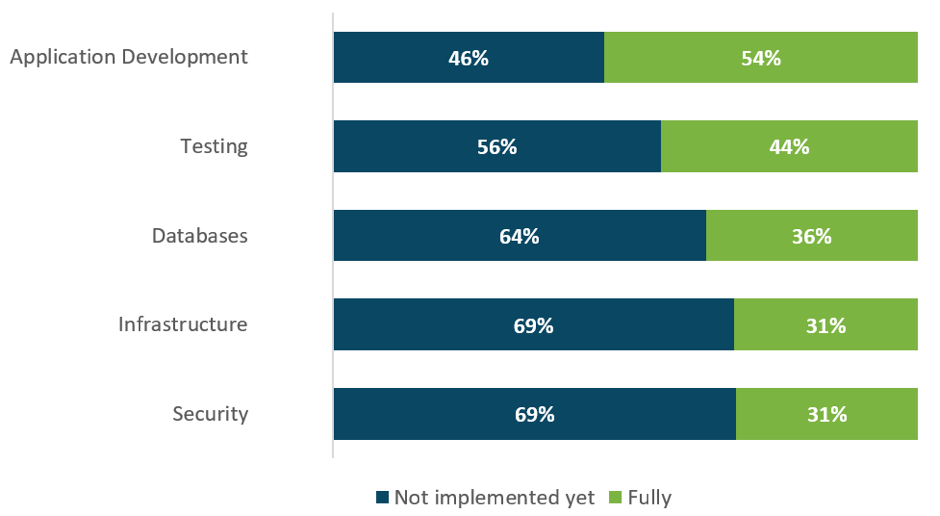
    More than half of the companies surveyed (54 percent) are actively using continuous delivery practices and tools for application development in 50 percent or more of their IT projects. The same cannot be said for databases, however; to date, only 37 percent of respondents have adopted continuous delivery for databases.

    Continuous Delivery Adoption Rates

    Interestingly enough, while the rate of continuous delivery adoption for databases clearly lags behind that of application development, it remains an area of great interest for companies in 2018. In fact, 17 percent of survey respondents indicated plans to adopt continuous delivery for just that purpose.

    DBAs Face Huge Responsibilities, Huge Risks

    Slow adoption of continuous delivery practices for databases leaves companies exposed to costly errors. The report offers insight into the biggest challenges companies face with database changes.

    In many cases, the bottleneck in the process lies in the division of responsibilities: 59 percent of respondents reported that DBAs are the only ones in the company allowed to make changes to databases.

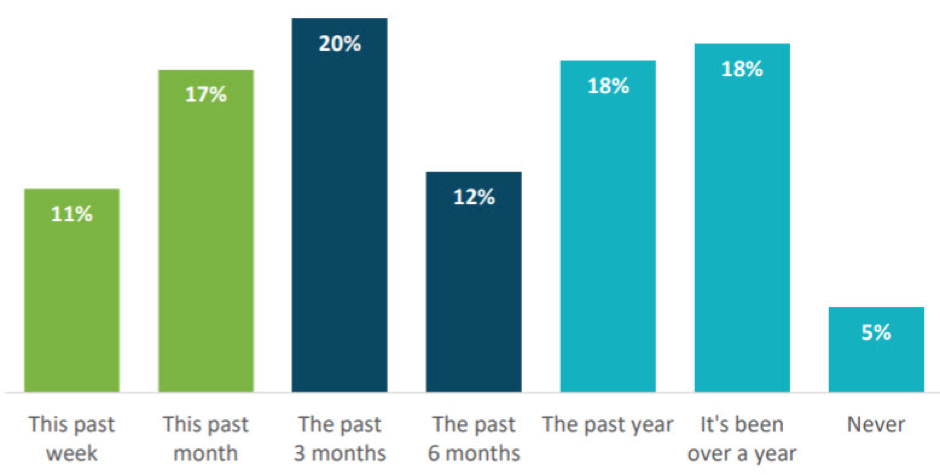
    Drafting database changes is a common task for DBAs, consuming approximately 22 percent their time, according to respondents. Deploying those changes, however, comes with big risks; when not done properly, deployments can cause significant downtime, impact the database’s performance and even result in data loss. It doesn’t help matters that database crashes remain disconcertingly common—almost one-third (28 percent) of survey respondents experienced a significant problem in the past month alone.

    Last Significant Problem in Database

    The good news is that many of the issues that can occur when database changes can be addressed through the use of release automation tools for databases, similar to what DevOps has been using for years in code development.
    Database continuous delivery not only assists in preventing mistakes; by simultaneously accelerating the release management process and making it more resilient, the results are faster database change deployment and fewer database errors.

    Database DevOps is (Still) the Solution

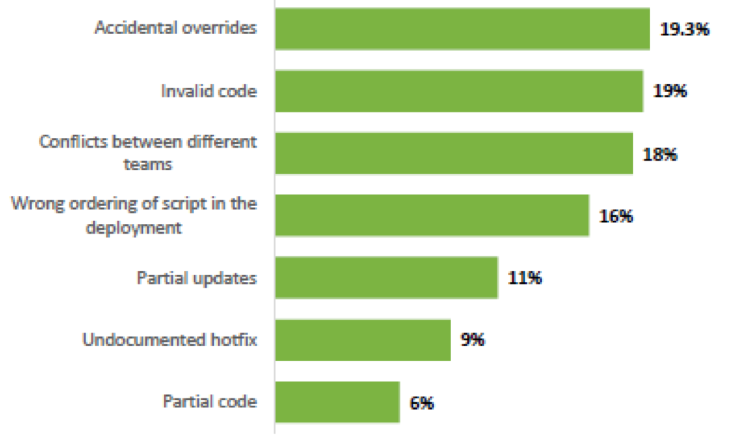
    Why do errors occur when deploying database changes? According to survey respondents, 19.3 percent attribute the biggest cause of errors to accidental overrides, followed closely at 19 percent by the use of invalid code. Rounding out the top three error causes, at 18 percent, are conflicts that occur between different teams.

    Database Change Errors

    Do these problems sound familiar? They should: Each of these issues has in the past been a challenge in the world of application code development. As far as application code development goes, version control management and automation of the application release process solved these problems. Therefore, it shouldn’t come as a surprise that the key to eliminating change errors lies in adopting these same methodologies and technologies for the database environment.

    Six percent of respondents reported that their company has no plan to adopt database DevOps practices. With database outages costing an estimated $8,851 per minute, can your company really afford not to?

    — Yaniv Yehuda

  • DevOps Chat: DevOps and Databases w/ Steve Jones, Redgate

    DevOps Chat: DevOps and Databases w/ Steve Jones, Redgate

    In this DevOps Chat, our guest is Steve Jones of Redgate and SQL Server Central. Steve talks to us about DevOps and databases, as well as the latest from Redgate SQL Clone. More and more we are hearing from DevOps teams that the database is becoming a constraint. We must take DevOps to the database!

    As usual, the streaming audio is directly below, followed by the transcript of our chat. There also is a link to a downloadable white paper from Redgate for your reading enjoyment.

    Streaming Audio

    Chat Transcript

    Alan Shimel: Hey, everyone! Alan Shimel, devopsy.kinsta.cloud, here for another DevOps Chat. This episode of DevOps Chat features Steve Jones of Redgate. Steve, welcome to DevOps Chat.

    Jones: Thank you, Alan. It’s good to be here.

    Shimel: Thank you. So, Steve, you are in—well, you have sort of a dual role in that you’re an evangelist with Redgate, but you’re also the, I don’t know if you wanna call it the curator, the editor, the manager—

    whitepaperJones: The founder. [Laughter]

    Shimel: – founder of—

    Jones: SQL Server Central.

    Shimel: – SQL Server Central, exactly.

    Jones: Yes.

    Shimel: Before we jump into SQL Server Central, though, you know, I’m sure there are people out in our audience who may not be familiar with Redgate, so let’s give them, if you can, just a quick kind of elevator story pitch on who Redgate is and where they fit in in the DevOps world.

    Jones: Okay. Well, Redgate has been around about 17 years, and really, we, our tagline kind of is, “We build ingeniously simple tools that help you build software.” So our goal is to help you build database software or .NET software in a more efficient manner. So that’s kinda the quick pitch on what Redgate does.

    Shimel: Got it. And how—give us a little more background. How long has Redgate been around?

    Jones: So, Redgate started right around 2001, and interestingly enough, SQL Server Central started at the same time. Myself and a couple partners put together this publishing area where we wanted to help people get better at their jobs and grow, and Redgate was actually our first customer and we sold advertising to them back in 2001.

    Shimel: Oh, cool.

    Jones: So I’ve known them almost since the beginning. And over the years, they’ve—Redgate has grown up. We’re now around 300 people or so. We have our main office in Cambridge in the UK, and then we have a sales office in Pasadena (California) as well, and we have a few people, then, like myself scattered around the world that do various jobs.

    And so, across the years, Redgate has tried to help different groups build software better. You know, we sell to a lot of Fortune 100, Fortune 1000 companies all over the world, and over the last probably five or six years, we’ve tried to tackle the DevOps problem in the database world. So we’ve spent a lot of brain power, a lot of effort to build products to try to help people incorporate the database into a DevOps flow.

    Shimel: Mm-hmm. So, you know, that kind of pre-empts my next question, Steve, which was, you know, obviously, when Redgate first started up here, there wasn’t people running around talking about DevOps, though people were still trying to do more faster and automate and all of these things.

    But it’s been about four or five years, you think, where you guys have kinda consciously said, “Oh, we’re gonna, you know, try to hit the DevOps mindset,” if you will, or the DevOps [Cross talk]?

    Jones: We are, yeah. You know, our founder—so, an interesting story. At the beginning, when he was looking for some additional money to get the company going, we had built our first product called SQL Compare, which compares the scheme of two different databases and gives you the differences and generates you a script so that you can do a deployment.

    And, in trying to explain this to the laymen, to the managers, to the people that would be bankers or sign checks, it’s kind of a cumbersome process, right? The idea of a schema and comparing that is a fairly technical area; I think a lot of people don’t intuitively understand that. But he brought in two phone books to the customers and said, “Find me the differences between these two,” you know? And they’re like, “I don’t know how we do that,” right? [Laughter] “Like, we go page by page and we lick this out?” And he said, “This is what our product does—it finds the differences between two things and lets you know.”

    And that’s where we’ve gone over the last 17 years. We’ve matured that product and then, five or six years ago, we decided to find ways to make it even better, and so we spent time looking at how people perform the deployments, some of the shortcomings sometimes of having somebody run a particular product to determine at this point in time what are the differences. And so we’ve built automation, we’ve built some of the other security ideas, some of the things you do in DevOps to produce a flow into various products so that we can ease the pain of deploying database changes.

    Shimel: Makes sense, makes sense. So, Steve, you know, we’ve seen Redgate and a few others really kinda not attack, but really work hard to bring the database and the DBA into the DevOps environment, into the DevOps family, if you will, right? You know, we talk a lot about culture and so forth in DevOps and we try to bring—break down silos, bringing teams together, bringing dev together with ops, bringing QA into it, bringing security into it, and bringing the DBA and the database into it.

    And, you know, I personally have seen this become a bigger and bigger piece of the DevOps puzzle. How—now, Redgate had a lot of success before that, right, and—

    Jones: Yes, yes.

    Shimel: – Yep, so my—I guess my question is, where are you seeing this uptake or, you know, DevOps—so your business was, it sounds like it was good before this. Is it really kinda hitting where—you know, or has it found that sweet spot with DevOps?

    Jones: You know, it’s getting better. I gotta say, five years ago, when I started to try to talk about doing deployment—so, we started a product years ago to do deployments to try to help people do web deployments, and we wanted to include a database in that. And we found it was a much more difficult problem than we expected, and you know, one of the things that we found as we worked on this is that, you know, DBAs, I think—more than ops, more than J, more than security, more than any other group, we fundamentally have a challenge that they don’t have in that we have to maintain state between deployments.

    In the ops world, right, they say that we wanna treat our servers like cattle—if one dies, we just pop another one up in its place and we go. Certainly we do that with containers, we do that with software, we can—you know, the QA people are used to doing that. But, you know, in the database world, we can’t do that, you know? If I could drop tables and recreate them every time I deployed software, my life would be so easy. [Laughter]

    Shimel: [Laughter] [Cross talk]

    Jones: Yeah. [Laughter] But you know, I think over the last decade, we’ve started to see in many industries, many businesses that the data is really, hugely important. You know, and as we see people moving to machine learning and AI and all these different things, the database fundamentally becomes even more important, because that data is required, you know? And whether you’re relational NoSQL or something else, you have to maintain that data as you make changes.

    And so we have this fundamental issue that we have to find ways that we can make changes without disturbing the state of our system too much. And that’s a difficult process, right? If I deploy the wrong .dll or the wrong XT or the wrong .jar file, I drop it and I throw the last one I have up there and we’re good. If I deploy the wrong version of a database, if I make a fundamental change to a table and it’s the wrong change, maybe store, which could be hours, minutes out, you know, who knows—you’d have to substantially try to reverse a change, which means, if any data has been altered, I have to try to undo that, I’m gonna have to capture that statement and then go through some sort of ETL transform to put that data back.

    It’s extremely risky and cumbersome, and you know, as a former DBA as part of my career, you’re risk averse. You don’t want to be in that place where you take the database down for substantial periods of time. So, you know, Redgate really, as we were trying to find new products to build and sell and try to enhance what we had, we realized this was a difficult process.

    Shimel: Mm-hmm.

    Jones: And so, five years ago, I talked to people, they thought it was done, they didn’t think it could be solved, and I’ve had a number of good friends that laughed at me three years ago, four years ago, and you know, in the last year, year and a half, they’ve been coming back to me and saying, “Alright, how do we actually get this database into a DevOps process and deployed?”

    Shimel: Yeah, fair enough. So, Steve—well, first of all, what’s the latest news ? Anything with Redgate?

    Jones: Absolutely. So today, actually—you know, we’re recording this from February 27th—Redgate has released SQL Clone, which is a product similar to some other ones in the marketplace, but it’s designed to provision copies of databases in seconds. So, what we essentially do is, we build an image file of your database, and then we can make real live copies of that in literally seconds.

    So if you’ve got a 1 terabyte database, once I’ve provisioned that image, I can make 1 terabyte copies of a SQL Server database and have it appear on your instants in about 7 to 10 seconds. And every copy is independent, they all look the same, they all look like the original database. You can write to them, you can change things, and you can drop them and recreate them in seconds.

    So, in the Dev/Test world, it’s a fantastic idea that I can provision a developer database in seconds, they can be on their own branch, they can make any changes they want structurally to the data to alter things. And if they decide they’ve made a mistake, as we often do in development where we experiment and we try something and if we want to undo it, they can drop that database, build another 1 terabyte database in seconds and continue with their development.

    Shimel: Got it, got it. Steve, I wanted to spend a little time talking about your role as evangelist with Redgate.

    Jones: Okay.

    Shimel: So, you know, evangelist is not—what’s the word I’m looking for? It’s not an unheard position within the DevOps world, but can you give our audience a little bit of a flavor of what your role entails, especially in dealing with the DevOps marketplace?

    Jones: Sure, sure. So, I—as an evangelist, what I end up doing is a lot of writing and speaking about Redgate and Redgate products, and certainly the DevOps world, but also just in general about good practices of software development and database administration.

    I’ve been working with SQL Server for Microsoft for 25 years, so I’ve been—basically since Microsoft has had the product, I’ve worked with it as part of my career, and you know, the mission of SQL Server Central is really to help you get better at your job every day. And so I do a lot of writing and speaking to that effect, and you know, Redgate is essentially all over the world, so I get the chance to go to different conferences, different events, and provide information about general good database practices or Redgate products in particular.

    Shimel: Excellent. Steve, we’re—as I mentioned here before, we got on, you know, live, the time here goes quickly. But I wanted to know if you can give our audience—well, first of all, where can they go to your SQL World blog? How can they find that?

    Jones: Yeah, so SQLServerCentral.com—all one word, SQLServerCentral—that’s the site where I’m kinda the editor, I was the founder, and I run that right now. So we publish daily information to help you there.

    I maintain my own blog at VoiceoftheDBA.com—so VoiceoftheDBA.com—and that’s where I write about a variety of topics related to data and databases and software in general. So, do that, and then on Voice of the DBA, I keep a speaking schedule, so I’m traveling all over. I head to Colorado Springs in about three weeks, and then SQLBits in England, and various places after that, so. [Laughter]

    Shimel: Got it. What about—and what about Redgate? Any plans for conferences, shows, DevOps events where maybe our audience—you know, our audience is pretty worldwide, Steve, if I didn’t tell you before.

    Jones: Okay.

    Shimel: Places where they might see Redgate?

    Jones: So, we’ll be—we go to a variety of DevOps conferences in the UK and the U.S. and elsewhere, so we will be at SQLBits in Telford in April, and then we’ll be at the Data Platforms Summit in Bangalore, and I’ll be there as well. And I don’t know all of our marketing presence where we’re gonna be beyond that, but you know, we have a good, active Twitter account at Redgate, and we post on there often where we’ll be with different events, so it’s a good place to find us.

    Shimel: Excellent.

    Jones: And of course, Redgate.com. [Laughter]

    Shimel: Yeah, well, that makes sense. So, Steve, we’re almost at the end of our time here. I wanted to ask you one last question, it’s one I ask a lot of our guest, and it’s this—if you had to recommend one must-have book, one must-read book for our audience out there, maybe regarding DevOps and databases or something related, what would it be?

    Jones: So, yeah, we talked about this briefly. I know probably everybody has thought about, talked about “The Phoenix Project,” which is great. If you haven’t read “The Goal,” which is kinda the precursor to “The Phoenix Project,” that’s good.

    But the one I might recommend is “Database Refactorings” by Pramod Sadalage, and it’s interesting because there’s a domain of problems in the database world that are complex and they’re problematic. And so they are the types of problems where you can’t easily make a change and undo it, you know? If I had a column, then I could drop it very quickly—but there are certain problems that are difficult.

    And in the “Database Refactoring” book, they’ve done a good job of laying out these problems and how you solve them across time, because most of these require you to make changes across maybe days, weeks, or months to actually complete them—so that might be the one I’d recommend.

    Shimel: “Database Refactoring”—great. By the way, I loved “The Goal” as well. I read “The Goal” many, many years ago—way before “Phoenix Project.”

    Jones: Yeah. Right—I did, too. That was the first one I read.

    Shimel: Yeah, it was good stuff—but “Database Refactoring” sounds good.

    Steve Jones, it was nice having you here. This is obviously your first time appearing on DevOps Chat, but we’d like to have you back in the future maybe again, and we can talk some more. And you know, I really do like to delve deeper into databases and DBAs and, you know, adopting and being adopted into the DevOps kinda methodology and work routine in many organizations. So maybe next time we could dive a little deeper.

    But for now, I think we’re about out of time.

    Jones: Okay. Thank you very much for having me, Alan.

    Shimel: Steve, thank you for appearing. Steve Jones, evangelist for Redgate, and the founder of SQL Central—is that, did I say that right?

    Jones: SQL Server Central.

    Shimel: Excuse me—SQL Server Central. Steve, I apologize.

    Jones: Yeah. No worries.

    Shimel: Steve, until next time, then, we’ll have you on, and continued success with both SQL Server Central and Redgate.

    Jones: Thank you very much. Great being here.

    Shimel: Thank you. Hey, this is Alan Shimel for DevOps Chat, and we’ll see you on the next DevOps Chat.

    — Alan Shimel