Tag: Cybersecurity

  • The Shifting Data Protection Paradigm: Proactive vs. Reactive

    The Shifting Data Protection Paradigm: Proactive vs. Reactive

    The ever-evolving threat landscape over the last few years should have prompted organizations of all sizes to revise their data protection methods. The volume of incoming data is now staggering, and will only continue to increase—and much of that data is sensitive or of great value to cybercriminals. Data may be structured or unstructured, distributed across numerous locations and be encrypted or unencrypted. Thus, many organizations are attempting to protect data without knowing what they have, whether it is valuable or even where the data resides.

    As the era of big data has exploded, so, too, have the number and size of cyberattacks. Hackers have grown increasingly adept, often refining their skills beyond those of many cybersecurity experts. Today’s hacker may be an idealistic “lone wolf,” but he or she is more likely to be an employee of a foreign government or associated with a gang of highly organized criminals. This means that attacks can be carefully planned and executed over many months, probing a target’s vulnerabilities repeatedly until an intrusion is eventually successful.

    Cybersecurity teams often are at a disadvantage when it comes to protecting data. It has become increasingly difficult to find and retain qualified, experienced cybersecurity experts, and this talent gap won’t be narrowing significantly anytime soon. Economic issues have forced many organizations to trim their budgets, which can result in reduced funding for the security operations center (SOC) or reduced staffing levels. However, even major corporations with large cybersecurity budgets and massive teams are finding it difficult to prevent breaches and keep their data secure. The breaches suffered by Home Depot, Sony and other high-profile corporations—as well as breaches at the U.S. Office of Personnel Management and the Pentagon—demonstrate that cybercriminals are winning more than their fair share of the battles.

    It is not that organizations are unaware of the need to protect their data. Virtually all companies have some type of cybersecurity program in place. However, most of them choose to take either a reactive approach to threats or a proactive security stance. But what they truly need is an approach that integrates both methods.

    Reactive vs. Proactive: The Differences

    With a reactive approach, action does not begin until an incident occurs. This does not necessarily mean that a breach has occurred; it simply means that some unusual or threatening activity has triggered an alert. Unfortunately, an organization can receive several thousand alerts in a single day. Many will be “false positives” and others may have been blocked by defenses, but some may represent a successful penetration of the system. Once alerted, the company’s incident response plan is initiated; in the beginning, the goals are to contain the threat and restore service. Forensics, analysis and efforts to prevent a recurrence follow quickly.

    With a proactive approach, organizations try to detect potential threats before an incident occurs. Files from unknown or suspicious sources can be quarantined automatically for investigation. If found to be malicious, the source, signature or other identifying characteristic can be fed automatically back into the system to block any additional attempts at the gate.

    A proactive approach also includes regular, planned hunting exercises to detect threats that may be lurking in the system but not yet detected or perhaps not yet detonated. Although ad hoc hunting can be accomplished to some degree if performed by experienced analysts, the best method is to automate certain steps so the efforts are sustainable and repeatable.

    Why Organizations Need Both Approaches

    It is always better to prevent a breach than recover from one. However, should—or when—an intrusion occurs, every organization needs a mature, workable, detailed plan to react to the incident. All employees need the training and experience to know what they need to do when the incident response plan is activated.

    Despite the need to have a solid plan to react to incidents, blocking potential threats can be more economical, faster and safer. Therefore, organizations need to be both proactive and reactive to provide the best security for their data. The key is to find the proper balance between the two approaches. Finding the right balance requires evaluating the budget, the skills of staff members and other resources that might be available.

    For both proactive and reactive methods, however, automation is essential. Manual processes simply cannot compete with automation when it comes to speed, cost, accuracy and risk mitigation. With the number of attacks growing by the day and hackers becoming increasingly more adept and persistent, automation provides the best way for organizations to stay one step ahead of the attackers.

    About the Author / Rishi Bhargava

    Rishi Bhargava is co-founder and VP of Marketing for Demisto, a cyber security startup with the mission to make security operations “faster, leaner and smarter.” Prior to founding Demisto, he was vice president and general manager of the Software Defined Datacenter Group at Intel Security, and before Intel, he was vice president of product management for Datacenter and Server security products at McAfee, now part of Intel Security. He has more than a dozen patents in the area of computer security. He holds a BS in Computer Science from Indian Institute of Technology, New Delhi, and a Masters in Computer Science from University of Southern California, Los Angeles.
  • Digital Transformation Spreads Cybersecurity Responsibilities Beyond Security Teams, Survey Finds

    Digital Transformation Spreads Cybersecurity Responsibilities Beyond Security Teams, Survey Finds

    A report published today from Forbes Insights with BMC Software, Inc. found that new digital business initiatives and the further embracing of new technologies are challenging enterprise cybersecurity teams. The good news is that digital transformation is spreading security responsibilities beyond cybersecurity teams.

    The survey consisted of 308 C-level executives, VPs, and SVPs in North America and Europe fielded in the fall of 2016. All respondents represented companies with at least $100 million in annual revenue; 26% were from companies with revenue between $1 billion and $5 billion; 24% had revenue of $5 billion or more.

    One highlight from the report won’t be a surprise to devopsy.kinsta.cloud readers, as they’ve seen firsthand for years the continued blending of development teams, operations teams, and security teams – a slim majority, 52%, of respondents indicated that accountability for security breaches has increased for operations teams.

    As we’ve covered, enterprises are moving swiftly in their digital transformation efforts, the survey found that that 69% of senior security and IT executives say digital transformation is forcing fundamental changes to existing cybersecurity strategies. And, of course, as always, financial and customer information, brand reputation, intellectual property, and employee information are all critical assets to protect. However, more executive leadership is waking to the dangers posed by public clouds – with 65% of respondents saying that that public clouds have the biggest security implications.

    According to the survey, as “digital transformation pushes IT and security leaders to reevaluate their cybersecurity strategies, it is also impacting overall enterprise spending priorities. Seventy-four percent of CIOs and CSOs say security was a higher priority in 2016 than in the previous year,” the report said. And “a decisive 82% of executives plan to invest more in security in the coming year, recognizing that company boards are more willing to increase in security investments if proposals come with solid business cases,” it said.

    Here are the key report takeaways, according to the report authors:

    • 69% of senior executives say digital transformation is forcing fundamental changes to security strategies
    • 64% will boost spending to protect against known security threats
    • 43% will make timely patching and remediation a higher priority in 2017
    • 68% plan to enhance incident response capabilities in the next 12 months
    • Operations teams are seeing heightened accountability for security breaches
    • 72% believe line-of-business managers must take a greater role in developing security strategies
    • Nearly half of enterprises will combine security and operations personnel into teams for fortifying mission-critical applications

    The study concluded with the following leadership cybersecurity action plan (with more details in the report). Enterprises need to:

    • Create a modern cybersecurity strategy backed by a solid business model.
    • Redouble efforts to secure mission-critical assets.
    • Improve organizational effectiveness by investigating new reporting structures.
    • Develop an enterprise-wide culture of security.
    • Shift thinking from safeguarding applications to securing the data itself.

    Last year in the story It’s Time to Couple Security, Business Leadership we covered how crucial it is for executive leadership to back enterprise cybersecurity efforts, because how unpopular necessary security decisions can be at times, such as slowing the release of a new service, requiring more tests or through suggesting alternative ways of doing things that may mitigate risks.

    It’s good to see more enterprise executive leadership coming to the same understanding.

    — George V. Hulme

  • DDoS Defense: Can You Tell Friend from Foe?

    DDoS Defense: Can You Tell Friend from Foe?

    In many organizations, networks are at the core of the business, enabling not only internal functions such as human resources, supply chain and finance, but also the services and transactions the business depends on for revenue. That makes network availability critical. Any interruption of access from the outside world turns off the revenue spigot, impacting profit and creating a poor user experience that can damage customer satisfaction and result in customer loss. The worse the outage, the worse the damage. That’s why speed is so important in detecting, diagnosing and responding to denial of service (DoS) and distributed denial of service (DDoS) attacks.

    One of the chief challenges in responding to an attack is to distinguish friend from foe. Without a way to drill down into traffic details and examine host-level traffic behavior, it can be difficult to tell the difference. Traditional network analysis technologies based on pre-cloud architectures have been too limited in their compute and storage capacity to do more than perform predefined alerting and summary reports. That’s just not enough information to really get to the heart of what’s happening in a complex networking scenario.

    Fortunately, new big data techniques allow us to dig deep into huge volumes of network traffic details so that it’s possible to understand what is really going on. With a properly implemented big data platform, you can pivot your views of data to gain insight rapidly, in operational time frames, so you can act to mitigate an attack or remediate a more innocent but still painful network issue. We’ll examine data that is readily available through common network traffic flow telemetry exports such as those provided by routers and switches enabled by NetFlow, sFlow or IPFIX.

    Starting at the Top

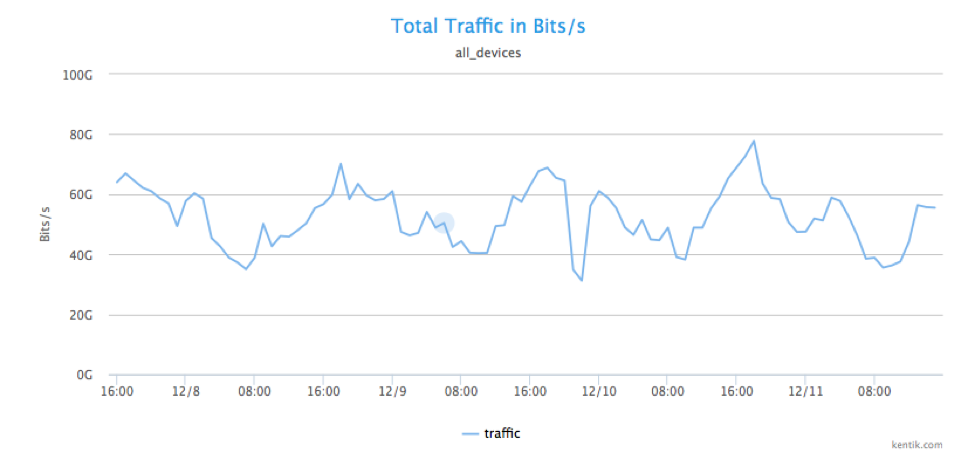
    Let’s say we’re seeing symptoms of an attack in our infrastructure. We’ll use traffic flow summary data to quickly scan total traffic in bits per second just to see if anything stands out.

    Picture1

    There’s no obvious traffic spike from this view, but then again the network we’re looking at is running at an average of 60 Gbps, so that doesn’t mean there aren’t worrying things going on at deeper levels of the network.

    Analyzing Source Geography

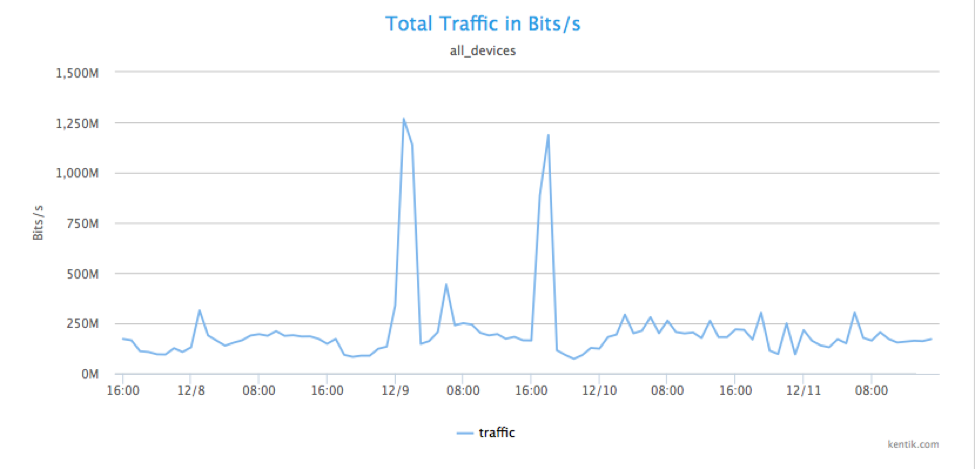
    One of the things that big data is good at is fusing many data sources together. By combining NetFlow data with GeoIP, we can look at traffic by source geography. In this case, the network doesn’t get a lot of traffic from China, so what happens when we filter total traffic by China as source?

    Picture2

    A ha! That analytical pivot produces a graph above, showing two obvious spikes that are well above average. Below, we zoom in on the time of the spikes.

    Picture3

    Analyzing Unique Source IPs

    The spikes themselves are suspicious, but is this just a large data file transfer? We can find out by looking at how many different source IPs are sending traffic. To look at host-level details, note that we’ve gone beyond the point where you can use summary information. At this point, we are analyzing raw NetFlow record details.

    Picture4

    Those raw NetFlow details sure are useful, because there is, in fact, a huge increase in the number of unique source IP addresses sending traffic to particular destination IPs. This tells us that we’re not looking at a large file transfer from a single machine, but a highly distributed set of senders. Botnet much?

    Who’s Getting Hammered?

    The next step is to  to determine which IP or IPs are getting all this (probably unwanted) traffic from 14,000 or so individual host IPs.

    Picture5

    The ability to dig into high volumes of host-level NetFlow details again proves its utility. We can see that the main target is a solitary destination IP address. There’s really only one likely explanation for traffic from thousands of hosts in a country which you have no business dealings with to a single IP that suddenly spikes from nearly nothing to more than 1 Gbps: This is a DDoS attack. Note that this isn’t a mega attack, but it still can cause real problems for whatever is running on that individual host and anything else that depends on it. If it’s your DNS server, the attack might make it impossible for lots of other servers and applications to function.

    Going Deeper

    Now that we know it’s a DDoS attack, we shouldn’t stop because we don’t know whether that attack is coming from other countries besides China. We pivot our analysis again to widen our lens.

    Picture6

    Lo and behold, there is indeed DDoS traffic coming from multiple countries, including the United States, Japan, Russia, Sweden, China, Taiwan, Brazil and Estonia. Good to know.

    Characterizing the Attack

    Next, we want to know specifically what type of traffic we’re seeing and what that tells us. We’ll group the traffic coming from all those source host IPs by protocol.

    Picture7

    Clearly, this is  UDP-based attack. Now we’ll look at the destination port(s).

    Picture8

    We can see that the UDP traffic is being sent to multiple ports, and it’s obvious that we’re experiencing a DNS redirection/amplification attack occurring on port 53, with a lot of port 0 UDP packet fragments being generated as collateral traffic.

    Is Something Underneath This Attack?

    So far we’ve gotten a lot of insight into the details of the DDoS attack from full NetFlow details. But is this volumetric DDoS the main event, or are we being distracted from looking for other, less obvious threats? We can see a lot of packets being sent to port 4444 (green line in graph).

    Port 4444 is the UDP port for the Kerberos service, and is—at least for Windows machines—a well-known target for buffer overflow attacks, often used to insert trojans such as Hlinic and Crackdown.

    So, potentially there are two types of attacks going on in parallel: a DDoS attack and a buffer overflow trojan insertion. Many security blogs and publications note that DDoS attacks often are used to obfuscate other exploits. This very well may be an example of that technique.

    Getting a Handle on Attack Mitigation

    Characterizing the attacks leads us to mitigation. One way is to take the attack traffic and group it by x/24 source network addresses:

    Picture9

    We now can take two mitigation steps:

    • Ask our upstream ISP to drop this traffic or send it to a scrubbing service or device, if we have one.
    • As an added precaution, drop all traffic from these countries going to port 4444 on our own routers.

    Conclusion

    One of the benefits of being able to dig into full-resolution NetFlow data is that you can get operationally useful insights without needing in-line devices. You also get more freedom to employ a portfolio of mitigation methods. Big data is the way forward if you want to have full details at your disposal to deal with DDoS attacks.

    About the Author / Alex Henthorn-Iwane

    AlexAlex Henthorn-Iwane is the Vice President of Marketing at Kentik. He has more than 20 years of experience bringing new technologies in networking, security and software to global markets. Henthorn-Iwane leads the global marketing strategy for Kentik and help the company bring its innovative story and solutions to network-dependent organizations around the world. Connect with him on LinkedIn, Twitter or SlideShare.

  • DevOps Security in Spotlight as Gartner Names vArmour Cool Vendor

    DevOps Security in Spotlight as Gartner Names vArmour Cool Vendor

    News Reports vArmour CEO Eades Nabbed $41 Million Ahead of Trump Presidency

    In May, Gartner named 2016 Cool Vendors in several security categories. Given the focus of this column, I was interested in several of the companies chosen for the designation, especially those named in the Cool Vendors in Cloud and Emerging Technology Security 2016 report. Interestingly enough, only vArmour, one of the new-era cloud security and visibility providers, was noted for supporting security in DevOps environments.

    Click to Tweet: Cloud Security #CoolVendor @varmour noted by @Gartner for #DevSecOps, datacenter vis. The latest @devopsdotcom: http://ctt.ec/uSRLd+

    In the report, analysts Joerg Fritsch and Brian Lowans wrote:

    Supporting the vision of a software-defined data center, all of the capabilities of the vArmour platform are exposed and consumable programmatically via APIs, providing support for highly automated and DevSecOps-type development workflows.

    The analysts also noted vArmour enables application-aware microsegmentation anywhere, from the data center to the cloud and all hybrid points in between. They also highlighted its capabilities that extend security to virtualized environments and containers—security anytime and all the time. Pretty cool, indeed.

    The report provides deep validation for a message vArmour has been pushing since its emergence from stealth—visibility. While many security vendors have interlaced the keyword into their marketing content, this report makes the claim for vArmour all the more true. According to the report:

    vArmour’s distributed security platform combines a scalable fabric with advanced security analytics that offer full visibility from a deep packet inspection engine. This deep visibility enables other cool use cases, such as network-based threat detection and the visualization of workload traffic. This is required in environments where the workload, the network and the security policies are interacting much more closely than we have been used to in traditional environments.

    Validation from firms such as Gartner can carry heavy weight among buyers, especially among deep-pocketed enterprise influencers. I’ve had conversations with C-level security execs at numerous mega corporations in the past who have stated point-blank that they won’t approve expenditures for any technologies that aren’t noted in recognized industry reports.

    vArmour also announced recently the closing of a $41 million round led by Redline Capital and Telstra. This D round lifts the software-defined security provider’s total investment to $83 million.

    In the official company release, vArmour stated it will use the capital for “global expansion and to accelerate worldwide software distribution of its Distributed Security System (DSS) through strategic partners in Asia-Pacific, EMEA and in North America.”

    Although the Presidential race wasn’t mentioned in the release, it was reported by CNBC’s Ari Levy that the real reason CEO Tim Eades sought funding now was in anticipation of a Donald Trump presidency. Eades was quoted in the CNBC story as having said:

    It really does matter what people think of the U.S. as we lead up to the election,” said Eades, a native of the U.K. who moved to the U.S. 18 years ago. With Trump, “the conversation he’s had around Mexico, trading abroad, his position on immigration — everybody outside America looks in and says, `What’s going to happen?’

    Levy continued:

    With Trump having closed the gap on Clinton in the polls less than six months before the election, Eades said it’s definitely time for start-ups to be padding their cash positions. He isn’t comforted by the fact that Trump is a businessman himself.

    To most reading this, vArmour being named a Cool Vendor and handily raising $41 million likely isn’t coming as a surprise. Starting with Eades, the company has an impressive cybersecurity and business leadership pedigree, especially when it comes to startups that are shaking up security thought and practices around the data center, cloud and DevOps movement. Eades is even viewed as a thought leader—likely one of the reasons why he is an occasional guest on global news shows such as Fox and Bloomberg, where he has been called to provide expert analysis on everything from cyberwar to breaches to investment.

    His vision to extend security to the rapidly growing trends of DevOps, cloud, containers  and automation is certainly smart, as these are directions most enterprise IT organizations are headed. Said Eades in a company issued release on the funding:

    It has been an amazing 18 months since we launched our company. We now have hundreds of customers adopting the vArmour Distributed Security System on a global scale, including some of the world’s largest telecom companies, banks, healthcare, retailers and U.S. government agencies. We believe Gartner’s ‘Cool Vendor’ recognition further validates the positive impact and true value we’re providing our customers. We’re offering them the industry’s simplest, integrated data center and cloud security solution to prevent, detect and remediate advanced persistent threats inside their network.

  • Murphy’s DevOps: The Internet Apocalypse

    Murphy’s DevOps: The Internet Apocalypse

    I’ve been immersed in cybersecurity for a good stretch, since it was known as just “infosec” and “security.” Over time, I’ve had opportunities to work with some brilliant minds and young-gun “hackers” (I’m not a name dropper, so I’ll refrain from using them as SEO-bait). I’ve watched attackers transition from being basement-dwelling teenagers to organized intruders to APTs. At one point or another, I’ve met all of Five Horsemen of the Internet Apocalypse: Scam, Extortion, Embarrassment, Theft and Death.

    The biggest cybersecurity news story of all time is still Edward Snowden. Fancying himself a “whistleblower,” champion of the Constitution and privacy rights expert, this fugitive data thief accused of espionage by the United States government has done more to force businesses and individuals to think about digital security and privacy than anyone or incident before him.

    Snowden aside, there are thousands of other stories about just how fragile our online lives and businesses are. If you were at the devopsy.kinsta.cloud Rugged DevOps event at RSA 2015 and caught the presentation by Wired cybersecurity and privacy writer Kim Zetter, “2015 — The Year in Hacks,” then you had a chance to get a great overview of some of 2015’s biggest digital crimes. You might have even noticed the Internet Apocalypse Horsemen riding through.

    With an ear to the ground on everything the NSA and APT-using hackers are guilty of, @KimZetter never fails to intrigue readers and live audiences. Whenever you read her stories or listen to her speak, you always walk away reassured that when all the smoke and headlines have cleared, the great deep-down reality is that everything we digitize is subject to the whim of Scam, Extortion, Embarrassment, Theft and Death. If you didn’t have a chance to attend, please enjoy some of the highlights listed below.

    China vs. U.S., Spy vs. Spy

    Internet Apocalypse

    She kicked off with the biggest hack of 2015: the one that penetrated the U.S. Office of Personnel Management (OPM). The full extent of the damage done and who the actual attackers were may never be fully realized. Were they Chinese spies, rogue hackers or a combination of both? What we do know is that it exposed millions of identities tied to covert U.S. operatives and their family members listed on security clearance forms. It may have even exposed personal information on everyone who has ever applied for a job with the federal government. One for-sure lesson is that even after several decades of security product development (with more than 800 available for review at RSA), the world is still in need of innovation in the space.

    Men Behaving Badly …

    Internet Apocalypse

    Some might argue that Embarrassment made a special appearance at Ashley Madison, but the fact that suicide was part of that hack leaves me to think that Death was the lead actor there. @KimZetter pegged the data theft as the most brazen hack of 2015. With 30+GB of account information stolen and dumped, login credentials for 32 million accounts purloined, credit card transaction information accessed and even several suicides tied to the incident, the hack again reminded the world that the great deep-down reality is that everything we digitize can be used by attackers to scam, extort, embarrass, steal and even kill us.

    From the Keyboards of Babes …

    Anyone at the presentation must agree that Embarrassment really stole the show in the hack of CIA Director John Brennan’s AOL email account. Allegedly perpetrated by a teenager, Zetter describes the incident more deeply in her October story: Teen Who Hacked CIA Director’s Email Tells How He Did It

    Internet Apocalypse

    Keep Calm and Internet On

    Anyone reading this may be walking away with a rather pessimistic view of our chances of remaining secure online. The truth, however, is that the existence of determined hackers should do no more to stop individuals or businesses from going online than road rage should to prevent anyone from getting behind the wheel of a car.

    If any lesson can be learned from news articles pumped out by @KimZetter and her peers, it’s that the world should continue to take full advantage of the Internet but to also take the time needed to apply effective security. Quite simply, we all should keep calm and Internet on …