Tag: culture

  • Don’t Let Cultural Debt Bring Down Your Business

    Don’t Let Cultural Debt Bring Down Your Business

    Businesses today are faced with myriad challenges to innovate and optimize. In doing so, we often need to make decisions that borrow against the future. This can come in a tangible form, such as taking money from investors to fund growth, or in more inconspicuous forms, such as making tradeoffs in technical decisions. When we make such tradeoffs, we expect them to come at the cost of additional technical work in the future; however, these decisions can also borrow against an externality that is often overlooked: culture.

    Technical Debt

    Technical debt occurs in the development of software when the “easy path” is taken to solve a problem rather than using the best overall solution. The concept implies that the time saved now will need to be paid back later (with interest!) in the form of rework.

    Ideally, technical debt is incurred knowingly, i.e. a decision to take a shortcut is made deliberately to increase velocity, and it is flagged to be fixed before becoming a compound problem. In calling out technical debt as such, we can better analyze our decisions, considering their net present value and future opportunity costs. By documenting it, we gain better insight into the responsiveness and flexibility of the code base. Having a strategy around managing technical debt has therefore become an essential discipline in the management of software products.

    Technical decisions also have an impact on the culture of a company, though, and this facet of technical management is often overlooked. “Cultural debt” can be taken on unknowingly, and the unmanageability that flows from it can be difficult to ascertain.

    Cultural Debt

    Cultural debt is when we make a technical decision that borrows against the culture of the organization. Such decisions can introduce divisions between teams, deteriorate communication or even weaken the effectiveness of leadership. These types of decisions need to be made regularly throughout the software development life cycle, and it is therefore critical that we begin to identify them, call them out and manage them accordingly. If the interest goes unpaid we can end up with a toxic environment that is difficult and onerous to manage—we risk a paradox wherein attempts to innovate can stifle progress.

    A Closer Look

    Just as with technical debt, a business ideally will have a strategy for managing cultural debt rather than allowing it to accumulate and bog down the business. Typically, decisions that involve cultural debt will impact on areas such as:

    1. Mission: Ensuring connection to the company mission and that there is minimal variance in how the mission is understood by different teams and departments.
    2. Values: Effective and reliable transmission of company values, the ability to apply them consistently and ensure that they are clear and tangible.
    3. Communication: Fostering openness and the ability to discuss, providing channels for communication and using channels effectively with clarity of purpose and minimal “noise.”
    4. Visibility: Providing the ability for everyone to see up, down and across their organization.
    5. Attitude: Happiness of employees, their effectiveness and retention.
    6. Leadership: Ability for leaders to govern effectively, and influence across departments

    When making technical decisions, we need to think outside the box and consider how our decisions will affect these cultural dimensions of the business.

    To reinforce the concept, let’s look at some current issues that the modern enterprise is being confronted with:

    1. Domain-Specific Tooling – As roles become increasingly specialized, a best-of-breed approach provides the tools needed to perform complex tasks. Unfortunately, tools create silos, and more tools means more fragmentation. Furthermore, in a world where tools are proxies for business processes, domain-specific tooling can cut off teams from processes, reducing visibility and impeding communication. This mean the business will need to devote cycles to meetings, emails and other noisy distractions just to pay down the interest and get the visibility and coordination needed for cross-functional effective leadership. Paying down the debt requires tool integration, and without an infrastructure to reduce the cost of integrating, domain specific tools can be a heavy debt to carry.
    2. Customization – Often we see the introduction of new tooling without the requisite investment to customize them to the business. Tools such as ServiceNow or Salesforce are highly valuable for being specialized to their use cases, but they still require customization to be effective. For example, when customer data is stored in notes fields rather than using structures data captured in the tool, visibility and reporting is gradually reduced and employee frustration abounds. The decision to introduce tooling should be made with the understanding that customization will be required and must be maintained over time to keep pace with the organization’s culture as it changes.
    3. Bimodal IT – One strategy for enabling cutting edge technologies is the use of a “bimodal” structure with essentially two IT organizations that operate under different constraints. While bimodal IT may be valuable for encouraging adoption of new technologies, it also encourages confusion of responsibilities, cross-team rivalry, knowledge silos and double work. The longer the structure remains, the deeper cultural divide and the more difficult an eventual transformation will be. The decision to introduce new technologies or practices using a bimodal structure should be done deliberately, cautiously and with clear goals in mind.
    4. Technology Selection – Often we are presented with new technologies that promise to deliver great benefits. Let’s assume that the new technology passes a technical assessment and is found to deliver on the promises: e.g. a language such as Clojure or Kotlin really will simplify development and increase velocity, or a new delivery tool does indeed remove a key bottleneck. Adopting such a technology invariably creates some cultural debt—developers unfamiliar with the new language may feel alienated, new silos will form around knowledge and expertise and tribes could be forcibly broken apart. Technology decisions that ignore cultural debt will involve more cycles and greater risk, while those that recognize it will implement new technologies with those issues in mind, providing the cross-training and collaboration needed to ensure success.
    5. DevOps – The dirty secret about DevOps is that it involves the introduction of a number of technologies and technical practices that carry a large amount of cultural debt. This can actually tear an organization apart if that debt is not managed closely, and it is therefore why DevOps—despite being closely associated with technical practices such as automation, infrastructure-as-code and CI/CD—is regarded as primarily a cultural movement. In the enterprise, DevOps technologies threaten roles, responsibilities and livelihoods. The cultural debt actually does outweigh the benefits, and DevOps transformations need to focus on cultural issues first before attempting to implement the associated technologies. This is common sense that we learned from observing lean manufacturing transformations in the nineties, which involved a similar change situation where technical practices became a function of culture.

    Cultural debt, like technical debt, can be hard to detect. If your business does not have a strategy for paying off the debt, or at least one for paying down the interest, the result will be a heavy load of cultural issues weighing down decisions and processes.

    Key Measures for Managing Cultural Debt

    • Understand your stakeholders: In an agile world it is easy to overlook stakeholders. We can learn from the disciplines of business analysis and project management, though, where stakeholder analysis is a core componency and key practice in work management. It is not possible to do a thorough breakdown of stakeholders for every technical decision, but an actively maintained stakeholder matrix will increase your mindfulness and can be referred to for a free sanity check when needed.
    • Understand your culture: Your organization is filled with cultural artifacts—if you are not aware of them and taking the time to manage them, you will not be able to assess cultural impacts. These artifacts can include mission and value statements, organizational and tribal structures, meeting cadences and compositions, control systems, routines, rituals, symbols and even legends. Think through your cultural artifacts and ensure that they match intention and are understood by leadership.
    • Obtain buy-in: Getting buy-in means giving people a stake in the game. Imposing technology decisions on people will not only result in a requirements mismatch, but it fosters discontent and mistrust. You can make a large downpayment on your cultural debt by bringing affected parties into the decision-making processes early. This has been shown to be very effective in helping pass decisions even when they have negative consequences.
    • Embrace the ‘Three Ways’: We can borrow from the DevOps movement the Three Ways, which provide a solid foundation for undertaking any technical work: Systems thinking encourages considering how decisions impact the whole system, not just the local area; feedback loops allow continuous feedback and communication about impacts; and continual experimentation and learning ensures that the organization is adaptive and resilient. Leadership that embodies the Three Ways is issued debt on very good terms.

    Conclusion

    Peter Drucker is quoted as saying that “Culture eats strategy for breakfast,” and the examples we’ve seen here highlight this. The best technology in the world cannot compensate for a broken culture, and a broken culture can be the result of a succession of ill-considered technology decisions. Understanding cultural debt is a key differentiator in being able to leverage Conway’s Law rather than be trapped by it. A key aspect of managing technology going forward will therefore be to identify and control this cultural debt as it is being created, and ensure that the organization is able to function with full-capacity engagement.

    About the Author / John Rauser

    John Rauser is the IT Manager of Tasktop Technologies, a global enterprise software company. As part of his role, he is responsible for specifying, managing and administrating software lifecycle tools, witnessing first-hand the impact they have on users and the business on a broader scale. He also serves as VP Operations at the board of the Project Management Institute – Canadian West Coast Chapter, providing leadership and expertise on technology issues. He has deep passion for discussing the business impacts of technology and analyzing strategies for IT management.
  • Simulating DevOps to Discover the ‘Culture Thingy’

    Simulating DevOps to Discover the ‘Culture Thingy’

    DevOps … is a term used to refer to a set of practices that emphasize the collaboration and communication of both software developers and information technology (IT) professionals while automating the process of software delivery and infrastructure changes. It aims at establishing a culture and environment where building, testing, and releasing software can happen rapidly, frequently, and more reliably. — Wikipedia

    We are all, I believe, familiar with the fact that culture is an important factor when adopting DevOps.

    Groan!

    Most engineers and technologists are probably tired of having the “C” word thrown at them: culture.

    Because let’s be brutally honest: DevOps value comes from the automation stuff. The latest “State of DevOps” report confirmed “that automation is a key differentiator for organizations.” All the shiny technology that supports the “continuous-es”: continuous integration, continuous deployment, continuous delivery, with infrastructure as code and spinning up servers in the cloud and then collapsing them when no longer needed, with other cool technology concepts such as containers, microservices and a whole array of sexy build, test and monitoring tools. Just when we start getting excited about it and drooling about the new tools we get to play with, somebody else pipes up with that culture. stuff again …

    Groan. Just let us get on and do IT!

    But equally, probably the most important part of the “continuous-es” is continual learning and improvement, because again, let’s be honest: The real value of DevOps takes years to realize. It is not a one-time, overnight migration with a simple press on the ‘Install DevOps” button. It is an iterative exercise involving people from the end-to-end value stream; therefore, it is all about continual experimentation, learning and improvement—and doing it with people from different siloes who don’t usually like talking to each other. So, it’s a “cultural thingy.”

    If it’s not somebody talking about culture and collaboration and communication, it’s one of those “frameworky-geeks” talking about agile, scrum, lean thinking and IT service management (ITSM) and how we need “flow,” “process engineering,” “voice of the customer,” “kaizan,”kanban,” and a whole host of other Japanese-zen-like mysterious terms which only consultants are qualified to talk about and do, as they are the enlightened-ones (probably with their own secret handshake or Doctor Spock type split fingered salute!).

    “DevOps is a philosophical movement,” we hear. Now, if there are two things that I wouldn’t normally associate with each other it is technical engineers (I was one!) and philosophy. Although I do remember trying to stare down a server once, hoping by the power of positive thought and sheer will power for it to start working again; the alternative was a sledgehammer …

    Where was I? Oh, yes. So what are some of these “culture things” we should care about, apart from the “Wall of Confusion” that everybody keeps talking about? “We’re not confused! It’s the other lot on the other side of the wall that don’t get it!”

    Below are some of the key discoveries relating to the culture, or soft skills, issues that teams experience and recognize during the DevOps business simulation, “The Phoenix Project.” Before you start getting all excited again, this is not a computer game in which you can win points by zapping Ops people who get in the way or setting phasers to stun when you see a developer about to release some more untested code or beam up an uppity product owner who tells you that what you coded may have been what they asked for but isn’t what they were thinking. This business simulation is a dynamic, interactive, classroom-based workshop in which people have to get together—face to face—and, well, communicate and collaborate! The simulation workshop has been performed with literally hundreds of DevOps teams across the globe and across different industries, and is used to support DevOps training and to help empower teams. (see a blog posted on this site).

    What are Some of These Key Learning Points and Takeaways?

    I have mapped these discoveries onto the DASA (DevOps and Agile Skills Association) competence model, particularly the “Skills & Behaviors” area.

    DASA has developed the competence model to help organizations assess and develop the right knowledge and skills within their DevOps teams. The competence model is based upon industry feedback from practicing organizations, and helps organizations assess their level in terms of Novice, Competent, Proficient, Expert and Master. It looks at four key Skills & Behavior areas and eight Knowledge areas.

    Skills & Behavior Areas: Courage, Team-building, DevOps Leadership, Continuous Improvement.

    Simulation exercise discoveries for Courage:

    • “Feedback” is often seen as negative. People don’t like or dare to give feedback. It is perceived as personal, as criticism and often as blame. A blame culture makes it even more difficult to create open, honest feedback which is a barrier to learning and improvement.
    • “Fail fast” often means “blame fast,” or “pass the blame.” A blame culture creates a lack of trust and willingness to experiment for “fear of failure.” Often in the simulations if things go wrong, people revert to asking,”Whose fault was that?” rather than asking, “What happened? How can we stop that happening again?”
    • Sharing knowledge. Still in many organizations, knowledge is power; people don’t like to share knowledge or don’t think others are capable of using knowledge. A critical aspect of DevOps is multi-functional teams with broad shared skills and knowledge.

    Simulation exercise discoveries for Team-building:

    • Teams are unaware of the need for active listening, confirmation of agreements and decisions and verifying “assumptions”—many mistakes are the results of “assumicide” and poor understanding, which causes disruptions and excessive hand-off moments to gain the right information resulting in waste, delays and rework.
    • Ownership, responsibility and being proactive. Many IT people wait to be told what to do. Many people don’t like to admit they don’t know or that they need help. others don’t actively seek out and ask, “How can I help,” asking upstream and downstream, “What do you need from me to be able to do your job?”
    • Many teams have an aversion to getting together as they have poor experiences of pointless meetings with lots of talking and then not a lot of decisions being made or action being taken.
    • Many teams don’t set for themselves goals for a meeting or learning objectives from a training session. They do not ask themselves, “What do I need to take away from this session?” They often don’t ask, “What do you expect from me?” “What should my contribution be?” They often cannot answer the question, “What problem do you want to be able to solve after attending this?” Many times in a session people say, “I was told to come.”
    • Silo thinking: Many teams still think from siloes, e.g the technology team they are in or the development team, and don’t think end-to-end. They are building and supporting a technology solution and not managing end-to-end business value.

    Simulation exercise discoveries for DevOps Leadership:

    • When there are managers in the simulation, people often sit back and wait to be told or managers feel they must come up with the solution and give instructions.
    • Managers have difficulty letting go, and sometimes don’t have the patience to let teams learn and improve themselves.
    • Managers fear experimentation and failure, as they may be blamed.
    • Managers often blame teams for not becoming self-steering, becoming self-empowered or for not taking ownership, yet they do not help coach and empower teams.
    • Often managers are unable to answer the “why” question: “Why are we doing DevOps?” If managers do not know then how can they expect team members to know?

    Simulation exercise discoveries for Continuous Improvement:

    • Teams are poor at reflecting, analyzing, thinking and coming up with solutions. They lack skills in “problem thinking,” also in terms of Kolb learning cycle. Often they recognize one symptom and then leap to conclusions and solutions.
    • Lack of skills in facilitating a stand-up meeting. See the five key team skills mentioned by Jan Schilt on devopsy.kinsta.cloud. These skills are: The stand-up; Facilitating a retrospective; Managing the Kanban (Visual Management System); Managing the Andon: (and swarming problems); and Collaboration.
    • Many teams struggle to record issues in their work, such as a CSI (continual service improvement) register. They agree it is a good idea, then nobody does it, or if they do then nobody looks at the list again. If I ask, “Who owns this?“ they usually look at each other the point to the business or IT manager. There is no sense of ownership for improvements. This confirmed our own mini-survey of 650 organizations: Less than 20 percent had formal CSI.
    • With improvements, teams wait for somebody to say, “You will do this,” rather than suggest, “I can pick up that.” Improvements mean more work and teams are already busy enough, allocating time for improvements and rewarding improvements are not valued.
    • Teams often say they do NOT reserve time to reflect and discuss improvements. They are often too busy and managers do not stimulate, or allow them to reserve time for thinking and acting on improvements to the way of working. Priority is given to completing the ever growing backlog of work.

    Knowledge Areas

    Business Value Optimization:

    • Many technology people do not understand the business they are supporting, the critical business activities and business times, how a system delivers value to the business, what happens at a given time if a critical IT feature, function or technology is not available. There is a technology mindset as opposed to a business mindset.
    • Many technology teams have never seen a user or seen how users or customers use and experience the technology. Many think they don’t need to know this. This is a top-scoring ABC (Attitude, Behavior, Culture) card worldwide in global workshops and has been for 15 years. “IT has too little understanding of business impact and priority,” and is also a top concern for business managers.
    • In every single simulation and workshop I conduct worldwide, the issue of prioritization is raised, again in relation to business impact and business value, yet all teams recognize a growing pressure on scarce resources, a dilemma between “innovation” and “maintenance work” and a need for clear prioritization.
    • Product managers in teams are often unaware of technical debt and its impact. ITSM teams have difficulty quantifying the impact of technical debt and how this impacts current and future business plans.

    And finally, the latest “State of DevOps” report also confirmed the importance of skills and behaviors, particularly what it calls “Transformational Leadership”: “By 2020, half of the CIOs who have not transformed their teams’ capabilities will be displaced from their organizations’ digital leadership teams.” The survey continues: “Leaders are the ones who set the tone of the organization, and reinforce the desired cultural norms.” Oh! There is that “C” word again. Are we ever to escape it?

    What are the characteristics of a transformational leader, according to the State of DevOps findings?
    Vision, inspirational communication, intellectual stimulation (challenges people to think about problems in new ways), supportive leadership, personal recognition. These characteristics are one of the reasons why leadership is one of the four key Skills & Behaviors in the DASA competence model.

    Conclusion

    A simulation experience helps make the “C” word become a reality. Delegates can translate it from a buzzword into meaningful behavior. The simulation allows delegates to see, feel and experience the benefits of communication and collaboration, while helping them to translate DevOps theory into practice.

    As a leader, you can use a simulation exercise as an instrument to communicate your vision in an inspirational way. End-to-end stakeholders can be brought together and stimulated to explore and develop DevOps skills, knowledge and competences together. At the end of the simulation experience teams have been empowered to capture takeaways they want to apply.  As a leader, you can support them in translating the captured takeaways into real behavior and helping shape together a DevOps culture for your organization.

    About the Author / Paul Wilkinson

    Paul has been actively involved in the IT industry for more than 35 years. Fulfilling a wide range of roles ranging from computer operator to IT infrastructure operations manager. He was co-author of the ITIL publication, “Planning to Implement IT Service Management,” and was a member of the ITIL advisory group for ITIL Version 3, and the architects team for ITIL Practitioner. Paul is also co-director and owner of GamingWorks, the company that developed the internationally renowned “Apollo 13 – an ITSM case experience” ITSM simulation game and most recently the “Phoenix Project – DevOps business simulation,” which is based upon the Phoenix Project book . He was also co-author and developer of the “ABC of ICT (The Attitude, Behavior and Culture of ICT)” publications, having conducted ABC workshops and simulation workshops with delegates representing more than 4,000 organizations worldwide. Follow him on Twitter or connect with him on LinkedIn.

  • DevOps Assessment: Assess, Analyze, Implement, Achieve!

    DevOps Assessment: Assess, Analyze, Implement, Achieve!

    DevOps has taken hold in IT. A growing number of organizations are adopting DevOps to deliver applications and services at higher speed; evolve and improve products at a faster pace than in a traditional software development and infrastructure management environment; and better serve their customers. After realizing the benefits of development and operations teams working together instead of in siloed environments, organizations are fast embracing the idea of DevOps.

    To move forward in the DevOps journey, companies first should outline, identify and map the areas where they need improvement. Having a clear idea of maturity of your current IT infrastructure will help you greatly in that process.

    What is a DevOps Assessment?

    Adopting DevOps practices is not a one-day process. And, if it’s not done correctly, companies can do more harm than benefit. So, it is necessary for any organization to know whether the practices they are following are in line with the DevOps initiative. A DevOps assessment is nothing but a set of questions that personnel from different organizational areas can answer. Based on the analysis of the answers, the organization can see whether it is moving in the right direction. DevOps assessment helps outline current maturity and identify a road map of improvement areas.

    Why go for a DevOps Assessment?

    An organization with continuously changing IT and performance needs might be thinking of going for—or may have already started—a DevOps initiative. It’s important to ask the following questions:

    • Do I really need DevOps?
    • Is my infrastructure flexible enough for DevOps?
    • What value is DevOps going to add to my business?
    • Are my DevOps strategies right?

    If yes, then the DevOps assessment is totally built for you.

    What Are the Typical Questions in a DevOps Assessment?

    A  DevOps assessment comprises of three stages: Dev and Test, Release and Deploy, and Manage and Monitor—all of which are part of any product development cycle. The assessment includes questions mostly about production test cases and environment, test cases and test data, the level of automation, complexity, visibility, proficiency in the dev-test-release-deploy-manage processes, etc.

    What Can You Achieve with a DevOps Assessment?

    Once a DevOps assessment has been completed, organizations can get a clear idea of functional areas which are underperforming, performing as expected or overperforming.

    A typical DevOps assessment report provides an evaluation of an organization’s current DevOps ability and recommendations for improvements based on the responses. Not only that, the organization also can get an idea of where it is compared to its competition, the expertise it needs to cement its position, the most valuable talent assets in the organization and the talent pool the organization needs to recruit. A DevOps assessment can help the organization align its software development and IT operations processes with business goals, and ship products faster without compromising with quality and with more reliability because of increased agility and ability to adapt to changes.

    In short, it will help:

    • Technical teams to baseline their performance and understand strengths as well as areas of improvement
    • Recruitment team to develop capabilities and recruit related talent
    • Management team to target the investment areas
    • Operations team to understand the most critical operations

    While DevOps has proven its accelerative impacts on development processes and timelines and quality assurance, it also imposes demands that every organization must be ready to address. DevOps Assessment is a real necessity to get an idea of where you are and where you can be on your DevOps journey.

    About the Author / Chaitanya Jawale

    Chaitanya Jawale is founder and CEO of Opcito Technologies, a leader in microservice-based product engineering and automation. Chaitanya comes with strong background in product engineering, datacenter automation, DevOps and multi-cloud orchestration and management.

  • Overcoming the People, Culture Barriers to DevOps Adoption

    Overcoming the People, Culture Barriers to DevOps Adoption

    The fact you’re reading this article on devopsy.kinsta.cloud suggests you’re already a DevOps fan. Or maybe you’re visiting this site because you’re considering moving to DevOps in your organization, or you’ve been told you must move to DevOps and are figuring out how on earth to do it.

    Whatever your view on DevOps, let’s get my position clear from the outset: I am a big believer in the power of DevOps to deliver continual innovation to an organization. I advocate DevOps in every project I do because I believe those organizations that innovate and change the fastest become the leaders in their sector, and since almost every business innovation relies on a technology innovation first (“every company is becoming a technology company,” after all), DevOps is the best way for an organization to adapt to, and benefit from, new technologies and gain a lead in the market.

    However, as anyone who has managed the transition from waterfall to DevOps will know—or, in fact, anyone who has overseen any change management project will know—the transition is rarely a smooth one. So, what is behind this reluctance to innovate and work in new ways?

    First, the Technical Arguments

    At some point, most organizations have been burned due to a lack of quality control in technology, whether a security breach, bugs or implementations/changes that went horribly wrong. We all know stories like these. They can have an immediate and catastrophic effect on the organization’s ability to do business. Therefore, there has been a tendency to inhibit change in favor of “stability” and known entities, and to adopt a “Better the devil you know,” strategy.

    DevOps has rocked this view of the world, and teams are reticent to move away from tried and tested approaches and processes because they are held responsible for operational stability. In addition, those people in a quality-control role believe their very purpose and job is under threat. There is also a view that DevOps is system- or application-centric, and can introduce risk to an interconnected IT estate.

    While these are all valid concerns, it is worth bearing in mind they are all technical arguments against DevOps, and they have all been countered before. Implemented correctly, DevOps does not jeopardize stability or undermine quality (in fact, many would argue it does the exact opposite), and it does not undermine a person’s role in development or operations, but rather liberates them from their silos.

    Culture is the Real Reason

    From my experience, innovation of any kind cannot be held back by technicalities alone. While the technical arguments are certainly valid, in most instances, the reluctance to adopt DevOps comes from something much more basic: the organizational culture borne from natural human behavior. Most people are simply risk-averse and resistant to change, so the resistance to DevOps is just a manifestation of human nature.

    The only way for DevOps to succeed is to change the organizational culture to be more open to change and to adopt an “innovation mindset.” The change must also encompass the whole organization. If you only bring half of the business with you, the innovators will become frustrated and find ways to circumvent processes and policy, resulting in additional operational risk and shadow IT.

    The influence that senior managers can have in facilitating—or undermining—the move to an innovation mindset must also be factored in. It is common for senior management to inadvertently foster a hero culture, where those individuals who get things back on track after a catastrophic event are rewarded, yet the well-structured and “stable” DevOps deployments are not given the same weight or focus. Again, it is human nature to be drawn to the dramatic event than the non-event. But you must ask yourself: As exciting as firefighting is, is it a sustainable way to run a business?

    Instilling a new mindset into a business is the same as any other transformation project. It requires you to tackle the four elements of process, organization, technology and information to bring about meaningful and sustainable change. To bring DevOps into your organization you must:

    • Align operational teams with development teams, embedding where possible for early involvement of Ops.
    • Ensure that operational/non-functional requirements have the same weight and priority as functional requirements—no user story is complete without a stable and secure operational environment.
    • Automate where possible to reduce human error and increase the speed of delivery.
    • Improve knowledge management to reduce “hero culture” or bottlenecks where knowledge is concentrated across a few people or one team. Never make exceptions for “heroes”; you need their support more than anyone else because they hold the biggest sway over the rest of the team.
    • Have accurate and comprehensive configuration information. Having a good understanding of the IT estate (including interconnectivity) can help move an organization from a one-size-fits-all governance model to a tailored risk assessment approach through better understanding of the impact of changes.

    DevOps often fails when people can revert to their default behavior. Only by actively identifying and supporting a project in a DevOps manner (considering process, organization, technology and information as previously explained) will you be able to change to a new “business-as-usual” innovation mindset and behavior. But this needs strong sponsorship, guidance and patience.

    DevOps must become the culture of the organization, driven from the top as well as the engineering teams, and people need to understand the implications for their role and responsibilities. CEOs and leaders need to actively support and drive the change, while providing the necessary working environments (tools and training) for those people who will be held accountable for operational stability. It is no good investing in technology and training for engineering to innovate if your ITSM functions are not brought along with the change, for example. But if you bring everyone with you, and address all concerns along the way, you will soon be reaping the rewards of the DevOps approach.

    About the Author / Romy Hughes

    Romy Hughes is director at Brightman. Romy is a business change specialist with expertise in service integration and management (SIAM) for managed services, business transformation and IT service management (ITSM and ITIL). Connect with her on LinkedIn.

  • Spurring the DevOps Adoption Journey

    Spurring the DevOps Adoption Journey

    Every few years, the IT canvas is splashed with a new initiative that sparks enthusiasm among businesses and technologists alike. DevOps is one such philosophy gaining significant momentum in today’s digital transformation landscape. At the same time, the concept remains misunderstood and adoption is slow.

    DevOps embodies Development plus Operations within software development. Traditionally, these two parts of an organization have operated siloed from one another with marked differences in both ethos and approach. The result: delays in launching products and releases to the market. The fundamental principles of DevOps are to reduce barriers between Development and Operations; increase Development autonomy; and to automate Development and Operations activities to reduce wait time (and waste from a customer’s perspective), thus enabling faster time to market—all while keeping the end customer at the center.

    Planning the Adoption Journey

    Here are four different aspects an organization should consider before starting the DevOps adoption journey:

    Conduct an as-is continuous delivery assessment on product development practices and processes within the organization

    This will best determine an organization’s current maturity level across several different parameters, including:

    • Culture and organization
    • Build management and continuous integration
    • Environments and deployments
    • Release management
    • Testing and verification
    • Data management
    • Design and architecture
    • Information and reporting

    This process also includes identifying current automation levels and opportunities to automate, inclusiveness of tools and environments supporting continuous delivery, and an assessment of existing product design to determine if it lends itself to frequent and fast deployments.

    Map the journey of a piece of code from a developer’s desk all the way to when the consumers use it

    Utilizing a development pipeline assessment to study the life cycle of a piece of code through its journey from a developer’s desk to production will best identify “waste” during the life cycle. This assessment should bring out critical information, including the number of environment hops, test pyramid maturity and level of continuous testing, level of provisioning and deployment autonomy and its automation.

    Establish a culture of inclusiveness, autonomy and a sense of a ‘common goal’ within the organization

    Product management, development and operations teams should have a common mission and goal for the product, sprint or release they are working on. The definition here should be the value delivered to the customer as opposed to the value of code, test results, or individual deployment steps. Including operations roles within a close-working scrum team benefits this cause by:

    • Bringing in common views on what a product, release or sprint is intended to deliver.
    • Creating an opportunity to bring forward and address operations needs during the development cycle.
    • Creating a better understanding of mutual expectations and empathy for delivering outcomes that meet customer expectations.

    Measure and track

    Finally, determine parameters the organization would like to establish to track progress towards a successful adoption. The key here is to have a few, simple metrics that truly reflect “value to the end customer.” Here are a few commonly considered metrics:

    • Production deployment frequency: The number of product releases within a specified time.
    • Average lead time for a production change: The typical amount of time it takes for a piece of code to traverse from a developer’s desk through production.
    • Average production recover time: The time taken to bring back production systems after an incident involving a release, release rollback or system outage.
    • Change failure rate in production: The number of releases that did not stick in the live environment and needed either a rollback or an immediate emergency fix.

    The goal and a true measure of successful adoption would be an improvement of all these parameters over time. Internally, they would require strong engineering rigor and cultural realignment to be able to improve these customer-facing metrics.

    Navigating DevOps adoption successfully is neither easy nor fast for a number of reasons. DevOps encompasses different parts of the organization, which historically may have operated in silos and with different ethos. DevOps also questions the status quo regarding engineering roles and practices, and focuses on automation and reskilling, all of which need both upfront time and effort investment. Finally, DevOps believes in and propagates continuous learning and improvement, whereas many organizations may have more stepwise-based programs in place.

    For a midsized IT organization, it could take anywhere from 18 to 24 months or more to be able to reach a reasonable steady state. That’s why it is important to carefully craft a charter that encompasses the above parameters before embarking on this DevOps adoption journey.

    About the Author / Amit Gupta

    Amit Gupta is leader of Ness Digital Engineering’s DevOps practice. He has several years of software delivery background. He has keen interest and has developed deep expertise in establishing practical software development processes especially for globally distributed teams. Amit currently leads Ness Digital Engineering’s DevOps practice, and engages with several customers on such areas as improving engineering effectiveness, engineering tools and process transformation. Connect with him on LinkedIn.

  • Achieving True Automation is a Marathon, Not a Sprint

    Achieving True Automation is a Marathon, Not a Sprint

    But It Starts in the Cloud

    Arguably, the most important goals for companies seeking to get into cloud today are agility and flexibility to innovate at speed and scale. Adding cost savings to the mix makes the possibilities all the more attractive. And these three pillars can only be achieved with automation.

    But while many companies may believe they’re automating (and thus attaining these three goals), they’re really not. In the rush to cloud adoption, they fail to see that this type of investment takes time and work—a lot of work. Think of it as a marathon, not a sprint.

    While it’s a significant step toward achieving scale and speed, simply moving an application to cloud is not enough to attain true automation. Adding genuine automation to your server means enabling it to spin up or down as needed, react to scaling requests and shut down when not in use. Only when these processes are in place can you then start seeing the cost savings and agility promised by cloud.

    While there is no simple road map to achieving true, seamless automation (near-Nirvana), there are clear and well-worn steps that organizations seeking these goals can take. Looking at it from a broad perspective, automation in the cloud depends on two major initiatives.

    Long-Term Value is in App Automation

    The first step is to figure out where automation will provide the most value (from an application perspective). In most cases, at least as far as what we’re seeing across the marketplace, the answer to this will likely revolve around infrastructure.

    The second step gets a bit trickier. You essentially want to connect automation to the applications themselves (replacing the manual task of writing a script). The challenge then becomes pulling the application back into the larger architectural context so that it can respond to an event without human intervention. This phase involves making the application cloud-ready—that is, furnishing it with the ability to trigger automation without someone sitting at the controls.

    This second phase bears closer scrutiny—it’s here that the people on the ground start to lose faith, because with some applications automation may seem all but impossible. Let’s face it: A fair majority of applications were not designed with automation in mind. Legacy applications in particular (which typically constitute the bulk of most companies’ IT estate) are fairly fussy when it comes to automation. This is when organizations start debating the value of opening code and making changes—whether the investment of time and capital is really worth it.

    Which brings us to the two biggest barriers to automation—costs and culture. Yes, it can be expensive to implement the processes and skills to achieve game-changing automation in the short-term. It requires moving application development specialists to new roles, a massive shift in culture and skill sets within IT. This is particularly true for code development, which has been manually focused for so long. Many companies fail because they don’t see automation as an ongoing true software development program (which, of course, it is).

    Attaining DevOps

    The Holy Grail of automation is achieving a seamless Development-Operations environment (DevOps), one in which software developers and the IT folks are continuously collaborating and communicating to automate software delivery and infrastructure changes. One of the chief goals of DevOps is to create a culture and environment where building, testing and releasing software happen frequently, rapidly and reliably.

    Achieving a true DevOps environment means that you are a functioning automated shop. Automation does not end with the first deployment. In fact, it is only the beginning. You will continually face new upgrades and changes in service, requiring near-constant tweaking. But automation smoothes the process, loosening the friction of life cycle management. Automation becomes embedded into the very fabric of your entire IT estate.

    For some companies (mostly startups), automation is not a luxury but a necessity. Look at Netflix (which, in some respects is less of a startup and more of an established player). The only way the company could scale and stabilize to meet customer demand with the success it has over the past few years was to automate. It would be physically impossible for Netflix to serve its customers any other way.

    Same with Amazon. Jeff Bezos figured out early on the value of automation in the cloud and built the flexibility into Amazon’s infrastructure to grow and scale according to exponential customer expansion.

    We’re seeing this happen increasingly across industries—from the financial sector to the healthcare industry.

    One large global financial institution is changing its very culture by putting automation at the very core of everything it does, from loan applications to payroll. It has taken the bold step of only adopting applications that can be automated. The simple rule of thumb here is, “If we can’t automate it, we’re not going to do it.” This has resulted in the financial institution being able to provide an improved customer experience, providing features for customization of services via their mobile banking app.

    Another is Avalon Healthcare Solutions, a laboratory benefit management company. The organization wanted to accelerate service delivery with a 100 percent cloud-based claims editor. So it developed a portal for providers, patients and health plans to offer appropriate access to data, claims and prior authorization. Avalon can now edit from 28,000 to 38,500 per hour in a single environment with 99.99 percent uptime and 99.95 percent accuracy,

    The lessons here are clear. By pacing their race with an eye for the long-term goal, Avalon, Amazon and Netflix—among others—trailblazers across industries, are reaping the benefits cloud-automation offers. Namely, they are scaling, becoming more agile, innovating and delighting their customers all at the same time.

    About the Author / Chris Wegmann

    Chris Wegmann is Managing director for Amazon Web Services Practice & Relationship lead, responsible for helping Accenture cross-industry enterprise clients leverage the power of Amazon Web Services including through the Accenture Cloud Platform. He has 20 years of experience in technology consulting and specialization in technical architecture, infrastructure design and engineering, legacy system migrations, cloud application architectures and systems operation. Connect with him on LinkedIn and Twitter.

  • ShiftLeft & DevOps: A Narrative Within a Narrative?

    ShiftLeft & DevOps: A Narrative Within a Narrative?

    I procrastinated watching the season finale of “Westworld” just because I ended up reading a day later how Dolores ended the episode! I don’t know who to blame: my inquisitiveness or that guy who couldn’t hold himself. It kind of feels stale when you know the ending.

    Finally, I finished weeding through the multiple narratives across the episodes, and the flashback narrative merged seamlessly with the current one. That got me thinking about using that as an analogy and maybe understand whether the concept of ShiftLeft is really actually a “narrative within a narrative” of #DevOps.

    Ok, so what is ShiftLeft?

    I came across the term at my fav go-to source, @devopsy.kinsta.cloud, where Alan wrote on how much to Shift Left and its diminishing returns, and another very old article on the continuous testing approach, which primarily seeks to test early and often, to catch defects, yeah, early!

    Then it was thrown at me in the context of identifying repeatable activities, often manual with consistent results, performed by the Support & Operations team, and moving that work left from Level-3 all the way to L-0. Empowering the help desk, I would say!

    In both the scenarios, the underlying objective was to catch defects and or reduce life support activities early in the cycle (below) which costs more and more as we move up the food chain, which in turn makes a release and subsequent maintenance cheaper.


    As Alan also referred in the same article to the IBM Study, it’s almost 100 times more expensive to fix an eventual production defect which cost about six times more if caught at Implementation stage or about 15 times more if found during testing. Thus, “Early identification and prevention can improve reliable software delivery” would be the mantra.

    Now, to the crux of this article, Is ShiftLeft not what we aim to achieve via DevOps?

    DevOps basically creates a collaborative, non-siloed cultural change to bring both Development and Operations together early in the game.

    Throw in a bunch of tools to facilitate CI/CD, pull in the security guys early, expand automated testing coverage, include change and release—who are the catalysts, as I call these functions in my earlier article here—squeeze in a few monitoring tools and dashboards and voila! You have a complete and mostly successful DevOps team to dish out the most appetizing feast of quality software repeatedly.

    A table for two (Dev & Ops) has become a party of six! Yaaay!!

    So, from DevOps standpoint, ain’t we doing the same as ShiftLefting (If I may coin the word) with the resulting cost effectiveness, more efficiently?

    We do when we as a team make shorter and frequent sprints; gain insight, not just on how to code better or leaner but also by learning from the masters in Operations who run that software on the infrastructure they monitor and support daily. Or perform the VA scan early, or push a scenario as unit test instead of regression, and/or raise flags on potential capacity challenges.

    So again, isn’t DevOps team already doing that ShiftLefting as part of its charter?

    There is a limit to moving things left, but then, if your organization is still doing wireframes under a waterfall or is in the process of setting up a DevOps team, then this approach could be a stop-gap arrangement, an eventual merging of a narrative within a new narrative.

    But then my argument would be, Why stop-gap and why not a full frontal? Why not embrace the DevOps model, which comes preinstalled with all the ShiftLeft possibilities?

    Even if we are aware how an episode ends, procrastinating raises the risk of being left behind in the race to deliver quality, cost-effective product quickly.

    Technology is redefining businesses: Transportation is an app and soon probably will be driverless; banks are rebranding as tech companies in FinServ business; a fridge can reorder milk; trash cans can be Wi-Fi-enabled! Ah, the internet of things. Is Alexa listening?

    My other relevant posts are here and here.

    Thank you for the time.

    — Abdul Salaam Khurram

  • CD 101 Podcast: The What, How and Future of Continuous Delivery

    CD 101 Podcast: The What, How and Future of Continuous Delivery

    Now that we’ve arrived at Episode 4 of our CD 101 Podcast, let’s address some basic concepts—like the what and how of it all and the future.

    Wait … perhaps we could—or should—have touched on these key topics earlier. Or not. At least not the future part? Anyway …

    While this (mostly) backwards-looking orientation may seem a bit odd, I’d argue that we’re actually navigating the conversation on precisely the correct path. Let’s rewind for a moment to look at where we’ve come from.

    Episode 1: We highlighted many of the fundamentals of this thing called CD, yet we did so from more of a conceptual and best-practices standpoint. While the ideas and processes involved do resonate in the real world, the topics we cover in this episode are bit closer to the water-cooler conversations we’re hearing about CD as it grows in practical adoption.

    In Episode 2: We covered the whole how do you “realize agility” piece of the conversation. This is important and a precursor to some of these other basic questions. The entire process of digital transformation begins with getting agile and you can’t truly adopt continuous delivery without doing so; therefore, this was another good place to feed today’s discussion.

    In Episode 3: We looked at the prospect of re-inventing the “Modern Software Factory” with agile development and continuous delivery. OK, so, perhaps we were getting a bit ahead of the basics here, but I’d maintain that this is an important piece to consider upfront that builds on these other building blocks. As with the topics covered in Episode 2, it is critical to understand the big picture challenges and benefits before you begin to get your hands dirty.

    And now for some nitty gritty.

    In Episode 4, we hear from Shamim Ahmed, CTO of Continuous Delivery Solutions at CA Technologies, as he answers the nine burning questions he most often hears in speaking to enterprise practitioners as they look to employ DevOps and Continuous Delivery practices in the real world.

    So, while these previous conversations were material, this is a crucial set of topics to consider as you invoke your own strategy, including:

    1. What is the difference between DevOps and continuous delivery?
    2. What are the key impediments/obstacles to achieving speed/quality in CD?
    3. How do we overcome these obstacles?
    4. How do we get started on the CD journey?
    5. What are the key top-level metrics you want to track in a CD program?
    6. What org changes do we need to make to implement CD?
    7. What the key capabilities we need to implement?
    8. How do we integrate all the different tools we have in our environment?
    9. How will the future of continuous delivery evolve?

    OK, that last part is a bit more postulation on our part—though we like to think on the practical side, based on the answers to all these other important real-world adoption dynamics.

    Tune in and hopefully learn a good deal about where your approach stacks up, and needs to evolve.

    As always, you can find said Episode 4 of the Continuous Delivery 101 Podcast by:

    • Listening to it on your computer on YouTube
    • Downloading it from iTunes store
    • Downloading it via the Podcast App by searching for “Continuous Delivery 101 podcast”

    Enjoy!

    — Scott Edwards

  • DevOps Chat: Maslow’s Hierarchy of Needs & DevOps with Omed Habib

    DevOps Chat: Maslow’s Hierarchy of Needs & DevOps with Omed Habib

    OK, I admit it. Thinking of Maslow’s Hierarchy of Needs and DevOps doesn’t seem like an obvious connection. But Omed Habib of AppDynamics gives us the connection of how Maslow’s theory applies to developers and DevOps people. Because after all, they are people too, right? Right?

    Anyway, this is a great conversation that I think you will enjoy. As usual the streaming audio of our conversation is below and the text is below that. Enjoy!

    Alan Shimel: One, two, three. Hey, everyone, this is Alan Shimel, devopsy.kinsta.cloud here for another DevOps Chat. Today’s guest on DevOps Chat is Omed Habib from AppDynamics. Omed, welcome to DevOps Chat.

    Omed Habib: Thank you, Alan. Pleasure to be here.

    Shimel: Thank you. So, Omed, I would imagine most of our audience is already very familiar, at least pretty familiar, with AppDynamics. You guys have sort of become just a huge success in the APM market, though some may call what you guys do not exactly “APM”—I’m not even sure if AppDynamics calls it “APM” anymore—but, nevertheless, company that’s had tremendous amount of success. What’s your role at AppDynamics?

    Habib: Well, I originally joined AppDynamics as a product manager. My first couple of years, very proudly brought our PHP, Node.js, Python APM agents to market. And, as of a couple years ago, I joined the product marketing team, so I’m now helping lead the strategy behind all of the outbound product responsibilities.

    Shimel: Sure. So, Omed, in simpler times, just three, four years ago, it was easy to put AppDynamics into that sort of APM bucket, if you will, but that’s not necessarily the case anymore, is it?

    Habib: You know, the term “APM” itself, like you said, is starting to put into question. What AppDynamics does, at least in my opinion, is very simple. I think what is becoming—the definitions that are changing right now are the processes within the software environments and where AppDynamics plays a role or, rather, where AppDynamics—sorry, APM as a concept plays a role. Historically, we’ve had divided teams, right—operations are responsible for production monitoring, and so they would have the production-monitoring tools; developers had their siloed environments—they would ship their code—and so they had their decouple tools.

    But what we’re starting to see now is a shift in runtimes becoming far more sophisticated, and the barrier to entry to production is so much lower now that developers and operations—I’m gonna introduce a whole new term; we call it—it’s not new, but I’m just gonna call it “engineering teams,” “application teams,” are now responsible for the entire software development life cycle of the product, so developers are now deploying code; operations folks are now responsible for not just the infrastructure and the production monitoring, but also they’re starting to look at everything from an application perspective, versus an infrastructure perspective.

    The other thing that I’m noticing, Alan, is that we’re starting to see far more abstraction here of the infrastructure and the deployment models of applications. In other words, teams are no longer responsible for spinning up servers and configuring hardware and configuring the specs behind the infrastructure. All of that’s becoming abstracted, and so it’s causing—again, I’m not gonna call it “dev teams” or “ops teams” because I see these two teams merging, I’m talking, five years, maybe possibly in 10 years, possibly even sooner than that, down the line. I’m just gonna call it “engineering teams.” Engineering teams responsible for the application, the product itself.

    And I see these roles starting to merge. We’re starting to already see _____ the ops responsibilities. You know, Google’s introduced the SRE role, right? The site reliability engineer. And the nature of that role is someone who comes from a developer background, facing the challenges of operations and the idea behind that is to have a developer mindset of “How much of this can you automate using code?” And so they’re trying to solve—again, it goes back to the abstraction idea, right? Everything becoming abstracted. So what they’re essentially trying to do is automate as much of the infrastructure as possible so that, end of the day, a developer can do what they do best, which is checking code and work on features and work on the backlog.

    What we’re seeing today, right now, is the crossroad of development teams starting to take a step back and realize that, “Hey, what the heck is going on here? We have this giant backlog full of features and we’re doing nothing but putting out fires all day long. We have bugs; we have performance issues; we have database issues; infrastructure issues.” Right? So if you were to look at it—[chuckles] it’s kind of funny. I get very Maslowian here, but if you look at Maslow’s Hierarchy of Needs, right?

    Shimel: Mm-hmm.

    Habib: I’m getting kind of philosophical here, but I got a point. [Chuckles]

    Shimel: No, no, go ahead.

    Habib: Maslow’s Hierarchy of Needs, essentially, states that everybody, every human with a purpose, goes through this journey, but they have to go through levels, and it starts with the foundational layer, right, into the second layer and a third and fourth layer. But the very top of that pyramid is what they call—what he calls “self-actualization.” And self-actualization is when you, as a human being, as a person, you get to actually do what you were on this planet to do, where you solve for everything else—shelter, security, your social needs, your physiological needs. And so you get to a point where you say, “Well, what is it that I was here to do to begin with?” Right? And so you get to actually work on the things that are larger purpose of you as a person.

    Developers, I’ve noticed, are actually going through a Maslowian hierarchy. The very premise, the very foundational premise, of what they do is their toolset—their development environments or sandbox environments, their pre-production environments—and so what we’re noticing here is that developers are starting to go through their own Maslowian-style pyramid, in that the foundation of the pyramid, essentially, is a development team solving for their proper development environments, sandbox environments, embracing a DevOps culture, ensuring a pragmatic, iterative software-dev life cycle, ensuring for proper infrastructure, making sure that they have the proper monitoring tools in place. And so, as they continue to move forward and advance from one layer to the other, they no longer have bugs in production, they’re no longer solving for bad code being shipped, because they’ve already solved for that. Right? The teams that have not are stuck at the bottom of the pyramid, and the teams that have advanced forward are hitting a point of self-actualization.

    And so, if I were to draw a parallel with Maslow, I’d say that developers—development teams, applications teams—today, have hit a point of self-actualization, which essentially says, “Well, what are you actually here to do?” And what you’re actually here to do, as a development team, is to work on moving the business forward—work on the backlog, work on the features. And what are those features? Those features come from a road map and have been prioritized, from business strategy perspective. So you’re essentially getting your development and engineering teams back in line with what they were there to do to begin with, which is “Now let’s start to move the business forward.”

    From a philosophical perspective, that’s what DevOps was to begin with, right? That’s what developers and operations teams are hired to do to begin with. Unfortunately, because of the lack of sophistication in the tools and the processes, what we’ve seen in the last few decades is that, developers and engineering teams and operations teams, they’ve been stuck in this rut on the first foundation of that pyramid or the second level of that pyramid. And it’s change blindness, right, from a psychological perspective. It’s, when something happens, some kind of change happens, so slowly over time, you don’t notice it whatsoever, and so you start—you eventually start seeing these development teams accept. Unfortunately, they’re trying to accept their roles as, “Yeah, I just fix bugs all day long.” Right? “I just put out fires all day long.”

    Shimel: Yeah.

    Habib: [Chuckles]

    Shimel: And you –

    Habib: That’s because you’re stuck at the bottom of that pyramid.

    Shimel: Yeah. And you know what? It’s funny you say that, Omed, because I’ve been in technology, oh, 25 years, and so we used to call it “They’re working in the sausage factory, but they really don’t know how we make sausage.” Right? And this happens. I see it in software’s life cycle and supply chain, where everyone kinda does their job but they don’t realize how their job is part of the larger picture. Right? If someone’s just stuffing meat in the sausage machine, in the back of the sausage machine, but they never see what the sausage looks like when it comes out or what it tastes like, it’s very hard for them to imagine or to empathize with the guy who has to eat the sausage. And, all too often, that happens, especially in software development. I’m sorry to say, but –

    Habib: Yeah, no, you’re absolutely correct.

    Shimel: Yep. So –

    Habib: What’s funny is that not only is the pyramid very similar to how software developers evolve, but Maslow also said that, if you’re stuck at any one of the foundational layers or, for example, if you don’t even have the foundation, that actually goes into the symptoms of what a person experiences. For example, if you don’t have a roof over your head and you’re constantly worried about the elements, right, the symptoms of that is gonna be anxiety and paranoia and discomfort, right? Development teams—I mean, you can draw the exact same parallel and say, “Well, if you don’t have a proper DevOps environment, then the symptoms of that are gonna be X, Y and Z,” right? Anything that is lower than self-actualization is gonna have symptoms, and those symptoms, obviously, are bugs in production, application issues, the backlog growing ever so bigger without you actually even touching it, technical debt increasing, so on and so forth.

    But it kinda reminds me—when you talk about the guy that works in the sausage factory, it reminds me of the famous story of the three—I might butcher the story, but it’s the three workers that were working on a cathedral. A passerby comes by and asks the first person, “What are you working on?” and he says, “Oh, I’m just—I’m working on this stone and I’m just hacking away at the stone.” And then he goes to the next person and says, “What are you working on?” He goes, “Oh, I’m just working on this wall, and it’s something that’s gonna be used on this home.” And he goes to—and, by the way, all three of them are doing the exact same thing.

    Shimel: Mm-hmm.

    Habib: He goes to the third person. He says, “What are you working on?” And he says, “Can’t you see? I’m working on a cathedral.”

    Shimel: Hmm.

    Habib: So, when you’re at the bottom of that pyramid, you lose sight of what you’re doing to begin with.

    Shimel: Got it.

    Habib: When you’re at the top of the pyramid, a point of self-actualization, right, where you’re supposed to be to begin with, where you’re supposed to be doing what you’re actually supposed to be doing, then you begin to realize the big picture. When you realize the big picture, then, as an engineering team, you are realigned back to the strategy of the business. And self-actualized engineering teams understand not just what they’re working on and how they’re working on it but also why they’re working on it. And with that comes the additional responsibility of, “Well, if you know why you’re working on it, then how do you measure success?” ‘Cause you already measured success at the bottom of the pyramid, for your application, but, if you’re now at the top of the pyramid—and, as a self-actualized engineering team, you’re not just measuring the success of the application, right—performance of the application, the technical performance of it—but you’re also measuring the success of the business performance of your application.

    Shimel: Sure.

    Habib: And that is what we’re starting to see today. A lot more engineering teams who are moving to the top of that pyramid are now getting reintroduced to having a seat at that table of “Hey, I’m not just a software developer. I’m not just an IT cost center. But I’m a partner in the business strategy behind this application.”

    Shimel: Yep. “And I deliver customer satisfaction.” Fantastic. This was a great—great conversation, Omed. Very insightful. Unfortunately, well, we’ve gone way over our time, but we’ll deal with it.

    Habib: [Chuckles]

    Shimel: Omed, we’d love to have you back on at some point, though, ’cause our audience is so developer-centric and ops-centric too, but “tech-centric,” I guess, is a better word, that I’m sure they identify with this, and I’d love to continue this conversation. So perhaps we’ll –

    Habib: Yeah, it was a pleasure chatting with you.

    Shimel: Yeah. We’ll find some time and do it—do more of it. Or maybe you wanna write about it on devopsy.kinsta.cloud. We’ll talk about it offline. Anyway, Omed Habib, AppDynamics, thanks for being this episode’s guest on DevOps Chat, and thank you for everyone listening, and we’ll see you again on another DevOps Chat. This is Alan Shimel for devopsy.kinsta.cloud.

    — Alan Shimel

  • Metrics Only Matter When They Matter

    Metrics Only Matter When They Matter

    Many studies have shown the significant value that DevOps can bring to a software organization. However, organizations on their own DevOps journey need more than general industry studies or case studies. Any practitioner needs to be able to show the value—specific to their organization—that the changes to people, process and tooling made in the name of DevOps are having meaningful results.

    Measuring the success of a DevOps practice or project is critical to securing and maintaining support for similar projects in the future.

    In a previous blog, I talked about some of the pitfalls that come from focusing on the wrong DevOps metrics and outlined a few general guidelines around what makes a good metric. Here I’ll expand on that theme and discuss more specifically what types of metrics can help you show progress within your organization.

    To review, in the previous blog we looked at the characteristics of a good metric. Specifically, good metrics should be obtainable, reviewable, incorruptible and actionable. With those as general guidelines, it’s helpful to consider the three core components of successful DevOps implementation to help us determine where to look at measurements.

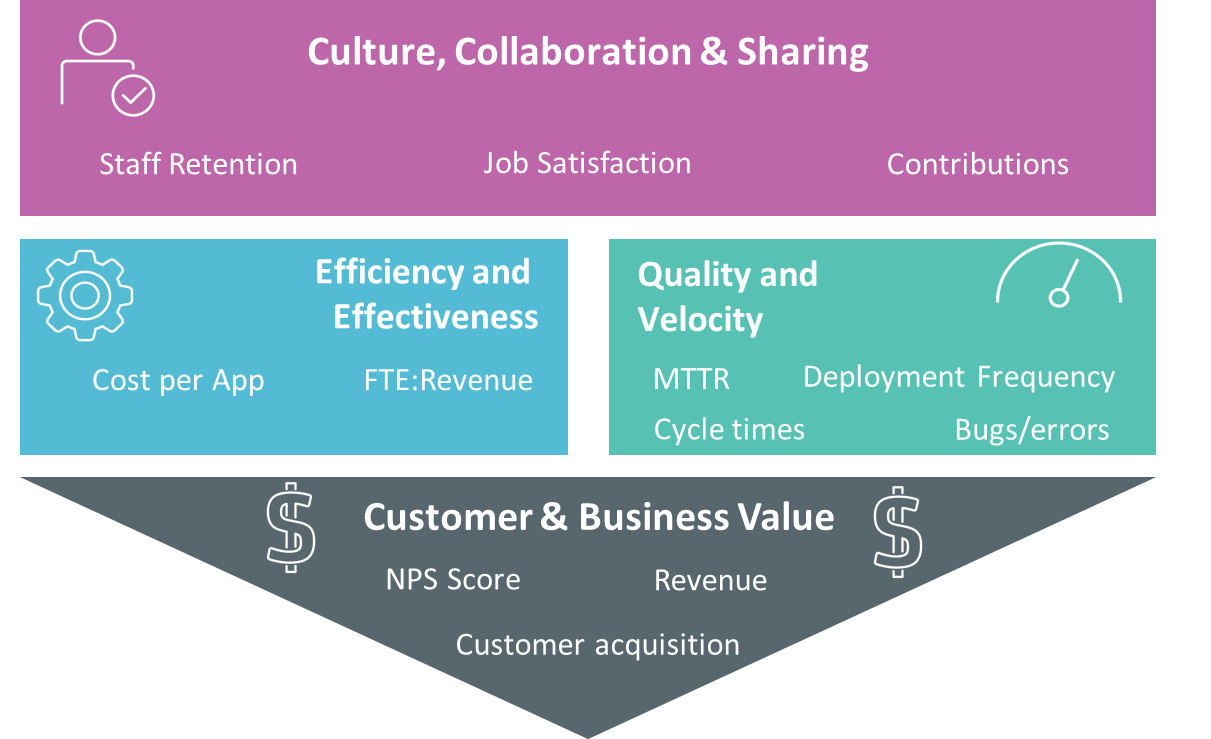
    DevOps is built around people, process and technology. But it doesn’t make sense to measure the components of DevOps; instead, we need to think about the goal, or outcome that each of these achieves. For example:

    • People changes are focused on improving culture, collaboration and sharing
    • Process changes are largely implemented with the goal of driving efficiency & effectiveness
    • Technology changes contribute to efficiency and effectiveness, but primarily drive quality and velocity

    Together, all three of these should lead to significant customer and business value.

    Notice how certain words above are in bold? That’s not an accident. These four key areas are the foundation of a successful DevOps practice—and therefore an excellent place to focus your measurement efforts. The figure below illustrates how these four areas fit together, and provides a few examples of the types of things that can be measure in each area.

    Of course, it’s important to consider your own organization when considering what metrics to focus on, as well as the guidelines mentioned previously. For example, in some organizations people-related metrics could be difficult to obtain on a regular basis. That’s not to say they’re not important—it’s been shown that DevOps can have a meaningful impact on employee satisfaction—but these metrics may not be the primary focus for some groups.

    DevOps has a wide range of benefits and I’ve seen organizations often have their own primary motivation, whether it is costs, velocity, competition or something else. It’s best to focus on metrics that are aligned to your organization’s primary objectives.

    Metrics matter only if what you’re measuring matters to your organization.

    If you are interested in learning more about DevOps metrics, the book “DevOps for Digital Leaders” explores this topic in more detail.

    In my next blog, I’ll delve into what to do with the metrics, once you’ve gathered and analyzed them. Because even the best metrics are only as good as what you—and your organization—can learn from them.

    — Aruna Ravichandran