Tag: CSA

  • Survey Sees Limited DevSecOps Progress Being Made as Vulnerabilities Mount

    Survey Sees Limited DevSecOps Progress Being Made as Vulnerabilities Mount

    A survey of 2,037 IT and security professionals conducted by the Cloud Security Alliance (CSA) on behalf of Dazz, a provider of a platform for mapping cloud computing environments, finds well over a third of respondents (38%) estimated that 21-40% of their code contains vulnerabilities, while 19% estimated 41-60% of their code contains vulnerabilities. Another 13% estimated they have vulnerabilities in 61-80% of their code.

    As a result, organizations on average have 55.5 security vulnerabilities each day in their remediation queue, with typically at least one being deemed critical, the survey finds. Overall, the average number of vulnerabilities that could be addressed is 1,025 per month, but organizations typically only address 270 within a month.

    In general, there are four phases to a remediation with each phase, on average, requiring between three to six hours so it easy to see how some organizations with limited resources can reach a point where they never catch up. The report noted that more than half of the vulnerabilities that have been remediated reoccur within a month, often because the root cause was never adequately addressed.

    Hillary Baron, senior technical director for research for CSA, said the high number of vulnerabilities that need to be regularly addressed suggested that progress in adopting DevSecOps best practices remains limited. While not every vulnerability is equally critical, it’s clear application development and cybersecurity teams are not yet proactively addressing application security issues, she noted.

    In fact, the survey found that less than a third (30%) of respondents reported there is a good working relationship between the application development teams that typically provision cloud computing environments and the cybersecurity teams that usually are held accountable for maintaining cloud security. Just under half of respondents (49%) said their vulnerability remediation teams comprised four to six members. Most respondents (60%) found it somewhat difficult to identify code owners, with an additional 24% facing moderate difficulty and 5% that found it highly challenging.

    Dazz CTO Tomer Schwartz said the more dynamic application development becomes, the bigger the DevSecOps challenge. Most organizations lacked the visibility required to proactively correlate their DevSecOps practices, he added. For example, more than three-quarters (77%) of respondents said they lacked full transparency into their cloud computing environments, and 6% had no visibility at all.

    In total, the survey finds organizations typically employ a variety of scanning and detection tools to safeguard their cloud environments, with 32% using five to six tools while another 29% report using three to four tools.

    More than three-quarters of respondents (76%) also noted that one in 10 of the alerts these tools generate is a false positive.

    Just under 75% of respondents also noted security teams spend more than 20% of their time performing manual tasks when addressing vulnerabilities, even though 83% reported using at least some automation in their remediation process. A full 61% also noted their organization is using three to six different detection tools, with nearly half (45%) considering increasing their security budgets in 2024, so it’s likely that many will be adding additional tools. In total, 22% dedicated less than 20% of their budget to cloud security, compared to 31% that allocated 21-40% of their budget and 27% that invest 41-60% of their budget to securing cloud environments.

    Unfortunately, less than a quarter (24%) said they feel very prepared for the cybersecurity threats their organization faces. Much of that uncertainty stems from knowing just how many vulnerabilities there really are in production environments and that they are being attacked with greater frequency each day.


  • DevSecOps @ RSA Conference 2017

    DevSecOps @ RSA Conference 2017

    One again this year, devopsy.kinsta.cloud, Sonatype and RSA Conference are teaming up to bring a Security/DevOps day of learning and networking to RSA Conference 2017 in San Francisco on February 13, 2017.  The event is DevSecOps @ RSA Conference 2017. Building on the previous two years of great events, this yearsevent promises to be even better. Some of the confirmed speakers are below and you can see for yourself what an amazing array of sessions there are. The best part is attending all of the RSA DevSecOps events are free.

    DevSecOps Sessions

    The line up for DevSecOps includes DevOps and DevSecOps pioneers, John Willis, Damon Edwards, Jez Humble, Dr. Nicole Forsgren, J. Paul Reed, Josh Corman, Shannon Lietz and more. Check out the site page for full details on speakers and topics.

    Attending the full day event (10am to 4pm) is free, but you need to register with RSA Conference. If you are already attending RSA, you need to modify your registration to indicate you are attending DevSecOps (or Rugged DevOps). If you are not already registered you can do so and receive a free expo pass to RSA Conference, which will allow you to register and attend the DevSecOps conference. You can use the code: 1U7DEVOPSXP and register here.

    DevOps Wine-ing (No Whining) Party

    In addition to the full day of amazing speakers, we will host the annual DevOps Wine-ing (no whining) cocktail party, immediately following the sessions. You need to be registered separately for the Wine-ing event. There is a link to the eventbrite registration here.

    The wine-ing event is from 4:30 to 6:30 and should once again be a great time for the security and DevOps tribes to intermingle. A tip of the hat to Josh Corman who is speaking at DevSecOps for starting the DevOps Wine-ing party 4 years ago.

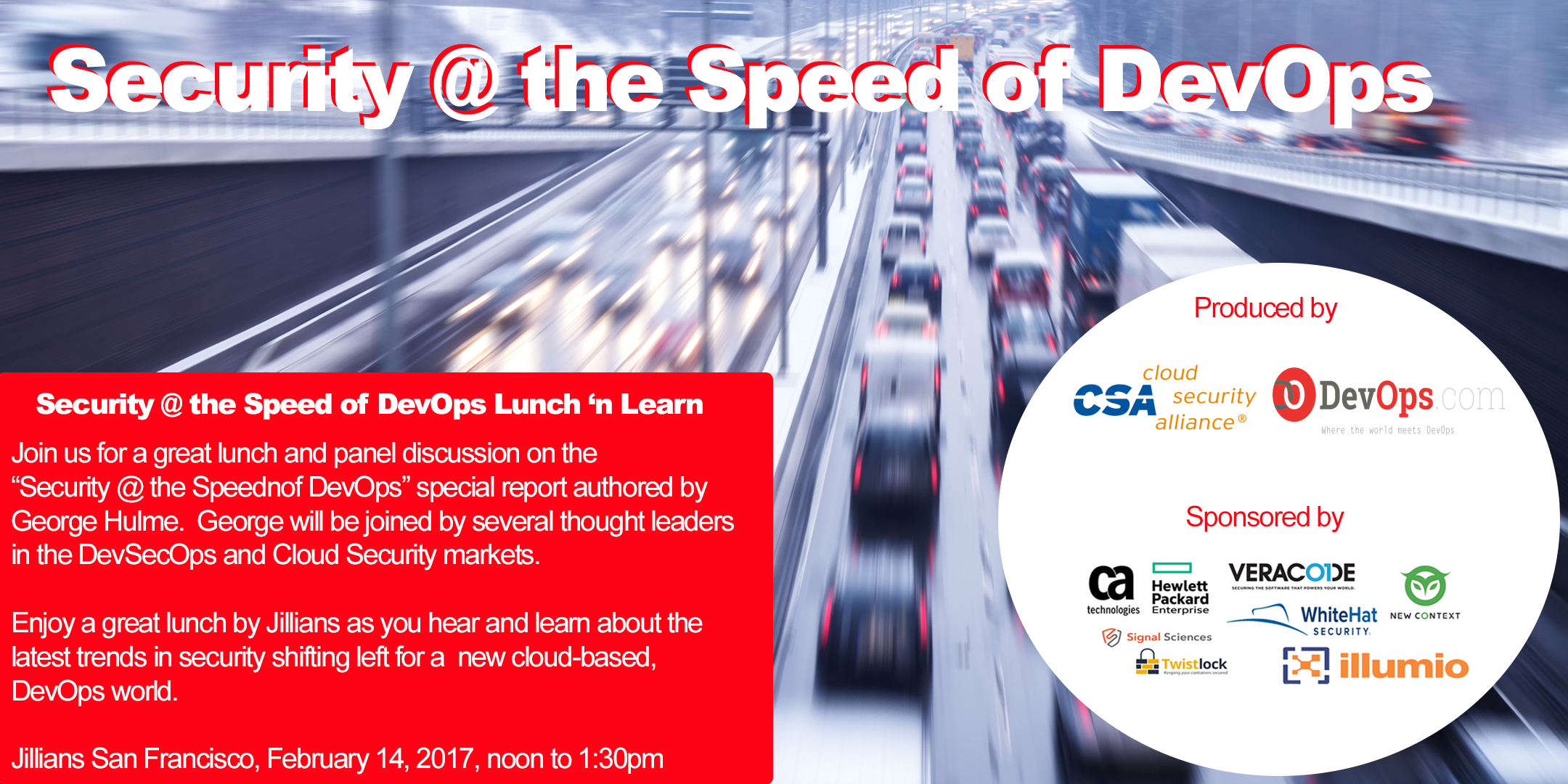
    Security @ the Speed of DevOps Lunch ‘n Learn

    On the following day, Tuesday we will host a lunch-n-learn on the “Security at the Speed of DevOps” report we are co-producing with the Cloud Security Alliance. We will have a panel including George and some leading DevSecOps and Cloud Security experts discussing the findings over lunch at Jillians. Again this event is free but you need to register for it here.

    The report is being written by George Hulme and is based on a survey co-produced and distributed by devopsy.kinsta.cloud and the Cloud Security Alliance. You can participate in the survey (we need your help here, so please do) by taking a few minutes at https://www.surveymonkey.com/r/RSACSADEVOPS. Feel free to tell your friends about it as well.

    security at the speed of devops

    We will be distributing copies of the report at RSA Conference, as well as digitally via devopsy.kinsta.cloud. We will also be distributing several other surprise giveaways at the event as well.

    Yes, this years RSA Conference will feature lots of DevSecOps and you can partake in all of it for free. Of course this wouldn’t be possible without the help of a great bunch of sponsors who have stepped up this year to support the events. In addition to RSA Conference, Sonatype and devopsy.kinsta.cloud, sponsors for the event are:

    Gold Sponsors

    CA Technologies, HPE, White Hat Security, Veracode, Cloud Passage, New Context and Illumio

    Silver Sponsors

    Signal Sciences, Twistlock

    See you on the 13th in San Francisco!


    — Alan Shimel

  • Software Assurance Takes Center Stage at Developer Day

    Software Assurance Takes Center Stage at Developer Day

    Cloud Security Alliance and SAFECode Develop Training for Improved Software Security Using Cloud and DevOps Practices

    Software assurance is one of the most important and possibly one of the least understood areas of software development today. Software assurance is a comprehensive process that encompasses a set of design, coding and testing methods for ensuring that software functions as intended without introducing vulnerabilities, malicious code or defects that can bring harm to the end user. This approach is especially important in the cloud because increasingly the tools for developing applications are coming from cloud providers. The architecture for applications is changing rapidly and requires developers to understand the risks and vulnerabilities when developing applications in the cloud environment.

    As we continue to see vulnerabilities within applications that lead to exploitation and theft of data, there exists a lack of acknowledgement in how to properly define and address these issues. With increased expectations on reducing time to market, development teams are pressured to work in sprint cycles using agile methodology thinking. New feature development is put first and developing secure code can become an afterthought.

    While individual companies do implement effective methods for developing and delivering more secure and reliable software, except for a small number of organizations such as Software Assurance Forum for Excellence in Code (SAFECode) and the Cloud Security Alliance (CSA), there have been limited coordinated, industry-led efforts to build upon this positive work and promote best practices to advance software assurance more broadly, especially in cloud technology.

    Inaugural Developer Day Planned for Sept. 12

    The inaugural Developer Day event launched by the Cloud Security Alliance and SAFECode is a workshop developed to address these issues by educating software professionals on the challenges of improving software security using cloud and DevOps practices. A unique curriculum was developed by CSA and SAFECode to address the challenge of improved security using cloud and DevOps practices. The event is free but pre-registration is encouraged:

    WHAT:  SAFECode/CSA Developer Day

    WHEN:  Monday, Sept. 12; 1-6 p.m. PDT             

    WHERE:  Adobe Systems Incorporated Corporate Headquarters
    345 Park Avenue, San Jose, California
    Park Room, East Tower

    Event Fee:  Free          

    Registration:  https://www.eventbank.com/event/777/register/

    Developers play a critical role in secure software assurance, and in today’s IT landscape, this role has never been more important. The application of effective software assurance methods is a proven way of enhancing and preserving trust and reliability of software.

    A Practical Primer on Software Assurance

    The half-day Developer Day event provides software developers with an important general primer on the core principles and applications of software assurance, and how to build in security utilizing cloud and DevOps practices. Attendees also will be provided with insight on state-of-the-art software assurance trends and learn how they can deepen their knowledge of software assurance. The event agenda includes three sessions:

    • SAFECode: Driving Software Assurance among Software Professionals
      • Fundamental Practices for Software Assurance
    • CSA: Cloud + Dev = Security Awesome
    • Putting Theory into Practice: Software Assurance Case Studies

    SAFECode and CSA created the Developer Day with two goals in mind. The first was to share recent developments and trends in the practice of software assurance across a number of different domains. The second was to demonstrate the top ways to combine development practices such as DevOps with cloud deployments to increase security without slowing things down.

    Online Software Assurance Training Available

    If you can’t make Developer Day, SAFECode and CSA also recently launched a jointly developed free, online, on-demand cloud security training program called, “Basic Practices for Service Development of Cloud Applications.”  The two-part training program teaches students about different cloud models as well as basic practices and aspects of secure development of cloud applications. It is part of a broader security engineering curriculum made available for free by SAFECode.

    About the Author / John Yeoh

    john_yeohJohn Yeoh is the Senior Research Analyst for the Cloud Security Alliance (CSA) working within industry working groups, SDOs and strategic relationships in the development of cloud security standards, tools and solutions and strategy development. With over 15 years in research, John has authored reports on IT, cybersecurity, cloud and new technologies. His thought leadership has been presented in SC Magazine, USA today, Information Week and others, and he currently sits on numerous technology committees in government and industry. John’s graduate studies include Massachusetts Institute of Technology and University of Southern California with undergraduate work at Eastern Washington University and University of Washington. Connect with him on Twitter and LinkedIn.

  • Q & A Cloud Security Alliance’s Jim Reavis on securing the IoT

    Q & A Cloud Security Alliance’s Jim Reavis on securing the IoT

    Cloud Security Alliance CEO and co-founder, JIm Reavis

    Earlier this month at the RSA Conference 2015 the Cloud Security Alliance released security guidance for the Internet of Things (IoT). The guidance came out of the CSA’s Mobile Working Group — IoT Initiative. Many security researchers I’ve interviewed in recent years have repeatedly cited frustrations around what they see as lax security design and implementations of IoT devices. There is rarely an adequate threat and risk assessment conducted on devices, there’s no secure software development lifecycle, and access controls and usual patch processes for deployed devices is often non-existent.

    If their perceptions are accurate, a good way to think of IoT security maturing is to think of the way software and eCommerce sites were developed in 1999.

    This is why it’s important to help early adopters understand the security challenges associated with IoT, and share information on how these devices can be security designed, built, and deployed. With that in mind, along with the CSA’s recent IoT security announcement, we reached out to Jim Reavis, co-founder, CEO and driving force of the Cloud Security Alliance to get some of his thoughts about the issues. Reavis has been named as one of the Top 10 cloud computing leaders by SearchCloudComputing.com.

    devopsy.kinsta.cloud: Do you think it’s important to have the IoT security discussion now, and what do you see as the CSA’s role?

    Reavis: We think IoT is an area that’s not a future security challenge, but a present one. Not only because there is so much that’s happening right now, but because the application of IoT is so broad as to range from personal devices to those in the critical infrastructure. We also felt that we have a place here because all of these devices are going to be cloud-provisioned, cloud-managed, and their data stored in the cloud.

    We actually have 30 people on this guidance, and we tried to provide a lot of examples of different IoT implementations and we thing it is a good first cut of guidance directed at what we think the issues around IoT are, and what we need to be looking at. The guidance is also a call for action, because we are going to shortly publish about five additional, and more detailed, papers. We are hoping this generates a lot of interest, because now is the time to really start solving this problem.

    devopsy.kinsta.cloud: Where do you see the big challenges here? Is it with the device makers, or with the implementation? Or all or none of the above?

    Reavis: It’s a very wide problem. We think some of the device makers know that security is important enough, and that there’s an economical incentive for them to get this right. However, other devices are going to be so cheap, 3D printed and such, that it’s not going to be possible to get to the manufacturers – and so security there is going to have to come from the network. This is an area where standards can help.

    Security practices such as the secure development life cycle makes sense for certain aspects of securing the IoT. In other areas, security will come from cloud-delivered technologies like encryption and strong authentication. It is a broad ecosystem thing that we’re looking at and so there’s also governance challenges.

    And, right now, it’s not apparent to me that there’s a huge advantage in going to one, or a handful, of stakeholders here.

    devopsy.kinsta.cloud: That’s fascinating, so do you see this as a bigger challenge than securing eCommerce was 15 years ago?

    Reavis: Yes, we are looking at seven, eight billion Internet connected devices right now. Maybe it’s going to be a trillion in a few years. And if you go look industry by industry, and look at what companies are saying they’re going to do, that one trillion figure is not a crazy number to reach in about seven years.

    With that kind of scale, the Internet model is going to break. The Internet has worked very well, and I think we felt that it can handle anything we throw at it. But we think we’re really going to have to change the model for the growth that is associated with IoT.

    Part of that is the network needing to overlay a type of dark net on top of the open Internet, and that’s our software-defined perimeter. We’ve had the software-defined perimeter around for more than a year now. We’re creating the specification so that it separates the data channels and the control channels. It essentially knows the devices, knowing who’s authenticating on the devices, and then deciding what parts of networks are visible to them.

    devopsy.kinsta.cloud: What do we you in the future with IoT guidance coming from the CSA?

    Reavis: We are going to align each facet of IoT security with the corresponding cloud security standard and best practices. And upcoming research will identify and document critical vulnerabilities found in IoT in enterprise environments. We will provide guidance on how to mitigate those risks as well as give developers secure development guidance.

    The full report released can be found at New Security Guidance for Early Adopters of the IoT.