Tag: Copilots

  • Exploring Low/No-Code Platforms, GenAI, Copilots and Code Generators

    Exploring Low/No-Code Platforms, GenAI, Copilots and Code Generators

    The emergence of low/no-code platforms is challenging traditional notions of coding expertise. Gone are the days when coding was an exclusive skill set reserved for a knowledgeable few. Low/no-code platforms have democratized software development. They empower individuals from non-IT or technical backgrounds to translate their business ideas into applications without the need to master complex programming languages.

    These low/no-code platforms, with their user-friendly drag-and-drop interfaces and pre-built components, have simplified application development. Imagine building a smart home application with just a few clicks and drags — low/no-code platforms are making it possible.

    Add generative artificial intelligence (Gen AI) into the mix, and the new development practices change the field remarkably.

    The Impact of Gen AI on Low-Code Platforms

    Expect low-code platforms to evolve further, becoming more intelligent, adaptable and seamlessly integrated into the software development lifecycle. There will be a shift towards platforms that use Gen AI to understand user intent, automate routine tasks and generate complex code snippets.

    Gartner predicts that, by 2026, over 80% of enterprises will use GenAI APIs and models or deploy GenAI-enabled applications in production environments, up from less than 5% in early 2023.

    Combining low-code and Gen AI will empower developers by automating routine tasks and allowing them to focus on high-level logic and creativity. Gen AI acts as a multiplier that can accelerate and optimize developmental operations.
    McKinsey estimates that generative AI could add $2.6 trillion to $4.4 trillion annually to the global economy by 2040.

    Another Tool: AI Copilots and Code Generators

    Another promising application for AI large language models (LLMs) is AI-powered assistants. Enter copilots and code generators — AI assistants that take the hassle out of coding.

    While low/no-code platforms have transformed application development, copilots and code generators add an extra layer of efficiency.

    AI copilots use a chat interface to simplify coding through a chat interface, where developers articulate their code requirements in natural language prompts, and the copilot generates the code accordingly. These assistants provide real-time assistance, offering contextual suggestions and code snippets, and they can anticipate potential bugs. Moreover, they can explain code blocks, generate unit tests and propose bug fixes, which enhances the coding process.
    AI copilots are like trusted assistants, ready to aid you with specific coding tasks or generate complex code – and they do it swiftly.

    The Big Question

    As a result of low/no-code platforms gaining traction, the skill sets required in the tech industry will transform. Gone are the days when proficiency in multiple programming languages was a must-have.

    With low/no-code tools taking center stage, does this mean coding is becoming obsolete?

    A big no.

    While basic programming knowledge remains valuable, it’s no longer the sole requirement for building innovative applications. With low/no-code platforms democratizing application development, individuals from diverse backgrounds can leverage technology to create impactful solutions.

    Do GenAI, copilots, and code generators render low/no-code platforms obsolete?

    Again, no.

    While GenAI, copilots, and code generators excel at certain specific tasks, low/no-code platforms offer a holistic solution, combining visual interface design, database integration and more. They’re the Swiss army knives of development, catering to a wide range of needs beyond just code generation.

    Gen AI, copilots and code generators are not here to replace low/no-code platforms or traditional coding practices. Instead, they are positioned to complement and enhance them. The fusion of these technologies holds great promise in simplifying software development, boosting efficiency, and unlocking new avenues for innovation.

    The Final Word

    With better code suggestions and automated testing capabilities, low/no-code platforms deliver high-quality solutions that meet the demands of today’s tech-savvy users.

    With the thrilling combination of low/no-code platforms and GenAI, the future of software development is promising. While these advancements may disrupt traditional coding, they also present opportunities for innovation and creativity.

    It’s time for us to embrace this change and build a brighter tomorrow, one line of code — or lack thereof — at a time.

  • Copado Expands Beta of Generative AI Tools for Salesforce DevOps Platform

    Copado Expands Beta of Generative AI Tools for Salesforce DevOps Platform

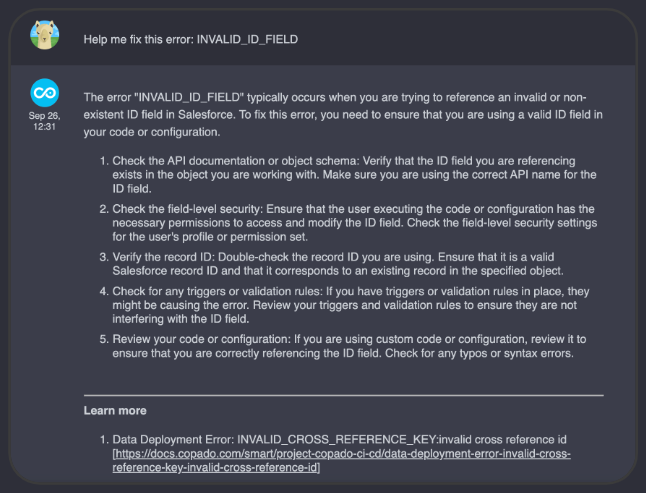
    Copado today announced it has expanded a beta program through which it provides application development teams building applications for the Salesforce software-as-a-service (SaaS) platform access to generative artificial intelligence (AI) capabilities enabled by ChatGPT.

    David Brooks, SVP of Evangelism for Copado, said the company, via the usage of vector databases, has exposed instances of ChatGPT to everything in its knowledge base that has been collected over the last 10 years. That approach enables Copado to extend the large language model (LLM) used to train ChatGPT without exposing any data that might be used to one day train the next version of the generative AI platform.

    The goal is to enable DevOps teams to generate code and tests faster while simultaneously reducing the time required to handle support calls, said Brooks.

    In addition, Copado is using ChatGPT to enable impact analysis and conflict detection to reduce the level of friction encountered when deploying applications in a production environment. That latter capability is critical because, in many instances today, DevOps teams don’t have a firm understanding of how code needs to be deployed, resulting in unnecessary rollbacks of application deployments, noted Brooks.

    Generative AI will also automate the creation of documentation, such as release notes for every application deployed, to reduce the overall level of toil DevOps teams experience, noted Brooks.

    Copado also plans to provide governance tools that will enable DevOps teams to ensure the code written by an LLM is not based on a hallucination that results when trying to reconcile conflicting data, added Brooks. There will, of course, always be a need for a human to review code before it is deployed in a production environment, he added.

    In the longer term, Copado will make it possible for organizations to invoke multiple LLMs to address various functions as they best see fit, said Brooks. In fact, DevOps teams should expect to soon be employing multiple copilots trained to address specific tasks such as writing code, deploying applications, assessing cybersecurity and addressing compliance mandates, he added.
    Ultimately, application development and deployment efforts that today require weeks to complete will soon be accomplished within the same day, said Brooks.

    At the same time, organizations will also be able to better manage application environments that today operate at levels of scale few IT teams can manually track. Generative AI capabilities, in effect, will make it simpler for DevOps teams to effectively manage application environments at much higher levels of scale, said Brooks.

    Each organization will naturally need to determine to what degree they are prepared to absorb that level of innovation, but it’s clear the pace at which applications are built and deployed is about to exponentially increase. The issue organizations will increasingly encounter is that business processes will not be able to absorb the rate at which software can be built and updated.

    It’s not clear just yet to what extent generative AI will transform DevOps, but as advances continue to be made, many of the manual tasks and bottlenecks that today conspire to slow down application development and deployment are about to be eliminated in ways that few would have thought possible a little more than a year ago.

  • Microsoft Previews Additional Copilot Tools for Azure

    Microsoft Previews Additional Copilot Tools for Azure

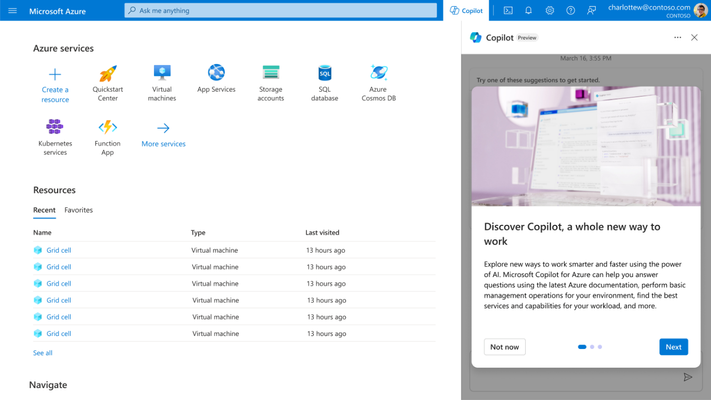
    At its Ignite 2023 conference, Microsoft this week previewed Copilot tools to simplify the management of the Azure cloud service along with a tool that streamlines the building and deploying of artificial intelligence (AI) applications on the Azure platform.

    In addition, Microsoft launched Microsoft Copilot Studio, a low-code tool that automates the process of creating data integration plugins and adding custom copilots within the Microsoft Copilot for Microsoft 365 tool that Microsoft previously launched.

    Microsoft Copilot for Azure leverages large language models (LLMs) to enable IT teams to use natural language to create, configure, discover and troubleshoot Azure services. It also enables IT teams to create complex commands, ask questions and optimize costs.

    Erin Chapple, corporate vice president for Azure Core at Microsoft, told Ignite attendees that Microsoft, along with a handful of customers, is already using Microsoft Copilot Azure to manage Azure infrastructure.

    In the long term, it’s clear that Microsoft is moving toward streamlining the building and deployment of AI applications using Azure AI Studio, a framework for invoking the AI models that Microsoft makes available on the Azure platform. The goal is to make it possible for organizations to create their own copilots based on AI models they have trained.

    It’s still early days in terms of organizations leveraging AI models to build applications, but it’s already apparent that DevOps and machine learning operations (MLOps), along with data engineering and cybersecurity best practices, will need to converge. Microsoft is making a case for Azure AI Studio as the framework that will enable IT organizations to achieve that goal.

    Of course, Microsoft is not the only provider of IT infrastructure resources with similar ambitions, but thanks to its investments in OpenAI and the acquisition of GitHub, it is furthest along in terms of defining a framework for building AI applications at scale. Last week, GitHub previewed an extension of the Copilot tools it already provides to help developers write code that leverages generative AI to automatically propose an editable plan for building an application based on natural language descriptions typed into the GitHub Issues project management software. Copilot Workspace will generate editable documents via a single click that can be used to create code that developers can then visually inspect. Any errors discovered by application developers or the Copilot Workspace platform can also be automatically fixed.

    At the same time, GitHub has extended the scope and reach of Copilot Chat to make it simpler for developers to use natural language to discover issues in their code base.

    Generative AI is already having a massive impact on the rate at which applications are developed, but that code still needs to be reviewed. Chat GPT is based on a general-purpose large language model (LLM) that is trained by pulling in code of varying quality from all across the web. As a result, code generated by the platform might contain vulnerabilities or be inefficient. In many cases, professional developers still prefer to write their own code.

    Of course, not every programming task requires the same level of coding expertise. In many instances, ChatGPT will generate, for example, a script that can be reused with confidence across a DevOps workflow. There is no shortage of mediocre developers who are now writing better code thanks to tools such as GitHub Copilot, and soon, domain-specific LLMs will make it possible to consistently write better code based on validated examples of code.

    The next challenge is going to be finding a way to manage increased volumes of code. There is no doubt that AI will be applied to the management of DevOps pipelines, but for the moment, at least, the pace at which AI is being applied to writing code is already exceeding the ability of DevOps teams to manage it.