Tag: continuous testing

  • Tabnine Unveils Beta of Generative AI Automated Testing Tool

    Tabnine Unveils Beta of Generative AI Automated Testing Tool

    Tabnine this week made available in beta a tool that enables developers to use natural language to interact with the artificial intelligence (AI) models embedded within its test automation platform.

    Brandon Jung, vice president of ecosystems for Tabnine, said Tabnine Chat extends generative AI capabilities the company developed to make it simpler for developers to invoke its test automation platform from within their integrated development environment (IDE).

    In addition to making it possible to search a codebase more efficiently, that capability can also be used to explain how a piece of code functions, said Jung.

    Developers can also generate new code via a natural language interface using Tabnine Chat in the same way other generative AI tools do, he added.

    In addition to developing its own LLMs, Tabnine previously announced it will be integrating LLMs provided by Google as part of a strategy to mix and match LLMs regardless of where they are hosted.

    Unlike general-purpose LLMs, the ones used by Tabnine were trained using a narrower base of testing code that the company curated using tests made freely available on the internet. No customer data was used to create any of those tests, so developers do not need to worry their code may inadvertently be accessed by anyone else, noted Jung.

    In general, as AI makes test creation simpler, tests will be run more frequently, said Jung. Over time, those AI capabilities and more frequent tests should significantly improve the overall quality of applications running in production environments, he added.

    It’s now only a matter of time before generative AI is applied across the entire software development life cycle (SDLC). Testing, however, may be one area where it will have the earliest impact.

    In the meantime, the debate over the impact generative AI will have on DevOps continues. Some proponents contend most of the software engineering process is about to become automated, while others suggest there will always be a need for a human to be in the loop of any process automated using AI models. Much of the current level of toil associated with DevOps today will be reduced, but the need for software engineers to manage the overall process will remain, they contend.

    The one thing that is certain is that the pace at which applications are built and deployed is about to be greatly accelerated. Prior to rise of generative AI, testing processes were barely keeping pace, so as more code is created with the help of AI, the need for similar advances in testing will become acute.

    There is as much irrational exuberance about AI as there is fear and loathing, but DevOps teams that committed early on to ruthless automation will naturally be at the forefront of adoption. The immediate challenge is assessing what functions will be automated and the impact those changes will have on the way DevOps teams are currently structured. Ultimately, the goal is to eliminate as many of the bottlenecks that conspire to slow application development and deployment while simultaneously improving the quality of the application experience.

  • Applitools Acquires Preflight to Further Apply AI to App Testing

    Applitools Acquires Preflight to Further Apply AI to App Testing

    Applitools this week revealed it has acquired Preflight, which provides a low-code automation platform infused with machine learning algorithms that makes it possible for developers to write their own tests.

    Applitools COO Moshe Milman said Preflight extends the company’s efforts to leverage artificial intelligence (AI) to shift more testing capabilities left toward application developers using its existing test automation platform. The Applitools platform is compatible with frameworks such as Selenium, Playwright and Cypress.

    One of the major challenges organizations encounter as they encourage developers to run more tests is that many of them don’t have the skills required to write them. Applitools’ AI capabilities reduce the cognitive load required to create and run tests, noted Milman.

    The goal isn’t so much to replace dedicated application testing teams but to enable developers to more easily test code as they build it, noted Milman. There will always be a need for dedicated testing teams to evaluate more complex use cases for applications, he added.

    The issue is, thanks to advances in DevOps automation, the pace of application development is outpacing the testing resources available, said Milman. IT teams need to invest in test automation to close what has become a quality gap because not enough code is being thoroughly tested, he noted.

    Test automation also serves to reduce the total cost of creating tests. That enables organizations to conduct more tests without slowing down application development, noted Milman.

    In the longer term, Applitools also plans to leverage large language models (LLMs) to provide generative AI capabilities alongside existing support for machine learning algorithms to further automate testing, noted Milman. Applitools is already making use of computer vision to automate app testing. Preflight adds a set of tools infused with AI to create tests.

    The reasons behind inadequate application testing aren’t entirely clear. Whether it’s because tests are too difficult to create or development teams simply run out of time because of scheduling delays, the impact is the same. Too often, developers convince themselves they will address any issues that might arise with the next update only to become distracted by other priorities. Regardless of the reason, however, there are more poorly-tested applications running in production environments than many DevOps teams would prefer. In fact, much of the technical debt IT organizations need to manage today can be traced back to inadequate testing.

    However, as testing tools become more automated, the overall quality of applications should improve and technical debt may become less of an issue. In the meantime, automated testing promises to improve overall developer productivity as it becomes simpler for developers to create code that has been, at the very least, vetted by algorithms before being added to a codebase. In effect, developers are running out of excuses for not testing applications before delivering them to unsuspecting end users.

  • The Future of Continuous Testing in CI/CD

    The Future of Continuous Testing in CI/CD

    If you ever wonder why continuous testing is so important, think about the following: In the past, software testing was typically done after the code was written and sent to the QA department for independent testing. When bugs were discovered, the code was returned to the developers for correction. While this testing method worked, it was time-consuming. Nowadays, companies want to produce high-quality products quickly, so they need a faster and more efficient testing process. This is when continuous testing comes in.

    In this article, we will explore continuous testing from its current state and its future in CI/CD to the emerging technologies and trends that will shape its development. We will also cover the importance of continuous testing for businesses and some of its challenges.

    What is Continuous Testing?

    Continuous testing is a software testing approach in which tests are automated and run throughout the software development life cycle. It is a part of the continuous delivery (CD) process, in which software changes are delivered to customers continuously and iteratively.

    Continuous testing aims to identify defects and issues as early as possible, reducing the cost and time of fixing them later. Continuous testing provides immediate feedback to the development team, helping them to detect and address potential problems quickly and efficiently.

    According to the Reports and Data source survey, 21% of QA professionals have incorporated continuous testing, source code management and continuous integration into their DevOps process to speed up code release.

    Advantages of Continuous Testing

    Here are several advantages of implementing continuous testing as a part of the software development process:
    ● Continuous testing enables teams to identify bugs earlier in the software development process;
    ● Continuous testing provides immediate feedback to developers on the quality of their code, enabling them to address any issues immediately;
    ● You can minimize business risks by assessing and identifying potential issues before they become real problems;
    ● Automating your test cases can reduce the time spent on testing;
    ● Accelerating the process of software delivery to production helps release the product faster;
    ● You can run performance tests in similitude, which can increase the speed of test execution.

    Disadvantages of Continuous Testing

    While continuous testing has become an integral part of the software development process, it’s not without its challenges. As software development teams work to incorporate testing into their CI/CD pipelines, they may encounter obstacles that can hinder their progress.
    ● Continuous testing requires a different skillset than traditional testing, including expertise in DevOps, automation and CI/CD pipelines;
    ● Different tools and technologies are available for continuous testing, and choosing the right ones can be tough. Integrating these tools with other parts of the development process can also be challenging;
    ● To fully realize the benefits of continuous testing, you need to update your testing strategy by moving away from relying solely on traditional testing methods and adopting a well-defined approach to test data management;
    ● Failing to integrate code regularly can result in issues such as duplicated coding efforts and non-compatible code, leading to defects.

    Emerging Technologies in Continuous Testing

    With the increasing demand for faster and more reliable software releases, emerging technologies such as AI/ML, automation and DevOps appeared in continuous testing. These technologies help teams to automate and streamline their testing processes, identify defects more quickly and improve overall software quality. Let’s examine some of them:

    Artificial intelligence/machine learning (AI/ML). AI and ML refer to the field of computer science that deals with developing intelligent machines that can simulate human intelligence and learn from data.

    One of the main benefits of AI and ML in continuous testing is the ability to automate test case generation, which reduces the need for manual testing and frees up time for other tasks. This enables testers to test applications more comprehensively and frequently, ensuring defects or issues are identified and addressed quickly. AI and ML increase testing accuracy by identifying patterns and anomalies in the testing data.

    AI and ML techniques can efficiently and rapidly analyze extensive amounts of data, allowing them to recognize patterns and irregularities in testing data that human testers might overlook.

    Automation: Automation in continuous testing refers to using automated tools and processes to execute software tests repeatedly and consistently. It involves automating various stages of the software testing life cycle, such as test planning, test case design, test execution and test reporting.

    Automation can efficiently perform regression testing, ensuring that changes do not introduce new defects or issues in the software. Tests can be executed 24/7 without human intervention, reducing the time and cost required for testing.

    DevOps: DevOps in continuous testing is the application of DevOps principles to continuous testing, focusing on integrating testing into the software development life cycle and enabling faster and more reliable delivery of software.

    In the context of continuous testing, DevOps emphasizes testing integration into the development process, enabling developers to detect and fix defects early in the cycle. DevOps also promotes automation, collaboration and communication between development and operations teams, allowing faster and more efficient testing and deployment.

    Blockchain: Blockchain technology has been gaining increasing attention in the software development and testing industry due to its ability to provide secure and tamper-proof data storage.

    In continuous testing, blockchain stores testing results and data in a decentralized and transparent way, making it virtually impossible for anyone to modify or manipulate the data. This enhances the credibility of the testing process and outcomes and provides an added layer of security to ensure the integrity of the data.

    Blockchain technology enables efficient and seamless data sharing between stakeholders involved in the testing process, enabling faster and more accurate decision-making.

    Internet-of-Things (IoT): In continuous testing, IoT simulates many IoT devices and platforms, enabling testers to test their applications across multiple devices and platforms. This ensures that applications are compatible with various IoT devices and platforms and perform reliably and consistently in various environments.

    For instance, when creating an application that needs to run on multiple devices, it is possible to use an emulator to test the app on your laptop without setting up a development environment for each type of device.

    IoT-enabled continuous testing provides real-time feedback on the performance and functionality of applications, enabling organizations to identify and address issues quickly and effectively.

    Trends in Continuous Testing

    Continuous testing is rapidly evolving to meet the needs of modern software development practices, with new trends emerging to address the challenges development teams face. Three key trends currently gaining traction in continuous testing are cloud-based testing, shift-left testing and security testing. These trends are driven by the need to increase efficiency and speed in software development while ensuring the highest quality and security levels. Let’s take a closer look at these trends.

    Cloud-Based Testing: Continuous testing is deployed through cloud-based computing, which provides multiple benefits like ease of deployment, mobile accessibility and quick setup time. Businesses are now adopting cloud-based services due to their availability, flexibility and cost-effectiveness. Cloud-based testing doesn’t require coding skills or setup time, which makes it a popular choice for businesses.

    AI-Driven Testing: AI-driven continuous testing is often integrated into cloud-based testing platforms, providing end-to-end automation for web, mobile and API testing. AI and cloud-based testing allows for access to testing environments anywhere, anytime, and provides for regular automated testing using platforms like Selenium.

    Shift-Left Testing: Shift-left testing is software testing that involves testing earlier in the development cycle rather than waiting until later stages, such as system or acceptance testing. The goal of shift-left testing is to identify and address defects as early as possible.

    Delaying testing until the end of development often results in more complicated bug fixes since the software is already fully built. This can cause an increase in cost and time to market. Identifying and fixing bugs earlier in the software development life cycle is generally more cost-effective.

    As IBM’s Systems Sciences Institute claimed, repairing a bug discovered during implementation costs roughly six times more than one found during design. If a mistake is detected after product release, the cost of fixing it is four to five times greater than one found during design and up to 100 times greater than one found during the maintenance phase. This suggests that a bug’s cost increases exponentially as the software progresses through the SDLC.

    Low-Code/No-Code: Low- or no-code in continuous testing refers to using visual interfaces and pre-built elements or modules to create and execute automated tests instead of writing complex code. Low-code/no-code testing tools often provide drag-and-drop interfaces and pre-built components that can be combined to create tests, reducing the time and effort required to develop and maintain test scripts.

    This type of testing provides several advantages, such as allowing non-technical business experts to run testing, speeding up test production and execution and enhancing product quality by enabling more thorough and efficient testing.

    Generally, according to statistics, by 2025, around 70% of new business applications are predicted to use low-code or no-code technologies.

    Security Testing: Due to the rising incidence of cybersecurity threats and data breaches, security testing has become a crucial aspect of software quality assurance. In the year 2023, the tech world anticipates that there will be a stronger focus on security testing, with the emergence of more advanced tools and methodologies aimed at detecting and resolving security weaknesses in software applications.

  • SapientAI Emerges From Stealth to Apply AI to App Testing

    SapientAI Emerges From Stealth to Apply AI to App Testing

    SapientAI emerged from stealth today to automate the writing of test code using a combination of generative artificial intelligence (AI), machine learning algorithms and data science.

    Fresh from raising $5 million in seed funding, SapientAI CEO Rishi Singh said the goal is to leverage AI to push application testing further left using an AI Test Coder the company built.

    The concept of AI Test Coder is similar to the co-pilot capabilities that GitHub and Google are providing to help developers write better code faster, but also goes beyond generative AI to add deeper analysis and contextual understanding to the tests it automatically generates, noted Singh.

    In the longer term, the ability to use AI to create tests will result in the deployment of more secure, higher-quality applications because there will be no need to short-shrift application testing processes in the interest of meeting deadlines, added Singh.

    Prior to the rise of AI, building application tests has historically been prone to error. AI Test Coder is designed to be a plug-in for an integrated development environment that will leverage the large language models (LLMs) created by OpenAI and cloud service providers to employ natural language to create tests based on an analysis of the application environment created using a combination of machine learning algorithms and data science techniques, said Singh.

    As part of the effort, AI Test Coder instantly inspects all software code to understand the software testing environment, including any incorrect assumptions that stem from errors and bugs, before generating any test code. It then leverages code intelligence to understand existing code and automatically identify and detect patterns to anticipate any new software issue that may arise. AI Test Coder also locates where code changes will have an effect before any test code is created. This eliminates time that would otherwise be wasted on manually debugging code.

    Once those steps are completed, Test Coder then generates more accurate tests without relying on the current trial-and-error approach to testing that can slow application development, said Singh.

    In effect, AI Test Coder provides each developer with their own assistant dedicated to managing testing tasks that ultimately improve quality assurance, including removing many of the vulnerabilities that create application security issues that have become the bane of software supply chains.

    It’s too early to determine precisely what impact AI will have on application development and deployment, but many of the manual tasks that create a sense of drudgery are about to be eliminated. That means the overall pace at which applications can be built and deployed is about to be greatly accelerated. DevOps teams are likely to find themselves pushing more code simultaneously through pipelines than ever.

    Naturally, AI will soon be applied to not just writing code and tests faster, but also DevOps workflows. The issue now is determining which of the tasks that today require manual intervention will be eliminated in a way that enables DevOps teams to focus more of their time and effort on more complex challenges.

  • Continuous Testing: The Key to Quality Assurance in the DevOps Era

    Continuous Testing: The Key to Quality Assurance in the DevOps Era

    Continuous testing has emerged as a critical aspect of quality assurance in the DevOps era. In recent years, there has been a rapid transformation in software development methodologies. With the advent of DevOps, there has been a significant shift toward automation and continuous integration and delivery (CI/CD). The traditional approaches to quality assurance are no longer adequate to meet the needs of modern software development practices. Continuous testing is the key to ensuring that the software is delivered on time, with quality and reliability.

    Definition of Continuous Testing

    Continuous testing is a process of executing automated tests continuously throughout the software development life cycle to provide rapid feedback on the quality of the code. It is an essential component of DevOps that ensures that the software is always ready for release. Continuous testing allows for the detection of defects and errors at an early stage, which reduces the risk of production issues and enhances the overall quality of the software.

    Importance of Continuous Testing in DevOps

    To understand the importance of continuous testing in DevOps, it is essential to understand the evolution of quality assurance in software development.

    Traditional Waterfall Method

    The traditional waterfall model of software development had a sequential approach to quality assurance. Testing was only performed after the development phase was completed. This approach often led to delays and increased costs due to detecting defects later.

    Agile Methodology

    The Agile methodology introduced an innovative approach to quality assurance. Testing became an integral part of the software development lifecycle, and the focus was on continuous feedback and improvement. However, even with Agile, testing was still done in batches, and there was a significant amount of manual testing involved, which could be time-consuming and prone to errors.

    DevOps Model

    The DevOps model took the concept of continuous feedback and improvement to a new level. With DevOps, testing became automated, and continuous integration and delivery became the norm. This approach significantly reduced the time to market, increased collaboration between development and operations teams, and enhanced the overall quality of the software.

    The Role of Continuous Testing in DevOps

    Definition of DevOps

    DevOps is a software development methodology that emphasizes collaboration and communication between development and operations teams to deliver software products rapidly and reliably. It involves the integration of development, testing and operations into a continuous process, with automation as a key enabler.

    Importance of Continuous Testing in DevOps

    Continuous testing is a critical component of DevOps. It enables the testing of software continuously throughout the development lifecycle, which helps to identify defects and issues early on.
    This early detection of issues is essential in reducing the risk of production issues, and it allows for timely feedback, which facilitates faster decision-making.

    Benefits of Continuous Testing in DevOps

    There are several benefits of continuous testing in DevOps, including:

    · Faster time to market: Continuous testing enables the rapid release of software, reducing the time to market significantly.
    · Improved collaboration: DevOps emphasizes collaboration between development and operations teams, and continuous testing facilitates this collaboration by providing continuous feedback on the quality of the code.
    · Enhanced quality: Continuous testing enables the early detection of defects and issues, which reduces the risk of production issues and enhances the overall quality of the software.
    · Reduced costs: Continuous testing can help to reduce costs by identifying defects and issues early on, which reduces the cost of fixing issues later in the development cycle.

    Implementing Continuous Testing in DevOps

    Choosing the Right Test Automation Tools

    The selection of the right test automation tools is critical to the success of continuous testing in DevOps. Some of the popular test automation tools for DevOps include Selenium, Appium, Cucumber and JUnit.

    It is essential to choose a tool that is easy to use, integrates well with other DevOps tools, and has strong community support.

    Building an Effective Test Automation Framework

    An effective test automation framework is essential to implementing continuous testing in DevOps. A test automation framework is a set of guidelines and standards that help in the creation and execution of automated tests.

    A good framework should be modular, flexible, and scalable. It should also be easy to maintain and extend as the project grows.

    Integrating Continuous Testing Into the DevOps Pipeline

    To implement continuous testing in DevOps, testing should be integrated into the DevOps pipeline. The DevOps pipeline is a series of steps that automate the software development process, from code commit to production release.

    Continuous testing should be integrated into every stage of the pipeline, from unit testing to acceptance testing.

    Best Practices for Continuous Testing in DevOps

    To achieve the full benefits of continuous testing in DevOps, it is important to follow best practices. Some of the best practices for continuous testing in DevOps include:
    · Test early and often: Testing should begin early in the development cycle and continue throughout the development process.
    · Automate everything: Automation is essential for continuous testing in DevOps. All tests should be automated, including unit tests, integration tests and acceptance tests.
    · Integrate testing into the DevOps pipeline: Testing should be integrated into every stage of the DevOps pipeline, from code commit to production release.
    · Use the right test data: Test data should be relevant and representative of real-world scenarios.
    · Collaborate across teams: Collaboration between development, testing and operations teams is essential for the success of continuous testing in DevOps.

    Challenges and Solutions for Continuous Testing in DevOps

    There are several challenges to implementing continuous testing in DevOps, including:
    · Test data management: It can be challenging to manage and maintain relevant test data that accurately represent real-world scenarios.
    · Test environment management: Ensuring that the test environment is consistent and reliable can be a challenge, especially in complex applications.
    · Test automation maintenance: Test automation scripts can become complex and challenging to maintain, especially as the application evolves.

    Strategies for Overcoming Continuous Testing Challenges

    There are several strategies for overcoming the challenges of continuous testing in DevOps, including:
    · Test data management: Creating synthetic test data can help ensure that the data is relevant and representative of real-world scenarios.
    · Test environment management: Using containerization technology such as Docker can help ensure a consistent and reliable test environment.
    · Test automation maintenance: Regular maintenance and refactoring of test automation scripts can help keep them up-to-date and relevant.

    Conclusion

    Continuous testing is the key to ensuring quality in the DevOps era. It enables the rapid release of software, reduces the risk of production issues and enhances the overall quality of the software. Implementing continuous testing in DevOps requires choosing the right test automation tools, building an effective test automation framework, integrating testing into the DevOps pipeline and following DevOps best practices. Although there are challenges to implementing continuous testing in DevOps, these challenges can be overcome with the right strategies and practices. By implementing continuous testing in DevOps, organizations can achieve faster time to market, improved collaboration, enhanced quality and reduced costs.

  • The Fallacy of Continuous Integration, Delivery and Testing

    The Fallacy of Continuous Integration, Delivery and Testing

    We know that continuous integration and continuous delivery (CI/CD) have become a DevOps best practice. And many have learned that by adding continuous testing (CT), they can create a virtuous loop, ensuring perpetual code quality and security. They’re not wrong.  Yes, testing continuously is good practice, but some incorrectly equate the concept of continuous with monitoring, thinking they’re able to see everything that could eventually affect a customer’s experience (CX) with their software application. That’s a fallacy. Many of the most glaring blind spots that wreak havoc on CX exist outside the environment that CI/CD/CT is able to “see.” CI/CD/CT, even when supported by application performance monitoring (APM), doesn’t and cannot monitor for and alert to blind spots across the internet stack. And there are many. Only internet performance monitoring (IPM) can take CI/CD/CT as input streams and shift to continuous resilience as a measurable outcome.

    How CI/CD/CT Typically Works

    As customer requirements evolve, software development teams write code that triggers a new software build. In the continuous model, each new build moves to a runtime environment for integration and quality assurance and, ultimately, is deployed to end users across public or hybrid clouds. This is an application-specific view of the world.

    Since quality assurance is part of the typical continuous process, monitoring is an assumed benefit or outcome. This assumption might be because many now complement their CI/CD/CT processes with APM. What is achieved with APM in this approach is testing, not monitoring. While testing provides a better picture of performance at the application level, it doesn’t provide full visibility into the blind spots that exist between the application layer and the end user.

    APM Isn’t Enough

    While APM tools focus on code—including everything that negatively affects an application such as database wait times and inefficient code—IPM focuses on the internet, which has become your network. IPM monitors what impacts your customers, workforce or application (API) experiences across the internet.

    While APM and IPM may seem similar, they are nothing alike. They may share common tools, such as using synthetic agents, but the difference is in what they monitor and how. In this age of highly distributed applications, that difference means everything.

    Where APM can “simulate” what a user may see from cloud location to cloud location, which can confirm application performance, this simulation isn’t true or comprehensive monitoring because it is blind to network-related problems with end-user experience, which are vast. Customers and employees each have a unique internet performance fingerprint and access applications from myriad devices across multiple locations and network infrastructures, not through the individual cloud locations that APM synthetics simulate.

    IPM approaches synthetic testing more holistically, replicating multiple user journeys across a much more complex Internet infrastructure to proactively flag performance issues before they impact end users. This true monitoring takes place 24/7, not as point-in-time tests.

    Forensics vs. Monitoring

    With APM and similar observability solutions that embrace real user monitoring (RUM), it’s important to focus on what monitoring really means. APM passively collects data that is a proxy for user experience, enabling postmortem assessment of causes and possible fixes, but after the fact. Observability looks at logs, metrics and traces and provides an assessment of whether users are having a good experience or why they did not. Neither solution by itself will prevent poor experience, and many fixes won’t take place until a postmortem analysis feeds the next iteration. The poor experience has already done its damage, and the costs are already sunk.

    With thousands of potential blind spots across the globe that can slow or disrupt applications, from ISPs and wireless carriers to CDNs, it’s not hard to grasp the increasing and differentiated importance of IPM. Where the combination of CI/CD/CT with APM can proactively prevent deployment of poor code that would affect user experience, only IPM is continuously replicating – even more valuable than monitoring–millions of experiences across a dynamic multi-node network where the unexpected is now expected.

    Internet Resilience Vs. Retrospection

    Businesses today understand the importance of resilience: It’s a board-level concept. Any business that has lost market share and market cap during sustained downtime or poor user experience understands what’s at stake: Millions if not billions of dollars. IPM is squarely focused on “internet resilience,” and its pillars are availability, reachability, performance and reliability. For businesses reliant on the cloud and employers operating with highly distributed workforces, retrospection alone is a risky proposition. Now that the internet is the new corporate network, internet resilience is a new organizational mantra.

    The Takeaway

    Whether your organization embraces CI/CD/CT already or is rethinking its approach to DevOps, this article should give you pause. Your job–perhaps as part of a larger team–is to catch performance issues and potential disruptions with your application before client impact is realized. Without IPM, only part of that job is being done.

    Why is this so important? Even conservative estimates put the cost of an outage at $6,700 per minute (Gartner) and the “cost of slow,” where something causes an application to perform poorly and it goes unnoticed, is likely significantly higher because it happens all the time. The fallacy isn’t that there’s value in CI/CD/CT–there is. The fallacy is that you’re in control of the entire CX of your internet-deployed products without monitoring the internet stack and ensuring internet resilience. Only by adding IPM can you have this assurance.

  • Harnessing the Power of AI Chatbots for Continuous Testing

    Harnessing the Power of AI Chatbots for Continuous Testing

    Artificial intelligence (AI) is revolutionizing the way we develop and test software, especially with the advent of AI chatbots. These intelligent agents have the potential to streamline and automate continuous testing while improving software quality. However, software and QA managers must understand the urgency, opportunities, pitfalls and best practices associated with integrating AI chatbots into continuous testing processes. This blog explains crucial aspects to help your team harness the full potential of AI-driven continuous testing.

    The Urgency of Integrating AI Chatbots Into Continuous Testing

    • Increasing complexity of software applications: Modern software applications are becoming increasingly complex, which makes manual testing time-consuming, error-prone and costly. AI chatbots can analyze vast amounts of data in real-time, identify patterns and learn from the testing process, making them invaluable for continuous testing.
    • Fast-paced development and market demands: Today’s competitive market demands faster release cycles and shorter time-to-market. AI chatbots can help you accelerate testing and development cycles, allowing your team to focus on delivering high-quality software promptly.
    • The growing importance of customer experience: AI chatbots can simulate user interactions and predict user behavior, helping to improve user experiences by identifying potential issues before they become real problems.

    Opportunities for AI Chatbots in Continuous Testing

    • Improved test coverage and accuracy: AI chatbots can execute a large number of tests simultaneously, leading to better test coverage and increased accuracy.
    • Enhanced defect detection: AI chatbots can identify defects early in the development process, reducing the overall cost and time spent fixing them.
    • Efficient resource allocation: By automating repetitive tasks and reducing human intervention, AI chatbots enable teams to allocate resources more effectively, leading to increased productivity.

    Pitfalls to Avoid When Implementing AI Chatbots

    • Over-reliance on AI: AI chatbots are powerful tools, but they should not replace human testers completely. Human intuition, creativity and critical thinking are essential for effective testing.
    • Insufficient training data: To work effectively, AI chatbots require quality training data. Ensure that your chatbot is trained with diverse and representative datasets to minimize the risk of biased or inaccurate results.
    • Integration challenges: Integrating AI chatbots with existing systems and processes can be challenging. Ensure that your team has a clear understanding of the integration requirements and potential issues that may arise.

    Best Practices for Applying AI Chatbots to Continuous Testing

    • Define clear objectives: Establish clear goals and expectations for your AI chatbot to ensure that it aligns with your team’s overall testing strategy.
    • Choose the right AI chatbot platform: Consider factors like cost, scalability, ease of integration and support for programming languages when selecting an AI chatbot platform.
    • Continuously monitor and refine: Continuously monitor your AI chatbot’s performance and make necessary adjustments to improve its effectiveness and efficiency.
    • Foster collaboration: Encourage collaboration between human testers and AI chatbots to leverage the strengths of both.

    Benefits of Applying AI Chatbots to Continuous Testing

    • Improved test coverage and accuracy: AI chatbots can execute a large number of tests simultaneously, leading to better test coverage and increased accuracy. By automating repetitive and complex tasks, AI chatbots can effectively handle edge cases and efficiently test various scenarios, thereby reducing the likelihood of undetected issues in the software.
    • Enhanced defect detection and early issue identification: AI chatbots can quickly identify defects and potential issues early in the development process, reducing the overall cost and time spent on fixing them. By leveraging machine learning and pattern recognition, AI chatbots can predict potential problems and bring them to the attention of developers, allowing for proactive resolution and improved software quality.
    • Efficient resource allocation and increased productivity: By automating repetitive tasks and reducing human intervention, AI chatbots enable teams to allocate resources more effectively. Human testers can focus on higher-level tasks that require creativity, critical thinking, and domain expertise. This leads to increased productivity, as the team can concentrate on delivering high-quality software and improving user experiences.

    Conclusion

    AI chatbots are transforming the landscape of continuous testing, offering unprecedented opportunities to improve software quality and speed up development cycles. By understanding the urgency, opportunities, pitfalls and best practices associated with integrating AI chatbots into continuous testing processes, software managers can effectively harness the potential of these intelligent agents and drive their teams toward success.

  • Checkly Adds Monitoring-as-Code to Testing Platform

    Checkly Adds Monitoring-as-Code to Testing Platform

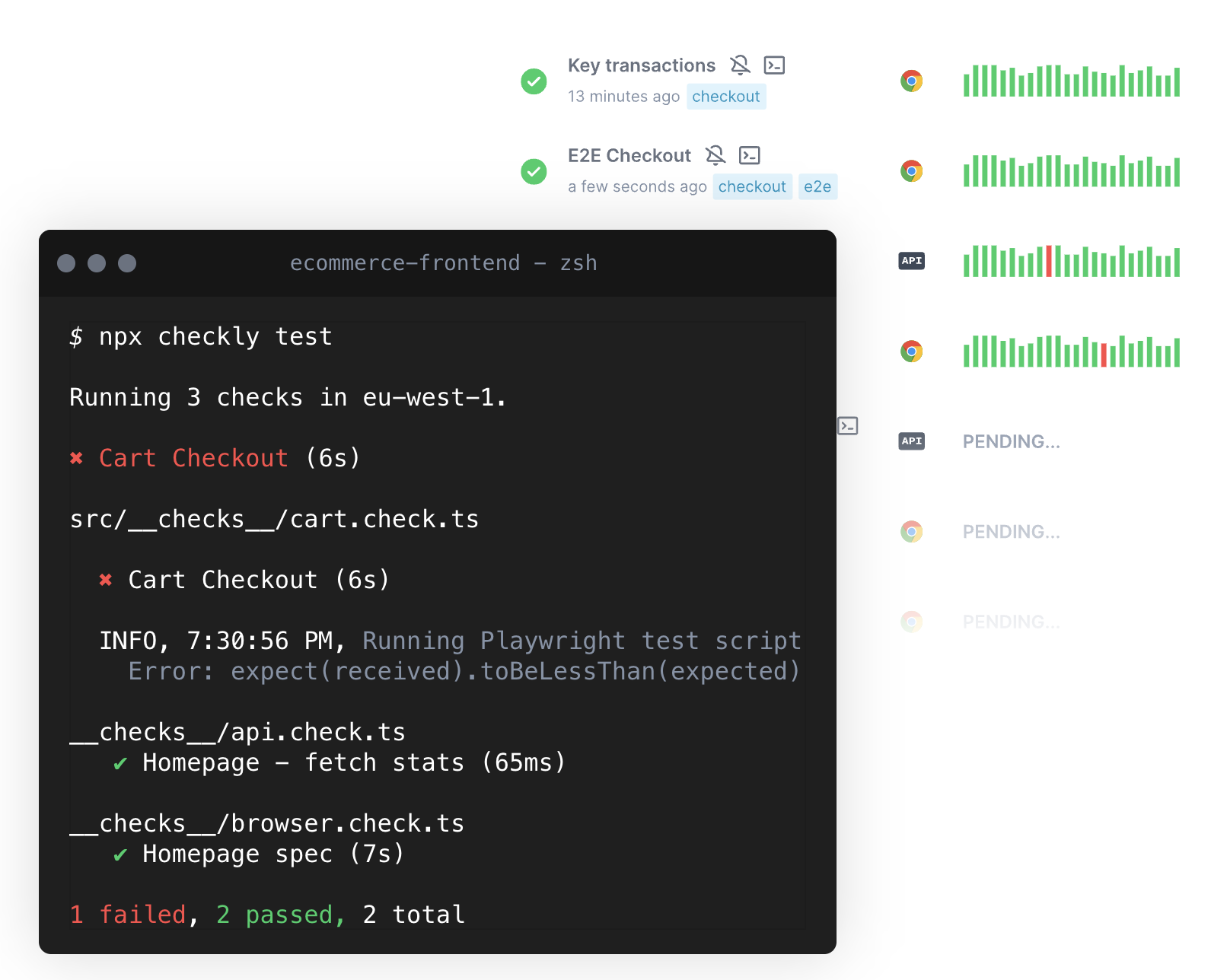
    Checkly this week added a monitoring-as-code (MaC) workflow capability to its software-as-a-service (SaaS) platform that is used to create synthetic tests for applications.

    The Checkly platform spins up browsers to test and can now monitor how applications are performing at both the user interface and application programming interface (API) level. That capability, currently available in beta, is enabled via a command line interface (CLI) for accessing an instance of TypeScript to invoke MaC workflows.

    Checkly CEO Hannes Lenke said that integrated approach enables application development teams to observe applications in as little as 60 seconds without instrumenting them with agent software.

    As part of that effort, Checkly also made generally available Playwright Test, a testing platform for web applications that spins up modern browsers on demand in addition to updating its public dashboards and adding an analytics API.

    Finally, the Checkly SaaS platform has passed a SOC 2 Type II security audit.

    Lenke said the overall goal is to make it simpler for developers to discover and remediate issues as they assume more responsibility for the ongoing management of applications.

    It’s not clear whether developers are taking over responsibility for testing and monitoring applications, but as more responsibility for applications shifts left, organizations are looking to give developers the tools they will require to succeed. That doesn’t mean IT operations teams won’t need to continue to monitor IT environments, but developers do need integrated tools that give them enough meaningful context to address them as they write code. Synthetic testing tools also enable developers to address many routine issues long before they might be discovered by a dedicated testing team that should be focused on ensuring the overall quality of the user experience.

    Regardless of the approach to testing and monitoring, Lenke noted that the silos that make up the software development life cycle are becoming more tightly integrated in modern application development environments. The primary objective is to make it possible for organizations to accelerate application development without compromising quality, he added.

    Of course, the more testing that occurs early in the application development process, the fewer issues a DevOps team should encounter after an application has been deployed in a production environment. The issue is that, historically, much of that testing occurs late in the application development process. Each time a project falls behind schedule, there is naturally a greater temptation to reduce the amount of time spent on testing to ensure the on-time delivery of an application. Providing developers with tools for testing and monitoring applications as they are being built should ensure that the proper level of testing is occurring before an application is deployed.

    There will, however, never be a perfect application. Over time, DevOps teams will discover that every application is impacted by drift to varying degrees as updates are made and the underlying infrastructure is upgraded. The most critical issue is reducing the number of potential issues overworked DevOps teams may need to address later on by ensuring the code being deployed is of the highest quality possible.

  • Tabnine Extends Generative AI Platform Reach to Testing

    Tabnine Extends Generative AI Platform Reach to Testing

    Tabnine today announced it extended its generative artificial intelligence (AI) platform that enables developers to write code faster to now include the ability to automatically generate tests for that code.

    Available in beta, this capability promises to make it easier for developers to test code at the time it is being developed. That approach should make it simpler for developers to address issues without losing any context.

    Brandon Jung, vice president of ecosystems and business development at Tabnine, said this latest addition to the Tabnine platform is part of a larger effort to extend the reach of the Tabnine generative AI platform across the entire software development life cycle. The testing capability is expected to be generally available in the third quarter, and Tabnine expects to also employ generative AI to automate a much wider range of tasks across the software development life cycle within the next 12 months.

    The Tabnine platform supports multiple programming languages including Python, Java and JavaScript and is designed to be integrated with integrated development environments (IDEs) such as Visual Studio Code and Jetbrains. The company has also previously integrated its code completion tool with the GitLab continuous integration/continuous delivery (CI/CD) platform. The overall goal is to make it easier for developers to automatically write code based on custom models using approved source code hosted in a secure private repository, said Jung.

    Generative AI creates a large language model that assesses the probability of what the next line of code will be based on what has preceded it. Tabnine is now extending the model it created to also generate tests for the code its platform helped a developer write. It’s not clear what impact this ability to automate test creation will have on the need for dedicated testing teams, but it is about to become considerably easier to shift more responsibility for testing further left toward developers.

    It’s not likely DevOps teams will be replaced as generative AI is extended across workflows, but the overall size of those teams might shrink, noted Jung. DevOps teams will soon be able to do far more with fewer people, he noted. At the same time, the barrier to DevOps adoption will also fall as AI platforms make it simpler for more organizations to embrace DevOps best practices, added Jung.

    The challenge will be making sure the data collected to train AI models is of a high enough quality to ensure the desired outcome, noted Jung.

    One way or another, it’s now only a matter of time before generative AI capabilities are applied more broadly. Platforms such as ChatGPT developed by OpenAI are only the tip of the iceberg that impacts almost every manual process, including software development and deployment. The issue will be determining at what rate those innovations will become practical to employ. In the meantime, it is already apparent generative AI platforms are having a significant impact on the rate at which code can be developed. Inevitably, that means the amount of code moving through DevOps pipelines at any one time is about to increase significantly.

  • Tricentis Extends Mobile Testing Reach

    Tricentis Extends Mobile Testing Reach

    Tricentis has added the ability to test native iOS and Android applications to its Testim software-as-a-service (SaaS) platform.

    Previously, the Testim platform was designed to test web applications, but is now being extended as organizations build and deploy more native mobile applications. Capabilities of the Testim Mobile platform include codeless authoring of mobile tests to eliminate the need to write and maintain Appium, Espresso or XCUITest scripts and the ability to set up, configure and manage mobile devices in minutes using the Tricentis Mobile Agent.

    Additionally, applications can be uploaded to the cloud to enable collaboration across testing teams as they opt to run tests on real or virtual devices. DevOps team can also customize tests with JavaScript, branch tests, and run tests from a scheduler or continuous integration (CI) build.

    Tricentis CTO Mav Turner said Tricentis is moving to implement a consistent set of mobile testing services across its entire portfolio of testing platforms now that mobile applications are equal, first-class citizens alongside web applications. The primary driver of that shift has been the COVID-19 pandemic, which saw more organizations relying on external-facing mobile applications to engage customers, partners and employees working remotely, he added.

    Testing those applications is more critical than ever because the cost of failure—in terms of impact to the business—is now much higher as more organizations depend on software to drive business processes, noted Turner.

    The goal is to make it simpler to test these applications as they are being developed to ensure quality, he added. The challenge is that many developers don’t have a software engineering mindset. Hence, they need to rely more on testing platforms infused with artificial intelligence to discover issues relating to, for example, scalability and security, said Turner.

    Most organizations are trying to shift more responsibility for testing toward developers as part of an effort to remediate issues earlier in the software development life cycle. It’s more challenging for developers to remediate issues after an application has been developed simply because they have lost context. Testing platforms infused with AI capabilities make it easier for developers to identify issues at the time they are writing code. In the future, Tricentis expects to take advantage of generative AI platforms to make it easier to author tests using a set of best practices that can be easily reused, noted Turner.

    That approach doesn’t necessarily eliminate the need for a dedicated quality assessment review, but it does allow testing teams to focus more of their time and effort on testing the application experience versus identifying lower-level errors that many developers routinely make.

    Over time, the quality of applications should steadily improve as many of the low-level mistakes that developers make are eliminated. That should improve everything from application security to the user experience as applications are continuously updated. In the meantime, organizations that embed testing within DevOps workflows are steadily reducing the number of issues that need to be addressed just before applications are supposed to be deployed.