Tag: continuous improvement

  • Testing What’s Important: Keep Growing Your Test Base

    Testing What’s Important: Keep Growing Your Test Base

    This project has gone on soooo long…

    In most human endeavors that take a stretch of time to complete, the idea is latched onto and people become excited about being involved. It doesn’t matter if it is building a skyscraper, inventorying a massive warehouse or even going to war. People are intrigued by the possibilities and want to get started doing the thing. After a time, though, this enthusiasm wanes, and most often is replaced by a weary determination to get the thing done. The nature of the endeavor doesn’t have to change; the reality of its implementation just becomes the dominant factor.

    IT projects in general—and continuous integration (CI) projects in particular—are no different. Whether a new project or implementing comprehensive CI on an existing project, the beginning is the most exciting part. Soon the excitement wanes and achieving the desired level of test coverage and a consistent build success rate becomes the goal that is trudged toward. It is a rare team that reaches for 100 percent code coverage with testing on initial implementation. The key becomes “testing what’s important.” And that varies by team and project.

    But testing at all levels—unit, integration, smoke, system, regression—could be better on almost every project. That improvement can be done incrementally while running through sprints. While some of the testing is managed by QA, some is managed by the developers—and in a CI/CD environment, arguably more is managed by developers. They are more involved in the testing process in CI/CD, so are more likely to be more involved in test development/management.

    The point is, good enough coverage is just that. And there is a hidden cost in getting too carried away with testing every line of code for every possible input, but improving tests is more than simply cranking out more permutations. Improving existing tests, or writing tests for functionality currently poorly tested, is increasing testing.

    So, as you strive to make your code get better, strive to make your testing get better, too. Testing after the baseline is established is one of the first things to get minimum attention, even in automated test environments. But improving it reduces the risk of releases, and that’s a benefit to the team and to the company. So it’s worth staying up on.

    Unless you have my friend, who we will only call Pete, on your staff. Then, no matter the quality of your testing, no matter the number of tools and layers of testing, he’ll find a way to break your product within 5 minutes. That made him a good tester, made him a better developer and, now, a better architect. But most of us don’t have Pete, so work on those tests.

    — Don Macvittie

  • Strategies to Build Trust in DevOps

    Strategies to Build Trust in DevOps

    I’ve been a member of the DevOps community a long time (literally since before it was ever even called “DevOps”). I was a pre-publication reviewer for both “The Phoenix Project” and the recently published “The DevOps Handbook,” and I’m always interested in seeing the outcomes successes software teams have and the failures they overcome, including trust.

    While DevOps has proven to be effective in organizations of all sizes—startups and enterprises alike—there are still many who have not yet begun their DevOps journey, so I thought I might share some of my own experiences while introducing DevOps into an enterprise IT group.

    When I was the VP of Operations at Big Fish Games, I had the responsibility for production operations at Big Fish’s three production data centers in Seattle, Virginia and Luxembourg. I also had responsibility for internal corporate IT and information security. Our production operations supported around a million game downloads per day. Games were localized into 11 different languages. We processed essentially every major currency, and right before I left Big Fish, we started taking Bitcoin as well. From an IT perspective, Big Fish Games was a global eCommerce company selling digital widgets on the internet. We had around 800 employees in our five offices in Seattle, Ireland, Oakland, Luxembourg and Vancouver, BC.

    My first attempt to introduce DevOps at Big Fish failed miserably due to cultural misunderstandings and a fundamental lack of trust between the development and operations teams.

    You absolutely need some minimum baseline level of trust in your organization if you are to have any chance at implementing DevOps. Trust is important because you are blurring traditional boundaries between development and operations responsibilities. Including development in production operations can be scary for operations teams. It just feels wrong from a historical ITIL-type perspective, and operations teams may know development as “the people who always break things.” At the same time, it can be scary for development to involve operations in the development process because they may know operations as “the team that always says ‘No.’”

    Building Trust

    Successfully merging the priorities and goals of development and operations teams to create one cohesive DevOps effort can fail due to cultural misunderstandings and, oftentimes, a fundamental lack of trust. I used three specific strategies to overcome these challenges.

    Lose the Term ‘DevOps’

    At Big Fish Games, application development teams equated DevOps with developers carrying pagers: an idea that they really did not like. They were highly resistant to this. Every time I brought up DevOps, they thought I was engaged in a secret plot to make the developers carry pagers. What I found interesting about this was that I had no intention of asking developers to carry pagers.

    The term “DevOps” covers a large range of continuous improvement techniques. Some organizations have developers carry pagers, and it works for them, but this is certainly not a prerequisite for DevOps. What was worse, I had no idea they were thinking this because they were afraid to bring it up for discussion. We failed in our first attempts to implement DevOps because the trust level between development and operations teams was so low that we couldn’t even tell each other what we were thinking.

    I realized two things from this experience:

    • Getting rid of a term that scared both development and operations teams would eliminate an unnecessary distraction preventing these teams from coming together to focus on common goals.
    • We needed to do something about the trust issues between development and operations before we could succeed with DevOps.

    Once I realized this, I immediately stopped using the word “DevOps.” Instead, I talked about continuous improvement and specific continuous improvement methodologies that we wanted to implement, and how these new adoptions would result in shared, organizational-wide growth.

    Focus on Methods That Benefit Other Teams

    When deciding which of these DevOps, a.k.a. “continuous improvement,” techniques we wanted to implement, I specifically chose ones that would benefit development teams as opposed to ones benefiting operations or other teams. The development teams noticed this over time. They could see I was doing this and that I (the person who ran operations) was going out of my way to help them. This helped build trust. This wasn’t a one-time thing. We did this consistently.

    Here’s another simple failure example: I noticed while managing release efforts that release schedules for the various development teams ranged from a couple weeks to a couple months—too long for a hyper-competitive industry like gaming. I asked the development teams if they would like our release engineering team to support daily code releases or even multiple code releases per day. I thought this was an innocuous question. In fact, I thought I was being a little clever by playing dumb here. I assumed I would get an enthusiastic high-five along with a, “Yes, we’d love that! How soon can you make that happen?!”

    I was surprised when I received a violent “No! We don’t want that!” This confused me for a while until I realized that the development team thought I was in cahoots with the product management team to put the squeeze on them. In my mind, I was offering to make their release process more lightweight so they could break up their work into smaller, more frequent releases with less stress for everyone, but I didn’t understand their fears and problems. I wasn’t looking at it from their perspective and here was the trust issue rearing up again. They misinterpreted my intentions as nefarious.

    I pictured them being able to release code whenever they want, which seemed like something they would like. In their minds, they pictured a product manager constantly randomizing them with demands for new features to be released right there while the product manager was leaning over their shoulder. This was not the kind of problem you could resolve with logic. The solutions and working procedures I was proposing were so far outside the development team’s experience that they couldn’t extrapolate through simple logic from their current state to the world I was describing.

    Maximize Daily Interactions Between Development and Operations Teams

    It’s easy to distrust someone you don’t know personally or you don’t have to see every day. It’s a lot more difficult to hate on someone you know and work with on a daily basis.

    One of the DevOps techniques that I implemented early on was embedding a dedicated operations liaison into each development team. This liaison acted as an advocate for that development team back into operations and they helped smaller development teams navigate their work through a large, complex, centralized operations organization. The operations liaison attended daily development team standups, group meetings and project meetings. This program was a huge success. Development teams saw how their operations liaison helped expedite their work through the operations organization and advocated for their development team’s interests inside operations.

    After the development teams got used to working with their operations liaison on a daily basis, we pushed a bit farther and got the development teams to agree to include operations in architectural discussions at the beginning of application design. At first, our development teams were skeptical that operations could provide useful input here, but the important thing is we had developed enough mutual trust that they were not fearful of including operations in the discussions. They were skeptical that we would add any value, but they weren’t afraid that we would cause them problems. This was a big win.

    Although it felt a little weird to our development teams to include operations in design discussions, they quickly saw how obtaining input from operations early on, before a product was built, resulted in better quality and fewer headaches for everyone when we launched into production. I also made sure that we put our most senior and diplomatic operations team members into this role.

    In conclusion, it is worth repeating that trust is a prerequisite for any organization to succeed with DevOps. This is due not only to problems arising from fuzzy definitions of what DevOps is and is not, but also the seemingly dangerous idea of blurring the boundaries between development and operations organizations. Whatever your definition of DevOps is, fostering an increased level of trust between development and operations teams as a prerequisite for your DevOps journey will ensure that even greater trust—and the positive business impact that comes with it—are your outcomes as well.

    Good luck!

    About the Author / Paul Farrall

    Paul Farrall is the VP of Operations for Skytap. He was most recently vice president of Operations at Big Fish Games where he led the rollout of global infrastructure for the Big Fish cloud gaming platform and implementation of the Big Fish DevOps program. Prior to Big Fish, Paul was the Director of Operations and Chief Information Security Officer at Intelius, a Bellevue e-commerce company. Previous companies also include AT&T Wireless in Bothell, Washington, and GetThere.com in Palo Alto, California (now Sabre). Connect with him on LinkedIn and Twitter.

     

  • What the Auto Industry Can Teach IT Development

    What the Auto Industry Can Teach IT Development

    The latest and greatest advances in technology often draw the spotlight, but the truly great changes in business aren’t driven by technology alone. They’re enabled by a change in culture that’s supported and accelerated by technology.

    Consider the assembly line in the auto industry. Automation, specialized tooling and robotics have provided a boost to quality and efficiency, but these advances only mattered because of a change in U.S. culture that emphasized speed, acceleration and economies of scale. Henry Ford capitalized on these cultural constructs to implement an innovative set of tools that revolutionized auto production. Toyota led the next evolution in auto manufacturing with its implementation of the Andon cord and Kaizen continuous improvement (CI) but similarly, these tools depend on a culture of trust and respect for the workers to be useful.

    In the field of software development, a similar shift is taking place through the DevOps movement that’s leading to faster, more efficient and higher quality application development. Technology has made DevOps easier to implement, but these new tools only add value when they are accompanied or even implemented via a change in culture across the entire organization and all technology areas. This includes items such as visualizing the delivery value stream to identify areas for improvement, increased trust and collaboration across silos and a CI mindset.

    A key aspect of DevOps is automation, and automation is only possible when patterns can be created, which requires eliminating any variances in practices and capabilities in all aspects of the organizations that don’t add value. For example, if every application is a snowflake in terms of its architecture and configuration, infrastructure automation won’t be possible. If release planning, management and deployment don’t have standard work associated with them, then again, an integrated delivery pipeline capability cannot be implemented.

    Nationwide’s Journey to DevOps

    At Nationwide, we began a change in how we developed applications almost a decade ago. At the time, the term was “agile.” We shifted application development to focus on smaller iterations of work with automated build and testing practices. While this proved valuable, we realized this was only part of the journey of accelerating our lead time from customer concept through delivery of business value.

    We started the journey to implement a Lean-based DevOps model that encompasses the entire development value stream, from the incoming business request to application deployment and monitoring. Our goal was to work more closely with the business units to continuously plan, design, develop, test and deploy incremental improvements in our application-based products.

    Nationwide has seen demonstrable benefits on this journey. Critical defects have declined by 80 percent, system availability is up 70 percent and on-time delivery of applications has risen to 90 percent from 60 percent. More importantly, we’re starting to see results in our business as we refine our ability to test business hypotheses and measure the results in terms of increased revenues.

    Infrastructure to Support the Cultural Shift

    Just as Ford’s auto assembly line utilized advanced technology to be successful (e.g. electricity enabled optimal placement of machines versus steam power), accelerated delivery is utilizing the development of new technologies. To advance DevOps, we use IBM Rational and UrbanCode software to manage and deploy applications. The new technology, though, has only worked because we have committed to both a technology and cultural change across our entire organization. We have more than 5,000 IT professionals on 200 different teams. Every team—whether it’s responsible for the mainframe, distributed, web or mobile— needs to utilize the same standard work approach to application development.

    Let me give you one example of how that works: Biweekly show-and-tells are a core part of our approach. For new mobile applications, the changes after two weeks might be dramatic, but even for the larger applications running on our IBM z Systems mainframes, the teams have something to share. They break the mainframe application work into smaller units and demonstrate updates they’ve made that fit into more long-term initiatives.

    The Autobahn for Application Development

    While applications and products are not all developed at the same speed (e.g. a change to a mobile app versus a regulated change to back-end banking system), there is a need for these systems to utilize similar approaches and a common delivery pipeline with visibility of dependent changes, to be implemented as quickly as possible.

    An example of this is a highway like the Autobahn accommodating different types of drivers and vehicles, such as a Porsche built for speed and a semi-truck built to carry cargo. The rules of the highway allow vehicles to drive at different speeds safely without having stoplights by providing exit and entrance ramps, speed limit minimums and visibility of other vehicles along with “standard rules of the road.”

    Likewise, we want our IT delivery capability to accommodate variable speeds of IT based on the business needs and the development teams’ abilities to go faster by implementing practices such as smaller batch sizes, APIs and microservices, feature flags and performing automated testing and readiness validation. While distributed and mobile applications might be the Porsches on the road, they can only go as fast as the mainframe and legacy applications, or semi-trucks and other traffic will allow.

    Consequences of Resisting Change

    No company will get through the next decade without being disrupted, either externally or internally via a continuous improvement and innovation mindset.  Those that embrace Lean and DevOps practices across the entire IT organization will have a steady stream of new services and improvements that outpaces the competition and transforms their business. Those who don’t will join former Fortune 500 companies that waited too long to realize that their competitor’s Porsches and semi-trucks were too far along to catch up with.

    About the Authors / Carmen DeArdo and Jason Patterson

    Carmen-DeArdo-sqCarmen DeArdo is the director of Build Technologies at Nationwide Insurance. He is responsible for helping drive accelerated delivery utilizing Lean and DevOps techniques across the end-to-end delivery value stream.  One current focus area is the creation of an integrated delivery pipeline capability.


    Jason PattersonJason Patterson is a Lean and Agile coach at Nationwide Insurance. He works with development and support teams across the company to help recognize process gaps and opportunities in their delivery stream. His background in development fuels that energy, while he resists the urge to automate every broken or unnecessary process. After nearly a decade at Nationwide and seven years experimenting with extreme programming, scrum and agile methods in a software development department at Indiana University, Jason is still learning.


  • Embedding Predictive Analytics

    Embedding Predictive Analytics

    For an enterprise with a deep DevOps maturity model, the initial “wow” factor of automation has worn off. At this point, the sexier concepts involve proving continuous improvement. As an example, our first baseline of metrics might have taken the pre-DevOps timings of a typical build and deployment of a given application. We can measure this time against our post-implementation of DevOps automation and show a significant savings in time. This is opportunity time, meaning an employee must be ready to turn around the decision cycle faster to take advantage of the time saved (not be playing solitaire, for example). But once DevOps automation is old hat, the difference between our initial post-DevOps typical build and deployment time and our current one still using DevOps may not be all that significant. But is there more hidden there than meets the eye?

    Establishing Context & Baselines

    At this point context may be a more meaningful measurement. As an example, if my first version of DevOps automation for a deployment contained 35 steps and my current one contains 160 steps it would stand to reason I am “doing more” now in my deployments than I used to do. These additional steps may involve executing more tests than I originally thought to do. They may be interacting with monitoring systems (turning them on and off as appropriate), which reduces “noise” in the alerts my monitoring teams have to respond to. In short, over time, my deployment processes may become “longer” because I am increasing the capabilities or the sophistication of what I do during these deployments. While from a pure timing perspective this may make them longer, it also makes them more powerful and, so, is worth measuring. To know the delta, however, I must have retained older versions of automation to compare against, not just throw away the old every time I update with new steps.

    So let us assume the context of my automation is now fairly stable. I do the same things, more or less, the same way every time I deploy my application. At this point, measuring the functionality of what I do becomes more meaningful. As an example, my deployment automation may complete four main functional tasks to complete, I deploy the code (the app), I deploy the dataset, I deploy the config files and, finally, I run a series of tests on the above. While I may not ever incorporate too many new kinds of things to do in this automation, understanding how long each function takes to complete is relevant to proving continuous improvement. For instance, if my code takes roughly the same amount of time each deployment, as does my config files, but all of the sudden my dataset begins to grow in each deployment (from normal usage), my overall deployments may be getting slower. This is not due to hardware inefficiency or network inefficiency; it is simply due to a larger dataset that keeps growing.

    If on the other hand, it is my test set that is getting progressively longer to execute, that is an indicator of test script inefficiency (given same code, same config and same dataset). If the number of tests being executed has not increased, but the length of time it takes to run them has, there likely is inefficiency in “how” the testing is being constructed or executed. Understanding the context for what is going on in a deployment or similar kinds of automation must occur before introducing predictive analytics can occur.

    Historical Trends Extended

    Predictively evaluating automation is nothing more than taking the data from a historical perspective and extending the trend lines into the immediate future. If for example, my deployment automation is getting four seconds longer each month for the last 12 months, I can reasonably infer the trend will continue, and I can predict the length of time it takes to execute a deployment in the coming months. Understanding “why” this occurs requires a contextual investigation, but predicting its occurrence does not. This may seem inconsequential as we talk about the length of deployment processes of a given app, particularly if my portfolio of apps is small. But if the trend holds true for a portfolio of thousands of applications, the impacts become more consequential. Or if the phenomenon is directly connected to a particular cloud provider and not seen elsewhere, again, the consequences become meaningful.

    Where having “ground-up” predictive analytics (build and/or deployment automation) becomes much more useful is in the construction of release events. Often, release managers are asked to supply an estimated time duration for a given event to factor into the construction of a new release. If a vendor were to integrate more predictive analytical tooling into the release orchestration (RO) toolsets, “random” or “best guess” timing estimates could be replaced by extending historical data into the timing estimation fields. The RO tooling could provide a default timing estimation based on examining historical trends for a period defined by the user. Estimation defaults could always be replaced by a user (assuming discreet knowledge of other impacting events), but at least the new overall lengths of releases then could become significantly more accurate.

    This has special significance for manual tasks. Let’s say our database admin team traditionally takes 40 minutes to perform a given release event update, but now is running significantly longer than that. Having the RO software aware of the historical trends could alert the release manager, as well as the database team manager, during the event to check out why this is occurring. For manual tasks in particular it may be hard for anyone besides a predictive analytics module to determine what timings “should” be, as compared with what they are in a given release.

    Impacts to the Bottom Line 

    The real questions are, Why should a customer care about this kind of feature set? Why should we be looking at the vendors of our tooling to incorporate forward-thinking architectures such as predictive analytics into the tooling they sell us? Because the efficiency it can bring to our DevOps set of services lowers the costs of administration and increases the speed at which we can deliver innovation in general. Over time, trending combined with context can statistically prove continuous improvement of our DevOps services, which is the promise we made to the executive teams that sponsored and made the investment in DevOps to begin with.

    Metrics analysis can occur (usually with a dedicated investment on our part) without a predictive view of the impacts. But this changes the perspective of our analysis to hindsight thinking instead of forward thinking. In essence, we then are simply “reacting” to what has occurred instead of tailoring our environment to alter the picture of future predicted events to be better than the software predicts it to be. We start tweaking the variables to instantly impact future predictions, instead of only examining them in a post mortem.

    This perspective is yet another cultural catalyst for change your business needs. When I talk about changing how an organization “thinks” about innovation, this is one of the key objectives. We take an enterprise from knowing little about the costs of innovation, to having an extensive knowledge, to having a forward view of what is—or what should be, possible. All of this is possible despite the loss of waterfall controls and in the midst of an agile construction model. All it takes is the integration of forward-thinking architectures into the products we select. If our vendor does not offer them, we begin to enlighten our vendors on the value they would bring to us in cost reduction and to them in market capture. If you need help in these areas, feel free to contact me, I am looking at the moment 🙂 .

    To continue the conversation, feel free to contact me.

  • Continuous Improvement: The Key DevOps Distinguisher

    Continuous Improvement: The Key DevOps Distinguisher

    DevOps has become a well-accepted and growing component for delivery success, shown in the State of DevOps Report among other respected publications. But even as it becomes more ubiquitous, it’s naive to think every organization will cease having delivery concerns. Implementations will differ widely, and adherence is essentially self-reported. So what is it, then, that separates those organizations that struggle with effective software delivery for years from those that consistently shoot further past their competitors?

    The fuzzier nature of the culture and relationships aspects of DevOps obstruct the potential for an ISO- or CMMI-style certification—which is likely a good thing, though it also opens the door for DevOps to be simply a re-branding exercise without any teeth. As a guideline, the CAMS model is still an excellent overview of key DevOps principles. It lays the groundwork for measurement, feedback and sharing that set the stage for improvement, yet stops before making continuous improvement a top-level concern.

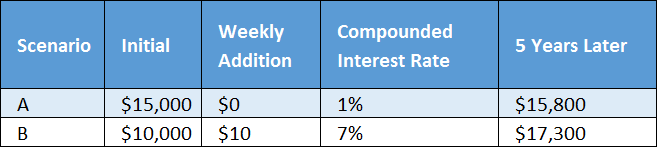
    The rate of continuous improvement is the metaphorical equivalent of compounding interest. It takes just a simple illustration to show how starting further behind, but focusing on continuous improvement, can take you past those that have more initial resources.

    Compounded Growth

    Prioritizing DevOps for Continuous Improvement

    DevOps with a focus on Kaizen or continuous improvement can catapult a company’s ability to effectively deliver software. Unfortunately, it falls squarely in the Important/Not Urgent quadrant in Stephen Covey’s model, where good ideas and good intentions are continuously frozen. An inability to keep momentum and traction in this state affects many companies.

    To reach our goal of continuous improvement in the DevOps implementation in a company, first we must examine how to successfully drive internal initiatives in general. As a default behavior, companies commonly relegate themselves to just making it through quarter to quarter, delivering mostly incremental customer features. More ambitious initiatives draw lots of excited talk in executive suites, yet often stall and get delayed in actual implementation. Why is that an all-too-common occurrence?

    There are three main hurdles:

    • Inconsistency of shared goals and priorities across all levels of the organization: There’s often a gap somewhere around either middle management or line management where initiatives can tend to slip. It doesn’t hurt to over-communicate and ensure it goes across all levels, especially when important changes are occurring.
    • Lack of individual accountability and empowerment: If communication is adequate, do individuals know not just the goals but also what they can and should be doing to reach them? This aspect is in principle tackled by official systems such as management by objectives (MBO) or objectives and key results (OKR). You can find success or failure in many systems, so rather than debating the merits of various people management systems, make sure to focus on the key goals and actions chosen.
    • Do people actually have the budget of time and potentially funding to take action? Without time for action, there is only a nebulous intention—and perhaps a slight feeling of guilt at not having made progress.

    Simply identifying the above obstacles and addressing their existence can be eye-opening and likely will cause common-sense measures to emerge to align the organization. After the initial quick wins, there certainly will be more difficult steps to follow that are specific to each organization. The end result is certainly worthwhile.

    Unblocking the organizational obstacles to DevOps implementation, not as a one-time project but an evolving program of continuous improvement, blazes the path for long-term success.

    As a further thought, imagine you also accelerate the rate of continuous improvement so it’s not a constant. An amazing example of the power of acceleration is the notion of a solar sail: Accelerating its velocity just 1 millimeter per second seems imperceptible, yet after one day, it’s moving 195 mph, and after 12 days, it’s up to 2,300 mph. “Astronomical” is an apt description of the delivery speed of some famous tech startups. That’s the power of continuous improvement!

  • 5 Things DevOps is Not

    5 Things DevOps is Not

    For those who have been embracing and championing DevOps for years, the growing popularity of DevOps is as exciting as landing your first job out of college! Okay, maybe not that exciting, but still really cool. More and more companies of all sizes are embracing DevOps by including the adoption of DevOps practices directly into their fundamental strategies.

    On one side, this is giving teams the leverage they have needed all along to either begin their DevOps journey or to increase the maturity of existing DevOps adoptions. On the other side, when DevOps becomes a mandate, some of that grassroots passion can become watered down, as the use of the word becomes increasingly overused or incorrectly used.

    DevOps incorporates a new collaborative culture that embraces numerous practices combined together for a continuous software development methodology that places significant emphasis on feedback loops, collaboration and continuous improvement. DevOps requires fundamental cultural changes and includes so many practices that can be overwhelming to those just starting their journey.

    Instead of highlighting everything that DevOps is, I thought it would be good to take a step back and highlight what DevOps is not instead.

    1. DevOps is not simply combining Development & Operations teams

    We’ve all seen this one when the term DevOps comes up. “Let’s combine the Development & Operations team and, voilà!, we now have DevOps.” DevOps combines a set of processes and practices to be adopted throughout the entire delivery pipeline and spans multiple stakeholders. A couple of the key practices within DevOps adoptions include continuous integration (CI) and continuous delivery (CD). Simply combining two teams and calling it DevOps cannot accomplish those practices.

    2. DevOps is not a separate team

    Setting up a separate DevOps team is another trap many organizations fall into when beginning their DevOps journey. In general, I’m not a fan of the DevOps team as I believe it leads to more silos in the end. I’ve also found the creation of these teams can lead to further confusion when the mission is not clearly defined.

    There are some cases where a temporary DevOps team may make sense to help enable the processes and potential tooling that may be needed for adoption, but the key is making it temporary—which is often better in theory than in practice. There are several great blogs out there discussing DevOps teams such as Matthew Skelton’s blog, “What Team Structure is Right for DevOps to Flourish?”

    3. DevOps is not a tool

    Let me be the first to say I actually love the growing number of tools that enable us to continue maturing our DevOps adoptions, but I’ve noticed the use of one or two tools starts to lead to the perception that DevOps is a tool. How many times have you heard?

    “We’re already doing DevOps. We have Chef.”

    “We do DevOps. We automatically deploy through Jenkins.”

    Keep in mind, I’m a big fan of both Chef and Jenkins, but I think the power of DevOps is drastically underutilized if you’re equating the utilization of a single automation tool to DevOps success. Adopting automation and tooling is, of course, a part of DevOps, but only when combined with end-to-end practices of increased collaboration with continuous integration/continuous delivery, amplified feedback loops and continuous improvement (to name a few)! DevOps is a journey and that journey may start with a tool, but the goal should be to first identify your DevOps strategy and then find a tool or tool chain that meets those goals.

    4. DevOps is not a one-size-fits-all strategy

    Because there are so many different business drivers and technologies to consider when setting up an overall DevOps adoption strategy as well as identifying your DevOps tool chain, it’s important to apply the same tenets of DevOps to your DevOps strategy. Embrace change, gather metrics, understand feedback, fail fast and correct your course quickly. As an example, if you initially identify a tool that no longer works for your technology or environment, abandon it and move on. Just because you used it on the last project doesn’t make it a silver-bullet fix for the next one. We need to first understand our current strategy and environment, then react accordingly.

    5. DevOps is not automation

    That one may have caught the eye of a few people, so I’ll clarify: DevOps is not solely automation. Automation is absolutely a huge part of DevOps; however, it is not the only part, and deploying some degree of automation is often used interchangeably with DevOps. I think understanding the key DevOps practices is a great precursor to ensuring DevOps is viewed as more than just automation. Understanding the core DevOps principles is key to understanding the true benefits of DevOps adoption.

    There are a lot of things that DevOps is and I think I share a widely spread passion for DevOps. There are also a few things that DevOps isn’t—or isn’t solely. If you’re just starting your DevOps journey or still maturing your existing model, making sure everyone on your team has some basic DevOps education and is aware of the DevOps strategy for your project is key. It will go a long way in helping everyone understand that DevOps is about a lot of things. It’s also not about a lot of things.

    The list above isn’t exhaustive and I’m sure you all have a few you’d like to see on the list. I’d love to hear you thoughts and suggestions at @Shelbee_SE.

    You also can download and browse through the DevOps for dummies e-book.

    About the author/Shelbee Smith-Eigenbrode

    Shelbee

    Shelbee Smith-Eigenbrode is a Senior Software Engineer/IT Architect at IBM Cloud Infrastructure Center of Competency. She has worked across varying roles spanning the software development life cycle. Her experience across functional roles as well as performing that work deeply inside traditional silos has contributed to her passion for embracing the DevOps culture and transforming the way teams are delivering technologies by adopting DevOps practices. She is a member of the IBM Academy of Technology committed to driving innovation and technical advancement.

  • All Systems Fail*

    All Systems Fail*

    Vince Lombardi once said, “It’s not whether you get knocked down, it’s whether you get up.”  But in today’s world of high velocity development and release practices, it’s also about how fast you can get up.

    Today, we are seeing more news about sites from major online retailers and service providers like HP, Target, PayPal and Neiman Marcus going down.  High site traffic, poor configurations, scalable architectures, and well planned recovery practices all come into play.

    But the best organizations have been failing repeatedly for some time now…on purpose.  Organizations like Amazon, Google and Netflix practice regularly for application, system and site outages.  In fact, Netflix has baked continuous failures into its operations through an internally developed Simian Army.  While it might seem unconventional at first, failing all the time allows them to succeed.

    Our CTO here at Sonatype, Josh Corman, often reminds us that “All Systems Fail*”.  For those that take this to heart and prepare for the inevitable, they can be better prepared to recover.  In fact, for the best prepared, recovery can be so seamless, it is a continuous part of their operations.