Tag: continuous delivery

  • Detours Ahead: Overcoming DevOps Challenges

    Detours Ahead: Overcoming DevOps Challenges

    Saying that you’re interested in DevOps is another way of saying you’re interested in change. That’s what DevOps promises any organization. No matter the problems a company is trying to solve or the goals it’s trying to reach, DevOps depends on a willingness to embrace some big changes. Sure, it can help you streamline software deployments, but it requires shaking up a company’s usual processes and routines. As we all know, change can be complicated, so before your organization transitions to an agile culture, it’s best to prepare for the likely challenges ahead.

    Breaking Old Habits for Continuous Delivery

    Many of the procedures we follow at work each day are second nature, and what’s familiar carries a certain comfort with it. Even when we realize a more efficient process is within reach, old habits are tough to break. For an organization that employs hundreds, any change can be a challenge.

    And DevOps offers no shortage of challenges. It entails overhauling a company’s deployment process, its communication patterns, its department structures and even the roles of individuals on a team. Yet unless an organization is willing to let go of its old habits, the benefits of continuous delivery won’t ever be achieved. When acclimating people to this new procedure, it’s important to convey that the old procedure – one team throwing code over the wall to another one – will be left behind for actual collaboration in which Development, Operations and possibly other departments work together, not just in silos.

    Getting Past the Resistance to Change

    Encountering some reluctance to change will be natural, and a smooth transition depends on making everyone aware of why DevOps will be a big step forward. This includes communicating what the advantages will be for individuals, departments and the company as a whole. With an agile plan in place, greater efficiencies will become the norm, and a team will have the ability to spot and fix problems more quickly, so 3 a.m. phone calls to the system admin won’t happen anymore. Once managers through C-level folks are aware of these potential advantages, resistance will gradually turn into acceptance and enthusiasm.

    Combating the Myths and Rumors

    Many think DevOps is only for the well-known unicorn companies, such as Etsy and Facebook, or that it’s an exact science that will produce the same results for everyone. Some even believe the rumor that DevOps only works with certain operating systems. The truth is that continuous development can take place anywhere as long as the company culture is right. As detailed in the Rackspace-sponsored e-book, The DevOps Mindset: Real-World Insights from Tech Leaders, many DevOps practitioners went through their own uphill climbs to become more agile, and they have the firsthand experience to resolve many popular misconceptions.

    “You don’t have to be in Silicon Valley to embrace the DevOps culture,” says James Kenigsberg of 2U. “In fact, many new firms these days have a bad habit of building shiny technology because it is shiny, which goes against the DevOps principles of communication and transparency.”

    Jeff Hackert of Chef dispels the myth that DevOps is a one-size-fits-all solution. “It is not a set of proscriptions or a recipe that will give you a defined best practices outcome,” he explains. “Your best practice is the collective wisdom of the very smart people you’ve hired to solve your problems. And if what you have is a siloed or broken environment, you want to increase the communication, not impose new rules.”

    Getting Automated Without a Struggle

    When an organization is considering DevOps, they may find that the opportunities for efficiency not only involve employee collaboration, but technology as well. Most IT departments would jump at any chance to save time when it comes to coding procedures, and automation is a means of making this happen. By offloading these processes to an automated system, people can tackle other tasks, and businesses that release several deployments a day can greatly simplify their rollouts. For those who might not be familiar with the ins and outs of automation, receiving some guidance from a trusted IT provider can be a good first step. Finding an advisor to guide your initial automation efforts can prevent the expense of hiring a DevOps engineer with automation knowledge.

    Finding a Path Around DevOps Obstacles

    Every company’s DevOps strategy will be unique, and every company’s plan for overcoming challenges will be just as unique. Whatever the circumstances, communication will be crucial to any adoption, as it ensures that everyone understands why such a change is necessary. Getting acquainted with the success stories out there will dispel any myths circulating among team members, and stumbling blocks can be avoided by the understanding that familiar silos will be replaced by more efficient collaborations.

    Despite its challenges, DevOps can be the catalyst for a variety of improvements, from productivity to employee morale. Those who are the most successful at being agile will not only have the right culture in place, but be able to negotiate the challenges that DevOps has in store for those ready to embrace change.

  • Transforming applications with Cloud and DevOps – one hybrid solution for multiple challenges

    Transforming applications with Cloud and DevOps – one hybrid solution for multiple challenges

    Are you on cloud yet or clouded? The answer lies in how you have adopted the transformation. Today, the world is Hybrid. For large enterprises and organizations, it always has been. Almost no enterprise is monolithic when it comes to their environments. They may already have different distributed environments and/or mainframes in their ecosystem. The advent of cloud has only added to this complexity and hybrid nature of the environments. Enterprises which have replaced their datacenter with cloud adoption, in some cases are unable to do so completely or even adopt a singular cloud solution as that remains the domain of born-on-the-web companies that started on the cloud (think Netflix) or started on physical servers and migrated very early to the cloud (think WhatsApp). You cannot think of a big bank or even a telecom giant that is a Cloud Service Provider (CSP) that fits this bill.

    For the typical Enterprise (IBM included), the cloud has replaced and consolidated large sprawls of physical servers. However, physical environments remain, and may never go away and cost of migration plays a very important part in this retention. There may be large data-heavy applications that are hosted on distributed environments that may be just too expensive to re-host on the cloud. Then there are mainframe-hosted applications that cannot be migrated to the Cloud. Or the migration to cloud may be a massive multi-year transformation that you are only starting on and will have to live with workloads spread between the cloud and the physical world for an extended period of time.

    What’s interesting is that, even the cloud itself will be ‘Hybrid’ in nature. There may be combination of on-premises and off-premises clouds adopted, with off-premise’s ‘cheaper’ cloud used for less critical workloads like Dev-Test environments, and on-premise’s cloud for business-critical workloads. There may also be the presence of a Platform-as-a-Service (PaaS) being used for developing innovative Systems of Engagement applications or for experimentation, which co-exists with an Infrastructure-as-a-Service (IaaS) Cloud for Systems of Record applications and other traditional workloads.

    That is the complex world we live in.

    DevOps and Hybrid Cloud

    Cloud is the transformation enterprises are looking for whereas DevOps practices help achieve the transformation with speed and quality. When we talk about DevOps in the Hybrid Cloud environments, there are two main scenarios that can be adopted.

    1. Cloud hosted application delivery pipeline: When adopting DevOps one adopts a set of tools that create what is an Application Delivery pipeline. This includes tools such as an Integrated Development Environment (IDE), a Source Code Management (SCM) System, a Build tool, an asset repository, Test tools, an Automated Application Deployment tool, Environment provisioning tools and application monitoring tools, etc. All these tools can be hosted in the cloud and made available as a service. If you are using a PaaS such as IBM Bluemix as your application delivery platform, it includes these DevOps services.
    2. Cloud Hosted Environments: As applications are developed and delivered to production, they pass through multiple environments. These include development environments, multiple test environments, System Integration Test (SIT), User Acceptance Test (UAT), Performance Test, and potentially other pre-production environments (names and type vary from organization to organization), and of course Production. These environments may be spread over cloud and physical infrastructure, or even multiple cloud environments.

    IBM has hosted offerings for the DevOps delivery pipeline that cover the first scenario, including its Collaborative Lifecycle Management as a Service (CLMaaS) and cloud hosted Rational Software Delivery Platform (SDP) tools available through IBMs business partner CloudOne. As mentioned before IBM Bluemix PaaS includes in it DevOps Services to deliver these capabilities in the PaaS.

    For the purpose of this post, we will examine the second scenario in detail.

    Application Delivery for Hybrid Cloud Environments:

    Let’s examine a customer scenario I worked on recently. This customer, a large bank, was looking to host all their application delivery and production environments to the cloud. For cost management, they had decided to host their highly dynamic Development and Test (Dev-Test) environments on an off-premise’s ‘public’ or ‘virtual-private’ cloud, and host their Production environments on-premise on a private self-managed cloud. At the same time, their core business systems, in this case their core banking systems, all remained hosted on a Mainframe z/OS system. They are exposing their core Banking Applications to other applications that consume their services as REST APIs via an IBM DataPower gateway.

    Enterprise_updated

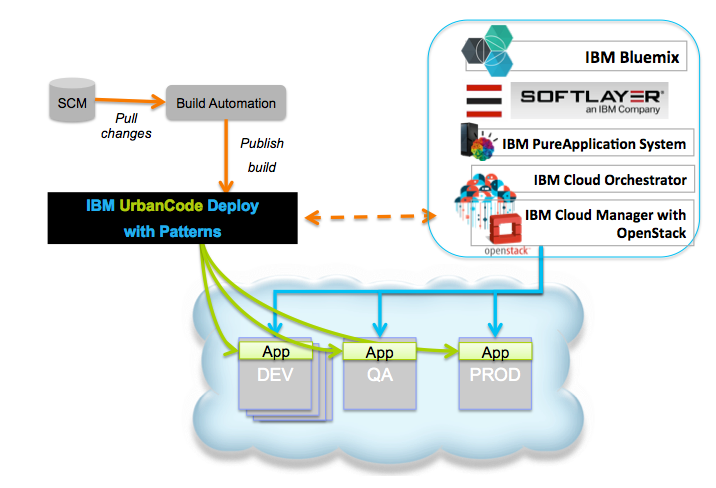
    The goal of this organization is to be able to deploy complete business capabilities which comprises of services and middleware components deployed to the Production Cloud, and the back-end Mainframe. The primary challenge was to use a Deployment Automation tool that can deploy components and manage application configurations across all these multiple environments.

    The second challenge was the need to deploy applications under development as they progressed through different environments in the delivery pipeline. These environments were hosted in a public cloud. As the production environments are hosted in a private cloud, there was a need to use ‘pattern’ technology that would allow for the provisioning of ‘production-like’ environments through the lower pre-production environments. These ‘patterns’ would allow for the production environments and the pre-production environments that match, albeit with different configurations and scale, to be managed and versioned as code. These patterns would evolve as the applications and the environments they were deployed on evolved through the development iterations.

    Architecture for Application Delivery for Hybrid Cloud

    Our discussion so far now leads us to designing architectures for application delivery for Hybrid Cloud which requires a deployment automation tool that supports multiple technologies comprising the hybrid cloud environment. As discussed before, multiple technologies ranging from off-premise, on-premise clouds to physical infrastructure may be included in these hybrid environments. IBM UrbanCode Deploy with Patterns provides such support.

    IBM UrbanCode Deploy with Patterns supports two cloud pattern technologies:

    1. IBM Virtual System Patterns
    2. OpenStack HEAT/HOT templates

    This allows IBM Urbanenterprise2Code Deploy with Patterns to support both provisioning of cloud environments using these patterns, and the deployment of applications to these environments, whether to an on-premise or off-premise cloud. In addition, it supports application deployment to static environments on physical infrastructure – distributed and mainframe. The Cloud technologies supported by UrbanCode Deploy with Patterns include OpenStack Private Cloud, Softlayer, Amazon Web Services and VMWare vCenter. In addition, IBM UrbanCode Deploy with Patterns also supports deploying buildpacks to IBM Bluemix PaaS.

    It is apparent from the example above that hybrid cloud is changing the face of enterprises and organizations today. With the speed the market is changing today, one cannot depend on waiting for transformation. IBM can help enterprises with their Cloud and DevOps journey leveraging our unique cloud and DevOps expertise. On November 20, you can know more about Hybrid cloud strategies and interact with some of the industry experts like Rosalind Radcliffe (Distinguished Engineer, Chief Architect for CLM and DevOps, Member of the Academy of Technology at IBM), Richard Irving (Certified Client Technical Professional at IBM) and Wayne Monk (Vice President, Business Development and Alliances at Skytap) at the IBM DevOps Symposium in the New York area (Jersey City). We are streaming the first hour as a series of lightning talks given by few distinguished industry leaders – so join us live or on the web. 

  • IBM DevOps Webcast Nov 20 – Transforming Application Delivery for Continuous Innovation

    IBM DevOps Webcast Nov 20 – Transforming Application Delivery for Continuous Innovation

    What if you could deliver applications faster without compromising quality or accepting higher risk? Fast-moving adopters of technology are transforming software delivery to disrupt entire industries with rapid-fire, digital innovations that leverage cloud, mobile, big data and social.

    How do you deliver 10-times faster business innovation instead of 10 percent incremental improvement? New and established companies are using DevOps to transform their software delivery process and are achieving dramatic improvements in overall speed, quality and business satisfaction.

    Join executives from GE Capital, Forrester Research, IBM and others for a series of lightning talks with real experiences and best practices. Learn how you can adopt DevOps practices that deliver early wins and transform your application delivery process.

    Date: Thursday, November 20th, 2014

    Time:  8:30 – 9.30 AM Eastern Standard Time

    Registration link: http://bit.ly/14z82GS


    Speakers

    Snehal Antani – CIO & Chief Architect, GE Capital Americas
    Kurt Bittner – Principal Analyst, Forrester Research
    Kristof Kloeckner – General Manager, IBM Software Group
    Steve Kagan – VP, IBM Global Business Services
    Dibbe Edwards – VP Development, IBM Software Group


    In the New York Metro Area?

    Join us in-person for a free, full-day event.

    Click here to sign-up: http://ibm.co/1ljyjQQ

    Download the event flyer here:  ibm.biz/jerseycityflyer


  • Nationwide banks on DevOps to drive towards Continuous Delivery

    Nationwide banks on DevOps to drive towards Continuous Delivery

    The Financial Services industry is fast moving, highly regulated and customer-centric. The general perception in our industry is that any change in processes implies risk and delay, neither of which we can afford. But at the same time, we are faced by the mammoth task of needing to continually introduce new products and services to stay competitive and cater to the growing needs of our customers. This is unthinkable without a fast software delivery lifecycle, as our business is highly dependent on technology. The best way to accelerate software delivery in a complex, fast moving environment like ours is to adopt a DevOps approach.

    As a speaker at a number of events, I have discussed the ongoing transformational journey at Nationwide and shared our approach with other enterprises who want to understand how they can follow suit. I recently had the opportunity to co-present with Hayden Lindsey from IBM at the DevOps Enterprise Summit (Oct 21 – 23) hosted by Gene Kim. You can watch a replay of our joint session Patterns for Enterprise Success: The DevOps Journey at Nationwide below.

    From humble beginnings as a small auto insurer serving the farming community, Nationwide has grown into one of the world’s largest insurance and financial services companies. Like many businesses today, we saw that we needed a better way to respond to changing market requirements and regulations, to increase speed to market, and to support new channels for customer interaction. Mobile, cloud and big data technologies were further raising the pressure on us to facilitate rapid digital innovation. What we required was not just a solution, but a change in culture (the way we look at things), processes (the way we do things) and tools (the technology we use). DevOps gives us the capability to achieve all of this—and more.

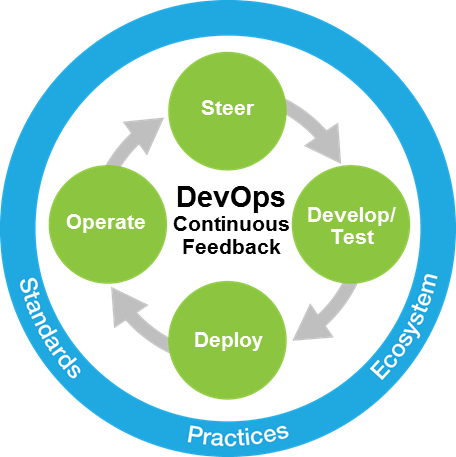
    The immediate challenge was to achieve these changes by leveraging our existing heterogeneous tool suite. We partnered with IBM DevOps, which has played a significant role in our success. We were already working towards agile transformation. With IBM’s support, we were able to use the DevOps approach to application development and delivery across our distributed and mainframe environments. While a DevOps approach as supported by IBM enables organizations to start anywhere based on their specific needs, we at Nationwide decided to address all four adoption paths across the software delivery lifecycle: Steer, Develop/Test, Deploy and Operate.

    devopspic

    DevOps enabled our IT department to perform continuous integration of its code and continuous deployment into its development environment several times a day. Teams can also perform acceptance testing of customer requirements within the same iteration as development. IT managers can show their internal customers, in near-real time, what developers are producing. This capability became a game-changer as we became more agile as a business and more responsive to customers. We achieved a 50% improvement in code quality, a 70% reduction in system downtime and were able to move 58% of our teams into the top quartile in key productivity measures. I believe that, the more agile we can be from an IT perspective, the more agile the business can be in terms of going from the development of an idea to the deployment of a customer-facing product.?

    The next step in our DevOps journey is to build on the gains generated by the adoption of Agile and Lean practices across the entire SDLC. This is where technologies such as TaskTop and UrbanCode come to the fore by providing the integrated continuous flow and visibility needed for a continuous delivery infrastructure. By creating this delivery highway, we are giving Business Areas the ability to deliver as fast as they need to based on their own determination of cost, risk and value. Time-consuming manual processes based on out-of-date information are replaced with automated deployment policies that use real-time information synched from systems of record. The combination of dashboard and dials gives the business the visibility and control to drive at a much faster pace than is currently possible. Lack of trust in development outcomes has historically been an impediment to speed. Our new automated approach is giving us the confidence to move faster to serve the business without compromising the quality of our deliveries.

    IBM was a great partner for us here as they share our support of the open standards approach, which gives us the ability to work with a heterogeneous set of tools, across the full lifecycle, allowing us to determine holistically the best tools, the best architecture and the best approach to meet our goals of high quality, high productivity and faster delivery for our customers.

    By balancing speed, cost, quality and risk, DevOps is helping us increase our capacity to innovate. That in turn helps us get to market faster and be more competitive. I mentioned during DevOps Enterprise Summit that the phrase “time is the new currency” resonated with our goals of optimizing the path from “concept to customer value”. We need to ensure we don’t let it slip through our fingers. We have long been dependent on manual processes, but in this new digital age they are only going to slow us down. This is the time to be agile, competitive and pragmatic. It’s time for all of us to break the age-old shackles and embrace the opportunity for change that DevOps represents.


    About the Author

    Carmen DeArdo is the Director of Application Development Tools and Technologies at Nationwide Insurance. Carmen is responsible for driving continuous delivery utilizing DevOps, Lean and Agile techniques across Mobile, Distributed and Mainframe and other technologies. This includes recommendations and implementation of technologies used across the development life cycle (e.g. IBM Rational tool suite, open source technologies).

  • IBM Webcast Nov 18 : Rapid and Continuous Delivery to Hybrid Clouds

    IBM Webcast Nov 18 : Rapid and Continuous Delivery to Hybrid Clouds

    Organizations need to innovate at speed. As software has become increasingly critical to business outcomes, delivering high quality changes quickly has become a competitive necessity. With rapidly changing applications has come a dynamic, programmable infrastructure that can meet changing business needs in the blink of an eye. In a word: Cloud.

    But how do development teams take advantage of cloud resources? How do organizations coordinate application changes across clouds? Where do platform as a service tools like Bluemix from IBM fit in? Can we move quickly without losing control or quality?

    Join Eric Minick, IBM DevOps Evangelist (and UrbanCode guy), as he examines best practices, and approaches for tying together cloud infrastructure, platform as a service and deployment automation to boost the responsiveness of IT as a whole.


    Date: Thursday, November 18th, 2014

    Time: 1:00pm – 2:00pm eastern standard time

    Registration link: https://ibm.biz/BdEqve


    About the Speaker:

    Eric joined IBM through its acquisition UrbanCode.  He has spent the last ten years helping organizations – large and small – adopt continuous integration, delivery and now –DevOps. He is a frequent speaker on the topic, and co-authored Application Release and Deployment For Dummies. Prior to consulting, Eric was a developer, test automation engineer and support engineer, and has contributed to multiple generations of UrbanCode products.

  • CI and CD Across the Enterprise with Jenkins – CloudBees

    CI and CD Across the Enterprise with Jenkins – CloudBees

    We are happy to announce the next devopsy.kinsta.cloud Webinar, in partnership with CloudBees :

    CI and CD Across the Enterprise with Jenkins

    Delivering value to the business faster thanks to Continuous Delivery and DevOps is the new mantra of IT organizations.  In this webinar, CloudBees will discuss how Jenkins, the most popular open source Continuous Integration tool, allows DevOps teams to implement Continuous Delivery.

    You will learn how to:

    • Orchestrate Continuous Delivery pipelines with the new workflow feature,
    • Scale Jenkins horizontally in your organization using Jenkins Operations Center by CloudBees,
    • Implement end to end traceability with Jenkins and Puppet and Chef.


    Date: November 19th

    Time: 1:00pm eastern, 10:00am pacific

    REGISTRATION LINK: (Limited registration, so don't wait!) 

    About the Speaker:

    Cyrille Le Clerc  is Director of Product Management at CloudBees with more than 15 years experience in Java.  Prior to CloudBees, Cyrille was Chief Technology Officer at Xebia.  As an early adopter of  the “you build it you run it” model, he put it in place for a number of high volume web sites.  He naturally embraced DevOps culture.  He is also very active in the Java community, creator of the open source project “embedded jmxtrans” and a speaker at various conferences.


    cloudbeesjenkinslogo72

  • Electric Cloud’s ship.io tackles mobile continuous delivery

    Electric Cloud’s ship.io tackles mobile continuous delivery

    As increasingly more organizations run into unique challenges around extending the continuous delivery development model to mobile applications, vendors are coming out of the woodwork to start helping organizations revamp their mobile build and test infrastructures accordingly. This week, Electric Cloud tossed its hat into the ring with the beta release of ship.io, a new SaaS service that it’s launching to help users build, test and deploy native iOS and Android apps.

    In spite of the fast-paced demands of the mobile marketplace, according to studies from Forrester, 64 percent of organizations release mobile apps four or fewer times per year per device. Many organizations struggle with the fragmented nature of the mobile device and operating system landscape, which can make testing a nightmare.

    “Testing typically needs to cover hundreds of different devices operating across multiple mobile platforms, including mobile devices that are no longer being sold or even supported but that are stil used in the marketplace,” writes Mark Buenen, an expert in managed testing services for consulting firm Capgemini.

    As a result, mobile testing lags significantly, with stats out from Capgemini stating that only approximately 55 percent of organizations test their mobile apps.
    At the same time, commercial app store demands for testing prior to release raises the stakes even higher for testing, as a buggy release could take days to fix due to the time it takes for app store approval. In just those few short days, negative reviews about the bugs could scuttle the app’s future success. And within the enterprise, mobile apps are gaining importance as mobile applications gain a higher profile within core business processes.

    “Mobile app development is increasingly important to a growing range of organizations, and it represents a challenge due to the range of operating systems and devices that each application must support,” said Steve Brodie, CEO for Electric Cloud.

    Ship.io automatically detects and configures iOS and Android dev projects to simplify the process of creating code across multiple operating systems, versions and device screen densities. Made possible by the acquisition of intellectual property from AngelPad-backed Cisimple, an early start-up in the mobile continuous delivery space, the service is powered by integrations with GitHub, BitBucket and other Git repositories. Similarly, ship.io centralizes the automation of testing and distribution through integrations with AppThwack, HockeyApp and TestFlight. These capabilities are all condensed into a centralized management platform meant to offer a dashboard into build and test status levels across all apps and development platforms.

    The ship.io release is a logical extension of services for Electric Cloud, which already focusing on automating processes for continuous delivery within the enterprise. Last week the company released a new version of its ElectricFlow Deploy product, which now, among other features, automatically detects the differences between what’s about to be deployed and what is already in an environment so that only the changed code is deployed in order to reduce risk and deployment time.

    While products like ship.io could stand to make DevOps teams more effective in bringing continuous delivery to their development and deployment of mobile applications, process will still play a huge role. According to Capgemini, in its annual World Quality Report focusing on testing trends, its study showed there was a marked shift in worry about mobile testing challenges from previously lacking tools to do a good job to now lacking appropriate testing processes and methods, which 56 percent of organizations stated as a stumbling block. Similarly, lack of mobile testing expertise was named by 48 percent of organizations as one of the biggest challenges.

  • Three essential elements to maximize business value with DevOps

    Three essential elements to maximize business value with DevOps

    DevOps is fast becoming the winning strategy needed to accelerate the continuous delivery of exceptional software without sacrificing quality and cost efficiency. With its focus on better communication, collaboration and feedback within and across development and IT operations, DevOps is gaining many fans – even in the business, where performance is seen as being directly attributable to its adoption.

    I’d be the first to agree that buzz plus a liberal dash of hype follows any new tech trend. We’re seeing this big time with DevOps. Already it’s one of the most Googled tech trends.

    Many vendors are washing and making ready their ‘DevOps products,’ while the #DevOps noise is shall we say, trending – we just love disruptive technology.  If you have read the Puppet Labs 2014 State Of DevOps survey, organizationswith high performing DevOps teams were 2.5x more likely to exceed profitability, market share and productivity goals, and had 50 percent higher market capitalization growth over three years.

    Don’t get me wrong I’m a disruptive tech fan too, but there’s a caveat – technology disruption is nothing unless it’s truly transformative– and that’s where I place DevOps.  It’s not a technical nicety, but actually a business imperative for companies to thrive in an increasingly software-driven world.

    Software applications are rewriting business. They’re no longer in the background ‘counting the beans’ and running the supply chains – they’re front and center – the mobile systems-of-engagement that shape your brand, delight your customers and, here’s really the cool part – disrupt markets.

    Sounds great you might say, but there’s a problem– the traditional fixed speed limit on the super highway of business computing.

    Enterprises have been stuck in the same gear for years maintaining large, complex/interconnected legacy systems. Mainly transactional and supporting complex business processes, the norm has been to change when only necessary (or forced to change?) – never exceeding the speed limit. Now however, consumerization of IT has dictated rapid delivery of software innovations. This requires a DevOps approach, where teams have a shared responsibility for not just keeping the lights on, but powering business.

    Being able to increase pace is important, so too nimbleness. By making IT infrastructure more flexible and the instrument used to digitally engage and interact with customers, cloud drives business agility. But it’ll never realize its full potential if IT continues operating in silos using manual processes. This is why DevOps collaboration, shared processes and tools are so critical for harnessing the cloud – or using and an analogy – if cloud is the supercharged engine of business – DevOps is the fuel that powers it.

    So with mobility and cloud computing being essential to a software-driven business, what additives do we need in our ‘DevOps fuel’ to spark agility and generate the greatest returns?

    There are three big ones:

    Agile Parallel Development

    DevOps must reduce all elements of waste. This is a tough nugget to crack because existing IT environments generate tremendous inefficiencies. Often separate dev teams have to contend for physically constrained resources, with quality compromised by poor test data, shortcuts and bottlenecks. Testing especially is seen as IT’s “angry monkey”; something to be loathed, when in fact it should be a unified process that bakes excellence (functional and non-functional) into  everything – from mobile apps and API’s to back-end systems – from dev day 1 and persisting right through to production.

    With Agile Parallel Development and shifting testing earlier in the lifecycle, teams avoid delays in the development of high-quality code. Toolsets are important here, especially service virtualization, which by removing testing constraints reduces cycle-times plus prevents bugs finding their way into production.  And, since business will increasingly engage customers across digitized multi-channels (mobile, API’s), teams will exploit real-time intelligence to test new ideas and experiments – pinpointing how functionality and performance converts to business gain.

    Continuous Delivery

    Release delays are a classic business fail.  Now, success depends on delivering a continuous flow of value from new mobile apps, APIs and software innovations. These types of services will be constantly enriched to capture new markets and customers yes, but they’ll also be operating within shorter windows of business opportunity – faster lead times mean everything.

    For IT, this ‘quick or dead’ imperative means teams must challenge a culture based on avoiding change and fear-of failure by using Continuous Delivery  processes and tools to accelerate and streamline complex, multi-tier releases; automating the testing, deployment and promotion of changes across all environments. Additionally, these processes should integrate other management requirements – for example, establish service-level monitoring and reporting with the application when released.

    Agile Operations

    Agility must extend to operations. For too long we’ve been asking questions like – “how long can we go between failures?” or “who’s to blame for this problem service?,”  but we should be asking – “If we want to increase customer conversion rates from our mobile app, what levels of performance are needed?” or “how can we detect and remediate performance problems before code reaches production?”

    This shift requires Agile Operations – shared processes and tools that optimally manage applications, but also feedback intelligence to the extended team. For example, Application Performance Management should pinpoint operational problems faster, but also ‘gift’ development rich insights they can use to improve code quality. Furthermore, teams will leverage advanced analytics (like how, where and when mobile apps are being used) to drive just-in-time enhancements –that’s a new take on end-to-end– customer ‘engagement-to-experience.’

    Business demand for software innovations is insatiable, and for good reason. Now the simplest mobile app experience or secure API can transform your business or screw it up completely.

    By establishing a rampant innovation culture with DevOps and the right processes and tools, IT will not just meet expectations – it’ll be the spark for growth and innovation.

    About the Author

    ravichandran arunaAruna Ravichandran is vice president of DevOps Solution Marketing and Management at CA Technologies, responsible for cross-portfolio solution marketing for DevOps across all product lines. Before joining CA Technologies, Aruna held several management positions in product marketing and engineering at Juniper Networks and HP. Aruna earned an MBA and master’s degree in Computer Engineering from Santa Clara University and holds a bachelor of science degree in computer science from Bangalore Institute of Technology. Ravichandran is  on twitter @aruna13 and on Linked in


  • Removing the Wall Between Dev and Ops

    Removing the Wall Between Dev and Ops

    Welcome to the new devopsy.kinsta.cloud Q&A series on Enterprise DevOps. In the first post in this series, I answered five key concerns for adopting a DevOps approach in a large enterprise. Now, I want to address a more specific question from an admin at a large enterprise about the silos and barriers between dev and ops …

    Q. How do you work with customers to remove the imaginary wall between dev and ops to create that DevOps environment?

    This is perhaps the core of a DevOps transformation – dev and ops teams working closely together toward common goals, rather than in isolated silos. I have seen several methods have substantive impacts on these entrenched silos, so I will take you through some of the more effective approaches.

    Familiarization

    In many organizations, dev and ops barely know each other – a huge barrier to the empathy at the centre of devops. Breaking this wall down may be as simple as getting both departments together for some social activities. Some successful approaches I have seen include:

    • Sponsor a one-off or regular shared non-work team activity, like paintball, a pool tournament, team picnic, LAN game, or cooking classes. Bring both teams together in a non-workplace environment to work together. Remember to mix up the teams – you do not want to reinforce any us vs them mentality;
    • Schedule sessions for team members to present to each other in short sessions (think lightning talks like Ignite or TedX) beyond technology to any areas of interest – like ‘My Sports Team,’ ‘Steampunk in the 21st Century,’ ‘Restoring Train Carriages,’ or ‘Strategies for TF2 Domination.’ Share common interests to create empathy for each other as people, not just functionaries;
    • Initiate informal knowledge sharing, with regular ‘lunch-and-learn’ or ‘brown bag’ sessions, where team members can explain what their role is, why they do it, how they do it. Offer a ‘Day in the Life…’ presentation, a Q&A session, or a whiteboard over pizza and sodas and your technical staff will come out like vultures, ravenous for … knowledge!

    Co-Location

    Telecommuting has many benefits, but standup meetings are hard to achieve across five time zones, ten locations and six languages. People communicate better in person, so physically co-locate teams as we at CA and others have done, to enable them to connect and talk in person, not just via e-mail or IM.

    Geo Alignment

    In multi-national enterprises central developers often push code to global operations, reinforcing the silo mentality. Align local devs and ops with local business users instead to facilitate customer-centric agile development, and enable smaller, closer, more agile teams with more immediate shared goals.

    Secondment

    Consider seconding team members into the other team e.g. for one day a week, one week a month, or one month in six. When ops learn firsthand the basics of their dev counterparts, and vice versa, they will better internalize how to work together, and the impact of each role on the overall process.

    Restructuring

    Some enterprises have combined dev and ops into one team. While often seen as an ‘anti-pattern,’ for some organizations this is working well. Others have adopted a flexible org structure with hierarchical management for administration (reviews, goals, training, etc.), but loose teaming for functional duties.

    Shared Technologies

    Beyond cultural and attitudinal shift, technology can also help. A shared toolchain for the end-to-end service delivery lifecycle can bring teams together too. Common tools for planning, testing, release, monitoring, or triage will help break down barriers with a common terminology and shared experience.

    Other Approaches?

    While there are no silver bullets, these are some ways I have seen enterprises break down these silos. But perhaps you have seen or been a part of other approaches? If so, other readers and I would love to know more, so please take the time to leave a note in the comments below, or drop me a line directly.

    And remember, if you have questions about Enterprise DevOps, let me know and I will try to answer them for you. If I can’t answer them myself, I will find someone who can! Please leave your questions in the comments below; hit me up on Twitter at @AndiMann; or send me an e-mail to me at andi.mann@ca.com.

  • devopsy.kinsta.cloud sponsors FlowCon

    devopsy.kinsta.cloud sponsors FlowCon

    devopsy.kinsta.cloud is happy to be a media sponsor of FlowCon this year. FlowCon is a popular event held in San Francisco that focuses on lean product development, continuous delivery, lean UX, and (our favorite) DevOps. From the show producers:

    FlowCon brings together technologists and industry leaders passionate about innovation through lean product development, continuous delivery, lean ux, and devops. We’ll be exploring the role of culture, technology and design in growing organizations that thrive in an environment of continual change. We will provide inspiring and actionable information for key decision makers responsible for products and services that depend on software.

    Our full program includes speakers from Google, Netflix, Heroku, Nordstrom, Soundcloud, Macy’s, HP, Joyent, ThoughtWorks, and IBM. The second day features an open space unconference, and workshops from Don Reinertsen, Mary and Tom Poppendieck, Whitney Johnson, and Sarah B Nelson.

    This conference is especially relevant for our audience because of the intense focus on environment with “continual change.” DevOps is a necessary ingredient for this environment because when the team is focusing on innovation and improvement, it becomes vital to have tedious tasks automated – not just to save time, but to ensure accuracy and efficiency. The most valuable resource at many organizations is time, and one mistake in a simple process can be critical.

    Our mission is to help build the DevOps community; to help the DevOps movement cross the chasm into the mainstream. We want to unite entire organizations behind a DevOps culture, taking lean and agile from being an exclusive club where only the dev team is invited, to being integrated into the overarching company strategy. Everyone is invited.

    We’re bringing this message to FlowCon. Come join us. If you do use this code:  Devops50,  for $50 off your registration.

    FlowCon Banner 2


    This is from last years event: