Tag: continuous delivery

  • Chevy and DevOps: What the Wi-Fi?

    Chevy and DevOps: What the Wi-Fi?

    In DevOps: Rapid Feedback, Rapid Repair

    I’m sure you have seen it too.  Chevy cars now come with wi-fi. How cool. I want that (and so would my kids). I can only imagine the possibilities.

    Screen Shot 2015-04-25 at 11.25.49 AM

    But, this is not all about my needs. Chevy and every other vehicle maker wants this too. And not for the reasons that you might first consider. Quickly, let me introduce you to the recalls of today:

    The glitches were related to cars losing power, erroneously deploying airbags, and other defects. This is just a small glimpse of the software recalls that have happened over the past year.

    But more troubling is this form of software “recall” from BMW showing a security flaw that could allow cyber criminals to unlock doors on 2.1M vehicles. Because every one of the 2.1M vehicles has the same defective software part, criminals effectively had access to a skeleton key to every one of them.


    http://i2.cdn.turner.com/money/dam/assets/140731164536-car-hacking-distance-1024x576.jpg


    In DevOps: Rule Your Supply Chain

    The reality is, that your new car has more software in it than you can image — about 100 million lines of code.  And, as we know, all software has flaws. But who wants to go to a dealer to get a software update? If my car can connect to the internet and update itself, that would save me an unscheduled trip to the dealer for a repair.

    While software updates to cars models in the past were would take 5 years to feed themselves onto the production line, that is now all changing.  For decades, large automakers like Toyota have been applying excellent management process for their entire supply chain.  And with the introduction of wi-fi in vehicles, they are expanding their highly-tuned practices to include their software supply chains. They know where every piece and version of their software is and who owns it. If a flaw is detected (be it quality, safety, security, or another attribute), they will now be able to automatically update that vehicle. Not only can they remove defects, automakers like Telsa are even making their cars faster.

    While many of us outside the auto industry think of these large industrialists as slow moving organizations, the introduction of wi-fi in cars is allowing them to now apply a core principle from the agile manifesto: “Our highest priority is to satisfy the customer through early and continuous delivery of valuable software”.

    In DevOps: Version Everything

    For those of you in the software industry, this kind of evolution is at the heart of many DevOps and continuous delivery efforts. Automate everything you can. Version everything you can. Deliver fast, improve visibility, and change fast. In many ways, the addition of 4G LTE Wi-Fi in Chevy Trucks means that DevOps has entered into our auto and software supply chains.

    If you imagine an even broader perspective of this wi-fi feature and software supply chain management, the auto makers are now leading the way to expectations of quality improvements in the Internet of Things (IoT). There is not much difference between an internet enabled truck, thermostat or fitness bracelet when it comes to rapidly improving and updating quality, features, performance, etc. (I’ll cover this topic more in future posts.)

    In DevOps: Optimize Your Software Supply Chain

    What have the auto makers learned from the software industry? And perhaps more importantly — when it comes to software supply chain management and continuous delivery — what can we learn from them?


    A final note on software and auto safety:  I am the Cavalry (@iamthecavalry) is encouraging the automotive industry to commit to cyber safety. The movement recently published a Five Star Automotive Cyber Safety Framework (PDF download) and calls for Automotive Industry adoption. Media outlets from across the US and Europe praised the effort and joined in calling for automakers and security researchers to work together to ensure a safe future.

  • Enterprise DevOps: Standardize for Security

    Enterprise DevOps: Standardize for Security

    Etsy is a shining example of the success that can be achieved with continuous delivery (CD). By 2014 Etsy had doubled its deployment rate, deploying more than 50 times a day. Today the site deploys API changes in 18 seconds and launches a new website every 150 seconds.

    That’s speed, to be sure. Speed that very few enterprises need or want to achieve. But that doesn’t mean that Etsy and CD don’t have valuable lessons for the enterprise, because one of the reasons CD and Etsy succeeds is because of the underlying principle of standardization.  

    Whether it’s standardization of tools or of processes – or both – it is standardization that eventually drives such speed. The use of the same tools and the same processes over and over hones them until they’re an optimized, lean delivery machine. That standardization has other, benefits, too that are as beneficial – maybe moreso – to the enterprise than the speed it eventually brings.

    Standardization of delivery processes in the enterprise, especially when extended to such concerns as security and the network, result in direct and indirect benefits. Directly, standardization allows security and even network infrastructure to ensure that corporate policies are implemented. If all infrastructure – application and network alike – should only be hosting certain services (like HTTP and SSH) and not others, standardization can help enforce that. Template-based (or policy-based, if you prefer) automation along with an “infrastructure as code” approach can assist in ensuring that basic security and network policies are put into place for every application deployed. Customization can (and should) be allowed and encouraged as extensions to the core templates (or policies) deployed during the app deployment process.

    Indirectly, standardization on a common toolset and processes will reduce the stress on network and security operations that comes from trying to implement common policies across a conga line of solutions. There’s no getting around the reality that many enterprises employ sometimes twenty or more “middle boxes” that provide everything from security to monitoring to performance and scalability services. Each one must be provisioned and configured during the app deployment process. This is not a trivial problem. 26% of organizations cited “security policies that are too complex and can’t be enforced with the current network security processes and controls” as a significant challenge in a 2014 ESG survey.  Establishing a standardized template that encapsulates common (required) policy implementations can go along way toward addressing the challenges network security professionals face when trying to secure applications across a growing portfolio of both applications and network services.

    app-cprThis level of standardization is not easily achieved. There is no easy button, and that’s one of the reasons DevOps can be a desirable approach in the enterprise to addressing these kinds of problems. It isn’t just about achieving phenomenal speed, but rather achieving consistency through the standardization of processes and methods used to deploy security policies and controls that can improve the stability and the security of the entire application and network environment.

    DevOps is, in relation to network and security operations, more about CPR for infrastructure services than it is speed. Consistency through standardization. Predictability through automation. Repeatability through templates and by treating infrastructure as code.

    DevOps is an approach to operations and inter-operations that can have just as many benefits in the enterprise as it does for web-scale and startups born in the cloud. The same standardization that benefits Etsy by giving it extreme speed can benefit enterprises by endowing it with extreme security.

  • The continuous continuousness of DevOps

    The continuous continuousness of DevOps

    Defining DevOps is getting easier, but it’s still an elusive goal. Part of the challenge is that DevOps is more of a culture than a specific “thing” and how that culture exists is subjective and varies from one organization to the next. DevOps is what you want or need DevOps to be to some extent, but one thing seems to be consistent no matter how you define DevOps—it’s continuous.

    If DevOps is the buzzword du jour for tech, then continuous is the buzzword du jour of DevOps. Everything is continuous. Continuous development and continuous testing lead to continuous deployment and continuous delivery, which requires continuous support. Continuous monitoring produces continuous integration and continuous change. Continuous security results in continuous incident response…or vice versa. To top it off, all of the continuous activities continuously feed each other to drive more continuousness in some sort of DevOps Mobius strip of continuity.

    What does it all mean? I mean, aside from being a catchy buzzword and making that new DevOps tool or service sound sexy and impressive?

    In a nutshell it means there’s no end. You don’t really reach a point where everyone can shut down their PCs and grab a beer to celebrate the completion of the project. The project—whatever it is—is more of a living, evolving thing than a deliverable.

    There’s also no beginning—or at least no new beginning. All of the continuous activities cycle back over each other like a Spirograph drawing. Have you ever tried to find the beginning or end of a Spirograph drawing? Good luck.

    DevOps is the Alpha and the Omega, the beginning and the end, the first and the last.

    When you strip out the buzzwords what it really means is working in a more effective and efficient way. I’ve worked on software development projects the old-fashioned way. No, not Agile—Waterfall. The cascading tasks feed each other in what appears to be a logical progression. It makes sense to define requirements, design the software, implement it, test or verify it, and then kick back and go into maintenance mode…on paper at least.

    In the real world new requirements are discovered when you’re ready to implement, and testing results in new design elements. Those new requirements need to be designed and the new design element needs to be implemented and it all needs to be tested and maintained which inevitably creates new requirements, design elements, and so on.

    Waterfall was already DevOps—it was just dysfunctional because each “continuous” loop was treated as a unique and separate project. Items that were identified after the design phase were just accumulated on a list to be incorporated into the next phase or iteration. The net result was producing a somewhat stable product that you already knew was flawed, but that you’d get to fixing eventually.

    Agile development accelerated some of the feedback loops of Waterfall and resulted in faster refinements to projects, but it still had issues. The primary issue is that developers can’t go faster by themselves. Developers are just one cog in the machine and producing software faster just creates a bottleneck if operations isn’t prepared and the infrastructure isn’t ready to handle it.

    Chris Riley explained the challenge of Agile. “However, the Ops department was inherently left behind with deployments piling up faster than they could be released and customers never actually received the value they demanded. This trend ultimately gave rise to DevOps, a new-age version of Agile methodology encompassing the Dev and Ops segment to enable service delivery agility and quality.”

    Another way of looking at it is that DevOps is an evolution of Agile. I wrote recently, “DevOps is just a natural extension of Agile. It takes the guiding principles and best practices that Agile brought to developers and applies them on a much broader scale across the organization.”

    So now everything is continuous. There is no top of the waterfall that cascades through multiple layers until you reach the bottom of the waterfall. Now there’s a continuous culture of continuity. It may sound confusing when viewed through all of the various buzzwords, but when you step back it makes sense. It makes sense because that’s really the way it worked—or should have worked—all along.

    DevOps gets processes and policies out of the way to enable people to get things done more efficiently. For some reason we’ve decided that every element should be labeled continuous—which actually makes it sound a little frenetic or overwhelming. Maybe we should use “efficient” instead. That can be our new buzzword.

  • 31 Reference Architectures for DevOps and Continuous Delivery

    31 Reference Architectures for DevOps and Continuous Delivery

    At QCon London, David Farley (@davefarley77) told the audience that “continuous delivery changes the economics of software delivery”.  I could not agree more.

    If you have been drawn to the evangelists like David Farley, Jez Humble, and Gene Kim, you’ll know that high performance IT organizations are seeing a massive payoff in their continuous delivery investments.  Industry leaders big and small are sharing noticeable results:

    • 8x more frequent production deployments
    • 50% lower change failure rates
    • 12x faster service restoration times when something went wrong

    5 Principles

    How are they achieving these results?  They are following a few key principles that David and Jez outlined in their seminal book, Continuous Delivery (highly recommended).  The principles outlined in their book and in David’s QCon presentation are as follows:

    • Deliver fast
    • Automate almost everything
    • Keep everything in version control
    • Build quality In
    • Empower the team 

    Reference Architectures for DevOps and Continuous Delivery

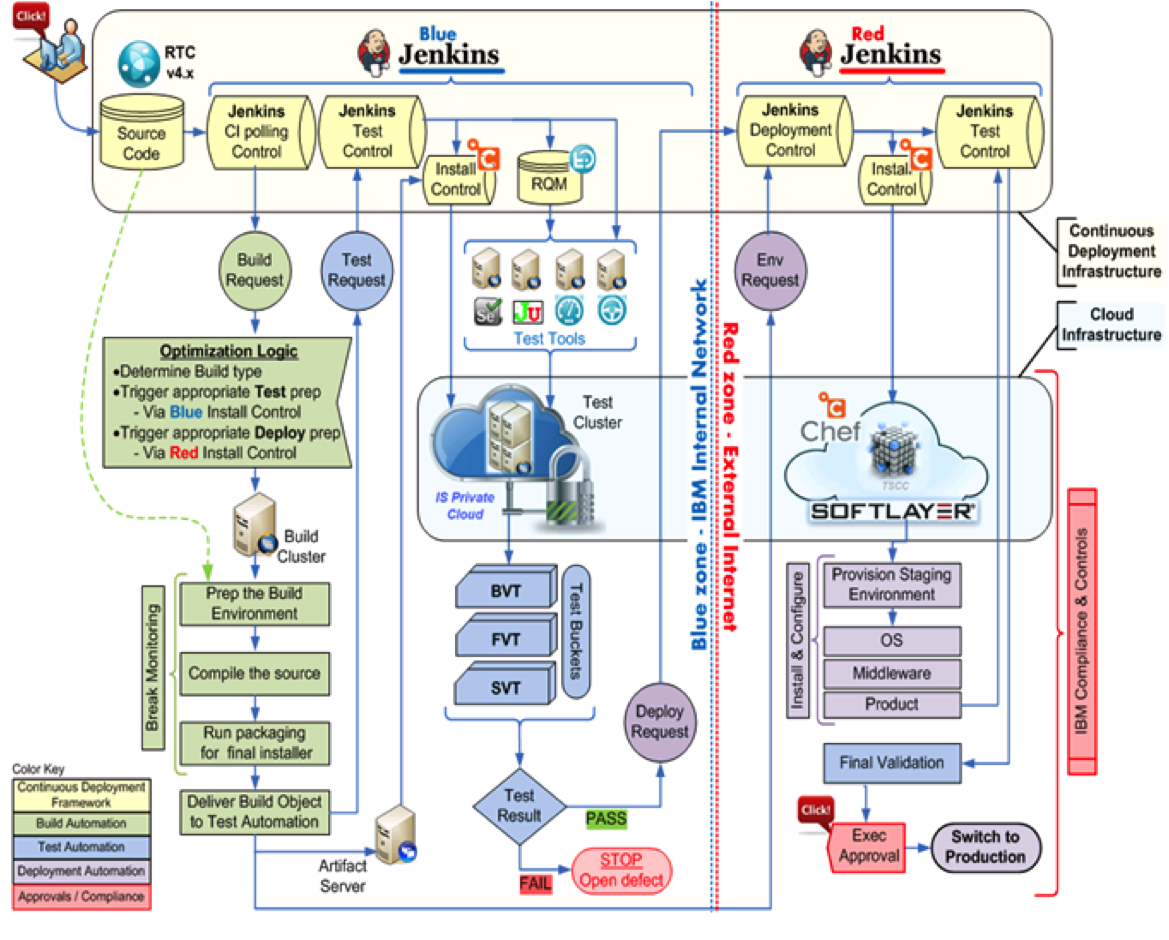
    In their book, they also provide insight to continuous delivery tool chains and processes which highlight build tools, CI platforms, testing suites, artifact repositories, and many other components. There are numerous examples of reference architectures available, and each of them vary in levels of detail, tools highlighted, and processes followed.  Yet, there is a constant theme among the tool sets: Jenkins, Maven, Nexus, Subversion, Git, Docker, Puppet/Chef, Rundeck, and Sonar seem to show up time and again.

    To help you along your continuous delivery and DevOps journey, I have compiled a set of 31 reference architectures created by users across the continuous delivery and DevOps communities.

     CD and DevOps tool chain

    Each architecture is accompanied by a link to the original presentation or blog where the architecture was referenced to ensure you have access to the full context of the discussion. You can also freely download the presentation from SlideShare where we now have over 7,000 views.

    Offer to help others: If you have a reference architecture to share, please consider posting a link to it in the comments section below.  I am sure others would love to see it and learn from it.

  • Is DevOps a Competitive Advantage? A Debate

    Is DevOps a Competitive Advantage? A Debate

    The idea of DevOps being a competitive advantage is not a new one. Service providers, software sellers, and internal IT frequently use this argument to justify all kinds of investments. But is there any real merit to this argument? Is DevOps truly a source of sustainable competitive advantage? Or is it simply just hype and a new way to sell a product / service?

    Here are some of the more popular points of view from both sides of the aisle.

    “Yes Absolutely” “No, Go Take A Hike”
    Speed is sexyIn the mobile, social, and web world customers expect speed and responsiveness. Bringing an idea to the market faster than your competitors is definitely an advantage and DevOps allows us to do just that. DevOps is not the only fish in the seaAgreed that speed is sexy. But at this given moment there are multiple technologies / philosophies out there that claim to do the same – i.e. cloud, big data, analytics etc. What makes DevOps so different?
    DevOps is hard to replicateWhile purchasing tools is easy, the real benefit lies in getting the culture and process right. Any organization that can get that right will be able to form a sustainable competitive advantage. Same has been said about other strategiesRemember when outsourcing started. It too was touted as a sustainable competitive advantage. Now it is the de facto strategy for IT erasing any advantages that the early adopters had. DevOps, if it does take off, too will follow the same path.
    New IT operating modelDevOps represents a new way for enterprise IT to operate. It breaks down the silo structures and unlocks the value trapped within the existing organization. Enterprises are not start-upsJust because it worked in a start-up environment does not mean that it can work in a large enterprise.
    Listening to customersSpeed is only one equation of DevOps advantage, the other is faster feedback loops so that you can determine that you are going in the right direction. Combine the two and you have a powerful competitive advantage. Not an IT responsibility / competencyIsn’t that what most organizations already do? I have my entire business / product / marketing org. focused on just that. The last thing I need now is IT to jump in and muck it all up.
    The new Software Delivery LifeCycle (SDLC)DevOps represents a new way for enterprise IT to operate. It breaks down the silo structures and unlocks the value trapped within the existing organization. Just good marketingThis is just repackaging of an old wine into a new bottle…DevOps is just a new thing. Like all other fads this too will pass.


    My Take

    Allow me to be the quintessential consultant and speak from both sides of my mouth. DevOps is and is not a competitive advantage. Now before you close the browser and move on, let me explain.

    DevOps in the short term is most definitely an advantage. Moving an organization from Traditional to a DevOps approach is not an easy task. Any corporation that can successfully achieve this transformation will be the first to reap its benefits – from faster speed to market to being more responsive to their customers. And the benefits are real! Ask Netflix and Etsy, who have been able to out innovate their competitors and gain a sizable lead in the market.

    However, in the long term, as more and more firms invest in DevOps the advantage will continue to shrink. DevOps, if you strip all the marketing jargon and go down to the most basic definition, is about reorganizing the internal plumbing of IT (i.e. how IT performs the various tasks within the software delivery lifecycle). And while in the short term plumbing can allow you to do some neat stuff, at the end it’s only internal plumbing and rarely a source of lasting competitive advantage.

    To see this is action, look at the automotive, financial, and then our very own Information Technology industries. In all three examples, the company that was able to transform was able to establish an early sizeable lead, reap the rewards, and the rest of the industry forced to catch up eventually.

    In automotive industry, early investment in lean and TQM earned Toyota customer loyalty and a significant lead over its traditional competitors. And while the lead lasted for a decade (short time in an industry where product lifecycles are 4 – 5 years), competitors quickly started to invest and catch up. You can now argue that U.S. manufacturers are at par with Toyota in both quality and speed. Where the competitors have still not caught up is in perception.

    In the 1970s it was not unusual for a home buyer to wait for up to 90 days to get a credit decision and a loan, as per “industry standards” in those days. Citibank rearranged its internal processes to give buyers a decision in 30 days. It took the industry by storm. Competitors eventually caught up and now 30 days is the norm.

    And as for our very own, Information Technology industry…outsourcing was considered to be a competitive advantage for many of the first movers. Like other strategies, it too required a structural change to make it happen. Many of the initial pioneers were able to cut IT costs by over 30% and establish a cost advantage over their competitors. But within a decade competitors copied, banked the savings, and eroded the cost advantages.

    In my opinion, DevOps too will follow a similar path. A few leaders will emerge (already happening), they will set the pace of change for the industry, and the rest will have to follow….whether they like it or not.


    About the Author

    MustMustafa Kapadiaafa Kapadia is the Service Line Leader for IBM’s DevOps practice, a business advisory practice focused on helping large enterprises transform their software & application delivery.  He has over 17+ years of experience in the tech. space, both as a service provider and a management consultant.

    Prior to joining IBM, Mustafa was a management consultant with Deloitte’s Strategy & Operations practice. He lives in San Francisco Bay Area, is an avid blogger (when time permitting), a speaker, and adviser to start ups.

    Connect with Mustafa LinkedIn| Twitter

  • 9½ Simple Steps On How To Start With DevOps Today

    9½ Simple Steps On How To Start With DevOps Today

    Isn’t it funny that a lot of people, me included, don’t really know the difference between DevOps and Continuous Delivery? Wikipedia tells that both are pretty much overlapping. In order to continuously deliver one must be familiar with DevOps. Anyway, I will tell you what you can do now to start with DevOps and Continuous Delivery. Here are 9½ simple approaches that tell how you can start immediately.

    (more…)

  • DevOps Makes Security Assurance Affordable

    DevOps Makes Security Assurance Affordable

    Despite the fact that information security is a top priority, many organizations face challenges integrating security assurance practices into their product and service development practices. All too often security problems are only detected and resolved with software patches following a security breach. Security assurance is often reactive but what is needed is a more consistent proactive and affordable approach to security. As indicated by Sean Michael Kerner in his article The DevOps model isn’t a threat to security; it’s a tool that can be used to enforce security like never before.

    DevOps with Continuous Testing (CT), when implemented according to best practices, is an opportunity for organizations to systematically and affordably integrate security assurance into product and service development. Using DevOps techniques, continuous security testing can be built into software change and deployment operations. Many refer to the application of DevOps practices to security assurance as “SecDevOps”.

    Below are some continuous testing best practices that make continuously testing security affordable:

    1) Develop expertise in SecDevOps CT: Security assurance demands that an organization develops expertise and processes to identify threats, protect against them, detect threats when they occur, respond with solutions and recover quickly. SecDevOps CT is not so different from any other DevOps CT except that it includes a security focus. Security assurance is really a special case of quality assurance and the practices for continuous testing also apply to security assurance. Other than the general continuous testing practices which I have described in my blogs on continuous testing, here are some specific skills needed for effective SecDevOps continuous testing:

    a. Include security experts in the DevOps CT team who are familiar with security domain knowledge including next generation network security protocols, understanding of BYOD security, cybersecurity attacks, in-application aware networks, streaming media and content delivery, virtualization and cloud security.

    b. Security experts should partner with and train the rest of the organization. This should be done from the beginning of the development process. This is important to ensure security is no longer an afterthought for an isolated department to worry about, but integrated at all stages of a project. This will ensure that developers and testers have a security mindset as part of their daily work.

    2) Leverage DevOps and continuous testing to make security assurance affordable: Because security assurance like quality assurance is considered a cost rather than a revenue generation activity, organizations are challenged to afford proactive security assurance. DevOps, when implemented in accordance to best practices, has a number of characteristics that make security assurance affordable as follows:
    a. DevOps infrastructures are configured as a common resource shared by the entire development, test and deployment teams and consolidate separate department test labs which allow budgets to be pooled.

    b. Orchestration tools include automated test topology re-configurations of products, test tools and interconnection components within physical, virtual and hybrid test lab deployments. This enables a wide range of security relevant production configurations to be stood up without expensive dedicated test equipment for each topology.

    3) Use Security-CT-Ready test tools which support security test protocols and flexible automation workflows: As indicated in my prior blogs not all test tools are CT ready and this is true for security tools also. Using the right security test tools that are CT-ready will make the job of integrating security into CT much easier. Here are key ingredients to look for in Security-CT-ready test tools:

    a. Use test tools with built-in security tests….no need to recreate them! These tools need to be compatible with security standards. The following whitepaper provides a framework of the impact –
    NIST Cyber Security Framework.

    b. Use test orchestrations tools that integrate well in the DevOps environments and can stand-up any production configurations consisting of a variety of platforms, mix of vendor components from the device level all the way to large scale network topologies. A good example is Spirent’s Velocity solution.

    c. Use static code analysis tools during continuous builds with built-in checkers that verify software security coding standards including CWE/SANS, OWASP and PCI DSS. For example Parasoft static analysis tools.

    4) Engage outside expertise to help accelerate your progress towards continuous security testing best practices: Many organizations make the mistake of trying to do everything themselves instead of employing expert consultants. Bringing in outside expertise can greatly improve the speed of accomplishing best practices. A good example of security expertise is Spirent’s Network Security Testing brochure.

    The above is a partial list of suggestions for continuously testing security that have been proven to yield good results for SecDevOps. At Spirent we think testing has a bright future in DevOps. You can read more about our views at Spirent.com/solutions/devops

    What do you think of these suggestions and do you have others that should be mentioned?

  • Webinar:  You Can’t “Do” DevOps.  You Can “Do” Continuous Delivery.

    Webinar: You Can’t “Do” DevOps. You Can “Do” Continuous Delivery.

    “DevOps” is the latest rage.  Leading edge companies like Netflix, Etsy, and Intuit (the “Unicorns”) have transformed their I.T. Development and Operations organizations into a new culture known as DevOps:  Development and Operations working collaboratively together to accelerate the pace of software and application delivery.  But they didn’t implement DevOps.  A DevOps transformation to their culture was the outcome of their implementation of continuous delivery of software.  Continuous delivery is a process that applies automation and orchestration technologies to the application lifecycle.  In this webinar you will learn how your organization can implement continuous delivery as a step toward your own DevOps transformation.  With continuous delivery, you can accelerate application delivery which will allow I.T. to better meet the needs of the organization.  With continuous delivery, I.T. becomes a business enabler.


    Event recorded Wednesday April 22nd, 2015

    SLIDES


    [seoslides embed_id=”45c149edc1c6″ script_src=”https://devopsy.kinsta.cloud/embed-script/cloudbees-webinar/6398/” overview_src=”https://devopsy.kinsta.cloud/slides/cloudbees-webinar/” site_src=”https://devopsy.kinsta.cloud” site_title=”devopsy.kinsta.cloud” title=”CloudBees Webinar” /]

    VIDEO


    Your Host:

    alan_new_head_shotAlan Shimel, Editor-in-Chief of devopsy.kinsta.cloud.  An often-cited personality in the security and technology community and a sought-after speaker at industry and government events.  Alan has helped build several successful technology companies by combining a strong business background with a deep knowledge of technology.


    Panelists:

    DanJuengst_Headshot_2015-500x600-bwAs CloudBees’ Sr. Director of Product Marketing, Dan Juengst leads the product marketing efforts for the CloudBees Continuous Delivery Platform powered by Jenkins. Dan brings 20+ years of high tech experience to CloudBees with expertise in grid computing, high performance computing, and application performance. Dan has worked as both customer and vendor at both startups and enterprises. Dan’s resume includes Red Hat, Sun Microsystems, SGI, Wily Technology, Terracotta, and Lockheed Martin where he started his career computing hypersonic reacting airflows around Mach 30 flight vehicles.

  • The Last One That Transformed the Future

    The Last One That Transformed the Future

    The headline made her yelp for joy. A year into the future of D-Chip, on a crisp August morning, Phoebe opened the newspaper and swiped to the technology section on her iPad. What she saw was riveting: D-Chip reborn as a star in wearable computing.

    She immediately thought of the article Marc Andreessen wrote on how software transformed the enterprise. It’s true of our company’s story, she mused. The credit for making the headline a reality was due to the stressful events of the last months. Who said stress couldn’t be a game changer? As she picked absently on a plate of fruit and relished the article for the second time, she recalled the events of the past year.

    Flashback a year ago at D-Chip

    Remember how Rachel pitched her enthusiastic idea to Chandler? She wanted to engage six engineers in six months to build an in-house solution. A solution that would integrate D-Chip and Enogo’s systems by letting them deploy in both OpenStack and AWS and manage wearable chip code from a single deployment platform.

    Chandler agreed in theory with the need for a single management platform but didn’t see the sense of doing it in-house. Why side-track from your business goals and spend months building a solution yourself when there are specialists solving this exact problem for many companies facing the same issues? After much debate, they came to a consensus. They decided to evaluate solutions from the best-of-breed products out there and transform their software development lifecycle to reflect the best agile practices. Thus was born the iTransform project.

    The iTransform project

    The name itself was a reminder that transforming was as much a matter of people internalizing and accepting a new way of doing things as much as it was about aligning and unifying D-Chip and Enogo systems. The first order of priority was to understand the pain-points that assailed the company. After a lot of meetings and detailed analysis, they identified key use cases from internal stakeholders, namely the engineering and IT operation teams:

    • Engineering personas, developers, QA, architects, all said the same things. They didn’t have access to the latest tech because it took weeks or months for approval processes to travel up the chain. Then they waited on builds and environments from IT operation teams. Most of the time, the environments in the private datacenter OpenStack cloud didn’t work properly, and deployments never succeeded the first time. It’s no wonder they took weeks or months to release anything decent.
       
      Self-service and continuous delivery were, therefore, the most important criteria for developers, QA, and architects. Without waiting for IT admins or operations teams, they wanted to spin up build environments in test, staging, even production on their choice of pre-configured infrastructure. They wanted to consume in an on-demand fashion the latest technologies on multiple clouds. Today they were using AWS cloud and OpenStack, but tomorrow they wanted any cloud that matched their workload configuration needs best.
    •  

    • IT operations and system admins brought up their set of challenges. Their primary goal was to configure environments for repeatability; safeguard builds from failures and structure stable workflows. Not an easy job come to think of it. On top of this demands from the engineering teams dictated that they learn and implement new technologies in a very short time. Technologies ranged from configuration management tools, cloud platforms, storage, networking, load balancing services, monitoring services, and more. Besides when engineers wrote configuration templates as Enogo did for AWS, it was hard to figure out who owned the deployment stack. In the case of problems, it resulted in pointless blame games. So they desired a clear level of separation between code, deployment automation, and infrastructure. Technologies and cloud platforms could come and go, but IT operations remained responsible to maintain smooth workflows, stable builds, and error-free deployments.
       
      A service catalog also met the needs of the IT operations teams. They wanted to build and manage specific platforms, runtimes and version configuration changes. Collaboration was a key factor. Many IT operations team members and engineers were experts in some but not all technologies and tools. But together in a collaborative platform, experts could contribute at their skill level and share knowledge with others. Automating configuration changes in bulk saved a ton of time. Therefore, API support for automation was high on their wish-list.
    •  

    • The IT managers were important though indirect stakeholders. They often approved and handled audits, compliance, and budgetary aspects. Policies and cost management were paramount to them. IT managers needed control and oversight to implement compliant deployment policies that gave the right level of access to the right set of infrastructure on pre-approved cloud providers. They needed to set and monitor quotas and track IT spend on cloud deployments against approved budget.

    Transformed enterprise

    After three months of evaluating proof-of-concept solutions with vendors, they zeroed in on a solution that met all of their uses cases and helped set up their current builds. Because of this, the teams were able to ship code ten times faster. It was only a matter of time before D-Chip stood out as a market leader. It was clear to the company executives what was driving this transformation.

    They retired the semiconductor business and switched their business focus entirely to SDK builds of software for wearable computing. The software services for wearable chips was now way more valuable than any piece of hardware. Their customers in wearable computing now consumed D-Chip technology as a service in the cloud. A faster and efficient software development lifecycle enabled them to carve a new market niche and become the de facto leader.

    The transforming story of D-Chip is a reminder for us all. When there are problems in software development, by aligning goals and helping people in different roles work together and participate in the development lifecycle, you increase the pace of innovation dramatically. It can be so powerful that it can transform the company’s core products or services.

    Disruptive change doesn’t happen one step at a time. It happens with mavericks and innovators like Rachel and Chandler leading radical changes in a focused group effort. You want innovation to transform your business? Get a dedicated group of mavericks together and make it happen.

    Just like mankind advanced their understanding through each cycle of civilization from the stone age up to the Renaissance and the Industrial Revolution, the future is heralded by the IT age of our times.

  • Automated Security Testing in a Continuous Delivery Pipeline

    Automated Security Testing in a Continuous Delivery Pipeline

    Automated unit, integration and acceptance tests are essential quality controls in running a reliable continuous integration or continuous delivery pipeline. Too often, security tests are left out of this process because of the erroneous belief that security testing is solely the domain of leather-jacket-wearing security experts.

    Security testing does not need special treatment

    We’ve made great strides automating many repetitive quality testing tasks and we can use the same approach to automating security tests. There will always be a need for intelligent human testing both for security and quality, but that doesn’t mean that all security testing must be manually driven. A large proportion of security tests are essentially checks that known weaknesses have not been introduced and these lend themselves superbly to automation. In fact, using a human to perform these types of checks is a terrible waste of resources.

    From an automation point of view, security tests can be categorised as follows:

    1. Functional Security Tests.
      These are essentially the same as automated acceptance tests, but targeted at verifying that security features such as
      authentication and logout, work as expected. They can mostly be automated using existing acceptance testing browser automation tools like Selenium/WebDriver.
    2. Specific non-functional tests against known weaknesses.
      Includes testing known weaknesses and mis-configurations such as lack of the HttpOnly flag on session cookies, or use of known weak SSL suites and ciphers. These are particularly well suited for automation because the weaknesses are known up front (if not by the development team, then by the security team). What’s more is that these tests lend themselves to a TDD approach in that they can serve as the security specification before building the application and environment.
      Some work has already been done in extracting these types of tests into security test automation frameworks, see: BDD-Security (I’m the author), Mittn by F-Secure and Gauntlt.
      Because these test non-functional aspects of the application, they need access to the HTTP layer which browser automation tools do not provide. So testing these requires a hybrid approach: Browser automation together with a proxy server to inspect and inject requests. My preferred combination here is WebDriver with OWASP ZAP.
    3. Security scanning of the application and infrastructure.
      Even manually driven penetration tests usually kick off with an automated scan using vulnerability scanning tools like Nessus, Burp and OWASP ZAP. It’s worthwhile understanding the difference between these tools and how they’re used. Nessus if primarily an infrastructure scanner in that it’ll test an IP address and all exposed ports for known weaknesses. It also includes a “web” scanning component that will test HTTP services for similar known weaknesses, but the scanning at the web tier is extremely superficial. For example, Nessus would not be able to scan any content or functionality behind the login form, nor navigate through a web wizard.
      Burp Intruder (Commercial) and OWASP ZAP (Open Source) are focussed on the web tier and are true application scanners in that they inspect and test at the HTTP layer by injecting attack data into parameters and evaluating the application’s response. They can provide in-depth security scanning if they’re used correctly. But if they’re simply used to spider the application and run an automated test then there’s a good chance that they won’t find or test all the available content.
      To successfully automate application scanning, one should ensure that all of the content to be scanned is navigated and populated in the scanning tool, before starting to spider and scan the application. If you already have acceptance tests that drive a browser, then these can be re-used to populate the Burp or ZAP content before kicking off a scan.
    4. Security testing application logic.
      Automated tools can only go so far in detecting security flaws. Toidentify flaws in the logic of the application requires a human brain (at time of writing). From an automated scanner’s point of view an online auction site and an online bank are the same type of application, i.e. a series of HTTP requests. But from a human attacker’s point of view, they are vastly different beasts offering very different functions. A human security tester might try tests such as:

      • Can I manipulate the HTTP Request to bid on an item that has already ended?
      • Can I manipulate the HTTP Request to bid with a high amount, and then modify that amount to a lower amount just before the auction ends?
      • Can I transfer funds to someone else’s account using a negative number as the value?

      These require ingenuity and experience to find, but once the attack is defined they too can be recorded as automated tests and become a part of the security regression tests.

    Screen-Shot-2015-03-18-at-21.21.253

    Walk before running

    If you’re just embarking on the journey to automate security tests, the above steps may seem daunting. But it’s not necessary to implement all of them to reap the benefits of automated security testing. Points 2 and 3 probably represent the greatest value in terms of time invested vs. security value extracted since they help identify a lot of common security flaws that slip through the cracks in a normal development process.

    Any testing framework can be used to orchestrate and run these tests but in the true spirit of SecDevOps, it would be good to choose one that the development, operational and security teams are comfortable using- and that easily integrates with your CI/CD server. I’m partial to the BDD frameworks because their use of a natural language to define the testing steps means that they’re instantly understandable by a wide audience and makes them very attractive for use as security-tests-as-specifications. But some teams that are well versed in programming language X may find this additional, natural language layer, superfluous.

    Point 3 above requires an additional step if we want to integrate those tests into a CI/CD environment. The other tests all have clearly defined passing and failing criteria, but running an automated scanning tool typically results in a number of false positive results: security issues reported by the tool which aren’t actually risks. Manual security tests that use automated tools include a process of investigating and removing these false positives. Automated tests would have to do the same thing and also specify a success criteria. This can be done by wrapping the scanning operation in a test and specifying the known false positives given a particular scanning tool and target.

    For example, the BDD-Security framework performs an automated scan for SQL injection vulnerabilities using the following test:

    SQL injection scanning example

    and the additional text file: tables/false_positives.table to define the known false positives to ignore:

    false positives example

    The final step in the test defines the success criteria and would need to be selected based on the security requirements of the application and the scanning tool used.

    When to run the tests

    Since they’re automated, the cost of running the tests is very low, so naturally we’d want to fail fast and run them as early as possible. But security issues are typically found at the component level and are difficult to test at the unit/class level. So testing at the application tier should be done on a running application. In other words, at the same time as automated acceptance tests.

    Testing the security of the infrastructure should be performed on an as-near-to-live as possible environment. This will typically be a pre-production environment. And of course, since running the tests doesn’t cost anything, there’s a good argument for performing the same tests in production as well- continuously.

    Blocking tests or in parallel?

    As a security practitioner, I would love to see security tests as part of the CD process and blocking delivery if tests fail. But in reality this may not be practical for all teams; and it’s ultimately a cultural question of how deeply security is integrated into the dev and ops teams.

    For those who’ve not achieved SecDevOps Nirvana, the tests can be run in parallel to the build with supervision by the security team. It’s then the security team’s responsibility to manually block delivery if test failures indicate the presence of unacceptable risk.

    CI Server Integration

    How well the security tests integrate with the CI server depends on the testing framework and CI choice. Java, Python and Ruby testing frameworks are likely to be supported by all the major CI servers. Using Jenkins and JBehave, which produces both JUnit and HTML reports, the tests output would be:
    xunit-test-results

    bdd-report-ssl-snippet