Tag: continous deployment

  • Back to Basics

    Back to Basics

    We here at devopsy.kinsta.cloud do sometimes suffer from The Curse of Knowledge. We write about DevOps regularly for an audience that is doing or managing DevOps. We assume knowledge, but there are still a fair number of people and organizations who are unclear about some of the terminology/technology that we talk about.

    So if you are a regular reader of my blog, this might be a redundant post—but read on because it might have info you haven’t had a reason to consider yet.

    I’m going to start with the obvious—how most readers got here to begin with: DevOps. DevOps is automating the build process so that builds are automated and repeatable. Teamed with Agile development, DevOps means that development teams can rapidly iterate through development and generate regular updates to their applications. Everything else in this blog is based on the premise that it is running in a DevOps environment.

    Continuous integration: Typified by Jenkins, continuous integration (CI) is the part of DevOps that runs the automated builds. It includes reporting and defect resolution only in the sense that it feeds into other systems that track defects. With CI in place, a developer or DevOps engineer can say, “Okay, ready to test a build,” and with one command, can kick off a build that will result in a finished artifact. Or result in a built product, anyway. ‘Finished’ is optional, and the target of CI is not generally a running application.

    Continuous delivery: One of the most confusing things for new DevOps people is CD. The way that the space evolved, there are actually two things that CD could stand for; continuous delivery–automated build of the complete application —or continuous deployment—delivery of a running application onto infrastructure. Continuous delivery is straightforward and means all the bits of the application are code complete–or at least the current state of the application is complete enough to build an application. Continuous deployment is much more convoluted. It might mean deployed to a development environment for developer-level testing or a test environment for running automated (continuous testing) tests on or in production. It might be a staged rollout, where users are siphoned over, or it might be a hard rollout where the old version is replaced by the new in a manner similar to ripping a Band-Aid off.

    Continuous test: Automated testing is at the heart of continuous test (CT), and it is only now becoming a real possibility for most short-staffed enterprises. Advancements in machine learning (ML) mean that tests can be run, results filtered to eliminate false or duplicate results, and IT staff is only notified of the important bits. Unlike traditional testing, staff is required only to create the tests and to look at meaningful results.

    Infrastructure-as-Code: Infrastructure-as-Code (IaC) is the ability to define all relevant elements of infrastructure with text files. Often this is done in YAML and sometimes in a variety of other formats. The idea is that infrastructure provisioning can be on-demand and adaptable. It is certainly more agile to change a text file from port 80 to 8080 and then run a command to process the text file–now the port is documented and whenever needed the command can be re-run to move to a known state. IaC largely relies upon software implementations over physical. While the idea of software-defined networking (SDN) has fallen out of favor, the underlying principles are everywhere and part of IaC, for example.

    GitOps: All the rage these days, GitOps is probably best defined as applying DevOps to operations. That does sound weird, but I like to break it up as “traditional DevOps is DevOps, while IaC (to a lesser extent) and GitOps (to a huge extent) are DevOps.” The point being that GitOps uses the text files generated in IaC and worker nodes generally designed for continuous deployment and then performs operations tasks based on those text files. If IaC defines the entire environment that an application needs and DevOps defines all of the sources that an application is composed of, bundling the two together will enable full-on automation from conception to decommissioning. When a new version of a source file or configuration file is checked into Git, the system then makes certain that every instance of the application is updated with the new version. Of course, this process, like every one listed here, is far more complex than that in implementation; we are talking about ‘what, not how’ at this level.

    All of this really is the very tip of the iceberg, but that was the goal here – to offer readers a place to start if they’re finding themselves looking at DevOps for the first time. As you dig deeper, things like DevSecOps and test driven development (TDD), or defect tracking and Agile methodologies start to play into the landscape, and maybe I’ll write an intro bit for those also. But this time, we’re out of space.

    As always, keep rocking it. No matter which or how much of the above you are using, if the organization’s applications are up and running, that’s you. And you deserve more kudos than you are likely getting. But keep grinding through—the rest of us get it, and thank you.

    Image source: Photo by Towfiqu barbhuiya on Unsplash

  • Top Reasons to Use Node.js

    Top Reasons to Use Node.js

    When considering the architecture of a new web app, it might be a good idea to include Node.js in the discussion as a key part of that architecture. Node.js could provide you with additional speed, can be used on numerous platforms and has an active community from which to get modules and other assistance.

    What is Node.js?

    Node.js is a server-side platform developed by Ryan Dahl in 2009. It was built on Chrome’s V8 JavaScript engine and designed with a non-blocking, event-driven I/O. It is also cross-platform, able to be run on Windows, Linux and OS X. Its non-blocking I/O is due to its use of asynchronous functionality, which keeps the server from waiting on data to be returned before being able to move on to other tasks.

    Why Use It?

    Given the architecture of Node.js, a number of advantages are provided both to developers and the resulting apps they develop. A few of these advantages include speed, programming language consistency, real-time apps developed easily and a large number of modules/packages for developers to use while creating new apps.

    Speed

    Node.js offers speed advantages in many cases. First, it uses the Google V8 engine, which is optimized for JavaScript speed. Also, its use of non-blocking asynchronous behavior can ease the time it takes for users to see actions as complete, since things can be going on in the background while the user moves on to other tasks.

    One Language

    JavaScript is listed as the most popular programming language. Source: Thenewstack

    Using Node.js, front-end and back-end code can both be in JavaScript, so your developers don’t have to transition between languages as they move through the stack. Some architectures, such as the MEAN stack (MongoDB, Express.js, Angular.js, Node.js), are designed around this principle. In this case, the stack uses JavaScript for Express, Angular and Node. MongoDB uses BSON for database queries, which uses the same syntax as JSON (JavaScript Object Notation).

    Seeing full-stack developer as the largest occupation and JavaScript as the top language among both back-end and front-end aligns with what we’ve been seeing in overall JavaScript adoption.

    Source: Mikeal Rogers, Node,js Foundation Community Manager 

    For developers, this can help both with moving across the stack during development as well as help communication among developers, as they will be referencing the same language (JavaScript) while discussing programming decisions.

    Real-Time Apps

    Node.js is a great platform for creating real-time apps. With a module such as Sockiet.io, you can create real-time chats, games and more. Along with its non-blocking asynchronous architecture, real-time apps can be developed with plenty of speed and responsiveness.

    Modules

    The Node Package Manager (NPM) makes it easy to install packages that others have developed to perform any number of tasks. This helps to encourage code-sharing among developers and to reduce the amount of custom development that has to be done when one or more packages can take care of that coding for you.

    Notable Examples

    Some notable examples of Node.js use are Paypal and Uber, showing that it can, indeed, be useful for large projects.

    Paypal

    Node.js and an all Javascript development stack helped PayPal bring efficiencies in engineering and helped rethink and reboot product, design and operational thinking.

    Source: Sameera Rao, Paypal Sr. Business Products Engineering Manager 

    Back in 2012, Paypal had a single app running all things, including UI, API and more. This included a lot of duplicated code that was copied and pasted from one app to another to make apps for different locations.

    Using Node.js, the company was able to modularize and clean up its code and processes, which in turn sped the development of apps it needed at any given time.

    According to Paypal’s engineering team, they were able to build the Node.js app with 33 percent fewer lines of code and 40 percent fewer files, and were able to build it twice as fast and with fewer people than before. Certainly, Node.js proved to be advantageous to their development.

    Uber

    Uber used Node.js from the beginning, and its distributed system was a perfect fit, since a lot of network requests are made. The non-blocking asynchronous I/O used by Node.js helped to ensure those requests could be made and handled quickly to provide the best service possible.

    Conclusion

    The benefits of Node.js have been proven. It helps speed development, can be used on numerous platforms and has an active community from which to get modules and other assistance. Include Node.js in your future conversations about website architecture.

    — Brian Wheeler

  • 12 Tips for Managing Your Multi-Cloud Environment

    12 Tips for Managing Your Multi-Cloud Environment

    No single cloud vendor has the perfect solution for your unique business situation. The only way to maximize the benefits of cloud services to your business is by dealing with several cloud providers and monitoring all of them simultaneously. That’s the IT equivalent of singing an aria while standing on your head and scrambling eggs. (Not really, but it can seem that way.)

    Here are 12 things to keep in mind when planning your company’s multi-cloud strategy:

    • Map your entire network, and then identify where the cloud fits in it. Get a clear picture of the cloud’s role in your overall system-management strategy to avoid having to backfill gaps in the data needs of business managers and other customers. Different lines of business will be best served by different cloud providers.
    • Work with vendors that respond quickly and positively to the unexpected. There will always be unforeseen situations when you’re stitching together multiple cloud services. Your partners should report regularly on the state of their services, enhancements, and new features.
    • Automate low-level monitoring and maintenance tasks. Two primary reasons for adopting cloud services are cost savings and more efficient operations. One way to achieve both is by reducing the amount of human oversight required to keep your systems humming.

    The potential complexity of multi-cloud management is shown in this flowchart encompassing the many elements that need to be stitched together precisely. Many of these low-level operations must be automated to optimize your strategy. Source: Carl P. Lehrmann, 451 Research

    • Follow your users. Pay close attention to how the “consumers” of your apps and systems are actually putting the tools to use. They are the best indicators of which processes are the biggest productivity boosters. You can also learn about any new services the users discover that help them get their work done faster, more efficiently and/or less expensively. This lets you get a jump on the kinds of tools the users are most likely to need in the future.
    • Double down on cost controls. You can’t control what you can’t see. Dealing with multiple vendors complicates the process for requisitioning new services. To avoid unnecessary impediments to quick implementation of useful new services, devise a purchasing process that is as flexible as the services themselves. However, not long after the service honeymoon period, evaluate whether each new service is proving to be worth the cost and whether there are better and/or less-expensive alternatives.
    • Application life cycle continues to dictate cloud migration. Data centers may be shrinking, but they are definitely not disappearing. For reasons related to security, compliance, insurance, and any number of other factors, some systems are staying in house for the foreseeable future. You certainly want to avoid attempting to lift and shift an in-house app to a cloud service, particularly one that is only a couple years old and thus hasn’t yet paid for itself. Once an older system is ready for a reinvention, it’s easier to make a business case for going cloud-native.
    • Take advantage of the power of pre-emptable virtual machines. Because they persist for no longer than 24 hours, pre-emptable VMs are a good choice for batch processing and fault-tolerant deployments, according to ComputerWeekly’s Matthew Cooter in a November 2016 article. Pre-emptable VMs are as much as 80 percent less expensive than Google’s regular instances, and their fixed price help companies plan and manage their costs.
    • Adopt an integrated data center management system designed for virtual environments. This is the only way to ensure your server, storage, network, security, operations and applications teams are working as a single unit toward common goals, according to Jay Litkey, president and founder of cloud service provider Embotics, in a November 21, 2016, article in Virtual Strategy magazine. Any organization structured around traditional physical infrastructure boundaries is destined to struggle with the shift to hybrid and multi-cloud environments.
    • Identify the apps in your organization that are best suited to cloud-native implementation. Traditional apps are monolithic, run as VMs, use a scale-up architecture and are generally more difficult to develop, deploy and maintain. By contrast, cloud-native apps are more modular and service-oriented, comprised of collections of containers and services, based on a scale-out architecture, and easy to automate, move, and scale.

    Focus on the apps in your organization that will benefit most from a cloud-native approach, and wait on those that are better served by deployment on a traditional data-center platform. Source: TechTarget

    • Match your apps to the services that play to their strengths. Big-name services such as VMware and AWS have bifurcated to meet the diverse needs of their customers. For example, VMware’s vSphere-based Enterprise Hybrid Cloud is intended for traditional apps, and the company’s Native Hybrid Cloud is designed for modular, microservice-based systems. Similarly, AWS’s Elastic Compute Cloud, Elastic Block Store, EFS file system and VPC private networks mimic in-house data centers, while the company also supports higher-level services such as NoSQL databases, BI processing, Hadoop-like clusters, message queues, push notification services, media transcoders and search engines.
    • Automate policy across cloud environments. The only efficient approach to use of multiple cloud services is to have a single standard for policies that are applied automatically to each environment. The policies cover such areas as virtual servers, workloads, data storage, traffic flows, compliance/regulation, reporting and security. It’s also easier to apply updates and changes when you have a single configuration across different infrastructures because the changes propagate seamlessly from environment to environment.
    • Vendor lock-in becomes a thing of the past. When you rely solely on one public cloud service, it can be difficult to migrate virtual machines and other resources to another service. Among the factors to consider are comparable read/write loads, data transfer needs and network latency. By relying instead on your custom combination of cloud services, all of which share policies and configurations, you find yourself managing the change instead of the change managing you.

    — Brian Wheeler

  • Taming 2 Cloud App Performance Enemies

    Taming 2 Cloud App Performance Enemies

    Whenever you hear the words “the network’s slow today,” or, even worse, “the network’s down,” you know somebody miscalculated. It may have been the person who decided to buy the wrong hardware, or maybe the one who signed up the wrong telecom provider.

    Often, that slowdown or outage was the result of somebody underestimating server demand or overestimating the amount of redundancy built into the network setup. It’s always tricky finding the right level of redundancy that will keep users from waiting for their data without overspending on cloud capacity.

    A common mistake IT managers make when switching from in-house infrastructure to cloud infrastructure is failing to take advantage of the flexible, affordable, redundant capacity offered by Amazon Web Services, Microsoft Azure and other cloud providers. That’s the conclusion of Yan Cui in a April 20, 2015, post on his “The Burning Monk” blog.

    Cui points out that latency is inevitable because things go wrong—and usually, those things are beyond your control. That’s why you have to design your applications with latency in mind. Too often developers work inside a bubble, where all hardware and network parameters are geared to the tasks at hand. In the real world, hardware, networks and software break. If your app isn’t designed to accommodate such failures, you’re leaving your users in the lurch.

    Get Real: Inject Latency in Your Test Environment

    To model app performance in real-world settings, it isn’t enough to test servers and databases under anticipated loads. You have to take the extra step of mimicking the glitches that are as inevitable as they are unpredictable. Cui proposes injecting random latency delays on every request. He even provides a simple PostSharp attribute that automates the process.

    Cui applies the concept of error-planning even further by introducing errors in the mechanism used to throttle requests to prevent bad guys from spamming their servers using such tools as Charles and Fiddler, or any of the spammers’ own bots. By making the errors visible in the dev environment, designers can anticipate them and engineer ways to handle the throttling errors “gracefully.” Once again, a PostSharp attribute is applied to randomly inject throttling errors; Cui states that the same approach can be used to plan for and respond automatically to session expiration, state out-of-sync, and other service-specific errors.

    These and other error-detection and -correction methods fall under the umbrella of Design for Failure, a principle championed by Simon Wardley as a key characteristic of next-generation tech companies.

    10_3_16_latency1

    Simon Wardley’s Design for Failure contrasts the development approaches of traditional shops and those he identifies as “next generation.” Source: The Burning Monk

    Cui explains how modeling latency and other errors within the development process has been applied by Netflix’s use of Chaos Monkey and Chaos Gorilla, as well as the mechanism Uber devised to allow its client applications to fail over seamlessly in response to a data-center outage.

    Learn How to Combat Latency from the experts: Gamers

    Nowhere does server performance matter more than in the world of online games, where one-microsecond hiccup can spell the difference between winner and loser, champion and chump. In an April 17 article on Venture Beat, Cedexis’s Pete Masden explains that a 500-millisecond network delay makes an online gamer twice as likely to walk away, while a 2-second delay in load time leads to abandonment rates as high as 87 percent.

    Addressing latency begins by measuring it, according to Masden. That’s why we added native monitoring to Morpheus when we built the cloud management platform. Being able to see the status of all your organization’s apps and business services at a glance isn’t just a nice convenience—it’s a competitive advantage. To be able to glance the status of all your organization’s apps and business services, group databases, app servers, messaging queues and web servers by system dependency and impact to view an overall status as well as each app’s current state is crucial to knowing what’s happening in your organization.

    One approach to cloud-server latency is to create separate instance, which is common for failover but less so for addressing regional network demand. Rather than the traditional active-passive model, however, Masden recommends an active-active approach when implementing multiple redundant instances to ensure all servers are up to date and optimized. Atop the multiple instances runs the global traffic analyzer to ensure no single instance becomes overly congested.

    Is ‘Zero-Latency Computing’ Even Possible? Why not?

    If you think network latency is a problem now, just wait until such technologies as 5G, the internet of things (IoT), virtual reality (VR) and robotics go mainstream. Equipment and bandwidth upgrades, and more sophisticated software-defined networking won’t be sufficient to address tomorrow’s application-performance needs. That’s the conclusion of Nitin Serro in a Sept. 29 post on the Channel Partners blog. Serro identifies three technologies as key to meeting future performance requirements: network functions virtualization infrastructures (NFVi), fog computing and zero-latency computing.

    10_3_16_latency2

    The applications made possible by 5G and related technologies come close to eliminating latency by shifting more intelligence directly to the network, not merely by providing faster speeds. Source: GSMA Intelligence, via The Unwired People

    While NFVi and fog computing focus primarily on the network and data layers (compute, storage and network infrastructure), zero-latency computing targets the application layer, where information has to be exchanged in real time between diverse components, most of which link directly to users. According to Serro, nothing short of an entire re-invention of the network infrastructure—from backbone to edge—will prevent today’s bottlenecks from becoming tomorrow’s blockages.

    Move the Network Intelligence Closer to the Data

    The network-capacity challenge we now face is unprecedented, according to Silicon Republic’s John Kennedy, who writes in an Oct. 3 post that even the much-touted 5G network will come out of the gate hobbled by the need to accommodate its many predecessors. Rather than the “step change” in network speed that most analysts expect, 5G will deliver a tremendous boost to network intelligence. This may be the technology’s greatest asset: a smarter network means the data doesn’t have as far to travel.

    From an application-design perspective, latency can be traced to three sources: the need to link to legacy infrastructure, the need to link to third parties via APIs and the innate unpredictability of the internet itself. Marqeta’s Dave Matter examines these situations from a payment-processing perspective in a Sept. 13 post on App Developer Magazine.

    As with the network infrastructure itself, the solution to application latency is to move more of the intelligence into the app itself and then rely on open APIs to link data sources in real time in an environment that’s closer to users. Once again, the data and associated analytics tools have less distance to travel, and much less latency to deal with. Ultimately, the solution to latency—in hardware and in software—will be fewer, shorter trips.

    — Brian Wheeler

  • Empower Developers to Build Security into DevOps

    Empower Developers to Build Security into DevOps

    Over the past 10 years, as more organizations have made the transition to DevOps, there has been a cultural shift in which security and development teams agree quality is a priority. Yet, even with a shared quality focus, Development, Security and Operation teams still find themselves at odds on the road to continuous delivery of secure software.

    Some people claim developers don’t care about security. The reality is they want to write great code that’s secure code, but often they don’t have access to tools that fit with the way they work.

    There’s also tension between different sets of expectations and performance metrics for different teams. Developers are graded on their ability to deliver features and functionality to market as quickly as possible, while security engineers focus on prevention and detection. Operations teams, meanwhile, focus on reliability, uptime and stability.

    Development managers feel pressure from senior management to avoid project delays. At the same time, security managers aren’t rewarded for reducing risk and may be asked to turn a blind eye and give the application a temporary pass so the project can move forward.

    Prioritizing delivery to customers over security creates real dangers for the business. Veracode has found that 63 percent of internally developed applications are out of compliance with the Open Web Application Security Project (OWASP)’s Top 10 standards when initially assessed for security. And, attackers increasingly target the application layer, with web application attacks now the most frequent pattern in confirmed breaches, according to the 2016 Verizon Data Breach Investigations Report.

    Empowerment = Security

    Regardless of where your team is in the DevOps journey, you’re likely aware that detecting and fixing quality issues as early in the software development life cycle (SDLC) as possible increases efficiency and reduces costs. According to the Puppet 2016 State of DevOps Report, “high-performing development teams spend 50 percet less time remediating security issues” when they address security throughout the SDLC, instead of “retrofitting security at the end.”

    While you want to find and fix bugs early in the SDLC, early detection of coding flaws has the unintended consequence of distorting an application’s risk posture. Development is once again in the hot seat, despite trying to do the right thing and testing new versions of an application early in the life cycle.

    There is a middle path that can allow development to deliver more secure code at DevOps speed, but it requires automating security into the SDLC and into a continuous integration or continuous deployment (CI/CD) pipeline. Integrating security into the pipeline ensures that security testing happens with every release, and avoids the problem of bolting on application security late in the process.

    This method has the ability to scale easily as more applications are developed. The release engineer adds a step in the CI/CD build workflow for an application security scan from the master branch. The assessment can take place in parallel to the CI/CD workflow process and any security issues can be loaded automatically into the defect tracking system that development teams already are utilizing for functional testing. Security issues are prioritized and resourced just as any quality issue.

    The best way to catch software defects quickly is to analyze code as close to the time that it was written as possible. Security assessment, such as functional testing, “follows the code” through the application life cycle. During the development phase, developers analyze code in the IDE and develop unit tests that will find issues relative to their individual code changes. At this phase, developers receive immediate feedback while coding a feature, allowing developers to remediate basic issues when they are least expensive to fix.

    During the build and integration phases, when a development or feature branch is merged into the master branch, compilation and integration tests are executed automatically by the CI/CD workflow. Issues detected at this stage are visible to the larger development team. No developer wants to be the one who “breaks the build” or has a basic defect that should have been detected during development phase. The integration testing is critical because functional and security tests are able to detect issues resulting when data and control flows between components. Coverage of the application expands and developers still have the time to fix before code goes moves to the next phase.

    Enter Infrastructure as Code

    “Infrastructure as code” (IAC)—the concept of managing, provisioning and configuration of development, QA, pre-production and production environments in a repeatable automated methodology—provides consistency that previously was challenging when each system was provisioned and configured independently. Product teams using virtual machines (VMs) or containers are able to advantage of this model more easily.

    Even for those product teams that cannot take advantage of IAC, teams can still automate the deployment and configuration of the application. This becomes particularly important during systems/pre-production testing, where finding issues takes longer to remediate and the complexity increases as the application integrates with other systems. At this point in the life cycle, system and pre-production tests are automated when possible, and QA engineers and user acceptance testers may run end-to-end tests. Running security assessments at this stage is just as important as functional tests. True, fixing issues at this stage will be more costly to fix than during the development phase. But by this point the developers have been incorporating quality throughout the process and the number of high-priority issues will be significantly reduced.

    Empowering developers to find and fix quality issues earlier in the life cycle provides them with the knowledge and skill set to more efficiently fix defects where it is less expensive and disruptive to their coding.

    About the Author / Janet Worthington

    janetworthingtonJanet Worthington is senior product manager at Veracode,  working on solutions to help developers and development teams smoothly incorporate security into the application development life cycle. Janet joined Veracode in 2012 as senior program manager, delivering Veracode’s secure development solutions to Fortune 100 companies. Prior to joining Veracode, she led software quality assurance test teams at a number of startup technology companies. Janet has over 19 years of experience in software product development and services. Connect with her on LinkedIn and Twitter.

  • DevOps: Shift Left to Reduce Failure

    DevOps: Shift Left to Reduce Failure

    DevOps is all about increasing the feedback loop from idea to customer and back again. Tremendous gains have been achieved in automation and tools to drastically reduce the amount of manual labor involved in progressing down the release pipeline. But mission-critical applications in a highly competitive market cannot afford to go down. Complex applications, environments and infrastructure increase risk, which can cause failure.

    The failure rate of production deployments is still too large. Studies show that the average cost of a production outage is roughly $5,000 per minute, while the average cost of a critical application failure per hour is $500,000 to $1 million.

    Why so much failure? All too often we’re still seeing a lack of consistency across the release pipeline. Many times the provisioning and deployment processes are very different at the opposite ends of the pipeline. But by shifting left the operations concerns, you can achieve much more success in production.

    Understanding How to Shift Left

    The term “shift left” refers to a practice in software development in which teams focus on quality, work on problem prevention instead of detection, and begin testing earlier than ever before. The goal is to increase quality, shorten long test cycles and reduce the possibility of unpleasant surprises at the end of the development cycle—or, worse, in production.

    Shifting left requires two key DevOps practices: continuous testing and continuous deployment. Continuous testing involves automating tests and running those tests as early and often as possible, along with service virtualization to mimic unavailable systems. Continuous deployment automates the provisioning and deployment of new builds, enabling continuous testing to happen quickly and efficiently.

    The first and most obvious way to shift left operations is to work side by side with development in creating the deployment and testing processes. Failures observed in production often are not seen earlier in the life cycle. Many times these failures can be attributed directly to differences in deployment procedures. Development may create its own deployment procedures that are very different from those used by operations for production. Sometimes production procedures are much more manual and may even use different tooling. Operations and development need to take ownership in building standard deployment procedures. The deployment process is then practiced potentially hundreds of times in test environments before reaching production. You then have much more confidence that the production deployment will be successful.

    Another way to reduce the failure rate is to make all environments in the pipeline look as much like production as possible. This is almost impossible using traditional provisioning processes. Production environments usually are much heavier and detailed than are needed by development. But by using cloud and pattern capabilities, you can get much closer.

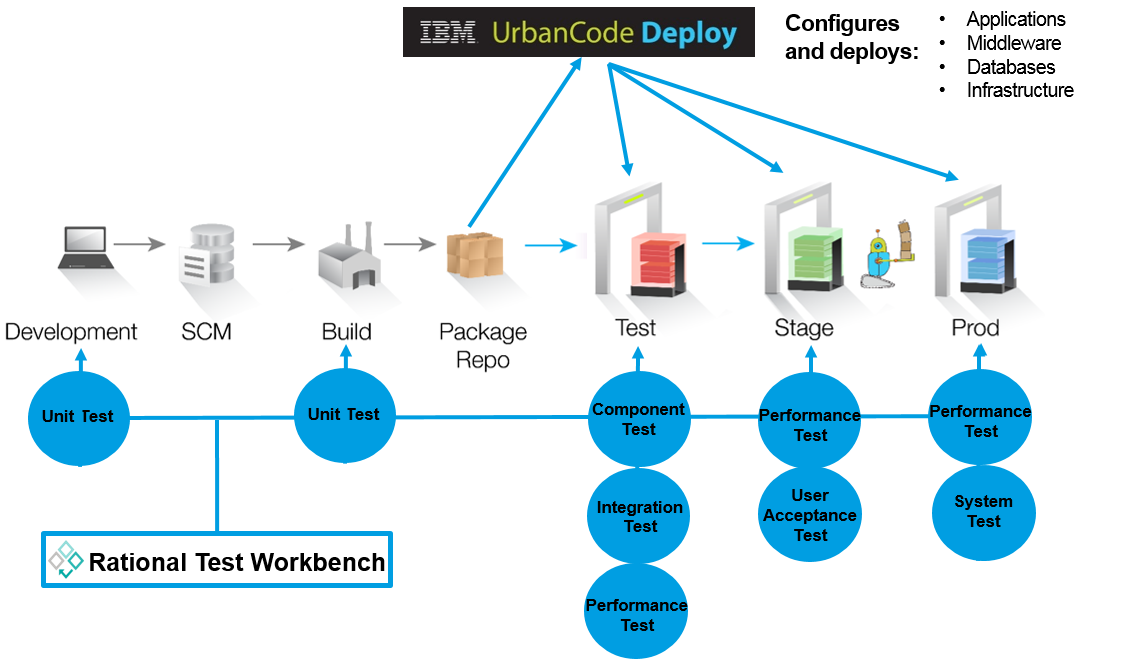
    The ability to use patterns to define consistent environments eliminates the failures that occur simply by configuration inconsistencies. This again requires operations and development to work together in creating the provisioning process so developers create their test environments the same way they are created in production. Using IBM UrbanCode as an example, this can be done by connecting UrbanCode Deploy to an automated self-service provisioning system such as OpenStack HEAT or IBM Cloud Orchestrator connected to OpenStack.

    Picture1

    These standard patterns can be used to create environments for all stages of the pipeline. And by using cloud capabilities you can deprovision these environments as fast as you can create them. This also allows the enterprise to have confidence in their environment patterns. They are tested on a daily basis and, therefore, operations can feel confident that testing is done on production-like environments.

    No one wants to experience production failures—and it is in everyone’s best interest to do all they can to prevent them. At the root of DevOps is the removal of those silos between development and operations. By applying these shift left operations principles you are well on your way to reducing your failure rate.

    The ingredients to make shift left are real and available: automated testing and deployment tools, service virtualization technology, agile practices and cloud environments. The main obstacle that remains is the mindset of delivery organizations. Learn more from the newly updated Application Deployment and Release for Dummies ebook to find out more.

    About the author / Dr. Darrell R. Schrag

    Darrell Schrag

    Dr. Darrell R. Schrag (@devopsdrs) is an experienced software lifecycle consultant specializing in the IBM cloud solution, helping customers establish their cloud strategy across the enterprise. He’s focused on implementing continuous delivery of software applications through the delivery pipeline incorporating cloud and provisioning solutions. He’s experienced in helping clients transition to “born on the cloud” applications utilizing microservices to take advantage of a flexible and nimble cloud platform.

  • Legacy IT Challenges Continuous Delivery

    Legacy IT Challenges Continuous Delivery

    Legacy information technology infrastructure has a strong effect on the potential success of DevOps. In environments where different teams have always used the same servers, change can be difficult due to inter-team coordination and limited server transparency and application inventories, says David Blank-Edelman, a 30-year systems administration/DevOps/SRE veteran and currently Technical Evangelist at Apcera.

    “Unraveling the Gordian knot to bring DevOps principles and practices into that environment will be quite a challenge,” he says.

    In such a legacy environment, the enterprise walks a topological tightrope stretched between one or more development machine clusters shared by multiple teams with no real isolation between teams and projects, Blank-Edelman notes. “In most cases, there is a second parallel set of machines for production and, if the business is very fortunate, for test/QA as well. There is seldom anything, however, to prevent a production workload from talking to a database server in development by mistake, which can lead to all sorts of fun.”

    How to Move to CD

    One solution is a policy system approach, in which the organization provides for a policy system to migrate a legacy information technology environment to a platform that uses continuous delivery (CD), Blank-Edelman says.

    To create the policy system, he notes, the organization will need to address questions such as:

    1. Are the workloads allocated/using only the resources that they should?
    2. What is inside the workload? What is its provenance? Is it acceptable and in good order from security, coding and business requirements perspectives?
    3. Where is the workload allowed to run? In which cloud? In which environment? In which country? Near what other containers?
    4. Can the workload communicate with only the things it should? If I move it to another location, is this still true?

    “The process of developing a policy system and then enacting it can lead an organization on a journey that brings their existing infrastructure to a much better place. If that platform can also automatically enforce the decisions that organization made during this question and answer discovery process, you can be certain that the answers to these questions stay answered,” says Blank-Edelman.

    Other approaches to moving to continuous delivery include tool-first approaches in which the organization adopts one to several CI/CD/workflow tools and then makes an effort to implement those, possibly by shoehorning existing processes and runbooks into that tool or toolset.

    A better tactic is the people-first or culture-first approach that focuses on how the development and operations personnel will work together to create a product vs. a project, says Blank-Edelman. While tools still have a role to play in the people-first approach, they are not the priority; rather, organizational change comes first. Once the people have made the commitment and the change, everything else will follow.

    Challenges During the CD Move

    It’s not the existing information technology infrastructure that presents moderate challenges to CD that is the issue; it’s the infrastructure that poses either very many challenges or very few that is the hurdle. “If you start with a more challenging situation, this will incentivize people to work very hard to reduce the associated pain points in their life,” Blank-Edelman says.

    On the other hand, he notes, when an organization begins a move to CD with an infrastructure that is already in pretty good shape, you won’t often hear its people say that they should stop working on the product and work on CD all the time instead. People will still claim they have plenty to do already.

    Continuous Deployment Can’t Exist Without CD

    Continuous delivery starts with a code base and takes logical steps through that code base to increase confidence that it is ready for production, using a process that is as smooth, automated and loosely coupled as possible, he says. With confidence in that pipeline comes confidence in moving the result of that process into production automatically, which is continuous deployment, he adds.