Tag: conference

  • In Building Communities, Our Preferred Pronoun is ‘We’

    In Building Communities, Our Preferred Pronoun is ‘We’

    It has been about 18 months since my last post. Toward the end of 2015 I started digging deeper into cybernetics and systems analysis, which led me to construct a model and write a paper. I haven’t posted it before now because it isn’t perfect. The funny thing is, I know it will never be perfect but I still have a list of edits to make. I always will.

    I would describe the paper as a form of hermeneutical phenomenology. The TL;DR on the model: it provides a basis to qualify systems for further analysis. Writing is a mechanism for me to study the model, but as my investigation varies so does my interpretation of what the paper should say. At the moment I’d like to add some observations around four-color mapping, thresholds and compactness. It’s a more rigorous argument than what I said about the continuum hypothesis, but I may leave that bit in anyway.

    Ultimately, the paper is my interpretation of the work I’ve studied. More than read my paper, I’d encourage anyone to review the sources themselves. It goes without saying that I couldn’t have written it in the first place if I weren’t standing on the shoulders of the giants that came before me.

    Self-Inflicted Othering

    I strongly identify as a technologist and a mathematician, but I would be neither of those things if it weren’t for the broader scientific community. Where I keep seeing people get stuck is celebrating our individual differences along with what we have in common. Humans have a tendency to form tribes and wage war. While I’m always glad to see the sense of belonging communities provide for their members, it’s the tendency to direct hostility toward other groups we should resist. J. Paul Reed wrote a post about this last year. We all have circles we run in where our faces are more familiar than others and it’s easy to get “othered” when we step outside of those environments.

    I meet a lot of really smart people at tech conferences who haven’t taken any trig or calculus. If I’m at a math conference I typically get a lot of beginner tech questions from people who are a different kind of brilliant. One conclusion from my paper is the operating environment is the ultimate constraint on a system. We can be local experts on whatever experience we have that’s not the focus of the event. We should also be able to find people that can teach us more about the event’s main topic while we’re there. If you find your experience in a field is making it difficult to learn, try spending more time with newer community members. Their challenges and experiences stand a good chance of providing a fresh perspective.

    We Rise

    This past week I spoke at We RISE Women in Tech Conference, which was hosted by Women Who Code Atlanta. I’ve been among the organizers for devopsdays Atlanta for the past two years and have been making an effort to engage the local community more.

    I spent most of my time at We RISE on the tools track. G. Ann Campbell gave a great talk on code quality called, “Refactoring with Cognitive Complexity: The New Option for Measuring Understandability.” I’ve used sonarqube for years and have been studying complexity science as part of my cybernetics journey. I felt like I was the target audience for her talk. I really liked Meera Subbarao’s talk, “Know Your Enemy, and Yourself: Demystifying Threat Modeling,” too. I enjoy any talk with maps and Sun Tzu quotes, but the highlights of Meera’s talk were the personal stories she shared about trust and failsafe experiments. Experimental methods are playing an increasingly important sociotechnical role in security as our systems become more complex and adaptive. I’m currently convinced all sociotechnical systems are cybernetic as a byproduct of their complexity and all cybernetic systems are sociotechnical at a coarse enough scale.

    Other Kinds of Othering

    It’s that kind of talk that got me grouped in with the “complexerati.” The first time I heard the word I knew they were talking about me (among others) and it wasn’t intended as a compliment. Nevertheless, I couldn’t deny it is who I am. I’ve also been called an insight junkie and street academic and I can’t deny those, either. I can get hooked on a phenomena and dig until I’m completely exhausted. I also never finished my undergraduate degree, which leaves me to perform my research in the street, like a busker. I’m not sure busting my chops over the part of my degree I’m missing is constructive feedback, but we can’t expect everyone to be nice to us all the time, either.

    I know we can catch people on a bad day so I try to be forgiving when someone gets a bit brisk with me. The complexerati comment led to some helpful advice after a diplomatic conversation. If I’m going to use language that’s specific but unconventional, I should make an effort to translate as I go along. People are comfortable with expanding their vocabulary but we shouldn’t introduce too much new material at once. What I said about cybernetics and sociotechnical systems translates into plainer English as, “any system with people in it is self-steering and any self-steering system will have people in it if we zoom out far enough.” The language isn’t quite as precise but it’s still accurate. Negative feedback can be helpful but we have to keep it constructive.fours

    Diplomatic Relations

    Churchill said, “Diplomacy is the art of telling people to go to hell in such a way that they ask for directions.” Communication is vital to trust and learning. Our human tendency to zoom in and steer toward our own familiar shores keeps us divided. This is an excerpt of my last post from December of 2015. It would seem my position has not changed.

    Instead of focusing on processes we should focus on enabling people to improve themselves. We improve when we learn and we learn when we communicate. If your culture does not foster communication can if foster learning? If you’re not open and honest with yourself, how does that effect your environment?

    I could go into more detail about my intentions for next year and may do so at a later date, but my plans are of no use to you as we are different people. I would encourage you to gain awareness of your own situation by challenging the assumptions that have bounded your operation.

    We can stay true to ourselves and our own identities while interacting with other communities. We’re members of some and just allies of others. It’s important to respect those boundaries and understand when our experience is welcomed and appreciated, when it’s time to listen and learn, and when it’s just not the time or place for us and we need to move onto something else for a while.

    We RISE was about technology and culture, which I believe are at the heart of what I’ve been studying for the past few years. The talks about DevOps and security couldn’t have been more relevant to my work. I felt some of the advice I heard in the keynotes from Jen Bonnett, Safia Abdalla and Estelle Weyl that was specifically targeted toward women was probably good advice for anyone, including me. Both Melanie Crissey and Sandra Persing shared their takeaways from the conference here and here, respectfully. Their posts should help shed some light on how I fit in and what I took away from this women’s tech conference more convincingly than I’ll be able to explain.

    I felt very welcomed and included at We RISE. Erica Stanley, Alicia Carr and Beth Laing threw a terrific event. We’re lucky to have them and Women Who Code as members of our Atlanta tech community.

    A Group Effort

    I think this slide I tweeted from Ashley Sun’s talk is the best I can do at summing it up. Ashley gave an awesome talk, during which she showed us how she’s using neo4j for cloud monitoring that gave developers in her organization the ability to manage more of their own infrastructure.

    Ashley shared Kelsey’s tweet in an effort to convince us that just because this solution was a good fit for her organization, it didn’t necessarily mean it would work for anyone else. Adrian Cockcroft had made the point that not everyone can be Netflix. Adrian used to work for them, so he might be a little biased. When Kelsey Hightower quoted him, it provided some external validation to the idea. Kelsey works for Google and they aren’t trying to be Netflix, either. They’re too busy being Google.

    Greg Poirier pointed out that not everyone can be Kelsey Hightower in his talk at devopsdays Silicon Valley a while back. I felt the point Adrian had about Netflix applies to us as individuals, too. Copying Kelsey’s results won’t give us the experience of walking Kelsey’s path. Some experience with Kubernetes may help you on your own journey, but it will never make you Kelsey Hightower. The same applies for Ashley Sun, Adrian Cockcroft and anyone who’s still reading this. We all have some experience others can learn from because we’re each on our own path. As things change over time and our memories fade, not all of what we remember remains how it was today. This is how the perspective of a novice can give fresh eyes to someone with more experience.

    One Step at a Time

    This is why Taiichi Ohno was unconcerned when people came from the United States and wanted to study TPS. By the time they had implemented what they had observed, the process at Toyota would have already adapted into something different (if you’d like to read more about it you should check out this book). The game we’re in has no finish line we can cross. The only successful move we can make is to try to support each other as individuals and communities as we’re able, sharing what we have in common.

    I had a great time at We RISE Women in Tech Conference and will look forward to it returning to Atlanta again next year.

    — Chris Corriere

  • SauceCon Speaker Profile: Mike Millgate, Optum

    SauceCon Speaker Profile: Mike Millgate, Optum

    Automation architect Mike Millgate wants to work himself out of a job. Of course, he doesn’t want to make himself obsolete. He simply wants to automate testing so that QA teams can free their time to do other strategic exercises, such as exploratory testing and focus on security.

    Mike knows what he’s talking about. At Optum, a health services and innovation company, he manages a suite of tests that runs in three hours, testing 18 different applications and more than 24,000 total test cases. He is passionate about parallelization, and notes that if the tests weren’t running in parallel, they would take 55 days to run.

    At the upcoming SauceCon conference, Mike will present, “Testing at the Speed of Concurrency,” taking attendees on a journey of in-house machine testing into cloud-based testing. He will show what works and what doesn’t, and how to use parallelization to improve efficiency as the machines are increasingly doing the work.

    Mike hopes his presentation will help attendees learn how to perform massive numbers of tests in parallel, whether they are using Sauce Labs or another test platform. His mantra is, “Quality is a team effort,” and says the entire team needs to be equally invested to be successful.

    Mike has been at Optum for 15 years. As an expert in test automation in the healthcare industry, he was brought into the tech surge to help fix healthcare.gov in 2013. His work in the industry helps Optum achieve its goal: to help people live healthier lives and to help make the health system work better for everyone.

    A resident of southern Utah, Mike loves hiking and exploring nearby national parks with his family. He is passionate about foster care and adoption, having adopted three young boys with his wife. Mike also runs daily and has competed in two marathons.

    Would he say test automation is a marathon or a sprint? “If you do it right, you can get a marathon’s worth of testing done in a sprint time frame,” he says.

    Join Mike and other presenters at SauceCon, the first-ever Sauce Labs user conference. SauceCon is a three-day event filled with training, workshops, best practices and visionary content from the leading minds in automated testing. For more on upcoming SauceCon presentations or to register, visit the SauceCon website.

    About the Author / Rebecca Cramer

    Rebecca Cramer is a writer and communications strategist specializing in technology. With more than 20 years of experience across disciplines including marketing, internal and executive communications at companies such as Dell and Quest Software, Rebecca is passionate about creating and sharing good content of all kinds. In her spare time, she enjoys spending time at the beach and hiking in her native Southern California.

  • SauceCon Speaker Profile: Adam Carmi, CTO of Applitools

    SauceCon Speaker Profile: Adam Carmi, CTO of Applitools

    Carmi to present a live coding session on testing responsive sites 

    Testing responsive sites and applications can be quite a challenge for development teams. We are fortunate to have Adam Carmi, CTO of Applitools, presenting a session at SauceCon on “Advanced Test Automation Techniques for Responsive Apps and Sites.”

    During Adam’s presentation, the audience will participate in a live coding session to learn how to effectively design responsive page objects, implement generic tests that work for all the layouts of their apps, control the browser’s viewport size to accurately target layout transition points, incorporate layout-specific assertions in their tests, and visually validate the correctness of their app’s layout​.

    Adam is passionate about everything related to software development and testing and is excited to share his knowledge with (and also learn from) similarly passionate practitioners.
    As CTO and co-founder at Applitools, a cloud service for automated visual testing, Adam spends most of his time developing image processing algorithms. However, he loves testing of all sorts, from designing the product to maximize testability to unit and API testing and, of course, automated visual testing.

    Adam regularly speaks about software testing at conferences around the world and organizes the Israeli Selenium Meetup group. He loves to ski and tries to stand on his hands as much as he can! When not working, he enjoys working out, watching movies and playing video games with his two children.

    SauceCon, the first-ever Sauce Labs user conference, is a three-day event filled with training, workshops, best practices and visionary content from the leading minds in automated testing. For more on upcoming SauceCon presentations or to register, visit the SauceCon website.

    About the Author / Rebecca Cramer

    Rebecca Cramer is a writer and communications strategist specializing in technology. With more than 20 years of experience across disciplines including marketing, internal and executive communications at companies such as Dell and Quest Software, Rebecca is passionate about creating and sharing good content of all kinds. In her spare time, she enjoys spending time at the beach and hiking in her native Southern California.

  • DevOps Viewpoints from Pink17

    DevOps Viewpoints from Pink17

    I recently had the opportunity to cover Pink17, Pink Elephant’s 21st Annual International IT Service Management Conference & Exhibition in Las Vegas, Nevada. In this case, what happened in Vegas did not stay in Vegas; instead, most came home with actionable takeaways surrounding Pink17’s theme, “Communicate, Connect. Change,” to help grow their businesses.

    The content-rich and comprehensive program, with inspirational keynote speakers, 12 tracks and more than 120 sessions, was a veritable smorgasbord of subjects spanning the IT service management (ITSM) spectrum. This included many thoughtful and informative DevOps-focused tracks. The event as a whole was a well-organized and executed conference. The attendees whom I spoke with thought the sessions were relevant and the peer networking invaluable. Whether you were there for a strategic vision, a tactical plan or operational know-how, Pink17 delivered.

    In this article, I’ll present some key takeaways from the conference along with some interesting conversations I had along the way with three of Pink Elephant’s thought leaders including their visions for DevOps in the ITSM space.

    IT Success is About Delivering Business Value

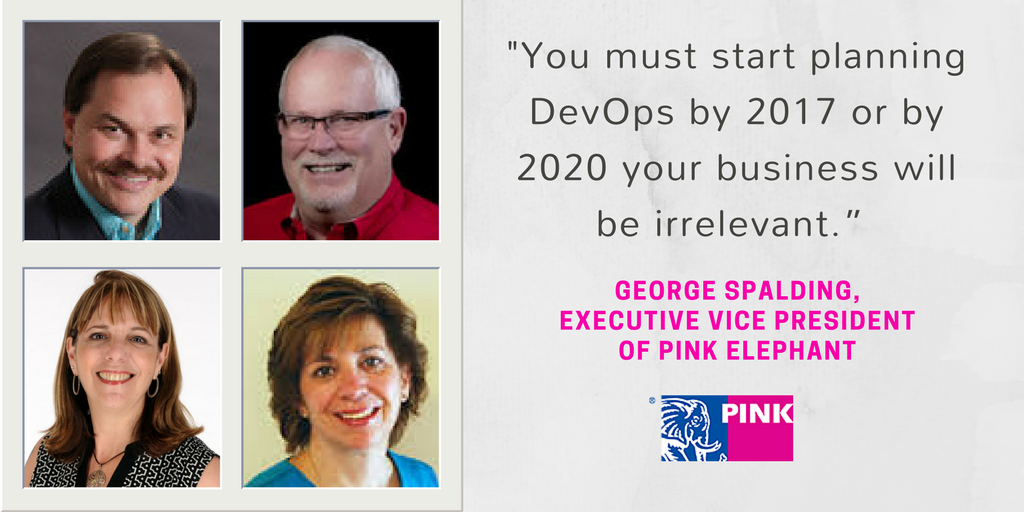
    In his opening remarks, George Spalding, executive vice president of Pink Elephant, had a message for IT professionals: “You must start planning DevOps by 2017 or by 2020 your business will be irrelevant.”

    This message was supported throughout many of the DevOps sessions, such as in “Agile, Lean, and DevOps – Working Together To Increase ITSM Efficiency,” presented by Troy DuMoulin, VP Research & Development for Pink Elephant. In this session, DuMoulin revealed how Agile, Lean and DevOps practices can work together to help organizations achieve the elusive challenge to be better, faster and cheaper.

    According to DuMoulin, much has changed in the IT world in last three years, and although many of the practices are the same, IT professionals now need to do their jobs faster, while at the same time delivering additional business value. “The language has changed. No longer do we talk about maturity, robustness, compliance, risk and availability,” said DuMoulin. “Now Agile, Lean, and DevOps are all about the concept of speed, and efficiency is key.”

    We Didn’t Invent DevOps—It’s Always Been There. The IT Community is Just Refining It

    According to several DevOps speakers, DevOps isn’t just one entity but rather a system of dynamic parts that work collectively together. When everything is about a quest for fast flow, DevOps can be considered a system of value generation. According to DuMoulin and others at Pink17, the key for ITSM professionals to realize is that a DevOps culture is about creating a fast flow for their existing work—not replacing it.

    DevOps Teams Deliver Real Value to Successful DevOps

    In her session, “DevOps Teams: A Continuous Engagement Approach,” Jayne Groll, co-founder and board member of the DevOps Institute (DOI) and also a member of the Pink Think Tank, provided insight into emerging DevOps roles, skills and competencies that are delivering real value to successful DevOps. In particular, she explored various models for DevOps teams to support continuous engagement, shared accountabilities, faster deployments and increasing trust between DevOps, Ops, Security, QA and Support.

    Besides defining the emerging roles and skills in DevOps, including those focused on people, practices and automation, Groll also discussed models and approaches for the creation of DevOps teams including how their value creation differs from today’s hierarchal IT organization.

    “The DevOps Teams are continuous and cross-functional,” said Groll. “These teams demonstrate ‘CALMS’ values—Culture, Automation, Lean, Measurement and Sharing.”

    Make Sure the Right People are at the Table at the Right Time

    Jack Probst, principal consultant at Pink Elephant and a member of the Pink Think Tank, thinks when most people talk about DevOps they see it as an automation play, when really it’s an organizational change and culture effort because people are really rethinking the way in which work will be conducted. According to Probst, the biggest challenge for IT professionals is finding the time to make sure all the right people are at the table at the right time. Regardless of DevOps tools that are used, if people aren’t talking to each other—DevOps won’t work.

    “For me, DevOps is defining the way you put the LEGO pieces together in an organization to make it work,” said Probst.  “DevOps has a lot of buzz, but at its core, it’s a people issue. Adopt and adapt and figure out what’s important and make it work inside your organization.”

    Furthermore, to avoid short-sighted thinking and get the optimal results in a DevOps initiative, organizations need to think of DevOps in terms of people and culture and not only tools.

    Start with Why?

    In her session, “The Yellow Brick Road & The Effective Organizational Change Manager,” Robin Hysick, management consultant with Pink Elephant, discussed the Change Management Body of Knowledge (CMBok)’s 13 critical knowledge areas, the related professional certification levels and how the methods are techniques covered by the CMBok can help organizations manage successful projects and transformative initiatives.

    Robin’s perspective on integrating DevOps into an existing ITSM system is all about the why.

    “The first thing an organization needs to do is to first understand why? I like to refer people to Simon Sinek and his ‘Golden Circle’ explanation,” said Hysick. “We’ve never done this in IT. … Organizations won’t succeed with DevOps and change management until they know why they’re doing what they’re doing.”

    In addition, Hysick teaches the DevOps Institute’s DevOps Foundation and Certified Agile Service Management courses. She says when people come to these classes they usually have no idea what DevOps is—when they leave they understand the concept behind DevOps and where it came from. Most importantly, IT professionals return from the classes knowing exactly what to ask their decision makers so they can best determine how to achieve a DevOps solution.

    Conclusion

    So what were my takeaways from my Pink17 Vegas experience? Mainly that DevOps isn’t only about tools, automation or continuous delivery—it’s about people. The right people at the same table who have the intelligence and the passion for getting to the heart of their business’s why factor?

    Too often IT managers are so busy in the day-to-day needs of quickly producing their products they forget the reason they are doing it in the first place. And the most important question gets lost in our frenetic world of disruptive technology: Why?

    At Pink17 IT professionals learned that to have a successful DevOps initiative, they need to take a beat before they run off to their next sprint or say “we’re doing DevOps now,” and figure out why their business wants to “do DevOps?” What is the business problem they are trying to solve? What change do they want to make it? Why will it benefit their business? What are the opportunities or urgencies of their business and then define what they need to do to make the outcome happen? Whether it’s bringing more tools to bear, implementing automation or more, it all should start with, Why?

    Did you attend Pink17? What were some of your favorite sessions? Looking to attend Pink18, read more here.

    — Ingrid Sides

  • What to Expect from DevOps Enterprise Summit San Francisco 2016

    What to Expect from DevOps Enterprise Summit San Francisco 2016

    Many have asked me what I’m looking forward to at DevOps Enterprise Summit 2016 in San Francisco—it is the third year of our conference, and I think it will be our best conference yet! Here are three of the things I’m looking forward to most:

    Where Are They Now?

    First off, we will have seven speakers back to present for the third time at the conference. Having this pattern of repeat speakers is a bit unusual for a conference, but I love that we’re following these leaders on their continuing journey. For me, it’s almost as if we have front row seats of an unfolding documentary of the ongoing transformations that they are helping drive in their large, complex organization.

    Why do I think this is important? My belief is that in the DevOps Enterprise community, many of us are on a common journey, increasingly being asked to help elevate the state of the practice for the entire technology organization, often involving thousands of engineers. To see the journey unfolding for other pioneering leaders is often a glimpse into our own future.

    The third-time speakers include:

    Heather Mickman from Target,

    Scott Prugh and Erica Morrison from CSG,

    Tapabrata Pal from Capital One,

    Carmen DeArdo and his colleagues Jim Grafmeyer and Cindy Payne from Nationwide Insurance,

    Terri Potts from Raytheon,

    Courtney Kissler in her new role at Starbucks, and

    Jason Cox, who is giving the closing keynote about the DevOps journey at Disney. (So stick around!)

    Each of these leaders will recap on their DevOps journey so far, whether and how their roles have changed, the new challenges that have emerged since last year, and what they’ve done to overcome those challenges.

    We’ll also be hearing from four people who have had a tremendous influence on the entire DevOps community: John Allspaw, CTO at Etsy; Mark Imbriaco, who led the Ops organizations at 37signals, Heroku, GitHub, LivingSocial and DigitalOcean; Adrian Cockcroft, who led the migration of Netflix into the public clouds; and Michael Nygard, author of the seminal book “Release It!”

    Transformations from Different Industry Verticals

    We always want to hear about DevOps transformations at all stages of the journey—I’m particularly looking forward to three of them that that are outstanding on their own merits, but are also interesting because of the industry they operate in: airline, hospitality and insurance. These are three industry verticals that we don’t typically associate with DevOps.

    Susanna Brown and Ben Chan will talk about how DevOps is changing how American Airlines works (and doing it in the middle of its merger and integration with US Airways), Matt O’Keefe will talk about speed becoming the prime directive at Hyatt Hotels and Resorts, and Opal Perry will talk about her efforts to transform culture at Allstate Insurance (which, like Nationwide Insurance, operates in an industry famous for its centuries-old, risk-averse traditions and decision-making styles).

    I’m also excited about another conference first for us, which is the joint presentation from Suzette Johnson and Robin Yemen, from Northrop Grumman and Lockheed Martin, respectively. I met Johnson at an Agile conference for the Federal Government community, and I was so inspired by the work that they’ve done within their firms and the broader community at large to improve outcomes for federal programs—both civilian and military.

    New Session Format: DevOps Workshops

    As adult learners—and this is especially true for leaders—we tend to learn more effectively from observation, experimentation and group exercises and group learning, as opposed to didactic lectures and descriptions of theory.

    I’ve observed that the DevOps Enterprise community is truly a group of people who are helping each other. To help further enable the spontaneous and serendipitous interactions that make great communities great, we are adding a set of sessions called DevOps Workshops.

    These are 60-minute sessions that run alongside the conference talks, and each workshop will focus on one of the community’s top problem areas:

    • How can we better lead change in our organizations?
    • What are the modern architectural and technical practices that every leader in our organization needs to know?
    • How do we design our organization to best enable DevOps outcomes?
    • What are ways that we can more effectively bridge the information security and compliance gap?

    Each of these workshops will have a 10-minute introduction, which will be followed by 45 minutes of small-group discussions. And to help ensure that each small group achieves its learning objective, as well as to ensure open and healthy dialogue, we have decided to have trained facilitators use the Lean Coffee format.

    Lean Coffee helps achieve this through a democratic selection of topics and rigorously enforced time-boxing of each topic. I’ve always been amazed at how effective this technique is at creating good outcomes.

    (Why Lean Coffee? In my personal experience, all it takes is a bad facilitator or one person who loves hearing themselves talk to ruin the small-group session for everyone. I can’t think of a better mechanism than Lean Coffee to neutralize these risks.)

    In addition to the amazing lineup of repeat speakers, expert talks, and new stories, my hope is that these DevOps Workshops will be of tremendous value and create fantastic learning and networking opportunities for all attendees. The collaboration and relationships that result from each of the DevOps Enterprise Summits never ceases to amaze me, so we’d like to give attendees a variety of opportunities to engage with our speakers and with each other throughout all three days.

    I’m looking forward to the best DevOps Enterprise Summit ever! I hope to see you there!

    — Gene Kim

  • Digital Transformation Top of Mind at PagerDuty Summit 2016

    Digital Transformation Top of Mind at PagerDuty Summit 2016

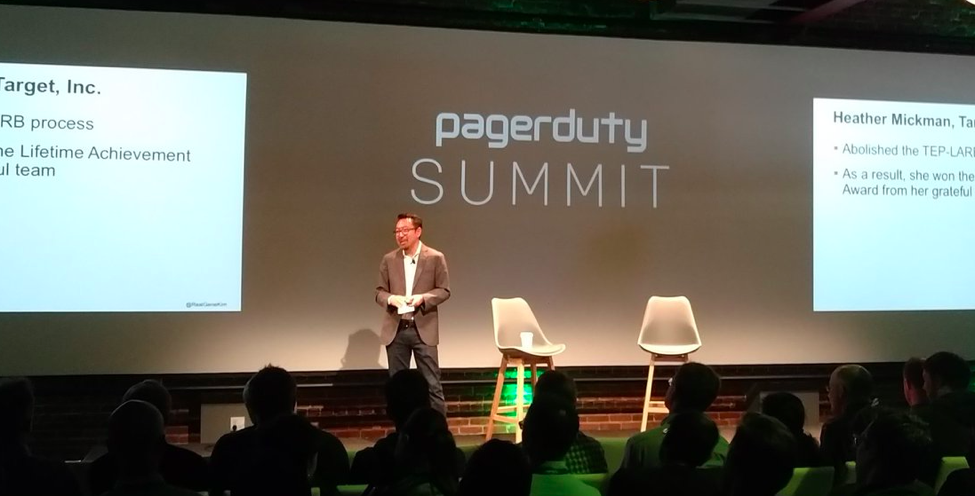
    Digital transformation may seem like the enterprise tech buzzword of the moment, but it completely came to life for attendees at the inaugural PagerDuty Summit. C-level executives, industry leaders, developers and IT operators all came together to discuss why and how companies are navigating our digital world with operational maturity and excellence.

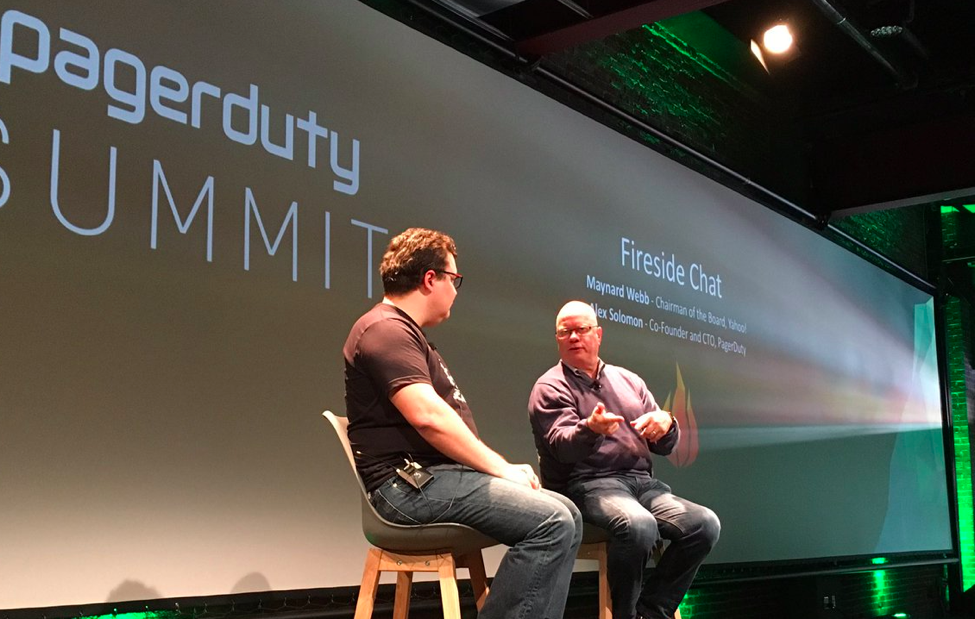
    picture1PagerDuty Summit was described as one jam-packed day filled with an impressive lineup of speakers, panelists and industry leaders including Gene Kim, author, researcher and founder of IT Revolution; Maynard Webb, chairman of the board at Yahoo!; and execs and ITOps folks from Google, IBM, Airbnb, Netflix, Splunk and more.
    Digital Dependencies

    Jennifer Tejada, PagerDuty’s CEO, kicked off the conference with an opening keynote noting digital is no longer just a convenience, but a dependency. Based on the flurry of tweets from the audience, her message about the importance of delivering digital experiences to consumers and how DevOps fits into the greater picture resonated with the audience of C-level execs, VCs, IT managers and engineers alike. Tejada pointed out how the importance of micro-moments matter in a world where the stakes are higher than ever before and just how much the end-user experience suffers if applications or services go down.

    Getting the Crucial DevOps Piece Right

    Soon after, Gene Kim took the stage to share his top five DevOps surprises and learnings for digital transformation, delivering key insights from his 17-year journey of studying high-performing technology organizations. He was preaching to the choir when he noted that the business value of DevOps is even higher than thought, and all agreed that he made a compelling case for the importance of measuring code deployment lead time. Surprise No. 5 on Kim’s list was that DevOps isn’t just for the unicorns; it’s for the horses, too. DevOps enables dynamic, learning organizations—and, equally as important, digital transformation itself, for companies in all walks of life, whether they are legacy enterprises or agile startups.

    picture2Twitter activity made it clear that attendees were particularly pleased to receive advance copies of Kim’s latest book, “The DevOps Handbook,” which has been five years in the making.
    Highlighting New Features

    No event would be complete without the announcement of new features. There were positive reports when PagerDuty took the stage to demo and share details around new platform features to make incident management and response better than ever, including:

    • Workflow Extensions: Building on PagerDuty’s ecosystem of more than 175 native integrations, organizations now can configure operational workflows between PagerDuty and other third-party services. This bi-directional flow of information helps provide consistent information across teams and services for faster incident resolution.
    • Live Call Routing: This feature allows anyone inside the organization to directly reach the operations team to report a problem by simply calling a number. Calls get routed via the same on-call schedules and escalation policies in place, and the ability to report incidents in real-time helps restore services faster.
    • Response Notes: This capability ensures that all relevant contextual and human generated data around incidents are captured and time-stamped, creating a clear timeline of the actions taken and the people involved. Response Notes delivers clear visibility on the current status of incidents and a historical record for postmortems, resulting in a reduction of future resolution times.

    Wrapping up PagerDuty Summit 2016

    picture4From the fireside chat with Maynard Webb discussing cloud wars, containers and where he sees the industry going over the next five years, and the inspiring breakout sessions on all things ITOps, the first-ever PagerDuty Summit was, from all accounts, both informative and poignant. Attendees said it spoke to how DevOps and operational excellence form the backbone of successful digital initiatives and transformation, and all walked away with strategies, best practices and use cases for adapting to the evolving digital landscape.
    For a more in depth look at PagerDuty Summit 2016, visit the blog: https://www.pagerduty.com/blog/pdsummit16-event-recap/.

    Joe Franscella is a regular devopsy.kinsta.cloud contributor and full time Bhava Communications employee. PagerDuty is a Bhava Communications client, but Joe Franscella does not work on the company’s account.

    — Joe Franscella

  • DevOpsDays and Diogenes: Thoughts from a First-Timer

    DevOpsDays and Diogenes: Thoughts from a First-Timer

    I went seeking honesty at a DevOps conference and met Diogenes.

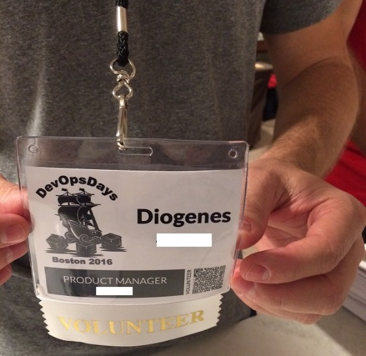
    Diogenes of Sinope was a controversial figure in ancient Athens who was known for walking around the famed ancient city—some say in the nude— during daytime with a lamp in his hand. He parried inquisitors who questioned his strange habit of using a lamp by day by insisting that he was looking for an honest man. At the recent DevOpsDays Boston, I actually met Diogenes. True story. See picture below. (Thankfully, he was wearing clothes.) But, as you probably guessed, this was not the man with the lamp, but rather one of the many conference organizers looking to help less-acquainted individuals find their way around the many meetings and speakers that filled the two-day conclave. Indeed, my Diogenes was instrumental in organizing the conversations and lectures that proved both honest and helpful.  Rather than a self-congratulatory summit, the two-day meeting was an honest conversation highlighting the advantages as well as many of the stresses befalling organizations that have adopted DevOps.

    DiogenesI found the most honest discussions were a floor up and a bit removed from the topics discussed in the main ballroom. These discussions were given the informal title of “Open Spaces” and were run in a typical un-conference format. These conversations were the real opportunities to learn about the stresses of implementing the modern portmanteau of DevOps.

    Tensions Between Dev and Ops: Why Can’t We All Get Along?

    One of the most interesting discussions in the Open Spaces looked at the dynamics between Devs and Ops. Like with any two groups that need to work together to accomplish larger organizational goals (think Sales and Marketing or Design and Engineering), there are inherent tensions that need to be overcome. The tensions between Dev and Ops are based on the different mission each pursues. Dev is striving to get software out the door as quickly as possible and push software updates forward. Ops is guided by the need to keep the ship as steady as possible, which often means limiting updates, as every update opens the door to potential bugs and deployment challenges. Starting with this premise of conflicting motivations, issues of trust and respect further complicate the relationship as each sees the other as trying to control the process.

    Yet, participants in this Open Spaces discussion were hopeful that tensions could be dissolved if management played an active role in creating cross-functional teams and managing workloads better. It was suggested that by essentially seeding Ops with Devs and vice versa, a greater community of understanding could be created. By promoting this cross-pollination, there would be greater understanding on both sides the implications (from the Dev side) of pushing software over the wall to Ops too quickly. From the Ops side, there would be greater understanding that 100 percent uptime is incompatible with dynamic product cycles that encourage innovation. A common and acceptable level of uptime needs to be agreed upon by both sides.

    For example, creating demos and code walk-throughs so both Dev and Ops can comment on potential problems and issues allows both Dev and Ops to see issues at the beginning rather than at the time of deployment.

    Blameless Post-Mortems in DevOps: Can They Exist?

    Another fascinating discussion in the Open Spaces focused on blameless post-mortems. Postmortems first and foremost suffer from an image problem. I believe it starts with the root word “mort” and it doesn’t get much better. To be clear, there was a lot of back and forth during this Open Space about the difference between a “postmortem” and a “retrospective.” Retrospectives are usually a weekly or bi-weekly event that bring to light the multiple root causes that are leading to defects or causing success through a review of RCA. In typical DevOps, one-week sprints are followed by a retrospective. Usually, the more data you can bring to a retrospective, the better. Post-mortems, on the other hand, result from an incendiary incident that was unexpected and undesired.

    Since post-mortems inevitably occur due to human oversight or lack of planning, there is no amount of thinking or planning that can prevent a crisis and thus prevent a post-mortem. As such, effective management will make post-mortems as painless as possible. The goal is to have blameless post-mortems balanced with accountability. According to one participant,

    “No one wants central casting to send in a screaming manager in a time of crisis who is only interested in assigning blame. That doesn’t help anything.”

    Importantly, you cannot fire yourself out of a post-mortem. Post-mortems are a necessary instrument to get at the root causes of issues. And while several different events can cause one issue, the post-mortem will at least begin to look at the process which caused the chaos. By not making the goal of post-mortems to find a scapegoat, the participants in one of these sessions can actually work on effective problem-solving.

    The goal of post-mortems needs to be effective problem-solving with the intent of committing the lessons learned to an actual document. It is not enough to let the lessons learned remain as an informal corpus that lives only in the heads of the engineers involved. Instead, documentation is required and it has to be in accessible place. Furthermore, it needs to be summarized and presented to management in either a lunch-and-learn or seminar so that the lessons learned then become actionable.

    Furthermore—and this was perhaps the most interesting part of the discussion on post-mortems—effective post-mortems are about getting Dev and Ops out of silos. There is no automation tool that will make Dev and Ops work together. Dev and Ops cannot just be about finding another automation tool. Instead, management needs to step in to help the process. Management needs to take engineers out of their silos and get them to work together if post-mortems are going to be really effective.

    Are You Feeling the Burnout Yet?

    After so many hours of interesting discussion in the DevOpsDays Open Spaces, I too was beginning to tire a bit. So perhaps it was well-planned to move on to a discussion on avoiding burnout.

    The artifacts of burnout are seen throughout the DevOps world as engineers constantly change jobs. This might be the phenomena of the “shiny orb,” where engineers always feel that there is a better, higher-paying job on the other side of the fence. However, as much as that might be true, it is equally the case that engineers are trying to escape burnout.

    According to the kanban methodology, which is woven into DevOps, you only pick up work as you can process it. Yet, DevOps practitioners often pick up work because they want to feel like they are team players or invincible or because they underestimate the work’s demands. They also fear the “imposter syndrome,” whereby colleagues seem less genuine if they don’t accept a piece of work offered to them. Inevitably, because the work is more than the engineer can handle, he or she becomes overwhelmed and is too proud to reach out for help.

    In a well-managed workplace, admitting overwork would not be an admission of failure. Instead, there would be a supportive culture to help the engineer or better mentoring on how to get through a challenging issue. “One-on-ones,” where the manager and individual contributor sit down together, would effectively solve the issue.

    But given the idiosyncrasies of workplaces, good management is not a given and engineers are often left to find their own coping techniques to help avoid burnout. The participants in this particular Open Space came up with the following gems:

    • Brain dumping. Empty your brain by putting all the thoughts and tasks that remain on your list and in your brain at the end of the day onto post-it notes. This helps avoid burnout because you are able to clear your brain prior to leaving work.
    • Create a Slack-based or bullet journal as a way to write yourself notes and create a list of priorities.
    • Follow the Pomodoro technique. Take a five-minute break every 25 minutes and a 15-minute break every two hours to better monitor how much time you are devoting to an issue and also to ensure you don’t forget to get a bit of movement into your day.
    • Learn how to say ‘no’ to requests. It’s a very simple word, but uttering ‘no’ once in a while will ensure that you mark boundaries and don’t take on more responsibility than you can handle.
    • Enlist management to make them aware of time you are spending beyond the normal working day and try to figure out ways to better manage the schedule and avoid burnout.

    The participants of this Open Space left with some new techniques to consider in avoiding engineer burnout. Hopefully, they will be implemented to practical advantage.

    Conclusion

    My first DevOpsDays conference was a true eye-opener.  I was lucky to get my education among such thoughtful and well-spoken individuals. I look forward to future opportunities to learn at the foot of Diogenes.

    About the Author / Orlee Berlove

    orlee_berloveOrlee Berlove is the Marketing director at OnPage Corporation located in Waltham, Massachusetts. OnPage is a cloud base incident alert and management system that elevates notifications so they continue to “ALERT-UNTIL-READ” so it’s not confused with email, SMS or phone calls. Incidents can be programmed to arrive to the person On-Call and can be escalated if they are not attended to promptly. Follow OnPage on Twitter and LinkedIn.

  • DEF CON: Where Have All the Black Hats Gone?

    DEF CON: Where Have All the Black Hats Gone?

    DEF CON is one of the most controversial conferences in the world. Only at that annual event have arrests been made, legal threats shut down presentations and zero-day attacks been anted in Texas Hold ’em games.

    The Usual Suspects

    This is a conference of people who grew up like me—people who, at 11 years old, were using IRC (internet chat relay) to share API (application programming interface) documents or download random material such as, “The Anarchist Cookbook.” We were influenced by movies such as, “The Matrix,” and “Hackers,” all the while thinking elite hacks were the cool thing to do. We spent lots of time playing Quake and other games. As we grew up, we may have gotten into trouble building projects using proggies or sharing things we weren’t supposed to share. Most of us grew up using computers to build software and make money. Some of us graduated from college and found great jobs for our skills.

    You start with chat rooms on AOL and dive deeper into IRC. You may meet people playing peer-to-peer games such as Quake. Those people share information, and, before you know it, you’ve downloaded software over peer networks and you’re sharing cracks. This is your hidden world, and your friends are handles with no name, age or location.

    Then one day you decide you’re going to meet all these handles in person at a central location that is easy to get to. You’re going to save up some really good cracks you haven’t shared yet for when you meet them. That, to me, was the adolescent rebellious start to DEF CON.

    Now, as adults, we appreciate the novelty of slipping away into childhood by attending DEF CON to witness new hacks and meet childhood hacker friends. It’s like meeting a bunch of people at your house who haven’t seen each other in a long time or only knew each other through internet chat rooms. It’s a good time to connect; it’s great to feel that energy.

    Going Down the Rabbit Hole

    Hackers are just curious folks who are so bored with all the content they consume that they turn the internet into a playground. Like every playground, there are good guys and bad guys. Sometimes they’re forced to get along. Sometimes they fight. Sometimes they decide to attack a system just because the company that runs it laid off a loved one. Other times they are just playing a friendly game of King of the Hill. You can take it too far and get in trouble or get a wake-up call. Or, you may simply grow out of it. No matter the situation, the curiosity and love for the internet remains with you; that is why DEF CON is attractive.

    DEF CON is white hats teaching black hats and black hats teaching white hats with a lot of gray in between. Everyone gets along and smiles as they watch “The Matrix” or “Hacker Jeopardy” together.

    Distinguishing the Hackers from the Hacks

    I was waiting in line. I always communicate with the people in line and ask them about the conference, current presentations and whether they have had any experience setting up XYZ or running up a large sheet of attacks using cloud networks. At this year’s event, most of the people I ran into looked like “hackers” but had no clue what I was talking about; they just uncomfortably laughed. It’s funny: They were going to presentations to see somebody talk about something highly technical, yet, they didn’t have a clue.

    Lots of folks had badges, hung out and looked as though they were on vacation and decided to check out the conference. This group, I believe, came because the conference was located in a casino in Las Vegas. The whole Vegas thing is probably the top reason why DEF CON attracted larger crowds.

    I noticed I found more competent folk at the Villages—different sections focusing on topics such as packet hacking, car hacking and social engineering. Villages had more unique, specific details on the concept of hacking in certain arenas. I found people were more in-tune and focused here. The Villages were away from the four main presentations rooms, which meant fewer tourist types. The Villages were where you found the passionate hackers.

    White or black, it was a lot of gray. I didn’t see my friends who specialize in network protection for a living using hacker tools maliciously; rather, they were curious to know how the tools work. After Justin got his MitM (man-in-the-middle) attack working, he smiled and looked at me, “Is it this easy!?” Then, “How do we stop this? Is it really just making everything TLS? That can’t be the only way.” So we ran a few Google searches to poke around deeper. When moving around the conference, you saw guys sitting on the ground running these attacks; they were just phishing to add to the wall of sheep.

    Was the guy who got paid to snoop at the Democratic National Convention convention with MitM attacks there? He might or might not have been. He might have been pioneering these attacks and learning from presenters, or he might have been so beyond what is shared at DEF CON that it was a mere novelty to attend. Even with DEF CON making it really easy to go undetected by using cash transactions, it’s still 2016 and surveillance cameras were everywhere—especially in casinos. If you’re looking to keep a low profile, DEF CON is the last place you’d want to be.

    So, I’m going to go out on a limb and say that the white hats and some grays were present with maybe a Sith Lord lurking in disguise. The true black hats were most likely reporting in remotely to their Sith while they observed petty hacks and recruited from a safe distance. Or maybe, just maybe, they were in board shorts acting like a clueless tourist.

    About the Author / Randy Apuzzo

    Randy Apuzzo_Co-founder_CEO_Zesty.ioRandy Apuzzo is founder and CEO of Zesty.io, the SaaS CMS Company. At age 12, Randy was hacking corporate sites and crashing systems for fun. As an adult, he applies his computer science and branding background as an industry visionary, architecting scalable solutions that help companies accelerate and scale their global digital content strategies. He is revered for empowering businesses with technology that grants agility, cost savings, security and increased market share. To connect with Randy, please visit https://www.zesty.io, Facebook/GoZesty, LinkedIn/Zesty-io, @RandyApuzzo and @Zestyio.

  • Jenkins World Speaker Gruver on the State of DevOps

    Jenkins World Speaker Gruver on the State of DevOps

    Santa Clara, California, will be home to the biggest gathering of Jenkins users in the world Sept. 13-15. This year’s Jenkins World conference will feature Gary Gruver, DevOps expert and author of “Leading the Transformation.” We had a chance to connect with Gary and hear his thoughts on the state of DevOps, continuous delivery and what he thinks the biggest trends are.

    devopsy.kinsta.cloud: As continuous delivery (CD) and DevOps continue to be adopted and advance, what specifically should we be on the lookout for?

    Gruver: I believe the biggest opportunity for breakthroughs in CD and DevOps is in large, complex, tightly coupled systems. Most DevOps implementations have been with smaller teams—whether in small businesses or large businesses—that allow these small teams to work fairly independently. Currently, these are the fastest moving, most innovative DevOps implementations. That said, I feel the biggest opportunities for positive business impact are in the larger, more complex systems just because they are currently much less efficient. This is why I think we will see the biggest improvements in those environments, and innovations and updates will track towards these advancements.

     devopsy.kinsta.cloud: How are technologies like containers becoming a bigger part of an automated pipeline?

    garygruverGruver: Containers make it easier and less complex to move to infrastructure-as-code, which is one of the big breakthroughs of DevOps. This space is moving quickly because of how important environment consistency is to companies. It will be interesting to see how this space evolves over the next few years.

     devopsy.kinsta.cloud: What advice do you have for enterprises just starting their DevOps journey?

    Gruver: Segment the applications down into different deployment pipelines to make the problem as small and less complex as possible. A deployment pipeline should include all the applications that have to be qualified and deployed together because of their architectural coupling. Then, optimize each deployment separately based on DevOps principles instead of forcing everyone to implement all the same DevOps rituals like was common with previous agile transformations. This is a topic I can spend quite a bit of time discussing and thinking about, as you can read more about in my book!

    devopsy.kinsta.cloud: What roadblocks still exist for companies trying to adopt DevOps?

    Gruver: Finding executives that are willing to engage with their organizations and lead the DevOps transformation is a solid roadblock. It is still new concept in larger enterprises that require the multiple acceptance from members of the C-suite.

    devopsy.kinsta.cloud: What do you find most exciting about the current state of CD?

    Gruver: It is finally scaling to large organizations where the majority of the code that is being worked with exists and therein are the biggest opportunities I see for improvement. This means that DevOps is being introduced right up the chain, extending it from just the realm of IT.

    devopsy.kinsta.cloud: What do you want Jenkins World attendees to know about your keynote?

    Gruver: I am planning to provide a framework you can use to help align your large organization on your DevOps journey. My objective is for DevOps practitioners in organizations of all sizes to walk away with tips for implementation and a better understanding of best practices to apply to individual DevOps journeys.

    devopsy.kinsta.cloud: What does being “all-in” on DevOps mean to you?

    Gruver: To me, being “all-in” on DevOps means that everyone one is committed to the DevOps principles and is working together to continually improve the development and delivery processes. In other words, they have the same approach to achieving the same goal.

    devopsy.kinsta.cloud: Where do you think DevOps adoption is today?

    Gruver: Mature in unicorns and just getting started in large enterprises; hence, there are so many opportunities!

    To learn more about Gary Gruver and his approach to DevOps, please visit his homepage. While you’re at it, download a sample of his latest book, “Leading the Transformation.” Interested in learning more about Jenkins World or attending this year’s Jenkins World? Click here and register with the code JWDEVOPSCUST to receive a 20 percent discount.

  • Call for Papers Now Open: CD Summit and Jenkins Days Fall Tour

    Call for Papers Now Open: CD Summit and Jenkins Days Fall Tour

    After a successful spring run, devopsy.kinsta.cloud, where the world meets DevOps, along with premier sponsors, CloudBees, the enterprise Jenkins Company and IBM, today announced that their DevOps Connect: CD Summit/Jenkins Days roadshow will continue this fall with seven dates in the United States and Europe. The call for speakers to appear at these events is now open. Today we are announcing the shows will be coming to Atlanta, Denver, Austin, Seattle, Los Angeles, Berlin, and Amsterdam.

    I began my employment at devopsy.kinsta.cloud as a web admin and social media manager. Shortly thereafter, I became marketing and media manager. I had decent education surrounding web scripting (HTML/PHP/CSS/Photoshop), but none about DevOps and software engineering. I attended the spring events and had a front-row seat to the summits and what they had to offer. The keynotes offered a plethora of information surrounding Jenkins, BlueMix and how to undertake a DevOps transformation at the corporate level. We were honored to have Kohsuke Kawaguchi, CTO of CloudBees and founder of Jenkins, offer his unique perspective on the growth of Jenkins, joining CloudBees, and the development of recently released Jenkins 2.0.

    Our other two keynotes featured individuals we were lucky to have. Gary Gruver, who led the transformation at HP and Macy’s, outlined what he walked into, how he changed the company, and what happened when we walked away. He gave a clear-cut story about the transformation he embarked on when joining those companies. The third keynote came from Mustafa Kapidia of IBM. Mustafa was such a captivating speaker who really knew how to gauge his audience’s knowledge surrounding DevOps and continuous delivery.

    The breakout sessions in the afternoon following lunch offered a bit of something for everyone. There were three separate tracks: technical, management and Jenkins. The technical track was just that: a track devoted to the more technical-oriented crowd such as engineers and developers. The management track was devoted more to those looking to undergo transformations, incorporate DevOps at their workplace, and manage DevOps teams. The Jenkins track focused solely on information that was connected to utilizing Jenkins in the workplace.

    In addition to the summit itself, CD Summit and Jenkins Days feature a day dedicated to workshops on DevOps, IBM BlueMix and Jenkins. These were a hit from the get-go, pulling in people of all levels, from developers to executives wishing to broaden their knowledge. The fall will feature the workshop day as well.

    I met a lot of people during my time at these events, cementing the fact it is a great place to network and learn about different companies and how they are doing devops. Prior to attending these events I only knew a small chunk about DevOps/CD/CI based on the articles we publish on devopsy.kinsta.cloud and from my interaction with professionals in the industry. By attending the events I expanded my knowledge, greatly improving my capacity to understand what occurs from the junior level to the executive level at a company utilizing DevOps practices and principles.

    According to the press release, “These events are designed for Enterprise Managers and Buyers along with Developers, Engineers, Sys Admins, and Architects. With three main tracks focused on IT managers, technical engineers, and Jenkins practitioners, attendees will get access to the best minds in CD and DevOps. The presenters are experienced developers, build managers, QA, DevOps practitioners, IT managers/executives, architects and IT operations who are luminaries within the DevOps community.”  I would recommend attending this event for anyone who fits this description, and for anyone outside the realm of this description who wishes to learn more about DevOps or continuous delivery.

    Today we are opening up the Call for Papers for the fall events. Anyone who would like to submit their entry can follow the respective links below for each city:

    For more information please visit http://www.devopsconnect.com

    Link to the press release: https://devopsy.kinsta.cloud/2016/06/27/devops-connect-cd-summit-and-jenkins-days-fall-schedule-announced/