Tag: compliance

  • CloudBees Acquires Neuralprints to Shift Compliance Left

    CloudBees Acquires Neuralprints to Shift Compliance Left

    At the online DevOps World 2021 conference today, CloudBees revealed it has acquired Neuralprints to provide the core technology for CloudBees Compliance, a real-time compliance and risk analysis platform that it will roll out in the first quarter of 2022.

    At the same time, CloudBees has enhanced the feature management capabilities of its namesake continuous integration/continuous delivery (CI/CD) platform to provide greater visibility into and control over feature flags that are now widely used to add new capabilities to applications.

    Prakash Sethuraman, chief information security officer (CISO) for CloudBees, said CloudBees Compliance will make it possible for DevOps teams to continuously enforce compliance policies as part of an effort to better secure their software supply chains. Those DevOps teams will be able to enforce compliance across code, binary artifacts, data, identity and infrastructure environments in a way that provides developers and IT operations teams with instant actionable feedback to enable issues to be addressed long before an application is deployed in a production environment.

    CloudBees Compliance is based on a mix of open source and proprietary technologies developed by Neuralprints and will be made available for on-premises IT environments as well as via a software-as-a-service (SaaS) application. The goal is to enable organizations to manage compliance as code as part of any effort to shift more responsibility for application security further left toward DevOps teams, said Sethuraman.

    CloudBees Compliance

    A survey of 500 C-level executives published today found nearly half (45%) admit that initiatives to secure their software supply chains are halfway or less-than-halfway complete. Nevertheless, 95% claimed their software supply chains are secure (95%), with more than half (55%) posting they are very secure.

    A full 93% said they are prepared to deal with an issue such as ransomware or a cyberattack on their supply chain. However, nearly two-thirds (64%) admitted they are not sure who they would turn to first if their supply chain was attacked; with 58% admitting that, if they experienced an attack, they have no idea what their company would do. An equal percentage (64%) said it would take more than four days to fix the problem if they did experience an issue.

    Almost all C-level executives (95%) said they think more about securing the supply chain now than they did just two years ago, and 92% said a security issue would impact their brand. A total of 83% said security issues cause their developers to drop everything to review code, with 82% noting that caused the organization to spend less time on innovation.

    On the plus side, 95% of executives said container images are checked for high or critical vulnerabilities, while an equal number said automation access keys are set to expire automatically. A total of 92% said their company only accepts commits signed with a developer GPG key, while 90% said dependencies to trusted registries are limited at their organization, while 89% said administrative access to CI/CD tools is restricted (89%).

    Of course, what C-level executives believe and what actually occurs inside an organization are not always one and the same. A series of high-profile software supply chain breaches resulted in a number of organizations reviewing their software supply chains. At the same time, the Biden administration has issued an executive order requiring all federal agencies to conduct similar reviews.

    One way or another, most organizations will soon find themselves embracing a wider range of DevSecOps best practices to ensure the integrity of software supply chains no matter how secure they may think their software development platforms are today.

  • Relyance AI Shifts Compliance Left Using ML Algorithms

    Relyance AI Shifts Compliance Left Using ML Algorithms

    Relyance AI emerged from stealth this week to unveil a namesake platform for managing privacy and data governance in real-time within the context of a larger DevOps workflow.

    Fresh off raising $30 million in seed capital, Relyance AI co-CEO Leila Golchehreh said organizations can now quickly and accurately answer essential privacy questions and ensure compliance and governance by mapping requirements directly to their codebase. The platform provides transparency and visibility all the way down to the source code in real-time using machine learning algorithms, she added.

    Relyance AI co-CEO Abhi Sharma also noted most legal and data protection teams today have limited visibility into digital operations. Developers and data scientists are constantly creating and updating applications. By the time compliance teams gather the data required, it’s obsolete, said Sharma.

    The Relyance AI platform analyzes contractual requirements against the operational reality as determined by data processing in real-time. Compliance teams can then address privacy issues as they arise, added Sharma.

    At the core of the Relyance AI platform are five integrated components that first inventory assets by connecting to application programming interfaces (APIs); generate universal records of processing activities (ROPAs) by scanning code and understanding how data is being processed; share alerts when issues are detected; provide views into data life cycles to highlight data subject access request (DSAR) exceptions and extensions and address vendor life cycle management to ensure third-parties are complying with policies.

    Relyance AI

    Sharma said compliance, much like security, is shifting further left toward application development as organizations look to eliminate issues before they arise in a production environment. The Relyance AI platform is designed to be integrated with continuous integration/continuous delivery (CI/CD) platforms that are the core of modern software development life cycle processes, he added.

    Undoubtedly, as the worlds of compliance and application development collide, there will be cultural challenges similar to what is now occurring with the rest of DevSecOps best practices that require more collaboration between developers and security teams. The challenge is compliance officers tend to be even further removed from application development than their IT security counterparts.

    However, it’s now only a matter of time before compliance becomes code. Modern applications already make use of the Open Policy Agent, for example, to embed compliance rules in applications. AI platforms should make it simpler to identify compliance issues as they arise so that they can be addressed before any infraction ever occurs.

    DevOps teams, of course, have a vested interest in managing compliance as code. It’s not uncommon for DevOps teams to race to build and deploy an application only to encounter a wave of compliance issues that need to be addressed by recoding elements of the application. Not surprisingly, those compliance issues often result in application delivery deadlines being missed. Machine learning algorithms provide an alternative to the current raft of documents that compliance officers create, but not enough other members of the IT team read those, much less understand them.

  • Mainframe Output Management That Drives Efficiency

    Mainframe Output Management That Drives Efficiency

    Mainframe output management that drives efficiency and increases security
    Simply providing access to reports and data on the mainframe is no longer enough for today’s stakeholders. Your users—whether they’re employees, partners or customers—increasingly expect a more modern digital experience and efficient workflows. And with more regulation and restrictions impacting data security, you’re expected to protect all data, regardless of platform. Rocket® EOS 360 integrates with mainframe environments to capture output from applications, manage the storage of that data and provide fast and secure access for users.

    Quickly improve mainframe output management efficiency
    Rocket EOS 360 allows you to allocate precious MSUs to business-critical applications, improving the efficiency of your output management system.

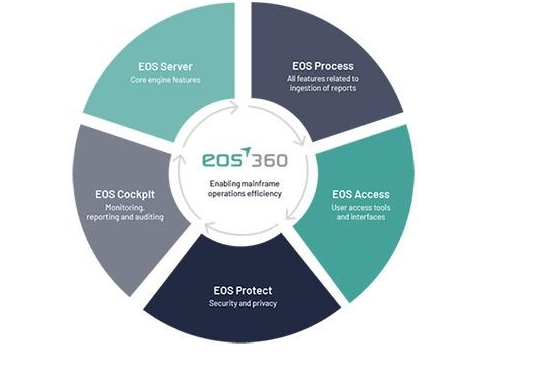
    Rocket EOS 360 Platform:

      EOS Server: Integrated components for storing and managing the data
      EOS Process: High speed, scalable ingestion of large data streams
      EOS Cockpit: Insight into EOS activity
      EOS Protect: High level encryption module to secure sensitive data
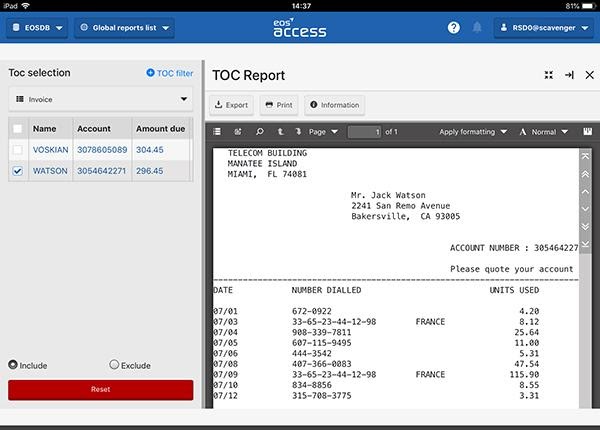
      EOS Access: Secured access to reports from any device through a modern interface

    Ensure data security and regulatory compliance
    Rocket EOS 360 centralizes your data and provides a single, secure point of access to ensure you stay in compliance with any regulations and minimize the risk of a data security leak.

    Improve user experience and optimize workflows
    Rocket EOS 360 provides a modern user interface that helps you retain talent and the ability to integrate with web services to build customized experiences for users such as partners and customers.

    Expertise in mainframe management
    Rocket Software is helping a new generation of managers and stakeholders to not only understand and leverage the mainframe intelligently, but also to merge modern technology with legacy infrastructure for a competitive edge and drive the user experience for today and tomorrow.

    Read the datasheet.

  • Building DevSecOps With Value Stream Management

    Building DevSecOps With Value Stream Management

    As teams develop software, testing for potential security risks and flaws is mission-critical, just as it has always been. Yet, cyberattackers continue to exploit code vulnerabilities as open source code remains the foundation for the majority of commercial applications across all industries. Security firms are churning out solutions at an aggressive rate, and both project managers and their teams hope they can purchase some bolt-on tool or license a service to take care of security, painlessly. In the end, vulnerabilities still occur.

    The most effective pathway to secure software code has always been to eliminate vulnerabilities. The question today is, “What is the best way to achieve that goal given such an accelerated, threat-laden landscape?” Before we dig into that answer, let’s take a closer look at the problem.

    Software Security Is Everyone’s Issue

    Even the largest organizations, from Adobe to Microsoft, have been humbled by the number and scope of code vulnerabilities that have been overlooked—and therefore escaped into public release—due to the frenzied pace of software updates. Here’s just one example:

    On May 11, 2021, Adobe issued a security update for Adobe InDesign that addressed multiple critical vulnerabilities. “Successful exploitation could lead to arbitrary code execution in the context of the current user,” the security bulletin read. “Arbitrary code execution in the context of the current user” is cybersecurity speak for “an attacker can execute arbitrary commands or code on a target machine or process.” Arbitrary code execution vulnerabilities are known to be one of the top attack vectors that lead to system penetration resulting in data breaches.

    Given the enormous effort companies and their software teams are exerting today, and the importance of avoiding software flaws in the current threat landscape, how is this happening? It doesn’t help to have publicly available lists of software vulnerabilities posted on the dark web and CVE (ironically, a database of vulnerabilities launched to help companies improve their cybersecurity). Hackers — from solopreneurs to nation-state teams — are having a field day with this information.

    Rearranging the Puzzle Pieces Doesn’t Guarantee Security

    In an attempt to resolve this challenge, industry professionals are coining new terms and calling for new approaches. One I have seen promoted recently is “SecDevOps” rather than “DevSecOps.” With SecDevOps, they assert, security is first—conducted at the start of the project and maintained all the way through.

    This approach isn’t new—it’s essentially a variant of shifting left, which for more than a decade has been an established mechanism in software testing for finding flaws and “failing faster.” In my experience, while failing earlier and faster with any software endeavor has considerable value, it is not automatically going to highlight all security challenges and enable their resolution.

    It is just as important for DevSecOps teams to collaborate and work together, not only to support development and operations, but also to ensure security, compliance and governance are built into every piece of code.

    Insight Is Preferable to Blind Interpretation

    Unfortunately, achieving that collaboration productively comes with challenges. DevSecOps teams need rich, real-time visibility into code vulnerabilities, early, so they can act on that information and update code as it moves through the pipeline. To do that, they need actionable insight—not a motley assortment of data that’s open to interpretation.

    In value stream management, we have seen firsthand while working with our clients that several techniques can be applied to eliminate vulnerabilities more quickly and effectively. All of these approaches hold value, whether a firm is seeking to deliver a new product to market or secure its current software pipeline.

    • Amplify feedback loops. Continuous feedback loops—from DevSecOps tools, for example—give developers more detailed insight into their code’s vulnerability.
    • Run security scans. Give testers the ability to run security scans on their code even before it is committed to identify security vulnerabilities as early as possible.
    • Leverage reporting and analytics. Gaining early access to as much insight as possible makes teams and management more confident regarding swift action to resolve code deficiencies.

    These approaches also support governance and compliance initiatives. As a bonus, they boost software quality, as well.

    The Business Case for Built-In Security, Governance and Compliance

    As mentioned earlier, these activities are integrally connected with the effort to eliminate code vulnerabilities. In case you are thinking, “This is obvious,” take a moment to reflect on this statistic: 60% of data breaches involved vulnerabilities for which a patch was available but not applied.

    The sheer scope of the problem also underscores the lack of attention to security and governance—and any compliance requirements that accompany it.

    Half of websites in production have high-risk vulnerabilities, and 82% of these are located in application code.

    The high percentage of errors in source code suggests it was not checked for vulnerabilities during development, signaling that developers focused on app functionality and gave short thrift to security. This often means they don’t have a program for governance and compliance, either.

    In my experience, a primary reason for these failures is that teams don’t have actionable information from the activities mentioned above, such as real-time feedback from DevSecOps tools. Developers need this insight when they are resolving sprint backlogs. Information relating to high-level security issues must be available so it can be addressed, with issues prioritized and resolved, and not left sitting in siloed DevSecOps tools.

    In many ways, DevSecOps is in the same stage of transformation as DevOps was a decade ago. Teams are frustrated by needs they do not know how to meet, and they hope for fast resolution in the form of tools and solutions. As with virtually every other software challenge over time, there is no replacement for getting in the trenches and fixing the problem rather than placing strategic band-aids.

    If you are not subject to compliance mandates and therefore dismiss the value of software governance, consider this: If your team misses a software vulnerability that results in a major data breach because you didn’t have the insight to identify it—or the governance to ensure it was addressed—your firm may not recover. The imperative for software security—and the governance that helps ensure it stays that way—should be sufficient for organizations to take vulnerabilities seriously.

    Effectively applying the insight gleaned from software code reporting and analytics is the surest way to eliminate vulnerabilities. As an added benefit, the reporting and analytics that informs the software effort can also make the case to upper management for the value of launching future improvement initiatives.

  • Managing Cloud Governance Costs Collaboratively

    Managing Cloud Governance Costs Collaboratively

    For those responsible for managing infrastructure, the concept of governance is common, especially as it relates to cloud services. For cloud services, it’s defined as a framework that guides how end users use these services by defining and creating policies to control costs, minimize security risks, improve efficiency and accelerate deployment.

    The term is often associated with “rules” or “compliance” and can restrain innovation within an organization, as it typically is mixed with regulatory bodies and governance procedures that add cycles to required tasks. But what if we could flip the script and make governance more of a collaborative effort? What if we used an approach wherein teams across an organization share information and feedback for better business outcomes?

    This collaborative approach can be beneficial in ensuring everyone is on the same page, enabling businesses to get the most out of their cloud infrastructure while ensuring costs stay within budgets.

    Legacy Governance Overshadows Growth and Creativity

    Legacy governance is an extremely paranoid way of running your business. For example, blocking people or departments from making buying decisions is a perceived best practice to avoid overspending on cloud infrastructure. Unfortunately, this is actually the opposite of what organizations with cloud infrastructure should do.

    The advantage of the cloud is that it gives your organization the ability to develop and bring products to market faster—and at a lower price point—than traditional methods. Following legacy governance processes—adding more steps to the process for provisioning resources—results in slower launch times and overprovisioning of resources (since there is a lack of visibility and teams are not sure when they will get more), negating the cost benefits of on-demand cloud infrastructure over traditional data centers.

    Empowered Employees Produce the Best Results

    Think about it: An overbearing manager or boss makes you feel like you’re walking on eggshells when it comes to your work. Sometimes, this is the same effect legacy governance policies can have on employees.

    Removing access barriers and giving team members the freedom to easily request and use resources should be a cloud operator’s ultimate ambition. It’s also cost management that’s collaborative.

    The idea behind a collaborative approach to managing costs is that the individuals who work on the projects themselves–whether that is the engineering team, DevOps teams, etc.–are best suited to manage them and provide the proper infrastructure recommendations because they know what their needs are.

    To receive the full financial and organizational benefits from a collaborative approach, there are three simple steps to take:

    Have a Consistent Source of Truth

    Have a consistent and agreed-upon source of truth for decision-making and self-evaluation against key metrics. This means that everyone in the business—executives, finance, managers and individual contributors—are aligned and looking at the same numbers. When this happens, teams spend less time haggling about ownership and more time looking at how they can improve. When this doesn’t happen, the focus turns to storytelling about why the numbers are wrong, not solving the underlying inefficiency problem.

    Trust the Team

    Trust the members of your organization to leverage this information for the best possible business outcomes.

    Collaborate

    Encourage collaboration inside and between layers of the business to ensure the decisions are made with the complete picture in mind.

    Implicit tradeoffs are made every day at every business level for teams to align their work to organizational priorities. Encouraging collaboration between different layers, viewpoints and skillsets in the business helps to highlight these implicit decisions and make them explicit, intentional and agreed-upon

    Moving away from legacy governance to a more collaborative approach is within reach for any organization. The key is understanding what methods are required for the transition to be a seamless and positive experience that teams will embrace.

  • Are Developers Responsible for Open Source Governance?

    Are Developers Responsible for Open Source Governance?

    There are lots of factors in the open source software world converging to make it a big year for “shift left” in software development. Heightened security concerns, an increasing need for software supply chain visibility and the growth and complexity of open source ecosystems will continue to push the responsibility for ensuring code is secure earlier in the engineering process as far left as the request and design phases.

    This means 2021 will be yet another year in which developers are challenged to take on more responsibility, and pushed further onto the front lines of open source governance. Developers will need access to the right training, resources and tools to do this job. But they also can’t be successful if they’re expected to do it alone. Shift left can’t mean shifting all responsibility to the developer as the sole protector of secure code and the only go-to open source expert. The reality is that the depth, breadth and complexity of open source governance in 2021 demands a cross-functional team and layered approach.

    Equipping Developers With Governance Knowledge

    Let’s start with how to better equip developers and other stakeholders in the governance process, including legal, security, IP compliance and product people. These teams need enough knowledge to be aware of the top compliance issues, and their corresponding remediation options, to be active contributors in this rapidly evolving space. Research from Forrester shows that of the top 40 computer science programs in the United States and the top five programs internationally, none include open source licensing and security coding practices in the curriculum.

    Instead, it has fallen to the industry itself to impart this expertise on the job. Leading companies are packaging open source training programs into something that resembles standard HR-led and managed training, including check-ins and quizzes to test and solidify knowledge, and regularly updating content and scheduling trainings to make sure people stay abreast of changes and challenges. In the spirit of open source, many industries work collaboratively to share best practices on governance in this regard, with industry experts speaking on the topic at other companies. Others are leveraging existing management training courses, such as the ones offered by the Linux Foundation.

    The growing importance of the Software Bill of Materials (SBoM) also points to the need for cross-functional collaboration. Software supply chain visibility will become even more crucial in 2021 so that companies can build and sell secure and safe products, as well as ensure compliance. More people across the organization will need to access and view the SBoM in ways relevant to their functional needs. As a result, its assembly is transforming from being assembly-line-esque (passed along and viewed in the context of siloed business functions) to becoming much more collaborative. The SBoM is becoming akin to a business intelligence tool, providing the ability for different functions and stakeholders to filter for relevant information.

    Depending on your function, you may be interested in a top-down view of the open source and third-party components across your portfolio of products in order to understand risks in the organization. For instance, as an engineering leader, you may want to understand if you are impacted by a new security vulnerability, where in your portfolio of products you may be exposed and the current status of remediation work for that vulnerability. If you are in legal, you may be interested in a significant licensing change for a component in use at your organization. This allows you to be prepared with changes to legal policies for automated reviews and obligation fulfillment guidance for engineering when the next build occurs and a more recent version of a dependency is pulled in. If you are in the export control function, and are required to provide your application’s encryption capabilities as part of the certification process, understanding which open source components are part of the application, and which provide cryptographic capabilities is essential. Finally, don’t overlook your customers, who today are requiring open source disclosures as part of commercial software contracts to protect themselves from insecure software.

    Collaboration has also been made simpler by the fact that new industry standards now enable an asset portfolio view of open source security. Open Chain obtained ISO certification in late 2020, ISO/IEC 5230:2020, providing a clear and effective process management standard for open source license compliance. It allows companies of all sizes and in all sectors to adopt the key requirements of a quality open source compliance program. Coupled with ISO/IEC 27001–the de facto standard for managing security in information security management systems (ISMS) – organizations can now take a more holistic view of all of their software assets in an effort to make the information they hold more secure.

    Open Source Program Office

    The best way to ensure developers aren’t left footing the bill for open source governance is to create a centralized team dedicated to it. Savvy organizations could form an Open Source Program Office (OSPO), which brings together key stakeholders in legal, engineering, product and security to develop, communicate and operationalize open source strategy for their entire organization. This team works to define a framework and process for consuming open source software as part of their development work (inbound use case) and/or contributing code to the community via open source projects (outbound use case). The mission and main charter of these teams is to help their organization create and manage an open source strategy in terms of the adoption, use, support, participation and development of open source software. However, they’ve also found their role has evolved to become the experts on open source internally and evangelists of the technology and its use.

    The bottom line is that the developer’s job is to develop software – and every piece put in place for stronger open source governance means less time spent focusing on the problems that could be in the open source code and more time on the promise of using it to rapidly innovate for the benefit of their customers.

  • How Low-CodeOps Can Transform DevOps

    How Low-CodeOps Can Transform DevOps

    Over the past year, enterprise adoption of low-code software development platforms surged across the world economy as COVID-19’s economic consequences drove an unprecedented number of digital initiatives. Enterprises are turning to low-code platforms to rapidly build new apps that empower customers, remote workers and external end users conducting business operations or pivoting to new opportunities.

    Accelerating software development, however, only solves half the puzzle of a digital-first approach. Quickly getting solutions into users’ hands requires careful planning to determine how these new applications will function within the organization’s overall software operations strategy. This is often conducted across multiple cloud deployments.

    But the real prize comes when low-code’s underlying principles of automation and abstraction are extended into the DevOps domain of software maintenance and management. The ability to push out a continuous pipeline of software updates with the click of mouse, with streamlined testing and quality assurance, requires a platform that automates myriad, time-consuming tasks associated with building, testing, releasing and maintaining applications in an enterprise-grade production environment. This inevitably leads to the concept of “low-code operations;” or, to coin a phrase, “Low-CodeOps.”

    Indeed, unless the benefits of abstraction and automation — in this case, primarily speed — extend to operations and deployment, the real benefits of low-code development are elusive. A platform that lets you build an app in six days but requires six months to deploy is no solution at all.

    Harnessing the Cloud for Game-Changing Results

    To witness the vital role seamless cloud operations played in business innovation, look no further than biotech giant Moderna and its success in Operation Warp Speed. Moderna used the public cloud to pull together geographically dispersed collaborators, integrate scientific insights and refine its production cycle, enabling the company to deliver its first batch of mRNA vaccine samples a mere 42 days after the COVID-19 virus genome was sequenced. The time-to-value for this solution was definitely warp speed.

    And, it’s safe to assume, expensive. Cloud engineers and DevOps system administrators are highly skilled specialists who roll up their sleeves at 2 a.m. to fix unexpected glitches buried deep in the connected ecosystem of software operations. They figure out how to make the software actually run. Enterprises, no doubt, wish they could hire more of them.

    But the same shortage of skilled IT professionals that fueled today’s demand for low-code software development also impacts DevOps. In this case, the same low-code platform is the solution, empowering a wider cross-functional, collaborative team to reduce operational burdens — in a word, Low-CodeOps.

    Essential Features of Low-CodeOps

    To achieve a frictionless handoff when moving applications and data to the cloud, a production environment leveraging low-code principles will deliver on these key principles of low-code operations:

    Performance monitoring: Daily monitoring and log checks of platform infrastructure are the backbone of modern DevOps operations, ensuring that complex interdependencies are running smoothly. Automated dashboard monitoring can transform hours spent on these repetitive tasks into opportunities for engineering teams to focus on innovation, while still ensuring the health and performance of enterprise software portfolios. The tooling needs to enable automated end-to-end visibility into application workloads and performance characteristics of upstream and downstream services.

    Compliance: Every economic sector is subject to specific government regulations. Software platforms and DevOp teams must keep track of every requirement when integrating new functionality into software upgrades. Banking customers must deploy digital solutions on infrastructure that’s earned ISO/IEC 27001 certification. Healthcare solutions must conform to federally mandated HIPAA requirements. Defense contractors must be FedRAMP certified. Data—the lynchpin of any digital solution—is subject to privacy laws that differ across nations and borders. Imagine having to manually recheck every iteration of your application deployments for compliance. Luckily, low-code operations mean having an automated, system-wide compliance framework in place. This makes short work of service organization (SOC) audits and reporting.

    Security: Cyberattacks that lead to system outages and disruptions are a growing concern in our digitally connected world. Well-resourced cloud giants are not exempt from damaging cyberattacks, such as last year’s SolarWinds hack. Resilience is key. Ongoing security scanning can halt automatic software deployments when suspicious changes are detected. Prevention is always best. Monitoring tools identify vulnerabilities, enabling systems to quickly come back online and help prevent outages that can last for hours or days.

    Infrastructure independence: Widespread enterprise adoption of multi-cloud and hybrid cloud for operational efficiencies has made flexible infrastructure the new standard. Organizations are bypassing single-vendor lock-in to spread workloads across multiple cloud partners. That means DevOps needs streamlined configuration and management tools that can track relationships between resources and keep track of compliance issues. Geopolitical considerations may enter the equation when cloud providers turn out to have close ties with governments antagonistic to other global trading partners. Monitoring instruments that provide observability across the range of vendors consuming enterprise data and applications is mission-critical.

    Resilience: Snafus happen. Platforms can automate continuous domain-level metrics to correlate performance from different sources (including logs, metrics, application tracing and outside penetration testing), speeding up detection and response time. Fast auditing and debugging tools, combined with real-time dashboard monitoring and system-wide alerts, plus an ounce of detection, equals a pound of cure. For agile DevOps teams, reactive firefighting is transformed into resilient firepower.

    Adopting an All-in-One Low-CodeOps Approach

    Low-code’s power to enable frequent iterations of software ideation, creation and deployment may seem contrary to the DevOps mission to minimize risks. However, the same radical abstraction and automation that has made software development faster, higher quality and more accessible to a larger cohort of developers can also reduce the operational burden of landscape management. Every low-code vendor touts the governance features in its platform. But the nuts and bolts of governance require some assembly, including system-wide actionable monitoring, testing alerts and compliance safeguards. Low-CodeOps combines the most efficient, agile, flexible development platform and powerful, streamlined operations tools, infusing both domains with solid guardrails for operational control and predictability. Adopting this approach will greatly increase time-to-value for enterprises, putting innovative digital solutions directly into the hands of end-users with the click of a mouse.

  • DevSecOps: Bringing Compliance to DevOps

    DevSecOps: Bringing Compliance to DevOps

    In today’s fast-paced business environment, the division of DevOps and SecOps must be bridged to create DevSecOps

    Now that the “X-as-a-service” model has taken hold, enterprise infrastructure, integration and solution delivery has accelerated rapidly. Waterfall methodology has given way to the Agile framework of rapid, continuous development and delivery. This necessitates the use of automation to speed QA and change management.

    In the midst of all this change and activity, a deeper goal is to make security and compliance part of the dev process from the ground up. For this to succeed, teams must take on a DevOps mindset regarding these aspects—one that places a priority on fast delivery and automated workflows.

    The tricky part is that DevOps and SecOps/compliance thus far have had different priorities.

    DevOps focuses on things such as policy management, monitoring, code inspection and risk mitigation. SecOps needs to anticipate risk and ensure controls are retroactively mitigating compliance and security risk. The inherent conflict comes from a traditional view that security review should come after software development as a final check, but instead ends up becoming a fractious process of reconciling necessary controls into the release cycle.

    Because there is a natural tension between DevOps and SecOps, as they have different charters and cultures, bringing about the idea of shared responsibility can be difficult. DevOps can be seen as more of a do culture (Atlassian calls this a “do-ocracy”) and SecOps can be seen as a control culture and they are inherently in conflict. To fulfill the promise of teaming for shared responsibility, DevOps and SecOps should align on three key objectives: collaboration, communication and integration.

    The Benefits of Collaboration in DevOps

    Emphasizing collaboration between an organization’s operations, development, testing and support teams is what DevOps is all about. The focus is on reducing time to market and improving agility through rapid development and rollouts. However, before the process of development can begin, you need to start with a plan. At the planning stage of development is where security and compliance can start to be incorporated.

    Organizations need to build a system of record that can implement and orchestrate the SecOps portion of the development plan. Policies and controls can be widely disseminated across product and engineering teams to document the intention of controls, define their implementation and enable teams to collaborate with comments and feedback in one hub.

    Closing the DevOps Communication Gap

    There exists a communication gap between the security function and the rest of the dev organization, and it is critical that security practitioners bridge that gap. Compliance and security can be viewed pejoratively by other teams because people don’t understand them or see their relevance to users’ lives. But this, too, can be changed.

    For instance, it’s better to talk about a security risk in terms of project delays and unplanned, unscheduled work rather than talking about a breach or a vulnerability. When speaking to operations teams, it’s better to talk about availability and user privacy requirements as correlated with mean response time or system uptime rather than a data breach. To succeed in a world that’s moving at the speed of DevOps, security groups need to be able to articulate control requirements in both the language and tools that DevOps lives in, such as Jira and GitHub.

    Integrating Sec Into Dev

    For security practitioners, the most radical process departure here is often the high degree of automation and workflow tools in DevOps. The critical success factor for integrating security and development operations is to make control implementation easy and clear for developers to follow. For example, if the team is working toward a SOC2 security certification, then a clear control framework broken down into tasks and issues will ensure a smooth integration of security into the dev cycle. A SOC 2 attestation will also require evidentiary verification that controls are implemented throughout the software development life cycle (SDLC), including release cadence. The final critical piece to achieving readiness for a security certification is to have integrated risk assessment, controls gap analysis and audit-ready evidence for your observation period in one central place.

    DevSecOps: Greater Unity, Stronger Security

    In a world where everything is offered “as a service,” the pressure is on to iterate quickly and non-stop. To make this possible, the DevOps methodology relies on the speed that comes through automation. But security is sometimes overlooked in favor of speed. That means security needs to automate, as well, to keep pace with continuous delivery. The division of DevOps and SecOps must be bridged to create DevSecOps.

    Understanding the benefits of this collaboration will go a long way toward easing the transition, as will learning how to communicate those benefits in a language that appeals to all stakeholders. What will enable the collaboration is an orchestration and demystification of security and compliance for the entire dev team. When DevSecOps is straightforward and simple for developers to integrate security, there won’t be a reason not to, and your product and organization will be more secure.

  • 20/20 Network Visibility: Making Cloud Migration a Success

    20/20 Network Visibility: Making Cloud Migration a Success

    Organizations need to take a considered and gradual approach to cloud migration to ensure security and compliance

    For businesses to succeed in 2021 and beyond, agility and responsiveness are critical. Data is the new currency, and businesses need to be able to access theirs instantly and securely to make the rapid-fire business decisions that will make or break their long-term strategies. One way IT can improve responsiveness and business agility is by moving business applications to the cloud.

    When migrating applications to the cloud, the need for network security is often overlooked. When this happens, applications are deployed in the cloud without adequate security and compliance measures in place—or, conversely, the security team steps in and halts the migration process.

    This puts the company at risk: Inadequate security makes it easier for hackers to access the network and mount an attack against the company, exposing the company to financial losses and legal repercussions. Moreover, if the business is unable to respond to market demands in a timely fashion, there are clear financial implications.

    The Challenge of Security

    Cloud migration comes with several benefits, but it also exposes a number of security risks. With every advantage comes a cost, and it is up to businesses to do whatever they can to mitigate that risk to leverage the cloud to its fullest potential.

    An AlgoSec survey found that organizations reported a range of problems when migrating to public clouds, with 44% having difficulty managing security policies post-migration and nearly a third struggling to map application traffic flows at the start. Respondents also had concerns about applications in the cloud, with the greatest worry being cyberattacks (58%) and unauthorized access (53%) followed by application outages and misconfigured cloud security controls.

    But this shouldn’t stop progress from happening. To demonstrate this, let’s take four of the biggest advantages of cloud migration and outline the security challenges that come with them.

    1. Security and Data Protection

    When adopting the public cloud, data itself is much more accessible no matter where it is located, but this does not come without a cost. Data in the cloud is highly regulated and therefore subject to greater regulatory compliance—for example, under GDPR in the EU. Once the data is no longer kept on-premises, security must be tightened and additional security controls must be employed to demonstrate greater control over data storage and usage, in accordance with set guidelines. There are best practices to uphold, as well as financial penalties if organizations do not comply with them.

    1. Agility

    Spinning up a server in the cloud takes mere minutes. Cloud computing requires no hardware and no locally installed software; all you need is a credit card and you can be up and running with your very own cloud-based infrastructure almost instantly. Some businesses are powered purely through SaaS and IaaS services, and it makes them incredibly nimble in rapidly changing times. But this agility also comes with risks. For security to be tight, businesses need complete visibility, and that is not always possible when working exclusively in the cloud. Therefore, stronger pre-fail measures and cloud firewalls are needed, as well as established baselines for allowed connectivity for each cloud server used.

    1. Cost-saving

    The cloud offers zero maintenance and capital cost along with reduced IT support costs. You also have the added benefit of only paying for what you use, which means you don’t have to purchase expensive hardware that you would only need during peak times. However, there may be hidden costs depending on which provider you use, so you will want to monitor usage and cloud assets more generally, ensuring they’re optimized and working as efficiently as possible.

    1. Time to market

    When the cloud is coupled with DevOps practices and tools, organizations can gain a flexible framework in which to build with zero capital investment. PaaS has revolutionized time-to-market for these organizations, but this too comes with risk. With so many teams collaborating on development and so many moving parts in the process, security is often sidelined and even forgotten, meaning it gets tacked on at the end of the process, leaving gaps that can be exploited.

    What these organizations need is a security policy automation that supports the DevOps methodology, and more importantly the DevSecOps approach to building a security foundation. This solution needs to be able to automatically copy the firewall rules—and then make the necessary modifications to map rules to the new objects when the rules are applied to each new environment in the DevOps life cycle. With the right automation solution, security can be baked into the entire process.

    Cloud migration is absolutely essential for businesses that want to stay market-fit and competitive. But too often security seems to fall down the list of priorities, causing damaging problems in the long run. So how should organizations approach their cloud migration projects to ensure that security and compliance are not compromised during or after the migration?

    Visibility Is Key in Cloud Migration

    Obtaining an inventory of applications is a key requirement when migrating to the cloud. Most businesses have two types of applications—enterprise and departmental—and it should be relatively easy to obtain the necessary connectivity information needed to migrate them to the cloud. The key here is to know that these applications exist.

    Once the list of applications is in place, you can move onto the next stage in the process of closing the security gap as you migrate to the cloud: identifying and sealing any vulnerabilities in the server that could be exploited by a hacker and understanding network connectivity requirements and application attributes such as the number of servers and associated business processes. These elements help determine the complexity involved in migrating applications.

    Several attributes can affect the complexity of migrating an application to the cloud, including its specific connectivity requirements and the firewall rules that allow/deny that connectivity. Mapping this connectivity provides a deeper understanding of network traffic, which then provides insight into the flows you will need to migrate and maintain with the application in the cloud. The more applications that utilize a server, the more difficult it is to migrate an application that depends on that server. It may be necessary to migrate the server itself or migrate multiple applications at the same time.

    Mapping the firewall rules provides insight into the security measures you will need to put in place once the application has been migrated to the cloud. As a rule of thumb, the more firewall rules are required, the greater the complexity. This mapping allows you to identify and decommission firewall rules that are no longer necessary post-migration.

    So how do you generate documentation of application connectivity? The obvious choice is to employ a solution that automatically maps the various network traffic flows, servers and firewall rules for each application. If you do not have access to such an automation solution, manually documenting—however tedious—will provide the necessary information.

    Adopting a Migration Strategy

    For most businesses, digital transformation is a gradual evolution that requires forethought and strategy to get it right. An organization might choose to only move a few of its applications onto the cloud to begin with and may even choose to use one or more cloud vendors for their needs. Either way, organizations still have a responsibility to manage and maintain security and compliance in the cloud, just as they did on-premises. This will need a deeper understanding of cloud security controls and how they connect to on-premises security devices, made possible by enhanced visibility and automated network management.

    No matter which approach they take to cloud migration, organizations need to take a considered and gradual approach, understanding that the responsibility to manage the security and compliance of their services still lies firmly at their door.

  • Building an IaC Security and Governance Program Step-by-Step

    Building an IaC Security and Governance Program Step-by-Step

    Infrastructure as code (IaC) is undoubtedly changing how engineers approach the cloud. IaC, when coupled with dev tools and automation, opens up new avenues for infrastructure performance, scalability and, now, security.

    By embedding IaC security and compliance controls into your version control systems and CI/CD pipelines, you can start identifying and fixing errors earlier. But, to do so without being disruptive, it’s vital to lay out a strategy to determine where and how to enforce security controls to meet your goals without slowing your developers down, from experimentation to governing your strategy.
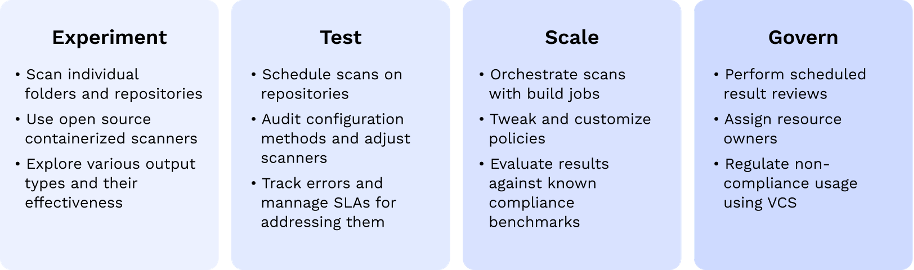
    This post will share a technical process for approaching and building an internal IaC security strategy.

    What are Your Infrastructure Security Goals?

    The key to implementing the most sustainable infrastructure security program lies in leveraging the tools and workflows developers already use. For many, that may be easier said than done because security tooling traditionally lacks the access and context necessary to play nice with dev workflows. The IaC security approach is fundamentally different from the more reactive cloud security monitoring and alerting that happen independent of developer workflows.

    As you start paving the road ahead for continuous infrastructure security processes, start by defining your ideal state. That way, as you go through the process, you’ll have an idea as to how and where you want to enforce different security and compliance controls.

    What Policies Do You Want to Enforce, and How?

    Your infrastructure security program is highly dependent on your organizations’ security priorities and maturity, and you should read this guide with your unique needs in mind.

    If you want to improve your overall cloud security posture, you may want to look for ways to apply common security policy frameworks such as the Center for Internet Security. Several open source security scanners such as Checkov or Open Policy Agent (OPA) enforce policy-as-code at the IaC level.

    They’re usually standalone packaged containers defined to accept a file, directory, repository, branch, etc., and output scan results in a machine-readable format such as JSON or JUnit XML. The most significant advantage of using an open source scanner is that they pre-package valuable security testing logic that your developers won’t have to learn.

    The alternative to a scanner is a full-featured security product, preferably one with exposed APIs and webhook integration sources. Most developer-first security solutions have done this part of the heavy lifting, so you should be getting some of this out-of-the-box.

    If you need to enforce external controls such as industry benchmarks or regulatory compliance requirements, you’ll need a more structured approach that maps individual checks to desired outcomes. Many cloud providers include robust compliance reporting for standard benchmarks such as HIPAA, NIST, PCI-DSS, etc. Make sure your policy enforcement approach enables you to build your own policies so you can adopt those controls as well.

    Where Should You Enforce Infrastructure Policies?

    Each of your teams likely has its unique frameworks and processes in place, and it’s important to have a full lay of the land before diving in. Start with a simple mapping exercise and list all the configuration frameworks in use—from CloudFormation or Azure Resource Manager (ARM) to Terraform or Pulumi.

    Once you know what frameworks exist internally, the next step is to determine the best place to scan them for infrastructure security errors. With many frameworks in place, building out new processes from scratch would be an uphill battle. Depending on your organization’s DevOps maturity, you’ll likely find an existing foundation on which you can build.

    Understand your teams’ end-to-end code review process—from committing new infrastructure changes to CI/CD build pipelines and deployments. Your team likely has some automated tests—unit, acceptance, integration, etc.—in place to ensure updates work as intended and don’t introduce bugs. Use those processes as an example for inserting security scanning. To better understand those processes, you might want to ask questions such as:

    • What triggers a CI/CD build?
    • Do your current automated quality assurance efforts run continuously on every new pull request and commit?
    • Do more time-consuming tests such as integration tests run on less-than-continuous intervals such as nightly or only on branches following specific naming conventions?
    • Are developers testing their work locally before committing?
    • How many CI/CD pipelines are in use?

    How and where you implement your security scanning will depend on those processes and the tools used to do them. Based on your current setup, you’ll generally want to take one of two approaches to IaC security—leveraging CI/CD processes or the built-in functionality from your version control system (VCS).

    Approach #1: CI/CD Pipeline

    Building security controls as part of CI/CD pipelines is probably the easier of the two approaches because modern CI/CD tools have completely abstracted away the complexity behind orchestrating test logic.

    In many cases, scanning security in CI pipelines is the fastest way to implement an IaC security and governance program. If a modern CI tool is already in place, you can probably set it up in less than 10 minutes. If you find yourself going down this path, consider the residual results of the scan and spend time dry-running it with the team that’s going to be in charge of handling its output.

    For teams operating in a centralized infrastructure operation model, this is an optimal solution. Expertise and control can remain in the hands of a small few, and the continuous enhancements to this process will not affect a large population of developers. For everyone else—continue reading.

    Approach #2: Version control system

    Your version control system (VCS) of choice is also hiding some robust security governance internal controls. Apart from adding individual automation capabilities, all of the three platforms currently dominating the market (GitHub, GitLab and Bitbucket) offer embedded code review and authorization controls that can be utilized to better control who can change what and where.

    Through their native versioning and branching, developers can perform extensive testing without compromising any running production system and continue to collaborate and converse before making changes due to a test.

    By embedding infrastructure security here, there are some pros in terms of more fine-grained access and controls. Two of the more common methods to do that utilize the standard pull request review (PR) process:

    • PR annotations: Start simple by choosing the path of least resistance. Using a standard webhook or API interface, you can start by scanning every PR and annotating its results with concrete secure coding advice. The benefit of the annotation is that it’s frictionless. Developers can choose to adopt or ignore it—little frustration, but on the other hand, not a lot of governance.
    • Checks: With the addition of native CI to most git platforms, you can also always incorporate a standard CI pipeline in git. The main benefit is to include a CI-like scan as part of each individual PR. It surfaces the same kind of output in an earlier stage and enables developers to react before actually failing building in the pipeline.

    How Should You Enforce Security Output?

    Before you include intrusive controls and overwhelming security scanning results, it’s a good idea to set expectations for how security output should be actioned. Nobody wants to get bombarded by tens of failure indications with no clear path to justify their decisions. If your IaC strategy is noisy or becomes a blocker at the end of the day, your team won’t adopt it.

    Define how passive or active you want the output of your security controls to be. Should it block builds actively or provide passive feedback to address in some pre-defined SLA?

    Some scanners can even integrate further into pipelines and orchestrate more advanced actions, such as blocking a build from completing until testing is complete. Scanning in CI was generally meant to be passive; it wasn’t built for interactive testing and troubleshooting. Should a development pipeline hold the answers to complex questions that need to be answered when resolving a security error or compliance violations?

    Ask yourself who is going to get the notification when that build fails. Continue by imagining if your CI console is where you want to troubleshoot a misconfiguration. Will you have sufficient context to solve the kind of issues your scanner is going to raise? Will you be able to deduce the impact of a change you’ll make to pass a CI scan?

    In addition to the previously mentioned benefits of hinging your IaC security strategy on your VCS, there are more fine-grained controls in git such as:

    • Approval rules: With a VCS, you can define how many approvals, and a pull request needs before it can be merged. Some even let you select which specific users those should be.
    • Code owners: If you have admin access to your main repo, consider using CODEOWNERS parameters to define a stricter approval protocol for more sensitive files.

    Some of the more mature tools also support advanced functionalities such as importing custom rule files and applying suppression and skips as code annotations. Those should help you make sure that only relevant checks eventually crop up.

    Conclusion

    There are no one-size-fits-all strategies for infrastructure security, and we as an industry are still defining the best practices for embedding it into IaC. It’s up to every security team to work closely with their engineering and DevOps to make security consumable and, ultimately, to prevent risk as early in the development life cycle as possible.