Tag: code scanning

  • CodeLogic Toolkit Increases Visibility Into App Dependencies

    CodeLogic Toolkit Increases Visibility Into App Dependencies

    CodeLogic launched today a toolkit that enables developers to scan binaries, runtime application behavior and database connections and then leverage graph technology to identify connections and dependencies in real-time.

    Brian Pierce, CodeLogic CEO, said the goal is to make it simpler for developers to identify the relationship between application elements to increase overall productivity and simplify the addition of new members to an application development project.

    In general, most developers add code to applications without really having much visibility into how that code might impact other components. The toolkit created by CodeLogic is an extension of the company’s existing continuous software intelligence (CSI) platform that employs server software to store and process data collected via its agent software. The goal is to make it easier for developers to directly consume those insights via a toolkit they can access directly from within, for example, an integrated development environment (IDE), said Pierce.

    As applications become more complex in the age of microservices, it becomes more challenging to understand all the dependencies between application components. Developers require greater visibility into applications to better manage the break/fix process that inevitably occurs when new code is added to any environment. The CodeLogic CSI platform provides an automated impact score for methods, classes and the overall health of an application as code is developed to provide that visibility.

    That information also plays a critical role in enabling IT teams to understand the implications any newly discovered vulnerability might have on the application environment, added Pierce.

    Overall, the level of technical debt that organizations accumulate over time saps developer productivity, he noted. The more difficult it becomes to add code to an application environment the less likely it is that developers will enthusiastically make the effort, said Pierce. Before too long, the number of updates made to an application environment starts to decline, he noted.

    Developer productivity has become a major issue simply because the number of applications that organizations now want to build and deploy is exceeding the financial resources they have available to hire or contract developers. The more time developers spend studying how an application has been constructed the less time there is to write code and drive innovation. In fact, the more frustrating it becomes to add code the more likely it becomes developers will move on to a company with much less friction involved in building and deploying applications, said Pierce.

    There are many senior IT leaders that also need visibility into application environments before approving projects. Many IT teams discover that there are multiple projects or other teams writing duplicate code or replicating existing functions. Regardless of the reason, more developers are voting with their feet when they feel their time and effort is not fully appreciated.

  • Turning Off DevSecOps Noise for Functional Fidelity

    Turning Off DevSecOps Noise for Functional Fidelity

    Analyzing the DevOps and DevSecOps software marketplace demonstrates the high demand for tools and platforms that reduce false positives. As businesses and organizations adopt a rigorous, disciplined software development life cycle and ascribe to strict compliance frameworks, they quickly realize that automated tools can generate a substantial amount of noise, in the form of false positives, that pollute their efforts to maintain a lean and focused operation.

    True Positive Vs. False Positive Vulnerabilities

    Static application security testing (SAST) is fundamentally about using pattern recognition to identify vulnerabilities in code. The more aggressive the scan rules, the more likely a snippet of code will be flagged as a vulnerability; in other words, a “true positive” finding. Automated scanning is fundamental to effective DevSecOps. But if the scanning is too aggressive, it may generate findings that aren’t actual problems; in other words, false positive findings 

    You want your scan to return true positive findings—actual vulnerabilities that can be fixed and remediated. A false positive is a finding that isn’t actually a vulnerability. The ideal tool catches all the true positive vulnerabilities and returns a minimal number of false positives.

    Many platforms give their users granular control over which rules run and are applied to their code. This first layer of control is similar to allowing your team to tune their scans to focus only on certain frequencies while ignoring others. Often, this is used to increase the speed with which a platform might complete a scan. It can also be used to tune out “noisy” rules. It’s perfectly legitimate to use controls like these, but it’s important to recognize that those completed scans aren’t comprehensive.

    Speeding Up Can Slow You Down

    Positive findings, whether they are true or false, take more time and resources to evaluate and remediate. Investing resources to remediate true positives is worthwhile. It would be ideal if they had been caught earlier in the process, but catching a vulnerability before it hits production is the entire reason you are doing DevSecOps in the first place! False positives may not require actual remediation, but reviewing them and then manually confirming their false nature is directly counterproductive to the reasons an organization adopted automated SAST in the first place.

    SAST Plus DAST Keeps You Ahead

    The gold standard for effective security testing is to pair SAST with dynamic application security testing (DAST), sometimes also called interactive application security testing (IAST). This process will correlate the positive findings from the SAST scans and test them using simulated data in an emulated runtime environment. 

    DAST/IAST actually tests each bit of code that looks problematic because of a particular pattern and then tests whether the code is actually vulnerable. DAST provides an automated, testable, repeatable and provable method to test those positive findings for trueness and falseness. If you are only doing SAST scanning, then the noise-to-signal ratio from your platform is governed strictly by the intelligence embedded into their pattern-matching code. Depending on the quality of the tool being used, your actual mileage may vary.

    DevSecOps Is the Right Path

    Businesses and organizations clearly understand the problem of potential vulnerabilities. Guarding against a security breach is critically important to protecting proprietary information and the privacy of their customers. DevSecOps is clearly the right path to take to reach that goal. However, it is critically important that the vehicle(s) these teams use to get there (in this case, SAST and DAST/IAST) have built-in functionality to focus their efforts on real problems and not waste it on phantom issues.

  • Contrast Security Adds Free Code-Scanning Tool

    Contrast Security Adds Free Code-Scanning Tool

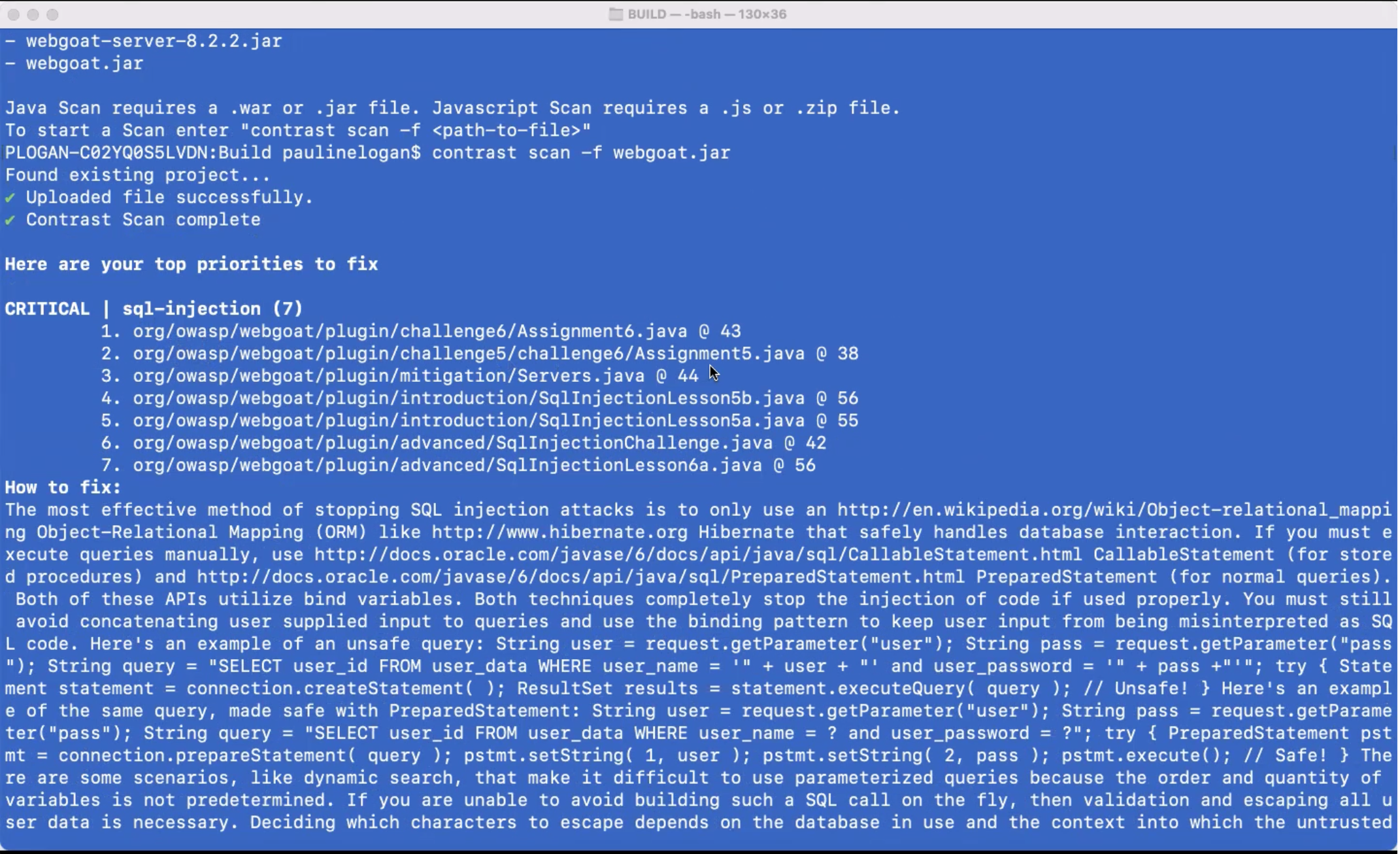
    Contrast Security this week made available a free security tool that enables developers to scan their code using the same core engine used by the cybersecurity team within their organization.

    Steven Phillips, vice president of product marketing for Contrast Security, said while there is no shortage of free tools for scanning code these days, the majority are not especially accurate. The scanning engine in CodeSec by Contrast Security is more than 10 times more accurate, Phillips said, because it is optimized to identify true positives versus generating a lot of false negatives, he claimed. He added that CodeSec is not just another freemium offering for developers that is a hobbled version of a commercial offering.

    CodeSec also differs from Contrast Security’s existing application security tool because it provides access to a command-line interface (CLI) that makes it easier to integrate within the context of a DevOps workflow. That approach makes it simpler for organizations to shift more responsibility for application security further left toward developers, noted Phillips.

    However, shifting responsibility left toward developers is not a panacea, Phillips said. The Contrast Security approach enables more collaboration between development and cybersecurity teams that are using the same scanning engine via a software-as-a-service (SaaS) platform to discover vulnerabilities, he noted.

    It’s difficult to determine just how far cybersecurity might shift left, but every vulnerability discovered by an application development team is one less for cybersecurity teams to ask developers to fix in a production environment. The challenge is making it as simple as possible for developers to discover those vulnerabilities.

    One way or another, the amount of time and effort being applied to application security has increased sharply in recent months following the disclosure of a series of high-profile breaches. Cybercriminals are now targeting software supply chains as part of an effort to compromise a wide range of downstream applications. Many of the modules that developers routinely reuse are being compromised by surreptitiously inserted malware. The fundamental challenge organizations are trying to address is how to build and deploy more secure applications without slowing down the rate at which they are built.

    Naturally, training developers to recognize security issues is a big part of the equation. However, no two developers are ever going to have the same level of cybersecurity expertise. Tools that identify vulnerabilities in ways that developers can act on are critical for advancing the adoption of DevSecOps best practices. Those tools require some level of acceptance among developers because they tend to prefer CLI tools.

    In the meantime, organizations will most likely have to scan a wide range of already-deployed applications for vulnerabilities. Applications running both inside and outside the cloud have been routinely deployed with a minimum level of scanning. The truth is that many developers have tended to view cybersecurity policies as an impediment to building and deploying applications. Unfortunately, cybercriminals now appreciate and take full advantage of the opportunity to wreak havoc.

  • WhiteSource Becomes Mend, Launches Automated Remediation Platform

    WhiteSource Becomes Mend, Launches Automated Remediation Platform

    WhiteSource rechristened itself Mend today and launched a remediation platform that automatically resolves security issues for application developers.

    Rami Sass, co-founder and CEO of Mend, said now the company is going beyond just identifying vulnerabilities in open source software using software composition analysis (SCA) tools and is also fixing them. The overall goal is to make it simpler for developers to address security issues without taking time away from writing code or slowing down the rate at which applications are developed, he added.

    To further that effort, Mend also announced today it is making available a plug-in for JFrog Artifactory that enables Mend Supply Chain Defender, formerly WhiteSource Diffend, to enable detection of malicious open source code. Last year the company acquired Diffend followed by the acquisition of two startup providers of static analysis security testing (SAST) tools.

    Collectively, those applications enabled the company to build the Mend Application Security Platform, a software-as-a-service (SaaS) offering that combines SCA and SAST tools to create an automated remediation framework that can be applied to both open source and proprietary code residing in a repository.

    Mend claimed it added more than 350 customers in the last year to bring its total to more than 1,000 organizations. Most recently, the company raised an additional $75 million in financing to continue investing in a platform specifically designed to address application security issues. In the wake of a series of high-profile security breaches involving software supply chains, Sass noted there is now a much greater appreciation for securing applications and that demand for application security solutions is growing. That demand, in turn, is fueling a wave of consolidation that is, in part, enabled by the convergence of application security tools made available via a SaaS platform, he added.

    Historically, much of the focus on application security focused on discovering vulnerabilities that developers are asked to patch. The issue is that developers are being asked to patch the same modules repeatedly. The Mend Application Security Platform keeps track of what modules have been successfully updated to give developers higher confidence in the updates being applied, said Sass.

    Those recommendations are not being surfaced using machine learning algorithms but rather by the data analytics capabilities that have been added to the company’s portfolio of tools over time, he noted.

    While there may never be such a thing as perfect security it’s apparent that most application security issues can be traced back to relatively common mistakes that developers routinely make. The more those issues are surfaced within a developer workflow, the less dependent organizations will need to be on embedding guardrails within DevSecOps workflows to prevent vulnerabilities from finding their way into production environment. The Mend Application Security Platform doesn’t eliminate the need for those guardrails as much as it reduces the sheer volume of security issues that might otherwise need to be addressed.

    It may be a while before these more advanced developer security tools achieve that result, but it’s clear from how quickly advances are being made that such tools should have a material impact on the overall state of application security.

  • OpenSSF Adds Open Source Package Analysis Tool Prototype

    OpenSSF Adds Open Source Package Analysis Tool Prototype

    The Open Source Security Foundation (OpenSSF) has made available a prototype of a package analysis tool that has already identified more than 200 malicious packages uploaded to PyPI and npm software components.

    Caleb Brown, an OpenSSF maintainer of the project, said the goal is to understand the behavior and capabilities of packages available on open source repositories. It also tracks how packages behave over time to make it easier to identify when previously safe software began to act in a suspicious manner.

    Most of the malicious packages detected are employing dependency confusion and typosquatting techniques, Brown said. They usually contain a simple script that runs during installation and provides a few details about the host to an external command-and-control system. Most of these packages are not exfiltrating meaningful data except the name of the machine or a username, but they make no attempt to disguise their behavior. The issue is that any one of these packages could have done far more damage, noted Brown.

    Future goals for the project include detecting differences in package behavior over time; automating the processing of the package analysis results; storing the packages themselves as they are processed for long-term analysis and improving the reliability of the pipeline. As such, the OpenSSF is looking for application developers and cybersecurity researchers to contribute to the project. The expectation is that many providers of application security tools will incorporate the package analysis tool within their offerings rather than requiring each vendor to create their own version of the same tool, said Brown.

    The OpenSSF has launched a series of initiatives to improve the overall state of open source security. Most recently, it added an Alpha-Omega Project to automate security testing processes for open source software using a $5 million initial investment provided by Microsoft and Google. The core challenge is that many organizations are dependent on open source software projects created and maintained by just a handful of volunteer maintainers and contributors. The individuals that created those projects don’t always have a lot of cybersecurity expertise. In fact, many of them would argue that the onus for securing open source software is on the organizations that use what amounts to free software. It’s not the responsibility of the contributors and maintainers to, for example, drop everything and immediately create a patch to address a zero-day vulnerability.

    It’s not clear how easily open source software could be compromised by cybercriminals that insert malware into downstream applications that rely on that code. However, in the wake of a series of high-profile breaches, it’s safe to assume that more cybercriminals than ever are trying to compromise open source software projects. While some organizations may opt to limit their dependency on open source code that has not been properly vetted, there is no way to entirely avoid using open source code. The challenge is finding a more efficient way to ensure the integrity of that code for all concerned.

  • DevSecOps Tools: Hot Air Ahead

    DevSecOps Tools: Hot Air Ahead

    I, like most of you, don’t like hardcore marketing that hinges its statements on “Well, that’s technically true…” I also am not a fan of talking heads that spew predictions about the future. Sure, they’re right sometimes; that’s because we have so many people pontificating that random distribution means some will be correct. I am bringing all this up to warn you that I (basically a high-tech talking head) am about to talk about tools, the future of tools markets (one in particular) and what I think should/will happen.

    Sometimes, talking about the future of a given tech is done to make a name for yourself. I don’t play that game. My goal is simply to say, ‘This is what I would like to see, and why I would like to see it.’

    Enough spewing—let’s talk about DevSecOps tools. I jotted down this topic a while back when I touched briefly on it, and my ideas firmed up while working on a recent project.

    Let’s start easy. If you are not using what we currently call DevSecOps tools in your DevOps toolchain, go get them set up. Go ahead, we’ll wait. It’s that much of a no-brainer that we’ll sit here while you choose, purchase and install your choice. Seriously. “Here is a tool that will make development more secure and make developers more productive.” Go install it now. Choose what functions you want to use and work them into your toolchain.

    But don’t get too married to your vendor. Because for the very same reasons I just told you to go install them, I will say I don’t think they should be a standalone market. Here is a toolset that plugs into the IDE on one end, and runs stand-alone, integrated with CI/CD on the other. It is DevOps in many ways. And while code scanning is inarguably a security function, the spirit of DevOps overall is “Who cares?” Using these tools shifts quite a bit of security functionality left and also warns about bad coding practices. Note I did not specifically say insecure coding practices, though those are covered. I said bad coding practices. The largest of these vendors will let you know things like, “Hey, you sent that variable to this function and then never used it. Are you sure?” or “This loop looks like it never exits. Are you sure?”

    It should be, and I predict will be, part of the DevOps process. In my dream world, the functionality would get split and some would end up in IDEs, while the rest would end up in testing tools or CI tools. But that’s not normally how markets get split up when there are established vendors. Even though you can feel the difference in the functionality (a bunch of them plug right into the IDE; the rest don’t), it won’t get split up because existing markets generally merge through acquisition. So we’ll have to see how things fall out, but I’m betting on CI/CD vendors or system-wide security vendors moving into this market. Indeed, companies with a SOC will likely find these vendors appealing because most of them also operate SOCs for the dynamic scanning part of the system.

    Still don’t have DevSecOps installed? Go now. Choose a vendor.

    Because I’m being so forceful about telling you to install one of these toolsets, I’ll state very clearly: At the time of this writing, I do not have any kind of relationship with any vendor in this space. I say this because I use the tools and strongly believe that the pain points they bring as a layer in development are very much made up for by the benefits they bring to the application.

    And keep rocking it. This will just make your systems more stable, and the merges (that I see as inevitable, but is actually only a possibility) you can worry about when they come along.

  • GitLab Allies With Rezilion to Add Workload Analysis Tool

    GitLab Allies With Rezilion to Add Workload Analysis Tool

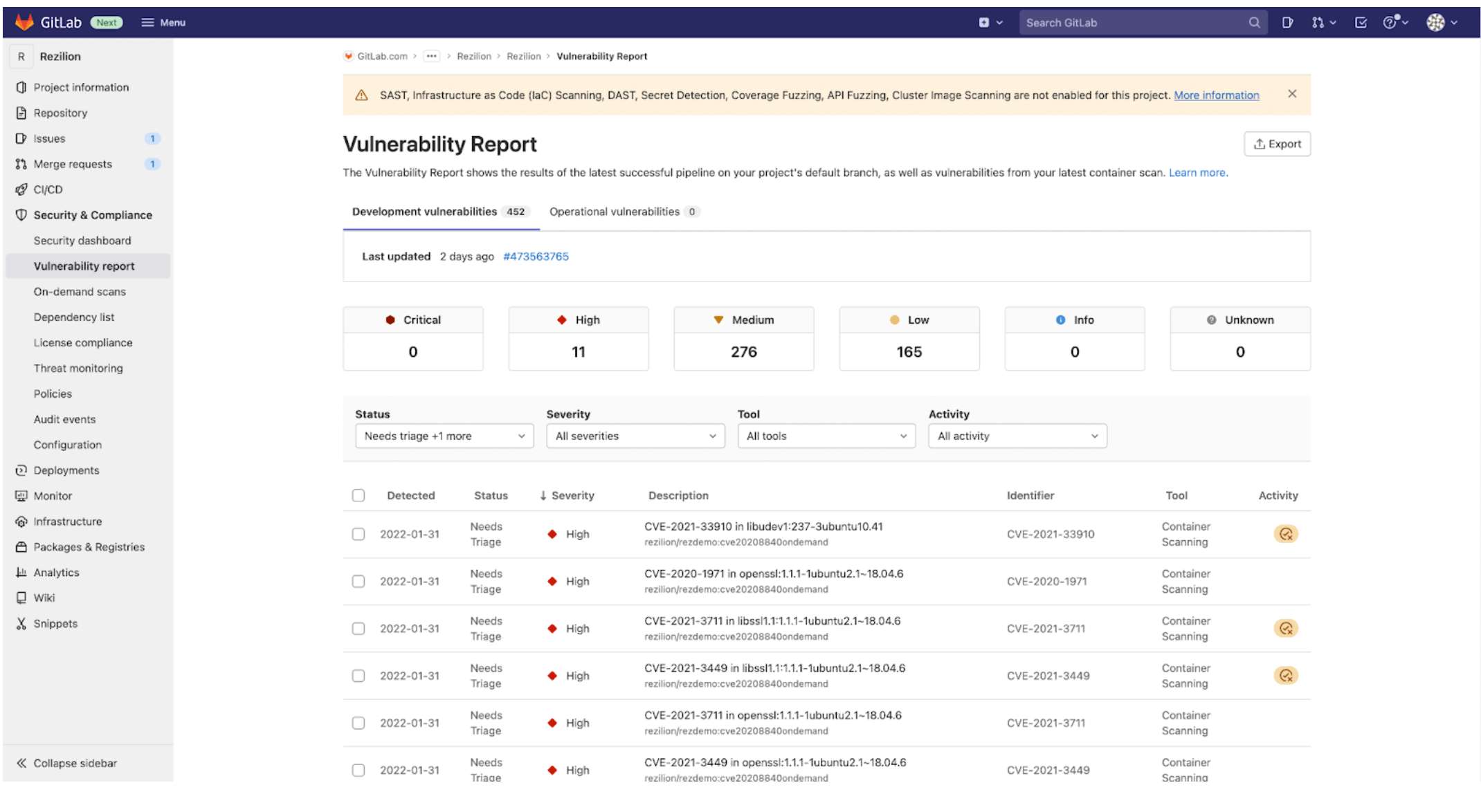
    Rezilion has integrated its workload analysis tool with the continuous integration (CI) framework provided by GitLab. The move is part of an effort to make it simpler for developers to discover issues such as vulnerabilities before they upload code into a repository.

    Sam White, a senior product manager for GitLab, said this integration will provide developers with an instant feedback loop that will enable them to address a wide range of issues before their code is ever reviewed. Rather than experiencing the shame of, for example, missing a vulnerability, the Rezilion platform enables developers to quickly write code while relying on a code analytics tool to surface common mistakes that they can remediate as they see fit, he added.

    Rezilion CEO Liran Tancman added that the proprietary workload composition analysis engine, dubbed Unison, on which the Rezilion platform is based makes it feasible to shift more responsibility for application security further left without requiring developers to become cybersecurity experts.

    Unison automatically creates a model of all the applications that include the underlying infrastructure and runtime environments. It reverse-engineers and maps that environment in memory to dynamically track the inventory, provenance, runtime execution, exposure and interdependencies between each piece of code and can generate a software bill of materials (SBOM).

    The code that is most in need of immediate attention is also surfaced directly with the GitLab user interface, said Tancman. That capability can reduce remediation time of the vulnerability backlog an organization might be working through by as much as 70% over time, he added. Rezilion enables organizations to achieve that goal because non-exploitable vulnerabilities are marked as “false positives” that shouldn’t hold back a release.

    Tancman said that without this level of automation it would be extremely challenging for an organization to implement a set of DevSecOps best practices. It might take developers years to attain the level of cybersecurity training that would be required in the absence of the automation enabled by the Unison engine, he noted.

    Historically, the relationship between application developers and cybersecurity teams has been tense. Cybersecurity teams tend to put off code review until it’s about to be deployed in a production environment. It’s not uncommon for an application to be pulled at the last minute because of a vulnerability discovered by a cybersecurity team. In some instances, that vulnerability is a legitimate concern but in others, it turns out to be a false positive because the flagged piece of code isn’t actually included in the application.

    By providing developers with a workload composition analysis tool within the context of a CI framework, GitLab is trying to reduce the level of friction that the process tends to create between developers and cybersecurity teams.

    It may be some time before most organizations fully master DevSecOps, but it’s clear that merely telling developers they will be held accountable for application security without providing the appropriate tools isn’t going to make applications any more secure.

  • WhiteSource Tightens Code Scanning Tool Integration with Azure DevOps

    WhiteSource Tightens Code Scanning Tool Integration with Azure DevOps

    WhiteSource has added the Microsoft Azure DevOps platform to the list of continuous integration/continuous delivery (CI/CD) platforms its open source vulnerability scanning tools natively supports.

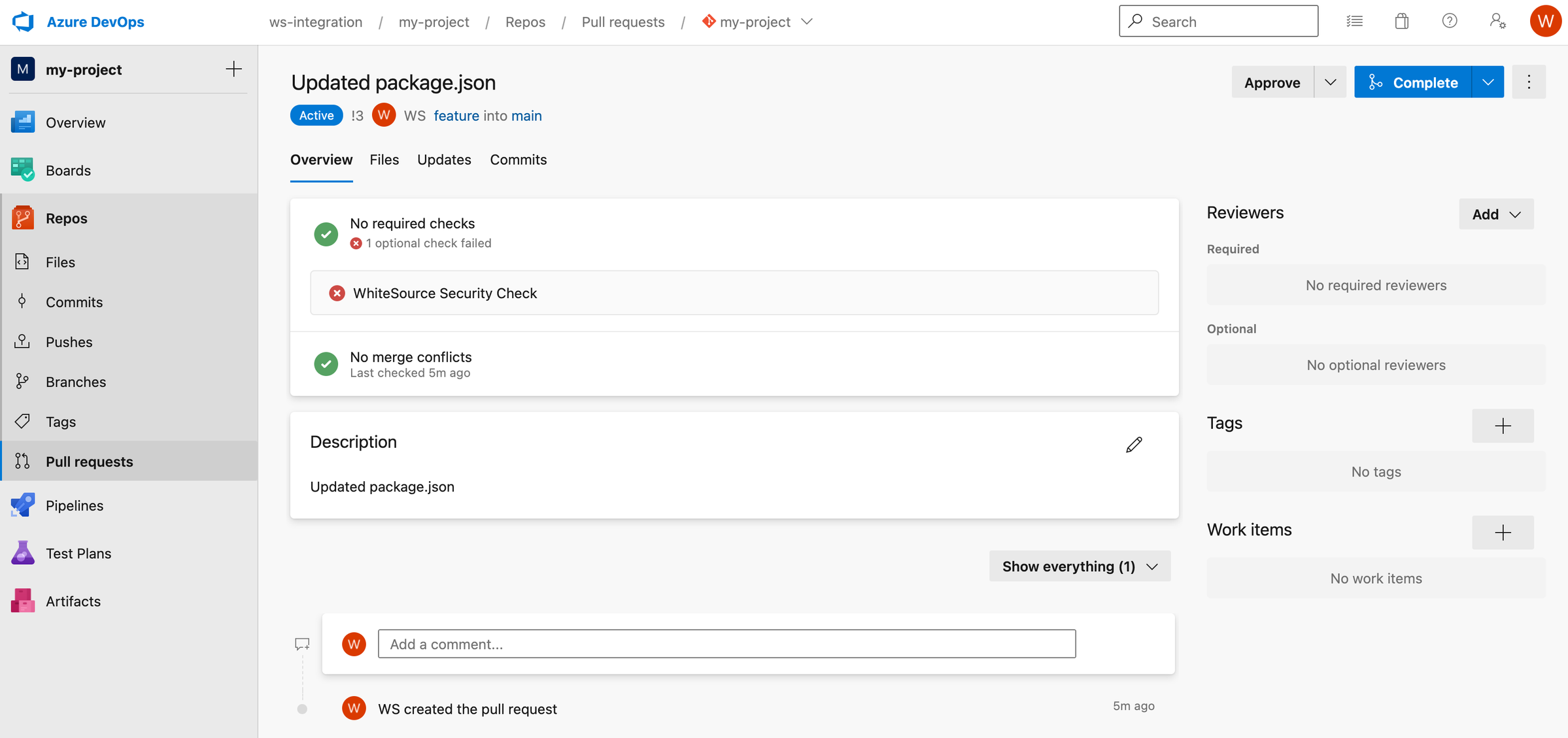
    Susan St. Clair, director of product management for WhiteSource, said while developers are always encouraged to scan for vulnerabilities, it’s more effective if organizations implement scanning by default every time there is a merge request. That approach reduces friction because organizations become much less dependent on developers to scan for vulnerabilities within the context of a larger DevSecOps workflow, she added.

    WhiteSource also provides a merge confidence feature that uses crowdsourced data to show how likely it is that an open source component can be updated without breaking the build. Merge confidence includes data on upgrade age, adoption and compatibility to create a confidence score.

    The WhiteSource integrations make it possible for DevOps teams to detect all open source components being used and automatically enforce security policies directly from their repository. DevOps teams are provided with vulnerability and misconfiguration alerts and license violations along with detailed remediation guidance, including suggested fixes and prioritization advice, within an existing workflow versus being required to switch to a tool that has a separate user interface (UI) they need to learn.

    Should a merge request introduce a new error, the developer is given immediate feedback to resolve any newly introduced vulnerabilities before the request is completed. That approach to separating feature branches and mainline branches prevents interruptions to workflows. The enterprise edition of the WhiteSource tool also automatically generates pull requests in the repository to update vulnerable open source components to the lowest non-vulnerable version.

    WhiteSource also supports code repositories such as GitHub, GitHub Packages, JFrog, Bitbucket and GitLab. The Azure DevOps platform is gaining traction as more application development projects are being managed via the cloud following the onset of the COVID-19 pandemic, noted St. Clair.

    As more organizations begin to embrace DevSecOps workflows each of them will need to decide how far left they want to shift responsibility for application security. In theory, each developer is now being held more accountable for every one of their applications that gets deployed in a production environment. In practice, most developers lack the expertise required to ensure applications are secure.

    There are, of course, more concerns being raised about the security of software supply chains that include open source software in the wake of the recent disclosure of zero-day vulnerabilities in the widely-used Log4j logging tool. Many of the maintainers of smaller open source projects lack the resources required to ensure there are no inadvertent vulnerabilities that could be exploited by cybercriminals. More challenging still, many developers may have used an older version of that software that has known vulnerabilities.

    It’s not clear how open source software will ultimately be made more secure. In the meantime, however, it’s clear the onus for ensuring the security of that software is on the DevOps teams that employ it.