Tag: COBOL

  • Is COBOL Here to Stay? Five Signs IT is Ready to Modernize

    Is COBOL Here to Stay? Five Signs IT is Ready to Modernize

    With increased demands and challenges around compliance and regulations, plus growing expectations for IT to provide more value-added services, companies are looking for more flexible and collaborative options. Interestingly though, while some IT departments have updated legacy systems, COBOL code has continued to be a mainstay. In fact, COBOL just turned 60 and many are saying it’s here for the long haul.

    There are a lot of reasons that make it challenging—or for some, unnecessary—to move away from the language, but there are also several clear signs companies and IT departments should know that indicate it’s time to make a change.

    Here are five signs IT leaders should pull the trigger on modernizing their legacy environments.

    You’re Constantly Worried About the Risk of Losing COBOL Expertise from Your Team

    COBOL has more production lines of code than any other language in existence, with over 220 billion lines of COBOL today—or around 80% of the world’s actively used code. One of the problems is that many that are well-versed in COBOL language are also nearing retirement, and the amount of COBOL programmers entering the market is much lower than it was 10 years ago.

    Author Glenn Fleishman put it best in his article on the subject stating “the language never died, though its early practitioners have faded away, and the generation of programmers who built systems towards the end of the predominant mainframe era in the 1970s and 1980s are largely near or past retirement age. It’s a slow-moving crisis with no crackling deadline, like Y2K, to focus the minds of Chief Information Officers.”

    Pressure from Business Leaders to Take Advantage of More Agile IT Methods

    Whether it’s cloud, DevOps or microservices, businesses want faster and more frequent IT delivery of new services to customers. In order to drive these results, embracing more agile methods of IT and developing a strategy that can support rapid application delivery is key. Moving to the cloud, integrating with Java or shifting to Linux requires open-based models that can handle legacy COBOL applications.

    You’re Quickly Losing Your Competitive Edge Because of the Reliance on Dated Technologies

    Direct and even indirect competitors are encroaching more and more in the industry and in new deals, and you feel as if your company’s position in the market is slowly declining. This may be a product of competitors’ willingness to open source systems that promote the business agility needed to react far more quickly to changing market dynamics and customer demands.

    If they are modernizing their IT and investing in new technologies quicker than you are, it’s likely they’ll catch up to or surpass you quickly.

    Your Confidence in Your Current IT Environment Is Extremely Low

    No matter the modernization strategy you pursue, you should ultimately feel confident and peace of mind when it comes to your environment today and as you look to the future. Without flexibility, collaboration and a tailored approach however, the business will likely suffer and may be the reason for the growing insecurities.

    For instance, if you’re interested in programming COBOL in some areas, but currently operate in a significantly pure native Java environment, a flexible and manageable solution is key. If you want to generate Java as the compiled object, the result will be inflexible static Java objects, rather than something flexible and extensible — and will require access to the Java source. That source is not nearly as maintainable as the source generated in the COBOL to Java conversion, but can be leveraged in Java-operating environments, and is much more flexible than other alternatives.

    You’re Experiencing Vendor Lock-In

    You’re wedded to an established tech company or consultants on-hand that seem like safe bets, but instead have caused you to miss the mark in being flexible and future-proof–not to mention are likely far over your budget to maintain. While transitioning to a new partner may seem daunting, conducting an assessment of your operational, infrastructure and application environment can provide a more comprehensive picture of the strategy that is right for the business, help manage the process more efficiently and ultimately cut unnecessary costs well before an exact migration or conversion path is decided on.

    Although many organizations have run COBOL without substantial updates and issues for decades, the ability to solely rely on the dated technology is quickly giving way to a growing need for additional languages and more agile systems. If IT leaders are experiencing one or more of these issues now, waiting any longer to address them can result in much bigger problems in the future and considering a modernization strategy may be the better path to success.

    — Cameron Jenkins

  • IBM Z Open Editor Support for Language Server Protocol is a Game Changer

    IBM Z Open Editor Support for Language Server Protocol is a Game Changer

    The integrated development environment (IDE) is an indispensable tool for software developers. Before it came along, coding was a laborious, detail ladened undertaking. We’ve become accustomed to the syntax checking and code completion features than even the most basic IDEs provide. These days we tend to forget how hard it was programming with nothing but a rudimentary text editor. Something as simple as finding a missing comma or a misplaced curly bracket that was causing a compilation error could take hours, maybe days should the codebase be big enough. When it came to tracing your way through a seemingly endless chain of functions and classes in order to find the culprit of a runtime error, well…fuggedaboutit! Without the modern IDE, we’d be sunk.

    Well, that was then and this is now. A few years back, a new technology emerged on the technical landscape that’s boosting the power of the IDE, and subsequently the scope of work a developer does and the decisions he or she makes by an order of magnitude. This new technology is Language Server Protocol (LSP).

    LSP Takes the IDE to a Whole New Level

    LSP is a specification developed by Microsoft that standardizes the way certain typical features are implemented within a programming IDE. LSP attempts to consolidate the implementation of IDE commonplace features such as code completion, hover-over tips, jump-to-definition, find-references and syntax checking into a standard format that can be applied to any IDE in an agnostic manner.

    LSP is a technology designed to address the following problem. Imagine that a tools vendor has an idea for implementing a new plugin that will automatically do code completion for programs written in the COBOL programming language. Such a feature might be useful to any number of COBOL programmers. However, not every COBOL programmer is programming using the same tool. Some might be using an IDE such as IBM Developer for z/OS. Another might be using a text editor such as Sublime Text, Atom or even something more basic such as vim. In earlier times, in order to get the feature to market the vendor needed to implement different versions of the plugin in a way that was special to the given development environment. There’d be a team working on a Sublime Text version of the plugin, another team working on the vim plugin so forth and so on. Not only did the tool developer need to accommodate different operating systems, but each team might come up with its own, particular way to implement the feature. As team members left the company and new members arrived to replace them, those new developers needed to learn each particular way the feature was realized. As you can see, not only did the variety breed complexity, but things got very expensive very quickly.

    LSP does away with the need for such specialized tools development. LSP provides a standard protocol that can be implemented in any tool. The protocol defines a set of standard methods, objects and communication methods that provide a common set of services in any IDE.

    Thus, the only work that needs to be done to get the previously described COBOL code complete feature to market is to express it in a way that is compatible with the LSP. The actual work of realizing the feature then involves writing a client that supports the standard. It’s a “one ring to rule them all” process so to speak.

    The LSP specification was originally published by Microsoft specific. But the standard has been embraced as an industry-wide. There are implementations in Java, C++, C#, Python, Scala, Swift and PHP, to name a few. Also, there is an implementation of LSP for COBOL under z/OS, which brings us to IBM Z Open Editor.

    Bringing the Use of LSP to the Mainframe

    IBM Z Open Editor is a free Visual Studio Code extension that provides a state of the art programming experience for COBOL and PL/1 developers. Also, IBM Z Open Editor integrates with Eclipse Che and Eclipse Theia. Integration with Eclipse Che and Theia is particularly interesting because it enables browser-based editing. It’s a powerful tool, even more so given that historically COBOL and PL/1 programmers have lived in the backwaters of modern IDE development. IBM Z Open Editor makes IDE-based software development a general programming experience. Developers can use the same tool to program COBOL as they do in Java or even HTML for that matter.

    LSP Enabled Features in IBM Z Open Editor

    The following is a list of tool features available to mainframe programmers using Visual Studio Code with IBM Z Open Editor enabled:

    • Code completion.
    • Hover over instructions and snippets.
    • Jump to definitions.
    • Workspace symbols.
    • Find references.
    • Diagnostics and syntax error detection.
    • Outline view.
    • Previewing of included copybooks on hover.
    • Navigate to copybooks.
    • Code template snippets.
    • Refactoring such as “rename symbol.”
    • Variable completion.

     Using a single IDE to program in a variety of languages is a trend that’s been evolving for a while. However, adding LSP into the mix allows any IDE to present a consistent set of design time features. For example, one IDE is now able to do code-completion, hover-over reporting and variable tracing regardless of the programming language in play.

    For example, Figure 1 below shows the COBOL code completion feature of IBM Z Open Editor plugin for Visual Studio Code. IBM Z Open Editor uses LSP to facilitate code completion.

    Figure 1: IBM Z Open Editor uses the Language Server Protocol to facilitate context-sensitive code completion.

    Figure 2 shows the search and sort features of IBM Z Open Editor, which again implemented according to the LSP.

    Figure 2: Using LSP to implement IBM Z Open Editor’s sortable and searchable outline view for navigation.

    Finally, Figure 3 shows how the IBM Z Open Editor takes advantage of the extensibility capabilities of LSP to implement a feature that resolves and loads copybooks for preview. A copybook is code that can be copied from a master source and inserted into several different programs or into a variety of places in a single program. A copybook is used to define the physical layout of program data, variables for example, as well as instances of procedural code.

    Figure 3: IBM Z Open Editor extends LSP to review and load a copybook within Visual Studio Code.

    Clearly, LSP brings a lot of power to the mainframe programming experience. Now tools developers can create a unified programming experience using a common methodology. But where things really get interesting is when LSP is used to report data that goes beyond standard programming and code management activities, to a place where the real-time behavior of those using deployed code is being reported. In other words, LSP makes it possible not only to get information about code that is local to the developer’s desktop but also about the code as it is being used at runtime out on the internet.

    Beyond the Mainframe: The Long Term Significance of LSP

    LSP is extensible by design. As you read above, IBM Z Open Editor extends LSP to allow programmers to preview and load copybooks. This is done by extending the protocol.

    The typical IDE to server interaction under LSP is that the LSP client reports to the LSP server when a code document has been opened, changed, saved and closed. Then, once the LSP server is aware that a code document is in play, the server can inspect the document and report back events that are relevant to the programming language (Figure 4).

    Figure 4: LSP uses a predefined set of commands and request/response objects to support programming IDE is a language and operating system agnostic manner.

    For example, the LSP server can inspect the document to make sure the code is syntactically correct. If an error is encountered the server reports back the starting and ending location of the error, along with a message. In the case of the copybook review feature, the client reports back the location of the cursor in the code window and the server determines an opportunity for a copybook review and informs the client accordingly.

    While the copybook preview feature is powerful, it’s confined in scope to the immediate document. This is good. But, imagine what it would be like if the server had knowledge of all instances of the code deployed and running on computers connected to the internet?

    Suppose for example, that your code was powering an API running on the internet and you had the ability to learn about the number of calls to a particular function backing the API or better yet, imagine that you had the ability to learn about function calls that encountered particular problems, such as a pattern of mistyped parameters or high latency calls. Then imagine if that global runtime behavior was reported right in the IDE? Such information would change the very nature of how a programmer approaches his or her work. More importantly, it would change the way an enterprise manages programmers.

    What if a programmer could decide what to work on based on global runtime behavior reported into the IDE via an LSP extension? For example, going back to the imagined pattern of mistyped parameters, let’s say that when a developer hovers over the related function in IDE a warning icon appeared informing the developer of 1000 instances of mistyped called were made at the global level. The developer decides that such an error rate is unacceptable. Then, he/she examines the developer documentation and discovers that the parameter type definitions for the function are poorly described and that the document needs to be corrected. The developer then makes updating that developer documentation a critical path, part of the day’s work that needs to be delivered immediately.

    Given the power that LSP brings to the programming experience, such a scenario is entirely possible. In fact, there are companies out there such as Apollo Graph Manager that presently allow developers and third parties to register their production APIs in order to collect the sort of global information described above and have it reported in an IDE via LSP. As those of us who have been in the software business for a while have come to learn, once a feature such as global reporting catches on, it’s only a matter of time until it becomes an industry-wide practice. It’s only a matter of time before globally collected runtime metrics delivered to a programmers LSP become commonplace.

    Again, the ramifications are significant. Once a programmer has the ability to make fundamental decisions about feature development and deployment schedules, what then becomes the role of the project manager and the product manager?

    To take the issue one step further, how much power should a programmer be given? And in terms of general business practices, how much should the programmer know about a company’s products? These questions might seem fantastic, but keep in mind at one time companies guarded their source code as a trade secret. Today, more code than not is shared between companies as part of the open-source movement. As a result, the way code is made and a developers work has changed. The same possibility exists due to the growing trend to extend the capabilities of the LSP. The ramifications of LSP go well beyond simply reporting syntax errors and doing code completion. LSP will change the way the entire industry works, from mainframe programming to developers working in the cloud or on commodity hardware.

    Putting it All Together

    Given current trends, there’s little doubt that LSP will make even the most rudimentary code editor a powerhouse tool for software development. Standardizing IDE features into a common format allows new features for any development tool to be implemented faster and at a reduced cost. In no time at all we might even figure out a way to use LSP to make is so large bodies of code can be written automatically with just a few guiding keystrokes from the developer’s keyboard no matter the programming language. It’s a real possibility.

    Not only will LSP making coding easier and faster, but it’s also going to change the role of the software developer. Once all the code running on the internet becomes LSP aware and accessible, developers will get runtime information about how their code is performing at runtime on a global level. The trend is already in play. As history has shown, the further down a technology goes into a given population, the more powerful that population becomes and the greater the ramifications when the power is exerted. There’s a very real possibility the information that LSP enabled IDEs provides will make the day-to-day programmer more prominent in the product decision-making processes that are presently the responsibilities of program and project managers. Once that shift takes place we’re likely to see another industry-wide transformation take place in the way software is made and delivered. History has shown that such transformations have long term benefit, but in the short term are disruptive and disturbing. We’ll do well to be prepared.

    — Bob Reselman

  • Why Legacy Application Development is a Challenge

    Why Legacy Application Development is a Challenge

    Enterprises seeking to modernize their legacy mainframe applications often cite the key reason as not being able to evolve quickly enough to support the changing needs of the business. This is also a driving force behind the increasing trend toward moving these legacy applications onto other platforms, either by attempting to rewrite or re-platform them.

    If this was a simple process however, the transition would have happened years ago. So, why is it so difficult to modernize mainframe applications? It is surely not the programming language. COBOL and other traditional languages are simply programming languages. They may not be considered “cool,” but neither are many of the other scripting or development languages, or configuration syntax programmers deal with day in and day out.

    So, what actually makes legacy application modernization challenging? After countless conversations with several outsourcers, system integrators and mainframe customers, four major issues came up time and time again.

    Development Tooling–Low Productivity on Mainframe

    The traditional environment for a programmer, working with COBOL or PL/1 on the mainframe, has few of the productivity features today’s programmers expect: smart cross-references, on-the-fly syntax checking, autocomplete for variables etc. Attempts have been made to bring the experience closer to that of a modern JAVA programmer, but there is no escaping the fact a mainframe exists in the background with all its quirks. This divergence in programmer productivity unfairly tends to stick to the programming languages on the mainframe. With the result that language choice gets conflated with developer tooling in decisions to make mainframe development more agile.

    Open-Source Availability–Limited Access to Innovation

    Looking for solutions to business requirements among the many popular open-source projects is one of the fundamental reasons why development processes in general have become more agile. Clearly, if less code is needed to support any requirement, the faster that requirement will be satisfied. Very few open-source projects have been implemented and tested on mainframes. Perhaps even more troubling is the difficulty of integrating a Linux-oriented solution with legacy applications in a natural way.

    Pipeline Integration–Separate Pipeline and Processes for Mainframe Development

    In a similar vein to developer tooling, modern development pipelines do not fit naturally with the way in which mainframe applications move from development into production. Build processes, testing, source-code management and promotion are integrated and streamlined within a modern development pipeline. Specifically, modern tools enable developers to promote locally-tested changes and have those changes flow through an automated testing pipeline, with steadily increased levels of integration with existing applications and data. The pipeline is facilitated by the tight integration of tools such as GIT, Eclipse, Jenkins, Containers, etc. to leverage the best practices of CI/CD. All working in harmony with an agile development organization to get application updates to production faster. The mainframe is not as efficient, mainly due to nascent support for many of these technologies, alongside the costs of running many of the automated processes repeatedly.

    Testing–Limited Autonomy and Automation

    Testing, as part of a modern development pipeline is a highly automated and scalable process. The ability to launch containers with a single click is a fundamental reason why development is faster today than in the mainframe era.

    Development expectations for testing extend to being able to launch a complete testing environment on the developer workstation, without recourse to systems administrators, for the recurring small unit tests intertwined with the development itself. Due to the physical hardware dependency of mainframe development, this testing autonomy can be highly impractical for legacy applications.

    Furthermore, large scale-tests, which can be regularly, automatically and cost-effectively scheduled in modern, container-based cloud environments, require extensive budgeting and planning for legacy applications.

    Consequently, all testing of legacy application developments is extended by the need to involve mainframe systems administrators, and schedule expensive mainframe resources.

    Solving the Issues

    To address the issues above, a solution is required which breaks the software lock-in that ties a legacy application to the mainframe. It is possible to rewrite or re-platform existing applications, although this can be time-consuming, costly and risky. A more beneficial approach is to rehost the mainframe applications by migrating them to the cloud, without recompilation or conversion of data types. This method replaces the proprietary, mainframe hardware and software dependencies with a set of Linux libraries, requiring less time and fewer resources to execute.

    Linux libraries can be created to include features that recreate the behaviors of the operating system, databases, security and language runtime that previously tied the application to the mainframe hardware. In addition, the incompatibility of the mainframe instruction-set with x86 hardware can be managed via a virtual machine.

    If the mainframe is represented as a set of libraries in the same way as any other more conventional application dependency, then the entire problem of legacy application development is reduced. Any workstation or commodity server can fully virtualize the mainframe environment, in several instances in parallel–if needed–thanks to containers. And with total elasticity when on the cloud.

    Migrating to the cloud makes it possible for a developer to spin up a full test environment for legacy applications on their workstation, in the same way as they would for a Java or C# program. The entire development cycle for legacy applications can follow the same pipeline as for other applications. The same agile models, and CI/CD DevOps policies with strong emphasis on shift-left testing can be employed. The same automated scale testing is possible. The same exploitation of open-source projects can be considered.

    Once rehosted, the word “legacy” can be dropped from the description of these applications. They simply become applications written in COBOL or PL/1. Everything else about their ongoing enhancement is identical to those applications written in modern languages.

    The highlighted issues that businesses seeking agility are facing, are only issues that exist on the traditional mainframe. Migrating legacy applications to a software defined mainframe, running on an x86 architecture provides a modern dynamic environment in which to develop, innovate, integrate and test applications.

    — Dale Vecchio

  • Why COBOL Still Matters After 60 Years

    Why COBOL Still Matters After 60 Years

    In the world of DevOps, the Agile Manifesto and countless other application delivery frameworks, one has to wonder how an anachronism such as the programming language COBOL (common business-oriented language) has managed to remain relevant. After all, COBOL has its roots back in the 1940s, and was built upon Rear Admiral Grace Hopper’s work on the FLOW-MATIC programming language (a text-based programming language). Hopper, who worked as a technical consultant on the FLOW-MATIC project, is sometimes referred to as the grandmother of COBOL.

    Last century, COBOL quickly became one of the most used programming languages in the world and it is still quite popular, claiming more lines of code in active use today than any other programming language. It offered a huge advantage over the other programming languages of the era. One that can be summed up as portability. From the outset, COBOL was the first popular language designed to be operating system-agnostic. In other words, it could be run on numerous different systems with little change made to the source code. What’s more, as a text based language, COBOL used English words and phrases to make it easier to understand and also made it somewhat self-documenting. 

    While much of the programming world has moved onto JavaScript, Python, PHP and even C and C#, COBOL can not be ignored. It continues to evolve and remains relevant, even in the age of the cloud. Simply put, it still has some chops to it. Take for example:

    • COBOL is a Language of Business: It is still used by the majority of major banks and insurers. The language can be found in widespread use across numerous other sectors, such as retail, healthcare, government and automotive. For most of those businesses, no other programming language has displaced COBOL and it remains as the back-office business language of choice.
    • COBOL is Extremely Portable: From the outset, COBOL was designed to be operating system agnostic, meaning the same applications developed under it could run unchanged across many different platforms. That allows COBOL developers to focus on building applications, instead of worrying about the intricacies of operating systems. That fuels DevOps and agile by allowing developers to test and deploy across a wide range of supported platforms.
    • COBOL Continues to Evolve: It supports and integrates with numerous platforms and works with operating environments such as Linux, mainframes, Windows and UNIX. What’s more, COBOL also integrates with Java, C#, Docker containers, mobile, .NET and JVM as well as Azure and AWS cloud environments. It can be used today to build cloud, containerized and managed code apps. And continues to evolve to meet the challenges of the future.
    • COBOL is Easy to Learn and Understand: It was created with the objective of making it easier for programmers to work with computers and each other. That objective has translated into a language easy to learn and understand by using English phrases and commands. The readability aspects of COBOL make it self-documenting, along with an ease of use not found in other languages. What’s more, the language costs less to maintain and its readability means it is easier to maintain.
    • COBOL is Future-Proof: It has continually evolved and now works with industry-standard IDEs, meaning programs can code with COBOL using familiar tools that support teams. COBOL developers are able to use the language alongside contemporaries, without having to forgo the latest IT tooling and processes.

    While many in the DevOps world sell COBOL short, there are many reasons why the language remains popular today. It continues to meet the needs of business and embraces many of the changes the cloud and new techniques can throw at it. COBOL is even now embracing APIs, micro services, the cloud and distributed platforms, making it a worthwhile tool for business today.

    — Frank Ohlhorst

  • The Bedrock of Digital Transformation

    The Bedrock of Digital Transformation

    Trends come and go. I’m old enough to have been persuaded, twice, about the good sense of flared jeans. I had a space hopper. I had a Betamax video player. Fads and cool ideas are a constant white noise, vying for our attention. Some will stick, some won’t. And that’s true in technology. No-one admits to owning a C5, but plenty of us built PowerBuilder and Delphi apps. A few of us tinkered with Smalltalk.

    But genuinely smart, enduring ideas find a way of sticking, of evolving, and adapting. No-one these days thinks of a phone as a wired device stuck to a wall which you could only use if you asked someone to connect you. And no longer do you have to employ anyone to run in front of you with a flag as you drive your motor car. Like cars and phones, good ideas endure and in the world of computers and IT, the COBOL language is no exception.

    Very few organizations of any size are not being impacted by today’s digital era and the seismic changes being seen in the market place. Entire industries have been disrupted beyond all predictions in the last decade or so. Indeed 88% of the Fortune 500 have dropped off that list in the last 50 years, as those who fail to keep up with the pace of change are being replaced by those who can adapt.

    But adapting isn’t easy. Making fast progress toward new digital objectives is often hampered by practical barriers that are individually difficult to solve, particularly in the case of the existing technology landscape already in place. Things such as vendor lock in, complex business processes, interdependent apps and data, inefficient delivery processes, technical constraints and skills issues.

    Additionally, the technology landscape is forever changing, but only growing in complexity. Today, large global enterprise businesses typically run a hybrid environment, which is a consequence of adopting multiple waves of technological advancements over time. Each individual advancement offered opportunity and progress, but eventually results in a highly complex and inefficient technology environment. Most organizations are pursuing digital transformation programs with a view to reduce complexity, create better flexibility and reduce total cost of ownership.

    There has been tremendous value created in business applications and data and there is a lot to be gained in digital transformation by leveraging that value as much as possible, in transforming it with the minimum cost and risk. Much of this value is encapsulated in systems built some time back, and which have evolved with the business. Oftentimes, using COBOL technology. COBOL was invented way back when, but has adapted to support ongoing business technology demands and rigors.

    Having an appreciation for where your organization is today, along with an awareness of what needs to be achieved in regard to the required updates, the process used and the infrastructure considered, can assist with plotting the pragmatic steps to develop a plan that delivers transformational value. With some of the most critical systems being written in COBOL, these core systems continue to power a variety of fundamental processes in modern business.

    The risks of ripping and replacing systems are measured as an average IT project failure rate of 71%, which amounts to a $1.7tr cost in a single year. These are dreadful numbers and no organization wants to waste that sort of time and money and reputation. There is now a growing realization, from many years of experience in those more radical transformation projects, that their success rate is relatively low, planned costs and timescales typically grow exponentially, and the risks to successfully continue business during such a transformation are unacceptably high.

    Enter stage left a more pragmatic approach: modernization. This concept prioritizes on protecting the value of what companies already have, exploiting advancements in technology to deploy and integrate applications in new ways and to surface and integrate data in new ways, with the minimum change to what already exists. Creating portability and operational independence for applications and data is becoming recognized as the fastest and most future proofed path to building a platform for digital transformation. Market influencers such as Gartner and IDC have commented on it, and most of the global systems integrators are industrializing their modernization practices to support companies successfully transform. So what is the underlying technology acting as the catalyst for this modernization and transformation?

    COBOL enters its seventh decade of helping run great chunks of the world’s largest IT systems entirely thanks to its staying power; its adaptability.

    COBOL’s endurance owes a lot to its original design that make it readable and portable, meaning it can be picked up by new staff quickly, and deploy wherever it is needed. What kept it in such demand owes more to the ongoing evolution of the language itself, and the tooling surrounding it. COBOL works alongside, integrates with and supports containers, cloud, JVM, .NET, JSON/REST, micro services, modern IDEs and other technology typically associated with more contemporary names. COBOL technology plugs directly into a DevOps toolchain that is adopting continuous delivery practices for some of the economies’ most important IT systems.

    COBOL is, in fact, a 2019 technology; just with a 60-year heritage.

    Next time you pick up your mobile to make a call, or sit in your car to drive to work, ask yourself how you feel about how old that idea is.

    — Derek Britton

  • ABO and the Mystical Art of Source Code Compilation

    ABO and the Mystical Art of Source Code Compilation

    Compilation can make or break the performance quality of an application. A developer might spend weeks creating the most elegant, efficient algorithm known to man, only to have it run at a snail’s pace in production because the compiler used to create the application’s executable binary is old, and not optimized to take advantage of the enhanced performance features offered by modern hardware.

    When it comes to getting the most out of code, companies in the know figured out a while ago that compilers count. Yet, for the most part, they remain a complex—if not somewhat mystical—set of technologies. I’ll admit it, for the longest time my understanding of compilation and compilers went only so far as running a make or build command. I was woefully ignorant about what was going under the covers.

    But that was then, and this is now. Recently, I’ve been taking an interest in IBM’s Automatic Binary Optimizer (ABO) technology. ABO is a technology that optimizes existing COBOL code to run better in mainframe environments, without having to alter source code or modify existing compilations.

    ABO intrigues meet for two reasons. First, it spurs my curiosity about mainframe compilation in general. Second, it makes me wonder how it’s possible to refine code that is already compiled and operating in a production environment.

    So, I decided to go beyond my comfort zone and find the answers to some of the fundamental questions around this mysterious process. Exactly how does a mainframe compiler work? What’s the difference between a good compiler and a bad one? And finally, how does a low-level optimization technology such as ABO do its work, given that it’s being applied to code already compiled?

    The following is the result of my research.

    Understanding Front-End and Back-End Compilation

    Compilation is the process of taking text-based source code and transforming it into a binary file that is executable against a specific piece of hardware. Mainframe computing compilation is divided into two parts: front-end compilation and back-end compilation. Front-end compilation has absolutely nothing to do with clients or GUIs. Rather, the purpose of front-end compilation is surprisingly similar to that of linting, as applied to interpreted languages. Front-end compilation is the process of making sure that the text-based source code is grammatically correct in terms of syntax, semantics, type usage and function declaration.

    Once source code is subjected to front-end compilation, it’s passed on to the back end compiler for further processing.

    Back-end compilation is the place where the artifact created by the front end, called the intermediate representation, is made into the binary format specific to the particular operating system and CPU of the targeted hardware. This binary file is what gets run on the targeted system. (See Figure 1).

    Figure 1: Compiling COBOL source code transforms it into an opaque binary.

    Back-end compilation is where the rubber meets the road in terms of machine-specific performance. A well-designed back end compiler will create binary code that’s optimized to take full advantage of the CPU architecture of the target system, squeezing out every bit of performance benefit possible. A good compiler will create a binary file that is fast to load and fast to run. However, if the underlying source code is inefficient—for example, having code that makes unnecessary trips to the database, thus creating episodic increases in network latency—no amount of back-end compilation is going to improve such runtime inefficiency. However, given that the source code is well-written, a good back-end compiler will improve overall application performance significantly. A compiler that is just so-so can do more harm than good; thus, the importance of compiler technology in the software development life cycle.

    Yet, for all the benefit that it provides, there is a potential problem that is inherent in any piece of compiled code. Once source code is compiled into an executable binary, it becomes difficult to maintain—particularly when the source code is no longer available.

    Compilation Creates Challenges

    Unlike interpreted languages such as Python or JavaScript, in which source code is stored as plain text on a machine and executed at runtime by an interpreter, compiled code exists in a binary format that is opaque to human inspection. It’s machine readable only. Once the code is compiled, it’s “locked down” and opaque.

    This creates two challenges. First, because the binary is locked down, it uses only the instruction sets that were available on the targeted system at the time of compilation. Thus, even though hardware that supports more robust instruction sets evolves, older code compiled for older systems will not be able to take advantage of the features of the modern hardware. All the compiled code can do is execute the instruction sets that were available on the older systems. The result is new hardware, yet old performance. The compiled code just doesn’t know how to move any faster.

    The second challenge is that while it’s easy to change programming behavior later on by rewriting the source code from which the compiled code is created, there’s no easy way that compiled code can be changed directly. Thus, maintenance developers are left in a lurch should they need to upgrade an application for which the source code is unavailable.

    In the world of mainframe computing, this is a big problem. Don’t forget that 80 percent of corporate data still resides in mainframes. There’s a lot of code out there that needs to be upgraded.

    More than one company has been in the situation of having to update code that is decades old, yet both the source code and the person who created the code is nowhere to be found. The result is that companies are left with an asset that is not realizing its full value. The code remains static while significant technological advances have taken place.

    There are tools that can be used for decompiling the binaries back to the original source code against which changes can be made, but the process is time-consuming and error-prone. Even if the decompiler gets it right and manages to reproduce source code that accurately reflects the original version, you still need to find a developer who can make the required changes. Such developers are in high demand in the mainframe world. Many companies simply prefer to leave well enough alone and allocate their mainframe developers to projects that have the highest return on investment.

    Clearly, having a way to transform old, legacy binaries into ones that are optimized to run on modern mainframes, without having to go through a complicated decompilation and recompilation process, will benefit any company that needs to get better code to market, faster and in a cost-effective manner. Fortunately, IBM has provided a way with its ABO technology.

    ABO: Solving the Compilation Challenges

    ABO is designed to modernize old code without having to go through an arduous compilation/recompilation process, as described above. The way it works is interesting.

    ABO works directly on the compiled binary to re-create its program structure as represented in the intermediate representation. The program structure is then passed onto the optimizer, which recompiles a new binary. This new binary takes advantage of the additional instruction sets offered by new hardware. And, it does so in such a way that the original programming logic is not altered in any way. (See Figure 2).

    Figure 2: ABO performs optimization on program structures extracted from the legacy binary without affecting program logic.

    For example, ABO optimizes standard math operations in COBOL such as SUBTRACT, MULTIPLY, DIVIDE and EXPONENTIATION by creating instructions in machine language that are more elegant and execute faster. No doubt, improving math operations is significant considering that COBOL is primarily used for business-oriented number crunching and correlation (being able to do math faster really counts, no pun intended), yet the important thing to understand is that the essential value of ABO optimization is that it’s taking advantage of the advanced instructions sets offered by the new target system. Remember, running older compiled code on new systems is not going to make that much of a difference in performance. In the PC world, it’s the same as running 32-bit code on 64-bit machines. Sure, in most cases it will work, but the code will never go beyond the efficiency of the low-level instructions supported by 32-bit processors.

    Yes, there is some performance boost that can take place without having to recompile due solely to the improved clock speed of the CPU. However clock speeds on new mainframe models are beginning to plateau. As clock speed levels off, so will the time it takes for code to execute on the processor. This fact has not been lost on mainframe designers. New ways of enhancing overall performance, beyond simply moving the bits through the processor faster, are being devised. Sadly, there is no magic in play; for legacy code to realize better performance that’s not dependent solely on clock speed, the code will need to be compiled.

    Recompiling from scratch using the source code is viable, but doing so is expensive. And, if that recompilation affects any part of the source code, additional testing needs to take place. Thus, the cost of change is increased due to both the expense of hands-on development and the added testing.

    ABO, on the other hand, works with existing binaries. The result is an upgraded binary that’s optimized to the latest mainframe technology. In addition to having state-of-the-art code that’s fast and efficient, a company saves time and money in the refactoring process. It’s pretty amazing when you think about it.

    What does such increased efficiency look like? IBM is reporting 24 times the reductions in CPU consumption time. That’s a substantial number.

    Now, granted we’re talking about optimizing existing functionality. Refactoring an existing application to add new features requires code rewrites, no question about it. Yet, there are a lot of applications in play today that are doing what’s required. The problem is that they’re performing poorly and slowing down workflows overall. Optimizing existing binaries means not only that applications can have better performance, but that entire workflows become more efficient as more room is made for other applications to run.

    Putting It All Together

    Making legacy code better is, and has been, a continuous burden for companies since the first days of computing. Updating code is difficult enough when the source code and developer who wrote it are available to do the work. When both are absent and all that’s left behind is an executable binary, refactoring the application becomes a herculean set of tasks. Decompilers will only get you so far.

    Fortunately, an optimization technology such as ABO makes things easier. ABO modernizes legacy binaries without the need to have the source code on hand. The result is improved system performance, reduced costs and faster release cycles.

    As those of us who have been out on the terrain have learned, the rate of change in computer technology never slows down. It only goes faster. Companies that can adapt to the breakneck speed of technological innovations will prosper. This includes companies that rely upon mainframe technology to get work done. Reducing the time it takes to optimize legacy code is essential to stay competitive in today’s marketplace. For those companies that rely upon mainframe technology to get work done, ABO’s ability to optimize code directly against existing binaries provides a transformational advantage that is difficult to ignore.

    — Bob Reselman

  • Best of 2018: The Beauty of the COBOL Programming Language

    Best of 2018: The Beauty of the COBOL Programming Language

    As we close out 2018, we at devopsy.kinsta.cloud wanted to highlight the five most popular articles of the year. Following is the first in our weeklong series of the Best of 2018.

    Well-written code is a work of art. Always has been, always will be. A programmer pulls a thought pretty much out of nowhere and transforms it into a working idea that can be used by others. It’s abstract expression made real. Computer programming requires a depth of creativity and discipline of logic that is hard to find elsewhere. Maybe architecture and the theoretical sciences come close, but computer programming stands apart. Computer programming is special and I love it!


    Thus, I am always interested to learn a new programming language. Every programming language offers a new way to expand my thinking. It’s always time well-spent.

    Recently I decided to learn COBOL, for no other reason than the fact that there are a lot of mainframe installations out there and it’s the mainstay language for many of them. Mainframes are critical to the operations of many banks, insurance companies, transportation systems and governmental agencies. Learning COBOL been on my Bucket List for while.  So I took the plunge.


    What does the term, COBOL stand for? Common Business-Oriented Language

    Working with COBOL in a Modern IDE

    The first thing I needed in my journey to learn COBOL was an IDE. I am a big supporter of coding in an integrated development environment (IDE). I like being able to write, test and run code all in one place. Also, I find the support features that an IDE provides, such as visual code structure analysis, code completion and inline syntax checking, allow me to program and debug efficiently.

    The IDE I found is an open source product, OpenCobolIDE, as shown below in Figure 1.
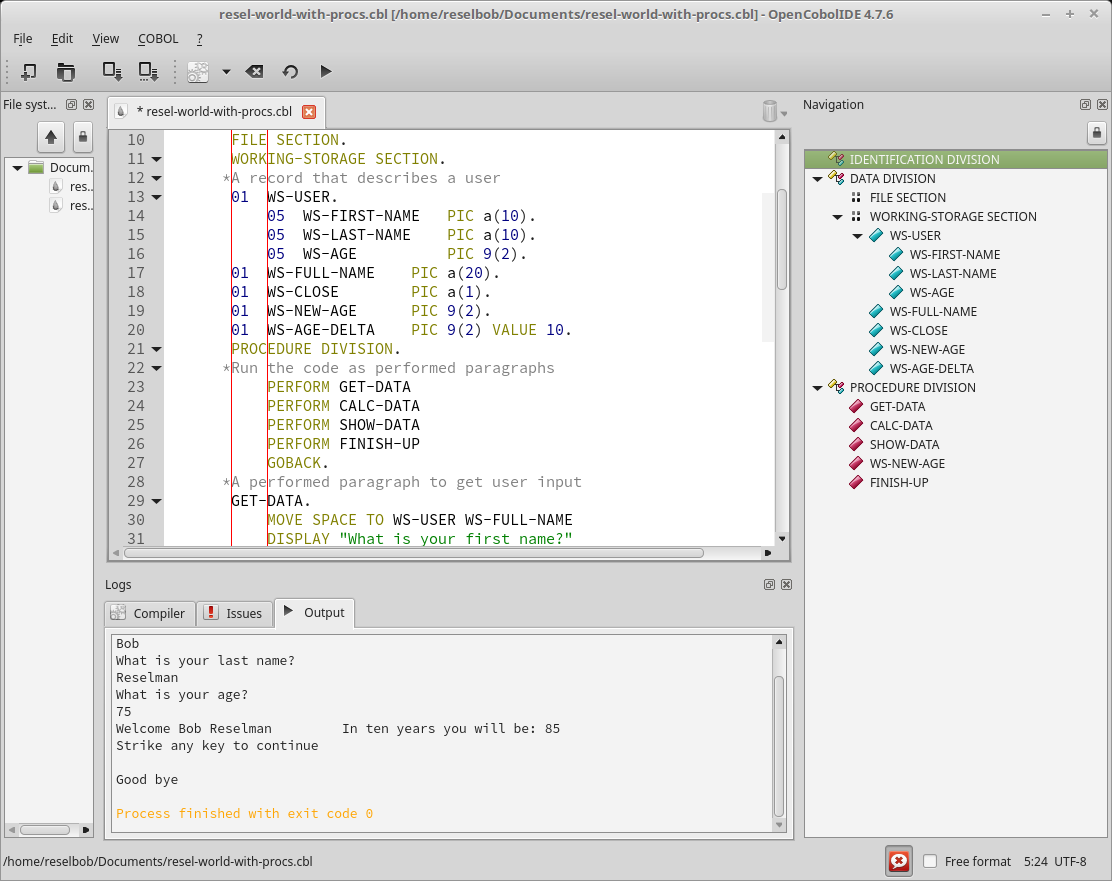
    Figure 1: OpenCobolIDE provides many tools to make COBOL programming easier

    OpenCobolIDE allows me to write, compile and run code all in one place, without having to go out to the command line, which is very good because I am the world’s worst typist!

    Programming COBOL in the Real World

    When it comes time to do real world, mainframe based COBOL programming, you will do well to look at the IDEs that IBM provides. The tools are designed to go about against its Z Systems environment seamlessly as a set of Eclipse plugins. These tools allow COBOL developers working in the mainframe environment to code, debug, unit test and do problem determination.

    Having set up my development environment, the next thing to do was design my first project.

    Designing My First COBOL Program

    Typically when learning a new language I like to start small and work my way up into more complex tasks. I did the typical Hello World program. You write the code to display string, Hello World, to standard output. Every developer does one. It’s a trivial program, as shown below in Listing 1

    beauty-of-cobol-listing-01
    Listing 1: A Hello World program written COBOL


    While the Hello World required that I learn about the concept of a DIVISION, which I will discuss in detail below, in the scheme of things, I needed more. I wanted to write a program that would force me to learn how the following:

    • How to create and use variables.
    • How to structure data into a hierarchy.
    • How to structure code into encapsulated procedures.
    • How to do some basic arithmetic.
    • How to accept user input and then do some manipulation around that input.

    Thus, I create the program, RESEL-WORLD, as shown in Listing 2, below.

    beauty-of-COBOL-Listing-02

    Listing 2: The COBOL program, RESEL-WORLD accepts and manipulates users’ input

    The user input and program output is shown below in Figure 2.


    Figure 2: The RESEL-WORLD COBOL program asks a user for first name, last name and age, then manipulates the input

    The RESEL-WORLD program taught me a lot about COBOL and how to program in the language. In the spirit of giving, I am going to share what I learned from writing the program. However, before I delve into the details, please be advised that the information I’m presenting is but a high-level overview. As with any programming language, it takes about a year of consistent coding to become an entry-level professional. My sincere hope is that the information I provide gives the reader a good sense of the language and enough motivation to want to learn more. As I mentioned early, learning COBOL is worth the effort.

    COBOL is Code in a Structured Document

    The most important thing to understand when learning COBOL is that is very strict in terms of code layout. The layout rules relate to the use of columns and characters. Also, the format uses a hierarchical outline structure. The following sections describe the details of layout specification.

    The COBOL Column Specification

    In COBOL a line of code can be no longer than 80 columns in length. You can also think of a column as a character. Columns are segmented into groups, with each group serving a particular purpose. The columns groups are as follows:

    Columns 1-6 is the group in which a programmer defines a sequence number. A sequence number is similar to a line number.

    Column 7 is reserved for special characters. Asterisk (*) starts a line of comment. Hyphen (-) indicates line continuation and slash (/) is form feed.

    Columns 8-11 is called Area A. Area A is the group of columns in which you start a DIVISION, PARAGRAPH and SECTION. We’ll talk more about these below in the next section, The COBOL Structural Hierarchy.

    Columns 12-72, also known as Area B, is where you write code statements.

    Columns 73-80 is reserved for developer use. You can write poetry in there, if you so desire. Just make sure you don’t go past column 80.


    Figure 3, below illustrates the columns grouping described above.

    Figure 3: Each column in a COBOL file is specified to serve a specific purpose


    COBOL is a compiled language. When it’s time to run your code, the compiler will check to make sure that the code layout adheres to the column grouping specification. If there is a violation, the compiler will error.

    Understanding Performance in Terms of Compilation and Compilers

    COBOL is a compiled language, as are others such as Java, C# and C++. Compilation is the process of taking textual source code and converting into a binary format that the computer can understand.

    There’s a lot of variety in the COBOL world when it comes to compilers, particularly when it comes to cost and performance efficiency. For example, how a compiler orchestrates the way numbers are loaded and then computed in memory matters a lot! A good compiler will make code run really fast.

    IBM has been in the COBOL business for a long time and has a keen understanding about making compilers that are fast and cost-effective. For example, the z14 System compilers improve efficiency by taking advantage of almost 24 new low-level instructions. As a result, computation speeds improve dramatically.

    As you work more with COBOL, you’ll come to appreciate the power that an industry-leading compiler such the IBM Z Systems brings to the coding experience.

    The COBOL Structural Hierarchy

    The concept behind the file format of a COBOL program is based on the structure of a document outline, with a single top-level heading followed by subordinate levels. The organizational units that make up the hierarchy are PROGRAM, DIVISION, SECTION, PARAGRAPH, SENTENCE, STATEMENT and CHARACTER. Figure 4 illustrates the hierarchy.
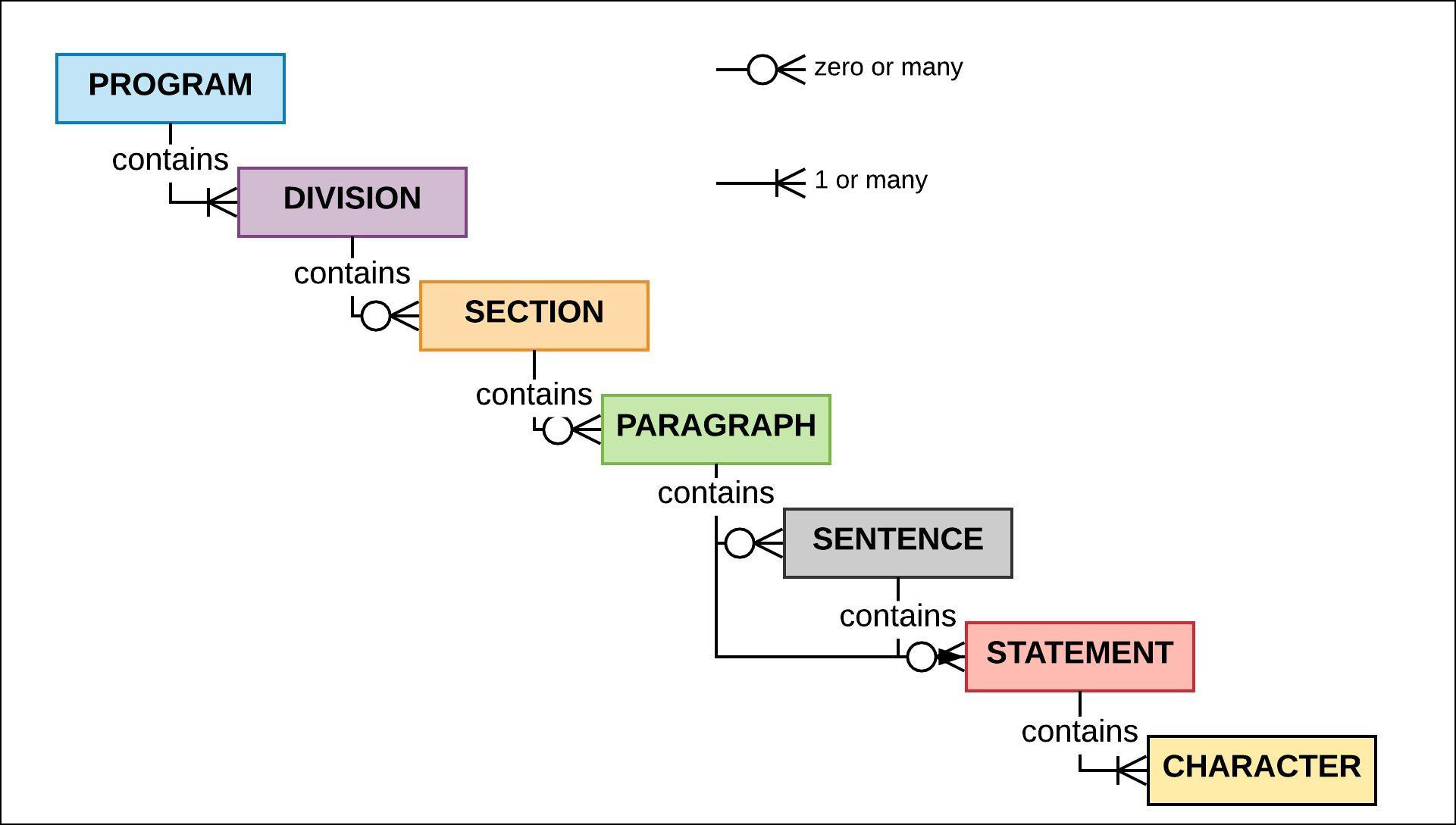
     

    Figure 4: The structural hierarchy of COBOL program entities

    PROGRAM is the root level of the COBOL code hierarchy. PROGRAM represents the unit of code that the mainframe job scheduler, the JCL, loads into memory to run. The program is identified by the PROGRAM ID statement in the IDENTIFICATION DIVISION. The IDENTIFICATION DIVISION is part of the next level of hierarchy that descends from PROGRAM. PROGRAM must contain the IDENTIFICATION DIVISION.

    There are other DIVISIONs that can be included. These other DIVISIONs are: ENVIRONMENT DIVISION, DATA DIVISION and PROCEDURE DIVISION,  which occur after IDENTIFICATION. Also, these subsequent DIVISIONs must appear in the order defined: ENVIRONMENT, DATA and then PROCEDURE. You can read a detailed description of each DIVISION here. DIVISION names are terminated with a period, for example,

    DATA DIVISION.

    The next organizational level down from DIVISION is SECTION. (Please see Figure 5.) Each DIVISION will contain SECTIONs that are special to it. For example, the DATA DIVISION can contain FILE SECTION, a, WORKING-STORAGE SECTION and/or the LINKAGE SECTION. You can read the details about DIVISIONs and SECTIONs here.


    Figure 5: A COBOL program is structured in a hierarchical manner

    A SECTION name is terminated with a period, for example:

    WORKING-STORAGE SECTION.

    A SECTION contains zero or many PARAGRAPHs. (Typically a SECTION will have at least one PARAGRAPH.) A PARAGRAPH name is terminated with a period, similar to a DIVISION and a SECTION.

    A PARAGRAPH contains SENTENCEs or STATEMENTs. A SENTENCE is a group of STATEMENTs. Usually a PARAGRAPH contains one or more STATEMENTs. A STATEMENT is a line of execution. A STATEMENT is made up of CHARACTERs. A CHARACTER can be an alphanumeric symbol or a special character. CHARACTER is at the bottom of the COBOL code format hierarchy.

    Variable and Data Types

    COBOL allows you to declare variables in a variety of data types. Special to COBOL is the concept of a variable level as represented by a level number. A level number defines a variable in terms of being or having a parent variable. (You’ll see more about this in the section, COBOL Supports Hierarchical Data, later on.)

    The following statement, which will be declared in the WORKING-STORAGE SECTION of the DATA DIVISION, is the declaration of a variable, WS-QUANTITY. WS-QUANTITY will hold a numeric value.

    01  WS-QUANTITY PIC 9(2) VALUE 12

    The expression above above declares a variable , WS-QUANTITY to be a two-digit value with an initial value of 12. Also, the variable is declared to be at level 01, which is the highest level possible. The variable has no parent. The way we know that WS-QUANTITY is a variable for a two-digit value is due to the PIC (Picture) clause. You can think of a PIC clause as a type declaration. Table 1 provides a high-level description of the various PIC clause symbols.

    Symbol Description Example Declaration Sample Value
    9 A numeric value where each occurance of 9 represents a digit 99 or 9(2) 35
    a Alphabetic aaa or a(3) “Bob”
    x Alphanumeric xxxx or x(4) “R2D2?”
    v Implicit decimal* v(3) .175
    s Sign s9(2) -76
    p Assumed decimal* p9 .6

    Table 1: Symbols for a PIC Clause

    *COBOL has a special way of storing numbers such that the numeric conversion take place when the characters are loaded into memory. For example, a variable with a PIC of p9(2) will be stored as 56 and loaded into memory as .56. For a more detailed discussion of usage and the PIC clause, go here.

    COBOL Supports Hierarchical Data

    Storing data in a named group of variables makes programing easier. For example, in the C programming language, we can use a struct to name a group of variables, as shown below in Listing 3.

    struct User { 
      char  first_name[10]; 
      char  last_name[10] 
      int   user_id; 
    };

    Listing 3: A simple structure in C


    One of the real nice things about COBOL is that it allows you to organize data according to a named group of values similar to that of a C struct. What’s interesting in a historical sense is that COBOL has had this capability well before Kernighan and Ritchie created the C programming language.

    The way COBOL accomplishes named data grouping is with construct called a record. Figure 6 below shows a graphical representation of a record named, WS-USER.

    Figure 6: The record, WS-USER contains subordinate variable, WS-FIRST-NAME, WS-LAST-NAME, WS-AGE

    The code snippet in Listing 4, which is from the RESEL-WORLD program at the start of this article, shows the COBOL code that declares the record, WS-USER.


    beauty-of-COBOL-Listing-04

    Listing 4: The record, WS-USER contains 3 subordinate elements, WS-FIRST-NAME, WS-LAST-NAME, WS-AGE

    Notice in Listing 4 above the there are two levels of data variables in play: 01 WS-USER and 05  WS-FIRST-NAME, 05 WS-LAST-NAME, 05 WS-AGE. The variable, WS-USER is a parent to the subordinate, level 05 variables, WS-FIRST-NAME, WS-LAST-NAME, and WS-AGE.

    Assigning variable to a numeric level is special to COBOL. The declaration logic is that a record variable (the root of the record) has a level number of 01.  Levels 02 to 49 are used to declare subordinates elements. (You can think of a element as a member of the record.)

    You use the reserved word OF to access an element of a record. Listing 5 below shows two statements. The first asks a user to input their first name. The second statement takes the value entered and assigns it to the element, WS-FIRST-NAME of the record, WS-USER.

    DISPLAY "What is your first name?".
    ACCEPT WS-FIRST-NAME OF WS-USER.

    Listing 5: Accessing an element of a record in COBOL


    It make sense that records were part of COBOL from the start. COBOL was intended to be a language used for business application. Businesses have been organizing values according to named groups since before the customer form was created. COBOL was designed to reflect business needs. It’s interesting that the fundamental needs of businesses in terms of logical data structures have been surprisingly consistent over time.

    COBOL Has a Natural Language Syntax

    Expressing a statement in COBOL is very similar to the way a person speaks naturally. Listing 6 below shows the statement that adds together the values of the two variables, WS-AGE-DELTA and WS-AGE (from the record WS-USER), and stores the result in the variable, WS-NEW-AGE.

    
    ADD  WS-AGE-DELTA WS-AGE OF WS-USER TO WS-NEW-AGE.

    Listing 6: Adding two integers, WS-AGE-and DELTA WS-AGE, then storing the sum in the variable, WS-NEW-AGE

    Notice that the statement in Listing 6 is very close to saying, “Add WS-AGE-DELTA and WS-AGE from WS-USER to WS-NEW-AGE.”


    What I find pretty astounding is that many modern programming paradigms try to capture the ease of natural language expression that COBOL has had for years. What comes to mind immediately is the use of natural language expressions in the NodeJS Chai package. Chai is used in NodeJS unit testing to express BDD assertions. Here’s a Chai expression that checks a variable, myVar to assert that it’s a string.

    expect(myVar).to.be.a('string');
    
    FAST FACT: Is COBOL a case-sensitive language?

    No. COBOL will consider a variable named WS-FIRST-NAME to be the same as one named ws-first-name.

    COBOL supports DRY

    For programming language to be really useful, it needs to support DRY. DRY is an acronym for Don’t Repeat Yourself. Most programmers don’t want to write the same code over and over again, nor should they. What you want to do is to encapsulate code in to a single area of execution that can be called repeatedly. Being able to program by DRY is common for most languages—BASIC, Java, C#, Javascript, Python, to name a few and … you guessed it: COBOL.

    COBOL supports code segmentation and reuse in a variety of ways. One way is through linkage, calling routines between programs. Another way is to segment code inline under a PARAGRAPH in the PROCEDURE DIVISION and then call that PARAGRAPH. (See Figure 7.)

    Figure 7: You can make code reusable in COBOL PARAGRAPHs

    The little RESEL-WORLD program I wrote uses the inline PARAGRAPH technique. Before I go in to the details of calling code encapsulated into a PARAGRAPH, it’s important that you know that in COBOL the entry point of execution into a program is the first line of code after the declaration of the PROCEDURE DIVISION, as shown below in Listing 7.

    beauty-of-COBOL-Listing-07
    Listing 7: COBOL supports reusable code by using PARAGRAPHS to segment execution

    Notice the PERFORM statements right after PROCEDURE DIVISION. These four statements are calling PARAGRAPHs. (For those of you familiar with JavaScript, you can think of each PARAGRAPH as a function definition.) Essentially what the code is saying is, “Execute the code at the paragraph named, GET-DATA, then perform the code at CALC-DATA, SHOW-DATA and then FINISH-UP.”

    Encapsulating code into STATEMENTs within a PARAGRAPH prevents code from become spaghetti that is hard to maintain. Also, the encapsulation enforces the sensibility of DRY. Any language worth its salt needs to support some sort of encapsulation. COBOL meets the need with room to spare.

    An Expressive Language for Now and the Future

    The more I learn about COBOL, the more I like it. The language continues to evolve to meet the needs of our fast-changing times, with revisions as recent as 2014. Since its inception there have been a dozen enhancements to COBOL including a continuing stream of formal standards.

    Today’s COBOL supports modern programming paradigms such as object orientation. The IDEs have grown to keep pace with the demands of modern users. And, given the immense installation base out there, there is a lot of money to be made doing COBOL programming. To quote Wikipedia:

    In 2006 and 2012, Computerworld surveys found that over 60% of organizations used COBOL (more than C++ and Visual Basic .NET) and that for half of those, COBOL was used for the majority of their internal software.


    What’s even more amazing to me is the cleverness of engineering the language has promoted. COBOL developers addressed problems in the past that still vex many today. We modern developers can fall prey to thinking that before we came along, there was no cool stuff. It’s like the young, aspiring guitarist who thinks thinks he has his chops down and can shred to the top of the heap. Then one day his music teacher gives him a 1936 recording of Django Reinhardt playing guitar, and playing with only two functional fingers on his left hand! At that point the young artist realizes that virtuosity transcends era and that creativity has no bounds. This is what it’s like for me as I learn COBOL. It’s a beautiful, expressive language that was cool then and is very cool now. Learning it is making me appreciate how much amazing thinking went on back then and continues to emerge. There’s a lot of rich opportunity at hand to make great code for mainframes using COBOL. It’s only a matter of mastery, creativity and discovery.

    Special Thanks

    If I have seen further it is by standing on the shoulders of giants.

    —Isaac Newton, Letter to Robert Hooke, February 5, 1675

    Learning any programming language is hard work. Years ago, when I wanted to learn a new language, I would get a few books on the topic and then hunker down to spend the hours necessary to absorb the required knowledge. If I had the time, I might take a course. Maybe I had an expert friend I could call up when I hit a wall or needed real-world guidance.

    We’ve come a long way since that time. The internet is a game-changer. Online tutorials, videos and interactive, digital books make things a whole lot easier than in earlier times. My experience learning COBOL testifies to the value of these modern benefits. But still, as I’ve been learning, I’ve hit more than one wall that required professional guidance and review. Allan Kielstra and Roland Koo at IBM (who also wrote this great article) provided the expertise that made my learning COBOL not only less difficult, but also fun. I am in their debt. Their enthusiasm for COBOL was infectious. Their commitment to technical excellence is inspiring.

    — Bob Reselman

  • COBOL: Completely Obsolete But Omnipresent Language

    COBOL: Completely Obsolete But Omnipresent Language

    The programming language COBOL is a nuisance, something everyone wants to get rid of; however, I’m about to advise you to learn it. It might be a gold mine.

    The IT world is a fast paced one where obsolescence is the rule and where things evolve so fast that any person who wants to understand it has to continuously learn and train. Languages, methodologies and technologies keep on changing, evolving to make programming easier, safer more robust and above all, faster. As to every rule, there is one exception.

    In 1959, convinced that the English language would be more suitable for programming than machine code or the assembly language, Grace Hopper creates the first ever human-readable programming language that would survive for over fifty years: COBOL

    COBOL, 55 years old and still in its youth, not ever thinking about retirement, has become a nuisance, something everyone wants to get rid of but no one has the courage to try.

    Are we ready to replace COBOL?

    Nowadays, 80% of financial transactions are made through COBOL programs and most of those programs have been written decades ago and have proven to be reliable, effective and efficient. To top it all most companies which are still using it have invested a lot of money in those systems and if it is not broken, why fix it?

    So why would one want to change them? Well, it’s not Java. COBOL was created in an era where IT didn’t have the meaning it has today. A program was mainly designed to replace simple repetitive tasks such as retrieving data from a database, performing a couple of operations and generating a report or updating some other data. Today’s programs have to present a front-end to thousands of users, go through different layers of security, logic and quick data retrieving before accessing the back-end to ultimately alter data and send some information back to the user. Alternatively, a program can be a tool to design objects and buildings, communicate with your friends, frag your opponents, enhance your reality, you name it… The whole philosophy behind the conception of programs has changed so much in the last two decades that having such an outdated technology that almost no one knows anymore represents a potential danger. Only few people learn COBOL these days and even though those systems are not supposed to evolve much, there is always maintenance to be performed. But are we ready to replace it just yet?

    Fast, robust and future-proof language

    COBOL has been on the brink of death for years but its presence overall hasn’t changed. Not only are the cost to migrate from one technology to another huge but the choice of the replacing technology itself is a million dollars question. What better than COBOL to perform typical COBOL operations? While not designed to be an Object Oriented Language such as Java or C#, COBOL has slowly adopted some of their aspects, extending itself and its functionalities to a point where almost everything is possible. Everything with the exception maybe of creating user friendly or good looking Human-Machine Interface. In that matter, nothing has changed much since Hopper’s time. Many of us still remember the frustration of spending hours to get a simple screen with a couple modifiable fields and those who still use them must be dreaming every day to replace F5 and F6 by simple buttons…

    But that was never the point; the point was to have a fast, robust and future-proof language.

    COBOLs main contenders

    The discussion is still opened as to which language could replace COBOL but here are some pros and cons to the main contenders:

    –       Java is easy to learn, well spread and has a huge community of developers already but is rather slow compared to other languages despite the existence of some specialized compilers and massive improvements in the last few versions. It is also arguably still in its youth and the yearly evolutions and changes to the language don’t play in its favor. Not to mention the recent security issues.

    –       C++ is fast, flexible and robust but it takes time to learn and understand and has what is maybe its biggest flow, potential memory leaks. Something COBOL and Java programmers have, almost, never heard of. By conception, it offers a lot of freedom to developers but that also implies few ready-to-use components and thus it’s less cost-worthy.

    Let’s say that one day we manage to find a clear winner, another major problem will suddenly emerge. COBOL was made to perform all kind of operations in one block but we have learned throughout the years that modularity is the key to success. So if we replace COBOL itself by another language, we will also need to have databases and SQL, a front end and HTML, most likely a Business Process Management Software to externalize workflows… Basically, replacing COBOL programs means creating whole new ones.

    The ultimate piece of advice

    While it is possible to replace this aging language, this comes at such an extremely high cost that we can anticipate its presence in at least the next twenty years which brings us to the ultimate piece of advice of this paper: if you have the opportunity to learn it and enough motivation to write white on black interfaces, go for it. The pool of competent COBOL programmers is getting smaller by the day and the demand doesn’t change, meaning that this personal investment might reveal itself a gold mine.