Tag: cloudbees

  • CloudBees Further Extends Jenkins CI/CD Reach

    CloudBees Further Extends Jenkins CI/CD Reach

    CloudBees announced it is expanding the scope and reach of its Jenkins open source continuous integration/continuous development (CI/CD) platform into the realms of compliance and serverless computing frameworks.

    Announced at the DevOps World | Jenkins World conference in Nice, France, a new plugin for Jenkins adds support for the AWS Serverless Application Model (SAM) defined by Amazon Web Services (AWS). That model spans AWS Lambda functions, application programming interfaces and Amazon DynamoDB tables and is natively supported by AWS CloudFormation. The AWS SAM plugin supports both classic FreeStyle jobs and Jenkins Pipeline to make it possible to read and deploy serverless applications.

    In effect, CloudBees is making it possible to treat AWS Lambda as a natural extension of any CI/CD pipeline. Longer term, serverless computing frameworks will play a larger role in the cloud-native instance of CloudBees as well.

    In the meantime, CloudBees is also extending its CI/CD platform to address compliance issues that arise from identity management. CloudBees Core is now integrated with the LDAP-based directory Google makes available within its Cloud Identity service. This capability makes it possible to centralize user management policies by using the same Google Cloud Identity or G Suite credentials to connect to CloudBees Core.

    Christina Noren, chief product officer for CloudBees, noted governance and compliance are becoming much bigger issues within best DevOps practices as more responsibility for security continues to shift left toward developers.

    The CloudBees community continues to grow, even as the number of CI/CD rivals continues to expand. At the conference, CloudBees executives revealed the Jenkins community has grown 24 percent in the period Sept. 30, 2017, to September 30, 2018, reaching 192,623 active installations. That number only applies to installations that permit usage information to be transmitted to the Jenkins project, so this number is not representative of the total Jenkins user population. All told, it’s estimated there may be anywhere from 15 million to 23 million developers globally relying on Jenkins. CloudBees also noted the combined number of defined Jenkins Pipeline and other jobs increased during this same annual period, from 10,509,706 million to 20,664,054 million, with Jenkins Pipeline jobs demonstrating growth of 309 percent from last year.

    Noren said one of the primary reasons for that continued success is that unlike other CI/CD platforms that provide a highly opinionated framework accessible only as a cloud framework, the Jenkins environment makes it possible to deploy a more flexible framework on-premises or in a public cloud.

    Of course, there are still millions of developers that have yet to be exposed to any type of CI/CD framework. But as DevOps practices continue to become the primary method through which application development and deployment is increased, it’s now only a matter of time before most developers are working within the context of a CI/CD platform.

    In fact, it’s arguable that those organizations that don’t soon embrace CI/CD platforms will be overwhelmed by rivals capable of updating applications at rates that are increasingly being measured in days and hours versus weeks and months.
    — Mike Vizard

  • HSBC Speeds Software Delivery with CloudBees Core

    HSBC Speeds Software Delivery with CloudBees Core

    HSBC Speeds Software Delivery with CloudBees Core

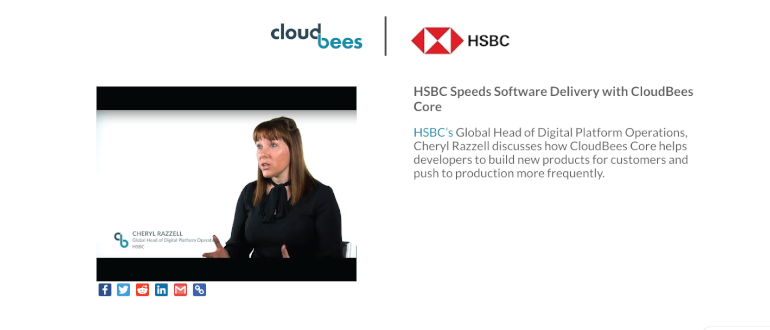
    HSBC’s Global Head of Digital Platform Operations, Cheryl Razzell discusses how CloudBees Core helps developers to build new products for customers and push to production more frequently.

     I see total evolution of the HSBC environment to encompass CloudBees Core and aligning the roadmaps of CloudBees and HSBC to create a platform that we can use for the future within the bank that not just sits within HSBC digital, but is used by and encompassed by the entire bank. 
    Cheryl Razzell
    Global Head of Digital Platform Operations
    [su_youtube url=”https://www.youtube.com/watch?v=eHgwJAuTIgI”]
  • CloudBees Extends CI/CD Scope, Reach

    CloudBees Extends CI/CD Scope, Reach

    CloudBees, at its DevOps World | Jenkins World 2018 conference this week, unveiled a broad strategy to extend the reach and scope of continuous integration/continuous deployment (CI/CD) platforms based on the open source Jenkins software.

    Company CEO Sascha Labourey said CloudBees Suite will provide the equivalent of a customer relationship management (CRM) application for software delivery. That approach will not only accelerate application development processes, but also provide application stakeholders across the enterprise with more visibility into DevOps processes. For example, business executives are demanding more visibility into DevOps processes as the organization begins to appreciate how dependent it is on the timely delivery of software, Labourey said.

    Rather than buying isolated components of a CI/CD platform, the CloudBees suite provides a single pane of glass through which all the elements of the platform can be managed. That capability is critical because it enables an organization to start with one element of a CI/CD platform that, over time, can be expanded frictionlessly as the organization becomes more comfortable with DevOps processes.

    Labourey said it’s clear the CI/CD platform is the hub around which those DevOps process revolve. The CloudBees Suite includes CloudBees Core to unify the management and governance of pipelines, which includes limited availability of the Kube CD for extending the CloudBees platform to Kubernetes clusters. In fact, Labourey noted that Kubernetes is rapidly emerging as the foundational element of a federated approach to CI/CD in the age of microservices.

    CloudBees also announced an alliance through which Lenovo will provide IT organizations a turnkey set of servers running instances of CloudBees Core on the Red Hat OpenShift application development platform. As DevOps continues to evolve, Labourey said, organizations want to reduce the amount of time it takes their IT teams to deploy the infrastructure required for a modern application development platform.

    Another core element of CloudBees Suite is CloudBees DevOptics, a software-as-a-service (SaaS) application that provides visibility and insights into value streams and operations as well as continuous reports on the four key DevOps metrics. CloudBees DevOptics will provide the raw data the company will rely on to apply artificial intelligence (AI) in the form of machine and deep learning algorithms to the CloudBees CI/CD platform, Labourey said.

    The two remaining core modules of CloudBees Suite are CloudBees CodeShip, which enables organizations to jump start projects using a CI/CD as a Service offering, and CloudBees Jenkins Support, which provides users of the open source Jenkins platform full support. CloudBees is also making support for instances of Jenkins available as a standalone subscription service.

    It’s clear that CloudBees is trying to extend the reach of its widely employed CI/CD environment not only to new platforms, but also to new users. As digital business processes continue to proliferate across the enterprise, there is now a lot more at stake whenever an application development project is delayed. While such delays may be inevitable, the degree to which organizations might be surprised by those delays can be reduced sharply when everyone in the organization is operating on the same DevOps page.

    — Mike Vizard

  • Keynotes and Announcements at DevOps World | Jenkins World 2018

    Keynotes and Announcements at DevOps World | Jenkins World 2018

    Each year DevOps World | Jenkins World is bigger and better than the year before. This means the announcements at the show also continue to evolve to keep pace with the rate of innovation. With the tremendous growth in DevOps adoption, the event will highlight the contributions of industry leaders and provide insight for attendees to better optimize their DevOps transformations. This year’s conference, taking place Sept. 16-19 in San Francisco and aptly themed “TRANSFORM,” will showcase the ways organizations are transforming software delivery, adopting DevOps and returning business value to their organization from DevOps initiatives.

    CloudBees has already released two big pieces of news for DevOps World | Jenkins World: The first is the name change from simply Jenkins World to denote the inclusion of the larger software development industry, while the second is the addition of a conference in Nice, France, to reach the global community of DevOps practitioners.

    Although most news is top secret until the event, there will be plenty of exciting announcements coming out of DevOps World | Jenkins World from CloudBees, sponsors and the Jenkins community. Attendees will experience keynote presentations on Tuesday, Sept. 18, where all the latest from both CloudBees and the Jenkins project will be announced. This will include news around the growing trend of “as-code,” collaboration between CloudBees and the Jenkins community and serverless capabilities. All announcements will underscore how organizations can adopt modern technology and infrastructure automation processes for accelerated software delivery.

    Along with CloudBees-specific and industry announcements, Dr. Nicole Forsgren, co-founder, CEO and chief scientist at DevOps Research and Assessment (DORA), will keynote the conference in San Francisco this year. In addition to her keynote, “The Data Behind DevOps: What Does it Take to Be a High Performer?,” which will cover insights into the key leadership, technical, architectural and product capabilities that drive these outcomes, she will also be hosting a session, “Leading Through Change,” which explores the aspects of leadership that drive successful outcomes.

    Additionally, DevOps World | Jenkins World San Francisco will boast more than 100 sessions this year. With a variety of industry experts covering everything from security, pipeline automation and containers to DevOps adoption and continuous delivery best practices, here’s a few sessions you won’t want to miss:

    With DevOps World | Jenkins World only days away don’t miss your chance to sign up for 20 percent off the cost of registration with this special code just for devopsy.kinsta.cloud readers: JWDEVOPSCUST.

    — Heidi Gilmore

  • A Certifiable Reason to Attend Training at DevOps World | Jenkins World 2018

    A Certifiable Reason to Attend Training at DevOps World | Jenkins World 2018

    There are many factors that make DevOps World | Jenkins World the essential DevOps event to attend each year. Whether it is the keynotes and speaker sessions from industry-leading DevOps experts, the expo where you can check out the latest and greatest from our friends in the software industry or the themed after-party, there are many reasons why year over year the conference grows. An added benefit that contributes to DevOps World | Jenkins World being the DevOps event of the year is the wealth of informative preconference training and certification. Think of them as the workout before the big game, providing you the tools and knowledge to make the most of the conference and beyond.

    The growth of attendance and variety of attendees of  the DevOps World | Jenkins World conference is one of the indicators that the industry is constantly innovating and evolving. Last year, Forrester declared 2018 as the “Year of DevOps,” with 50 percent of survey respondents reporting they had already implemented DevOps with plans to expand. For DevOps practitioners to keep up with the continuous pace of modern software development, there also has to be continuous learning. Training and certification at DevOps World | Jenkins World will cover relevant topics in software development, such as authorization and security, build management, instance administration and interfacing with cloud services, in addition to Jenkins and CloudBees Core fundamentals.

    Not only are all training sessions available to add on to your full conference sessions pass, but you also can receive a free Jenkins certification exam voucher—a $150 value—for the Certified Jenkins Engineer (CJE) and Certified CloudBees Jenkins Platform Engineer (CCJPE) exams. You can choose to sign up for an onsite exam at DevOps World | Jenkins World (first-come, first-serve) or use it at a later date. There are also several half-, one- and two-day courses that can be added during the event registration process.

    In addition to our recommendations below, check out the Training and Certification page to see what courses can help strengthen your software delivery pipeline skills.

    DevOps Leader Certification Training

    Successful implementation of DevOps requires leadership. Whether you are in a  tactical or strategic role, if you help design, influence, implement or motivate the cultural transformation in DevOps adoption, this course will take your DevOps leadership to the next level.

    Value Stream Mapping for DevOps

    If you’re looking to better understand DevOps, you are in the right place! Join Mike Orzen, a recognized and prominent Lean thought leader and author, to learn the ins and outs of DevOps value stream mapping, helping you identify inefficiencies in your current process, and optimize it to deliver more value to your customers.

    Jenkins Fundamentals

    It wouldn’t be Jenkins World without Jenkins! To prepare yourself for both the Certified Jenkins Engineer (CJE) or Certified CloudBees Jenkins Platform Engineer (CCJPE) certifications, Jenkins Fundamentals introduces you to the best practices for leveraging Jenkins to drive your continuous development life cycle with Jenkins.

    CloudBees Core Fundamentals

    As the foundation of CloudBees, once you’ve mastered Jenkins Fundamentals, CloudBees Core Fundamentals is the obvious next step. In this training, attendees will gain the skills needed to leverage the CloudBees Core product suite to successfully scale CD and DevOps in their organizations. The training includes an overview of the key proprietary features provided with CloudBees Core to enhance the capabilities of Jenkins.

    CloudBees Core on Kubernetes

    Kubernetes is seeing widespread adoption as the operating system for cloud native applications and the industry’s go-to container orchestration system. This course will provide attendees with the tools needs to run CloudBees Core on Kubernetes, and leverage public and private clouds to establish an elastic, scalable CD and DevOps platform. The course includes hands-on installation of CloudBees Core on Kubernetes. 

    Go to https://www.cloudbees.com/devops-world to learn more and to register. Additionally, use this special code just for devopsy.kinsta.cloud readers—JWDEVOPSCUST—at registration, and you’ll get a 20 percent discount.

    — Brian Dawson

  • DevOps World | Jenkins World 2018: Q&A with CloudBees CEO Sacha Labourey

    DevOps World | Jenkins World 2018: Q&A with CloudBees CEO Sacha Labourey

    Jenkins World has come to hold a regular spot on the calendars of the software development community. As the conference, and the industry, have grown over the years, the event has transformed—which is aptly the theme for this year’s event—into DevOps World | Jenkins World. CloudBees, the premier sponsor, also extended it for DevOps practitioners in Europe—specifically to Nice, France.

    In this Q&A, CloudBees CEO Sacha Labourey talks about the changes to this year’s conference and offers attendees a sneak preview.

    Gilmore: Why is Jenkins World changing its name to DevOps World?

    Sacha Labourey: Our goal with the change to DevOps World, was to scale the topics covered to create an event where people can meet and learn from each other and enhance their knowledge of not only Jenkins but the entire DevOps landscape. Although Jenkins remains a very important focus of the event, with the tremendous growth in DevOps adoption we wanted to expand Jenkins World to include a breadth of industry topics, such as cloud native, DevSecOps, software value streams and the more practical DevOps adoption use cases.

    Not only is the DevOps World | Jenkins World conference bringing together the best of both DevOps and Jenkins, but we’ve extended all of the learning opportunities for IT practitioners across the globe by introducing our first conference in Europe—in Nice, France, in October. Similar to what we’ve created in San Francisco, we’re hoping the event provides many opportunities for attendees to learn, network and explore in order to optimize their DevOps initiatives.

    Gilmore: What can attendees expect from this year’s event?

    Labourey: With the new name and additional location, attendees will get even more out of DevOps World | Jenkins World 2018. We’ll be hosting more than 70 sessions at the San Francisco conference and more than 50 in Nice, covering a variety of DevOps and Jenkins topics from security, pipeline automation, containers, DevOps adoption and continuous delivery best practices. Additionally, the workshops and training that precede the conference offer attendees the opportunity to get certified as a DevOps practitioner or Jenkins Certified Engineer, deploy applications to a Kubernetes cluster, learn how to get the most out of Jenkins Pipeline and also do a deep dive into what’s coming with Jenkins X.

    We have some amazing keynotes lined up for both conferences. Kohsuke Kawaguchi, CTO at CloudBees and Jenkins founder, will provide an update on the latest and greatest of Jenkins which is always cool to hear. Dr. Nicole Forsgren, CEO and chief scientist at DORA, will take the stage in San Francisco, sharing her insights into the key leadership, technical, architectural and product capabilities that drive positive outcomes based on the “2018 State of DevOps Report.” In Nice, you can catch James Governor, analyst and co-founder of RedMonk, who will be discussing why he’s devoted to putting developers first. Christina Noren, chief product officer at CloudBees, and I will also be keynoting in both locations.

    Here’s a glimpse of some of the conference sessions on the agenda:

    • Measuring and Quantifying DevOps Outcomes
      Panel discussion led by Chris Condo, Forrester
    • Mission Possible: Eliminating DevOps Security Roadblocks
      Jason Vanderhoof, CyberArk
    • Managing Hundreds of Jenkins Instances at the Eclipse Foundation
      Mikaël Barbero, Eclipse Foundation
    • Delivering Enterprise Architectures: Perspectives from Duke Energy and Wolters Kluwer
      Dwayne Culbertson, Duke Energy
      Harris Kirk, Wolters Kluwer
    • The Build That Cried Broken: Building Trust in Your Continuous Integration Tests
      Angie Jones, Twitter

    Gilmore: What are you looking forward to the most about DevOps World?

    Sacha Labourey: Jenkins World, and now DevOps World, is always the highlight of the year for me. I am excited to meet and learn from so many innovators in the DevOps industry and amongst the CloudBees’ partner ecosystem. The process of software delivery is in an era of rapid growth and tremendous innovation. In the last year, we’ve seen the rise of Kubernetes, more and more a desire for actionable metrics to measure the DevOps initiatives that have been adopted, and DevSecOps is coming on stronger than ever. This has inspired us to create expanded learning opportunities at DevOps World | Jenkins World 2018 that reflect the interests of people within the industry so that we can continue to foster learning and the advancement of software delivery. I’m thrilled to see this come to life every year—and proud that CloudBees and our sponsors make it all happen.

    I’m especially looking forward to hearing some of the cloud native sessions, since that’s a newer topic this year. We also have put together several DevOps experience panels from real-world practitioners who will be sharing their successes in the field—and maybe even more importantly, their failures. We learn the most from failure and sharing those experiences can help others avoid doing the same things.

    With two events this year, it means the DevOps World | Jenkins World fun will extend further into the fall! I hope devopsy.kinsta.cloud readers will join us in San Francisco or Nice. If they do, they can get 20 percent off their registration using the devopsy.kinsta.cloud special code: JWDEVOPSCUST

    — Heidi Gilmore

  • CloudBees Expands Visibility into DevOps Processes

    CloudBees Expands Visibility into DevOps Processes

    CloudBees has moved to bring some order to the potential DevOps chaos via an update to CloudBees DevOptics, a monitoring tool for tracking stages of the software delivery process in real time.

    The update to the software-as-a-service (SaaS) application adds capabilities that identify everything from potential bottlenecks to periods of inactivity that might be better allocated to maintenance activities.

    Michael Baldani, product marketing manager for CloudBees, said CloudBees DevOptics makes it possible to create benchmarks that track DevOps performance across the entire software delivery life cycle, including deployment frequencies, lead time to committing code into production environment, mean time to recover from failures and change failure rates. The “2017 State of DevOps Report” identifies these four most important metrics for a DevOps team to track.

    Armed with those insights, a DevOps team is capable of drilling down into a specific issue to make more informed decisions concerning how best to optimize processes, said Baldani, noting that longer term, CloudBees DevOptics also sets the stage for eventually applying machine learning algorithms to processes.

    The rate at which organizations have been making the transition to DevOps has been uneven at best. Much of that issue can be traced back to a lack of visibility into how specific processes are being employed, Baldani said. The analytics capabilities provided via CloudBees DevOptics should help organizations accelerate the transition to DevOps by enabling organizations to more easily identify areas where they need to optimize DevOps best practices, he said.

    Traditional enterprise IT organizations are still wedded to legacy approaches to software development largely because of inertia. CloudBees DevOptics provides an analytics application that, in addition to helping optimize DevOps processes, provides access to dashboards through which a DevOps process can be shown conclusively to be more efficient than, for example, an existing waterfall approach.

    Most organizations are embracing DevOps from the bottom up as individual teams launch various application development projects. As those teams start to deliver applications faster, it’s usually not too long before senior managers want to replicate that success across the rest of the organization. CloudBees DevOptics provides a mechanism through which the best practices implemented by various teams can be captured to facilitate sharing them with other teams. The biggest challenge facing most organizations today is not so much being convinced they can benefit from DevOps, but rather how precisely to go about it.

    It may take a while longer for DevOps processes to become the most widely used approach to developing software in the enterprise. But as more organizations continue to appreciate how dependent they are on software to manage increasingly digital processes, the need to accelerate the rate at which software is being developed becomes more apparent. CloudBees is betting that access to real-time analytics will be a major factor in any decision to standardize on a continuous integration/continuous deployment (CI/CD) platform by providing visibility into how software development ultimately impacts the business. After all, it’s now only a matter of time before some new or existing rival leverages software to create a competitive edge. In fact, it’s already been proven time and again that the rate at which organizations can create and deliver quality applications is critical to the overall customer experience.

    — Mike Vizard

  • CloudBees Acquires Codeship to Extend CI/CD Reach

    CloudBees Acquires Codeship to Extend CI/CD Reach

    CloudBees today signaled its DevOps ambitions to extend well beyond the Jenkins continuous integration/continuous deployment (CI/CD) platform by acquiring Codeship, a provider of a CI/CD platform that is delivered as a software-as-a-service (SaaS) application.

    The decision to acquire Codeship is being driven by the need to engage smaller DevOps teams that don’t have the time or expertise required to set up on-premises instances of Jenkins, said CloudBees CEO Sacha Labourey.

    Codeship today is being used by more than 100,000 developers spanning 2,400 customers. Many of those developers are working at smaller companies. But Labourey noted that small teams of developers inside larger companies also prefer to invoke a CI/CD platform as a service.

    “Different teams will decide to do different things in the same organization,” said Labourey.

    The Codeship platform is not based on Jenkins and there is no plan to rehost the Codeship service on Jenkins, says Laborey. Jenkins is designed to be highly customizable by the organization that employs it. The Codeship service is a highly opinionated instance of multitenant CI/CD platform that is designed to provide a turnkey experience capable of support lots of developers at once, explained Labourey.

    CloudBees will explore ways to bundle its core platform with the Codeship service for organizations that find themselves needing to deploy both a CI/CD platform on-premises in addition to a cloud service, he added.

    The acquisition of Codeship signals a wave of coming consolidation across the DevOps sector, Labourey said, predicting that over time, a much smaller number of companies will account for most of the DevOps software and services sold. Some will rise from the ranks of the pioneers of DevOps. Others will be the same companies that today dominate application lifecycle management (ALM) and software development lifecycle (SDLC) software in the enterprise. As DevOps continues to gain momentum in the enterprise, it’s now only a matter of time before legacy ALM and SDLC vendors are forced to modernize their portfolios by making acquisitions or partnering with companies such as CloudBees, he said.

    It’s too early to speculate how that consolidation might play out. But it’s clear the rise of microservices is about to force the DevOps issue in many enterprises. The rate at which DevOps processes have been adopted across enterprise has been uneven, but as organizations embrace microservices to build better applications faster, many will need to re-engineer their application development processes. There always will be monolithic enterprise applications that may be better-served by waterfall approaches to application development, but in time, the bulk of applications will be built employing microservices architectures that make it easier to update and manage applications employing modern DevOps best practices.

    How much those DevOps processes will be based on CI/CD platforms running in the cloud or on-premises is anybody’s guess. More than likely, most organizations will rely on a combination of both, depending on the size and scope of their efforts. Regardless of the approach, however, at a time when every company is becoming more aware of their dependency on software to compete, it will be those organizations that embrace DevOps processes best that will prosper at the expense of rivals.

    — Mike Vizard

  • CloudBees Applies Analytics to DevOps

    CloudBees Applies Analytics to DevOps

    At the heart of many DevOps initiatives is an automation server based on open-source Jenkins software developed by CloudBees. At the recent Jenkins World 2017 conference, CloudBees showed that Jenkins is now becoming the foundational element through which DevOps teams can now manage a continuous integration/continuous deployment (CI/CD) process end to end.

    New additions to the portfolio include CloudBees DevOptics, an analytics application to aggregate data from software development pipelines as it moves through a Jenkins server. CloudBees CTO Kohsuke Kawaguchi says once organizations are armed with those insights they will be able to, for example, identify potential bottlenecks in their software development processes. CloudBees DevOptics creates a single point of reference on the status of any application delivery project, all the way down to individual commits, says Kawaguchi.

    CloudBees also launched CloudBees Jenkins Advisor, a free plug-in for a Jenkins environment that Kawaguchi says provides another watchful eye capable of continuously analyzing a Jenkins environment using algorithms the company developed. Cloudbess Jenkins Advisor comprises a knowledge base and diagnostic tools that can be employed to detect and resolve issues ranging from simple configuration issues to security and other forms of best practices.

    Finally, the company revamped the user interface provided with CloudBees Jenkins Enterprise, an implementation of Jenkins that comes pre-configured with built-in security and integrations with more than 1,400 DevOps tools. It also announced that a few select managed services providers are now building a practice around Cloudbees Jenkins Enterprise.

    CloudBees reports there are now more than 150,000 active installations of Jenkins worldwide that span a user community of more than a million. Those numbers represent a 50 percent growth rate from January of 2015.

    Most organizations employ DevOps processes to accelerate development of software. But along the way it’s not uncommon for many organizations to lose control over those processes as the amount of software being developed begins to overwhelm their management teams. CloudBees clearly sees providing tools to optimize DevOps processes based on Jenkins as its next big opportunity.

    In general, DevOps is much more of a journey than an event. But rather than being a simple article of faith, analytics can be used to show all the participants in a process that progress is in fact being made. Otherwise, resistance to increasing the number of application development projects being undertaken at the same time starts to mount. Whatever the reason for gathering those metrics, however, that old “Things Measured Are Things Done” maxim continues to apply. Those metrics also help IT organizations justify the return on investment in DevOps to senior managers.

    Of course, managing DevOps processes at scale is as much a cultural challenge as it is a technical issue. When many organizations first embrace DevOps there’s a lot of initial enthusiasm. But the further down the DevOps maturity curve an organization gets, the more they encounter various hurdles. Metrics collected and analyzed by the tools provided by CloudBees help organizations determine to what degree those hurdles are related to simple technical glitches versus organizational issues that are almost always a lot harder to resolve.

    — Mike Vizard

  • VMware Cloud on AWS Will Bring DevOps Issues to a Head

    VMware Cloud on AWS Will Bring DevOps Issues to a Head

    Now that instances of VMware are starting to become available on Amazon Web Services (AWS), a DevOps ecosystem is starting to emerge around the management of applications workloads moving into and out of AWS.

    Among the more than 4,500 applications that VMware claims already support VMware Cloud on AWS are those from Blue Medora, CA Technologies, Chef, Cloudbees, Dynatrace, Jfrog, Puppet, SaltStack and the Ansible arm of Red Hat.

    VMware CEO Pat Gelsinger told attendees at the recent VMworld 2017 conference that VMware and AWS are just now scratching the surface of what they plan to accomplish together. AWS CEO Andy Jassy added that, unlike other alliances, which consisted mainly of marketing, engineers at both companies are working closely together to deliver VMware globally across all AWS availability zones. At present, VMware Cloud on AWS is available in the AWS availability zone hosted in Portland, Oregon. The service soon will be extended to the east coast of the United States, followed by rest of the world over the course of 2018.

    The availability of VMware Cloud on AWS should force several DevOps issues within enterprise IT organizations that have deployed the VMware stack of software mainly on-premises. Many of those organizations have also been employing public clouds such as AWS. But because those environments are based on different hypervisors, it was never easy to migrate workloads between the two platforms. There are plenty of options for running VMware software in the cloud, but because AWS is the largest provider of public cloud services, there are many customers who want to seamlessly move workloads between their on-premises IT environments and AWS via a common stack of VMware software.

    In many organizations the desire to shift applications workloads into AWS will bring many DevOps issues to a head, as VMware and AWS use has occurred in independently of each other. There could be many workloads running on each platform, but for all intents and purposes, IT organizations have managed both platforms in isolation. Now that VMware is becoming available on AWS, all the challenges associated with moving workloads between a public and private cloud come to the fore.

    Most of those DevOps issues will be focused first on moving some classes of workloads running on VMware into AWS. Application workloads that don’t need to run constantly will be among the primary candidates followed by a slew of data protection applications that will enable IT organizations to back up and archive massive amounts of data inexpensively. Next up will be applications that need to be distributed globally to increase availability.

    At the same time, a lot of VMware shops will be moving application development into the cloud. But just because an application is developed in the cloud doesn’t mean it will stay there. Many IT organizations have already discovered that when it comes to long-running applications, the total cost of deploying them on-premises is less than deploying them on a public cloud. The DevOps tasks ahead, of course, will start with figuring out which VMware-based applications make the best candidates from a financial and availability perspective to be deployed on AWS.

    — Mike Vizard