Tag: cloud

  • 5 Ways to Connect with me at IBM InterConnect2015

    5 Ways to Connect with me at IBM InterConnect2015

    interconnect-badge-250x250_im_attendingWell, I am an IBMer and going to IBM InterConnect2015 is a part of my job. And the best part about this event is that I will get the opportunity to meet all my clients and colleagues at one location instead of going to three different conference events which we use to call PULSE, IMPACT and INNOVATE. And for our clients, this is an opportunity to really get the broadest and deepest immersion into what IBM has to offer for cloud, mobile, bigdata, security etc.. and of course DevOps. That being said, I am really looking forward to it. By every measure it is going to be the largest DevOps conference ever with 300+ sessions just focused on DevOps. Although, InterConnect as a whole is not a DevOps conference – it has several areas of foci, across IBM’s massive and diverse portfolio. DevOps just happens to be one of the most significant areas of focus. At the conference, we have IBMers, sharing the IBM DevOps adoption journey with industry leaders, influencers, SME’s, and most importantly several of our customers who will talk about how they have adopted DevOps and achieved business benefits.

    I myself have multiple sessions that I am delivering/participating in at InterConnect. These include:

    1. Understanding DevOps (Session DTS-1778, Monday 12:15PM): This is my flagship session which I have been doing at IBM conferences for three years now. I introduce DevOps – it’s history, what it means, capabilities that make up DevOps, and where to start on your DevOps adoption journey.
    2. Eliminate Dogwork with Leaner and Smarter Methods (Session DEV-6306, Monday 3:50 PM): This is a unique session. I will be delivering this with Walker Royce, IBM Chief Software Economist. It will be in the dev@InterConnect, a developer focused event happening in parallel with the main InterConnect event. You can register just for this event separate from InterConnect. Walker and I will go over how developers can self-empower themselves and reduce the waste in their application development and delivery pipelines. We will explore common sources of waste and techniques on how to identify and mitigate them.

    Panels, Panels, Panels: I am on two panels with a bunch of very illustrious experts.

    1. Mobile to Mainframe Experts: DevOps Best Practices for Systems of Engagement and Systems of Record (Session DEM-4399, Monday 2PM) – This panel is focused on organizations developing multi-platform applications – from Mobile to Mainframe. My co-panelists are: Rosalind Radcliffe (IBM Distinguished Engineer), Carmen DeArdo (Nationwide Insurance), Claus Bjorno (KMD A/S), Slavik Zorin (Synchrony Systems Inc), Jeff Blackadar (CMHC) and Mads Frank Zanderson (Xact Consulting).
    2. Experts in Mobile, Deployment, Web IDE and Agile Answer Your DevOps Questions (Session DEV-1902, Wednesday 8 AM). This is a Q&A format panel with SMEs on all things DevOps. My co-panelists are: Yan Tina Zhuo (IBM), Eric Minick (IBM), Donald Thomas (IBM) and Wayne Monk (Skytap).
    3.  I will also be running a series of DevOps workshops in the ‘Inner Circle’ Event taking place at the MGM.

    So, now you know where you can catch me at the conference, but that’s not all, there is a lot to look forward to with so many different stories at so many different sessions. Check out the entire agenda here. I intend to spend most of my time in and around the Cloud and DevOps tracks, DevOps Transformation workshops, and in the expo center in the DevOps zone. Come look me up. I will also be signing copies of my updated DevOps For Dummies book (2nd Edition) on Monday and Tuesday nights in the expo center.

    Register for IBM InterConnect 2015 today to know what’s happening in the world of DevOps and understand how you can be a part of it. And get your signed copy of DevOps for Dummies book today.

  • Webinar:  How to Achieve Continuous Delivery Without Downtime

    Webinar: How to Achieve Continuous Delivery Without Downtime

    Today’s businesses demand quick access to new technology, which means they need shorter release cycles and centralized control of both your on and off premise resources. Integrating cloud resources into your traditional datacenter management can prove challenging and time consuming at best. What if you could increase your organization’s ability to innovate utilizing business automation to bridge the gap to the cloud?

    This webinar will be looking at how you can:

    • Automate your deployment of code updates with the correct configuration
    • Reduce errors by automating manual steps and scripts
    • Achieve quicker deployment times to meet business demands
    • Integrate with Jenkins build management

    Join us on February 18th as Tom Flitter, Director of Applications and Integrations at TASC, discusses how TASC solved long release cycles, extended service downtimes per release, and highly manual processes for releasing their main application across all environments.

    RECORDING

    SLIDES

    [seoslides embed_id=”b0034e485c27″ script_src=”https://devopsy.kinsta.cloud/embed-script/automate-your-world-tasc-v1-0-pdf3531/4773/” overview_src=”https://devopsy.kinsta.cloud/slides/automate-your-world-tasc-v1-0-pdf3531/” site_src=”https://devopsy.kinsta.cloud” site_title=”devopsy.kinsta.cloud” title=”automate-your-world-tasc-v1-0-pdf3531″ /]


    Date: Wednesday, February 18th, 2015

    Time: 2pm eastern standard time

    REGISTRATION LINK:(CLOSED) 

    About Speakers:


    Tom_Flitter_HeadshotTom Flitter is currently the Director of Applications and Intergrations at TASC (Total Administrative Services Corporation).  He is an information technology leader with substantial experiene in application development, program management, project management and team development.  He has years of experience in leading complex, strategic, cross-functional, and high ROI technology initiatives.  He holds an MBA for Business Administration Management and has been working at TASC for 5 years.  You can connect with Tom on LinkedIn:  Tom Flitter


    Ralf_Pashen_Headshot_LargeRalf Paschen is currently the Business Automation Executive at Automic.  Over the past years he has held various positions in the software industry.  Coming from a technical datacenter role, he moved into presales, sales to product management, and product marketing in several software companies.  He was responsible for the complete SAP portfolio at Automic and is now building the solutions marketing department to give customers and partners a clear understanding about the innovation value of the unique One Automation Platform.  You can connect with Ralf on LinkedIn: Ralf Paschen or Twitter: @RalfPaschen.

  • Top Skills for Enterprise DevOps

    Top Skills for Enterprise DevOps

    There is one question I hear almost every time I talk with my large enterprise customers about DevOps:

    1. What skills do my people need to be successful with DevOps?

    Talk of DevOps almost immediately focuses on culture – like having empathy for fellow workers, being flexible and adaptable, seeking continuous improvement, building relationships, etc. However, while critically important in DevOps, culture is an outcome, not an input; and such attributes are mostly either innate or acquired slowly. Culture cannot easily be taught.

    At the other end of the spectrum, we often look at technologies – agile development, coding languages, virtualization/cloud platforms, management tools, etc. Again, these can be important, but while learning these skills might make you a better dev or op, they may not make you a DevOps practitioner.

    Like most transformations, DevOps will need new people, process and technology skills, so in this post I take a look at a handful of the most important, pragmatic, and trainable skills in all three areas for practitioners looking to adopt DevOps, especially in large and more complex organizations.

    People Skills

    • Communication skills – while this may not come easily to typically introverted IT staff, both written and verbal communications, within and across the organization, and even with customers, are essential to a strong DevOps approach. This skill is learnable from formal courses, groups like Toastmasters, direct mentoring, social activities, or informal sessions like ‘lunch and learn.’ For extra credit, jump on stage for open mic night at a local comedy club!
    • Business alignment – much of a dev or ops life is spent embedded in the technology of software delivery, rather than the business need. This can cause many issues, and is something DevOps tries to address. Understanding the business strategy, goals and priorities is essential to DevOps, helps drive and easily trainable. A ‘big picture view’ helps everyone collaborate on common objectives to deliver high-value business outcomes – a key tenet of DevOps
    • Workplace history – “an appreciation for history, both technical and organizational”* will help staff understand the critical antecedents of DevOps, so they can internalize its principles not just rote learn its actions. For example, understanding hierarchical and network structures, why we adopted open work environments (and why it hasn’t always worked), and the antecedents of DevOps in things like The Toyota Way will help staff not just to act predictably in known circumstances, but adapt appropriately to new ones. (*Thanks to @garethr for input on this!)

    Process Skills

    • Agile development – it may be possible to take a DevOps approach in a waterfall environment, but it is almost definitely less effective. DevOps arose out of the Agile movement, and they pair so well that it is sometimes referred to as ‘agile for infrastructure.’ Teaching on one or more specific agile approaches (Scrum, Kanban, Kaizen, etc.) will give staff an approach and mindset informed by agile practices to help teams work together to improve flow, delivery and quality
    • Lean approaches – ‘lean’ theories born in the manufacturing world (see ‘history’ above) give a pragmatic foundation for applied DevOps, not just new-age ideals. Concepts like Just-In-Time, Toyota Production System, Design for Manufacture, Theories of Constraint and Waste can be learned from original texts, courseware and many business courses. Some are also revised in modern IT-specific texts like The Phoenix Project or Implementing Lean Software Development
    • Process reengineering – DevOps is as much about refining and improving ‘flow’ in the SDLC as it is about encouraging a sharing culture, so classic learning about how to effect change in business processes is invaluable to early stage DevOps adoption. Understanding how and why to analyze needs, identify problems, and effect change in software processes, organizational structures, teaming etc. is essential to DevOps and a long-established body of knowledge

    Technology Skills

    • Coding/scripting – in its current iteration there is a lot of focus on helping operators to understand coding languages; and teaching developers to use script-driven operations tools. From JavaScript (eek!) to C# or .NET, any coding or scripting skills will help both dev and ops to have empathy for each other’s jobs, and help to develop the elusive ‘T-shaped people’ that are so well-suited to a DevOps approach
    • IT Automation – Enterprise DevOps especially will likely involve (require?) a raft of technologies in an automated tool chain. Because DevOps is concerned with end-to-end flow, such skills need to cover the whole SDLC. Look to provide training in Portfolio Management, Agile Project Management, Source Code Management, Version Control, Test Automation, Test Data Management, Service Virtualization, Continuous Integration, Release Automation, Cloud Provisioning, Configuration Management, Process Automation, Performance Monitoring and Event Management, whether through formal training or informal knowledge transfer
    • Workflow mapping – smaller organizations might get away with pen and paper, or even a whiteboard/flipchart, but to document, share, analyze and rationalize the SDLC for large, complex, enterprise applications, you will need to learn to use workflow mapping tools. This will allow team members across the org (and the world) to take ownership of the end-to-end process, and start to collaborate on continual improvement

    This is of course a (very) short list, but should give you a starting point for developing essential skills for enterprise DevOps practitioners. As always, please feel free to drop a comment and tell me what I missed, what is more important, or even what I got wrong. I am always interested in discussing ideas and learning new things!

  • Eliminating ShadowOps

    Eliminating ShadowOps

    If you were like me, you thought that cloud and compute virtualization technologies were transforming the data center, but they are nothing compared to what is coming our way. The IT landscape evolution is accelerating with the advent of application containers, network and storage virtualization, big data, and integrated and hyper-converged infrastructures, to name just a few. IT and business unit roles for infrastructure and application support and management are also changing; driving the need for solutions that are not found in the traditional IT playbook.

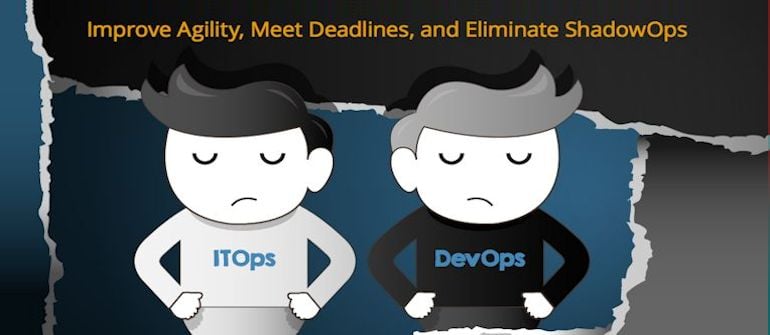
    The competitive online marketplace is placing increasing pressure on businesses to deliver services and application updates faster to market. While the increased focus today is on the applications themselves, the reality is that they are dependent on infrastructure in order to be delivered to the end user or customer. The inflexibility of traditional IT operations to deliver needed infrastructure impedes development teams from meeting that need for speed in service delivery, causing a disparity between ITOps and development teams.

    The availability of infrastructure resources from cloud service providers today is viewed by application/service owners and development teams as a faster and more flexible way to get infrastructure for application and service delivery.  When the business units and development teams begin to circumvent traditional IT operations to get the agility they require to meet their rapidly evolving needs, it creates what I call ShadowOps.

    ShadowOps is characterized by the clandestine proliferation of outsourced infrastructures and services, which further impedes the relationship between IT and development operations and creates risk, affecting everything from governance and compliance, to business continuity disaster recovery, service quality and more.

    Understanding ShadowOps

    The infrastructure that application/service owners and developers require to run their applications is supported and managed by IT Operations.  The business’ perception is that IT operations is a barrier.  They are too slow and inflexible.  This causes the businesses to seek outside infrastructure and thus a ShadowOps strategy is born.

    ITOps has an enormous responsibility to meet certain requirements, such as regulatory or security audits, while also making sure there are disaster recovery and business continuity plans and systems in place; essentially planning for everything and anything that may happen.

    Developers, on the other hand, live in the business unit and often have no baseline understanding of what IT Ops goes through on a daily basis, or how their procedures and needs are impacted by their operations.

    While developers can typically deliver multiple releases per day, mostly unfettered as they traverse testing, development, QA and pre-production, once they enter the production environment, IT Operations is often unsuspecting of new or changed application behavior and underlying infrastructure requirements and are often left scrambling to deliver what new and changed applications need.

    This causes the impacted developers to begin to look for infrastructure solutions that can give them the ease and speed they crave. So they go to Rackspace, or Amazon, or Microsoft Azure and simply buy the infrastructure they need to support their application and pay for it on a monthly basis.

    When developers and application owners begin to outsource infrastructure, often with little regard for risk, they tend to overlook things like compliance requirements, audits, and the fact that a simple change can significantly impact IT operations.

    IT Operations is burdened with certain regulatory demands and company policies, which makes them “slow” in the eyes of the application owners.  External infrastructures are extremely appealing to application support and DevOps teams because of the pace at which cloud service providers can provision and deliver what is needed.

    IT Operations is also saddled with legacy monitor systems, which requires a huge manual effort. Not only are there separate tools for monitoring storage, database, network and middleware, now with ShadowOps, there are separate infrastructures altogether and IT Ops has extremely limited insight into or control over external resources.  They often don’t even know they exist until someone calls into the help desk unable to get to their application or unable to process a transaction. This is when things start to get out of control.

    The Allure and Consequence of ShadowOps

    ShadowOps is alluring to the developer for a few reasons: better time-to-value, time-to-market, agility, speed, responsiveness, which are all good things until they begin to impact availability or increase risk with no disaster recover or business continuity or audit ability on the part of IT operations. When developers purchase cloud service provider offerings rather than working through IT channels you have to deal with multiple providers – project management suffers, costs get out of control and you don’t get economies of scale.

    So if each business unit, or development team goes this route independently, you have to ask yourself: Are they meeting business continuity requirements? Do they have redundancy in place? Are they backing up on a regular basis? Are they logging everything required? Are they controlling which administrators have access to certain systems? And finally, will it pass an audit, and how will the provider give access?

    The consequence of a ShadowOps environment is not only multiple providers, but also the lack of a point person to negotiate response rates and SLAs that will meet the needs of their business unit, so when there is a security issue, there is no one to respond in a time frame to enables its resolution.

    Unify, Automate, and Empower IT

    So how do you eliminate ShadowOps and give developers the agility they need while also empowering IT?

    It begins with enabling developers from central IT for better coordination, with better tools that address the needs of the changing IT landscape.

    Providing IT operations with a unified, automated performance and availability monitoring tool, with a single UI and single datastore, along with event management for your entire infrastructure wherever it’s deployed is a big step towards overcoming the hurdles that lead to ShadowOps.

    With a unified model that is automatically built and updated you’ll always be able to monitor the most accurate view of your entire IT environment, contain costs, promote shared resources and allow different units to make better purchases that meet evolving business demands.

    A key symptom of a ShadowOps environment is an inflexible IT Ops organization, where it controls everything in-house with a strict menu of services and SLAs that developers are forced to deal with to meet their requirements. By leveraging a unified monitoring solution, you can empower IT to adapt and relinquish some of that control and facilitate a common ground with developers where IT acts as an enabler rather than an enforcer.

    If the business unit wants to use an outside provider, IT operations can help them choose the right one, assign a project lead, help them set it up and make it work with the right controls.

    IT is then free to be consultative with the business and development teams, guiding them to make better purchases and have more control of their environment, potentially combining multiple business units’ needs with a particular provider that specializes in the infrastructures they actually need.

    IT operations, along with X-as-a-service (infrastructure, platform, software, etc.), allows greater flexibility to support rapid prototype and delivery. It allows IT to be a technology enabler for development teams, rather than forcing them to rely solely on their existing infrastructure and inevitably seek out ShadowOps.

    For more on how you can eliminate ShadowOps by leveraging a unified monitoring tool to make IT Ops more agile and meet the evolving needs of your development teams, read our full report on aligning ITOps and DevOps here.

  • Transforming applications with Cloud and DevOps – one hybrid solution for multiple challenges

    Transforming applications with Cloud and DevOps – one hybrid solution for multiple challenges

    Are you on cloud yet or clouded? The answer lies in how you have adopted the transformation. Today, the world is Hybrid. For large enterprises and organizations, it always has been. Almost no enterprise is monolithic when it comes to their environments. They may already have different distributed environments and/or mainframes in their ecosystem. The advent of cloud has only added to this complexity and hybrid nature of the environments. Enterprises which have replaced their datacenter with cloud adoption, in some cases are unable to do so completely or even adopt a singular cloud solution as that remains the domain of born-on-the-web companies that started on the cloud (think Netflix) or started on physical servers and migrated very early to the cloud (think WhatsApp). You cannot think of a big bank or even a telecom giant that is a Cloud Service Provider (CSP) that fits this bill.

    For the typical Enterprise (IBM included), the cloud has replaced and consolidated large sprawls of physical servers. However, physical environments remain, and may never go away and cost of migration plays a very important part in this retention. There may be large data-heavy applications that are hosted on distributed environments that may be just too expensive to re-host on the cloud. Then there are mainframe-hosted applications that cannot be migrated to the Cloud. Or the migration to cloud may be a massive multi-year transformation that you are only starting on and will have to live with workloads spread between the cloud and the physical world for an extended period of time.

    What’s interesting is that, even the cloud itself will be ‘Hybrid’ in nature. There may be combination of on-premises and off-premises clouds adopted, with off-premise’s ‘cheaper’ cloud used for less critical workloads like Dev-Test environments, and on-premise’s cloud for business-critical workloads. There may also be the presence of a Platform-as-a-Service (PaaS) being used for developing innovative Systems of Engagement applications or for experimentation, which co-exists with an Infrastructure-as-a-Service (IaaS) Cloud for Systems of Record applications and other traditional workloads.

    That is the complex world we live in.

    DevOps and Hybrid Cloud

    Cloud is the transformation enterprises are looking for whereas DevOps practices help achieve the transformation with speed and quality. When we talk about DevOps in the Hybrid Cloud environments, there are two main scenarios that can be adopted.

    1. Cloud hosted application delivery pipeline: When adopting DevOps one adopts a set of tools that create what is an Application Delivery pipeline. This includes tools such as an Integrated Development Environment (IDE), a Source Code Management (SCM) System, a Build tool, an asset repository, Test tools, an Automated Application Deployment tool, Environment provisioning tools and application monitoring tools, etc. All these tools can be hosted in the cloud and made available as a service. If you are using a PaaS such as IBM Bluemix as your application delivery platform, it includes these DevOps services.
    2. Cloud Hosted Environments: As applications are developed and delivered to production, they pass through multiple environments. These include development environments, multiple test environments, System Integration Test (SIT), User Acceptance Test (UAT), Performance Test, and potentially other pre-production environments (names and type vary from organization to organization), and of course Production. These environments may be spread over cloud and physical infrastructure, or even multiple cloud environments.

    IBM has hosted offerings for the DevOps delivery pipeline that cover the first scenario, including its Collaborative Lifecycle Management as a Service (CLMaaS) and cloud hosted Rational Software Delivery Platform (SDP) tools available through IBMs business partner CloudOne. As mentioned before IBM Bluemix PaaS includes in it DevOps Services to deliver these capabilities in the PaaS.

    For the purpose of this post, we will examine the second scenario in detail.

    Application Delivery for Hybrid Cloud Environments:

    Let’s examine a customer scenario I worked on recently. This customer, a large bank, was looking to host all their application delivery and production environments to the cloud. For cost management, they had decided to host their highly dynamic Development and Test (Dev-Test) environments on an off-premise’s ‘public’ or ‘virtual-private’ cloud, and host their Production environments on-premise on a private self-managed cloud. At the same time, their core business systems, in this case their core banking systems, all remained hosted on a Mainframe z/OS system. They are exposing their core Banking Applications to other applications that consume their services as REST APIs via an IBM DataPower gateway.

    Enterprise_updated

    The goal of this organization is to be able to deploy complete business capabilities which comprises of services and middleware components deployed to the Production Cloud, and the back-end Mainframe. The primary challenge was to use a Deployment Automation tool that can deploy components and manage application configurations across all these multiple environments.

    The second challenge was the need to deploy applications under development as they progressed through different environments in the delivery pipeline. These environments were hosted in a public cloud. As the production environments are hosted in a private cloud, there was a need to use ‘pattern’ technology that would allow for the provisioning of ‘production-like’ environments through the lower pre-production environments. These ‘patterns’ would allow for the production environments and the pre-production environments that match, albeit with different configurations and scale, to be managed and versioned as code. These patterns would evolve as the applications and the environments they were deployed on evolved through the development iterations.

    Architecture for Application Delivery for Hybrid Cloud

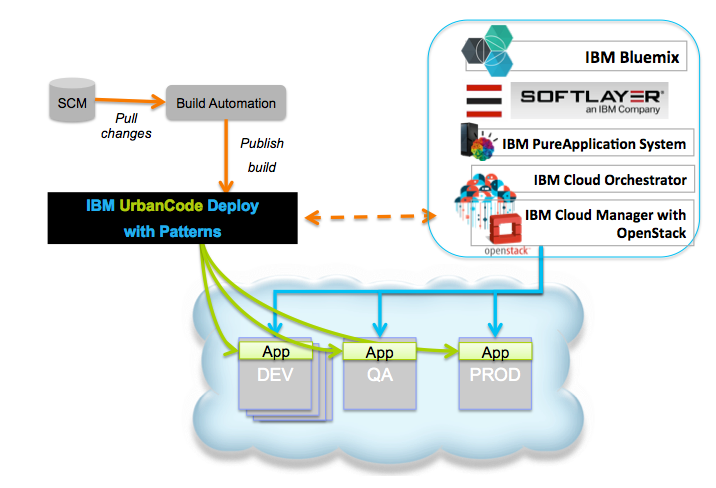
    Our discussion so far now leads us to designing architectures for application delivery for Hybrid Cloud which requires a deployment automation tool that supports multiple technologies comprising the hybrid cloud environment. As discussed before, multiple technologies ranging from off-premise, on-premise clouds to physical infrastructure may be included in these hybrid environments. IBM UrbanCode Deploy with Patterns provides such support.

    IBM UrbanCode Deploy with Patterns supports two cloud pattern technologies:

    1. IBM Virtual System Patterns
    2. OpenStack HEAT/HOT templates

    This allows IBM Urbanenterprise2Code Deploy with Patterns to support both provisioning of cloud environments using these patterns, and the deployment of applications to these environments, whether to an on-premise or off-premise cloud. In addition, it supports application deployment to static environments on physical infrastructure – distributed and mainframe. The Cloud technologies supported by UrbanCode Deploy with Patterns include OpenStack Private Cloud, Softlayer, Amazon Web Services and VMWare vCenter. In addition, IBM UrbanCode Deploy with Patterns also supports deploying buildpacks to IBM Bluemix PaaS.

    It is apparent from the example above that hybrid cloud is changing the face of enterprises and organizations today. With the speed the market is changing today, one cannot depend on waiting for transformation. IBM can help enterprises with their Cloud and DevOps journey leveraging our unique cloud and DevOps expertise. On November 20, you can know more about Hybrid cloud strategies and interact with some of the industry experts like Rosalind Radcliffe (Distinguished Engineer, Chief Architect for CLM and DevOps, Member of the Academy of Technology at IBM), Richard Irving (Certified Client Technical Professional at IBM) and Wayne Monk (Vice President, Business Development and Alliances at Skytap) at the IBM DevOps Symposium in the New York area (Jersey City). We are streaming the first hour as a series of lightning talks given by few distinguished industry leaders – so join us live or on the web. 

  • IBM Webcast Nov 18 : Rapid and Continuous Delivery to Hybrid Clouds

    IBM Webcast Nov 18 : Rapid and Continuous Delivery to Hybrid Clouds

    Organizations need to innovate at speed. As software has become increasingly critical to business outcomes, delivering high quality changes quickly has become a competitive necessity. With rapidly changing applications has come a dynamic, programmable infrastructure that can meet changing business needs in the blink of an eye. In a word: Cloud.

    But how do development teams take advantage of cloud resources? How do organizations coordinate application changes across clouds? Where do platform as a service tools like Bluemix from IBM fit in? Can we move quickly without losing control or quality?

    Join Eric Minick, IBM DevOps Evangelist (and UrbanCode guy), as he examines best practices, and approaches for tying together cloud infrastructure, platform as a service and deployment automation to boost the responsiveness of IT as a whole.


    Date: Thursday, November 18th, 2014

    Time: 1:00pm – 2:00pm eastern standard time

    Registration link: https://ibm.biz/BdEqve


    About the Speaker:

    Eric joined IBM through its acquisition UrbanCode.  He has spent the last ten years helping organizations – large and small – adopt continuous integration, delivery and now –DevOps. He is a frequent speaker on the topic, and co-authored Application Release and Deployment For Dummies. Prior to consulting, Eric was a developer, test automation engineer and support engineer, and has contributed to multiple generations of UrbanCode products.

  • Cloud-Based Documentation at the Speed of DevOps

    Cloud-Based Documentation at the Speed of DevOps

    Welcome back to this (semi-)regular column where I attempt to answer questions about DevOps, especially in larger enterprises. This time I address a vexing issue facing many large enterprises – how to make sure downstream processes move as fast as development and operations:

    Q. In my enterprise we are getting faster at releasing code, but we are still slow to update and translate downstream product documentation. How can documentation and technical writing be optimized as part of a DevOps approach?

    As I have said before, you can ask me any question you want (in the comments below, via e-mail, or on Twitter), but that doesn’t mean I know all the answers. If (when) I don’t know, I have promised to try to find someone who does – and this is one of those times.

    This question stumped me, so I asked around to find some insight into this issue. As it turns out, my company (a large enterprise, building out our DevOps capabilities, developing and operating new software every day, in many different languages, across about 40 countries worldwide) is working with what we think is an answer to this question. So I asked my colleague Jim Turcotte to explain what we are doing to address this problem. Here is what he said:

    The problem – serial downstream processing

    I know exactly the problem that this writer is facing! We have been wrestling with this ourselves. The problem is that with current industry practice, a team of technical writers shadow developers to document the latest product functionality. By the time product is delivered, it’s a mad dash to publish the PDF/HTML. Then, to make matters worse for international customers [our software users], it may be days or weeks before localized [translated] versions of content follow. It’s a slow, tedious, serial process that ends up being a rush to the content finish line every time.

    To make matters worse, both documentation and code are typically “thrown over the wall” for Support to discover and address bugs. Documentation bugs are often handled by Support engineers writing dozens of knowledge docs.  The end result is that skilled Support engineers are often diverted from addressing customer issues, to updating documentation.  We then expect users of our software – our customers – to search through the product documentation and sometimes hundreds of Support knowledge documents to find answers to their questions—not exactly an optimal self-service experience!

    Introducing a cloud-based collaborative approach

    Something we have started doing to address this concern is by applying what we call ‘DocOps.’ It is a continuous content supply chain that connects all the stakeholders, and which is agile and collaborative. In this way, our approach mirrors many of the characteristics and culture of DevOps.

    Instead of waiting until code is complete before starting on documentation, multiple writers “curate” content throughout the product lifecycle. Instead of producing static, standalone knowledge documents in PDF (or even HTML), we use cloud-based documentation, wikis, forums and chat groups. Instead of a single one-time effort, original content topics are matured continuously in a collaborative effort.  Instead of channeling documentation through a single technical writer, we allow developers, operations, support, and even technical field staff [pre-sales] to curate documentation.

    On-demand translation is performed as needed using local cloud-based translation services. Highly automated workflows determine which vendors will be used for each product and language. The platform senses the customer’s language preference and automatically pulls up the content in the language they prefer.

    Then there’s online help. With the approach, we provide contextual help by linking content directly to product UIs. This allows customers to access additional sources of information like education courses and discussion threads all from the same source. Customers no longer have to log into multiple systems or sites to find the information they need to be successful.

    Benefits of the new approach for end-users – and for us

    For end-users, collaborative curation ensures documentation is always crisp and relevant, reducing the age-old problem of large quantities of duplicated knowledge/content. Customers who need help using a product are always able to find and use the latest curated content – in their language, relevant to their experience. Customers can also now access not only the developer’s original instructions, but also knowledge from other product experts, colleagues and peers.

    For us, we can use its analytics to provide real-time operational feedback, so technical writers can make updates on the fly to further improve the customer experience. The new approach also enables us to close the feedback loop, connecting end user questions with engagement and lead generation tools such as Marketo, marking the first time product documentation can also be leveraged as a serious sales tool.

    The old school Content Supply Chain cannot support the business agility that DevOps requires to be successful. The new documentation approach solves that. It was conceived and built around the need for an improved customer experience with product information. Do you really want to maximize your DevOps platform? Support the content with the new approach for the ultimate agile experience.

    Jim Turcotte is a Senior Vice President with CA Technologies and the Business Unit Executive for its Information Services team. For more information about DocOps, follow him on LinkedIn Pulse.


  • DevOps and Infor’s Journey to the Cloud

    DevOps and Infor’s Journey to the Cloud

    Infor, a leading provider of micro-vertical application suites, has introduced DevOps as part of an initiative to migrate its enterprise application suites to a cloud platform. The significance of this should not be lost.  Infor is not a young, Web 2.0 unicorn that was born with DevOps DNA.   Infor is a 14 year old privately held software supplier with over 70,000 customers across multiple micro-vertical markets.  Infor’s industry-specific applications are mostly deployed and managed on-premise.  The move to a cloud based AWS platform is as much of a paradigm shift for Infor as it is for its diverse customer base.

    Infor Labs (3)
    Infor Labs Journey to the Cloud

    Infor’s leadership team launched the company’s annual user conference last week with keynote details about Infor XI’s cloud strategy and partnership with Amazon Web Services.   CEO Charles Phillips explained the reasoning behind the move while COO Pam Murphy recounted the technical efforts behind the scenes.   Both acknowledged the necessity of creating a function that would be dedicated to cloud operations. Standing in front of thousands of customers, Ms. Murphy described Infor Labs and how its DevOps practices would ensure that the right operating procedures were inserted into the development lifecycle.  According to Ms. Murphy,   DevOps would bring “fully automated hands-free cloud operations that improves efficiency, effectiveness, consistency and security while reducing manpower requirements. “

    Infor’s recognition of DevOps as a critical business success factor for its next generation of industry suites is impressive.  Brian Rose, Senior Vice President of Infor Labs and a key member of Infor’s management team for the past nine years provided some insight.  “The motivation behind developing and growing the DevOps team was driven by our ‘Cloud First’ strategy.  Over the last 18 months, Infor underwent a significant transformation to deliver industry solutions in the cloud.   This required development teams to gain a new understanding of the technical operations so that our products operate optimally and cost effectively in the cloud.”

    “Our DevOps team worked closely with the development and cloud operations teams to develop standards for the cloud.  Further, they were responsible for setting and maintaining the cloud standards including the development of architectural components  that allowed for the automation of provisioning, patch processing, upgrades, backups, restores, monitoring and the development of a portal to provide a self-service option for these functions,” Rose explains.

    Infor Labs has already seen results from DevOps. “The benefits that we have experienced include the reduction of the provisioning of an industry suite from weeks to minutes, decreased implementation time and costs for our customers, and solutions that are optimized from a technical ops perspective that allow our cloud infrastructure to scale so that we can support the thousands of customers that we have today in the cloud and the ability to scale to support the thousands more that we see moving to the cloud in the future, ” says Rose.

    While DevOps is not intended solely for applications in the cloud, software providers such as Infor that publicly promote the value of their own DevOps culture increase proof of concept while serving as role models for their enterprise customers.    If the primary objective of DevOps is to improve speed to market and time to value, who better than a trusted commercial software provider to demonstrate real world insight and results.

  • Fighting federal agencies culture shock to get over cloud and DevOps hump

    Fighting federal agencies culture shock to get over cloud and DevOps hump

    As federal agencies face budgetary pressures that drive them toward more agile IT pushes around cloud deployment and DevOps practices they must first tackle big perceptual and cultural roadblocks. Case in point is a survey out last week that showed that 89 percent of federal IT professionals still feel apprehension about migrating to the cloud, with 43 percent saying that it felt like giving their son the keys to their new convertible.

    Conducted by government research firm MeriTalk on behalf of NetApp and Arrow, the study shows that only 44 percent of agencies report having mature data governance practices in the cloud, and cite data exceptions, data integration, and collaboration and interoperability as their top challenges. Security still tops that list, though, with just one in five IT pros completely confident in their cloud vendors’ security.

    Interestingly, just a third of agencies met the June deadline this year to make sure their cloud solutions meet the security criteria laid out by FedRAMP. Among those who didn’t make the deadline, another third plan to do so within a year.

    The push to do so could present opportunity to work on the associated applications and cloud integrations with a new approach that could potentially embrace DevOps principles. For example, IT staff at the National Renewable Energy Laboratory recently used its initiative to gain FedRAMP compliance for its AWS integration as a chance to establish a DevOps pilot program.

    According to Keith Trippie, executive director for enterprise system development at the Department of Homeland Security, federal agencies’ ability to improve through DevOps, security and cloud deployments will all play important roles in improving time to value for citizens.

    “I look at the budget challenges we have today as a change agent for the government. It’s going to force us to innovate quicker than we have,” Trippie says. “It’s part of a healthy IT diet, where we’re looking at DevOps, we’re looking at continuous assurance on the security side, we’re looking at cloud in commodity IT, which will enable us to provide services more quickly than we have before.”

    On the cloud front, one of the big ways agencies can drive more safe deployments is through better governance. According to the MeriTalk survey, 52 percent of organizations don’t have well-understood data integration, 50 percent don’t have defined data owners and 49 percent have no known systems of record. The survey showed that the more mature organizations were in improving data governance programs, the more likely they were to be comfortable with turning over IT services to cloud vendors.

    The cultural stodginess and lack of groundwork laid by federal agencies to make cloud migrations possible could also potentially prove the biggest stumbling blocks for federal DevOps deployments.

    “The federal government will have to call into question some well established practices in order to implement DevOps,” wrote Mike McGarr of Netflix recently.

    A current engineering manager for the Netflix Build Tools team, McGarr previously worked as a federal government contractor. He advises agencies to avoid the sales people who will try to sell DevOps in a box and take a deep look at processes both within the agency and contractor organizations.

    “There are number of practices, rules and even regulations that inhibit government IT evolution. Government agencies need to continually ask ‘why do I really need to follow this rule?’ and keep asking,” he writes. “Get to the core goal of these restrictions, and propose a better way to solve this problem.”

  • Will you have your IDE in a box? On a Train? With a Firefox?

    Will you have your IDE in a box? On a Train? With a Firefox?

    As predicted the Cloud IDE race is picking up. Now I’m sure. Cloud IDE or no Cloud IDE it is not a choice. But it is an huge opportunity.

    (more…)