Tag: cloud

  • DevSecOps: Realities of Policy Management

    DevSecOps: Realities of Policy Management

    Policy management is essential to scale cloud environments and is key to secure DevOps practices. It enables organizations to manage policies put in place that secure the cloud environment, ensure Kubernetes configurations are secure and enable the continuous monitoring of a company’s overall security posture. 

     As businesses migrate workloads across multi-cloud architectures to achieve the agility and scalability needed to keep up with the pace of digital transformation, the growing demands placed upon developers often leave a gap that exposes potential threats and risks in the configuration settings, making security an even greater focus in DevOps. In fact, IDC’s 2020 survey found that 67% of breaches in the cloud are caused by misconfigured applications or infrastructure, including some of the industry’s largest breaches like Marriott’s second breach.

     To add to this, the first State of Policy Management report by Nirmata and the creators of the CNCF project Kyverno revealed that nearly 50% of users in cloud-native environments have now adopted some type of policy management solution. This tipping point of mainstream adoption across production cloud-native environments is making it critically important for DevOps teams to look at their practices and simplify and operationalize policy management across their Kubernetes stack by eliminating vulnerabilities through built-in, curated policies, without the barrier of learning complex policy languages. But this widespread adoption also acknowledges that organizations are finally realizing the need to put attention, investment and innovation into addressing security and compliance gaps as they adopt Kubernetes through proper DevSecOps practices and tools so applications being built can empower businesses.

    To confidently build cloud applications in Kubernetes, DevSecOps teams need to accept these DevSecOps realities and apply policy management effectively. 

     Customization Creates Security Risks

    Kubernetes can be highly customized, but DevSecOps teams need visibility into what’s happening in each cluster as organizations scale to ensure application reliability and security. Exploits on containers—including malware installation, cryptomining, host access and privilege escalation—offer opportunities for more security vulnerabilities. They can exist in images, production-accessible container registries, failed builds and third-party admission controllers in Kubernetes clusters.

    To address these risks in applications running on Kubernetes, it’s important to protect your environment with three A’s: Authentication, authorization and admission. This should be done at the cluster layer which enables secure access to authenticated entities that are authorized to perform certain actions. One way to accomplish this is through policy management. In fact, according to the State of Policy Management report, the top use case for policy management is for Kubernetes admission control (31%). When a request is authorized, having a policy in place ensures the request goes through another set of filters. For example, an authorized request may be rejected by an admission controller due to quotas or due to other higher-priority requests. In addition to validation, admission webhooks can also mutate incoming requests as a way of processing request objects for use before reaching the Kubernetes API server. 

    Configuration Issues

    Container images, namespaces, runtime privileges, persistent storage and control plane, together with network policies that are not compatible with best practices, are a source of misconfiguration and risk exposures. It’s this potential for greater risk exposures that have led configuration management to be a key driver of policy management adoption. In the Nirmata State of Policy Management report, it ranked third in security tools that are adopted today and fourth for the organization’s plans for future adoption.

    There are several ways to define security policies to protect cloud environments. Policies can be used for auditing purposes, to reject pod creation or to mutate the pod and limit what it can do. By default, pods can receive traffic from any source and send traffic to any destination. Network policies allow you to limit the ingress and egress access for your pods. The network policy typically translates to firewall rules.

    Lack of Adequate Authorization 

    Cloud authentication allows authorized users to securely access information stored in the cloud with authentication provided through cloud-based services. In The State of Policy Management report, key findings revealed that more than 24% of respondents today are using tools like policy management to authenticate users accessing applications. With data theft one of the fastest-growing and most expensive cybercrimes, the ability to process information and have strong authorization measures needs to be part of DevSecOps best practices.  

    In Kubernetes environments, as a user request is authenticated, it goes through an authorization workflow that decides if the request should be granted. It evaluates the request attributes against all policies and allows or denies the request. The main authorization mechanism is role-based access control (RBAC). Each authenticated request has an HTTP verb like GET, POST or DELETE, and authenticated entities have a role that allows or denies the request. Other authorization mechanisms include attribute-based access control (ABAC), node authorization and webhook mode.

    As the trend of moving security further to the left in the application life cycle accelerates, developers are being required to take active responsibility for it, which creates a higher desire for automation. The rapid releases can expose applications to many vulnerabilities, raising the risk of a breach.  With DevSecOps, organizations can transform the development pipeline by shifting security and compliance to the left, enabling developers to check the code before every commit. In doing so, security and compliance vulnerabilities can be identified and fixed in development, saving the organization from high costs and negative publicity from potential breaches. 

    There’s no doubt that Kubernetes is complex and challenging to adopt. On top of this, the development landscape is flooded with tools and more demands are being placed on engineers.  These shifts are changing the traditional role of a developer, leaving a gap for organizations to address to get the most out of DevOps. But by taking a secure, continuous, iterative approach that also includes policy management, companies can reduce the risk and exposure of their cloud environments. The more mature an organization’s DevOps practices are, then generally, the stronger the security and compliance practices are—they grow in relation to each other. The most innovative companies accept policy management in DevSecOps as a necessity of development and adopt some level of policy management best practices. With the right implementation tools like policy management and security and compliance best practices, organizations can remain efficient in agile and DevOps while adhering to critical go-live deadlines—which can’t be missed in this fast-paced business environment. 

  • Database Migration From Microsoft Azure to Snowflake on AWS: Part 2

    Database Migration From Microsoft Azure to Snowflake on AWS: Part 2

    In part one of this blog series, we looked at our approach to migration by leveraging the Azure data factory, tuning the performance of Data Factory Pipeline, using Parquet files and increasing computing power. 

    In this blog, we’ll look at some of the challenges encountered during the migration, cost-saving actions and our approach to data validation.

    Challenges Encountered 

    • Data Factory export failed for tables if the column name had spaces or special characters. In such cases, aliases were used (replacing spaces with an underscore) for column names and the query method was used as a source.
    • Data Factory export failed for the column data type “Geography” and had to be cast to varchar and then exported to Blob.
    • Some column names in SQL server were keywords in Snowflake, which didn’t allow it to migrate. For example, ‘LOCALTIME’ is a column name in SQL but is also a keyword in Snowflake, and it is addressed using inverted commas as escape characters (“”) while creating the Snowflake table.
    • During ingestion into Snowflake, the flat files were named after tables, listing files based on the name pattern. For example, if we wanted to list the file with table name test_1, Snowflake would list all the files starting with the name test_1. It is essential to make sure that each file name is unique.
    • If the file to be ingested was incorrect with respect to the table, Snowflake did not return any error messages or warnings. It simply ingested the file and put NULL wherever column mapping was not found.
    • While creating the tables, if the column name had spaces, escape characters were used so that the same spaces could be maintained. But for ingestion of such columns, the column mapping from a flat file would be the same aliases that were used in the source query.
    • Triggers and compute columns were not supported in Snowflake and had to be eliminated while creating the tables.
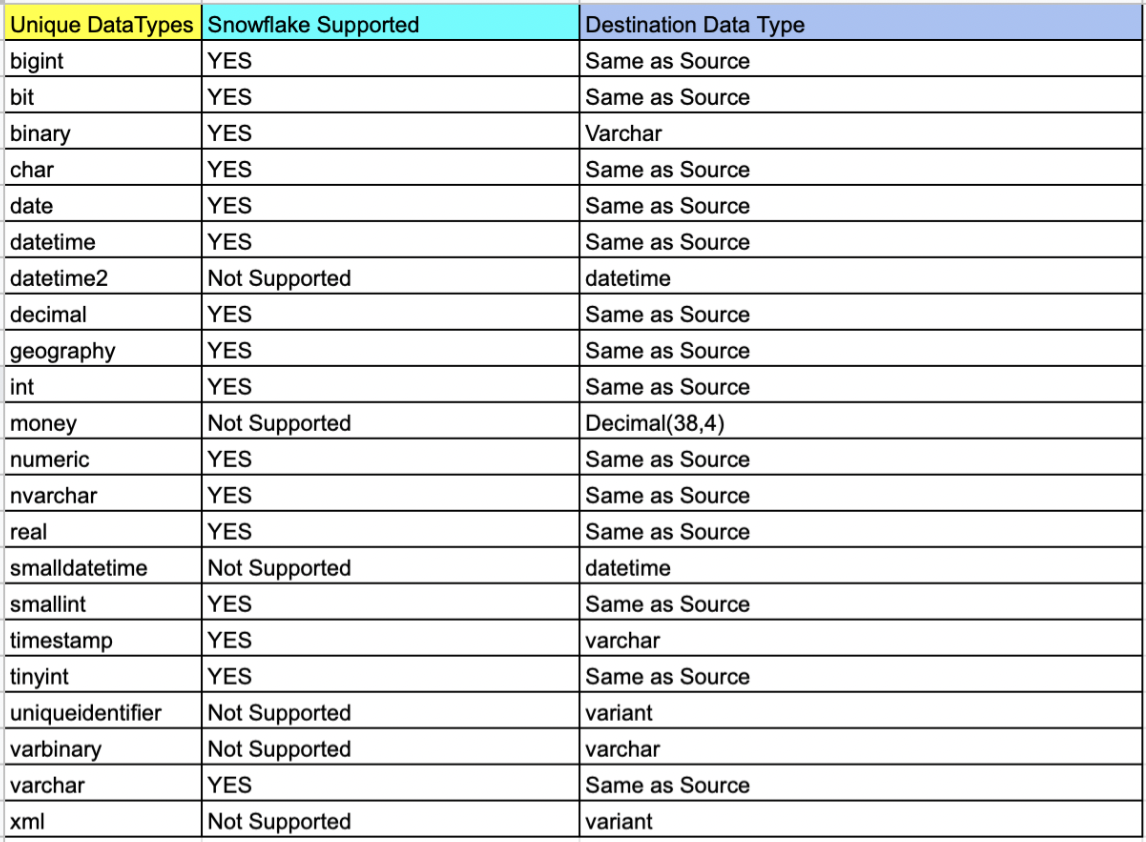
    • Also, data types that did not exist in the Snowflake schema had to be changed, keeping in mind the correctness of data.

    Cost-Saving Actions

    • Use of the Parquet file facilitated a compression rate of up to 75%. The 800GB of data was compressed to 234GB in multiple files which reduced the storage cost of Blobs.
    • Detailed POC and analysis discovered that Snowflake ingestion was optimal with Small for moderate sized tables and Medium for large sized tables which kept Snowflake costs in check.
    • Self-hosted IR saved on the data pipeline operating cost as the compute power of Azure VM was used.

    Cost Estimation 


    Data Validation

    The vital part of the project was ensuring that the integrity and correctness of the data were maintained during the migration process. As a part of standard DataOps best practices, a thorough data validation activity was performed to make sure that the data stayed meaningful and remained of use to drive business decisions.

    The approach to data validation was two-fold:

    In the first approach, all the distinct data types in the SQL server that were part of the db migration were listed and sampled randomly across one row per data type. The same row was fetched from Snowflake and matched.

    List of tables based on data type

    select table_catalog,table_schema,table_name,COLUMN_NAME,* from
    INFORMATION_SCHEMA.COLUMNS
    where DATA_TYPE = 'money' and TABLE_NAME not like 'sys%'

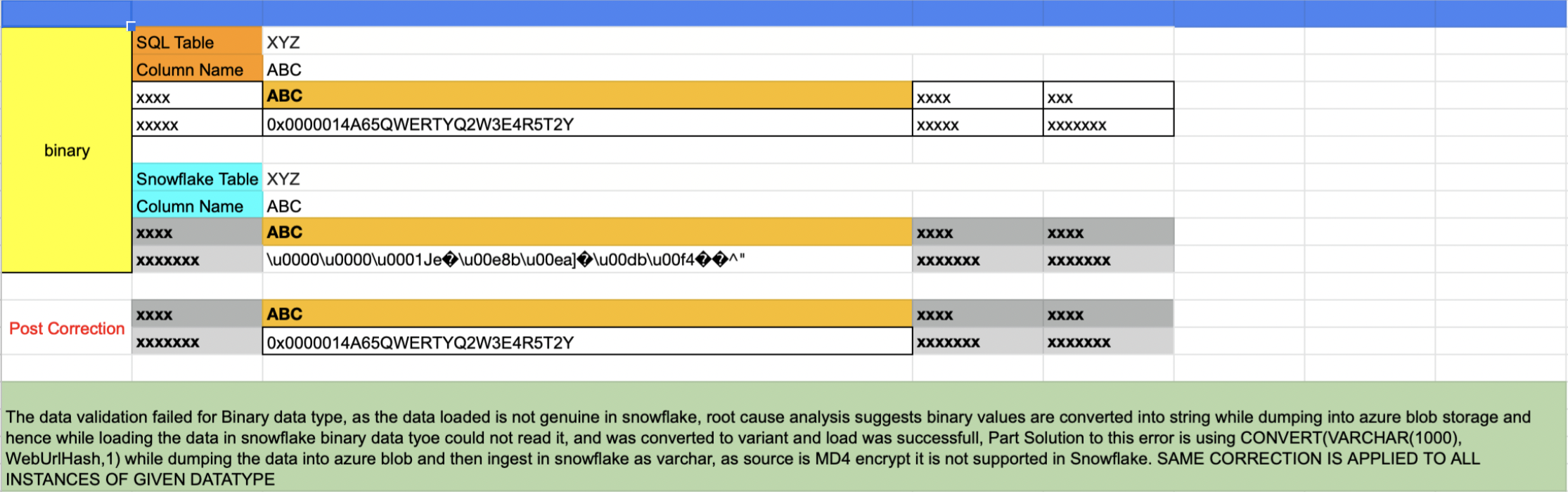
    Issues like that shown below were uncovered in this validation process and were corrected for all instances of the data type.

    The second approach involved writing an automated script that accomplished the following results (More details can be found here):

    • Script touched each table of each database
    • A set of five records were randomly sampled from both sides and matched
    • If the tables were empty, it was recorded as tables with zero records
    • If the sample sets did not match the script, it wrangled the sets and sorted them one column at a time. If the sample matched the script, it was recorded. This wrangle took care of the scenario wherein the first n number of columns had duplicate records
    • Any failed validation attempt would be visible in a generated log report:

    Validation Started for Table: Test1

    —-> Validation Passed for table Test1

    Validation Started for Table: Test2

    —-> Validation Passed for table Test2

    Validation Started for Table: Test3

    —-> Table has 0 records

    Validation Started for Table: Test4

    —-> Validation Failed for table Test4

    Validation Started for Table: Test5

    —-> Validation Passed for table Test5

    ============= Report =============

    # Total Number of Tables Scanned: 5

    # Tables with 0 records: 1

    # Passed: 3

    # Failed: 1

    # Percentage 60.5556123

  • Tackling the Complexities of Multi-Cloud With a New IT Model

    Tackling the Complexities of Multi-Cloud With a New IT Model

    The pandemic put incredible pressure on organizations to modernize and accelerate digital transformation efforts, with many businesses rushing to embrace cloud strategies in response. According to this year’s Enterprise Cloud Index from Nutanix, multi-cloud—an IT operating model that combines multiple clouds, public or private—is the most commonly deployed IT environment and the only IT model on an upward adoption trajectory. In fact, nearly two-thirds (64%) of organizations plan to operate a multi-cloud environment within three years.

    But there are complexities and challenges of managing across cloud borders that organizations are still grappling with, and concerns about security, data integration and cost remain. Enterprises will need to find ways to leverage existing cloud investments and redefine best practices and what it means to have agility and resilience in IT.

    Current Challenges

    Businesses have traditionally been designed around managing costs, increasing efficiency and streamlining operations, but lean IT teams find themselves under new pressures to support the challenges we’re facing today. The pandemic forced organizations to prioritize implementations and view the public cloud as a quick solution for everything without proper due diligence at the expense of optimization. This approach lacked focus on strategic business outcomes, and ultimately led to increased complexity, higher costs and less flexibility. According to the study, 87% of respondents agreed that multi-cloud success requires simpler management across mixed-cloud infrastructures.

    Enterprises also continue to rank improving security as a top IT priority, yet managing security was among the top multi-cloud challenges cited. Additionally, the majority of respondents (80%) say that moving apps can be time-consuming and costly, and 77% agree that workload portability is a significant challenge. This underscores the need for uniform management and operations across different cloud environments to avoid costly and time-consuming efforts to move applications.

    “Cloud-Smart” approach to IT

    Current cloud thinking is that there’s a “best” cloud environment for each workload or application, but there is no one-size-fits-all approach to the cloud. Organizations will start to move away from blanket cloud-first approaches to IT, and instead, be more thoughtful about which workloads run where. It is no longer a foregone conclusion that taking every app or workflow to the cloud permanently is the best course of action. The adoption of this “cloud-smart” approach, leveraging the most appropriate cloud environment for each use case, is likely a primary driver behind the proliferation of multi-cloud.

    The use of IT infrastructure by organizations is becoming more strategic over time. Nearly three-quarters of IT professionals (72%) feel that the IT function in their businesses is seen as more strategic now than it was a year ago. While businesses are now viewing and using IT more strategically than ever before, the complexity of multi-cloud is creating challenges that are standing in the way of cloud success. Despite challenges, a strong case is made for why the future of IT is hybrid multi-cloud, a model that enables more operational consistency across clouds. In fact, 83% consider it ideal.

    Multi-Cloud Supports New Ways of Working

    The pandemic has changed how nearly all organizations operate, and the top reasons cited by businesses for changing their infrastructure and deployment models are improving remote work and collaboration. While an organizations’ remote workforces may fluctuate, they are here to stay for the foreseeable future and IT will need to be nimble to support a remote, hybrid workforce and keep people productive and connected regardless of location.

    Over half (61%) of organizations are focused on offering more flexible work setups because of the pandemic, and multi-cloud supports this new way of working. It offers the most agile IT environment for supporting this kind of flexibility by distributing data and allowing remote access to business applications from diverse geolocations for user proximity and business continuity, and enabling organizations to implement technology that helps retain and attract talent.

    Multi-cloud is here to stay—and is the only operating model that is expected to increase in the coming years. 2022 will bring about a shift towards hybrid multi-cloud deployment as organizations look to take advantage of what each cloud has to offer while still having the flexibility and freedom of choice around their applications and data. This would deliver on the flexibility and agility that most organizations seek to compete in today’s digital world while enabling enterprises to significantly simplify operations. Future-proofing cloud strategies is the key to building IT resilience.

  • Survey Shows Increased Focus on Modernizing IT, Retiring Apps

    Survey Shows Increased Focus on Modernizing IT, Retiring Apps

    A survey of 140 enterprise architects and IT leaders published today suggested that, while moving applications to the cloud remains a priority, more attention is being paid to reducing technical debt by retiring applications.

    Conducted by LeanIX, a provider of a platform for managing enterprise architecture and managing value stream management (VSM), the survey found 40% of respondents identified reducing technical debt created by legacy applications and modernizing legacy systems as their top IT priorities. A full 96% said their company has at least one project planned for this year aimed at reducing technical debt with more than half (52%) noting that retiring IT applications is the primary means they will employ to reduce technical debt.

    Nearly 60% considered migrating applications to the cloud to be a high priority, as well. However, less than a quarter of respondents (24%) identified cloud initiatives as a top IT priority. The second most important cloud initiative, identified by 41% of respondents, is to increase the number of SaaS applications being employed.

    Regardless of the approach to the cloud, nearly three-quarters (73%) of respondents said enterprise architects should form a closer connection with software development teams, with an almost equal percentage agreeing on the importance of tracking the business impact of software development.

    However, only 16% of those surveyed considered the evolution and improvement of their security posture a top priority, even though more than two-thirds considered security initiatives—such as improving risk assessment capabilities and adopting more zero-trust IT offerings—as important or highly important.

    Dominik Rose, vice president of product management for LeanIX, said enterprise architects—or someone within IT who assumes responsibility for enterprise architecture—are trying to minimize disruptions to the business as IT environments continue to expand and evolve. The challenge they encounter is there is usually a divide between software development teams and the rest of the business. The size of that divide will vary by organization; in general, though, digital business transformation initiatives should help bridge the gap—assuming enterprise architects can establish and maintain close connections with software development teams, noted Rose.

    LeanIX is making a case for an enterprise architecture management (EAM) platform that provides visibility into IT environments. The company also makes a VSM offering available on top of that platform that provides visibility into software delivery processes. The number of organizations that have adopted VSM platforms remains relatively small, but as organizations depend more on software to drive digital processes, the need for senior business and IT leaders to have more visibility into software delivery schedules is expected to increase.

    In the meantime, it remains to be seen just how aligned DevOps teams are with the strategic goals of the business. The ability to build and deploy software faster does not automatically equate to gaining a deeper understanding of the needs of the business. In fact, there may come a day when software is built and deployed faster than most organizations can effectively absorb unless they have some equivalent of a VSM platform in place.

  • 8 Skills Cloud Architects Need to Succeed

    8 Skills Cloud Architects Need to Succeed

    For cloud architects, a deep understanding of cloud tools and technologies is only the starting point in terms of skills that need to be mastered. Enjoying a successful career as a cloud architect requires much more, including certain skills that are typically not associated with the tech industry. 

    Architecture and Design

    The cloud architect needs to be an expert on end-to-end system design since their primary responsibility is solving a customer’s problems through the use of technology. The architect’s ability to develop a design that solves a business’s problem is where their true value lies. Because design is architecture, the cloud architect must have expert knowledge of all the current and legacy systems that exist in the network and in the data center and also understand how to migrate them to the cloud, matching them to the proper cloud-based systems.

    Network and Data Center Technologies

    Networking and data center skills are critical for the cloud architect because one of their major responsibilities is designing a plan to take the systems that were on the network and hosted in a data center and migrate them to the cloud. To do this successfully, cloud architects must be experts on networking and data center technologies.

    Digging deeper, they must be experts at routers, load balancers, switches, routing protocols, IP addressing and WAN connections whether those are private line-based, VPN-based or software-defined networking. They must be experts on servers and server virtualization and containers and storage, too: Block storage, object storage and file storage. The cloud architect also needs to be an expert at file-sharing protocols such as Server Message Block for Windows and NFS for Linux. Security, too, is an important skill; they must understand how firewalls, IDS/IPS systems and how VPN concentrators work. The cloud architect needs to have full knowledge of databases, understand how web applications work and understand ERP applications and supply chain applications. Good, strong network and data center knowledge is the foundation for architects who are overseeing the migration of tech from the data center to the cloud.

    Business Acumen

     Cloud architects are digital transformation specialists. They must craft end-to-end business solutions for customers with the goal of improving their businesses. If they do not have a thorough understanding of customers’ business, they cannot effectively engineer solutions that will solve their business problems.

    Business skills include the ability to calculate an ROI model based upon the expected value of an opportunity, to read a financial statement and to read a balance sheet. It includes knowledge and understanding of what the CEO, CFO, CIO and CTO care about and being able to communicate with them in ways they understand. Without an understanding of business, cloud architects limit themselves to simply adding or removing technology, which might make business outcomes better or might make them worse.

    Leadership

    Accomplishing anything great requires a team, which means being a great cloud architect requires leadership skills. When working for a client, a cloud architect typically will need to set a baseline of current systems. Accomplishing that effectively might require a team of 50 cloud engineers working together to evaluate the customer’s systems. Leadership skills allow you to effectively manage that team of engineers.

    And leadership skills go beyond effectively managing people as they work on proofs-of-concept and deployments. Leadership skills empower the architect to make sure teams are motivated, are fully engaged with projects and are contributing to success.

    Sales

    When on the job, a cloud architect is constantly selling. The solutions they designed need to be sold to the customer. The plan to implement the solution needs to be sold to management before the necessary resources can be obtained. When it is time to get people to work with us on a project, we need to sell them on its value. Sales skills are employed in a wide variety of ways. Cloud architects sell to customers, internal stakeholders and to management.

    Presentation

    Cloud architects also need exceptional presentation skills because they will be presenting to customers. Those customers could be technology professionals like engineers; they could be presenting to management and/or to C-level executives. Additionally, cloud architects will be presenting information at executive briefings and at conferences. In general, presentations are part of everyday life for the average cloud architect.

    Communication

    Determining the business requirements for any cloud architecture project requires asking a lot of questions. They’re never just handed a piece of paper by a client that says, “Build this.” Without stellar communication skills, it’s difficult—if not impossible—to determine the business’ requirements, meaning the solutions that are designed could be incorrect.

    Even once the business requirements are well understood, the next step is to take those requirements to a team of technology professionals, which means communicating effectively with tech people as well as business people. Communication skills, which include communicating to customers, teammates and various other stakeholders in the organization, are critical.

    Emotional Intelligence

    Emotional intelligence is a critical skill for those who want to increase their professional value and propel their cloud architect career forward. Emotional intelligence increases the capacity for leadership, understanding and communication. When used regularly in the job, it is the best predictor of career success and typically results in about a $30,000 increase in the average person’s salary. For a cloud architect to have a successful career, building on the skills outlined above is critical.

  • Google Focuses on Enterprise Cloud With Mandiant Acquisition

    Google Focuses on Enterprise Cloud With Mandiant Acquisition

    Thomas Kurian became the CEO of Google Cloud Platform (GCP) with a modest mandate: Turn Google Cloud into an enterprise cloud platform behemoth. Easy, right? By 2019 “Google” was already a verb because of its search engine dominance and the company’s revenue was north of $136.8 billion. So, why have I been closely tracking Google Cloud’s progress on winning enterprise cloud business? Let’s back up.

    When Kurian left Oracle and joined Google, the company was an extremely successful advertising company. At the time, over 85% of Google’s revenue came from advertising. The search engine, email service and lightweight office productivity apps all served the ultimate goal of keeping eyeballs on Google sites so that users could be served more advertisements and increasingly more personalized ads based on a user’s Google interactions.

    If You Build it, Will They Come?

    Enterprises Require More Than Just Technology From Their Cloud Providers

    Google clearly has the scale, tools and technical expertise to provide businesses with what they need from a cloud vendor. When Kurian left Oracle, he was one of the highest-paid technology executives in the world (according to Oracle, his 2017 compensation package was around $36 million). So why would Google hire Thomas Kurian? Because enterprises require their technology and services partners to have more than just great tech. When advising enterprise clients, the following are the top three topics that come up when discussing the selection of a cloud vendor:

    • Industry Expertise: For the enterprise, understanding industry nuances is critical. I recently talked to an executive at a large airline company that fired their large, publicly-traded technology services company because the partners and the services company didn’t truly understand the airline industry. They weren’t using the right terminology and didn’t understand the business pain points.
    • Predictability: Why have large enterprises been hesitant to go all-in on the cloud? They need predictable technology. That doesn’t just mean “stable;” it means that costs, security, usability and service levels must all be predictable. Why, for example, is the mainframe still critically important for many enterprises? Because it is predictable and secure.
    • Ecosystem: Clouds can’t live in isolation. Cloud vendors must have an ecosystem to support enterprise client needs. My number two cloud prediction for 2022 is that we will see an increase in industry-specific ecosystems. Amazon Web Services (AWS), Microsoft Azure and IBM Cloud all have cloud ecosystem strategies focused on financial services.

    Thomas Kurian is well aware of the need to play well with other cloud providers and enterprise cloud providers. In fact, the widely held belief is that Kurian left Oracle because he and Oracle CEO, Larry Ellison disagreed on Oracle’s multi-cloud strategy—Kurian wanted Oracle’s packaged applications to be available on other vendors’ cloud platforms.

    What Does the Mandiant Acquisition Mean for Google?

    It’s clear that Google Cloud is focused on the enterprise. Google has no shortage of DevOps, data, machine learning and artificial intelligence tools to satisfy developers and data scientists. However, what Google needs are more features that enterprises expect from a cloud partner.

    Google Cloud isn’t new to cybersecurity—the company has been securing its own cloud since its foundation. In addition, the company has been gaining enterprise traction with Google Workspace and Gmail and the security around these SaaS offerings is paramount.

    By acquiring Mandiant, Google Cloud can more closely partner with cloud customers throughout the entire life cycle: From code creation (through a combination of Google’s existing Google Chronicle tools) through testing, threat detection and advisory work around incident response.

    My Analyst View

    The debate around security and the cloud isn’t even close to being resolved. Many will tell you that cloud vendors invest millions upon millions of dollars more than any other company in the cloud. It’s imperative that cloud vendors don’t experience infrastructure or SaaS security breaches. However, security continues to be a roadblock for cloud adoption—and, most importantly, enterprise cloud adoption. While every enterprise is doing some work in the cloud, many are still reluctant to move critical workloads (especially their sensitive data) to the cloud.

    Google Cloud should use Mandiant as the bedrock on which its enterprise cloud security business is built. Rather than having piecemeal parts and partners, businesses want their cloud providers to have opinionated frameworks and best practices. Mandiant has some of the best security minds in the industry and can help Google Cloud customers create secure instances. I expect Google Cloud to provide ready-to-provision cloud environments tailored for specific regulated industries by leveraging Mandiant’s expertise. Of course, customers aren’t going to want to necessarily adopt everything that Google Cloud suggests, and customers should be able to swap out components. However, many businesses are already overwhelmed with the number of cloud partners they have to engage with to create a secure cloud environment.

    What Will Microsoft and AWS Do?

    I expect AWS and Microsoft Azure will focus their attention on building out enterprise-focused security offerings. I recently wrote about why it made sense for Microsoft to purchase Mandiant. My general feeling was that Microsoft had many security offerings—ranging from simple consumer-grade virus scanning to enterprise offerings—but that the company lacked a cohesive enterprise security strategy. I still believe Microsoft needs to clearly define its enterprise security assets (and more coherently group them together) either through a reorganization and/or an acquisition. Like Microsoft, AWS has hundreds if not thousands of security offerings and partners. Although AWS is the cloud leader, the company is well behind Microsoft and Google in defining its cloud security strategy. The company needs to outline its enterprise cloud strategy, and cybersecurity needs to be one of the linchpins of that enterprise strategy.

  • The Lego Approach to Overcoming the Developer Divide

    The Lego Approach to Overcoming the Developer Divide

    As end-user demand for new services continues to rise and businesses adapt to changing times, digitalization has never been more important. Pressure is increasing on organizations to deliver digital transformation initiatives more quickly as 55% of CIOs in 2021 said they were increasing staff to accelerate their digital programs. The cloud is essential for this. Because it can enable new opportunities for revenue and quicker delivery to market, the cloud is the way forward for companies that want digital success. That’s why 95% of those surveyed by Accenture say they’ve adopted advanced cloud services. 

    However, this is not without its challenges. For one, teams need the skills to match—individuals who know how cloud works and the expertise to unlock its potential. But this is proving difficult as talent remains hard to recruit (a recent Gartner report found that IT executives view the talent shortage as the most significant barrier to deploying cloud, edge computing, automation and other emerging technologies). In addition, as 92% of companies believe DevOps is crucial for revolutionizing their digital strategies, it’s worrying to see a new report from Boston Consulting Group that revealed up to three-quarters of developers are looking to change their jobs within two to three years. 

    This is something enterprises need to address if they wish to accelerate digital transformation programs and take advantage of the emerging cloud technologies that support the growing need for a distributed cloud architecture. Without the required developer expertise, organizations will fail to address end user expectations and fall behind their rivals. 

    A Concrete Problem

    While the shortage of developers was an issue even before the pandemic, the problem is only getting worse due to the increasing need for digital transformation. It is putting more pressure than ever on existing developers and making it difficult for organizations as they struggle to recruit more talent. In fact, research found that pressure on digital architects has more than doubled during the pandemic, with almost 50% saying they are currently under high or extremely high pressure to deliver digital projects.

    This skills shortage is an important issue for companies to consider. It is well-known that the expertise needed to deploy and maintain cloud services differs considerably from what’s needed for on-premises environments. Without those skills, it becomes difficult for IT teams to oversee and understand what is happening with regard to their cloud deployments, and it ultimately hinders organizations from generating new revenue opportunities through increased innovation. Cloud is a whole new world where control and insight are limited, there are new inflexible cost structures to get used to and other departments can easily procure new applications without the IT team’s involvement. However, we still see examples of organizations being tripped up by these differences. 

    Organizations take proactive steps to keep their developers engaged and happy to avoid digital transformation burnout and ensure they make the most out of their cloud deployments.

    One Brick at a Time

    One way enterprises can do this is by embracing a Lego approach to their digital transformation journey. By adopting a composable business strategy, organizations are in the best position possible to remove pressure from developers and drive increased innovation with less need for highly specific technical expertise. 

    When building things with Lego, even if you’re starting without instructions, you don’t need to completely start from scratch—and you can use the same bricks time and time again. Composability, or the notion of building and configuring infrastructure and applications from component parts with well-defined interfaces, means the same is true when developing new digital services. Instead of having to start from scratch each time or write specific code, developers and even business users can quickly innovate new experiences by composing and decomposing existing digital assets and reusing them—just like Lego bricks. In this way, the company is using its existing skillset to the fullest; maximizing the value of its resources and allowing it to concentrate on actually developing new experiences and services.  

    Perhaps most importantly—especially for developers—this means less pressure on development teams, not only because there’s less need to reskill but because composability means they no longer need to worry about managing underlying infrastructure or reconfiguring physical assets like servers, storage and connectivity. Instead, they can manage all assets through a single unified control plane that spans multiple clouds, right through to the edge. 

    Making use of Existing Resources

    As part of this composable approach, enterprises should also examine how they move away from legacy technology, making sure they invest in innovations that leverage their existing in-house developer expertise. For instance, using a database-as-a-service platform that has the same programming language and tools that developers are already used to will accelerate adoption and reduce training costs. 

    The move away from legacy technology won’t just increase value for the money at a time when developers are becoming harder to recruit and budgets are tight. It will, again, also make life easier for developers. Instead of having to struggle with the integration of older systems with newer innovations, next-generation technologies will make this process harmonious and easy, further reducing the pressure and speeding up digitalization.

    Creating a Solid Foundation

    The developer divide is an issue that organizations need to take seriously if they wish to drive forward their digital transformation initiatives. At a time when demand for improved end user experiences is high, the need for developers has never been greater.

    While recruitment and retention remain a challenge, the Lego approach of composability means enterprises do not need to lose out. Using the existing skills and resources of a company, composability propels faster innovation and greater agility. 

  • Survey Predicts Massive Migration to the Cloud

    Survey Predicts Massive Migration to the Cloud

    A global survey of 1,600 enterprise IT decision-makers found more than half are working for organizations that plan to eliminate the use of data centers over the next two years.

    The survey was conducted by Aryaka, a provider of a secure access service edge (SASE) platform, and found a quarter of the respondents have closed 25% to 50% of their office sites; 75% of respondents said at least a quarter of their employees will remain remote permanently post-pandemic. Just under a third (32%) expect at least half of their workforce would be permanently remote.

    Despite the apparent accelerated shift to the cloud, the report found a full three-quarters of respondents (75%) are projecting at least a 10% growth in IT spending, with a quarter expecting IT budgets to grow 25% or more. Nevertheless, more than a third (36%) report they have IT cost concerns.

    David Ginsburg, vice president of product and solutions for Aryaka, said the shift to the cloud in the wake of the COVID-19 pandemic is being driven mainly by digital business transformation initiatives that require applications be quickly built and managed by IT teams that are working from home themselves. With the pandemic entering the third year, a hybrid workforce that regularly shifts between home and the office is now permanent, he noted.

    Consequently, with more people working from home, nearly two-thirds of respondents (64%) said they will shift toward a SASE-based approach over the course of the coming year to provide secure access to cloud applications over a software-defined wide area network (SD-WAN). Over two-thirds of those respondents said they will opt for a managed SASE offering rather than build and maintain these platforms themselves.

    SASE was originally coined by Gartner to describe a cloud-delivered service that brought together networking and security offerings. Those offerings should include a firewall-as-a-service (FWaaS), secure web gateway (SWG), cloud access security broker (CASB) and zero-trust network access (ZTNA). In effect, it’s a secure software-defined wide-area network (SD-WAN). As organizations adopt SASE-based platforms and services, just under a third of respondents (61%) are recognizing that dynamic bandwidth reallocation will be a very important requirement as workers shift between the office and home.

    The transition to SASE involves setting a strategy (35%), phasing out of legacy virtual private networks (32%) and consolidating cloud security with zero-trust (29%). Top desired capabilities include SWG (47%), SD-WAN (36%) and FWaaS (28%). A full 41% reported that responsibility for networking and security decisions have now been consolidated into a single team. However, only slightly more than a third (34%) said security is a major priority.

    The implications of a shift to the cloud at this rate and level of scale are likely to have a profound impact on DevOps teams. While cloud infrastructure is designed to scale on demand, accessing applications across an SD-WAN can have a significant impact on application performance. The survey, however, finds only 29% of respondents are concerned about whether applications will perform properly. Nevertheless, well over two-thirds (69%) said there will be an increased focus on observability and control, while 42% noted identifying slow performance for remote and mobile users will be a key issue and 37% expected slow performance at the branch office to also be an issue. Lackluster application performance is a time sink, according to 42% of respondents.

    Naturally, many IT teams will add new tools and platforms to deploy and manage cloud applications. The Aryaka survey found that only slightly more than a quarter of respondents are concerned about the newness of the technology they might employ.

    The coming year is shaping up to be incredibly disruptive to the IT landscape. The challenge is making sure balance is maintained between cost, flexibility and application performance.

  • IT Ops Trends: Cloud, Containers and COVID

    IT Ops Trends: Cloud, Containers and COVID

    Almost all companies are modernizing their IT infrastructure to remain competitive, with the focus firmly on migration to the cloud and the use of dynamic infrastructures. In a recent Trends in IT Ops 2021 survey, more than 160 IT professionals were asked how the implementation of IT strategies affected their day-to-day work. The results provided an impressive insight into the current work priorities of system administrators and IT Ops in general.

    According to the survey, most administrators believe that monitoring cloud (79%) and container (73%) environments will take on a more important, or much more important role for them in the future. Additionally, 59% of those surveyed agree that their job role has evolved over the years due to cloud computing and containerization.

    Not all IT Teams are Equal

    However, the data also shows that the changes are not affecting every IT team equally. For example, 37% of all respondents say that cloud solutions are not relevant—or less relevant to them on a day-to-day basis. This response shows that on the one hand, system administrators see cloud computing as an essential topic. However, on the other, the impact in practice is not felt to the same extent by every administrator. These responses show that not every administrator has to deal with cloud platforms on a day-to-day basis, with some being ‘siloed’ into dedicated teams that may not interact with the broader corporate cloud strategy. In addition, not every organization has fully committed to the cloud, with some finding their migration hindered by applications that are not suited to cloud migration.

    In the survey, 45% of respondents also said they believe the importance of monitoring physical infrastructure will not change in the next few years. However, 43% believe that monitoring physical systems will become more important or much more important. Conversely, a mere 1% replied that they thought physical infrastructure monitoring was less critical. 

    Taken together, these responses demonstrate that, despite the excitement around the cloud, many organizations take a hybrid approach to infrastructure. IT Ops and administrators recognize the importance of monitoring cloud systems and dynamic assets while, at the same time, the monitoring of local systems remains relevant or is even expected to gain in relevance.

    Network Management and Automation

    Cloud and containers enable faster growth of IT environments and promote digitalization. However, they also lead to a sharp increase in data traffic and more complex networking of systems. As a result of these changes, the demands on local networks are growing. This increasing demand demonstrates the importance of network management tools. 81% of respondents said that solutions in this area are relevant, or very relevant to them in their day-to-day work.

    This year, the move to a home office joined the trend towards migration to the cloud, containers, and network monitoring. In the wake of the COVID-19 pandemic, many IT departments had to adapt their infrastructure to allow employees to work from home offices. However, most administrators were relatively stress-free, with 54% saying they had no trouble adapting infrastructure to meet remote work requirements.

    Automation is also a key issue. For example, 81% of all respondents say projects that deliver deployment and configuration automation have been relevant in their organizations in the past 12 months. In addition, 92% say that automation tools are relevant, or very relevant to them on a day-to-day basis. 

    Cloud, Containers and COVID

    The Trends in IT Ops 2021 survey shows that system administrators are concerned with cloud computing and containers and several other topics. In addition, most administrators recognize the increasing importance of monitoring cloud environments and containers. That said, administrators continue to see monitoring networks and other physical infrastructure assets as critical, and some system administrators see increasing importance in monitoring this vital area. 

    In addition to the topics outlined here, respondents also provided feedback on topics such as virtualization, application performance monitoring and network management.