
Tag: cloud-native
-

Five Great DevOps Job Opportunities
devopsy.kinsta.cloud is now providing a weekly DevOps jobs report through which opportunities for DevOps professionals will be highlighted to better serve our audience.
Our goal in these challenging economic times is to make it easier for DevOps professionals to advance their careers.
Of course, the pool of available DevOps talent is still relatively constrained, so when one DevOps professional takes on a new role it tends to create an opportunity for others.
The five job postings shared this week are selected based on the company looking to hire, the vertical industry segment and, naturally, the pay scale being offered.
We’re also committed to providing additional insights into the state of the DevOps job market. In the meantime, for your consideration:
LinkedIn
Harris Allied
New York, New York
DevOps Engineer
$160,000 to $175,000CareerBuilder.com
MassMutual Financial Group
Remote
DevOps/Kubernetes Cloud Infrastructure Engineer$137,800 to $180,800
Indeed.com
Lawrence Livermore Labs
Livermore, California
DevOps Engineer
$123,960 to $159,168SimplyHired.com
CVS Health
Remote
DevOps Engineer
$90,000 to $180,000Dice.com
Idea Entity
Herndon, Virginia
Azure DevOps Engineer
$80,000 to $100,000 -

Four Ways to Modernize Your Enterprise Monoliths
In a perfect world, every application would run like Netflix–by which I mean every application would be cloud-native, microservices-based, containerized and, in all other senses of the word, modern. Unfortunately, not every application can be transformed in these ways. Some of the most important enterprise applications–like those powered by SAP or Oracle–don’t lend themselves to architectural transformations simply because the vendors don’t support that strategy. As much as organizations might wish that they could re-architect legacy apps from the ground up, the reality is that they just can’t.
Fortunately, though, all hope is not lost if you have an enterprise app that you can’t containerize or “microservices-ize.” Even if you can’t “break down your monolith”–to quote the standard advice you’ll find if you read articles about how to modernize legacy apps–there are a variety of practical steps you can take to make legacy, monolithic applications look and feel (in most respects) like modern, cloud-native apps.
Here are four ways to make your enterprise monolithic apps more cloud-friendly, even if they’re not technically cloud-native.
Use Cloud Automation to Modernize Legacy Application Management
Most enterprise apps are compatible with the cloud in the sense that you can host them on cloud-based virtual machine (VM) instances using services like Amazon EC2.
By taking advantage of cloud hosting for enterprise apps, organizations can also leverage cloud automation tools, such as autoscaling policies and rules that automatically start or stop VMs. In this way, it becomes possible to deploy enterprise apps in a highly scalable, automated way. You get something that resembles Kubernetes-based orchestration, except your apps don’t actually run in containers on top of Kubernetes. They’re just monoliths that benefit from cloud automation tools.
Deploy Load Balancers to Optimize Performance
Load balancers, which automatically manage network traffic flowing to and from applications, are another critical tool that organizations can easily leverage when they migrate legacy applications to the cloud.
Although configuring load balancers for enterprise apps hosted in the cloud is not a strict requirement, doing so can substantially improve application performance and reliability because load balancers help to ensure that requests are directed at application instances best able to handle them. They prevent situations where one instance of your application is overwhelmed with traffic while another sits idle.
Again, this is something that platforms like Kubernetes also do for microservices apps. But, as I’ve explained, you don’t actually need your app to run as microservices to take advantage of load balancing. You can do it with monolithic legacy apps, too.
Adopt an Everything-as-Code Strategy
When your app lives in the cloud and is managed by cloud automation tools, it becomes possible to manage most aspects of application operations via code. Specifically, you can:
● Use infrastructure-as-code (IaC) tools to automate infrastructure provisioning and setup.
● Automate application configuration management using code rather than applying configuration changes manually.
● Codify operational processes, such as application updates and backups, instead of relying on manual operations.Practices like these, which enable a strategy known as everything-as-code, significantly reduce the amount of time and manual effort that engineers spend managing applications. They also provide consistency and minimize the risk of errors due to human oversight. And there’s no reason why you can’t leverage these practices for legacy apps as well as modern ones.
Integrate Legacy Apps With Modern Toolchains
If your enterprise app is hosted on-premises, you probably manage it using tools and processes designed solely for it. But when you move an enterprise app to the cloud, it becomes possible to manage the application using the same integrated toolchain you deploy for other applications and processes.
You can, for example, take advantage of cloud-based monitoring tools to continuously collect data about application performance and generate automated alerts when something is wrong. Likewise, you can regularly create image-based backups of your application.
This toolchain-based operational strategy is another way to streamline enterprise application management, even in situations where you can’t rewrite or containerize the application itself.
Conclusion: Getting More From Legacy Apps
Just because you have a legacy enterprise app that you can’t transform into microservices doesn’t mean you have to settle for legacy management and operational practices. Modern automation tools combined with modern operational strategies like everything-as-code make it possible to achieve an enterprise application management experience that closely parallels that of fully modern, cloud-native apps, regardless of which architecture your app actually uses.
-

New Relic Report Surfaces Spike in Amazon JDK Usage
An analysis of the Java applications observed by New Relic showed nearly one-third of organizations (31%) are using the Amazon Java development kit (JDK) compared to 28% using the Oracle JDK as more Java applications are built and deployed in the cloud.
The report also found the number of Java applications running in containers is remaining steady year-over-year at 70%.
Overall, the report published last week found more than 56% of applications are now using Java 11 in production, followed by Java 8 at nearly 33%. However, more than 9% of applications are now based on Java 17, representing a 430% growth rate.
Jemiah Sius, director of developer relations for New Relic, said it’s clear that Java 17 is starting to gain traction in production environments. This is happening at a faster rate than previous releases of the venerable programming language as more cloud-native applications based on containers are being built and deployed, noted Sius.
Regardless of the version of Java, it doesn’t appear developers are moving away from Java as they build cloud-native applications, noted Sius. Rather than requiring developers to learn a new programming language, it’s simply been more cost-effective to enable them to continue building applications using a programming language they already know.
Java, meanwhile, has been experiencing a renaissance after more organizations began contributing to projects once the core platform became available under open source licenses. In fact, the Java community is now adopting many concepts pioneered in other programming languages to enable organizations to, for example, drive digital business transformation initiatives that are dependent on legacy applications being modernized. As a result, most organizations will continue to deploy Java applications everywhere from the network edge to the cloud.
New Relic, of course, is betting that as more cloud-native applications are deployed, the need for an observability platform that addresses the needs of developers and IT operations teams alike will become more apparent.
In general, most organizations are still in the early stages of achieving full-stack observability. A recent New Relic survey found only 27% of respondents have achieved full-stack observability and only 5% claimed they have a mature observability practice in place. A third (33%) of respondents also said they still primarily detect outages manually or based on complaints, the survey found.
On the plus side, the survey also found nearly three-quarters of respondents said C-suite executives in their organization are advocates of observability and more than three-quarters of respondents (78%) saw observability as a key enabler for achieving core business goals. However, more than half (52%) of respondents said they experienced high-business-impact outages once per week or more and 29% said they take more than an hour to resolve those outages.
The expectation is that that augmenting DevOps teams with observability tools and platforms that are increasingly being infused with artificial intelligence (AI) will reduce outages, even as cloud-native applications make IT environments even more complex than they already are. The issue is, however, those application environments are becoming more complex at a rate that is far exceeding the pace at which observability platforms are currently being adopted.
-

Understanding Cloud APIs
Six out of every 10 businesses had moved their workloads to the cloud as of last year. More steady traffic in the cloud and more direct cloud instances mean more to juggle–and the need for greater customization and integration. That’s where APIs come in. APIs are doing for the cloud what they did for on-premises resources: Segregating, simplifying, specializing and integrating services across a network–only this time, it’s future-proofing the architecture by building it in the cloud. As one cybersecurity researcher quipped, “Everyone wants to use APIs to build innovative solutions, but no one wants to invest in building them.” Cloud APIs will soon spell the difference between companies that can keep up with digitization and those that can’t.
Ultimately, it will come down to which organizations take the time to understand them and use them to their best benefit.
What is a Cloud API?
Simply put, “a cloud API is a software interface that allows developers to link cloud computing services together.” APIs allow services to share functionality and information for other programs to use, and nowhere is this more important than in the interconnected ecosystem of the cloud.
Because APIs act as a waiter in a restaurant, the better the waiter, the simpler ordering will be for you and for your customers. The best cloud API connects backend cloud components, services and platforms and does all the busy work so all your users see on the front end is a seamless customer experience. Since most of the work of tomorrow will be in the cloud (and is moving there in ever-increasing numbers), to not build up this functionality now is to take a deliberate risk.
Types of Cloud APIs
There are several types of cloud APIs based on the four major areas where cloud computing will require integration–either with another platform or another cloud provider.
● PaaS APIs (Service level): These platform-as-a-service APIs are designed to integrate with databases, portals, storage components and messaging systems, providing access and functionality in the cloud.
● SaaS APIs (Service level): Referred to as software-as-a-service APIs, these connect application layer resources with the cloud and underlying IT infrastructure. A CRM is a good example of where these types of APIs can be used to create a “cloud application extension” for your ecosystem.
● IaaS APIs (Service level): Infrastructure-as-a-service APIs control the distribution and deployment of specific cloud resources, performing such tasks as rapid provisioning and de-provisioning, network configurations and workload (VM) management in the cloud.
● Cross-platform APIs: Because many environments use multiple cloud providers and platforms, cross-platform compatibility is required. Cross-platform APIs streamline data management by allowing tenants to access their cloud-based resources and workloads from any of their cloud providers, not just their primary one. They provide a higher level of abstraction by translating a specific provider’s API calls into a more generic form, making accessibility, manageability and interoperability in the cloud easier.Cloud API Security
In many respects, the security threats faced by cloud APIs are the same that any cloud-based resource would encounter and present the same challenges. That being said, malicious API traffic surged over 117% last year, from an average of 12 million to over 26 million calls, according to one industry report. The same study revealed that over a third of respondents experienced authentication and data exposure-related incidents with their APIs, and 54% delayed rolling out a new application because of API security concerns.
Unguarded, a cloud API could present the keys to the kingdom and allow an attacker to access the hub of not just one but several cloud providers and their workloads, resources and assets. Protecting cloud-based APIs with standard authentication and authorization practices such as OAuth2.0 and OpenID Connect can reduce the chance of a lateral attack.
Why Cloud APIs
Cloud usage is not set to slow down and will soon become ubiquitous. Companies that aren’t on it are migrating their workloads in greater numbers and entrepreneurial ventures are spinning up as cloud-native. Cloud APIs are simply the logical response to the complexities that come with the terrain. Without cloud APIs, the user experience will be negatively impacted and will only become more apparent when compared with companies that do use cloud APIs.
For companies looking to innovate in 2023 and release new applications, APIs are the way to cut-and-paste the process safely. Similarly, as more cloud-based services become API-reliant, application reusability is another factor requiring cloud APIs. And lastly, the complexity of cloud products, platforms and ecosystems (even within one organization) makes cloud APIs a necessity for smooth interoperability. And they help with scalability–multiple components of a cloud-based service can be parsed out, updated and patched individually and refined separately so that one area can develop without being dragged down by the whole. Cloud APIs allow for that granular level of customization that can help an organization refine its edge.
Simply put, organizations will need these APIs to not only compete but stay relevant as businesses continue to take their fight to the cloud.
-

NETSCOUT Taps F5 to Optimize Custom App Performance
Through its alliance with F5, NETSCOUT Systems has extended the reach of its nGeniusOne enterprise performance management platform to support custom applications.
The nGeniusONE platform supports more than 1,000 voice, video and business data applications using NETSCOUT InfiniStreamNG appliances in combination with nGeniusONE to provide visibility into any infrastructure environment, including data centers, private and public cloud and co-location facilities. The integration with F5 extends those capabilities to add support for custom applications via integration with F5 BIG-IP server pool definitions that can now be directly imported into nGeniusOne.
Eileen Haggerty, area vice president for enterprise product and solutions marketing for NETSCOUT, said that approach enables nGeniusOne to access clear, unencrypted traffic from the BIG-IP Local Traffic Manager.
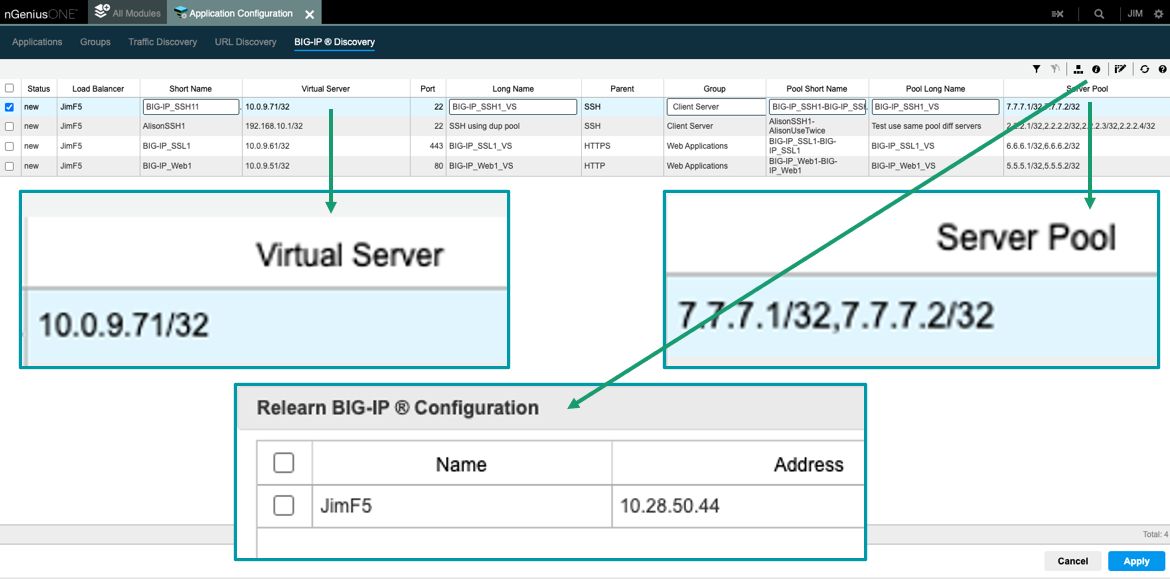
As more cloud-native applications built using microservices are deployed across distributed computing environments, network latency is becoming a bigger DevOps challenge. A wide range of networking issues can adversely impact application performance, but without any visibility into network traffic, it can be challenging to determine the root cause of an issue. NETSCOUT has deployed a global network of appliances to surface those issues.
A recent report published by Cloud Security Alliance (CSA) found the average enterprise uses 464 custom applications and expects to deploy 37 new applications in the next 12 months. At that rate, the number of organizations likely to encounter networking issues is only going to increase, noted Haggerty.
It’s not clear to what degree network operations (NetOps) teams are becoming integrated with DevOps teams that build and deploy custom applications. The need for both teams to collaborate more effectively is becoming more apparent as more application code is deployed at the network edge. In some cases, developers are now programmatically invoking network resources directly, while other organizations provide developers access to a portal to self-service their requirements within the context of a set of pre-defined guardrails. Regardless of approach, the need for greater visibility into the underlying networks that custom applications depend on has become critical.
Exactly how much that need will drive organizations to embrace one networking vendor over another remains to be seen. DevOps teams are starting to exercise more influence as organizations realize how much they depend on custom software to drive digital business processes. DevOps teams need to be able to understand whether an issue is the result of a networking problem or an inherent problem with the code written or the way an application has been deployed.
Of course, DevOps and NetOps teams don’t share a common nomenclature so the cultural divide between these teams can be wide. The simpler it becomes for NetOps teams to share visibility into networking services the easier it becomes to bridge that divide. Developers should be able to see for themselves how changes to application code might potentially improve network performance. In the absence of any proof to the contrary, most DevOps teams will simply assume there is a fundamental flaw in the networking services being provided.
-

More Java Apps Are Migrating to the Cloud
A survey of 879 enterprise developers and architects from Vaadin, a provider of framework for building Java applications, found that, as part of modernization efforts, the pace at which Java applications are moving to the cloud is now accelerating.
The survey found more than one-third (36%) of Java applications are already deployed in the public cloud. More than half of respondents (56%) are also already deploying some of their Java applications into Kubernetes or serverless environments. Nearly two-thirds (63%) said they planned to move more Java applications to the cloud over the next 24 months, the survey also found.
Kim Weins, vice president of product and marketing at Vaadin, said the survey makes it clear that enterprise IT organizations are still highly committed to Java. Still, there is a clear shift underway in terms of where those applications are being deployed. More than a third of respondents (35%) said they have Java applications deployed on Amazon Web Services (AWS), while 22% have deployed them on the Microsoft Azure Cloud. Another 11% are running them on the Google cloud platform.
This shift, however, will take time. Almost half (47%) of Java applications still need modernization. As a result, 63% of respondents planned to increase their investments in modernizing existing Java applications.
Maintainability is the top-ranked motivation for modernizing Java applications (32%), followed by security (20%) and ongoing maintenance costs (10%), the survey found.
The top three challenges in developing Java applications are building an intuitive and simple user interface (81%), upgrading the tech stack (81%) and ensuring app security (78%).
There is also a shift underway in terms of the frameworks used to build and modernize applications using a more cloud-native approach. A full 70% of respondents use Spring today, but 50% also noted they are planning to increase their use of Spring Boot. Other Java frameworks used include Vaadin Flow, Quarkus, Hilla and React. While derivatives of Spring are the dominant framework, it appeared more organizations are at least evaluating other options, noted Weins.
Most organizations are also integrating Java applications with modern tools for logging (72%), observability (61%) and single sign-on (53%), the survey found.
The shift to Java 17 is also well underway, with nearly three-quarters of respondents (73%) using or planning to use it over the next year. More than a quarter (26%) are already on Java 17 or a later release. Another 21% are currently upgrading, while 26% plan to update in the next 12 months.
Overall, the survey found Java is being widely used for both internal (64%) and customer-facing (62%) applications. Java is most often used to build full-stack Java apps (70%) and backends (69%), the survey found
Finally, the survey found more than a third of respondents (38%) expected that finding and retaining developers would be a significant challenge in 2023.
There are, of course, no shortage of options when it comes to deploying Java applications. Most organizations will deploy Java applications everywhere from the network edge to the cloud. The one thing all these applications will have in common is they will be written in a venerable programming language that itself has been modernized.
-

Cisco Bets on OpenTelemetry to Advance Observability
Cisco today announced a technology preview of a Cisco Full-Stack Observability Platform based on instances of open source OpenTelemetry agent software being advanced by the Cloud Native Computing Foundation (CNCF) to collect metrics, event, logs and distributed traces. The Cisco Full-Stack Observability platform will be available in June 2023.
The platform, announced at a Cisco Live EMEA event in Amsterdam, Netherlands, will combine the capabilities of multiple Cisco platforms and technologies into a single offering.
At the same time, the company also announced the bidirectional integration between its existing Cisco AppDynamics application life cycle management (ALM) tool and the Cisco ThousandEyes network monitoring platform beginning in April.
Finally, Cisco is making available a Business Risk Observability offering to provide business risk scoring. Business Risk Observability combines capabilities of its Kenna Risk Meter tool—gained when Cisco acquired Kenna Security in 2021—with the ability to monitor business transactions through Cisco AppDynamics to provide better visibility into application security. In addition, Cisco has integrated its Panoptica application programming interface (API) management security tool and the Talos threat intelligence platform within the Business Risk Observability Platform.
Carlos Pereira, a Cisco fellow and chief architect for strategy, incubation and applications at Cisco, said Cisco is moving to narrow the historic divide between application development and cybersecurity teams to enable organizations to adopt DevSecOps best practices and make it simpler to prioritize the remediation of vulnerabilities that are likely to have the most impact on the business.

Like most providers of observability platforms, Cisco is betting that more applications will be instrumented as OpenTelemetry software continues to mature. Cisco is now the single largest contributor to this project, noted Pereira.
OpenTelemetry will also play a critical role in improving application security as more applications become instrumented, he noted. In fact, a recent Cisco AppDynamics survey found more than three-quarters of respondents (76%) believed that DevSecOps is essential for organizations to effectively protect against a multi-stage security attack. However, only 43% reported their organization had started implementing DevSecOps workflows.
Observability, of course, has always been a core DevOps tenet, but achieving and maintaining it is challenging. Most DevOps teams today aspire to maintain some level of continuous monitoring. However, as it becomes easier and less costly to instrument applications, interest is rising in observability platforms that make it simple to investigate anomalies indicative of an issue that could disrupt an application environment. Most of those observability platforms are infusing those platforms with machine learning algorithms to surface those anomalies as part of an effort to augment the capabilities of a DevOps team.
Regardless of the approach to observability, many organizations will soon be trying to determine whether to rely on existing monitoring tools that make it possible to track pre-defined metrics. In some cases, there may still be a need for that legacy approach to managing IT. Still, in other instances, it may be possible to rationalize some of those platforms in favor of a more advanced approach that relies on a more advanced approach to achieving observability.
-

The Database of the Future: Seven Key Principles
The database of the future will be more than just a database. Instead, it will be a platform that focuses on the user experience and abstracts the technology. Looking at the evolution of application development, an enormous amount of effort has made it easier to build and deploy applications. Similarly, databases need to evolve for ease of use with a delightful developer experience and an exemplary user interface that surfaces features and functionalities that engineers will actually use.
Here are seven principal features needed to chart the development of the future database.
1. Serverless by Default
Serverless is unquestionably the most significant paradigm shift in software engineering in the last five years and the one that’s been realized the least. There aren’t that many people at this point that are all in on serverless. It’s the shift away from buying a server to a service that does what you need and scales with your growth.
Serverless by default is the only way to ensure the database of the future will be easy to operate while being consistently reliable. Serverless is evolving from running functions in the cloud to becoming the standard for fast-paced development teams that don’t want to worry about vCPUs or node pools but focus on outcomes.
The companies that are doing it the best still deploy servers, but they are leveraging products that scale independently, regardless of how many servers they have. Their component vendors can increase the number of resources allotted to them, and they only pay for what they use, and the architecture of the solution scales in that way. They’re not buying a single server and pushing it as hard as they can. They’re telling one platform, ‘here’s my code,’ they’re telling another, ‘here’s my data,’ and then that scales up based on usage much, much farther than buying a single server.
When people think serverless, they think JavaScript and Lambda, but there’s serverless PHP out there, too. It’s not just the JavaScript community. Other software paradigms are going for this. We will see more and more people pulling this out when they need to do some quick code and they want to ship to production as quickly as possible and scale as quickly as possible.
2. Easy to Operate
The most significant advancements in DevOps have been freeing developers from complex operations that overwhelm their day-to-day operations. Engineering teams today are organized around product and business goals, not maintenance and servicing. But databases have yet to catch up. Product teams still rely on experts to perform overly complicated database operations tasks.
The database of the future must fit into everyone’s DevOps workflows. It must be usable for any developer and leveraged by every team within a technical organization. The database needs to be operable by everyone and no longer require database admins to manage backups and capacity planning or worry about disaster recovery.
Developer-centric features like database branching, database developer environments, autoscaling and usage-based billing will be commonplace.
3. Reliable
Reliable simply means it’s harder to hit the scaling limits. Not only does it mean that the database is there, but that you get the right information when something is going wrong, and you can collaboratively help scale.
Nothing scales infinitely. There are not enough computers in the world to scale something to infinity. You’ll always be able to query a database and pull too much information out of it too fast. No matter how many cars you get or how much horsepower you have, you can’t go a million miles an hour. A good database must let you know when you’re hitting those limitations and help you move past them, whether at a small scale, medium scale or large scale.
4. Interoperable
Future databases will be accessible to every imaginable client–from smart refrigerators to fleets of autonomous delivery vehicles. But this client-agnostic approach requires planning for many more transactions and connections than most current databases could ever manage simultaneously.
In the future, databases can handle unlimited connections through smart connection pooling, query replication and intelligent query routing. Databases will also need to serve a wide set of connections and clients. Although we are already seeing many databases offering web APIs and new connection types, as these get tested at scale, we will begin to see them adopted and used to power the next generation of applications.
5. Globally Distributed, Locally Available
Today, most businesses and applications don’t need a global database, which often introduces unnecessary complexity and operating costs. However, there are many reasons the future database will need to be globally distributed, as they must be located where you need them the most.
The key to this is knowing what your requirements are. Many people look at multi-region and think it’s faster reads, failover, scaling and breaking the speed of light. Ultimately, it’s all a series of tradeoffs. For example, when you read from a local replica, you trade off consistency because you have asynchronous replication. But this is really leveraging the global internet to deliver a better outcome where it’s necessary.
Being compliance-ready with regionally stored data enables you to scale rapidly to a new region and provides a great user experience by quickly serving locally available data. High-transaction, low-latency applications such as mobile games already need this capability.
But there’s one caveat: Global data distribution cannot break principle number two—being easy to operate. Tools will need to be elegant and have straightforward interfaces as their main goal is to make operations easier, not harder.
6. Intelligent
The future database is intended to be used by people and will be able to tell them how it needs to be used and how to make it better. All the tools you buy today can only give you the data you need to make some educated guesses. The future database will replace that with concrete recommendations, then self-healing actions.
This starts with basic data collection and observability and moves to, “let’s record every query that someone makes and use some decision engines and some AI and recommend how they can shard automatically.” It will be able to say, “I’ve recorded your database use for the last 30 days; this is how you should shard for optimal performance. Click the button, and we’ll do it.”
The future database will say, “You’re scaling too far for the single machine at a per-user level. You must break it down into two or break it down into four, and we figured out how to do it for you, so you don’t have to figure that out. We’ve sharded your data on your behalf.”
7. Linearly Horizontally Scalable
Future databases will also need to be designed for future scale. Only a handful of companies on the planet have hit a scale that tests the limits of current technologies, but as information grows, more companies will get there. The next databases will do that by automatically scaling both vertically and horizontally within seconds. Many existing databases require a maintenance window, replication and a failover before they can be scaled up or out. But downtime is unacceptable, and scale should not come at the cost of performance. And it doesn’t have to. The database of the future will scale intelligently and without a blip on the status page.
In short, the consumer should be able to get what they need when they need it, with no risks. It should be easy to say, “I’ve doubled the number of servers, I’ve doubled the amount of throughput. I’ve quadrupled the number of servers and the amount of throughput.” This is what sharding provides. Good sharding happens automatically at a super high scale, and you’ll only pay for what you use as you go along. The future database will do all of this without users having to turn a knob.
In conclusion
It will take the entire database industry to agree on these principal features, adopt a user-focused approach and build future database platforms designed to make engineers more successful by delivering superior products and services to their customers. I envision a day where every company no longer worries about its infrastructure and can simply focus on its business. I want development teams to take back control over their development workflow. Using a database should be as easy as writing code.
-
Top Three DevOps Tools for Cloud Infrastructure
A survey from Canonical of 326 IT executives found the most widely employed DevOps tool for managing cloud infrastructure is the Bash shell and command language (53%), followed by the Ansible automation platform (47%) and Terraform (40%). Another 27% reported they used tools they developed themselves.
The survey also found 58% managed their cloud infrastructure entirely on their own rather than relying in part or entirely on some type of managed service.
Not surprisingly, the survey also found that 83% have seen spending on cloud infrastructure expenses increase over the last two years, but 23% have no visibility into how much they are actually spending. Well over half (57%) do feel they are paying “a lot” for cloud infrastructure.
Tytus Kurek, a product manager at Canonical, said during uncertain economic times, there’s now more focus on the total cost of IT. Cloud costs have become a much larger percentage of the IT budget, so more scrutiny is being brought to bear, he added. As such, there’s more interest in FinOps as a framework for programmatically managing cloud costs more effectively, noted Kurek.
However, only 58% said they believed their public cloud costs were predictable. Well over half (53%), however, noted they qualified for discounts on cloud services offered by providers. In comparison, 73% said their private cloud costs were predictable.
The most widely deployed software on cloud infrastructure are web applications (57%), followed by file storage (52%) and databases (51%). The most widely employed cloud service providers were Amazon Web Services (AWS) at 60%, Microsoft Azure (49%) and Google Cloud Platform (GCP) (33%). In terms of private cloud platforms, the most dominant is VMware (40%), followed by OpenStack (28%) and Azure Stack (15%). Only 25% of respondents managed less than 1TB of data.
In general, cloud computing environments are evolving as more cloud-native applications are built and deployed. The bulk of applications running in the cloud today are monolithic. As such, they typically consume a set of IT infrastructure resources dedicated to running that application. Cloud-native applications take advantage of Kubernetes to scale consumption of IT infrastructure more efficiently; over time, the cost of running a cloud-native application should be less than a monolithic application. It’s still early days as far as deployment of cloud-native applications is concerned, so the bulk of applications running in the cloud will continue to be monolithic for many years to come, noted Kurek.
In the meantime, there is a clear need for more automation. Many cloud infrastructure resources are currently provisioned by developers. There is an opportunity for DevOps teams to automate that process so that it is more efficient and more secure. Developers tend to make mistakes when provisioning cloud resources that, for example, result in data being exfiltrated by cybercriminals via a port inadvertently left open.
One way or another, the management of cloud computing is becoming more structured in an era where IT organizations are rediscovering the importance of capacity planning. The challenge is that many organizations have never known anything other than the cloud, and they may not even know how to achieve that goal. On the plus side, however, it may not be too long before the whole process is automated by an artificial intelligence (AI) model that optimizes the allocation of resources without any human intervention required.