Tag: cloud freedom

  • Should Your Apps be Cloud-Native?

    Should Your Apps be Cloud-Native?

    There’s plenty of life left in a great number of the applications companies have been relying on and profiting from for years. The future may belong to cloud-native apps that deliver the performance and efficiency benefits of microservices and containers, but in the here and now, organizations are looking for ways to combine the best of the old with the promise of the new.

    With continuous development, you could argue that the software industry has eliminated the concept of product life cycle altogether. Yet, IT managers know that some of the applications currently used by their organization likely will be running long after they have hung up their compilers.

    These legacy applications have proven their worth many times over. Some are one-offs that easily accommodate and are accommodated by new systems as they are implemented. Some are so good at what they do they epitomize, “If it ain’t broke, don’t fix it.” In the mass migration of apps and data to the cloud, it’s natural that such grand old apps would come under scrutiny as candidates for replacement by their cloud-native counterparts.

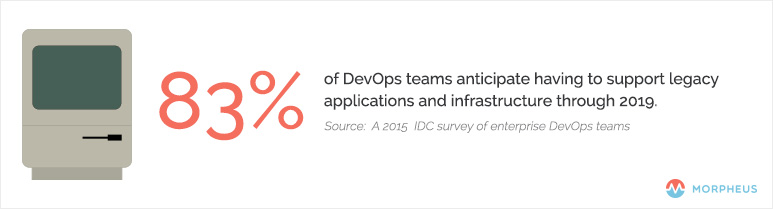
    In a Dec. 8, 2015, article on The Stack, Red Hat’s Gordon Haff examined the results of a recent IDC survey of enterprise DevOps teams, which found that 83 percent anticipate having to support legacy applications and infrastructure through 2019.
    DevOps_Cloud_Native

    It may seem counterintuitive, but the organizations that have gone furthest in adopting distributed, scale-out, microservices-based applications are twice as likely to delay converting existing apps to cloud architectures, he noted.


    What Characteristics Make an Application Cloud-Native?

    The simplest definition of a cloud-native application is one that is “decoupled from the physical infrastructure,” as TechTarget’s Sean M. Kerner wrote in a December 2015 article. In addition to being designed from the ground up to run in the cloud—whether private or public—the app also must scale on demand, both up and down, and across nodes.

    Cloud-native apps are fault-tolerant, built to scale and designed to process requests asynchronously, using queues to decouple functionality, according to Munish Kumar Gupta via Slideshare.

    Another feature that quickly is becoming standard on cloud-native apps is the use of Docker containers, which facilitates deployment on public Amazon Web Services (AWS) clouds and private OpenStack clouds, among other options. A more formal definition of “cloud native” likely will arrive soon from the Cloud Native Computing Foundation (CNCF), an effort sponsored by the Linux Foundation and others.

    Containers are a key component of the CNCF’s proposed standard for applications and services that run natively on public and private clouds, and that move seamlessly between the two environments. Rather than writing specs on paper first and then implementing the code based on the specs, CNCF will create the code for its reference implementations. Google, a CNCF member, has donated its Kubernetes container-orchestration system and stands to benefit via the foundation’s support for private and hybrid clouds, a technology the company currently lacks.

    The Continuing Evolution of Cloud-Native

    It’s tempting to limit the definition of a cloud-native app to those two primary characteristics: decoupled from the infrastructure and scalable up, down and across nodes. If this approach strikes you as too simplistic, you’re not alone. InformationWeek’s Charles Babcock explained in a July 30, 2015, article that the key to cloud-native is microservices—which he referred to as “discrete application services”—running in their own containers and connected via a network to create custom applications. The result is an environment for “user-driven systems” comprised of standardized parts and governed by “standardized deployment and operational procedures.”

    The combination of microservices and containers pushes down the app stack and simplifies deployment in computing environments of all types, according to Richard Harvey of Ngineered via SlideShare.

    The payoff for companies is still far off, according to Babcock, but ultimately cloud-native apps will keep firms focused on their customers as the software landscape shifts around them. This translates into a competitive advantage via continuous deployment and delivery of “fresh” software.

  • Flexiant Offers Cloud Freedom for DevOps

    Flexiant Offers Cloud Freedom for DevOps

    Flexiant Concerto gives DevOps the fastest way to build, deploy and automate applications consistently across multiple clouds

    London, UK – March 25, 2015 – DevOps tasked with driving success in the cloud need a solution to efficiently leverage multiple clouds while avoiding cloud lock-in. Flexiant today announces the commercial availability of Flexiant Concerto. With Flexiant Concerto, DevOps have cloud freedom to automate the build, deployment and operations of applications consistently across multiple clouds. Concerto is available through four disruptive pricing models aimed to deliver multi-cloud at a price point everyone can afford.

    Not limited to just Amazon Web Services, Flexiant Concerto gives DevOps the ability to automate their application on Digital Ocean, GoGrid, Google Compute Engine, IBM Softlayer, Microsoft Azure, Rackspace, amongst others through one consistent toolset and interface.

    Marco Meinardi, Vice President Products at Flexiant, said “Other solutions enable people to use multi-cloud platforms once an application is built, or if it’s already present within the cloud providers’ specific library. Flexiant Concerto is unique because it allows DevOps to build, deploy, configure, run, publish, monitor, load balance and auto-scale applications straight in the cloud or multiple clouds of their choice, without relying on the cloud provider’s specifics. Once deployed, that workload can be replicated on other clouds if necessary, with the guarantee of the exact same result helping to reduce uncertainty and risk when developing in the cloud.”

    Flexiant Concerto helps to remove barriers to productivity by automating core and non-core components, consistently across the best cloud for the project/department/business. A great example is how Flexiant Concerto’s UI takes away the complexity to deploy Chef cookbooks, making them easily accessible to everyone. Flexiant Concerto automates the Chef configuration, i.e. set up and configuration of Chef servers and clients with the various dependencies involved, and the management, pull and execution of cookbooks.

    Chef’s Vice President EMEA & Chief Enterprise Architect, Justin Arbuckle, said, “Flexiant Concerto’s hosted Chef solution makes managing the Cloud easy and it uses Chef at the heart of its engine.”

    Flexiant Concerto also offers DevOps the ability to drive continuous innovation. By making Flexiant Concerto part of the CI/CD pipeline, DevOps can enable the automated testing and deployment of every code change in the application, offering a cycle of continuous feedback and release, to maximize the efficiency and productivity.

    George Knox, CEO, Flexiant said, “We help DevOps achieve velocity across multiple clouds with the automation of core and non-core components and Concerto’s configuration management capabilities. Rapidly and frequently adapt applications to the business needs – from the code development to the production deployment – with Concerto.”

    Launched first in 2014, Flexiant Concerto has been refined based on initial user feedback. Flexiant Concerto offers disruptive pricing starting with a free version FREE4LIFE and offers packages that can support businesses as they grow. Find out more about the packages.


    Concerto is available through four disruptive pricing models aimed to deliver multi-cloud at a price point everyone can afford.

    About Flexiant

    Flexiant provides solutions aimed solely at helping service providers capture the cloud market opportunity. Its portfolio of solutions includes Flexiant Cloud Orchestrator and Flexiant Concerto. Since 2009 Flexiant has armed service providers with the solutions necessary to launch revenue generating cloud services quickly and easily.

    Flexiant has been named a Gartner Cool Vendor in Cloud Management and received the Info-Tech Research Group Trendsetter Award for two consecutive years. Flexiant is a Gold Parallels Partner and a Dell certified technology partner. Customers include Brinkster, Computerlinks, FailProof Technology and ThinkGrid Ceano, part of Colt Telecom. Flexiant is also a key participant in the EU’s Horizon 2020 program. For more information visit www.flexiant.com.