Tag: Cloud Foundry

  • Using Open Source to Secure Software Supply Chains

    Using Open Source to Secure Software Supply Chains

    Recently, there’s been a lot of attention paid to software supply chain security. In particular, here’s a quote from the May 2021 presidential executive order on improving the nation’s cybersecurity: “The Federal government must … advance toward zero trust architecture; accelerate movement to secure cloud services, including … platform as a service (PaaS).”

    There are two parts necessary to create a truly trusted software supply chain; securing the non-technical areas and securing the technical areas.

    Non-technical aspects of any secure software supply chain involve having individuals or teams focused on security and audit compliance. Internal company policies that act as a regulatory system and set standards for developers are a must, as are efforts to enforce compliance with security best practices. While this can bode well for large organizations, small software engineering teams and startups do not have the bandwidth, budget or culture to make this a reality.

    Envisioning Robust Security Best Practices

    Tools that are open source, governed strictly and enable automation of secure build and deployment are the components that form the technical aspects of the solution. Engineering teams must find a way to envision robust security best practices and find a way to apply them without unduly affecting the developer workflow. This is a founding principle of the DevSecOps efforts within the larger community of software development professionals.

    Ergo, advocating a technology stack that:

    • Is composed of open components
    • Provides automated builds
    • Reduces the dependency on developers
    • Allows security operators to extend control
    • and is actively supported by the community is an ideal choice upon which to build a platform for use by development teams.

    The focus of this article is to describe a robust stack that will sit above compute resources and power applications. The stack will consist of fully customizable open source components that put reliability and security at the forefront.

    Simplify Operations

    Application source code is the single source of truth when working with this stack. The use of Git, a popular version control system that is free and open source will allow developers to work with a source code management system from which all the downstream steps will be triggered.

    Kubernetes is an open source container orchestration tool developed under the auspices of the Cloud Native Computing Foundation (CNCF). It serves as an abstraction over the infrastructure and compute layers to power the system from underneath. Kubernetes has managed to gather a large community following—second only to the Linux OS itself. Using Kubernetes will bring homogeneity above the infrastructure layer and will simplify further operations.

    Cloud Foundry is an open-source PaaS tool. The use of Kubernetes introduces complexity that introduces a bit of overhead for developers who work with the platform. Cloud Foundry provides a countermeasure that simplifies the developer experience and greatly eases the pain points commonly associated with Kubernetes adoption. The Cloud Foundry platform does the job of deploying all the applications to the Kubernetes infrastructure. The cf push command triggers the export of a container image from the application source code.

    When building these containers to deploy to the runtime within Kubernetes, Cloud Foundry uses Paketo buildpacks internally. Paketo buildpacks are an implementation of the cloud-native buildpacks specification which aims to provide a unified means to generate OCI-compatible container images for all languages and frameworks that are commonly used to build applications. Paketo buildpacks are also open source and fully customizable according to the needs of software development teams.

    A Trusted Architecture

    Together, this platform, built on open tools, supported actively by the community and facilitating the exact needs of software developers helps promote a trusted architecture upon which to stage applications. Using these tools would enable an organization to build a software development ecosystem that satisfies all the requirements implied and enumerated in the various recommendations for improving software security.

  • Survey Sees Cloud Foundry Momentum Gains

    Survey Sees Cloud Foundry Momentum Gains

    At a time when many organizations are wondering to what degree they should rely on legacy application development and deployment platform versus emerging container-based platforms, the Cloud Foundry Foundation (CFF) today released the results of a survey that shows reliance on the organization’s namesake open source platform-as-a-service (PaaS) environment continues to grow.

    Announced at the European Cloud Foundry Summit, the annual survey of 306 IT professionals finds 45% of respondents describe their use of the PaaS as “broad,” compared to 30% a year ago. The same survey finds nearly 20% started using Cloud Foundry in just the last 12 months and 39% of developers are deploying applications now in less than one day. More than three-quarters (77%) report application development cycles of fewer than three weeks.

    Nearly half of survey respondents report they have at least 100 developers using the PaaS, a significant jump from just one-third last year, and the share of companies with more than 50 applications on Cloud Foundry grew to 43% in 2019.
    The future of the PaaS has been called into question ever since the rise of Docker containers and Kubernetes. The CFF has been slow to adopt Kubernetes as a more efficient foundation for deploying a PaaS environment. Most recently, the CFF has provided organizations that adopt the PaaS the option of replacing the Diego container orchestration engine developed by the CFF with Kubernetes. At the same time, the CFF is working toward replacing much of the foundation layer for Cloud Foundry with Kubernetes to provide a more efficient means of standing up a Cloud Foundry environment.

    The CFF has also made it possible to deploy applications built on Cloud Foundry on a Kubernetes runtime. CFF CTO Chip Childers says that no one should be surprised when the rise of Kubernetes leads to more adoption of Cloud Foundry. Most of the application development environment available for Kubernetes today are not as robust as the Cloud Foundry PaaS, with the notable exception of the Red Hat OpenShift PaaS. Following the acquisition of Red Hat, IBM is now promoting Red Hat OpenShift as the cornerstone of a hybrid cloud strategy that has Kubernetes at its core. Meanwhile, last month Pivotal Software, provider of a curated instance of a Cloud Foundry PaaS, told financial analysts it expected to see a $40 million to $50 million decline in revenue in fiscal 2020. Shortly after, VMware moved to acquire Pivotal, which, like VMware, is a unit of Dell Technologies.

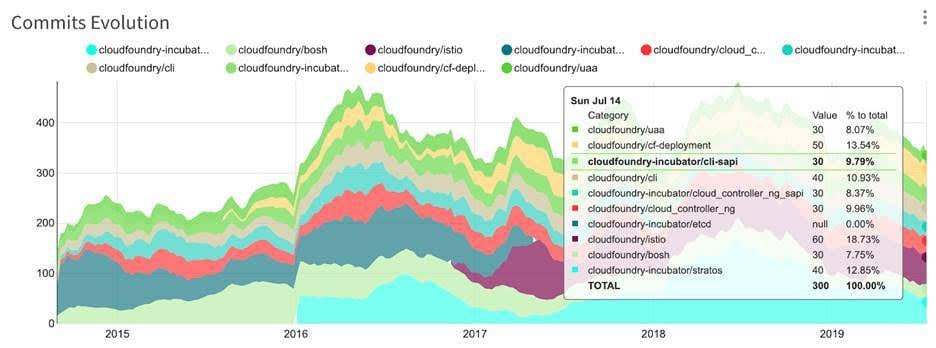
    An update to a previous report published today by source{d} shows there are now 879 repositories in the Cloud Foundry GitHub organization, with the total number of commits reaching approximately 50,000 per month. The report finds the highest levels of activity are centered around the Stratos UI project, Istio integrations and the core Cloud Foundry Application Runtime Cloud Controller.

    The CFF and Kubernetes, under the auspices the Cloud Native Computing Foundation (CNCF), fall under two separate arms of The Linux Foundation. It’s unclear if the Linux Foundation might one day merge these two arms or continue to keep them separate as a means of navigating conflicting vendor strategies. Whatever the outcome, Cloud Foundry is likely to remain a vibrant part of the open source community for many years to come.

    — Mike Vizard

  • Dell Boomi Enhances its Enterprise iPaaS Portfolio

    Dell Boomi Announces New API Gateway and Developer Portal, Self-Service Offering, Blockchain Integration, Data Services for Pivotal Cloud Foundry, Enterprise Innovation Services and Bot SDK 

    https://boomi.com/press_release/dell-boomi-enhances-its-enterprise-ipaas/

    LAS VEGAS – BOOMI WORLD 18 – November 6, 2018 – Dell Boomi™ (Boomi), the leading transformation provider of cloud integration and workflow automation software to build The Connected Business, announced, at Boomi World 18, the company’s latest additions to its integration Platform as a Service (iPaaS) for today’s enterprise. The only vendor to offer a unified platform with built-in data quality and connectivity across the enterprise —from people, applications and databases to devices and things—Boomi defines the iPaaS industry today.

    With its latest capabilities for The Connected Enterprise —Boomi Connect Now, Boomi Data Services for Pivotal, Boomi API Gateway and Developer Portal, Bot SDK and new Professional Services offerings —Boomi provides the tools organizations need to support a breadth of use cases across all personas, ensuring both high productivity and IT control. Boomi democratizes integration, making it accessible to all users regardless of their level of technical expertise or role in the organization from citizen developers, business analysts and integration experts.

    “Sky’s mission is to connect customers to more of what they love. Dell Boomi’s ability to connect data, processes and people has an extremely positive impact on the experience Sky provides its 12 million UK customers,” said Olive Perrins, Service Strategy Manager at Sky. “Our people are critical to our success and being able to bring together our rich talent along with critical applications and data will be key to our continued success.”

    New highlights of Dell Boomi’s capabilities geared toward the enterprise include:

    • Boomi Connect Now – Allows partners and select customers to provide a centralized self-service offering for users who don’t have integration expertise. Boomi Connect Now increases productivity for the business user, customer, vendor or supplier by assisting in accomplishing quick, foolproof integrations, while IT still maintains total control.
    • Boomi API Gateway and Developer Portal – As we look to redefine the definition of integration to evolve beyond data and applications to include people, it’s increasingly important to facilitate secure and scalable interactions with external parties. By leveraging the gateway functionality, our customers will have increased confidence in the security and scalability of the services that they provide. Furthermore, with the developer portal, our customers will greatly enhance the discoverability and be able to engage at scale with their broader API consumers.
    • Data Services for Pivotal – Boomi and Pivotal now offer customers even faster deployment of the Boomi iPaaS, with deployment options available for Pivotal Kubernetes and Pivotal Application Services environments (PKS/PAS) from the Pivotal Cloud Foundry marketplace. This allows joint customers to rapidly respond to changing customer needs and provides a modernized IT infrastructure to help organizations become agile and cloud-first. Deep integration and seamless runtimes allow Boomi integration to fit seamlessly into Pivotal’s Continuous Integration and Continuous Delivery (CI/CD) framework.
    • Boomi Enterprise Innovation Services – The latest professional services offering from Boomi allows enterprise customers to collaborate with Boomi experts to achieve innovation and excellence at scale and fully capitalize on Boomi’s industry-leading integration cloud to build a connected business. Available as a subscription, Dell Boomi Enterprise Innovation Services provides a package of integration services, support and resources, with the flexibility to customize to specific customer needs.
    • Architectural Services – Allows customers to harness the full power of evolving IT architectures by partnering with Dell Boomi’s architectural experts. With this service, customers can collaborate with Boomi technical, solutions, business and enterprise architects who offer unmatched industry experience.
    • Blockchain – The evolution of business will require the ability to integrate with blockchain smart contracts. Boomi’s world-class platform offers support for the industry-leading blockchain platforms Ethereum and Hyperledger Fabric, so customers will now be ready to quickly and easily incorporate smart contracts into their business processes.
    • Bot SDK – an accelerator toolkit that packages everything a Boomi developer needs to build a bot. Customers can now achieve faster time to market with bots that are highly integrated into their existing infrastructure and optimized for lead generation and ROI in as little as 15 minutes.

    Additional Leadership Quotes

    “Just as is the case today with most businesses requiring an integration platform solution like Dell Boomi that helps them solve their integration challenges of a hybrid landscape, business will need to solve challenges that now require integration of their hybrid landscape and blockchain smart contracts,” said Michael J. Morton, CTO, Boomi.

     “We are seeing Boomi developers build their presence at every enterprise organization, extending their reach within a line of business and influencing business decisions,” said Steve Wood, Chief Product Officer, Boomi. “With the continued growth of our enterprise offerings, we are committed to improving organizational productivity and helping developers lead their organizations—whether that’s doing their own custom work in the Boomi environment, supplementing it with outside sources and expertise or providing their organization the tools it needs to enable its own citizen integrators.”

    “Perficient has strong, strategic partnerships and implementation experience with Dell Boomi and Pivotal, key technologies which support IT modernization,” said Vishal Rajpal, general manager of Perficient’s cloud platform solutions group. “The depth and breadth of our experience and expertise positions us to expertly deliver these platforms, accelerating digital transformation for our clients. Together, these technologies unleash powerful application development and cloud integration capabilities that our customers need.”

    About Dell Boomi

    Dell Boomi (Boomi), an independent business unit of Dell, is the leading provider of a unified platform to build The Connected Business, from cloud integration to workflow automation. Boomi helps organizations accelerate business agility by connecting data, applications and people to run faster and smarter. Visit http://www.boomi.com for more information.

    © 2018 Boomi Inc. Dell, Boomi, and Dell Boomi are trademarks of Dell Inc. or its subsidiaries. Other names or marks may be the trademarks of their respective owners.

  • Cloud Foundry at the Crossroads

    Cloud Foundry at the Crossroads

    At the time the Cloud Foundry platform-as-a-service (PaaS) environment was constructed, the only form of infrastructure abstraction available consisted of virtual machines. Flash forward to today and there now exists multiple layers of abstraction, some of which potentially obviate the need for functionality built into Cloud Foundry.

    The Cloud Foundry Foundation (CFF) is now in the middle of trying to navigate all those changes largely by committing to interoperability with technologies such as Kubernetes and the Open Container Initiative (OCI). Cloud Foundry developed its own container format (Garden) and associated container orchestration software (Diego). For now, the CFF is committed to continuing support for those technologies, while also providing interoperability with OCI, Kubernetes, the Container Network Interface (CNI) and Envoy, an open source service proxy, said CFF executive director Abby Kearns.

    CFF also took the lead on developing an Open Service Broker application programming interface (API) that is being rapidly embraced by both the Cloud Foundry and Kubernetes communities and is starting to evaluate additional open source projects such as Istio, a framework for load balancing microservices developed by member of the Kubernetes community.

    It’s already clear that all this interoperability is a first step toward tighter integration. After all, the amount of technical resources being poured into Kubernetes and OCI by consortiums such as the Cloud Native Computing Foundation (CNCF) and The Linux Foundation dwarfs anything CFF is likely to be able to match on its own.

    In fact, the real opportunity for CFF may be to establish Cloud Foundry as the platform that provides the best application experience there is on Kubernetes. Red Hat is has already staked out that ground by tightly integrating the Red Hat OpenShift PaaS with Kubernetes. The best CFF has been able to do so far is certify a distribution of Cloud Foundry created by SUSE that can be encapsulated in Docker containers.

    Naturally, it’s challenging to get a CFF consortium led by Pivotal Software, IBM, SAP and others to agree on strategic technology directions in a timely manner. Red Hat, for example, did not have to consult with anyone outside the company before deciding to integrate Red Hat OpenShift with Kubernetes. By now, however, it’s apparent that it’s no longer a question of whether Cloud Foundry will be integrated with Kubernetes, but to what degree. CFF last year created a Cloud Foundry Container Runtime environment on which IT organizations can deploy applications as an alternative to the native runtime.

    In the future it may be a lot more difficult to distinguish where the line between Cloud Foundry and other forms of abstraction begin and end—or, for that matter, what platform it will be deployed on. Kearns noted there’s already a bare-metal instance of Cloud Foundry, so there’s already a precedent of deploying it without hypervisors.

    Regardless what underlying technologies are employed, however, as long as developers enjoy the Cloud Foundry experience the chances are high the open source PaaS environment will be around the enterprise for many years to come.

    — Mike Vizard

  • Reliance on Cloud Foundry PaaS Increases

    Reliance on Cloud Foundry PaaS Increases

    A survey of 383 IT professionals published April 18 suggests the open source Cloud Foundry platform-as-a-service (PaaS) environment is gaining traction across the enterprise.

    The survey conducted by the Cloud Foundry Foundation (CFF) finds one-third of companies now have at least 100 developers using Cloud Foundry. The number of companies with more than 50 developers using Cloud Foundry rose from 20 percent to 47 percent in the last year. More than half the respondents (53 percent) report they have been using Cloud Foundry for less than two years.

    Companies with more than 50 applications on Cloud Foundry rose from 24 percent to 40 percent in just over six months and nearly a third (30 percent) of respondents describe their Cloud Foundry usage as broad.

    More than a third of Cloud Foundry users report they now save a few months or more per application development cycle, and 10 percent report saving more than six months. In addition, nearly a quarter report saving $500,000 per application development cycle, with 17 percent saying they have saved more than $1 million.

    The survey also finds there has been a sharp rise in interest in containers. A total of 13 percent of respondents already are using both the Cloud Foundry Application Runtime (CFAR) and the Cloud Foundry Container Runtime (CFCR), which is based on an instance of Kubernetes. Another 45 percent are evaluating CFCR.

    CFF CTO Chip Childers said he expects the Cloud Foundry PaaS and Kubernetes to be employed side by side for years to come. The CFF will continue to develop technologies that unify the management of Cloud Foundry and Kubernetes before there is an inevitable convergence of the two platforms, he said, adding that for now, a PaaS and container-as-a-service (CaaS) environment are serving different classes of applications. In the case of Cloud Foundry, that historically has been complex 12-factor applications. But Childers noted that the types of applications being deployed on Cloud Foundry is also expanding.

    Overall, Cloud Foundry reports more than 3,200 contributors participating in the community, with more than 60,000 commits in the last 12 months alone. According to Gartner, the total market value Cloud Foundry is approximately $3.1 billion.

    As application development continues to evolve, it is clear many organizations are embracing multiple platforms. Different business units within organizations want to be able to develop applications in the cloud or on-premises as needed. Ninety percent of ten Cloud Foundry users surveyed cited cross-platform flexibility as important capability, with 67 percent calling it “very important.” One of the core value propositions of Cloud Foundry is that it provides a highly portable platform backed by a consortium that includes IBM, Pivotal, SAP, SUSE and, now, Alibaba.

    In general, DevOps teams are embracing PaaS and CaaS environments to take advantage of higher levels of abstraction that don’t require them to manage the underlying IT infrastructure. The theory is that the more automated the environment becomes, the more resources there are to allocate to developing applications versus managing the platform.

    The trade-off is that each PaaS and CaaS environment is usually highly opinionated in terms of how the application development process should be managed. Because of that issue, many organizations still prefer to build their own platforms from the ground up. But as PaaS and CaaS platforms continue to mature, it’s likely many more organizations may decide there isn’t enough differentiated value to be gained by building a platform themselves.

    — Mike Vizard

  • IBM Adds Cloud Foundry PaaS to Cloud Private

    IBM Adds Cloud Foundry PaaS to Cloud Private

    As IT organizations are being asked to provision and support an ever-growing number of platforms, they increasingly require an approach that abstracts away as much of that complexity as possible. With that goal in mind, IBM created IBM Cloud Private, an on-premises platform that automates the deployment of a private cloud based on Kubernetes container orchestration software. This week, IBM announced it is extending the reach of IBM Cloud Private to include support for the open-source Cloud Foundry platform-as-a-service (PaaS) environment.

    IBM Cloud Private is designed to be deployed on top of virtual or physical servers, including instances of hyperconverged infrastructure based on software from Nutanix. Michael Elder, an IBM distinguished engineer for IBM Cloud Private, says IBM has developed tools for automating the provisioning of not only underlying infrastructure, but also containerized and legacy versions of IBM middleware such as IBM DB2 databases, the Open Liberty Edition of WebSphere application server and IBM Microservice Builder. In addition, Elder says IBM Cloud Private can be employed to deploy a variety of open-source databases, including MongoDB and PostgreSQL.

    Also available for an additional fee with IBM Cloud Private are a plethora of DevOps tools including APM, Netcool, UrbanCode, Cloud Brokerage, Jenkins, Prometheus, Grafana and ElasticSearch. Regardless of the platform employed, IT organizations should be able to apply a consistent set of DevOps processes to manage either Kubernetes or Cloud Foundry, Elder says.

    IBM is also addressing security issues by including Security Vulnerability Advisor to scan containers and an ability to encrypt all data in flight.

    Elder says many IT organizations will deploy 12-factor applications on a PaaS environment alongside containerized applications running on Kubernetes. IBM Cloud Private is designed to provide a common management framework for managing both environments. However, IBM is not extending that management framework to the IBM public cloud. Elder says the company determined that attempting to create a common management framework for both would result in too much complexity, especially for administrators of public cloud services that require a much more streamlined user interface experience.

    Most IT organizations could, of course, craft their own private cloud. IBM Cloud Private simplifies that process by providing all the pieces required under a common management framework. Rather than spending months putting those elements together, IBM is making a case for an integrated platform that enables IT organizations to concentrate more of their efforts on deploying applications instead of managing infrastructure.

    The debate occurring across the IT industry now is to what degree will container-as-a-service (CaaS) environments based on Kubernetes supplant traditional PaaS environments. IBM, as a major supporter of both Kubernetes and Cloud Foundry, is clearly betting there will be room for both. The Cloud Foundry Foundation recently furthered that goal by adding support for a Kubernetes runtime.

    Thus far, however, the complexity of standing up a PaaS environment has limited the adoption of Cloud Foundry to Fortune 1000-class IT organizations or cloud service providers. Meanwhile, CaaS environments based on Kubernetes increasingly are being stood up by developers and then handed over to IT operations to manage. Given that disparity in deployment models, it may not be too long before the number of CaaS environments simply overwhelm the number of instances of traditional PaaS environments.

    — Mike Vizard

  • Cloud Foundry Study Confirms Accelerated App Development

    Cloud Foundry Study Confirms Accelerated App Development

    When it comes to accelerating the development of applications, having a standard set of runtimes can make all the difference. A new study of 753 IT professionals conducted by ClearPath Strategies on behalf of the Cloud Foundry Foundation (CFF) finds a marked decrease in the time it takes organizations using the Cloud Foundry platform-as-a-service (PaaS) environment to develop code—just 18 percent need three months or longer, compared with 51 percent of respondents that don’t use the Cloud Foundry Application Runtime. And, according to the study, the 46 percent of responding companies that use the Cloud Foundry Application Runtime see application development times of less than a week, compared with only 16 percent of non-users.

    Abby Kearns, executive director for CFF, says use of Cloud Foundry Application Runtime has expanded considerably in the last year. Nearly half (45 percent) of the respondent have been using the PaaS environment in the last year. The survey also finds that more than half (51 percent) now have more than 10 developers employing Cloud Foundry Application Runtime, while 28 percent now have more than 50 developers.

    Kearns says those results are noteworthy because it shows that CF is now being used for a lot more than simple proof-of-concept projects. In fact, Kearns notes use of CF to develop a broader range of cloud-native application is increasing. The study finds half of Cloud Foundry users currently use containers, with another 35 percent evaluating or deploying containers.

    Kearns says there’s a high correlation between implementations of CF and adoption of DevOps processes. He notes that often organizations decide to implement CF to force the DevOps issue—a PaaS environment the size and scale of CF requires every process and function within an IT environment to participate in what has become a large-scale continuous application/continuous integration (CI/CD) platform operating at scale. Confronted with that requirement, Kearns says it’s not too long before the IT culture adjusts to that new reality by implementing a new organizational structure.

    CF is not the only PaaS game in town. But via CF distributions from Pivotal, IBM, SAP and others, use of CF has steadily grown, especially among larger enterprises that have the skills required to implement CF at scale. The survey finds that enterprise IT organizations with more than $1 billion in revenue account about half (49 percent) of all CF users. As deployments of the various elements of a PaaS environment becomes more automated, adoption of CF in small-to-medium enterprises should increase.

    In the meantime, IT organizations need think through the amount of time and money developers are wasting using alternative approaches. Not every IT organization appreciates the opinionated workflows that are baked into a PaaS environment. But given the length of time it takes to build applications using other platforms—as well the total cost of maintaining those environments—building and deploying applications at a higher level of PaaS abstraction is difficult to ignore. In fact, managing IT at a higher level of abstraction may eventually prove to be the difference between thriving and merely surviving.

    — Mike Vizard

  • Pivotal Enlists Rackspace to Advance DevOps in Cloud Foundry Environments

    Pivotal Enlists Rackspace to Advance DevOps in Cloud Foundry Environments

    In a sign of the level of complexity now associated with managing DevOps, Pivotal has partnered with Rackspace to create a managed services practice for its distribution of the Cloud Foundry platform-as-a-service (PaaS) environment.

    Ian Andrews, vice president of product for Pivotal, says that at least half of the company’s customers have a least one instance of Pivotal Cloud Foundry (CF) that they would like to have managed by a third party. The reason for that is two-fold. For one, the Cloud Foundry PaaS can be complex for many IT organizations to deploy and manage on their own; Andrews notes that Pivotal releases updates to its distribution of the Cloud Foundry PaaS every 90 days. That’s a cadence the average internal IT organization is not prepared to keep pace with without help from an external services provider, he says.

    Also, increased usage of microservices based on containers running on Cloud Foundry is driving organizations to shift allocation of their own internal resources away from managing underlying infrastructure. By relying on managed services providers such as Rackspace to manage both the PaaS and the underlying infrastructure, Andrews says more resources can be focused on managing the DevOps pipeline.

    Pivotal opted to partner with Rackspace because Rackspace is capable to supporting instances of Cloud Foundry running on a public cloud, in a hosting center or on-premises, he says, adding that 60 percent of the Pivotal instances run on VMware vSphere platform, while the rest are distributed across multiple clouds and other on-premises environments. Pivotal is a sister company of VMware, operating under the umbrella of Dell Technologies.

    Brannon Lacey, vice president and general manager for applications and platforms at Rackspace, says his company is embracing Pivotal as part of a larger push to deliver managed services above the infrastructure level. Previously, Lacey says, Rackspace managed e-commerce and content management applications, then acquired TriCore to add a portfolio of managed ERP application services. However, the company doesn’t have any plans to add more PaaS environments to its portfolio beyond the Cloud Foundry PaaS curated by Pivotal.

    Historically, managed services have accounted for about a quarter of all IT spending. But as the number of deployment options available to IT organizations continue to expand, Lacey says Rackspace is expecting the number of companies that look beyond their internal IT organizations to manage that complexity will only increase.

    As more managed services providers become part of the DevOps pipeline, it’s clear that many companies will soon need to consider how to create processes that extend well beyond their own organizations. That may prove to be a significant challenge because of the cadence of the update process is dictated by the external entities. Of course, IT organizations can dictate the pace of the upgrades. But the further an IT organization falls behind in terms of upgrades, the more expensive the managed service tends to become. In short, there’s no such thing as a proverbial DevOps easy button.

    — Mike Vizard

  • Microsoft Lifts Investment in Cloud Foundry

    Microsoft Lifts Investment in Cloud Foundry

    At the Cloud Foundry Summit Silicon Valley 2017 conference this week Microsoft formally pledged its support for the open-source platform-as-a-service (PaaS) environment by becoming a gold member of the Cloud Foundry Foundation (CFF).

    Beyond influencing the future direction of the Cloud Foundry PaaS, Microsoft also revealed this week it will tighten the integration between the Cloud Foundry PaaS running on Microsoft Azure and backend database services. There also now command line tools for Cloud Foundry available within Azure Cloud Shell, a browser-based tool for managing Azure resources.

    Corey Sanders, partner director for Microsoft Azure, told conference attendees that Microsoft is fully committed to Cloud Foundry as any member of the foundation. In fact, there have been instances of Cloud Foundry running on Azure for years, including the version of Cloud Foundry that SAP makes available as part of a multi-cloud computing strategy it has crafted. Microsoft claims usage of Cloud Foundry on Azure has increased 300 percent over the last year.

    CFF CTO Chip Childers says that endorsement of Microsoft is significant because, along with Google, it means two of the three largest public cloud providers are now investing in Cloud Foundry. There are instances of Cloud Foundry running on Amazon Web Services (AWS), but the largest public cloud service provider has not seen fit to join the CFF.

    The mission of CFF is to promote the adoption of multi-cloud computing via technologies that can be deployed across both public clouds and an on-premises IT environment, Childers says. He expects Cloud Foundry and the Kubernetes container orchestration engine to play similar roles in that regard. The actual operating system deployed in those environments, he says, is now much less relevant. The choice regarding when to deploy one or another will come down to the nature of the application workload and the relative cloud-native maturity of the organization deploying those workloads.

    Microsoft has already made it clear it it is committed to offering multiple classes of services with Azure. In addition to Cloud Foundry, Microsoft already offers a PaaS environment built on its own proprietary stack of Windows software. There’s also both a container-as-a-service offering based on Kubernetes and implementations of the container stack developed by Docker Inc., in the wake of a strategic alliance between those two companies.

    Obviously, the range of deployment options now being made available on platform such as Microsoft Azure creates some significant DevOps challenges. Rather than trying to limit the number of services developers might invoke, IT operations teams will need to focus more on making sure the right type of application workload invokes the class of cloud service that is best optimized for that workload. Naturally, that approach will require IT organizations to address both technology and cultural issues within their organizations. But given the limited effectiveness most IT operations teams historically have had in terms limiting deployment options, there’s no better time than the present to get started.

    — Mike Vizard

  • How to Bridge the Developer Gap

    How to Bridge the Developer Gap

    It’s time to bring cloud application development back into the organization and bridge the developer gap by training your own people.

    For years, companies have outsourced many IT functions, treating computing as a commodity, perhaps thanks in large part to Nick Carr’s publication, “IT Doesn’t Matter.” Carr predicted that computing would become a utility. And while spinning up new servers in the cloud might be almost as simple as switching on a light, the functions specific to your business—your competitive DNA—aren’t flipping on automatically. Not even close.

    Computing is not a commodity. It’s the cognitive engine of your business. The companies that are killing it right now view their computing environments the way we look at the human brain and nervous system. Their businesses generate, collect and process signals, and act on the intelligence influenced by those signals. Case in point: GE is building its own operating system—a central nervous system for its industrial applications. This is large-scale cognition.

    You would not outsource your brain or spinal cord. You couldn’t survive without those crucial components of your overall nervous system. Yet for decades, companies outsourced key functions—technology and processes for understanding their businesses—because they didn’t think of technology as a core competency.

    Now that they’re bringing it back in-house, companies are faced with another problem: a looming developer gap. The majority (64 percent) of IT professionals and executives taking part in the Cloud Foundry’s 2016 Identifying the Developer Gap report agreed that the developer shortage is a real threat. Most respondents (57 percent) state that this shortage has already impacted their ability to hire skilled people.

    Every new technology comes with a labor gap. The way to close the cloud application skills gap is to bring the knowledge back into the organization—to train people who are part of the central nervous system of your business.

    Business computing in the digital world is not just a faster way to process paper. When you think of your organization as an organism and integrate intelligence from all its parts, you behave more intelligently. Building apps to enable that integration is the difference between treating computing as a commodity vs. cognition.

    Our study showed that by a nearly 2:1 margin, companies are choosing training over hiring or outsourcing as the preferred method for addressing a shortage of skills in their own companies. I have had multiple conversations with CIOs in the last two months in which they have said, “We have this working with a team of 40 developers. Now we need to make it work for 1,000. We aim to certify over 200,000 developers on Cloud Foundry in the next three years.”

    The best way to bridge this developer gap is to train your own people. Think of them as essential parts of the whole. Enable them to use technology to adapt and streamline your business so you can compete in the digital world.

    About the Author / Sam Ramji

    samramjiSam Ramji is CEO of the Cloud Foundry Foundation. A 20-year veteran of the Silicon Valley and Seattle technology scenes, Sam brings a wealth of business, product and open source experience to the foundation. He was head of strategy for API powerhouse Apigee, designed and led Microsoft’s open source strategy, and drove product strategy for BEA WebLogic Integration. Previously he held a range of software engineering positions at firms including Broderbund, Fair Isaac and Ofoto. He is a member of multiple industry advisory boards and volunteers with the Sierra Club. Sam is happiest in the mountains, where he loves to hike, run and play with his dog. In his spare time, he likes to play guitar, read fantasy and sci-fi novels, and spend time with his wife. Connect with him on Twitter.