Tag: Cloud Foundry Foundation

  • Developers Are Gaining Clout, and We Need to Pay Attention

    Developers Are Gaining Clout, and We Need to Pay Attention

    I’ve been watching the ascent of developers for quite some time. A few years ago, I wrote an open letter to developers in which I noted their power and collective influence over the direction of technology across industries. As creators of our digital future, developers hold incredible power—and with that power comes great responsibility.

    Developers now directly influence technology decisions within their organizations. They have achieved widespread recognition for their expertise and, as such, have frequently acquired a broader role in their company’s digital trajectory.

    While developers have always been first and foremost in feature and functionality development at the Cloud Foundry Foundation, we’re starting to see this approach bubble to the surface across the business landscape and in other open source communities. Cloud-native technologies often focus on operators, but it’s just as important to empower developers.

    If our goal is, as it should be, to enable developers to be more productive and give them the freedom to create more applications to production as quickly as possible, a developer’s workflow needs to be seamless and intuitive.

    Developers Need Widespread Support

    The long-tail impact of developers gaining a seat at the table and influencing technology decisions is a positive shift that demands widespread support. It’s critical that we recognize the important role developers play today and give them accompanying responsibilities to meet our common goals.

    Think about who is creating the software that’s changing how organizations operate and interact with customers: It’s the developers. Developers, above anyone else, know the technologies that make them most productive and impactful. Putting them in the driver’s seat is paramount because we all benefit when they are given space and time to be as productive as possible.

    Enterprises of all shapes and sizes are taking notice and shifting strategies as a result. Indeed, a significant majority of organizations are empowering developers with the freedom to choose the tools they use. In our most recent research, we found that 59% of respondents said their company is giving development teams more authority to choose their tools.

    Perceptions Are Evolving

    It’s no coincidence that this change is happening when software development becomes more critical for companies across all industries. Organizations realize the biggest hurdle to improving application development productivity is culture. More than a third (37%) of survey respondents feel that way today. We’ve been tracking this sentiment since 2016 and only a quarter of respondents felt that way then.

    Just three years ago, 39% of respondents said technology was the biggest hurdle for their organizations to overcome. That number has dropped to 29% today.

    That’s quite the inverse from 2016, and it indicates the levels at which software development is becoming a greater priority for businesses. As such, it’s increasingly common for organizations to give developers resources and influence to shape the direction of their business.

    Let’s not become complacent. We all need to double down on giving developers the best possible experience. It’s the developers who are driving transformational change in our organizations. The more power we give them to do so, the better off we will be as a result.

    — Abby Kearns

  • Survey: IT Striking Balance Between Innovation, Reliability

    Survey: IT Striking Balance Between Innovation, Reliability

    When it comes to managing IT, most DevOps teams are locked in an eternal struggle to balance innovation with reliability. There’s always a keen interest in being able to take advantage of the latest and greatest IT platform. However, new IT platforms don’t achieve the level of maturity required to build and deploy mission-critical applications overnight. Enterprise IT organizations often build an application on one platform and deploy it on another platform that is perceived to be more reliable.

    But a global survey of 505 IT and other executives published by the Cloud Foundry Foundation (CFF) suggests that, at a time when adoption of microservices based on containers and serverless computing frameworks is rising, the need to strike a balance between innovation and reliability has never been more acute.

    Conducted by ClearPath Strategies on behalf of the CFF, the survey finds serverless usage and container usage are now at 14% and 37% respectively. At the same time, adoption of platform-as-a-service (PaaS) environments such as Cloud Foundry has increased to 47% from 41% in the last six months.

    The study also suggests the rate at which organizations are adopting serverless computing and containers is starting to plateau. However, organizations that have adopted serverless computing frameworks and containers are making greater use of these capabilities as they continue to mature, according to the survey results.

    CFF CTO Chip Childers said it’s not uncommon for organizations now to deploy a PaaS and Kubernetes platforms alongside each other. In some cases, applications built using containers on a Cloud Foundry PaaS will be deployed on a Kubernetes run-time at the network edge. In other cases, applications built using development frameworks running on Kubernetes will be deployed on a Cloud Foundry PaaS that is perceived to be more reliable.

    Of course, the percentage of organizations that are employing a PaaS environment is not nearly as high as those using a less opinionated framework for building applications. However, whatever the path chosen, Childers said multiple types of abstractions that simplify IT complexity will live alongside one another for many years to come. At the same time, the underlying technologies that enable those abstractions increasingly will converge. For example, the Cloud Foundry PaaS was built before Kubernetes existed. Now the CFF is moving toward replacing much of the Cloud Foundry substrate with Kubernetes.

    According to the survey results, 65% of respondents place the most value on a platform that delivers a consistent experience. However, 59% also said a platform that integrates innovations is of the greatest value to their ability to develop software applications. In addition, almost two-thirds (63%) said a technology’s ability to integrate with their environment is the “touchstone” that makes technology better.

    As is often the case, what constitutes a touchstone is in the eye of the beholder. However, DevOps teams are not likely to sacrifice reliability no matter how cool that next big thing in IT may or may not be.

    — Mike Vizard

  • Survey Sees Cloud Foundry Momentum Gains

    Survey Sees Cloud Foundry Momentum Gains

    At a time when many organizations are wondering to what degree they should rely on legacy application development and deployment platform versus emerging container-based platforms, the Cloud Foundry Foundation (CFF) today released the results of a survey that shows reliance on the organization’s namesake open source platform-as-a-service (PaaS) environment continues to grow.

    Announced at the European Cloud Foundry Summit, the annual survey of 306 IT professionals finds 45% of respondents describe their use of the PaaS as “broad,” compared to 30% a year ago. The same survey finds nearly 20% started using Cloud Foundry in just the last 12 months and 39% of developers are deploying applications now in less than one day. More than three-quarters (77%) report application development cycles of fewer than three weeks.

    Nearly half of survey respondents report they have at least 100 developers using the PaaS, a significant jump from just one-third last year, and the share of companies with more than 50 applications on Cloud Foundry grew to 43% in 2019.
    The future of the PaaS has been called into question ever since the rise of Docker containers and Kubernetes. The CFF has been slow to adopt Kubernetes as a more efficient foundation for deploying a PaaS environment. Most recently, the CFF has provided organizations that adopt the PaaS the option of replacing the Diego container orchestration engine developed by the CFF with Kubernetes. At the same time, the CFF is working toward replacing much of the foundation layer for Cloud Foundry with Kubernetes to provide a more efficient means of standing up a Cloud Foundry environment.

    The CFF has also made it possible to deploy applications built on Cloud Foundry on a Kubernetes runtime. CFF CTO Chip Childers says that no one should be surprised when the rise of Kubernetes leads to more adoption of Cloud Foundry. Most of the application development environment available for Kubernetes today are not as robust as the Cloud Foundry PaaS, with the notable exception of the Red Hat OpenShift PaaS. Following the acquisition of Red Hat, IBM is now promoting Red Hat OpenShift as the cornerstone of a hybrid cloud strategy that has Kubernetes at its core. Meanwhile, last month Pivotal Software, provider of a curated instance of a Cloud Foundry PaaS, told financial analysts it expected to see a $40 million to $50 million decline in revenue in fiscal 2020. Shortly after, VMware moved to acquire Pivotal, which, like VMware, is a unit of Dell Technologies.

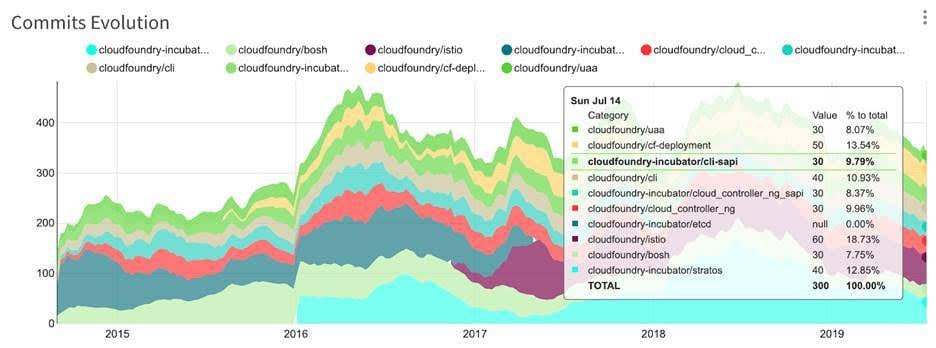
    An update to a previous report published today by source{d} shows there are now 879 repositories in the Cloud Foundry GitHub organization, with the total number of commits reaching approximately 50,000 per month. The report finds the highest levels of activity are centered around the Stratos UI project, Istio integrations and the core Cloud Foundry Application Runtime Cloud Controller.

    The CFF and Kubernetes, under the auspices the Cloud Native Computing Foundation (CNCF), fall under two separate arms of The Linux Foundation. It’s unclear if the Linux Foundation might one day merge these two arms or continue to keep them separate as a means of navigating conflicting vendor strategies. Whatever the outcome, Cloud Foundry is likely to remain a vibrant part of the open source community for many years to come.

    — Mike Vizard

  • Pivotal Embraces Spinnaker for Continous Delivery

    Pivotal Embraces Spinnaker for Continous Delivery

    Pivotal Software has added support for the Spinnaker continuous delivery platform to its platform-as-a-service (PaaS) environment for the open source Cloud Foundry PaaS.

    Richard Seroter, vice president of product marketing at Pivotal, said version 2.6 of Pivotal Cloud Foundry (PCF) extends the reach of the Spinnaker CD platform developed by Netflix to its PaaS environment and Enterprise PKS, an instance of Kubernetes curated by Pivotal and its sister company, VMware.

    At the same time, the latest version of PAS adds support for a beta instance of custom sidecar processes, which enable developers to embed additional functions running in an isolated container directly within their applications. That capability makes it possible to deploy, for example, a service mesh within the application, said Seroter.

    Finally, Pivotal plans to add multicenter replication capabilities for MySQL databases and a permissions model to Concourse for PCF, a continuous integration tool for building application pipelines with a Pivotal CF environment. That latter capability provides a mechanism through which DevOps teams can automate application updates, including patches, end to end, Seroter noted. As more patches are released to address the growing number of critical flaws involving microprocessors that make use of hyperthreading, the ability to automate their deployment is now more critical than ever, he said.

    Pivotal is seeing the deployment of both traditional 12-factor applications and more modern containerized applications on its PaaS environment. At the same time, the Cloud Foundry Foundation, which oversees the development of the Cloud Foundry PaaS, has,  via Project Eirini, made it possible to deploy containers that rely on Kubernetes rather than the Diego orchestration platform developed for Cloud Foundry. However, Eirini is still an alpha project and Pivotal has not yet fully committed to a specific level of support for Kubernetes with its overall PaaS strategy.

    In the meantime, Seroter said PCF continues to gain momentum in organizations looking to build and deploy software much like a technology company. As more organizations realize how dependent they are on software to drive revenue, they want to rely on a platform that makes it easier for them to manage software development and deployment platforms at scale, he noted.

    As part of that effort, Pivotal Software is aggressively incorporating tools that will enable organizations using its PaaS to implement best DevOps process. Many have adopted various modern development platforms in isolation but continue to rely on the Cloud Foundry PaaS to automate the building and deployment of mission-critical applications. Now, two classes of development platforms are merging into a single entity that makes it easier to embrace agile development methodologies using a lightweight development platform.

    Whatever the outcome, PaaS environments are not going away anytime soon. However, what organizations perceive as the role a PaaS environment plays in any enterprise soon might expand considerably as more container technologies are infused into the platform.

    — Mike Vizard

  • Cloud Foundry Global Survey Finds Companies Commit to Digital Transformation Process with Confidence in Cloud

    More than half of companies surveyed are putting mission-critical apps in the cloud


    PHILADELPHIA — April 2, 2019 – For the first time, a majority of companies are putting mission critical apps in the cloud, according to the latest report released today by Cloud Foundry Foundation, home to a family of interoperable open source projects for the enterprise, at its North American Cloud Foundry Summit in Philadelphia. The study revealed that companies treat digital transformation as a constant cycle of adaptation rather than a one-time fix. As part of that process, cloud technologies such as Platform-as-a-Service (PaaS), containers and serverless continue to grow at scale, while microservices and AI/ML are next to be integrated into their workflows.

    As more companies embrace the reality of digital transformation, they are adapting to the iterative journey that unfolds. Case in point: 74 percent of respondents equate digital transformation to “perpetual shifts and constant adaption of new technology,” compared to 26 percent who view digital transformation as a “one-time change and adoption of new technology.” More than three quarters of IT decision makers believe digital transformation is a reality, and 86 percent of CIOs, CTOs and Line of Business leaders agree.

    “The vast majority of companies agree digital transformation is a constant process of incremental change, rather than a one-time initiative, and are realizing their long-term strategy must involve adaptation to a wide range of unforeseen challenges and technological changes,” said Abby Kearns, Executive Director, Cloud Foundry Foundation. “Although companies are starting to see the benefits of advanced cloud technologies, what’s coming next—artificial intelligence, machine learning and blockchain, for example—will continue to prove that the only constant in technology is change.”

    Key findings from the report include:

    • Multi-platform strategy is flourishing: Almost half of respondents (48 percent) report using a combination of PaaS, containers and serverless technologies together—an increase of nine percent from last year’s multi-platform report. There are increases across the board in companies using a combination of all three technologies in various iterations, with 72 percent using PaaS and containers together (+8%), 50 percent using PaaS and serverless together (+7%), and 49 percent using containers and serverless together (+7%).
    • Container usage widens: Among companies using or evaluating containers, there has been substantial growth in the number of containers used. Organizations using 100 or more containers has grown from 34 percent in April 2018 to 48 percent in February 2019. Among the IT decision makers surveyed, 62 percent report they expect containers to be mainstreamed at their organization within a year.
    • Serverless evaluation slows, but there is broader deployment among users: While there was a slight pull back in overall usage and evaluation since September, for those using and evaluating serverless, broad deployment doubled since last year—increasing from 9% to 18%.
    • Timeline to see digital transformation vary by region: North American companies are largely feeling the benefit of digital transformation or expect to in this quarter (49%), though slightly more than a third (34%) don’t expect to see benefits for a year or more. Conversely, a third of organizations in Asia expect to see benefits later this year while only 24% expect it to take over a year. More than half of European companies (56%) already feel the benefit or expect to this quarter, while a small percentage (19%) expect to feel the benefits within the year.

    To receive a copy of the report, go here.

    Since 2015, ClearPath Strategies, a strategic consulting and public opinion research firm, has conducted Cloud Foundry Foundation’s Global Perception Study (GPS), a series of deep-dive research on topics critical to cloud and developers. The results in this report come from the ninth round of this global quantitative and qualitative research in that series. The survey consisted of 501 interviews of IT professionals and execs, covering eight geographies (Canada, China, Germany, India, Japan, South Korea, the UK, and the US) and was offered in five languages corresponding to those geographies. The data was weighted evenly across three regions, Asia, Europe, and North America, to correspond with past waves of research. While margin of sampling error cannot technically be calculated for online panel populations where the relationship between sample and universe is unknown, the margin of sampling error for equivalent representative samples would be +/- 4.8 percent.

    The sample was distributed across four major ITDM roles and the proportions were weighted to reflect consistency with past GPS waves. The breakdown of roles is as follows: Dev/DevOps (30 percent), Ops/Architect (30 percent), CIO/CIOs/Line of Business (25 percent), and IT Managers (15 percent). This mix of company size is as follows: 32% SME (<1K employees),  68% Enterprise (1K+), 25% Large Enterprise (10K+). To ensure the highest quality respondents, surveys include enhanced screening beyond title and activities of company size (no companies under 100 employees), cloud IT knowledge, and years of IT experience.

    Cloud Foundry is an open source technology backed by the largest technology companies in the world, including Dell EMC, Google, IBM, Microsoft, Pivotal, SAP and SUSE, and is being used by leaders in manufacturing, telecommunications and financial services. Only Cloud Foundry delivers the velocity needed to continuously deliver apps at the speed of business. Cloud Foundry’s container-based architecture runs apps in any language on your choice of cloud — Amazon Web Services (AWS), Google Cloud Platform (GCP), IBM Cloud, Microsoft Azure, OpenStack, VMware vSphere, and more. With a robust services ecosystem and simple integration with existing technologies, Cloud Foundry is the modern standard for mission critical apps for global organizations.

    About Cloud Foundry Foundation

    The Cloud Foundry Foundation is an independent non-profit open source organization formed to sustain the development, promotion and adoption of Cloud Foundry as the industry standard for delivering the best developer experiences to companies of all sizes. The Foundation projects include Cloud Foundry Application Runtime, Cloud Foundry Container Runtime, BOSH, Open Service Broker API, Eirini, CF Containerization, Abacus, CF-Local, CredHub, ServiceFabrik, Stratos and more. Cloud Foundry makes it faster and easier to build, test, deploy and scale applications, and is used by more than half the Fortune 500, representing nearly $15 trillion in combined revenue. Cloud Foundry is hosted by The Linux Foundation and is an Apache 2.0 licensed project available on Github: https://github.com/cloudfoundry. To learn more, visit: http://www.cloudfoundry.org.

    ###
     

  • Pivotal Software Extends Development Platform Reach

    Pivotal Software Extends Development Platform Reach

    Pivotal Software announced an expansion of its implementation of the Cloud Foundry platform-as-a-service (PaaS) environment in addition to extending its support for Kubernetes to the Amazon Web Services (AWS) public cloud.

    At its SpringOne Platform 2018 conference, Pivotal revealed that Pivotal Cloud Foundry (PCF) can now extend a single instance of its distribution of the open source PaaS across multiple data centers. In addition, Pivotal is making it possible to automatically update the operating systems on which its PaaS is hosted, and added a more extensible user interface to its PCF Healthwatch monitoring tool.

    What’s more, Pivotal announced that Pivotal Container Service (PKS), its implementation of Kubernetes, now can be deployed on EC2 instances of the Amazon Web Services (AWS) public cloud. PKS is currently based on version 1.11 of Kubernetes that has been packaged with a software-defined runtime for spinning up clusters known as Kubo, developed under the auspices of the Cloud Computing Foundation (CFF), which also oversees Cloud Foundry. PKS was developed in collaboration with VMware, which is a sister company of Pivotal operating under the same Dell Technologies umbrella, and the latest version adds the ability to configure a namespace or cluster to emit logs to a specific destination, such as VMware vRealize Log Insight, without operator intervention.

    Richard Seroter, senior director of product for Pivotal, said Pivotal and VMware are collaborating to make Kubernetes clusters more accessible to enterprise IT organizations that typically don’t have engineers available to manage IT operations. By combining automation frameworks from VMware and Pivotal, the expectation is that PKS will gain more traction as IT organizations evaluate which flavor of Kubernetes to deploy in a production environment, he added. A recent research report published by the Cloud Native Computing Foundation (CNCF) would suggest that strategy is starting to gain traction.

    Pivotal apparently is pursuing a dual application development strategy. The first is based on a PCF framework that is highly prescriptive in terms of how applications should be built and deployed. The second is a more flexible container-as-a-service (CaaS) platform based on Kubernetes.

    In general, organizations that have invested in Cloud Foundry to deploy a PaaS are not likely abandon it in favor of a container platform overnight. But Pivotal and the CFF are under some pressure to be more aggressive in unifying Cloud Foundry and Kubernetes: There already are several instances of Cloud Foundry that run on top of Kubernetes, and Pivotal Software revealed earlier this month that it missed Wall Street’s expectations for billing revenue in its most recent quarter by 25 percent.

    It may take a while for the relationship between Cloud Foundry and Kubernetes to become more firmly established in the minds of IT professionals. But there are certainly no shortage of options when it comes to developing modern applications—there will be more than a few organizations employing multiple frameworks for building these applications for many years to come. The real issue may lie in deriving value from those investments.

    Survey findings published this week by Pivotal revealed that only 39 percent of global organizations are deploying code on a continuous, hourly or daily basis and only 40 percent deploy code on a monthly, quarterly or annual basis. The survey also found that only 35 percent of developers’ time is spent writing code for new products or features to deliver value, as opposed to maintenance or fixing old code. Also, one-third of U.S. respondents (33 percent) reported delaying application releases more than 11 times due to security concerns, compared to 21 percent globally. Clearly, there is much more DevOps work to be done.

    — Mike Vizard

  • Bridging the Multi-Cloud, DevOps Skills Gap

    Bridging the Multi-Cloud, DevOps Skills Gap

    The cloud is driving a digital transformation revolution throughout the world, as traditional “brick and mortar” companies morph into software companies. This is easy to see with retailers and publishers, but it’s also happening at companies such as ZipCar, Boeing and Liberty Mutual (more about them later). This transformation, while driving radical performance and cost improvements, has caused the skills gap to widen substantially as businesses struggle to find top developer talent—competing with the likes of traditional software companies such as Google and Microsoft. I attend the Cloud Foundry Summit in Boston to verify my assumptions.

    The diversity of offerings of cloud products has opened up a variety of possibilities, and one specific usage is on the rise: the multi-cloud strategy. This means that a company is using multiple cloud providers to host its services. There are numbers of reasons to do this: to take advantage of price differences, distribute the traffic to serve different geographical regions or as part of a disaster recovery plan, to name a few.

    Having a multi-cloud infrastructure brings a lot of complexity and challenges. Fortunately, solutions such as Cloud Foundry are designed to help companies embrace what the cloud industry has to offer, including the multi-cloud aspect. Cloud Foundry has actually seen a 12 percent increase in adoption from 2017 to 2018, and 42 percent of its users consider themselves developers or DevOps engineers.

    The 2018 GitHub developer survey confirms the trend: “DevOps and machine learning are important trends in the software industry today. Languages and frameworks associated with these kinds of works are on the rise, and developers working in these areas command the highest salaries.” DevOps engineers are not only the second most well-paid developers, but they are also among the ones with the most experience.

    DevOps engineers or site reliability engineers (SREs) are a rare type of talent, because these professionals need a wide range of knowledge within the software scope—more specifically, development skills and infrastructure/system administration skills. The fact that DevOps engineers are generally more experienced is because most people start as developers and then end up learning about infrastructure on the job, and this takes time. And our education system is to blame.

    Most computer science degree programs do not focus on practical computer science and software development. System administration skills are often not covered at all, so there are hardly any graduates taking on this type of position. As a result, many engineers learn on the job rather than during their degree programs.

    I heard time and again from attendees at Cloud Foundry Summit how difficult it is to find talent. When I asked about students graduating from colleges (even top colleges), they universally responded that new graduates were far “too green,” required months of training and were not familiar with or attracted to the DevOps/SRE career path.

    Taos, a prominent Silicon Valley IT consulting and services provider, is among some that are getting creative when it comes to attracting and developing quality DevOps talent. “Our customers are increasingly investing in projects that require engineers trained in cloud technologies and DevOps,” said Trish Palumbo, vice president of Talent at Taos. “To meet the demand, we look for knowledge-seekers with a baseline of CS fundamentals to join the Taos DevOps Bootcamp.” The training is free and students get paid to attend.

    As more businesses digitally transform, more developer talent will be needed. The Cloud Foundry Foundation has been aware of this skills gap for some time, having published a full report on the topic in 2016. The foundation continues to work hard to close this gap by hosting summits where developers can take training sessions, participate in a hack-athon and learn about a career in DevOps, while networking with experienced developers and organizations seeking talent. Cloud Foundry Summit is a crucial event for organizations in need of digital transformation, as this is one of the best industry conferences to meet top-tier talent.

    — Sylvain Kalache

  • Global Survey: Companies Turning to Multi-Platform Strategy to Digitally Transform Their Businesses

    Nearly forty percent of respondents are using PaaS, containers and serverless technologies together for flexibility and interoperability

    SAN FRANCISCO — June 27, 2018— Companies are using different cloud-native technologies side-by-side at an increasing pace to build both new cloud-native applications and to refactor traditional applications, according to the latest report released today by the Cloud Foundry Foundation, home of the most widely-adopted open source cloud technologies in the world.

    “As IT Decision Makers settle into their cloud journey, they are more broadly deploying a combination of available platforms, including PaaS, containers and serverless,” said Abby Kearns, Executive Director, Cloud Foundry Foundation. “In this multi-platform world, it should come as no surprise that, as they become more comfortable with these tools, IT decision makers are searching for a suite of technologies to work together. They want technologies that integrate with their current solutions in order to address their needs today—but are flexible enough to address their needs in the future.”

    Key Findings include:

    • A Multi-Platform World:Technologies are being used side by side more than ever before. IT decision makers report 77 percent are using or evaluating Platforms-as-a-Service (PaaS), 72 percent are using or evaluating containers and 46 percent are using or evaluating serverless computing. More than a third (39 percent) are using a combination of all three technologies together.
    • A Mix of New Cloud-Native and Refactoring Legacy Applications:57 percent of IT decision makers report their companies do a mix of building new cloud-native applications and refactoring existing applications, an increase of nine percentage points from late 2017.
    • Containers Have Crossed the Chasm: For companies choosing to develop new or refactor existing applications, they are choosing containers.
    • Serverless is on the Upswing: Serverless computing is being evaluated with rapid momentum. Only 43 percent of respondents are not using serverless and 10 percent more companies are evaluating serverless than in 2017.
    • PaaS Usage Continues to Swell: PaaS is being more broadly deployed than ever before and companies are developing new cloud-native applications at increased momentum. It stands to reason that these two upsurges happen in tandem. This growth in usage is bolstered by the 62 percent of IT decision makers who report their companies save over $100,000 by using a PaaS.
    • Flexibility and Interoperability are Key: IT decision makers ranked “Integration with existing tools” and “Flexibility to work with new tools” in the top five attributes in a platform, alongside Security, Support, and Price.


    Less than six months ago, the Foundation’s 2017 report “Innovation & Relevance: A Crossroads on the Cloud Journey” indicated IT decision makers were advancing in their cloud journeys. In 2016, IT Decision Makers reported a lack of clarity around IaaS (Infrastructure-as-a-Service) and PaaS (Platform-as-a-Service) technologies, and most were still in the evaluation stages. By late 2017, they had progressed to selection and broader deployment of cloud solutions. Twenty percent report of IT decision makers report primarily building new cloud-native applications, up five percentage points from last year, while 13 percent say they are primarily refactoring, a drop of 11 points. As an increasing number of companies are developing new cloud-native applications, PaaS is being broadly deployed by more companies than ever. It stands to reason that these two upsurges happen in tandem.

    Cloud Foundry Application Runtime is a mature and growing cloud application platform used by large enterprises to develop and deploy cloud-native applications, saving them significant amounts of time and resources. Enterprises benefit from the consistency of Cloud Foundry Application Runtime across a variety of distributions of the platform, thanks to a Certified Provider program. Cloud Foundry Container Runtime combines Kubernetes with the power of Cloud Foundry BOSH, enabling a uniform way to instantiate, deploy and manage highly available Kubernetes clusters on any cloud, making deployment, management and integration of containers easy.

    To receive a copy of the survey, go here. The survey was conducted and produced by ClearPath Strategies, a strategic consulting and research firm for the world’s leaders and progressive forces.

    Cloud Foundry is an open source technology backed by the largest technology companies in the world, including Dell EMC, Google, IBM, Microsoft, Pivotal, SAP and SUSE, and is being used by leaders in manufacturing, telecommunications and financial services. Only Cloud Foundry delivers the velocity needed to continuously deliver apps at the speed of business. Cloud Foundry’s container-based architecture runs apps in any language on your choice of cloud — Amazon Web Services (AWS), Google Cloud Platform (GCP), IBM Cloud, Microsoft Azure, OpenStack, VMware vSphere, and more. With a robust services ecosystem and simple integration with existing technologies, Cloud Foundry is the modern standard for mission critical apps for global organizations.

    About Cloud Foundry Foundation

    The Cloud Foundry Foundation is an independent non-profit open source organization formed to sustain the development, promotion and adoption of Cloud Foundry as the industry standard for delivering the best developer experiences to companies of all sizes. The Foundation projects include Cloud Foundry Application Runtime, Cloud Foundry Container Runtime, BOSH, Open Service Broker API, Abacus, CF-Local, CredHub, ServiceFabrik, Stratos and more. Cloud Foundry makes it faster and easier to build, test, deploy and scale applications, and is used by more than half the Fortune 500, representing nearly $15 trillion in combined revenue. Cloud Foundry is hosted by The Linux Foundation and is an Apache 2.0 licensed project available on Github:https://github.com/cloudfoundry. To learn more, visit:http://www.cloudfoundry.org.


    ###

  • Cloud Foundry at the Crossroads

    Cloud Foundry at the Crossroads

    At the time the Cloud Foundry platform-as-a-service (PaaS) environment was constructed, the only form of infrastructure abstraction available consisted of virtual machines. Flash forward to today and there now exists multiple layers of abstraction, some of which potentially obviate the need for functionality built into Cloud Foundry.

    The Cloud Foundry Foundation (CFF) is now in the middle of trying to navigate all those changes largely by committing to interoperability with technologies such as Kubernetes and the Open Container Initiative (OCI). Cloud Foundry developed its own container format (Garden) and associated container orchestration software (Diego). For now, the CFF is committed to continuing support for those technologies, while also providing interoperability with OCI, Kubernetes, the Container Network Interface (CNI) and Envoy, an open source service proxy, said CFF executive director Abby Kearns.

    CFF also took the lead on developing an Open Service Broker application programming interface (API) that is being rapidly embraced by both the Cloud Foundry and Kubernetes communities and is starting to evaluate additional open source projects such as Istio, a framework for load balancing microservices developed by member of the Kubernetes community.

    It’s already clear that all this interoperability is a first step toward tighter integration. After all, the amount of technical resources being poured into Kubernetes and OCI by consortiums such as the Cloud Native Computing Foundation (CNCF) and The Linux Foundation dwarfs anything CFF is likely to be able to match on its own.

    In fact, the real opportunity for CFF may be to establish Cloud Foundry as the platform that provides the best application experience there is on Kubernetes. Red Hat is has already staked out that ground by tightly integrating the Red Hat OpenShift PaaS with Kubernetes. The best CFF has been able to do so far is certify a distribution of Cloud Foundry created by SUSE that can be encapsulated in Docker containers.

    Naturally, it’s challenging to get a CFF consortium led by Pivotal Software, IBM, SAP and others to agree on strategic technology directions in a timely manner. Red Hat, for example, did not have to consult with anyone outside the company before deciding to integrate Red Hat OpenShift with Kubernetes. By now, however, it’s apparent that it’s no longer a question of whether Cloud Foundry will be integrated with Kubernetes, but to what degree. CFF last year created a Cloud Foundry Container Runtime environment on which IT organizations can deploy applications as an alternative to the native runtime.

    In the future it may be a lot more difficult to distinguish where the line between Cloud Foundry and other forms of abstraction begin and end—or, for that matter, what platform it will be deployed on. Kearns noted there’s already a bare-metal instance of Cloud Foundry, so there’s already a precedent of deploying it without hypervisors.

    Regardless what underlying technologies are employed, however, as long as developers enjoy the Cloud Foundry experience the chances are high the open source PaaS environment will be around the enterprise for many years to come.

    — Mike Vizard

  • Microsoft Lifts Investment in Cloud Foundry

    Microsoft Lifts Investment in Cloud Foundry

    At the Cloud Foundry Summit Silicon Valley 2017 conference this week Microsoft formally pledged its support for the open-source platform-as-a-service (PaaS) environment by becoming a gold member of the Cloud Foundry Foundation (CFF).

    Beyond influencing the future direction of the Cloud Foundry PaaS, Microsoft also revealed this week it will tighten the integration between the Cloud Foundry PaaS running on Microsoft Azure and backend database services. There also now command line tools for Cloud Foundry available within Azure Cloud Shell, a browser-based tool for managing Azure resources.

    Corey Sanders, partner director for Microsoft Azure, told conference attendees that Microsoft is fully committed to Cloud Foundry as any member of the foundation. In fact, there have been instances of Cloud Foundry running on Azure for years, including the version of Cloud Foundry that SAP makes available as part of a multi-cloud computing strategy it has crafted. Microsoft claims usage of Cloud Foundry on Azure has increased 300 percent over the last year.

    CFF CTO Chip Childers says that endorsement of Microsoft is significant because, along with Google, it means two of the three largest public cloud providers are now investing in Cloud Foundry. There are instances of Cloud Foundry running on Amazon Web Services (AWS), but the largest public cloud service provider has not seen fit to join the CFF.

    The mission of CFF is to promote the adoption of multi-cloud computing via technologies that can be deployed across both public clouds and an on-premises IT environment, Childers says. He expects Cloud Foundry and the Kubernetes container orchestration engine to play similar roles in that regard. The actual operating system deployed in those environments, he says, is now much less relevant. The choice regarding when to deploy one or another will come down to the nature of the application workload and the relative cloud-native maturity of the organization deploying those workloads.

    Microsoft has already made it clear it it is committed to offering multiple classes of services with Azure. In addition to Cloud Foundry, Microsoft already offers a PaaS environment built on its own proprietary stack of Windows software. There’s also both a container-as-a-service offering based on Kubernetes and implementations of the container stack developed by Docker Inc., in the wake of a strategic alliance between those two companies.

    Obviously, the range of deployment options now being made available on platform such as Microsoft Azure creates some significant DevOps challenges. Rather than trying to limit the number of services developers might invoke, IT operations teams will need to focus more on making sure the right type of application workload invokes the class of cloud service that is best optimized for that workload. Naturally, that approach will require IT organizations to address both technology and cultural issues within their organizations. But given the limited effectiveness most IT operations teams historically have had in terms limiting deployment options, there’s no better time than the present to get started.

    — Mike Vizard