Tag: Cloud Computing

  • How Platform Engineering Bridges the IT and DevOps Divide

    How Platform Engineering Bridges the IT and DevOps Divide

    Ballooning lead and process time, with an opaque corollary relationship to fixed and marginal cost, is a significant and complex burden for any enterprise. And multi-cloud complexity and inefficient organizational and technical processes are some of the most wasteful areas companies face–so much so that Synergy Research reports organizations are cutting back on their cloud spend as tech budgets continue to fall under intense scrutiny, resulting in a Q1 2023 cloud spending growth rate of 19% compared to 32% just last year. With cloud cost containment a top priority, Forrester advised tech leaders to demonstrate to CFOs how they will stay on budget and demonstrate ROI at the board level. A key area where companies can eliminate expensive waste and increase time to value is the relationship and workflow between IT and developers, which, while being the DevOps charter for nearly 15 years, has gotten less attention among the viable cost-containment strategies for enterprises in 2023. Revisiting the latest iteration of this DevOps charter through the implementation of platform engineering strategies can help enterprises create a faster, leaner and more scalable dynamic. Let us examine why it’s now time for enterprises to consider platform engineering as a potent way to not only increase efficiency but also to bridge the divide between DevOps and IT.

    The Old Way: Forcing DevOps to Dance to the ITSM Tune

    In traditional enterprise organizations, IT typically dictates a top-down ITSM practice that limits the tools an organization can use for development and deployment; in many cases, it inhibits CI/CD and other core capabilities and practices of DevOps. This awkward attempt to accommodate modern DevOps practice through an aging ITSM paradigm has led to a suboptimal software delivery performance and poor developer experience (DX).

    McKinsey, highlighting the criticality of DX, found developers at a leading SaaS provider spent 20% to 30% of their time integrating different services such as firewall changes, DNS and security access to deliver code through its CI/CD pipeline. That’s a lot of time spent on low-value, repetitive tasks, ensuring a painful journey for a disappointing result. If the DX pain is high enough, developers often go around IT and create resources on their own, leading to shadow IT, adding new cost burdens and growing security exposures. Every minute and engineer count: Five minutes saved per day among 500 developers saves a week’s development time.

    Surely, there is a better way.

    Platform Engineering: Collaboration Through Composition

    Platforming engineering and “platform as a product” have been key to the PaaS ecosystem for years but are now gaining fresh traction in the industry. In Puppet’s State of DevOps Report, 51% of respondents said they had already adopted platform engineering and 93% said it was a step in the right direction. Gartner predicted 80% of software engineering organizations will have platform teams by 2026.

    The concept can be defined in several ways. Gartner reported platform engineering is “an emerging trend intended to modernize enterprise software delivery… designed to support the needs of software developers and others by providing common, reusable tools and capabilities, and interfacing to complex infrastructure.” PlatformEngineering.org’s recent blog post defines it as the discipline of designing and building toolchains and workflows for self-service capabilities in software engineering organizations during the cloud-native era.

    Regardless of definition, platform engineering is the latest iteration of IT centralization, though now attempting to retain all the benefits of distributed team empowerment through “composition” rather than converged control. As modernization continues, we experience the ebb and flow of composition and decomposition, both organizationally and technically. Microservices, Kubernetes, and GitOps patterns pushed the rational limits of decomposition and significantly raised the level of technical complexity in the enterprise. The natural counter pressure is a new cycle of composition that aims to simplify that complexity through platform engineering practices. Teams now look for these toolchains and workflows to be centralized in internal developer platforms (aka IDPs), exposing the development, deployment and maintenance of the entire life cycle of modern, cloud-native applications.
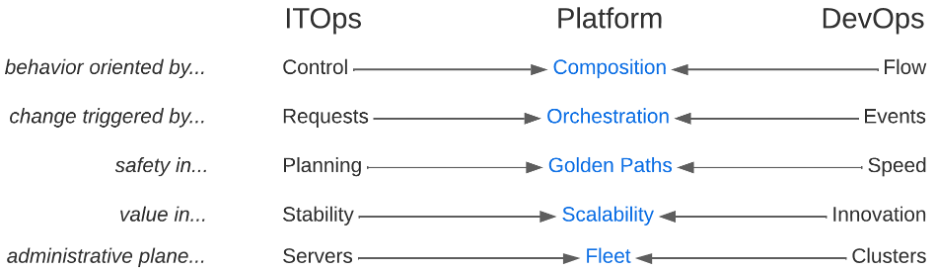
    IDPs can facilitate the flow, speed and innovation DevOps teams are demanding without sacrificing stability, security and control. They enable developers to configure their toolchain while meeting all controls through approved blueprints or “golden paths,” reducing lead and process time. Developers can focus on delivering business value instead of infrastructure tasks.

    Bringing IT and DevOps Back Into Alignment Saves Time, Money and Sanity

    Platform engineering creates a collaborative framework that connects IT and DevOps teams, so they can focus on outcomes rather than methods. Developers can use an IDP to follow conventions that speed up development and prevent anti-pattern creep. Guardrailing choices through golden paths reduce cognitive load and simplify execution context for security teams. The result? Developers can focus on what they were hired for and want to do–creating innovative, transformative applications and differentiated value. Security can sleep well knowing bespoke behavior isn’t opening new attack surface areas.

    On the Day 2 operations side, IDPs enable SRE and support teams to have a fleet-wide view and work effectively with developers to streamline the management of production needs across all applications, clouds and tech stacks.

    The reframing of composition breaks the false dichotomies between IT and DevOps practices. You don’t have to choose between control and flow, change isn’t triggered by serial requests or async events, safety isn’t found in planning or speed, value isn’t found in stability or innovation and administrative plane primitives aren’t servers or clusters. Platform engineering practices allow you to prioritize composition, orchestration, golden paths, holistic scalability and fleet management to get teams out of entrenched myopia and embrace systems thinking that gets your business delivering strategic gain instead of tactical win/loss tallies.

    Finally, platform engineering positively impacts software delivery and operational performance metrics by streamlining development processes and reducing manual efforts. The bottom line is faster time to market while ensuring more consistency, less human error and improved software quality. This maximizes productivity, minimizes downtime and optimizes resource utilization, leading to cost advantages and increased efficiency for enterprises.

  • Cloud Orchestration and its Impact on DevOps Teams

    Cloud Orchestration and its Impact on DevOps Teams

    Cloud orchestration refers to the coordination and management of various interconnected cloud services and resources to automate and streamline complex IT processes. In simple terms, it is the process of integrating, synchronizing, and automating various cloud-based components to create a seamless and unified workflow. 

    Cloud orchestration aims to optimize the deployment, management, and use of resources in a cloud environment, improving efficiency, reducing costs, and ensuring that cloud services are delivered in a timely and effective manner. It is related to the concept of CloudOps (cloud operations), which uses cloud orchestration concepts to allow more efficient management of cloud resources. Cloud orchestration is a critical aspect of modern IT infrastructure management, as it enables organizations to manage and control their cloud resources more effectively.

    Difference between Cloud Orchestration and Cloud Automation

    Though the terms cloud orchestration and cloud automation are often used interchangeably, they have distinct differences. 

    Cloud automation refers to the process of automating individual tasks and processes within the cloud environment. It involves the use of scripts, templates and other tools to automate repetitive tasks, such as provisioning resources, deploying applications and configuring environments. The primary goal of cloud automation is to reduce the time and effort needed to manage cloud resources.

    Cloud orchestration is a broader concept that encompasses not only the automation of tasks but also the coordination and management of the entire cloud ecosystem. It involves the integration of various cloud services, tools and resources to create a unified, streamlined workflow. Cloud orchestration ensures that all components in the cloud environment work together seamlessly, automating complex processes and managing dependencies between tasks.

    In essence, cloud automation is a subset of cloud orchestration. While cloud automation focuses on automating individual tasks, cloud orchestration takes a more holistic approach, orchestrating multiple tasks and resources to achieve a higher level of automation and efficiency.

    How Cloud Orchestration Enhances DevOps Practices

    Increased Efficiency and Speed

    One of the main benefits of cloud orchestration in a DevOps context is the ability to increase efficiency and speed in the software development and deployment process. By automating and streamlining various tasks, cloud orchestration eliminates manual processes, reduces the potential for human error and accelerates the overall development cycle. 

    Improved Collaboration and Communication

    Cloud orchestration fosters better collaboration and communication between development and operations teams by providing a unified platform for managing cloud resources. This shared platform enables teams to work together more effectively, breaking down traditional silos and ensuring that all stakeholders have visibility into the development and deployment process. 

    Enhanced Infrastructure and Application Management

    Cloud orchestration simplifies the management of complex cloud infrastructure by providing a single, unified platform for cloud optimization—improving the management of resources, applications and services in the cloud.

     This centralized management approach enables organizations to more easily monitor, control and optimize their cloud environment, ensuring that resources are used effectively and that applications are running smoothly. With cloud orchestration, organizations can more easily scale their infrastructure to meet changing demands, ensuring that they have the resources they need when they need them.

    Improved Monitoring and Troubleshooting

    Cloud orchestration provides improved monitoring and troubleshooting capabilities, enabling organizations to more effectively identify and address issues in their cloud environment. With comprehensive monitoring tools and dashboards, teams can gain insight into the performance of their applications, identify bottlenecks and pinpoint potential issues before they become critical.

    Challenges of Integrating Cloud Orchestration With DevOps

    Despite the numerous benefits of cloud orchestration, integrating it into DevOps practices can present several challenges. Some of the common challenges include:

    • Complexity: Cloud orchestration involves the integration of various cloud services, tools and resources, which can be complex and time-consuming. Organizations may struggle with complexity, particularly if they lack the necessary expertise or resources to effectively implement and manage the solution.
    • Resistance to change: Implementing cloud orchestration requires a change in mindset and approach to software development and deployment. As your organization migrates more systems to the cloud, some team members may be resistant to adopting new processes and tools, making it difficult to fully embrace and realize the benefits of cloud orchestration.
    • Security concerns: As with any cloud-based solution, security is a critical concern when integrating cloud orchestration into DevOps practices. Organizations must ensure that their solution is secure and that they have the necessary policies and procedures in place to protect their sensitive data and resources.
    • Cost and resource constraints: Implementing and managing a Cloud Orchestration solution can be resource-intensive, requiring significant investment in infrastructure, tools, and personnel. Organizations must carefully consider the costs and resources required to implement cloud orchestration and determine whether the benefits outweigh the investment.

    Best Practices to Integrate Cloud Orchestration Into DevOps

    To successfully integrate cloud orchestration into DevOps practices and overcome the challenges mentioned above, organizations should consider the following best practices:

    • Assess your organization’s readiness: Before implementation, evaluate your organization’s readiness for change. This includes assessing your existing infrastructure, processes and tools, as well as your team’s willingness and ability to adopt new practices and technologies.
    • Develop a clear strategy: Develop a clear strategy for integrating cloud orchestration into your DevOps practices. This should include defining your goals and objectives, identifying the tools and resources you will need and establishing a timeline for implementation.
    • Choose the right tools and technologies: Select the appropriate tools and technologies that best meet your organization’s needs and requirements. Consider factors such as ease of integration, scalability, security and cost when evaluating potential solutions.
    • Train and educate your team: Ensure that your team has the necessary knowledge and skills to effectively implement and manage cloud orchestration. This may involve providing training and education on new tools, processes and best practices, as well as fostering a culture of continuous learning and improvement.
    • Monitor and measure success: Continuously monitor and measure the success of your implementation. This includes tracking key performance indicators (KPIs), such as deployment speed, resource utilization and application performance, to ensure that your solution is delivering the desired results.

    Conclusion

    Cloud orchestration is an essential tool for organizations looking to streamline and optimize their IT infrastructure, particularly in the context of DevOps practices. By automating and coordinating complex cloud processes, organizations can improve efficiency, speed, collaboration and overall performance. 

    However, successfully integrating with DevOps can be challenging, requiring a clear strategy, the right tools and technologies and a commitment to continuous improvement. By following the best practices outlined in this guide, organizations can overcome these challenges and fully realize the benefits.


  • FinOps Gaining Ground, But Progress is Slow

    FinOps Gaining Ground, But Progress is Slow

    A CloudBolt Software survey found that while the majority (98%) of respondents worked for organizations with a formal FinOps team (82%) or are actively considering adding one (16%), realizing value from FinOps is slow. More than half of existing FinOps teams (54%) were formed just 12 months ago or less, the survey also found.

    The trouble is, only one in of 500 respondents claimed to achieve any material value from FinOps to date. More than three-quarters of respondents (76%) said they will have to wait two to three years to see real FinOps-driven results.

    The survey polled 500 executives, engineers and developers at companies with over 5,000 employees in the U.S., Canada, United Kingdom and Australia. It was conducted by Wakefield Research on behalf of CloudBolt Software, a provider of a platform for managing distributed computing environments.

    A total of 45% of respondents also questioned FinOps efficacy in the real world. Specifically, 15% flagged FinOps as being “theoretically easy but harder in practice,” with another 13% regarding it as “much ado about nothing.” Another 10% said it is “nothing more than a suggested framework,” while 7% labeled FinOps as “a necessary evil.”

    Nevertheless, a full 89% also described FinOps as the silver bullet for reining in the complexity of cloud cost management, with 68% noting that FinOps is among their organization’s most strategic priorities for 2023. The average size of a FinOps team is now 4.1 people, with the “director level” being the senior-most leader on the team 53% of the time, the survey noted.

    A total of 71% noted that achieving this year’s IT goals without a FinOps practice would pose a significant challenge, with 74% reporting that FinOps is now on par with ITOps, DevOps, SecOps and other IT disciplines.

    In addition, 71% of respondents said funding for FinOps initiatives increased in 2023, with 58% reporting key performance indicators (KPIs) and metrics to the C-suite or board of directors.

    CloudBolt Software CTO Kyle Campos said it’s clear that when it comes to reining in costs, large enterprises are struggling to effectively manage IT across multiple silos. In many cases, organizations were investing heavily in IT before and during the COVID-19 pandemic to drive digital business transformation initiatives without many cost controls being put in place, he added.

    Now that organizations are encountering economic headwinds, many chief financial officers are now asking IT leaders to be a lot more efficient, noted Campos.

    Developers, in particular, have for years been provisioning cloud infrastructure resources with little to no oversight. Unfortunately, developers are prone to leaving the proverbial lights on by, for example, leaving application development environments running over a weekend or simply forgetting that a virtual machine has been left to run for weeks—sometimes even months.

    Developers are also not especially good at alerting IT leaders of possible spikes in consumption due to, for example, a data-intensive workload being constructed. No finance team likes to be surprised by a monthly bill for a cloud service that is twice as much as the previous month.

    The one thing that is certain is that time is of the essence. FinOps, at its core, may not necessarily be a new idea, but IT organizations that fail to practice it may soon find themselves being held more accountable than any time in recent memory.

  • Survey Surfaces Raft of Enterprise IT Challenges

    Survey Surfaces Raft of Enterprise IT Challenges

    A survey of  enterprise IT leaders found less than a third (32%) are extremely confident that they have the right technology, processes and people in place to execute an effective approach to IT management.

    The survey, conducted by Rocket Software, polled 275 U.S. IT leaders in organizations with more than 1,000 employees. A full 93% of IT leaders are also committed to maximize the value of investments in existing platforms.

    As a result, the top priorities for IT leaders are hybrid cloud computing (65%), data and content management (68%) followed by DevOps and infrastructure and application modernization, tied at 58%, and automation (57%).

    A total of 62% noted they have a much greater focus on efficiency due to the economic landscape, with faster DevOps processes, automated processes and increasing overall output as the top three improvements that would be most impactful for increasing efficiency.

    The survey also suggested many organizations still have much work to do to achieve those goals, with 63% of respondents spending anywhere from six to 15 hours on manual data entry and analysis each week.

    Phil Buckellew, president of infrastructure modernization for Rocket Software, said most organizations are still trying to determine the right level of DevOps to adopt. Few organizations have implemented DevOps workflows on an end-to-end basis, with many employing a mix of DevOps and waterfall processes to build and deploy applications across a hybrid cloud computing environment, he noted.

    Overall, IT leaders are most worried about improving overall IT performance (60%), data security (50%), process risk and compliance (46%) and the need to improve agility (41%), the survey found. Respondents also noted that they measure success within their IT organization by increased efficiency (71%), optimized resources (67%) and reduced risk (63%).

    The survey makes it clear that, despite challenges, enterprise IT organizations are committed to hybrid cloud computing as they become more comfortable with using various platforms that are fit for purpose, said Buckellew.

    Mainframes, for example, continue to play a major role in running online transaction processing (OLTP) applications alongside analytics applications that are now being infused with artificial intelligence (AI) capabililities, noted Buckellew.

    A quarter of survey respondents also identified providing cloud applications with access to mainframe data as an area where they need additional tools, followed by automation (22%).

    The biggest automation obstacles are the complexity of implementing automation (18%), resistance to process change among workforce (18%) and lack of skillsets to implement automation (18%), the survey finds.

    As always, the biggest challenge in enterprise IT environments is often simple inertia. Organizations that have been building and deploying applications on mainframes, for example, have been relying on waterfall processes for decades. Many of them have now adopted DevOps processes to varying degrees, but few have completely replaced legacy approaches to building and deploying software, noted Buckellew.

    It’s not likely the management of complex hybrid cloud computing environments will be simplified any time soon, but progress continues to be made. Soon, AI may automate many existing manual tasks. In the meantime, however, the number of enterprise IT organizations standardizing on a single IT platform remains few and far between.

  • Survey Sees Value But Limited Understanding of Platform Engineering

    Survey Sees Value But Limited Understanding of Platform Engineering

    Platform engineering is emerging as method for managing DevOps at scale, but a survey suggested that many organizations are still not clear on the concept.

    A survey of 100 DevOps engineers, platform engineers, developers, site reliability engineers and IT managers conducted by Civo, a cloud service provider, found 85% of respondents work for organizations that have partially or fully embraced a DevOps culture, with nearly two-thirds (65%) identifying platform engineering as the next evolution of DevOps. Nearly, a third (30%) of respondents work for organizations that are already currently evaluating whether they should adopt platform engineering.

    Overall, the survey found 50% of the respondents at organizations that have adopted platform engineering reported improved standardization, with 43% also seeing faster product delivery.

    However, only 41% of the respondents in DevOps roles that were familiar with platform engineering said they had a moderate to high level of familiarity with the concept.

    Saiyam Pathak, director of technical evangelism at Civo, said the survey makes it clear that, in terms of understanding how platform engineering best practices should be implemented, there is need for more clarity. Many organizations initially adopted DevOps to spur innovation, so any approach to centralization shouldn’t come at the expense of developer productivity, he noted.

    Historically, DevOps adoption of DevOps workflows in most organizations has been driven from the bottom up. As a result, it’s fairly common for multiple application development teams within an organization to have adopted multiple DevOps platforms to manage workflows. Advocates for platform engineering are making a case for eliminating many of those redundant platforms in favor of, for example, a single continuous integration/continuous delivery (CI/CD) platform that serves as a corporate standard.

    At the core of those efforts is the assumption that centralization will reduce costs by eliminating redundancy. At a time when more organizations than ever are sensitive to the cost of IT, there is always going to be a natural tendency to rationalize platforms. Challenges arise, however, when centralization results in a loss of flexibility. Many of the teams adopt DevOps because they want to be able to add and replace tools as they see fit. If there is a corporate standard that narrows their tool options, those teams may start to look for ways to do an end-run around the corporate standard.

    The philosophical IT battle between advocates for centralization and proponents of decentralization has been around since the first PCs showed up in enterprise IT environments. As always, organizations need to strike a balance between both extremes, said Pathak.

    It’s not clear how much platform engineering might accelerate the pace at which applications are built and deployed, but the total cost of DevOps should decline as various tools and platforms are consolidated. The challenge, of course, is that centralizing DevOps workflows is likely to disrupt the application development workflows on platforms that may about to be rationalized.

    Regardless of what platforms become the corporate standard, the one thing that is certain is the cultural challenges associated with successfully making that transition will loom large within most organizations.

  • HashiCorp Releases Slew of Updates to Improve DevSecOps

    HashiCorp Releases Slew of Updates to Improve DevSecOps

    At a HashiDays event this week, HashiCorp launched updates to its Terraform implementation and a software-as-a-service offering, dubbed HCP Vault Secrets, that promise to simplify infrastructure security and ensure that secrets are not leaked.

    In addition, HashiCorp has added a self-hosted edition of its remote access security tool, Boundary, that can now also record SSH sessions. The company is also announcing general availability of Vault Secrets Operator, which provides a high level of abstraction for managing secrets in a Kubernetes environment and which synchronizes with the secrets management interfaces defined by the Kubernetes Technical Oversight Committee.

    Finally, HashiCorp is making available in beta a 1.16 update to the Consul service mesh for containers and virtual machines that adds a Sameness Groups capability to improve the resiliency of microservices by redirecting requests to an identical service. HashiCorp has also added a transparent proxy mode to enable failover between services along with a permissive mutual TLS (mTLS) that enables a service to be configured to accept both mTLS traffic from mesh-enabled services and non-Consul mTLS traffic from external downstream applications.

    Chris Van Wesep, senior director of product marketing for HashiCorp, said Version 1.5 of HashiCorp Terraform adds config-driven import workflow and check blocks capabilities that make it possible to declaratively use code to add existing resources into a Terraform state. Previously, the only way to update a Terraform state was to use an import command that could only be applied to one resource at a time. Terraform 1.5 also adds automatic code-generation capabilities for imported resources.

    In addition, version 1.5 of Terraform also includes a tool to validate that provisioned infrastructure is behaving as intended. That latter capability makes it possible to reduce the number of misconfigurations created by developers that might one day be exploited by cybercriminals to breach an IT environment.

    HCP Vault Secrets, meanwhile, provides a beta release of a SaaS edition of the existing Vault offering specifically designed to enable organizations to better manage application secrets that might inadvertently be exposed to cybercriminals in a production environment, said Van Wesep.

    HashiCorp is moving toward providing a portfolio of tools that enable DevOps teams to securely provision and manage hybrid cloud computing environments using a common workflow, he noted. A Forrester Consulting survey found nearly three-quarters (73%) of respondents are reporting this strategy is helping them reach their business goals, with another 19% adding they expected this strategy to help them achieve their business goals in the next year.

    It’s not clear whether organizations are fully embracing multi-cloud computing, but each additional cloud added to an enterprise IT environment increases the total cost of IT. The only way to mitigate those costs is to define a set of best practices for building and deploying applications that can be applied to any cloud computing environment.

    Unfortunately, many organizations will discover that, as they attempt to define those best practices, they have inadvertently become dependent on a set of proprietary application programming interfaces (APIs) that thwart those efforts.

  • Survey Finds Cloud Management Strategies Shifting

    Survey Finds Cloud Management Strategies Shifting

    Even though organizations continue to consume cloud resources inefficiently, they continue to increase the amount of money allocated. These were among the findings of a global survey of 1,000 technology practitioners and decision-makers conducted by Forrester Consulting on behalf of HashiCorp.

    The survey found a full 94% of respondents reported that their organization struggled with cloud waste. Top factors contributing to avoidable cloud spending included overprovisioning resources (50%), idle or underused resources (50%) and a lack of needed skills (43%). Nevertheless, more than half of respondents (56%) said they boosted their cloud spending in the last year compared to 22% which reduced it.

    At the same time, however, 92% of respondents said they are moving toward adopting, standardizing or scaling platform teams as part of an effort to centralize the management of cloud services, but only 39% are scaling the use of platform teams throughout the organization. The survey also found, however, that organizations are addressing skills shortages by adopting a common operating model/shared automated workflows (58%), reskilling/upskilling (56%) and working with partners (43%).

    The survey also found many organizations are also committed to multi-cloud computing, with nearly three-quarters (73%) reporting this strategy is helping them reach their business goals. Another 19% said they expected this strategy to help them achieve their business goals in the next year.

    The most-cited reasons for adopting a multi-cloud strategy were reliability (51%), cost reduction (48%), security and governance (45%), digital transformation (45%) and scalability (45%). Only 10% had no choice but to go multi-cloud due to acquisitions or other issues.

    Security (88%), availability (84%) and scalability (84%) were identified most often as being important/very important multi-cloud success factors, followed closely by regulatory/compliance requirements (82%), staffing and skill levels (82%), budget (80%), visibility into cloud infrastructure (78%), automated tooling (77%) and platform teams (75%).

    The top cloud initiatives were data protection (77%), followed by secrets management and access control (both at 75%), the survey finds. The top security concerns were password/credentials/secrets leakage (50%) followed by data theft (49%), phishing (46%) and ransomware (42%).

    Overall, respondents said the biggest benefits of having a multi-cloud computing strategy were a stronger security posture (74%) and helping attract, motivate and retain skilled staffers (68%).

    Chris Van Wesep, senior director of product marketing for HashiCorp, said it’s clear organizations are purposely using multiple clouds to reduce costs by pitting one cloud service provider against another. The challenge organizations face when using that approach is they need to define a consistent set of development processes that can be used across multiple clouds to keep total costs under control.

    Organizations that embrace multi-cloud computing are also more likely to implement security best practices because of their need to consistently manage multiple cloud computing environments, he added.

    Of course, there is always going to be a great disparity between high- and low-performing organizations. The survey found that about 25% of survey respondents are high performing, with an equal number falling at the other end of the spectrum. The rest fall somewhere in between those two ends of the spectrum. The issue is that the gulf between the high and low ends of that spectrum appears to be widening as more organizations fail to muster the level of skills and expertise needed to succeed in the cloud era.

  • Why You Need a Multi-Cloud and Multi-Region Deployment Strategy

    Why You Need a Multi-Cloud and Multi-Region Deployment Strategy

    As I began writing this article, I encountered some technical challenges in my attempt to provision three cloud providers in three separate regions to simulate multi-cloud and multi-region deployments.

    I couldn’t get one of the regions to behave as I expected when provisioning the environment. As it turned out, the region (and by association, cloud) was down due to a cut undersea cable, and it would take several weeks until the outage was mitigated.

    Fortunately, there are plenty of clouds in the sky to choose from, but this experience emphasized the importance of multi-cloud redundancy, especially in a production environment.

    This article examines the benefits of adopting a multi-region and multi-cloud deployment strategy for better resiliency, regulatory compliance and optimal user experience.

    Resilient Reasons to Choose Multi-Cloud and Multi-Region Architectures

    The first reason to choose a multi-cloud or multi-region environment is for data resilience. When our data is in a single region or on a single cluster, there is a good chance that you will experience data failure. You need a mitigation strategy if you want to keep the data lights on 24/7. These strategies fall into two buckets: Multi-region and multi-cloud.

    We first need to define the differences between multi-cloud and multi-region. The architectures are simply the implementation details of how we plan for one versus the other. However, depending on your database provider, those details can represent a significant time investment, which we’ll look at later.

    Multi-Region

    With multi-region, we typically deploy our applications to globally distributed regions. However, regional deploys are subjected to physical faults. Inclement weather, political unrest, acts of foreign or domestic terrorism and other physical variables have all led to regional outages in the past.

    Regardless of the cloud, the regions are exposed to similar physical faults. Instead of losing your data, we can switch to another region to handle the workload. Even though much as our industry hates latency, it is always preferred over loss.

    Deploying to multiple regions allows for failover handling. If the Sydney region goes down, Singapore may still be online. It would be a globally bad day if the same physical faults simultaneously impacted Frankfurt, Sydney and Seattle, for example.

    Multi-Cloud

    Physical faults are only one of the problems that public and private clouds encounter. User error, poorly configured networks and even banal errors can have substantial consequences that impact entire clouds, either from the provider or the user.

    In these circumstances, regional failover won’t help you. An expired certificate, accidental deletion or disabling the wrong port will take you offline, regardless of whether you’re in Seattle or Sydney. If that happens, someone somewhere is most definitely awake and is likely very unhappy.

    Choosing a multi-cloud configuration protects you from these types of faults so that if Google, for example, has interruptions, AWS is still online—or IBM, Deutsche Telekom, OVH or Hetzner.

    The Correct Answer: Deploy Both!

    Multi-region is a go-to method to mitigate against mostly physical faults. Multi-node clusters in each of those regions handle general data corruption or failures on a more granular level.

    Multi-cloud is a go-to method to mitigate configuration or software-level faults, which are not that uncommon.

    The correct answer is to blend the two, working within operational cost constraints and general survivable requirements from regulatory and business objective use cases. For example, I do want access to my heart-rate data from two years ago, but the order of browsing across Amazon shopping is less important.

    Regulatory Reasons for Multi-Region Architecture

    Apart from data resiliency, most companies serving a global market are subject to a number of geopolitical influences, as well. Most users will be familiar with the GDPR regulations ensuring European data stays on European soil. Further regulations require the ability for government oversight to request data at will from service providers, which requires its own set of reasonable isolation from those not in those jurisdictions.

    Using a multi-region database provider allows companies to ship single binaries of software without creating isolated applications for different countries—a practice that was the norm not too many years ago.

    Performant Reasons for Multi-Region Architecture

    Co-locating data and access provides the optimal pathway for getting a user’s data to the end destination. It goes without saying, but the less copper your data has to traverse, the faster the experience will be for your users. Retention and regulation aside, in many cases, you need to mitigate latency caused by region separation.

    It’s not just the individual user’s data. Imagine a sales enablement platform where an account executive needs to manage all of APAC or EMEA. If these accounts are optimally stored for reads on geo boundaries, you can remove seconds of delay between page navigations for your account manager. We all know how much account executives like to click!

    Choosing a DB Provider With Multi-Region and Multi-Cloud

    At this point, you should be convinced of the benefits of multi-region and multi-cloud deployments. But at what cost? Creating replication, failover, logging and synchronization mechanisms is a big, expensive ask. Even with deployment tooling, coordinating all the pieces for multi-region deploys is still a significant operational lift, let alone multi-cloud, where variables in APIs come into play.

    Choosing a single provider that deploys across regions and clouds means you get to benefit from their collective experience while reducing a significant burden.

    Having a database provider offer one-click multi-region deploys is the way to go, but you still need to handle the data access layer. The role-based access, federation and other settings that enable your developers still need to be distributed along with the underlying data sources.

    You need a provider that makes it simple to deploy the same configuration for horizontally scaled instances, leaving you to pick your geo router of choice to distribute the request to the nearest point of presence.

    Closing

    Multi-cloud and multi-region deployments provide significant redundancy, scalability and flexibility. Not only does this enable faster access times and improved reliability, but also provides the flexibility required to adapt to disruptions or unpredictable increases in traffic.

    Deploying multi-cloud and multi-region is no small feat–but the peace of mind and security it provides make it worth the effort.

  • Optimizing SaaS With Automation and Zero-Touch IT

    Optimizing SaaS With Automation and Zero-Touch IT

    For the first time in 10 years, businesses have slowed their frenetic pace of SaaS adoption. Based on recent BetterCloud research, the average enterprise today uses 130 SaaS applications. While that represents an 18% increase from last year, it’s worth noting that it’s the slowest annual growth rate since we began tracking SaaS usage in 2012—and it will likely continue to trend downward. Let’s examine why.

    The pace of companies adopting new SaaS applications has been fast and furious in the last couple of years. But this trend created a number of challenges. One, SaaS sprawl burdened many employees who had to learn and constantly switch between new apps. Two, the spike in the number of applications brought about serious governance and security challenges for IT. Lastly, it created waste; many applications were never fully deployed, rolled out and adopted by users.

    Fast forward to today; these challenges are compounded by the current macroeconomic headwinds that are driving greater scrutiny on SaaS spend. And the decelerated growth in SaaS adoption is just an early sign. We’re entering into a more deliberate phase of SaaS adoption and optimization as an industry.

    In the coming years, we are going to see the total number of applications used in organizations plateau. The priority in 2023 and beyond will be to better integrate, manage, govern and extract maximum value from the applications that are in place today. We are going to see more organizations continue to embrace automation with the goal of achieving zero-touch IT — the peak point at which the number of manual “touchpoints” by IT support is as close to zero as possible.

    2023 IT Mandate: Automation

    Automation of processes is hardly a new concept, and IT pros believe it will be a big part of their future. In our research, an overwhelming 86% see automation as critical to overcoming SaaS operations (SaaSOps) and security challenges.

    Many have started their journey and are already reporting efficiencies. Of those we surveyed, 71% already automated at least one help desk process, like onboarding or password resets. Additionally, 43% already have a dedicated SaaSOps automation role or team, and another 23% plan to establish one.

    But if the ultimate goal is to reach peak automation, there’s still much work to do.

    Zero-Touch IT: Managing SaaS Sprawl

    At most organizations, many workflows can be automated, replacing all their manual IT touchpoints. Many in the industry call this approach to automation “zero-touch IT” and agree that it’s a top priority. Our findings show 72% believe zero-touch automation is the future of SaaSOps, and 69% are working toward it.

    While it may seem daunting, the journey to achieving zero-touch IT is not out of reach. It does require investment in time, technology and people, however. And once you get there the efficiencies will be apparent. Let’s break these benefits down by category.

    Zero-touch IT helps companies manage their software applications much more effectively. IT groups have historically gotten bogged down in the manual execution of tasks that are complicated and tedious, despite being basic and common. Two processes cited as top concerns for IT professionals, onboarding new employees and offboarding departing employees, are concrete examples.

    But managing the user life cycle of an employee doesn’t just start at onboarding and stop at offboarding. Many changes take place during an employee’s time at the organization—promotions, changes in departments, password resets, new project assignments, etc. And every single time an event like this occurs, some type of action, like giving or revoking access to new files, elevating access rights or taking security steps to prevent unauthorized access is required. This is a lot to keep track of, especially once you multiply these steps across your entire SaaS stack for multiple users.

    Automating all of the necessary steps—or at least some of them—will make the user life cycle management experience much more streamlined and efficient. Not only that, but you’ll reduce the chances of making an error from repeatedly retyping employee details.

    Additionally, going zero-touch with onboarding means that new employees will contribute value on day one. They’ll have almost immediate access to all the devices, apps, data and groups they need to be fully productive. Automating repetitive onboarding steps also does away with scads of request tickets and frees up IT for more strategic work.

    Zero-Touch IT: Governing SaaS Sprawl

    Once upon a time, SaaS security would have solely fallen on security teams. Not so today. Based on our research, 81% of IT professionals now say they are responsible for protecting SaaS and sensitive data. Further, 43% added a new SaaS app that stores sensitive data in the last 12 months.

    This is why zero-touch principles have become so critical to IT; it’s the key to securing and protecting applications and the data in them.

    Here’s a real-world scenario. Imagine you’re offboarding 100+ departing employees. Given this task is most often done manually, a handful of those employees are overlooked and therefore retain access to the company’s systems. By automating the offboarding process, you can ensure you quickly cut off access to every employee leaving the company with zero room for error and reducing the risk of a data breach or other potentially destructive action.

    Or imagine an employee externally sharing a file that contains sensitive business information. This immediately exposes said data. By automating the data detection process, IT now receives an alert every time such a vulnerability is identified. IT can then automate intervention to immediately stop any further data exfiltration and/or restrict file access.

    As more applications are deployed, more high-value data gets spread across them, creating new opportunities for bad actors to breach systems and exfiltrate (steal) information. IT groups recognize that automating SaaSOps strengthened their cybersecurity, with 26% citing better compliance or data security as an outcome.

    The bottom line is that zero-touch IT can provide a more comprehensive and up-to-date understanding of what employees are doing with their corporate and shadow applications and their data in order to uphold security standards.

    Zero-Touch IT: Boosting Operational Efficiency

    Nearly a third (32%) of IT professionals cited improved operational efficiency as the top benefit of automating SaaS management. Zero-touch IT helps organizations do more with less and ultimately save money.

    For example, automation can help IT extract insights into the utilization of apps to determine which resources are needed and which are expendable. IT can then find functionality overlaps between different apps, as well as orphan and ghost apps. This often allows IT to consolidate similar apps. It becomes simple to identify underused applications that do not deliver sufficient value and then discontinue them.

    Shockingly, two-thirds of SaaS apps are unsanctioned at organizations. Automation can help curb shadow IT by catching unauthorized applications in use. But shadow IT isn’t always a bad thing if it’s under control. With the right insights, IT can better understand what applications its employees need to be productive.

    The Future is Brighter With Zero-Touch IT

    SaaS growth may be slowing, but at most enterprises, the SaaS stack remains large, with many IT pros (59%, to be exact) citing management challenges.

    But achieving zero-touch IT won’t happen overnight. It’s a journey.

    Every application has its own idiosyncrasies, protocols and processes. In many cases, applications hold or share sensitive business data. Most organizations are tasked with carrying out all tasks related to the SaaS stack manually, a seemingly impossible task.

    But there is light at the end of the tunnel. This coming year we will consolidate, control, optimize and protect the SaaS stack at new levels — with a little help from zero-touch IT.

    At the end of the day, it’s organizations that prioritize automation that will be able to deliver more time savings, cost efficiencies, value and benefits.

  • env0 Extends Workflow Platform for Provisioning Infrastructure

    env0 Extends Workflow Platform for Provisioning Infrastructure

    env0 today announced it has added support for additional infrastructure-as-code (IaC) tools and the Microsoft Azure DevOps platform to its workflow automation and management platform.

    Fresh from raising an additional $35 million in funding, env0 CEO Ohad Maislish said while Terraform remains the most widely used IaC tool, there are now more organizations using alternatives such as CloudFormation from Amazon Web Services (AWS) along with Pulumi and Terragrunt.

    Other capabilities added to the env0 platform include automated drift detection, multi-tier workflows, auditing, external logging platform integration, support for plug-ins and expanded role-based access controls and OpenID Connect (OIDC) authentication.

    Finally, env0 is extending its existing Terraform support to include support for remote backend, module registry, remote plan, and the ability to plan and apply pull requests. The capabilities are especially critical for organizations that are now building microservices-based applications that require more sophisticated workflows to provision infrastructure resources, noted Maislish.

    Most IaC tools are designed to enable developers to address technical implementation and provisioning issues without regard for user experience, security and governance, or business goals. The env0 platform makes it possible to create infrastructure environments with guardrails in place that enable DevOps teams to centrally address governance issues, noted Maislish.

    In general, there’s now a lot more focus on continuous delivery (CD) as organizations look to continuously update applications, said Maislish. That requires a more structured approach to provisioning infrastructure across teams of developers that is managed by a platform engineering team, he added. The challenge is that CD is dangerous—in the sense that mistakes can easily be made, noted Maislish.

    It’s not clear whether organizations are embracing platform engineering to centralize the management of DevOps workflows, but the number of organizations that have mastered CD best practices remains low. Most organizations are adept at continuous integration (CI), but given the number of unique platforms on which applications are deployed, CD has proven more challenging to adopt. In theory, a platform engineering team should make it easier for DevOps teams to define a consistent approach to CD that could be adopted across an organization.

    Regardless of the DevOps approach, the overall goal is to improve developer productivity. The problem is that in the absence of any guardrails, developers have been provisioning cloud infrastructure as best they can. Not surprisingly, cloud computing environments are rife with misconfigurations that create vulnerabilities that cybercriminals have become more adept at exploiting. The fundamental issue is not such much the cloud infrastructure that is available as much as it is the processes employed to provision the resources. In their rush to build and deploy applications, developers will sometimes ignore best practices unless guardrails force the issue.

    One way or another, IT organizations are exercising more control over cloud computing environments as the security of software supply chains becomes a bigger issue. The only thing that remains to be resolved now is how to put much-needed guardrails in place in a way that adds the least amount of friction possible.
