Tag: citizen developer

  • Citizen Development Program: Establishing Guardrails

    Citizen Development Program: Establishing Guardrails

    Citizen development is as easy as one, two, three.

    1. Select the right use cases
    2. Enable the citizen developer(s)
    3. And establish the guardrails, which I will cover here.
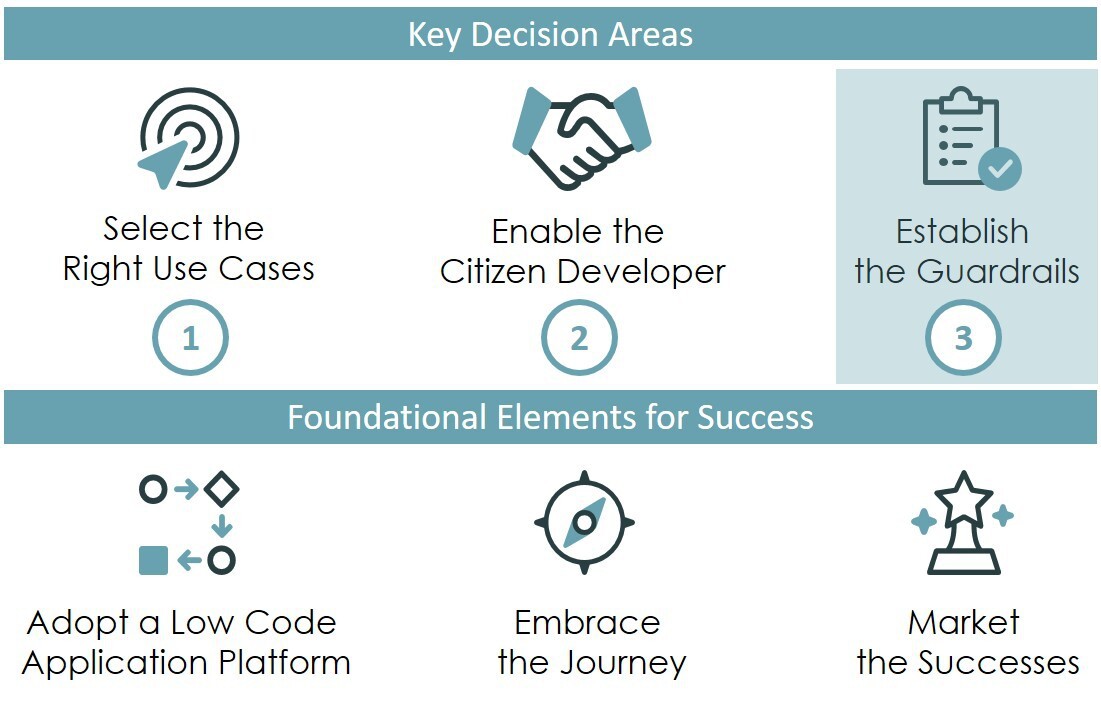
    Of course, there is a little more to it than this. Success requires focus, planning and patience. We previously discussed, in parts one and two of the series, the discipline required around use cases and citizen developers (CDs). This third and final post covers how to establish the appropriate technical and process guardrails to ensure the wider enterprise, platform and developers are protected.

    Establishing the Guardrails

    Guardrails exist for two primary purposes: alignment and independence. Clear and concise guardrails ensure alignment across organizational objectives, company policies and disparate teams. Those same guardrails provide CDs with a degree of independence – a safe operating space where they will not be micromanaged or unnecessarily burdened by processes.
    Effective guardrails define and enforce a range of acceptable behaviors, as well as reduce risk and speed application delivery.

    While low-code application platforms (LCAPs) each have their unique capabilities and technical implementations, relevant features can be viewed in three broad categories: platform foundation security, app dev access control and development tools & processes.

    Within the context of your specific LCAP and development methodology, you need to consider and answer the following questions:

    Platform Foundation Security

    • How will you provide your CDs a “safe” environment to build and test their applications? Does your platform support separate and secure development, test and production environments? Will you put your citizen developers in their own discrete development environment?
    • Will your developers be working with data that requires encryption and/or localization? If so, does your platform support data encryption and compliance with relevant data residency laws?
    • Does your LCAP support anti-virus scanning and/or HTML sanitization, and if not, how will you prevent a CD from inadvertently putting your organization at risk?
    • What logging and auditing is required for your CD activities? Who reviews logs? How long is the information kept?
    • Does your platform support enhanced security mechanisms like two-factor authentication (2FA) or virtual private networks (VPNs)? Will citizen developers be working in areas or with applications that require enhanced security?
    • Are there other risk, compliance and security standards that your organization mandates? If so, how will you incorporate them?

    App Dev Access Control

    • How will you provision or deprovision developer and tester accounts? How will you handle developer login and authentication into the development environment?
    • Will CDs have development access to downstream environments across testing, staging and production?
    • Will you use groups to control access to applications in development, and if so, who will manage these groups?
    • Will you use roles to grant access to distinct development capabilities like tables, workflows, UIs, mobile, reporting, analytics, etc.? What determines which role(s) a citizen developer is granted?
    • Will you provide a library of pre-built application components (e.g., workflows, dashboards, virtual agents, etc.)? How will you control access to and usage of the pre-built components?
    • Will you allow citizen developers to access pre-built integrations? How will you control access to and monitor usage of those pre-built integrations?
    • Does the developer identity and access management process need to be driven by an enterprise identity provider, such as Azure Active Directory?
    • Will citizen developed applications be able to access other citizen developed applications? How will app-to-app access be controlled?

    Development Tools and Processes

    • How will you manage your demand intake process? How will you ensure that new applications do not duplicate existing application functionality? What criteria will you use to determine if an application is a good fit for a citizen developer?
    • Will you require your CDs to adhere to all, some or none of your existing development methodology? Can you explain the methodology in terms the citizen developer will understand and accept?
    • Will you require CDs to create requirements or agile stories before building an application?
    • Will you require tests be developed for CDs’ applications, and if so, can these be automated? Who will develop those tests?
    • Will you require code or application reviews of citizen developed applications? What best practices and standards will be used during those reviews? Can those reviews be automated?
    • What level of documentation, if any, will you require developers to produce?
    • How will you promote applications through the development pipeline (i.e., dev to test to prod)? Can the app promotion process be automated?
    • How will you track and manage CDs’ applications through the development pipeline and their life cycle?

    Reflections on Citizen Development Programs

    The exercise of writing this series and your feedback has encouraged me to reflect on parts one (selecting the right use cases) and two (enabling citizen developers). Here are a few final thoughts to consider:

    • Do you care that a CD builds just one app or do you want them to build more?
      Ideally, a CD continues to deliver app after app. But attrition can be high in a CD program. Therefore, if your CD built a single application that delivers business value and then returned to their “day job,” you should still celebrate that success.
    • Is citizen development better suited for creating new apps or maintaining existing apps?
      In my view, the answer is both. LCAPs provide great opportunity for CDs to prototype or even produce an MVP of an application. At the same time, LCAPs allow professional developers to build more complex applications and turn the maintenance of those applications over to CDs.
    • How many LCAPs can you reasonably expect a citizen developer to understand?
      Realistically, perhaps one, or maybe two. Keep in mind that app development is important, but having CDs focus their technology choices on a single LCAP vastly improves their chances of success.
    • Do citizen developers make good professional developers?
      Consider this – some of the best developers I have worked with do not have computer science or software engineering degrees. It’s more important that a developer has a passion for technology and, more importantly, for understanding how technology solves business problems.
    • Finally, explore and embrace citizen development before your competitors do, as the value proposition is real in this new world of work we have found ourselves in. After 30 years in enterprise IT, I can confidently say we’ve reached an inflection point in technology and business, truly democratizing application development.

    This post is the third of a three-part series from Mark Tognetti that provides real-world insights on delivering business value from citizen development initiatives.

  • Citizen Development Program: Selecting the Right Use Cases

    Citizen Development Program: Selecting the Right Use Cases

    The COVID-19 pandemic forced us into new ways of working that demanded a truly digital enterprise. Digital enterprises require we deliver applications for our everyday tasks and processes with unprecedented speed. Our traditional development resources – our professional developers – and traditional, professional code development environments simply cannot meet the demands from our lines of business.

    Citizen development

    The rapid adoption of low-code application platforms and the ability to use more readily available “low-code developers” partially closes the demand-supply gap by improving app delivery velocity for IT organizations. But velocity is only half the battle. Because our app development teams (pro and/or low code) can be so focused on the application itself, they may not fully understand the larger context around that application, the business processes they are attempting to digitize or how to connect with the process owners to gain that understanding. We become faster at app delivery, but not necessarily more agile. True business agility comes when we push app development to the edge; out into our lines of business and into the hands of “citizen developers.”

    citizen development

    Now let’s all take a deep breath, pause for a moment, and accept that citizen development is not the panacea for all our digitization needs – nor is it the beginning of application anarchy. A well-executed citizen development program can dramatically improve delivery velocity and business agility if organizations make good decisions in three key areas: 1) selecting the right use cases for citizen development; 2) enabling and empowering our citizen developers; and, 3) establishing citizen development guardrails that protect our organization.

    Before exploring the key decisions, it is important to note a few elements that are consistent across successful citizen development programs:

    • Adopting a Low-Code Application Platform (LCAP) – LCAPs benefit IT developers (both professional and low-code) but are critical to citizen developers. Teaching Java to your lines of business is what’s called a distributed development model – and that’s a whole different article.
    • Embracing the Journey – A citizen development program is a learning process for both the IT organization and the lines of business. Start focused, learn from the experience, adjust the approach and expand the reach.
    • Marketing Success – It is important to raise awareness of the program by telling the company about both the successes and the lessons learned – be candid and clear. People feel good about successful programs and rally around them.

    Selecting the Right Use Cases for Citizen Development

    We want to set up citizen developers, and the citizen developer program, for success, which means matching the business need to the citizen developer skillset.
    We need answer the following questions regarding line of business needs.

    • What business use cases are a good fit for our LCAP?
    • What technical requirements are a good fit for our LCAP? What technical requirements are not?
    • What types of applications in our enterprise are a good fit for citizen development?
    • Are there lines of business / departments that could benefit more than others from empowering citizen developers?
    • Are there specific risk, compliance, security and legal (RSCL) mandates that need to be addressed?
    • Are there other core enterprise systems that need to be considered for certain use cases?
    • Are there legacy technologies and/or is there technical debt that should be targeted?
    • What is the potential return on investment? How quickly can we start achieving that ROI?

    The answers to these questions are not binary. These questions, and others unique to each company, provide a filter to vet – and possibly score – use cases to determine suitability for a citizen development program.

    Just as important as selecting the right use cases is finding the right citizen developers. We need to answer the following questions about any potential citizen developers.

    • Will we have different categories of distributed / citizen developers? Are those categories based on skill level, organization and/or access?
    • Have we identified the aptitude and attitude characteristics of a good citizen developer?
    • How will we recruit and incentivize developers to join the program?
    • What is our value proposition to the citizen developer’s manager? Why would they support allocating some portion of their resource(s) building apps?

    In the early stages of a citizen development program, the most successful programs tend to prioritize the right developer over the right use case. A “high fit” developer delivering a “medium value” use case is a better bet than a “low fit” developer attempting a “high value” use case. Early wins matter.

    In part two of this series, we will explore enabling and empowering our citizen developers. We have now identified the right use cases and the right citizen developers, so let’s set them up for success.


    This post is the first of a three-part series offering real-world insights on delivering business value from citizen development initiatives.

  • Low-Code To Become Commonplace in 2021

    Low-Code To Become Commonplace in 2021

    A new study finds 85% of engineer leads predict low-code and no-code will soon become common

    New findings from an Internal-endorsed study suggest 2020’s software development challenges will undoubtedly carry into 2021. Many businesses are making immediate transitions to a digital-only economy, forcing a ton of new app development requirements. Yet, hiring top engineering talent is especially difficult, amid a developer drought and pandemic uncertainties.

    One in three organizations has implemented a hiring freeze. Respondents also cited rising development challenges and insecure internal software, putting a strain on normal operations. To help address these challenges going forward, a whopping 85.1% believe implementing low-code and no-code will become more and more omnipresent within their company.

    Below, we dive into the report’s major findings, which surveyed 500 IT and engineering workers at medium-to-large enterprises. Using this data, we’ll forecast hurdles software development teams may face in 2021, and gauge if low-code tooling adoption is the ultimate panacea or no more than a Band-Aid for a much larger ongoing problem.

    Development Challenges Will Increase

    In the thick of the pandemic, software is often the only touchpoint many traditional companies have with a user. Naturally, the number of digital experiences required to meet this new reality is skyrocketing. Experts and data show this trend has no signs of stopping.

    In fact, 60.1% of surveyed saw app development increasing due to work-from-home policies. Only 9.7% reported a decrease in app development. One could easily attribute rising app development with growing software requirements brought on by the current digital-first climate.

    In this new economy, finding bold ways to increase productivity is critical. Improving the efficiency of engineering teams was a priority for most respondents and a high priority for 40% of respondents. For small groups with lean margins, improving automation for software delivery could help compete with larger players.

    Talent Will Become More Competitive

    The biggest challenge employers face is finding talent—30.6% of respondents cited increased competition for talent as a top challenge in 2020 and 22.2% also recognized developer drought as a significant obstacle. If you had trouble finding skilled software engineers in 2020, good luck next year …

    Looking to 2021, 45% see competition for talent remains a top challenge. Trailing problems include developer drought, immigration issues and a poor reaction to new work-from-home policies.

    Hiring Practices Will Continue to Shift

    With COVID–19 in full force and a developer scarcity, you’d think hiring would come to a freeze. Yet, the results of this study were mixed—hiring practices are pretty varied across teams.

    According to the report, 34.5% of organizations surveyed had paused hiring new engineers. Conversely, 37.3% have hired more engineers, and 18.5% of organizations reported no change to hiring practices at all. About 10% had layoffs.

    Whereas some tech companies are thriving in the new normal, others may pause hiring due to uncertainness around COVID-19. These companies could be turning to low-code technologies as a replacement. “If you pause hiring, you still need to build, and low-code is a great option for that,” said Arisa Amano, CEO of Internal.

    Low-Code Will Become Commonplace

    To address the above issues, companies are turning to low-code solutions. These platforms help relieve the development burden for internal business tools and open up citizen developer use. And, it’s more than a fad—the report was able to squarely demonstrate an uptick in low-code use.

    Most companies (75.2%) have already implemented a combination of low-code and traditional engineering methods. It appears that low-code is complementing existing software engineering practices at a number of institutions.

    In addition, 28.8% of respondents predict low-code and no-code will become a high priority in the coming months, and for 21.6%, it will become an essential focus. Impressively, 85.1% of developers foresee low-code and no-code as becoming more commonly implemented within their company.

    Low-Code Will Open Doors for Non-Tech

    The citizen developer concept has been gathering marketing steam, but it might not be just hype. Now, data suggests low-code tools are actually opening doors for such non-developers. Seventy percent of companies said non-developers in their company already build tools for internal business use, and nearly 80% predict to see more of this trend in 2021.

    It should be noted that low-code and no-code do not seek to replace all engineering talent; instead, to free them up to engage in more complex tasks. “With low-code, you free up your engineers to work on harder problems, instead of having them work on basic things,” said Arisa Amano, CEO of Internal. She believes this could translate into more innovation companywide.

    Surprisingly, bringing non-traditional engineers into the development fold is not being met with ambivalence—69.2% of respondents foresee that citizen developers positively affect engineering teams, with the rest primarily exhibiting a neutral reaction.

    Improved Access Control Will Boost Internal Security

    The costs of internal security threats are high. Breaches could decrease customer trust, harm brand reputation and lead to escalating legal fees. With cyberattacks a prevalent concern, cybersecurity must come back in style.

    Not only are threats external, but internal too—46.8% of respondents were extremely concerned about employees having access to customer data. The cause for concern is duly noted, as the majority, 58.1%, have experienced internal data security breaches in the past.

    The reasons for internal breaches vary across the board. Respondents attributed the top cause simply to a rise in the number of employees and contractors with access to sensitive information—a surge in employees means a greater chance of human error or leaked credentials. It also means an increase in the number of devices with access to sensitive data—this is particularly tricky, as CISOs face a dilemma on how to govern privileged access for housebound laptops and mobile devices.

    Respondents also noted the increasing complexity of technology and the overabundance of new cloud applications. It’s hard to expect DevOps to secure modern infrastructure when they’re still trying to figure out how it works! As a knowledge gap could quickly introduce vulnerabilities, 62.7% of respondents are actively investing in increased employee security training.

    Other security problems, such as a lack of granular access control or lack of logging and audit trails, seem like they could be mitigated with the right configurations and DevSecOps approach. In fact, 55.4% of respondents are in the process of baking in fine-grained access controls. “Having that at the forefront of internal tools is key,” said Bob Remeika, co-founder, Internal.

    Shifting security left could correct an age-old trend of adding security after the fact, which only prolongs the problem. On the whole, companies require a combination of better access enforcement, multi-factor auth and increased monitoring to mitigate mounting threats.

    Low-Code Becomes Mainstream in 2021

    Software development teams face many challenges in the coming year. Demands for new software will increase and processes to increase efficiency will fall under the microscope. Rising engineer competitiveness and developer drought will also continue to shift hiring practices.

    Companies that weren’t 100% digital will be forced to embrace the new norm and develop internal software and automation. Yet, building internal tools isn’t straightforward and will be especially difficult for companies less technical than their software-as-a-service counterparts. All this, paired with ongoing security threats, means internal app development in 2021 has its challenges.

    Although conditions look dicey, the underlying issues are not unusual, Remeika said. They have just been amplified. “There’s always been a developer drought, companies have always been trying to find ways to do more with less, and competition for talent is never getting less fierce,” he said.

    Though we’ve seen a spike since COVID-19, the desire to offload work has been everpresent. Remeika believes sophisticated low-code platforms will empower technical non-engineers and assist with things people typically tend to disregard when building internal applications, such as security, deployment, testing and review capabilities.

    Nevertheless, development team output appears to be resilient throughout work-from-home policies. And as I recently covered, a low-code movement could also enable a democratization effect, helping SMEs who can’t afford the top talent to still compete at the same table as large tech companies. We expect low-code and no-code adoption to spill well into 2021, seemingly, as a panacea to these mounting concerns.

  • The Future of Application Development

    The Future of Application Development

    What lies ahead for application development? Can we look forward to a less hierarchical system?

    The current state of application development has an often overlooked problem: It’s inaccessible.

    Top tier companies such as Google, Microsoft, Apple and Facebook are at a major advantage. With their large capital, they can invest in innovative development tools and round up extensive workforces of leading talent to use them—which matters, especially amid an ongoing developer drought. Meanwhile, companies lacking these privileges must make do with a leaner toolset and smaller, less cherry-picked workforce—which is not to say that they don’t make smart, creative use of what’s available to them, but that they deserve to play ball on a more equal playing field.

    Unfortunately, the pandemic compounded this issue, at times bringing even greater advantages to the tech giants. To overcome what some consider a trend of software elitism, efforts have been made to accelerate the pace of application architecture for all. Employing no-code and low-code tools, for example, could help the smaller guys compete. However, as Robson Grieve, CMO of enterprise software company OutSystems sees it, “these latest approaches are mostly point solutions solving a limited set of problems.”

    I recently invited Grieve to share more of his take on this issue and how he envisions a future of application development that works inclusively for a wider set of companies.

    Application Development: The Other 99%

    “It’s frustrating that the best, most advanced development tools have traditionally only been accessible to the largest, richest companies,” said Grieve. “Everyone else suffers with ballooning backlogs and struggles to take advantage of the latest, greatest technologies.”

    While it may sound like a platform out of a Bernie Sanders speech, recognizing the advantages of the top 1% in the application development world brings up a valid line of questioning as to whether maintaining this status quo is really how we want to go forward. After all, wouldn’t it be better if more companies had access to the best technologies? Wouldn’t we all benefit from that?

    Creating a More Equal Playing Field in Application Development

    Luckily, we are already feeling the winds change in this department, as top tier companies are beginning to lose their stronghold on the crème de la crème of development tools. What’s beginning to change, Grieve believes, is “access to the most sophisticated tools and advanced technologies are being democratized … sophisticated, feature-rich, beautiful, and mission-critical applications are no longer the sole domain of the elites.”

    How is this being realized? In many ways, it’s coming from the makers of the development tools themselves, who are bringing careful thought and creativity to tool design. Some of the strongest approaches in Grieve’s eyes include the following:

    • Holistic approaches that streamline the most critical innovations into single, integrated platforms.
    • Low-code approaches that help accelerate development while retaining the power and expressiveness of traditional code.
    • Platform approaches that offer design, development, deployment, monitoring and management capabilities in one place.
    • Multi-functional approaches that serve a diverse team, support the full DevOps life cycle and, in effect, improve productivity and collaboration. For example, platforms crafted to serve the unique needs of UI/UX experts, business analysts, professional developers and architects.
    • Automated approaches that allow applications to be continuously updated and seamlessly modified once they’ve been deployed, using an AI-powered automation layer that underpins the tool, managing application dependencies and providing self-healing capabilities to ensure that regardless of what changes are made, the tool never breaks.

    One thing that stands out here, according to Grieve, is the idea that broad, multi-functional development platforms reign supreme. As Grieve noted, “the most valuable tools are the ones that solve the broadest set of problems.” In general, approaches that keep in mind security, scalability, reliability and availability will be robust solutions for diverse teams, both large and small. A bonus is if the tool is visually appealing and model-driven for the best ease of usability and user experience.

    All for One, and One for All

    The issue of software elitism is one problem that can be seen as a clear opportunity, and that opportunity is not being missed among the smartest makers of development tools. As Grieve said, “Modern application platforms have the potential to help the vast majority of the economy succeed by offering a better approach—one that takes state-of-the-art technology and makes it more approachable, accessible and adaptable.”

    Again, we see a version of AI democracy at play. This is an exciting shift for many companies and teams that exist outside the elite tier. As an example, Grieve said that instead of “procedural code or minimalistic point solutions,” modern applications platforms “harness the power of advanced technologies and AI to create efficiencies for companies outside of the tech bubble.”

    This could be one way to level the playing field and allow companies of all sizes to complete the work needed, shrink backlogs, overcome developer drought with tools that are friendlier to citizen developers, support team collaboration, accelerate efficiency, and—for the underdogs—compete with the big dogs.

    Looking to the Horizon

    So, what does Grieve see for the future of application development? To him, it is bright if we continue on the current trajectory. “More and more,” he said, “successful development projects will require business and IT to work together and collaborate closely.”

    This means investing in sophisticated technologies, with powerful built-in AI, that can help companies ensure that even though applications are built quickly and efficiently, they are built securely and reliably—and in ways that can be easily scaled and evolved.

    If this is all to be realized, Grieve forecasts that we can look forward to “a bright future that is welcoming of a much more diverse and representative community of people who build applications together to solve all the most pressing problems.” It’s an optimistic view, but one that many will welcome as a fresh breath of air in what have been some particularly trying times.

  • Meet the Citizen Developer

    Meet the Citizen Developer

    Much has been written on the rise of citizen developers, but little about who they are and why they choose to do what they do

    The enterprise is always thirsty for new applications. More than ever, this thirst seems unquenchable. Consider a recent market analysis from Global Market Insights, which expects the enterprise application market to grow at a rate of 7.6 percent annually from 2016 through 2024. That’s a clip swift enough to more than double its 2015 $150 billion market size by 2024.

    The demand for enterprise applications—and especially for mobile apps—is so high that most enterprise IT departments can’t meet it and often have backlogs of months to more than a year.

    We’ve written extensively about how the citizen developer is now stepping up to fill this gap. Citizen developers are helping enterprises to not only close the application demand gap but also innovate more rapidly. However, we haven’t seen much regarding the nature of these citizen developers—who they are and what makes them decide to tackle app development independent of IT.

    Recently, Apple subsidiary FileMaker Inc. surveyed hundreds of citizen developers within organizations ranging from five employees to more than 1,000 employees. Those surveyed either created or were involved in the creation of custom apps, didn’t classify themselves as IT professionals and were not full-time custom app developers.

    As we’ve written before, we consider the rise of the citizen developer to be an extension of the consumerization of the IT trend, which began with endpoint devices, evolved to include many cloud services and now encompasses citizen development. Just as  users began choosing which tablets and smartphones they would use for work, many staff members now are choosing, independently, to shun old-fashioned spreadsheets and endpoint databases for higher-level, cloud-based platforms that make it possible to build applications with little to no coding.

    Why do citizen developers choose to develop work apps on their own? According to the FileMaker survey, it’s because a sizable majority—83 percent—wanted to create a better way to work, while 63 percent wanted to be more productive and 42 percent wanted to help others in their organization. Only 12 percent of citizen developers had been asked by their boss to start building apps. Currently, the citizen developer movement is self-directed and self-motivated—41 percent started developing business apps to improve their skill sets.

    So who are these citizen developers? Not surprisingly, the majority are savvy computer users with no formal background in computer science or software engineering, and 34 percent play a management or supervisory role in their organization. When respondents were asked what three words colleagues would choose to describe them, about half chose “problem solver.” Other descriptors such as “creative,” “hard-working,” “organized” and “leader” also ranked high.

    The citizen developers also reported that citizen development had a significantly positive impact on their career. Nearly half, at 48 percent, cited increased satisfaction at work, while 42 percent found that the practice increased their confidence, 29 percent received more recognition within the organization and had more time to work on efforts they enjoyed, and 26 percent felt increased motivation at work.

    Finally, because citizen developers can spot a business need and fill it quickly with an app, they are helping to fill the application demand gap in many enterprises. Eighty-two percent of citizen developers said they witnessed a reduction in inefficient tasks, 71 percent reported an increase in team productivity, and 60 percent said their apps helped to reduce data entry.

    They’re building these apps quickly, too—often building their first app in less than three months, according to 71 percent of respondents. Only 12 percent reported it taking three to six months to do so. That type of accelerated app delivery—when the idea is conceived, designed, and delivered by the users who needs the functionality—will not only help to clear app backlogs but also could become a cauldron of internal innovation.

    — George V. Hulme

  • Citizen Developer Movement Gains Steam

    Citizen Developer Movement Gains Steam

    It’s been about a year since we covered how the rise of the consumerization of IT had extended beyond cloud services and devices to application development and the advent of the Citizen Developer from rarity to mainstream. The momentum of citizen developers in the enterprise has only increased in the past year. And the move is proving to provide much needed faster time to market for enterprise apps.

    According to the “QuickBase annual State of Citizen Development Report,” a survey completed this summer of 153 North American enterprises that develop and use custom business applications, the need to rapidly develop new apps is one of the leading reasons why non-developers in business roles are rolling up their sleeves and developing some of the apps their companies need.

    As readers of devopsy.kinsta.cloud are aware, app backlogs are a big concern. Reportedly, many organizations have app backlogs that range from weeks to months to years. Rather than wait for an IT department that is struggling to meet—or even catch up with—app demand (largely fueled by the thirst for mobile apps), they are turning to low-code and no-code development platforms that enable anyone to develop without understanding a formal language.

    How do enterprises support citizen development? They do it mostly by providing employees a place to build apps in cloud-based, low-code platforms. Some of the highlights from the QuickBase report include:

    • Developing a custom application using traditional development methods requires more than two months on average for 67 percent and more than six months for 31 percent of application builders.
    • Citizen development platforms are seen as capable of developing 26 different custom applications for a variety of top use cases including asset management, project management, IT help desk, inventory management, contact management, workforce management, service management, compliance management, contract management and facilities management.
    • Organizations consider the top benefit of no-code citizen development to be the ability to maintain and update applications faster than the more than two months required by 35 percent of traditional developers.

    The acceleration of app development and the fact that citizen developers help to move app ideas from the bottom up in an organization are why many IT leaders say citizen development is a catalyst of the innovation enterprises need. As Michael Beckley, CTO of Appian relayed to associate Tony Bradley in his story, “Citizen Developers Can Benefit an Organization“: “The best-designed products have always been built with the needs of the user from the outset. Who better than citizen developers to design software that enables organizations to transform customer experiences, launch compelling new products and manage risk efficiently? Citizen developers are motivated by the opportunity to create a new reality, not merely accepting the workplace as they found it.

    “Citizen developers are most successful when supported by IT,” Beckley continued. “One critical area where IT can help is in promoting reuse and modularity in the applications and business processes that citizen developers build.”

    That’s the key to success, going forward, in my view: The organizations that succeed with citizen development will be those that wholeheartedly embrace the movement and cultivate it, with IT’s help and guidance.

    In the QuickBase survey, among the broad population of app developers surveyed, the majority reported being able to deliver their apps in less than a month. Compare that to traditional IT developers alone, 67 percent of whom reported it takes more than two months to build an app and 31 percent reported more than six months. This is probably why 80 percent of respondents said that development speed was one of the top reasons for embracing citizen developers: The QuickBase survey found that 42 percent of their users are able to build apps at twice the speed of traditional development.

    With results like that, it’s just a matter of time before every large organization embraces citizen developers to clear app backlogs and innovate more rapidly.

    — George V. Hulme