Tag: Cisco Systems

  • Cisco Adds Open Source Tool to Validate Serverless Functions

    Cisco Adds Open Source Tool to Validate Serverless Functions

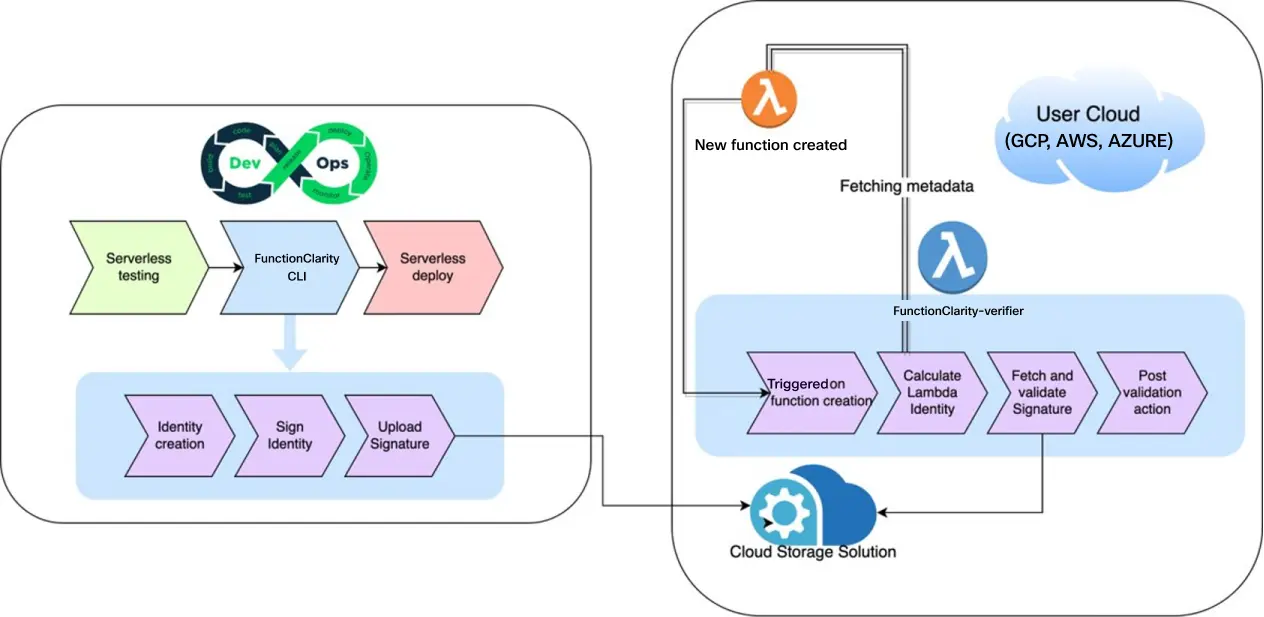
    Cisco has launched an open source project, dubbed FunctionClarity, that makes it possible to verify signatures before code is deployed in a serverless computing environment.

    Vijoy Pandey, vice president of emerging technologies and incubation at Cisco, said that one of the application security issues that has emerged in serverless computing environments is the lack of validation capability to verify code signatures prior to deployment. As more organizations employ serverless computing frameworks, the overall software supply chain becomes less secure, he noted.

    FunctionClarity includes a command line interface (CLI) tool to invoke a verification function that can be deployed on the Amazon Lambda serverless platform to address that issue; support for Microsoft Azure and Google Cloud serverless platforms is planned, he added.

    The FunctionClarity project aims to close that gap by employing either a keyless approach using open source sigstore tools or a traditional encryption key, noted Pandey.

    The FunctionClarity project is the latest extension of a Cisco OpenClarity initiative that includes an existing project for securing application programming interfaces (APIs) using a service mesh, dubbed APIClarity, and a tool for detecting and managing software bills of materials (SBOMs) and vulnerabilities in container images and filesystems dubbed KubeClarity. All three projects are part of an ongoing Cisco effort to contribute code to the open source community that, while essential, does not provide a lot of differentiated value for any one vendor, said Pandey.
    The FunctionClarity project arrives at a time when concerns over the security of software supply chains is on the rise. Many of the software security issues that organizations are encountering stem from the simple fact that developers can provision cloud infrastructure without any kind of meaningful cybersecurity review. Code signing, within the context of a larger set of DevSecOps workflows, is now starting to gain traction to better ensure secure software supply chains. The challenge is that as more code winds up running on serverless computing platforms, a need to extend the reach of whatever approach to code signing an organization adopts becomes more evident.

    In general, the open source community is collectively trying to respond to an executive order issued by the Biden administration that required federal agencies to implement a series of steps to better secure their software supply chains. One of those measures includes wider adoption of code signatures to ensure the authenticity of code being incorporated into applications. The challenge is that incorporating code signatures into DevOps workflows has historically not been a trivial process to implement. Most recently, a free sigstore cloud service launched that promised to make it easier to achieve that goal.

    It’s not clear how widely or even how rapidly code signing will be adopted, but enterprise IT organizations are paying close attention to how federal agencies are responding to the executive order. Many of the tools and processes defined by those agencies will inevitably be copied by enterprise IT organizations that have thus far made limited use of code signing to verify the authenticity of software components. The challenge now is finding a way to achieve that goal without slowing down the rate at which modern software is developed.

  • AppDynamics Partners With Cisco to Secure Application Runtimes

    AppDynamics Partners With Cisco to Secure Application Runtimes

    AppDynamics today announced its agent software, which it provides as part of its observability platform, now has the ability to enforce application security policies.

    Developed in collaboration with the security business unit of parent company Cisco, the Cisco Secure Application offering, available from AppDynamics, can detect attacks, identify deviations in application behavior and block attacks automatically.

    Gregg Ostrowski, a regional CTO for AppDynamics, said the goal is to make it simpler for IT teams that employ AppDynamics for monitoring and observing their IT environments to also embrace DevSecOps best practices. In effect, IT teams can now piggyback security for application runtimes on their existing investment in AppDynamics, Ostrowski said.

    The AppDynamics approach provides the added benefit of easy integration with the Cisco security tools to improve collaboration between DevOps and cybersecurity teams, Ostrowski said. Security details correlated with the application topology make it easier to share context in a way that identifies the actual business relevance of any security event, he added.

    As organizations accelerate digital business transformation initiatives, Ostrowski said the need to embrace DevSecOps best practices is becoming more urgent. The level of risk attached to these types of projects is significantly higher than with previous generations of applications, Ostrowski said.

    While most organizations appreciate the need for greater application security, there’s a debate about how best to achieve that goal. There’s general agreement that developers need to be more involved. However, shifting responsibility for application security to the proverbial left often comes at the expense of developer productivity. AppDynamics is making a case for enabling IT teams, that may already rely on its application performance management (APM) platform, to enforce policies defined by the cybersecurity team.

    Of course, there’s still a need to provide developers with the tools required to write more secure code in the first place. The debate is over how involved in the cybersecurity management process developers need to be after applications are deployed in a production environment.

    Arguably, the goal should be to enable both teams to accomplish their respective tasks in a way that doesn’t require a constant stream of meetings and updates. In the event a vulnerability is discovered, it’s critical for security teams to determine the threat level that vulnerability represents. Otherwise, remediation of that vulnerability will be just one more item in a long list of patches that developers are already working on.

    Regardless of approach, there are now myriad ways to improve overall application security. In effect, the same defense-in-depth approach that IT organizations have relied on to secure network perimeters can now be applied to application security as applications are both constructed and deployed. The most significant challenge is not so much finding the tools required to improve application security, as defining the processes through which best practices can be consistently applied.

  • OpsRamp Extends AIOps Reach to the Network

    OpsRamp Extends AIOps Reach to the Network

    OpsRamp today announced its AI-enabled IT operations management (AIOps) platform now has the ability to analyze network flows and communications traffic.

    Ciaran Byrne, vice president of product management for OpsRamp, said the new analytics capabilities will make it possible for IT teams to correlate the IT events OpsRamp already tracks on servers and storage systems against multiple types of traffic moving across a corporate network.

    OpsRamp is based on a software-as-a-service (SaaS) platform that simplifies IT adoption of AIOps without having to build and maintain their own management platform or install an AIOps platform on their own infrastructure.

    Rather than acquiring a separate platform to analyze network traffic, OpsRamp is adding an OpsRamp NetFlow monitoring module, for analyzing packets using the NetFlow protocol developed by Cisco, and an OpsRamp Unified Communications monitoring module, for analyzing voice and collaboration data.

    OpsRamp NetFlow provides real-time diagnosis of network latency across wide area networks (WANs). It generates alerts based on network traffic utilization, and delivers insights into network utilization patterns by identifying source, destination, protocols and applications that impact services.

    OpsRamp Unified Communications works in a similar way, surfacing alerts and insights about traffic patterns impacting, for example, Zoom or Microsoft Teams.

    With more employees working remotely, the need to analyze network traffic has become more acute, said Byrne. Network performance degradations can have a major impact on overall application experience, Byrne said.

    Communications and collaboration platforms like Microsoft Teams pose particularly stubborn challenges, because they offer IT teams little to no visibility into that traffic, Byrne said.

    It’s unclear whether – and to what degree – networking and other IT operations will converge, but as AIOps platforms become more accessible, the ability to correlate IT events across multiple infrastructure classes as they transpire will steadily improve. While that may not lead to IT role consolidation anytime soon, it should enhance the level of collaboration teams can achieve.

    In the meantime, AI is poised to have a profound impact on how IT environments are managed. The amount of time spent in “war rooms” performing root cause analysis can be sharply reduced through the use of machine learning. As algorithms surface insights, IT teams will be better able to proactively address issues before they have a major impact on application performance and user experience. It may take time for IT teams to fully trust AIOps platforms, but in the near future, IT professionals will avoid working for organizations that don’t have such platforms in place. For IT professionals, keeping complex application environments running without AIOps platforms will be nearly impossible.

    Of course, transitioning to any type of new IT management platform is no small undertaking. However, as AIOps platforms continue to evolve, the overall cost of managing IT should also decline as leadership justifies the costs of these tools.

  • Cisco Moves ACI Strategy Forward

    Cisco Moves ACI Strategy Forward

    Cisco is advancing its hybrid cloud computing strategy with release of version 5.0 of Cisco Application Centric Infrastructure (ACI), a software-defined networking (SDN) that can be deployed on cloud platforms or networking equipment deployed in an on-premises IT environment.

    The latest version of Cisco ACI adds support for a transit gateway between virtual private cloud (VPC) instances on the Amazon Web Services (AWS) cloud to provide a more efficient means of routing traffic across east-west and north-south cloud computing environments.

    Cisco is also extending the networking services it provides for the Microsoft Azure cloud to include VNET peering within the Azure Virtual Network, shared service deployments, additional service automation functions.

    Via ACI 5.0, IT teams are now provided a centralized view of cloud resource inventory within AWS and Microsoft Azure along with status indicators and a set of wizards to simplify configurations.

    Cisco also has deepened the level of integration between Cisco ACI and Kubernetes as well, to increase the level of scale that can be achieved in IT environments based on platforms such as VMware vSphere.

    Finally, Cisco has added support for role-based access control (RBAC) in multi-tenancy environments along with two-factor authentication (TFA) capabilities enabled by the Cisco DUO platform. Cisco also added a more flexible policy construct, dubbed Endpoint Security Group (ESG), that can be employed to group endpoints based on L3 attributes and apply contracts between ESGs.

    Srinivas Kotamraju, senior director for product management for Cisco ACI, said the latest update to the SDN platform provides IT teams with the equivalent of many of the same networking services that Cisco historically has provided in an on-premises IT environment.

    Cisco has been making the case for a hybrid cloud computing approach to delivering network services that enables IT teams to manage those services via a central console. Rather than having to manage networking services provided by each cloud service provider, Cisco ACI makes it possible to deploy the same SDN across multiple clouds and on-premises IT environments. Cisco contends that approach ultimately serves to reduce the total cost of delivering networking services by both centralizing management and making it easier to automate the management of networking services across multiple IT environments.

    There are two primary ways Cisco exposes those networking services. DevOps teams can take advantage of application programming interfaces (APIs) to programmatically invoke ACI services. Alternatively, Cisco provides network managers access to a graphical user interface (GUI) through which they can access a command-line interface (CLI) to configure a specific router or switch.

    Kotamraju said with the rise of DevOps the number of organizations giving developer programmatic control over networking services continues to rise. It’s too early to say to what degree NetOps and DevOps teams might ultimately converge; however, Kotamraju said finding ways to meld those two groups is being discussed more frequently within many IT organizations as applications become more distributed.

    Of course, the biggest challenge when it comes to achieving that goal will be more cultural than technical. However, as networking services become more accessible via APIs, it’s now more a question of when and how than if.

  • Survey: Rapid Automation of IT Ops Looms Ahead

    Survey: Rapid Automation of IT Ops Looms Ahead

    The rate at which IT operations will become automated is about to accelerate significantly over the next two years. A global survey of 1,500 senior IT leaders conducted by Cisco Systems finds that 64 percent of respondents today would describe their approach to IT operations as either reactive (26 percent) or proactive (38 percent), but within two years more than two-thirds expect their approach to be either become predictive (33 percent) or preemptive (33 percent). Only 14 percent of respondents describe their IT environments as being preemptive today.

    In general, the survey finds 88 percent of IT leaders said their investment in IT operations over the past 12 months had improved external customer satisfaction, while 89 percent said there have been improvements in innovation. But only 26 percent collect data on an ongoing basis and even fewer (17 percent) employ any kind of real-time automated analysis, the survey finds.

    Nevertheless, 42 percent of respondents said they expect artificial intelligence (AI) to have the biggest impact on their ability to automate. More than half (51 percent) said they already rely on AI to some extent today to automate IT operations.

    A full 82 percent also already collect operational and performance data about their security infrastructure.

    Joseph Bradley, global vice president for IoT, Blockchain, AI and Incubation Business at Cisco, said much of the investment in automating IT operations is being driven by the realization that IT has become a profit center rather than cost center. As organizations increasingly realize they are a software company that happens to make something, they are looking to maximize the return on their investments in IT wherever possible, said Bradley, adding as a result, line of business (LOB) executives are exercising more influence over what applications get built and deployed within the context of an overall digital business transformation strategy.

    Naturally, all that increased appreciation for the value of IT is putting more pressure on IT organizations to modernize their processes. As the number of applications that need to be built, deployed and maintained continue to increase, the need to embrace DevOps processes becomes a greater imperative. To facilitate that shift across enterprise IT environments that now routinely span multiple clouds, Cisco has been making a two-fold case for centralizing the management of highly distributed IT environments and upgrading to next-generation software-defined infrastructure that makes use of machine learning algorithms to automate IT management.

    Cisco is not the only IT vendor pursuing a similar strategy. The success of those strategies, however, depends as much on the ability of the IT organization to implement the processes required to modernize their IT environments as much as it does the technology platforms. That creates something of a chicken-and-egg relationship between processes and platforms. It is difficult, but not impossible, to implement some level of DevOps without having a lot of automation. But applying DevOps at any meaningful scale within an enterprise undoubtedly will require a lot more automation than currently exists within most IT environments.

    — Mike Vizard

  • Cisco Looks to Bridge Gap Between Networking and DevOps

    Cisco Looks to Bridge Gap Between Networking and DevOps

    Networking in the enterprise has always stood apart. It might take two minutes or less to spin up a virtual machine, but it can take two weeks to set up the network connections. To help bridge some of the gaps between networking and the rest of the DevOps team, Cisco Systems this week unveiled a series of intelligent switches that promise to do just that.

    Via a Cisco intent-driven networking initiative, it soon will be possible to describe a business outcome that will be automatically enabled at the networking level, says Kiran Ghodgaonkar, senior marketing manager for Cisco. To achieve that goal, Cisco is moving to unify networking on an end-to-end basis, which Ghodgaonkar says primarily will require building a common controller that can be implemented at both the edge of the network and in the data center.

    The first concrete step in achieving that goal is a set of Catalyst 9000 switches running an IOS XE operating system, which Cisco has imbued with machine learning algorithms. Over time, those algorithms will be deployed across both legacy networking infrastructures when appropriate, as well as any new networking and security equipment Cisco brings to market in the future. Once in place, IOS XE will make it easier to implement policies in software that spans everything from prioritizing traffic to implementing security polices.

    This latest Cisco initiative follows the rollout a Tetration analytics platform based on an instance of Apache Spark and Cisco’s acquisition of AppDynamics, provider of an application performance management service delivered via the cloud. Ghodgaonkar says Cisco is aiming to combine analytics and machine learning algorithms to simplify network management in a way that furthers DevOps integration. Right now, however, the biggest impedance to achieving that goal, says Ghodgaonkar, is the fact that 80 percent to 90 percent of networking tasks still require manual intervention. Because of that issue alone, many organizations have experienced limited success in terms of integrating server, storage and networking management, despite the rise of software-defined networking (SDN) in the data center. In fact, to get past that issue, many organizations make investments in pre-integrated systems such as the Cisco Unified Computing System (UCS) platform. But the number of organizations willing to make that kind in forklift investment in IT infrastructure is not all that high when compared to the size of the overall IT market.

    The biggest DevOps issue IT organizations now face, says Ghodgaonkar, is that as various elements of the IT organization invest in automation, silos of automation are created. Cisco says it has developed open application programming interfaces (API) will provide interoperability between its technologies and the rest of the IT environment to help break down those silos.

    It’s still a little unclear these days just how much networking and IT operations can get automated. The good news is that, given the state of network management inside most organizations, things can only improve. The real issue (as any existing DevOps team already knows) may not be so much the technology as it is the culture differences spanning the compute, storage and networking teams.

    — Mike Vizard

  • AppDynamics Buy Expands Cisco’s DevOps Agenda

    AppDynamics Buy Expands Cisco’s DevOps Agenda

    AppDynamics’ $3.7 billion acquisition by Cisco Systems has two major implications for the DevOps space. On a tactical level, Cisco has committed to distributing AppDynamics’ agent software everywhere from the public cloud to individual devices connected to the Internet of Things (IoT) and in between. On a more strategic level, the company is positioning itself to be able to uniquely correlate IT operations data generated by applications and IT infrastructure to give organizations comprehensive visibility into their entire DevOps environments.

    During a briefing with analysts and the media this week, Rowan Trollope, senior vice president and general manager of Cisco’s IoT and Applications Business Group, described how his company sees AppDynamics as a linchpin acquisition that propels the company well beyond its well-established networking and server infrastructure base. After the merger is completed, expected sometime in the third quarter, AppDynamics will continue to operate as an independent business unit within the IoT and Applications group, and current AppDynamics CEO David Wadhani will report to Trollope.

    Trollope described AppDynamics as a complement to Cisco’s ongoing efforts to drive more recurring revenue. The company, which offers an application monitoring service delivered via the cloud, was poised to shortly go public prior to being scooped up by Cisco. AppDynamics is employed mainly by IT organizations to monitor applications running on public clouds. But Wadhani noted one of the fastest-growing segments of AppDynamics’ business is monitoring applications running in private clouds.

    The data AppDynamics gathers in those environments can be correlated against, for example, the data Cisco collects via its Tetration analytics application, which the company launched last year. That capability, Trollope said, will significantly increase the total Cisco value proposition.

    In fact, as hybrid cloud computing scenarios based on microservices and containers become more common, Wadhani noted that monitoring of complex applications running in production across multiple clouds will become a more crucial requirement. AppDynamics recently extended its monitoring service to include support for containers deployed in these environments.

    Under the leadership of CEO Chuck Robbins, extending Cisco’s reach across the enterprise has become a high priority. Cisco recently abandoned a cloud interoperability service strategy. But its acquisition of AppDynamics suggests the company is shifting its focus to higher-margin software that generates recurring revenues across multi-year contracts.

    Following the acquisition, Trollope said Cisco also plans to take advantage of its existing relationships with senior business and IT leaders to advance a vision of DevOps that provides organizations with visibility all the way down to how each customer engages with their IT resources. The issue Cisco needs to navigate is the degree to which those senior executives actually exercise control over DevOps. To date, DevOps has been more of initiative led by developers and IT operations staff than mandates from senior executives.

    Wadhani said Cisco’s direct and indirect sales staff should significantly expand the number of organizations that are exposed to AppDynamics services. That means one way or another, DevOps is about to become a much broader discussion across the enterprise.

    — Mike Vizard