Tag: circleCI

  • CircleCI Acquires Ponicode to Gain AI Testing Tool

    CircleCI Acquires Ponicode to Gain AI Testing Tool

    CircleCI today revealed it has acquired Ponicode to gain control over a unit testing platform infused with artificial intelligence (AI) that makes it simpler to review application code prior to uploading it into a build. Financial terms of the deal were not disclosed.

    Jean-Philippe (JP) Leblanc, senior vice president of engineering at CircleCI, said the goal is to integrate Ponicode’s testing technology within CircleCI’s continuous integration/continuous delivery (CI/CD) platform. That approach will make it possible to apply algorithms to individual developers’ code as well as to code aggregated from multiple developers within a build as it is continuously updated across a DevOps workflow, he added.

    Ponicode was initially launched in June 2020 as a JavaScript unit testing extension for Microsoft VS Code. Since then, the company has started to support TypeScript, Java and Python, including complex functions such as variable mocking and infer suggestions of complex structures for nested objects.

    The issue that DevOps teams frequently encounter is that even when individual developers test their code prior to uploading into a build, integrating different developers’ code can still result in an application failure. The Ponicode AI testing tools will give both developers and IT operations teams more confidence in the quality of the code being employed to drive applications, noted Leblanc.

    Although not many developers want to admit it, Leblanc noted there is still a lot of sloppy code finding its way into applications.

    In addition, Leblanc said the Ponicode acquisition will help the code review process become more efficient. Instead of requiring another developer or dedicated tester to review code, he said most issues will be surfaced by the AI testing tool that provides the equivalent of a built-in peer review. As a result, AI testing tools will improve the overall quality of the code being used to drive applications, added Leblanc. Developers will also be able to spend more time on the business logic that drives their application than on code reviews.

    The goal, however, is not to eliminate the need for dedicated testing teams as much as it is to augment them and the developers they work with, said Leblanc.

    It’s not clear to what degree responsibility for testing code is shifting left toward developers. However, many developers would prefer to have issues surfaced via an AI tool so they could address issues on their own rather than having them discovered by someone else. In fact, there are already more than 20,000 users of the Ponicode AI tool that plugs directly into developers’ integrated development environment (IDE), said Leblanc.

    In general, there’s never been a greater focus on developer productivity. Organizations are attempting to simultaneously build and deploy more applications than ever—thanks mainly to digital business transformation initiatives launched in the wake of the COVID-19 pandemic. The challenge they face is recruiting and retaining developers. As a result, organizations are looking for ways to increase developer efficiency by eliminating as many manual processes as possible.

  • CircleCI Adds CI/CD Service for macOS Development

    CircleCI Adds CI/CD Service for macOS Development

    CircleCI today added a dedicated continuous integration/continuous delivery (CI/CD) edition of its namesake platform for developers building applications on the macOS platform.

    Jim Rose, CircleCI CEO, said this offering is aimed at developers that either want dedicated resources to speed up their build processes or have to address compliance and security requirements that prevent them from using shared infrastructure via the existing CircleCI cloud service.

    Most of the developers building applications on macOS platforms are creating applications that will ultimately be deployed on Apple iOS devices, noted Rose. Given the popularity of those devices, the number of organizations using CI/CD platforms to accelerate creation and updates of those applications has increased, Rose added. CircleCI estimated there are now more than 30 million developers building applications on the macOS platform that would benefit from a CI/CD platform running on dedicated bare-metal infrastructure accessed via the Amazon Web Services (AWS) cloud. CircleCI’s dedicated host provides secure access to 50% more cores and more than twice the storage capacity than is available via a CI/CD platform running on top of virtual machines.

    Other capabilities provided by CircleCI include the ability to monitor the performance of apps being developed for multiple platforms in the same pipeline. Many applications deployed on iOS are also deployed on other platforms such as Android, Windows or Linux, noted Rose.

    CircleCI also provides access to testing tools that the company recently added to its portfolio of DevOps tools. Those testing tools are especially critical given the stringent requirements developers face when trying to get approval to make their iOS applications available via the Apple Store, said Rose.

    Developer productivity is, of course, a major issue for organizations trying to strike a balance between automating software development tasks and the art that goes into building applications. While developers appreciate automation, they don’t necessarily want to feel they are working in a factory. Given the demand for their expertise, many developers will simply jump ship when they feel software development processes have become overly onerous. While many managers tend to believe they have a handle on measuring developer productivity, there is often too much focus on, for example, how many lines of code are written versus the business outcomes achieved.

    A recent CircleCI survey also found that more than half (52%) of respondents don’t allow their software developers to choose their own tools. While there is a clear need for a consistent approach to building and deploying applications, organizations will find it challenging to attract and retain the best developers if they don’t allow them to experiment with different tools.

    One way or another, however, the rate at which developers can build and deploy applications is rising as DevOps best practices are adopted. It’s not clear that organizations are going to be able to absorb all that software but, in the wake of the COVID-19 pandemic, the appetite for mobile applications that drive digital business transformation initiatives has never been greater.

  • CircleCI Adds Free Unlimited Access Tier to CI/CD Service

    CircleCI Adds Free Unlimited Access Tier to CI/CD Service

    CircleCI has added a free unlimited access tier to its continuous integration/continuous delivery (CI/CD) platform.

    Jim Rose, CircleCI CEO, said in contrast to other ‘freemium’ offerings, CircleCI’s free tier provides developers and DevOps teams with frictionless access to all the premium capabilities of the platform. Those capabilities include up to 6,000 build minutes per month, unlimited users, the ability to fine-tune pipelines using caching, concurrency, test splitting, security tools and health metrics.

    CircleCI claims more than 200,000 teams now employ its CI/CD platform. The freemium tier is intended to make it easier for a DevOps team to take advantage of a CI/CD platform as they begin an application development project, noted Rose. As that project evolves and matures, many of those teams will eventually require commercial support and other services provided by CircleCI, he added.

    The free tier of the CircleCI cloud service comes as many organizations attempt to accelerate the rate at which they can build and deploy applications. Digital business transformation initiatives, in particular, have become a much higher priority in the wake of the COVID-19 pandemic. A free tier of a CI/CD service is likely to encourage more experimentation simply because it reduces the level of overhead associated with setting up an application development environment.

    As the number of applications being developed continues to steadily increase, competition among CI/CD platform providers is becoming more intense as the number of organizations adopting DevOps best practices to accelerate application development increases. At the same time, more DevOps teams than ever are relying on cloud services to host CI/CD platforms in the wake of the COVID-19 pandemic.

    It’s still not clear whether DevOps teams will opt to rely on a proprietary platform versus an open source platform. While an open source platform prevents organizations from vendor lock-in, the ease of use of a cloud service may lessen those concerns as the cost of switching from one cloud service to another declines.

    One way or another, usage of CI/CD platforms will increase sharply in 2022. It’s not uncommon for different DevOps teams within the same organization to employ different CI/CD platforms despite efforts to encourage standardization. In the name of productivity, DevOps teams tend to exercise a fair amount of autonomy within many organizations.

    The biggest challenge, of course, will not necessarily be building applications but deploying them. Despite the availability of CI/CD platforms, the processes that most organizations rely on to deploy an application are still largely manual. In the age of the cloud, however, it should become easier to automate application delivery thanks to the APIs cloud service providers expose. In fact, 2022 may be the year that DevOps teams finally master CD. Providers of CI/CD platforms, of course, have a vested interest in making sure the full promise of an integrated CI/CD platform finally becomes an everyday DevOps reality.

  • CircleCI Adds Test Insights Module to CI/CD Platform

    CircleCI Adds Test Insights Module to CI/CD Platform

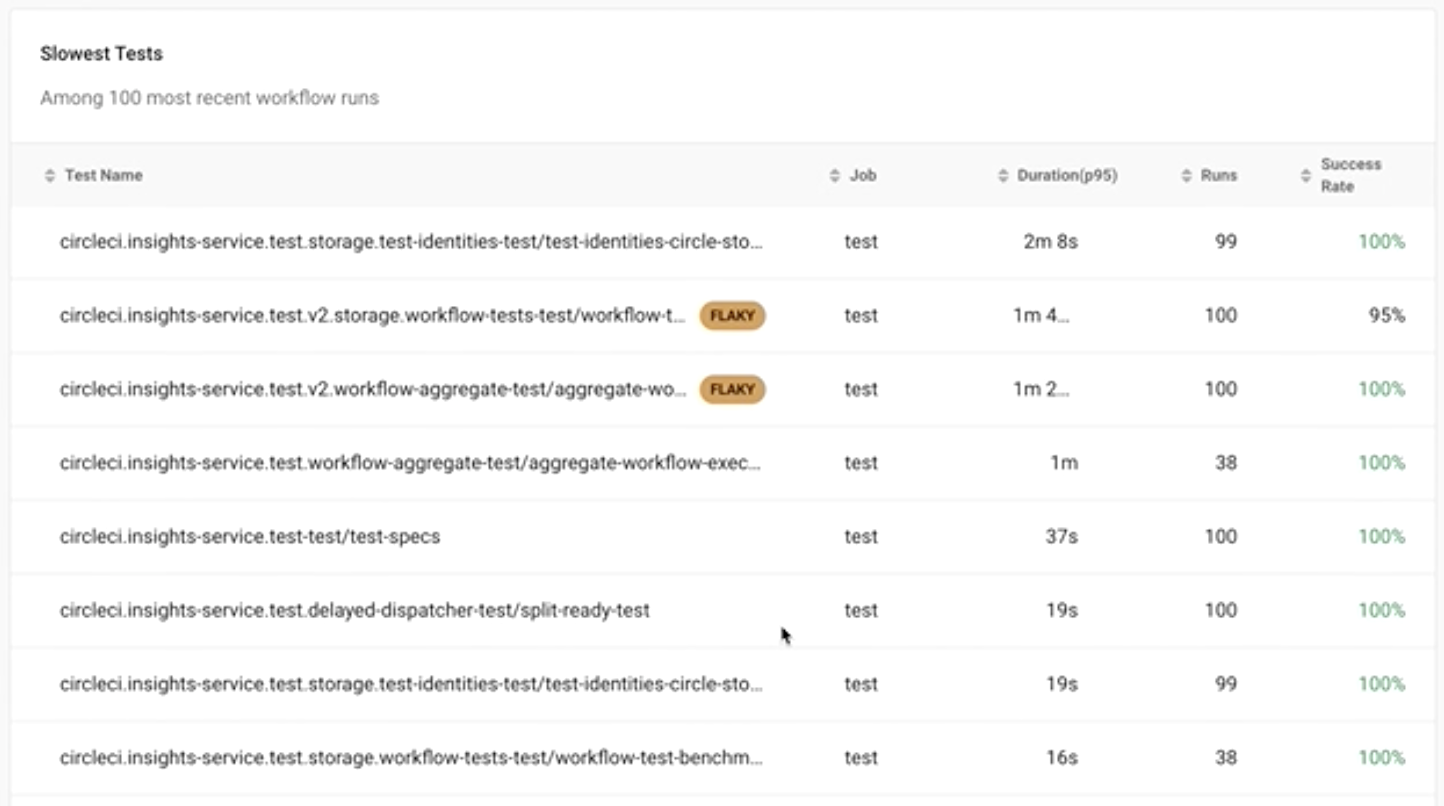
    CircleCI today announced it has added a Test Insights capability to its continuous integration/continuous delivery (CI/CD) platform to make it easier to identify tests that are either taking too long to run or simply exhibiting some form of anomalous behavior.

    Dawit Gebregziabher, product manager for data insights at CircleCI, said Test Insights is designed to make it simpler for IT organizations to shift more responsibility for testing further left toward DevOps teams that identify issues as applications are being built on the CircleCI platform.

    Each organization will still need to determine what tools to employ to create a test, but once it starts running, the Test Insights module will be able to surface the tests that, for one reason or another, are problematic to execute, he added.

    Test Insights, for example, will flag flaky tests and identify the longest-running and most failed tests. It will also enable DevOps teams to identify performance changes over time to pinpoint changes in application behavior.

    Finally, DevOps teams can track benchmarks at the organization, workflow and job level, as well as metrics for mean-time-to-recovery, throughput and durations for 24-hour, 7-day and 30-day windows of time.

    The challenge DevOps teams often encounter is a test may be run even when it’s apparent the application will fail. Test Insights makes it feasible for DevOps teams to manage the testing process much more efficiently, said Gebregziabher.

    It’s not quite clear how far testing is shifting left. There’s no doubt more developers are testing their code before it is loaded into a production environment to hopefully avoid issues that will only become more expensive to fix later. Other organizations have dedicated software engineers to create testing processes that are tightly integrated with CI/CD pipelines, noted Gebregziabher.

    However, many large enterprise organizations continue to also hire and retain dedicated application testing teams that are trained to identify issues that might either adversely affect the end-user experience or run afoul of compliance requirements.

    Regardless of who does what kind of testing, however, it’s clear there’s a lot more focus on addressing issues earlier when they are much less expensive to fix. The goal should be to make it easier to optimize when tests should run based on probabilities that ultimately reduce the time wasted running tests that either will fail or are, for one reason or another, flawed.

    Developers, of course, are all equally committed to running tests, so organizations will need to determine for themselves how far to shift that process left. However, at the very least, DevOps teams should be able to identify patterns that might indicate there is a need for additional developer training. After all, it’s unlikely a developer is going to understand there’s an issue until some meaningful metrics are shared.

    In the meantime, the more testing that occurs at a faster rate the more likely it becomes that an organization can provide a superior application experience the first time—and every time—an application is built and deployed.

  • CircleCI Bets on Webhooks to Streamline DevOps Integrations

    CircleCI Bets on Webhooks to Streamline DevOps Integrations

    CircleCI today announced CircleCI webhooks, a feature that enables software engineering teams to build integrations that react to CircleCI job and workflow status notifications in near-real-time.

    Tom Trahan, vice president of business development at CircleCI, said this latest iteration of the company’s implementation of webhooks, which send messages any time an event occurs, will become the foundation upon which CircleCI will expand the ecosystem surrounding its continuous integration/continuous delivery (CI/CD) platform.

    For example, the CircleCI platform can now employ webhooks to integrate with a CI visibility tool from Datadog that can now be used to surface CicleCI metrics. Sumo Logic is similarly employing webhooks to enable its Continuous Intelligence observability platform to track events on the CircleCI platform. Those capabilities are now available via the software-as-a-service (SaaS) edition of the CircleCI platform.

    Trahan said the primary goal is to reduce the amount of friction within DevOps workflows that span multiple platforms by increasing the level of orchestration DevOps teams can take advantage of without having to create and maintain integrations using low-level application programming interfaces (APIs).

    Webhooks make it possible to streamline developer workflows while also increasing overall engineering velocity, he added. In addition, it should also become simpler for DevOps teams to triangulate events in a way that results in incidents being resolved faster, noted Trahan.

    CircleCI is relying on webhooks to strengthen its case for a best-of-breed approach to DevOps that enables organizations to mix and match tools as they best see fit rather than getting locked into a single integrated DevOps platform. The best-of-breed approach often makes it simpler to take advantage of new tools as they become available. The downside is the level of integration that DevOps teams need to maintain after they integrate all the tools that make up a DevOps workflow.

    It’s not clear what impact relying on webhooks to share messages in real-time about events as they occur across multiple platforms will have on integrations. However, any effort to streamline DevOps environments without requiring DevOps teams to abandon one tool for another is likely to be well-received. After all, every minute spent managing a DevOps platform means much less time that can be applied to building and deploying applications.

    It will be up to each DevOps team to decide to what degree a best-of-breed approach to DevOps suits their organization. As more organizations realize how dependent they have become on software to, for example, drive digital business transformation initiatives, many IT leaders are making a case to standardize DevOps platforms across their organization. Achieving that goal, however, may be difficult given all the various departments within an enterprise that have already adopted a wide range of tools and platforms.

    In the meantime, the focus on developer and engineering productivity will only increase as organizations look for ways to further accelerate application development and deployment at a time when software updates can now have a profound impact on profits and revenue. In fact, a delay to one software project can have a cascading impact on a wide range of initiatives that can’t go forward because of their dependency on a delayed project. Given the impact all those delays might have on revenue, the tolerance organizations have for delays to software development projects is understandably lessening by the day.

  • CircleCI Survey Shows the Need to Prioritize DevOps

    CircleCI Survey Shows the Need to Prioritize DevOps

    A CircleCI survey of 2,013 business leaders in the U.S. and UK published today finds nearly all respondents (97%) recognize that the success of their business within the next year depends on their software development teams. Despite those findings, well over one-third of respondents (39%) admit their organization is challenged when it comes to innovation and acquiring and maintaining developer skills.

    A full 89% of respondents said they also have a good understanding of how to measure the performance of their engineering teams. However, 40% of companies are still using antiquated metrics such as the number of lines of code written, while another 37% measure story points.

    More troubling still, less than one-third of respondents (30%) said they plan to make adoption of DevOps best practices a priority. On the plus side, only 15% of respondents said they are implementing a continuous integration/continuous delivery (CI/CD) platform for the first time.

    The CircleCI survey suggests that improvements in how software is delivered could be worth, on average, up to $126 million per year. Nearly two-thirds of respondents (65%) said their business is involved in digital business transformation initiatives of one kind or another. Another 20% said they have completed one.

    Jim Rose, CircleCI CEO, said it appears that while more organizations now realize how dependent they are on software, many of them have yet to address issues that fundamentally impact developer productivity. For example, more than half (52%) of respondents don’t allow their software developers to choose their own tools, noted Rose. While there is a clear need for a consistent approach to building and deploying applications, Rose noted that DevOps best practices should not require developers to employ a specific set of tools. Developers are only able to truly innovate when they are able to experiment with different tools, said Rose.

    In general, Rose said DevOps adoption tends to go through various cycles. Many organizations today are looking to reduce the number of tools that make up a toolchain. However, those efforts shouldn’t curtail the ability of developers to innovate. A CI/CD platform that provides the foundation for DevOps workflows needs to be easily extensible, noted Rose.

    It’s not clear to what degree adoption of DevOps best practices have stagnated, but the number of organizations that have implemented DevOps across their entire enterprise remains limited. Most organizations have individual teams that might have adopted DevOps to one degree or another. In many cases, those teams are using disparate tools and platforms.

    Most organizations clearly want to be able to build and deploy applications faster. The challenge isn’t so much mastering DevOps platforms as overcoming many of the cultural issues that conspire to limit DevOps adoption. In time, however, the need to rely more on digital processes will force the DevOps issue. As one organization makes advances—thanks in part to their ability to effectively employ DevOps processes—the more keen rival organizations will be to make sure they don’t lose ground. It may be a while before business executives connect the dots between their ability to compete and the degree to which organizations have mastered DevOps, but it’s increasingly apparent that day is not too far off.

  • CircleCI CEO Sees Growing Need for Developer Experience Engineers

    CircleCI CEO Sees Growing Need for Developer Experience Engineers

    There is no shortage of titles to go with all the tasks that make up a DevOps workflow, but given the critical role developers now play within any organization, it might be time for organizations to start creating a developer experience engineer (DXE) function within DevOps teams that is specifically tasked with increasing developer productivity.

    CircleCI CEO Jim Rose said it’s become apparent there is more friction than ever in the application development and deployment process, as more complex applications are constructed, thanks, in part, to the rise of microservices.

    A DXE, as outlined in a report published by CircleCI, would be responsible for implementing a common set of DevOps principles, maintaining the right tools and putting in place a cohesive set of standard processes that ensure developer success. Today, there are simply too many languages, frameworks, engineering styles and processes being employed within the same organization, and that conspires to reduce overall developer productivity, said Rose.

    While software engineers are, today, addressing subsets of these issues, Rose said the time has come to assign these tasks to an engineering team that views itself as an advocate for developers by making available more responsive infrastructure.

    As organizations of all sizes increasingly realize how dependent they are on software to drive digital business transformation initiatives, Rose noted that developer productivity is becoming a major corporate issue. Revenue forecasts and profit margins are now being directly impacted by the rate at which software is being delivered and updated.

    Software engineers today routinely build DevOps pipelines for developers, but not much time and effort is put into optimizing the developer experience, noted Rose. That’s become not only a major productivity issue, Rose said, it has a material impact on the ability of organizations to attract and retain developer talent. One of the reasons so many developers prefer to work for smaller startups than large enterprises is because their daily work experience is simply better. Large organizations need to reduce the amount of friction developers experience if they want to be able to compete for that same talent, said Rose.

    A DXE would also be more inclined to solicit input from developers on tool selection to best optimize productivity, noted Rose. Many software engineers today construct pipelines with little to no regard for how simple or hard it might be for a developer to employ tooling.

    Organization today are, of course, starting to become more obsessed with measuring application development velocity. However, in many cases, simply making someone responsible for achieving a goal is going to result in more gains at a lower cost. Analytics tools have a role to play, but obsessing over key performance indicators (KPIs) may not generate the same result as quickly as simply giving an engineer a specific mandate.

    As responsibility for application management continues to shift left toward developers, it should not come as a surprise that there is a lot more interest in automating the underlying infrastructure. The issue, at this point, is determining to what degree software engineers are going to achieve that goal versus forcing developers to seek out yet another platform that promises to do it on their behalf.

  • CircleCI Acquires Vamp to Apply AI to CD

    CircleCI Acquires Vamp to Apply AI to CD

    CircleCI today announced it has acquired Vamp, a provider of an orchestration platform for automating application releases. CircleCI at the same time revealed it has garnered an additional $100 million in financing to attain a $1.7 billion valuation.

    Jim Rose, CircleCI CEO, said Vamp will play a significant role in advancing the capabilities of the CircleCI continuous integration/continuous delivery (CI/CD) platform at a time when the rate at which applications are being deployed continues to steadily increase. In fact, CircleCI claims its platform is now being employed to process 2.5 million jobs processed per day.

    The Vamp platform makes it easier to construct and orchestrate a multi-stage release cycle involving, for example, canary releases of an application. It then employs machine learning algorithms to validate the impact, performance and quality of releases based on the service level objectives defined by an IT team. If anything is determined to be amiss, the platform will then automatically roll back a release.

    CircleCI

    While many organizations have successfully implemented CI best practices, the ability to continuously deploy application releases has proven to be a more elusive goal. Each platform on which an application is deployed has unique attributes. The addition of machine learning algorithms that can provide continuous validation of deployments should help drive a sea change in the way applications are being developed and deployed to improve the overall state of CD, noted Rose.

    Those machine learning algorithms, along with other forms of artificial intelligence (AI) won’t replace the need for DevOps teams as much augment them at a time when IT environments, thanks in part to the rise of microservices, are becoming more complex. In fact, with the arrival of containers, Kubernetes and serverless computing frameworks, it’s becoming next to impossible to manage an IT environment without the use of AI.

    Rose added that, as the line between pre-production and production environments continues to blur, it’s critical for IT teams to more closely align CI and CD workflows. Rather than isolating CD from CI within the context of a GitOps workflow, the goal should be to integrate those processes more closely. It is becoming more apparent that the elements of what constitutes an application are more empirical thanks to, for example, configuration files that are now stored in a Git repository along with application code. That tighter integration ultimately makes it easier to test and validate applications before they are deployed. Metadata that can be analyzed to optimize application development and deployment can also be more easily captured as part of a continuous feedback loop.

    That approach is more critical than ever, because the days of the “Big Bang” deployment of an application update are over. In its place are now a steady stream of updates that deliver new capabilities, which need to be continuously vetted, noted Rose.

    Each successive era of DevOps is, naturally, going to be more automated than the previous one. The challenge is recognizing when those new eras arrive before rivals gain an advantage in speed and agility that becomes too big to overcome.

  • CircleCI Previews Support for Arm Platforms

    CircleCI Previews Support for Arm Platforms

    CircleCI today previewed the ability to deploy applications on platforms based on Arm processors in a forthcoming release of its namesake continuous integration/continuous delivery (CI/CD) platform.

    Tom Trahan, vice president of business development for CircleCI, said that Arm processors are rapidly being embraced by DevOps teams seeking to take advantage of the price/performance advantages they currently have over conventional x86 processors. Amazon Web Services (AWS), for example, makes available an AWS Graviton2 service based on 64-bit Arm Neoverse processors that it claims provides a 40% advantage in overall price/performance.

    The Arm community, meanwhile, has adopted many of the libraries employed on x86 platforms, Trahan noted, which is making it simpler to automate the deployment of applications on Arm-based platforms using a CI/CD platform.

    It’s not clear how quickly developers are building applications for Arm processors. Historically, Arm processors can be found in a wide range of embedded systems typically deployed at the network edge. However, cloud services based on Arm processors are also becoming more widely available, and it’s only a matter of time before more Arm-based platforms are deployed in on-premises IT environments.

    Arm itself is also in the process of being acquired by Nvidia, which envisions running machine learning algorithms, and other classed of advanced workloads, on both Arm processors and graphics processing units (GPUs). Many of the early efforts to build processors optimized for running AI workloads at the network edge are based on Arm processors.

    The addition of Arm platforms to any IT environment will naturally create some management challenges for DevOps teams. In some cases, developers may even decide to build applications using, for example, the latest generation of machines from Apple, that are based on Arm processors, to streamline the application development and deployment process. In other cases, however, applications that are intended to be deployed on Arm processors might still be built on x86 systems.

    Regardless of approach, the arrival of more Arm-based platforms in the enterprise doesn’t mean other classes of processors are going to fade away. Rather, from a processor perspective, IT environments are about to become a lot more diverse as more workloads are deployed on a wider range of processors. It may be quite a while before Arm-based platforms usurp x86-based systems that still dominate the IT landscape. However, during any turbulent economic time, the number of organizations inclined to reduce the total cost of IT by embracing new platforms always increases.

    Fortunately, as more IT infrastructure is managed as code, the easier it becomes to switch platforms. There may even come a day when the decisions about which platform to employ and when is completely automated by machine learning algorithms trained to maximize IT infrastructure efficiency to the fullest extent possible.

    In the meantime, DevOps teams should expect, to one degree or another, to revisit their workflows processes in the months ahead. Not only are more workloads being pushed out to edge computing platforms where Arm processors are commonly found, those Arm processors will soon find their way into the rest of the extended enterprise.

  • CircleCI Adds Private Orbs to DevOps Toolchain

    CircleCI Adds Private Orbs to DevOps Toolchain

    CircleCI announced today it is enabling IT reams to configure their own private integrations around its namesake continuous integration/continuous delivery (CI/CD) platform.

    The company enables integrations with third-party services via reusable config packages, based on YAML files, known as orbs. Now, internal IT teams can create private orbs that they can securely reuse to invoke, for example, a frequently accessed microservice via the command line interface (CLI) and invoked via the CircleCI platform.

    CircleCI CEO Jim Rose said the goal is to make DevOps teams more efficient at a time when the number of microservices organizations are reusing is increasing steadily. Rather than having to manually integrate each of those services every time they are needed, a private orb will consistently automate the process using the same template, said Rose. That approach, over time, will enable DevOps teams to more easily build and maintain an ecosystem of microservices, Rose added.

    In general, Rose said, with more DevOps teams now working from home to help limit the spread of the COVID-19 pandemic, there is a greater need to automate as many tasks as possible to enhance overall DevOps productivity. Constructing an orb gives DevOps teams a relatively simple way of achieving that goal, Rose said. Today, there is often a small, elite group within DevOps teams that builds tools to automate processes in a way that the rest of the DevOps team can more easily consume. Private orbs make it easier for anyone on the DevOps team to create a reusable process, said Rose.

    Many of those DevOps teams are, of course, attempting to accelerate digital business transformation initiatives launched in response to the pandemic. Those initiatives are generally based on applications being constructed using microservices that, ideally, developers will reuse across multiple projects. The CircleCI private orbs can be remotely invoked from anywhere via the CI/CD platform the company manages on behalf of DevOps teams that employ it.

    It’s not clear to what degree IT organizations are shifting CI/CD platforms to the cloud in the wake of the pandemic. In theory, a cloud-based platform is more accessible to DevOps teams that, like most employees, are working from home. Even after the pandemic eventually subsides, many members of DevOps teams will undoubtedly be working from home more regularly.

    In the meantime, a recent analysis of data from 11 million workflows on the CircleCI platform suggests that, after an initial spike of activity in the early days of the pandemic, DevOps teams settled into a more deliberate pace of application development after quickly adjusting to what has become the new DevOps normal. That new normal is likely to change again once COVID-19 vaccines become more widely distributed, but there will certainly be no returning to the way applications were built and deployed prior to the pandemic.