Tag: chatbots

  • Intelligent Virtual Assistants and Their Role in Helping Brands Transform Customer Experiences

    Intelligent Virtual Assistants and Their Role in Helping Brands Transform Customer Experiences

    The relationship between computers and humans has undergone a significant paradigm shift over several decades. From the emergence of the web in 1995 to applications or apps in 2005, technology has grown by leaps and bounds as the years progressed. This growth has brought technology to the modern era, where artificial intelligence (AI) has ultimately begun to come of age.

    Engineers and scientists have invested a great deal of effort, in terms of both energy and time, over the past few decades, which has allowed AI to be adapted into nearly every technological innovation in recent years. One such innovation is the intelligent virtual assistant (IVA).

    An IVA is a conversational AI system that has the capability to emulate human interaction in order to carry out and optimize tasks—customer service, for example. Digital assistants are gaining widespread attention across the industrial landscape, owing to a plethora of technological advancements, including machine learning and deep neural networks, among others. What makes these virtual assistants intelligent is their ability to emulate three key elements that enable customer service agents to solve problems—learning, reasoning and understanding.

    How did these conversational AI technologies achieve these capabilities? To answer this question, it is essential to delve into the evolution of the IVA market.

    Evolution of IVAs

    Although the terms “chatbots” and “intelligent virtual assistant” are often used interchangeably, and despite the fact that these technologies share a core commonality—i.e., their ability to facilitate consumer-enterprise interaction—these conversational AI technologies have some distinct differences. These differences lie mainly in complexity, scope and abilities, which IVAs’ possess more of than chatbots.

    In simple words, IVAs are the result of a decade-long chatbot evolution.

    Chatbots were first introduced in the late 60s and early 70s. These technologies were programmed with rudimentary capabilities, including scripted responses based on user inputs in the form of specific phrases and keywords.

    However, with conversational flows becoming increasingly more complex over time, these chatbots began facing limitations in their scope, mainly owing to their lack of learning process and pre-programmed responses. With no memory or context retention capabilities, the bots were unable to comprehend relevant user information between sessions or even during the conversation.

    However, conversational AI evolution reached a turning point with the emergence of two novel technologies, machine learning (ML) and natural language understanding (NLU).

    NLU gives the digital assistant the ability to comprehend and interpret inputs from users in natural language, which can enable the bot to converse with a customer naturally, as a customer service agent would.

    Meanwhile, ML allows the bots to self-train based on data such as previous customer service interaction transcripts or by observing live customer-agent interactions. This helps the IVAs to cater to customer needs in a more efficient and seamless manner.

    The technological advantages provided by these technologies, therefore, facilitated the gradual evolution of simple chatbots into IVAs, which possess in-depth domain knowledge that they can leverage to understand customer preferences and intents, fulfill their needs and enhance performance over time by gaining new insights from each interaction.

    As a result of these advanced capabilities, automation and customer satisfaction are assured outcomes of IVA adoption. Thus, brands that make use of this technology can make sure that they refocus on their primary objective: ROI.

    The Gradual Shift of IVA Technology from a Personal to a Commercial Landscape

    Starting out as an ideal solution for virtual personal assistants, such as Apple’s Siri which allows users to use voice-technology to perform myriad tasks like texting, scheduling meetings or making phone calls, IVAs are now gaining prominence as crucial tools for brands to implement effective customer engagement.

    AI assistants are rapidly making their way out of personal applications and entering a more business-oriented landscape, for instance, Oracle’s Digital Assistant which is designed to be an ideal platform for sales, marketing and other industry verticals by interfacing with a vast software app portfolio.

    IVA technology is used across a range of industrial applications, for example, taking up the role of sales agents or customer service executives, which makes it a scalable and appealing option for enterprises. Businesses predominantly adopt digital assistants to drive efficiency, enhance ROI, optimize processes and help reduce workloads.

    As the industrial space grows increasingly more competitive, customer engagement has emerged as one of the most significant assets for a successful brand. In fact, studies have shown that almost 96% of customers across the globe believe that customer service is a significant factor contributing to their loyalty to a brand.

    IVAs help brands deliver positive customer experiences by covering a number of different aspects. For instance, AI assistants can quickly solve customer problems through customers’ preferred channels, ensuring speed and convenience. They can also integrate with various systems and databases of brands, thus offering a robust knowledge base to provide tailored solutions to customers. Additionally, they are able to adapt their tone and language to context, which helps them emulate human conversations. All these factors help digital assistants play the role of an efficient and helpful customer service representative.

    How Brands Are Leveraging Conversational AI Assistants to Drive Customer Engagement

    Given the strong capacity of conversational AI technology to engage actively with customers and optimize customer service, more and more companies are adopting the technology as an integral part of their customer experience activities.

    To illustrate, Volvo has plans to develop conversational assistance to guide drivers in the use of various in-car apps to deliver a more effortless connected car experience.

    Likewise, Spotify has also earned positive reviews for its AI-based technology to track user patterns and make accurate recommendations and predictions based on preferences of individual customers, in turn elevating the overall user experience.

    The IVA industry has witnessed several prolific advancements over the years. The future outlook for the technology seems positive, with even more exciting avenues as the years progress, and AI researchers investigating the prospect of enhancing the emotional intelligence of assistants. The ability to comprehend not just the user’s preferences but also their emotions would revolutionize the way customer service is delivered, thus positioning AI assistants as a pivotal component of the future customer experience landscape.

    — Saloni Walimbe

  • COVID-19 Response: Espressive Makes AI Help Desk Free for 90 Days

    COVID-19 Response: Espressive Makes AI Help Desk Free for 90 Days

    Espressive, a provider of a help desk software that makes extensive use of artificial intelligence (AI), announced this week it will provide free access to its software-as-a-service (SaaS) platform for the next 90 days.

    Company CEO Pat Calhoun said the COVID-19 Rapid Assistance Program is intended to provide a way to augment existing help desks that are now being overwhelmed by requests from end users working from home.

    With a massive spike in IT incidents being seen since the onslaught of the COVID-19 pandemic, many help desks are now simply overwhelmed. In some cases, Calhoun said some end users are finding themselves on hold for 2.5 hours or more.

    Espressive, via its Barista virtual agents, provides a means to automatically address most routine requests using chatbots and a natural language processing (NLP) engine that the company developed specifically to address help desk use cases.
    The Espressive platform has already been trained to recognize 750 million phrases, Calhoun said, noting each time a new phrase is added to the NLP engine, the entire customer base benefits from the addition.

    Organizations that are finding it difficult to handle the volume of support calls being made by often geographically distributed remote workers can employ chatbots via a SaaS platform in a few hours, Calhoun said. In many cases, IT staff are trying to respond to help desk requests using on-premises applications that they need to access remotely, often using cumbersome virtual private network (VPN) software. A SaaS platform provides an alternative approach that is designed from the ground up to be accessed remotely, he said.
    Chatbots are already being widely employed online by customer service organizations with mixed success. Most end users, however, are at the very least familiar with interacting with them. In the case of IT support calls, the volume of requests is within a narrow range of tasks that could be handled via a chatbot, such as requesting a new password.

    Many organizations have already been gradually infusing AI into their help desk operations. The COVID-19 pandemic is likely to accelerate that transition. AI isn’t likely to completely eliminate the need for help desk staff anytime soon. However, it does provide a way to scale help desk services at a time when IT staff are trying to manage a massive transition in how and when applications are accessed by the entire organization.

    Naturally, it remains to be seen how much organizations will rely on AI to resolve support issues once the current pandemic crisis has passed. Short of being replaced altogether, there are many rote tasks that many IT professionals would just as soon not have to manually perform multiple times a day. The challenge now is defining the line between where an interface between man and machine makes the most sense for the benefit of all. In the meantime, to one form or another, chatbots are now here to stay.

    — Mike Vizard

  • The Role of Bots in DevOps

    The Role of Bots in DevOps

    DevOps has evolved from its infancy into a mainstream focus area for a majority of CIOs. DevOps has become a main focus and has been shaping the world of software and infrastructure engineering and operations for the last few years.

    Some of the key DevOps trends include:

    • DevOps assembly lines automation.
    • Smart, actionable alerts from monitoring tools.
    • Monitor and orchestration infrastructure.

    Improved Collaboration

    With the increase of DevOps adoption, organizations today face many challenges in the end-to-end service delivery life cycle.

    • For applications with complex environment configurations, creating, setting up and deploying a new environment is costly, time-consuming and prone to errors.
    • Due to manual interventions, moving/promoting code across environments involves risks and may give rise to outages.
    • Development teams are looking to maximize change by writing new code or enhancing existing code, while operations teams are looking to minimize change to keep up with key performance indicators (KPIs) and service level agreements (SLAs). These goals are opposing in nature and create a culture of blame between dev and ops teams.
    • Organizations are unable to keep dev, test and production in synchronization due to process and tool gaps. A manual process cannot bridge this gap in consistency; thus, outages in production are common.

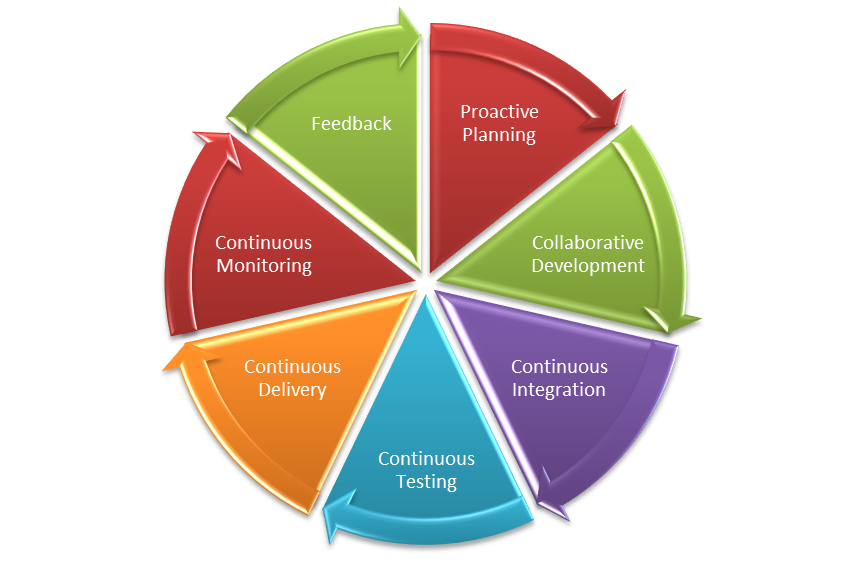
    Various collaboration mechanisms let teams work and learn together to produce better results. The figure below depicts the end-to-end life cycle of DevOps. Collaboration across the phases is essential to the success of your enterprise DevOps transformation.

    DevOps Lifecycle

    What are ChatOps and Bots?

    ChatOps is a term coined by GitHub to describe “putting tools in the middle of a conversation.” In a typical CI/CD pipeline, there are multiple tools that you interact with that have varied functionalities, such as source code management (SCM), defect management, continuous integration, continuous deployment and others. These are all discrete tools, but there is nothing that bridges them together. This is where ChatOps comes into play.

    A bot is a bridge between the collaboration tool and the DevOps tools. The bot receives a request from the user in the form of a chat command through a collaboration tool, analyzes the request and executes a set of commands on the target DevOps tool.

    The main components of ChatOps and bots are:

    Chat app/collaboration tool: This is the front-end chat system that connects the various stakeholders and enables them to interact between themselves and the systems around them.

    The bot: This is the core of ChatOps. A bot is the glue between your collaboration tool and your systems. It facilitates a two-way communication channel where you can fetch relevant information from the systems and act on the information received. A bot fits in between your collaboration tool and the DevOps tools, e.g. Hubot, Lita, ErrBot or AWS Lex.

    Target platform/infrastructure: Integration with the target platforms/DevOps tools is a key ingredient to a successful implementation of bots. These are the target tools and platforms on which the bot will execute the required commands. The tools integration allows your bot to communicate with tools and execute actions such as build, deploy, test, provision and scale infrastructure directly from the chat window.

    Where Bots Fit in the DevOps Pipeline

    Bots can prove to be an accelerator in various stages of the CI/CD pipeline. Below are the details of the integration with various DevOps tools in each phase of the life cycle:

    • Proactive planning – JIRA
    • Requirements management – JIRA
    • Continuous integration – Jenkins
    • Continuous deployment – Ansible, Chef
    • Continuous monitoring – Nagios, Grafana, Splunk
    • Continuous feedback – JIRA

    A chatbot plays a major role in bringing the different teams together into a single, persistent chat room to triage and resolve the issue at hand. In addition to just troubleshooting and triaging issues, bots can be used for various other business-as-usual jobs including:

    • Cleaning up servers.
    • Kicking off build and deployment jobs.
    • Rotating server logs.
    • On-boarding application on the monitoring tools.
    • Collecting metrics from tools such as Nagios or AppDynamics.

    Bot Technical Blueprint

    To achieve the aforesaid targets, we need to have a supportive bot platform in place. How closely the tools integrate with the bot ensures the quality of the implementation and opens new opportunities of automation.
    Bot Blueprint
    As the diagram depicts, the chatbot is hosted on a chat tool such as Slack. This can be on the cloud platform or an existing chat/communicator application. The bot is integrated with a key-value pair reference database, which is fed with the responses depending upon the activities or capabilities that have been fed to it. The key could be the name of the application to retrieve data from or any unique ID that would reduce the number of reads. A lookup of the defined key corresponding to the secondary key is performed on the response database and a response is sent back to the chatbot. Depending upon the number of outputs, the queries can be defined and stored in the response database.

    DevOps Bots: Use Cases

    Below are some examples of use cases for bots. This includes the complete life cycle of DevOps:

    Proactive Planning
    Create new user stories in sprint planning tools and assign sprints to teams. Update sprints and product backlogs.

    Build and Continuous Integration
    Execute build jobs and report back statistics of the build job. Perform daily/nightly builds and report on the status of the build to the relevant teams.

    Continuous Deployment
    Run deployment jobs and perform deployments across environments. Roll back deployments in case of failures, status checks, perform post-deployment actions such as JVM restarts.

    Infrastructure Provisioning and Configuration Management
    Kick off Chef jobs to provision infrastructure or provision application environments. Enable monitoring and restarting services and servers.

    Continuous Monitoring
    Provide application statistics or performing daily data lookups and grabbing metrics.

    Continuous Feedback
    Monitor application health and perform analytics.

    Key Measurement Metrics

    To achieve optimization and enhance performance of the continuous delivery process, metric measurement is the key. These indicators will help in taking certain corrective and preventive actions based on the results. Below are some of the key metrics indicators that can be measured.

    Effort Reduction
    Indicates the reduction of human/manual efforts for tasks such as triggering a build or deployment or collecting metrics from monitoring tools.

    Human Error Reduction Rate
    Reduction in the effort required due to rework caused by human errors.

    Reduce Issue Triaging time
    Indicates the time taken to resolve issues where multiple parties are involved and triaging of problems is required.

    Conclusion

    DevOps bots can significantly improve team efficiency, as well as a team’s ability to respond to emergencies. They save time and money, are fun to build and use and can have a positive impact on team morale, as well as increases the overall productivity of teams. This applies to both the engineering and operations teams. Enterprises embracing digitization are looking for partners with an engineering mindset who know how to bring in collaborative agile teams with the very latest knowledge of open source platforms and DevOps toolchains.


    Contact the Authors

    For more details please contact the authors on LinkedIn @
    Shriniwas Sathe
    Saswati Mohanty

    — Shriniwas Sathe

  • Bots: ‘Like a CLI on Steroids’

    Bots: ‘Like a CLI on Steroids’

    Overheard in a Palo Alto coffee shop:

    “… so, we tokenize the utterances, lemmatize the tokens, vectorize with StarSpace embedding, and run the featurized input through the neural net. The softmax activation layer tells us what the user intent was.”

    “Sorry, you what the what and then what?”

    “Or, you can say the user types commands, the bot interprets those and takes the appropriate action.”

    “Oh, now I get it; it’s like a CLI on steroids!” 

    Calling a chatbot “a CLI” is like referring to a mobile phone as “a portable wireless teletype”:  not even close to a complete representation, yet not entirely wrong. Like a smartphone, a well-trained bot will do as much or as little as the user requires of it.

    Historical Perspective

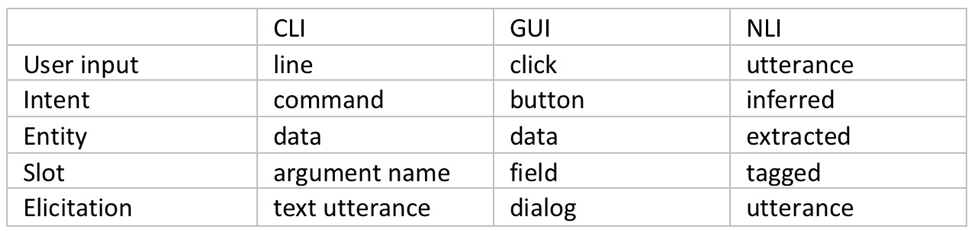
    The command-line interface (CLI) dominated human-computer interaction for a few decades, until the growing number of options software offered made GUI the new favorite way of talking to computers. Both of these interaction models are based on human to human communication: the operator communicates “an intent” complete with some input “entities,” each inserted in its “slot.”  This is exactly how bots operate, so how is a bot not just another UI?

    Fig. 1: User Interface Elements

    Bots as UI

    While a user interface is merely a human-readable catalog of machine’s capabilities and a set of input slots tightly coupled to a specific application, an NLI-enabled bot acts as our agent: it infers the intent (even multiple intents) from a natural language utterance, identifies any entities in that utterance, such as food: pizza, toppings: (olives, pepperoni) and fulfills that intent, be it by talking to Pizza Hut’s API or by calling the local pizza shop on the phone. Or even by making the pizza itself.

    NLI bots have already made quite an impact on the sales and support side, but how suitable are bot agents for more technical work? How would a chatbot perform in the DevOps world, replete with esoteric terms and complicated interfaces?

    Although there is a lot less training material available (after all, more people eat pizza than reconfigure Kubernetes clusters), there are also a lot fewer ways to express a technical intent, so in the end the technical bots are easier to train and make fewer mistakes than their sales brethren. But is a bot’s ability to classify an intent to deploy a new EC2 instance of specific flavor enough to make hardcore DevOps techies give up their favorite CLI?

    Beyond Interface: Advantages of Bot-assisted System Interaction

    Context memory: Whether a bot remembers your favorite pizza toppings, or you have to say “pepperoni and mushrooms” a couple of times a week is of little consequence. However, if your input looks like this:

    I’m sure you’d rather not have to type that ever again. The machine learning models of the leading bot platforms not only remember your slot values, they also remember the context in which those values were entered, so a well-trained bot is always able to suggest an appropriate value when looking to fill a slot.

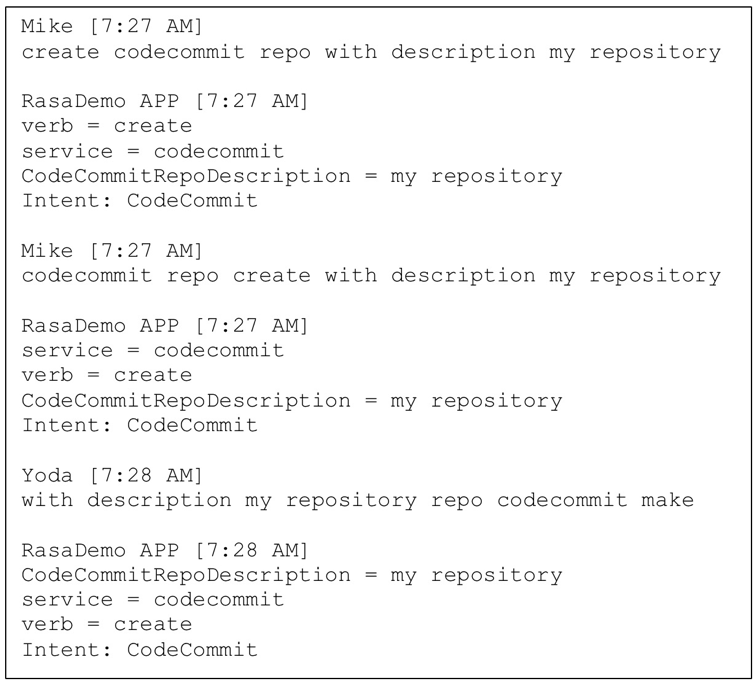
    Natural language understanding: Just like a human would not be fooled by variations in the word order or use of synonyms, neither would a well-designed bot. Not having to remember the exact syntax or even spelling translates into higher efficiency.

    Fig. 2: Intent classification and slot tagging

    Continuous training and improvement: The more time a bot spends with a team, the better it gets at its task of helping members of that team, not only due to filling its context memory with details about team members and tasks, but also because of reinforcement learning. In addition to the initial training corpus of data, most contemporary bot platforms feature interactive training mode, wherein a human user can provide a real-time feedback on the bot’s performance.

    Seamless automation: Since it’s an agent rather than a mere translation layer, the bot remembers successfully fulfilled intents and chaining those into a sequence, with or without slot elicitation, with or without branching and decision making is significantly simpler and easier than even the simplest of scripts.

    Collaboration platform integration: Teams typically meet in a collaboration platform such as Slack, WebEx or MS Teams, decide what needs to be done, then go and do it. With a bot on their team, they can get right to the “doing” part without leaving the collab platform; avoiding context-switching improves productivity.

    Built-in analytics: A bot’s main job is to classify intents, fill slots and invoke fulfillment. However, in its spare time it could listen in and take notes. At the end of an event (release, incident, outage, etc.) it could use its NLP savviness to provide a linguistic breakdown of the event: How many questions were asked? How many answers? How many statements? Or, even, What was the level of profanity use as compared to the average? This kind of summary provides benefits for parts of the company beyond bot’s original team.

    Conclusion

    Bots can and do increase productivity in a software development or operations environment. Automation is important, but when done through traditional means such as scripting, its high cost often causes it to be prioritized behind other tasks. The use of an NLI-enabled bot as an agent for interfacing with various back-end systems not only ensures the very best in user interface (“CLI on steroids”), but also minimizes the need to switch contexts and significantly lowers the cost of automation.

    More importantly, the emerging agent-facilitated process control prepares us for the next phase in the human-machine interaction: the post-app world.

    Bots will help us navigate the new world of commoditized services that will replace the familiar apps. They will track our experience and base future selections on our satisfaction with their past choices. What more can we ask for? Aren’t most of humanity’s dreams centered on intent (wish) fulfillment? What are the wish-fulfilling creatures from the fairy tales if not expressions of human desire for the perfect bot?

    — Mike Dimitroff