Tag: CA

  • CA Technologies Delivers First Integrated and Open Continuous Delivery Ecosystem, Enabling Organizations to Deliver Applications Faster and More Efficiently

    CA Automates Complete Application Lifecycle for Improved Deployment Times and Testing Efficiency

    New York, June 15, 2016 – CA Technologies (NASDAQ: CA) today announced the availability of CA Release Automation Continuous Delivery Edition, and several new integrations across CA’s DevOps portfolio and third party solutions creating the first integrated, fully automated and open continuous delivery ecosystem. Organizations can now connect and automate the entire app pipeline progression from development, to test, to production, to accelerate deployment times of applications by as much as 20 times* and improve testing efficiency by up to 25 percent**.

    “To thrive in the application economy, digital transformation must be driven by continuous delivery—the ability to rapidly and reliably release applications that meet the demands of external and internal customers alike,” said Jeff Scheaffer, general manager, Continuous Delivery, CA Technologies. “CA is the only DevOps solution provider that currently bridges development, testing, release management and operations in an open, seamless tool chain that helps organizations achieve entirely new levels of application delivery speed and quality.”

    Develop Swiftly, Test Agilely and Release Reliably 

    As organizations progress on their digital transformation journey, the volume, velocity and complexity of applications continues to grow. “Businesses no longer have the luxury of time. Rising customer expectations, competitive threats, and increased consumer choice have turned rapid delivery and iteration of software applications into a competitive differentiator. Optimizing the delivery value chain has become the new means to better business outcomes,” according to Forrester Research.***

    For application owners tasked with rapidly delivering innovative and inspiring applications, but struggling with constraints and dependencies across the software development lifecycle, CA helps eliminate these challenges by providing continuous delivery capabilities that enable organizations to improve release planning and orchestration, use agile testing to test less and cover more, provision data on demand and deploy simulated environments – all with zero touch workflow.

    This is accomplished through:

    “With CA’s continuous delivery solutions we’re standardizing our application products, achieving consistency between server environment platforms and are able to easily integrate CA Release Automation with other continuous integration applications such as Jenkins,” said Matt McComas, AVP Critical Applications, GM Financial. “As a result, we are quickly identifying and resolving inconsistencies in our application environments and have been able to cut deployment times down to two and a half minutes for a 98% reduction in deployment time.”

    Furthermore, to help organizations leverage existing investments, CA’s continuous delivery solutions integrate easily with market tools such as HP Application Lifecycle Management (ALM), Atlassian’s JIRA Software, Jenkins, Docker, Perfecto, Chef and Puppet for an open and fully integrated continuous delivery solution stack.

    “By using different CA tools as part of the software development lifecycle, testing is no longer a gatekeeper, but rather an operational quality door opener that helps simplify the development of new releases,” said, Arnold Hoogerwerf, IT strategy advisor at KPN, a leading telecommunications company in the Netherlands. “The tools we use from CA’s set of continuous delivery solutions have allowed us to reduce our investment and increase our agility in testing and helped us discover defects earlier so we can continually improve the quality of our applications in a shorter timeframe.”

    Release automation goes hand-in-hand with DevOps practices and Cloud technologies to ensure that organizations can deliver apps that provide the very best customer experiences and drive competitive advantage in today’s app-driven, cloud-connected, mobile-everything world. The open and flexible architecture of CA’s continuous delivery solutions can help organizations deploy applications to modern Cloud platforms such as Amazon Web Services, Microsoft Azure and Skytap as a standard part of their app delivery practices.

    To learn more, join InformationWeek, CA Technologies and a team of industry experts on Wednesday, June 15 from 11 a.m. ET to 1 p.m. ET for the live virtual event, Automation, Speed and Quality: The Keys to Your Continuous Delivery Journey. To register for the event or watch the replay visit,http://cainc.to/Wfn25T.

    Resources

    • The Total Economic Impact™ Of CA Release Automation, Forrester Research, December 2015

    **The Total Economic Impact™ Of The CA Technologies Test Data Manager Solution, Forrester Research, December 2015

    ***TechRadar™: Continuous Software Delivery, Q2 2015, Forrester Research, May 1, 2015

    About CA Technologies

    CA Technologies (NASDAQ:CA) creates software that fuels transformation for companies and enables them to seize the opportunities of the application economy. Software is at the heart of every business in every industry. From planning, to development, to management and security, CA is working with companies worldwide to change the way we live, transact, and communicate – across mobile, private and public cloud, distributed and mainframe environments. Learn more at www.ca.com. 


    Press Contact 

    Michelle Laidlaw

    Public Relations

    (631) 342-4701

    michelle.laidlaw@ca.com

  • CA World 2015 wrap up

    CA World 2015 wrap up

    Just back to my room from the Sheryl Crow/Fall Out Boys concert that ended CA World 2015. It was a full two days of information and news showing how CA Technologies is evolving to remain relevant in the changing world of ITOps and Development. There was certainly lots of new things to report as CA has had a busy year. Among the highlights:

    Rally Software’s agile business is going to transform CA. While you didn’t hear or see the name Rally, you saw Agile everywhere.  From the large “agile transformation zone” to the frequent mentioning of agile ways and training by all of the executives there. The entire top cadre of CA management has undergone agile training according to CEO Mike Gregoire. Agile training is going to be a big part of CA’s business going forward. It represents an expansion from the core software shop business that CA is built on.  How this will effect relations with their channel partners who have traditionally delivered training and pro services around CA software tools, remains to be seen.  But in order to use CA’s portfolio of software, some training and transformation counseling will be necessary.  My prediction is that over the next 18 to 24 months the Rally culture is going to profoundly change CA for the better, making them more nimble, agile and delivering transformation change to their large enterprise customers.

    New leadership faces. While Gregoire himself is now one of the veterans of the exec team having been there about 3 years, much of senior management is new having just taken the reigns in the last few months. I had a chance to question Otto Berkes, CTO and Ayman Sayed, Chief Product Officer. While both have only been on the job for a few months each, they both seemed to have a firm grip on the companies road map and what the market is looking for.

    aymanSayed in particular seemed to have strong feelings about what the market is going to demand in the coming months and years, as well as a willingness to have CA deliver it. Among these is a change in how products are sold and delivered. CA had already started delivering some of their solutions as SaaS based solutions. Sayed went further saying that CA is going to move to a freemium model with some products. Not just a free trial period but actual free versions of their product and dare we say it, even open sourcing some code.

    This will mark a big departure from CA’s traditional enterprise sales force. But I think it is an idea whose time has come. Today’s technical buyers don’t like to be “sold to” or even marketed to. They like to be educated, they like to hear about problem solving, they like to try solutions and if they find they work they will buy these solutions without the hard sell that traditional enterprise sales team used to exert.

    Other new faces were the Xceedium team joining CA’s security team. My old friend Mo Rosen is aboard and Xceedium’s privileged identity management solution is being integrated with CA’s existing identity products to create a full spectrum of choices both host-based and in the cloud.

    The idea of solutions that work both on premises and in the cloud is another big theme at today’s CA. They recognize that for the foreseeable future hybrid environments will rule.

    ottoaymanOf course DevOps was everywhere. It has been and remains one of the foundational aspects of CA’s business model. In listening to several sessions on DevOps at CA it also became clear that CA is using DevOps to expand their business from tools for IT operations to providing developers with tools for the total software development lifecycle.

    Among these developer tools API and API management is big business at CA. Their API and APM business lines are both leaders in their markets. CA seeks to use these best of breed tools to expand their customers use of CA portfolio products.

    I also had a chance to speak one on one with GM of the DevOps business at CA, Mike Madden.  Madden comes from the mainframe division over to DevOps and he recognizes that in todays bi-modal or variable speed IT world DevOps and mainframes actually work together. Madden has a good vision of what DevOps is and what CA needs to do to remain and grow their relevance in the market. He is also a big fan of the agile business from Rally and I think we will continue to see that as a big part of the DevOps business.

    This years CA World was considerably larger than last years event. When you think about it CA World is really different than many other conferences. Just about all of the 5000 attendees are CA customers. The idea is that attendees already use CA product, they are primed to perhaps buy more.

    It will be interesting to see what changes are in store and what next years CA World will look like. A sure bet is that DevOps will continue to play a major part of the CA story.

  • CA beefs up DevOps offerings with Grid-Tools acquistion

    CA beefs up DevOps offerings with Grid-Tools acquistion

    After a relatively long hiatus from the M&A scene CA seems to be back with bang. Following on the heels of its nearly half a billion buy of Rally Software, CA yesterday announced the acquisition of Grid-Tools. Grid-Tools is a test data management market leader. Prior to the acquisition they were a partner of not only CA, but HP and Oracle as well.  Post acquisition it will remain to be seen whether HP and Oracle remain important partners.

    Taken with the Rally acquisition a week ago this buy makes a strong statement that CA is doubling down on DevOps. Of course Rally literally wrote the book on Agile and with Grid-Tools leadership position in its space, CA has in one week brought in two leading companies in their space.  As with any acquisition integration is always a question. In this case it is a double helix of integration. Integrating Rally with Grid-Tools and both into the larger CA portfolio will take some work.

    Last week I spoke to James Harvey, General Manager and SVP, IT Business Management Division at CA Technologies. One of the topics we spoke about was that CA in buying Rally was not only buying some great IP and products, but also getting some top people. The Grid-Tools acquisition brings another influx of new blood to CA as well.  On top of this CA also announced the appointment of Otto Berkes as CTO.

    Taken all together we get a picture of CA on the move. They are adding new ideas, new people and new products as they seek to transform from a software provider in the mainframe space to a major player in the new application economy.

    One of the things that I think we will also see CA move into in a bigger way is SaaS and services in general. Unlike many of its competitors, CA has remained a traditional software vendor for a long time. But with the state of technology today, offering software as a service and offering consulting services around the software is more and more a requirement rather than a luxury. This may cause some angst among CA service delivery partners, but I feel it is an inevitable step in CA’s market evolution.

    Another telltale clue will be CA’s ability to retain the talent at these acquisitions. All to often brain drain occurs after acquisitions. I have not seen any announcements around management teams staying on post-closing, but CA could use the talent. They have seen some executives leave recently.

    The real winner in all of this in my opinion is DevOps. Large technology providers continue to load up on DevOps offerings in anticipation of the larger global enterprise market adopting a new way of IT that includes things like Agile, DevOps, Cloud, SaaS, etc.  It also bodes well for future acquisitions in this space by CA competitors which should help make some VCs sleep easier about their investments in startups in the space as well.

    BTW, in the interests of full disclosure CA is a sponsor/advertiser here on devopsy.kinsta.cloud, though we had no special notice or insight into any of this news.

  • What are the most critical DevOps Tools?

    What are the most critical DevOps Tools?

    What are the most critical DevOps tools categories? According to the results of a new survey by CA Technologies the answers may be surprising. That is just one of the insights reported on. The survey results and report are chock full of other great insights about DevOps usage as well.

    The survey shows that a staggering 88% of respondents either are already utilizing or expect to be utilizing DevOps within the next 5 years.  The over 1400 respondents to the survey represented IT or line of business executives and is a significant increase over last years 66% response rate. This would certainly indicate that DevOps is crossing over in the mainstream and is no longer solely in the realm of early adopters and visionaries.

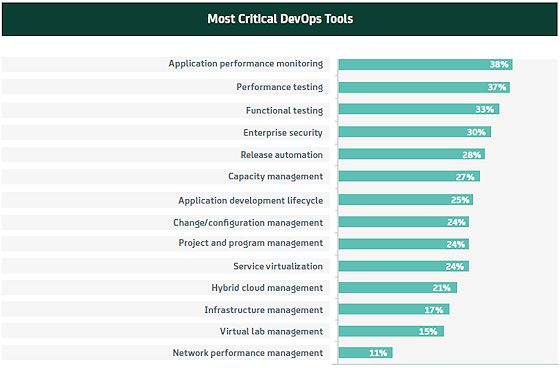
    So according to the study what are the most critical DevOps tools?

    tools

    APM as the most critical? It is a popular segment with players like New Relic, App Dynamics, Dynatrace (Compuware) and CA to name a few. But I thought that change/configuration management which would include Chef and Puppet would be number 1. Also performance testing and functional testing were 2nd and 3rd. Could this be a case of categories CA plays in being over emphasized, the “everything looks like a hammer to a nail syndrome”?  I don’t know, but the numbers speak for themselves. I was happy to see enterprise security coming in 4th on the list (another area CA plays in).  Bringing up the rear at only 11% was network performance management. I think that may have a lot to do with the fact that with the rise of the cloud, so many organizations are less invested about network as the cloud and Internet has replaced much of the internal LAN.

    I spoke to Andi Mann, VP in the CTO’s office at CA and a frequent contributor to devopsy.kinsta.cloud about the survey. Andi said that it is re-enforcement that despite all of the talk about DevOps being about culture, we should not forget that it is about tools as well.

    So what are the reasons given for this massive adoption statistic. What are the perceived benefits and reasons driving DevOps adoption?  According to the survey results:

    devops benefits

    As can be seen over 40% cited improved quality and performance of applications as the driver for DevOps.  For those who wonder about whether you can have increased speed only at the expense of quality, this would seem to show that you can have both with DevOps. Perhaps equally as rewarding was the 2nd most popular response, improving the end customer experience.

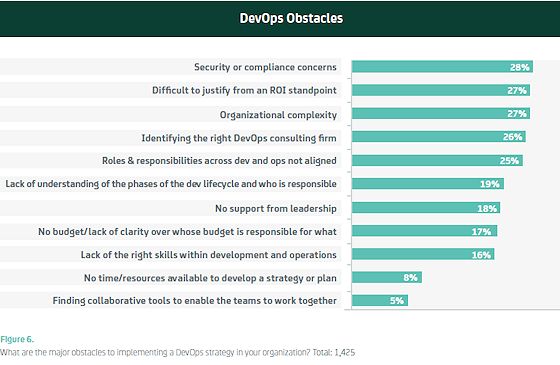
    In any case with 88% of respondents on board with DevOps, one thing is for sure, DevOps is the worst kept secret in IT. However, let’s not paint an overly rosy picture. Not every DevOps effort succeeds. What are the biggest obstacles to DevOps adoption? Again the survey says:

    devops obstacles

    So while enterprise security is a big benefit for adopting DevOps, security and compliance concerns are the biggest obstacles to DevOps adoption as well. I guess that is the Jekyll and Hyde nature of security? I don’t buy the ROI being difficult to justify. Most DevOps examples I have seen show a clear positive ROI.  Identifying the right DevOps consultant firm?  I don’t know about that one either. But then again I am bullish on DevOps, so I may be as guilty of the “hammer looks like a nail” as anyone.  I am surprised though that under obstacles we didn’t see that our culture is not trusting or some other culture related reason.

    You should go have a look at the survey yourself as there are other good insights there. In the meantime here is another indicator of just how deep DevOps is penetrating the IT market.


  • Organic engineering team a must for long term DevOps success

    Organic engineering team a must for long term DevOps success

    Last month I was out in Las Vegas at CA World. While there I had a chance for a one-on-one meeting with CA CEO, Michael Gregoire.  In our discussion Gregoire told me that one of the things he is most proud of in his time at CA is the fact that he has instilled a culture of an “organic engineering team”.  According to Michael you can’t truly be a successful software company (and just about every company is a software company today) or a DevOps empowered organization without this organic engineering team.

    I don’t think any CEO would be against having a high functioning engineering team. But what does Gregoire mean by organic? My understanding is that he is talking about the team being internal. Not outsourced or acquired, but built, grown and nurtured within the organization.

    So what does that mean for outsourcing? When software is eating the world, can you have a successful business when you can’t develop and operate your own software? If DevOps is a key ingredient in a high functioning IT organization, can you outsource DevOpst?

    In the case of DevOps, with cultural change being such an important ingredient in the recipe, it would seem that you can’t outsource culture, it has to be organic. But if you can’t outsource cultural change and DevOps, can you import it? Can you graft a culture of DevOps into your organization?

    This was exactly the conversation I had with another person at CA World and with several people thereafter. At CA World I had a chance to speak with Rohit Antao, a Principal at PwC who heads up many of the DevOps engagements that PwC is involved in. Rohit shared with me that in many of the IT advisory and transformation engagements that the firm undertakes instilling a DevOps friendly culture and process is just about obligatory.

    I asked Antao how they go about grafting a DevOps branch onto the main trunk of a company’s IT tree. Like similar paths I have heard from IBM and others, he explained that their blueprint is usually to pick a few small projects to build success upon. From these small projects where DevOps is injected they seek to expand this DevOps way deeper and deeper into the organization. The idea is that after some months the DevOps way of doing things take root. It becomes organic to the organization.

    Actually this kind of engagement involving coming in and transforming IT from within, then leaving behind a team and new way of doing things while you move on to the next engagement was something I first saw put in action by a company called The Feld Group. Charlie Feld in many ways pioneered modern CIO models. He and his firm would come in and turn an IT department on its head, hire in some new leadership and when things were on track leave to the next engagement. But leave behind a solid team and culture.

    This type of engagement is not only the purview of IBM, PwC and other big name firms. I had a chance to speak with Laszlo Szalvay, VP of SolutionsIQ. They are an Agile Enterprise Solutions company who today announced the acquisition of Boson-based Big Visible to form the largest agile consultancy focused on enterprise transformations.

    Laszlo explained to me that in his view there are two kinds of IT transformation consulting engagements. You can tell them apart by a cup of coffee. In one type of engagement the consultant tells the customer to grab a cup of coffee and leave the consultant to his work. The consultant will let the customer know when finished. In the other type of engagement the customer and the consultant sit down over a cup of coffee and plan how they will work together to accomplish the goal which ends when the consultant hands the keys back to the customer after they have worked together to instill in the case of SolutionsIQ a culture, processes and tools for an agile development team.

    Funny how though the names, faces, technology and tools change, the process stays the same. The same thing the Feld Group was doing 25-30 years ago is what these companies are doing today. You can graft a new culture and a new way of doing things into organizations. If planned well and done correctly you can grow your own organic engineering team.

    Can you outsource DevOps though? Can you have DevOps-a-a-Service? I am not sold on that one. I guess someone will have to convince me on that before I buy into it.

  • DevOps Is About Serving The Customer: Q&A with Shridhar Mittal

    DevOps Is About Serving The Customer: Q&A with Shridhar Mittal

    As a longtime proponent of continuous delivery and fast deployment schedules, Shridhar Mittal has advocated for DevOps operational patterns since before the DevOps moniker was even coined. It was a philosophy that stemmed from what he and his colleagues at what was then Interactive TKO saw happening in response to the service-oriented architecture movement: many organizations were slowing down their releases as opposed speeding them up, which was the whole “promise” of SOA, he says.

    “So we started a whole company around how do you change your development processes to get speed with quality in this new world of distributed architectures,” he explains.

    Since iTKO’s acquisition by CA Technologies in 2011, Mittal has used his current role as general manager of application delivery at the company to focus his efforts on evangelizing DevOps cultural shifts within the enterprise. He believes that DevOps is on the brink of revolutionizing the way IT departments function and in addition to his anecdotal evidence from frequent talks with IT leaders, he points to a recent survey CA conducted together with IDG for evidence. According to technology decision-makers, while only 7 percent of organizations have already adopted DevOps practices with enterprise-wide scope, it is gaining traction. Another 39 percent report that they’ve either implemented DevOps principles with limited scope or are in the process of adopting DevOps. And another 28 percent are either planning on implementing or are evaluating DevOps.

    devopsy.kinsta.cloud recently spoke with Mittal to discuss the mainstream uptake of DevOps, the biggest transition challenges and the attitudes about IT job performance in a new era of cooperation.

    devopsy.kinsta.cloud: Why do you believe that DevOps is gaining so much traction today?

    Mittal: I think the whole promise of DevOps is around better customer experience. Better quality for the customer, but in a much, much faster way than you could do it before. To me, that is ultimate goal.

    Ever since the whole consumerization of IT, everyone uses the web and everyone uses mobile devices, and there is no buffer in between the application and the end consumer now. Previously to that you used to have, in the call center, you had people who are using applications and the consumer never actually interacted with the application.

    So if it sucked, its internal people that had to deal with that–it wasn’t the consumer. Now, you cannot afford to have your customers have a bad experience because then you are going to lose business. One of our case studies is the .com part of a very large company–one of the Fortune 100. They had done a study that showed that for every one second delay in the response in the website dropped the conversion rate of sending someone to the next step of purchasing. It dropped significantly for every second.

    Think about it. If you’re doing a big marketing event, you’re sending hundreds of thousands of people to your website, and just because your website doesn’t respond properly, you lose that many more potential customers.

    That’s the kind of value that we’re talking about right now. Take a simple example, say there’s the launch of a phone and the telecomm company wants to release it at the same time the manufacturer is releasing it and the systems are not connected in time. They would end up losing hundreds of millions if not billions of dollars of business because they didn’t release it at the same time, and one of the competitors actually released on time.

    These are the kinds of the hundreds of millions worth of value we’re talking about. In the past, people thought about it as, maybe if I can get three percent or four percent more efficiency I can save x numbers of millions. But what I think they’ll really be looking for now is the ability to grow their business much faster.

    devopsy.kinsta.cloud: How can organizations start meeting the challenge of transitioning to DevOps?

    Mittal: Start small and then build up to the big There are at least three different on-ramps we talk about to get to DevOps. One is, just start with the development side of the word and decouple the development teams from each other so that they can do their things faster and still be able to deliver things on a higher quality. That’s using things like server virtualization and API testing. The second on-ramp is just improving your environment management, the release management capability. People today are spending tens or hundreds of man-hours creating and maintaining these environments then tearing them down and then bringing them up again.

    So figure out how automate that process where you can take so many man-days of work and bring it down to something that can be handled by one person and can be done as a self-service in a matter of minutes as opposed to taking days weeks or months to happen.

    And then the third on-ramp is to put more automated testing processes in place, for instances doing performance testing. Trying to do it in-house today is becoming more and more difficult because there’s never enough infrastructure internally to be able to handle simulating these tens of thousands and hundreds of thousands of people coming to your web site. It’s just not possible. So figure out ways to leverage cloud-based automated testing capabilities to support that.

    There are many different on-ramps and people can start from one or another and then start building to much bigger things. Start small and eventually expand to put it across the enterprise.

    It is also important to get the trust built between developers and operations through better visibility. The classic scenario is, the developers just want to write code, release it, then they want to go back to writing code again. Operations want to slow things down because all they care about is a stable environment. If I could get devs to have visibility and ownership and be measured on how the products are actually behaving in production and, same thing with ops, if I could give them visibility to what’s in the pipeline, what’s coming out, why is this coming out, what is the business case and how this impacts your business, they’ll all start feeling an ownership for the whole process.

    devopsy.kinsta.cloud: That brings up an important question: how critical is it to change job performance metrics in both development and operations in order to make DevOps work?

    Mittal: I think it’s very important. I think it’s not something that has to be done from the get-go but I think somewhere after you have done the first couple of projects and some of the people have started buying into DevOps, that’s when you have to fundamentally change the culture of the company. In my mind, that’s contracted behavior—and it’s not because people are coin-operated.

    I’m not saying this in a bad way. To me, people look at the way they’re comped as a way of understanding what their direction is. What are they being asked to do?

    So if they are not getting measured on quality, to them, that means “Just make sure that you just get things out as fast as possible and then if you have to roll back, then you have to roll back.” And if you’re not getting measured on constant speed, then that’s like being told by the executives that, “All I want you to do is have a stable environment; I don’t care as much about getting new stuff out there.”

    So there has to be changes in the comp structure, how people are rewarded, to really change the culture of a company.

    devopsy.kinsta.cloud: What other things need to be done on the line-of-business executive leadership side of the house to make DevOps work?

    Mittal: I think that the business side needs to be the driver to a large extent, because the business needs to say why something is important. If supply of IT capabilities is much less than demand, that means there has to be some kind of prioritization of work. And who’s making that determination? Who is doing the prioritization? To me, without a business context, you can’t be doing direct prioritization.

    I think the business has to be very involved in helping IT understand a prioritized list of what needs to get done. They don’t say how it needs to get done, they just need to say, “This is more important than this, and this is the impact to our business of that.”

  • CA Technologies Launches Industry’s First Management Cloud for Mobility

    Solutions to Secure the Mobile Enterprise and Accelerate Innovation to Capture Growth in the Global Mobile Economy

    Mobile World Congress 2014

    BARCELONA, Spain–()–MOBILE WORLD CONGRESS– Today at Mobile World Congress, CA Technologies (NASDAQ:CA) launched the industry’s first, comprehensive Management Cloud for Mobility. Delivered as a cloud service, this portfolio enables enterprises to manage, secure and grow their business, increase productivity and deliver an enhanced mobile experience.

    “The growth of mobile devices and apps in the enterprise is blurring the lines between personal and corporate data and leading to new challenges for enterprises”

    “The explosion of new devices, applications, content and transactions in the mobile environment has opened new challenges for enterprises of all sizes, worldwide. The CA Management Cloud for Mobility will help enterprises transform the challenges of the new mobile economy into significant opportunity,” said Ram Varadarajan, general manager, New Business Innovation, CA Technologies. “With solutions that power innovation, drive productivity and accelerate the development of new mobile applications and offerings, CA is extending its leadership in IT management to help businesses capitalize on the next technological and business shift – mobility.”

    The portfolio includes three complementary solution suites: Enterprise Mobility Management (EMM) to manage and secure mobile devices, applications and content; Mobile DevOps to accelerate application development and deployment; andEnterprise Internet of Things (IoT) to enable the adoption of internet-connected devices. The complete EMM suite and key products of the Mobile DevOps suite are available for purchase. Customers have the choice and flexibility to deploy the complete portfolio of solutions or individual components, with the ability to customize and scale cost effectively.

    This CA Management Cloud for Mobility is powered by Smart Containerization™ technology. Unlike traditional device-focused mobility management techniques, Smart Containerization™ allows enterprises to manage the security, performance, compliance and support characteristics of the device, application, content or email while preserving the quality of the mobile user experience.

    “The growth of mobile devices and apps in the enterprise is blurring the lines between personal and corporate data and leading to new challenges for enterprises,” said Chris Hazelton, Research Director, Mobile & Wireless, 451 Research. “The EMM space is evolving as companies are looking for more complete offerings that support customers and productive mobile employees. Secure container technologies must provide enterprise scalability and comprehensive security across app development, delivery and support, all while preserving the familiar native look and feel of nearly any mobile device an employee chooses to carry.”

    Enable Enterprise Mobility Management

    The EMM suite enables enterprises to drive employee productivity and satisfaction by simplifying the management and security of devices, applications, content and email.

    The four products within the EMM suite available for purchase are:

    • New CA Mobile Application Management (CA MAM): Provides security, management and control of mobile applications with fine-grained access control polices for mobile applications.
    • New CA Mobile Content Management (CA MCM): Enables secure content access and collaboration through file synchronization, access to enterprise content repositories and cloud store integration made available to the end user through policy-based mobile access.
    • New CA Mobile Email Management (CA MEM): Provides users with secure access to their corporate email and ensures group and policy-based controls to protect sensitive email content.
    • CA Mobile Device Management (CA MDM): Delivers comprehensive capabilities to provision, secure and manage mobile devices, and deploy mobile applications automatically or through an enterprise app store.

    Accelerate Mobile Application Delivery

    The Mobile DevOps suite helps enterprises accelerate the delivery of user-experience-focused mobile applications. It enables enterprises to achieve faster time to market by accelerating continuous application delivery while enhancing security. Working across multiple development tools, languages and methodologies, Mobile DevOps makes it easy to build and test rich API-based mobile applications, gain deep insights into performance, user experience, crash and log analytics, and automate and support these mobile applications when deployed onto millions of devices.

    The four products within the Mobile DevOps suite available for purchase are:

    • New CA Layer 7 API Portal: Simplifies publishing APIs, onboarding developers, and streamlines enterprises’ ability to rapidly develop applications based on these APIs.
    • New CA Layer 7 Mobile Access Gateway: Delivers unified access across web and mobile, authenticates users based on risk levels and protects the datacenter against rogue applications.
    • CA LISA Test for Mobile: Offers mobile and web developers global access to a comprehensive platform that simulates an exhaustive list of user scenarios for testing.
    • CA LISA Service Virtualization: Allows customers to test new mobile applications in simulated environments.

    Additional Mobile DevOps capabilities will be available in the next few months, including mobile APM, crash and log analytics, user experience analytics and remote application support.

    According to a Forrester Research report, “Development shops are just starting to grapple with the biggest change to system architecture since the rise of client/server in the early 1990s: omnichannel clients deployed on smartphones, tablets, and other connected devices. The mobilefirst focus these organizations adopt, forces application architects to think differently about the APIs clients use to access data and functionality.”*

    Manage and Grow in the Ubiquitously-Connected Tomorrow

    Enterprise IoT will enable businesses to deploy internet-connected devices, and manage and secure billions of Machine-to-Machine (M2M) interactions. Ubiquitous connectivity, advancements in big data analytics and the ability to embed computing into everything have led to the rise of the IoT phenomenon. The Enterprise IoT suite will provide enterprises a secure foundation to extend mobility with IoT infrastructure to achieve business efficiencies.

    These Mobility offerings from CA are further supported by significant advances in the CA Security portfolio. These include new and updated identity-based solutions that help customers secure their growing portfolio of cloud services and mobile applications.

    For more information on the various solutions supporting mobility from CA Technologies, please visit: http://www.ca.com/us/mobility.aspx.

    *The Forrester Wave™: API Management Platforms, Q1 2013, Forrester Research, Inc., February 5, 2013.

    About CA Technologies

    CA Technologies (NASDAQ: CA) provides IT management solutions that help customers manage and secure complex IT environments to support agile business services. Organizations leverage CA Technologies software and SaaS solutions to accelerate innovation, transform infrastructure and secure data and identities, from the data center to the cloud. Learn more about CA Technologies at www.ca.com.

    Follow CA Technologies

    • Twitter
    • Social Media Page
    • Press Releases

    Legal Notices

    Copyright © 2014 CA. All Rights Reserved. One CA Plaza, Islandia, N.Y. 11749. All trademarks, trade names, service marks, and logos referenced herein belong to their respective companies.

  • CA Technologies and IDG Ventures Team Up to Drive Innovation in the Indian Enterprise Software market

    CA Technologies invests in IDG Ventures India Fund II LLC as a Strategic LP

    …expansion into enterprise  markets including mobility, cloud, Software-as-a-Service, big data and DevOps.

    New Delhi, India, February 13, 2014 – CA Technologies (NASDAQ:CA) today announced a strategic partnership with IDG Ventures India, a leading technology venture capital fund investing in India, to help drive innovation in the enterprise software market.

    IDG Ventures India is a part of IDG Ventures, a global network of technology venture funds. IDG Ventures India helps build category-leading companies from India for the Indian and global markets.

    “We believe in the growth and innovation of India’s development community,” said Jacob Lamm, executive vice president of Strategy and Corporate Development, CA Technologies.  “With IDG Ventures India, we have a proven partner who can help us gain early visibility into the many enterprise software startups in the region that represent compelling investment opportunities.”

    The investment also complements the organic growth planned for CA Technologies in its R&D and Engineering centers, along with expansion into enterprise  markets including mobility, cloud, Software-as-a-Service, big data and DevOps. The investment provides CA with a platform to nurture new ideas and innovations outside the constraints of an existing business, while offering the flexibility to quickly ‘roll-in’ successful technology into its product portfolio. With this investment, CA Technologies also gains periodic proprietary updates on technology trends, market dynamics and the venture landscape, which will provide the company better visibility into coming trends in the enterprise software market.

    About IDG Ventures India

    IDG Ventures India is a leading India-focused technology venture capital fund. The fund is part of IDG Ventures, a global network of technology venture funds with more than US$6 billion under management, over 200 investee companies and 10 offices across Asia and North America.

    The fund’s lead investor and sponsor is the International Data Group (IDG), the world’s largest IT media company. By combining the IDG platform – an unparalleled combination of global technology publishing, market research (IDC), and conferences/exhibition resources – with years of hands-on experience in company building, IDG Ventures India helps its investee companies understand their markets better and penetrate them faster than their competition to build category-leading companies. Learn more about IDG Ventures India at www.idgvcindia.com.

    About CA Technologies

    CA Technologies (NASDAQ: CA) provides IT management solutions that help customers manage and secure complex IT environments to support agile business services. Organizations leverage CA Technologies software and SaaS solutions to accelerate innovation, transform infrastructure and secure data and identities, from the data center to the cloud. Learn more about CA Technologies at www.ca.com.

    Follow CA Technologies

    Legal Notices

    Copyright © 2013 CA. All Rights Reserved. One CA Plaza, Islandia, N.Y. 11749. All other trademarks, trade names, service marks, and logos referenced herein belong to their respective companies.