Tag: business case

  • DevOps is a Risky Business

    DevOps is a Risky Business

    I spend a considerable amount of time with clients discussing DevOps and the potential value it can bring to them, but there is one theme that always resonates: the ability of a DevOps approach to eliminate risk. While many of us understand the benefits in terms of being faster (improved productivity), cheaper (reduced cost) and better (improved quality), I find that a conversation based around risk, especially when talking to the business or department heads, usually gets straight to their concerns in a language they understand.

    IBM’s definition of DevOps is not simply about connecting development and operations; it is fundamentally about providing a capability that: 1) allows lines of business to connect with their customers (which may be internal employees) quickly, and 2) facilitates rapid feedback from their customers so relevant adjustments can be made. DevOps, therefore, embraces the philosophy of iterative (and incremental) development and delivery, whereby solutions are delivered through a series of incremental releases.

    DevOps is a Risky Business_1

    By ensuring all aspects of a solution (requirements, designs, code, executables, tests, etc.) evolve over time as each increment is completed, DevOps is fundamentally focused on addressing risks including:

    • The risk of not knowing the requirements (have you ever tried to write down and freeze the requirements for a mobile app?)
    • The risk of not knowing the solution (especially when it’s new, you’re defining a new architecture or you’re embracing new technologies)
    • The risk of not knowing the effort (especially when the solution is novel for the organization)
    • The risk of not delivering on time (when the pace of the team, for example, is an unknown)
    • The risk of not providing the right level of quality (and the impact this may have on customer sentiment)
    • The risk of adopting inappropriate practices (meaning that the approach being taken by the team is not working for them)
    • The risk of having an ineffective delivery environment (including automation through the use of delivery tools)

    I could go on. There are so many risks that can be addressed simply by delivering working software iteratively, that it’s surprising how many organizations continue to fall back to a “waterfall” mentality—even in high-risk environments where much is unknown.

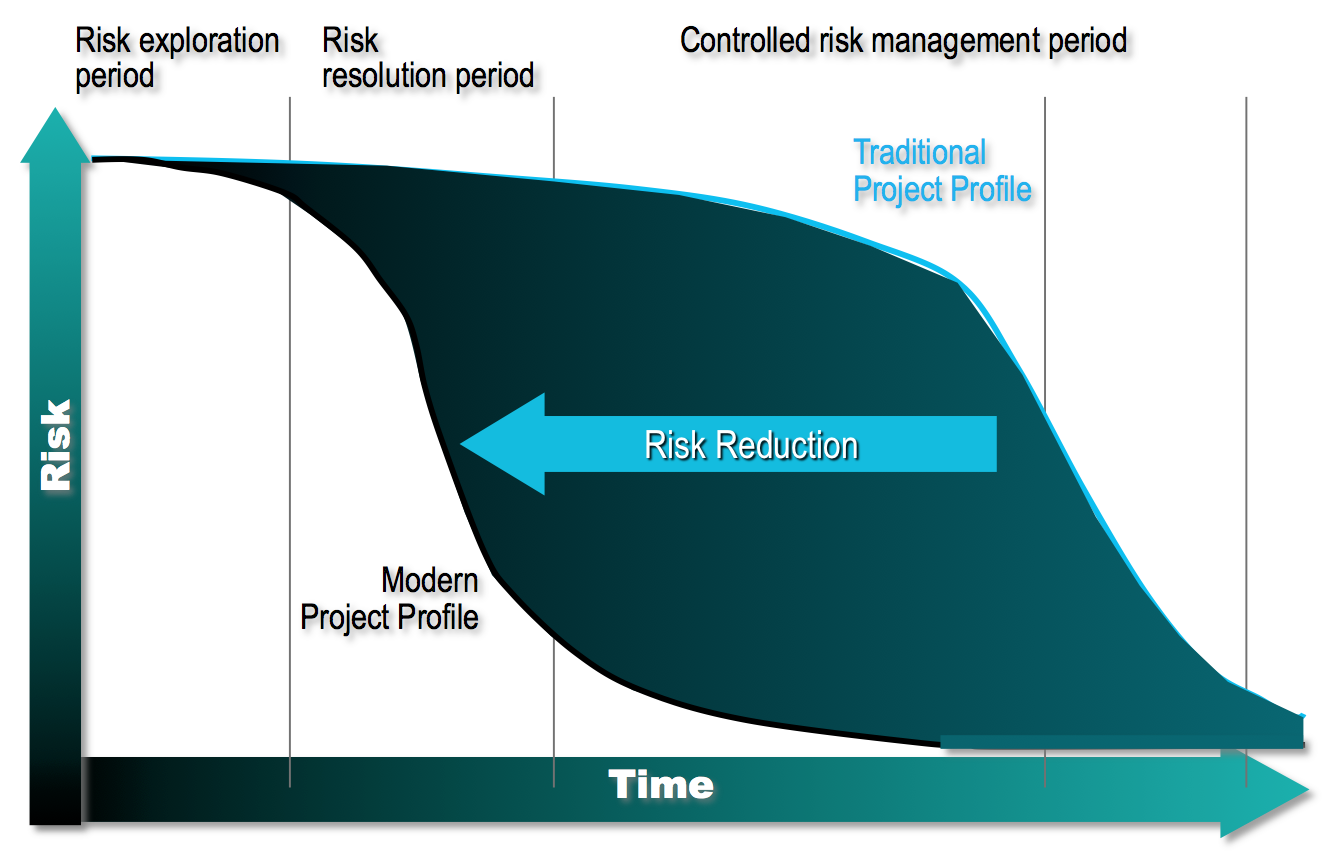
    The tack I’ve taken here originates from my time at Rational Software Corp. (which IBM acquired in 2003), where we would emphasize the need to deliver software iteratively and progress was measured based on the results achieved (i.e., working software) rather that the documents produced. My favorite graphic from that time is the one shown below, which shows how a modern approach changes the risk profile associated with a delivery project, since it focuses on removing risk as early as possible in the life cycle.
    DevOps is a Risky Business_2

    In summary, incremental and continuous delivery evident in a DevOps approach allows us to call out risk early and determine its resolution. DevOps often is used along with “lean startup” thinking (and its build-measure-learn cycle) and monikers such as “fail fast” since these are, at their heart, also focused on addressing risk.

    Take the DevOps self-assessment to find out where are you on your DevOps journey

    About the Author / Peter Eeles

    Peter Eeles

    Peter Eeles is an Executive IT Architect in the DevOps Global Tiger Team, IBM Hybrid Cloud, where he helps organizations improve their IT delivery capability in order to drive tangible business value. He has a particular interest in the adoption of architecture, agile, DevOps and cloud as innovation enablers. In the IT industry since 1985, Peter comes from a delivery background and was previously chief architect of IBM Rational’s Worldwide Solution Delivery organization, where he led many large-scale transformations in a variety of industries. Peter has written many papers and several books, including “The Process of Software Architecting” (2009), “Building J2EE Applications with the Rational Unified Process” (2002), and “Building Business Objects” (1998). He runs his own website at www.architecting.co.uk.

    Connect with Peter on LinkedIn and Twitter.

  • DevOps by Osmosis — Is That Even Possible?

    DevOps by Osmosis — Is That Even Possible?

    “We don’t do DevOps. We can’t, as our development plans are agreed so far in advance and our priority from a production point of view is to keep our systems available 24/7.”

    I heard this comment from a pal of mine as we had a quiet beer over the weekend, but I’m sure this comment, or a variation on it, has been uttered many times in many places. Here’s the irony: I had met my pal, who works as a developer for a major financial services company, after he had had the week from hell. His group tried—and succeeded—to fix a major system issue that had come out of the blue. He had certainly earned the beer that week.

    So, I asked him: “How did you get the problem sorted in the end?”

    “Well, we had to form a Tiger Team,” he replied. “Pulled together some of the DBA team, the key developers and the Ops guys, worked throughout the night and managed to keep the systems up and running the next day, while we used that time to address the root cause.”

    “How did you get around the Governance guys?” I asked.

    “Well, we brought one of them into the team for a few hours, and she was able to get us past some of the key bottlenecks,” he said.

    “And how about QA?” I asked.

    “Oh, they knew this was a major issue and so we cut out a lot of the QA and just went ahead,” he replied. “It was a bit risky, but we had all the right guys in the room to fix anything that cropped up.”

    “So, you manged to get a major change through in a couple days, kept your systems up and running, kept your customers happy, and earned that beer,” I said.

    “Yep, that’s about it, alright,” he said.

    “So, that’s pretty much what DevOps is all about—minus the emergency element,” I pointed out. “Seems to me like you guys are already on the DevOps road.”

    It was about then that the penny dropped with my pal. He suddenly realized that yes, they could do changes quickly, yes, they could do them in an orderly manner and yes, they could keep their systems up and running while all that happened. But, as quickly as the penny dropped and the realization dawned on him, the light went out again.

    “There’s still no way we can do DevOps in our place,” he said. “There’s too many hurdles to overcome, too many guys used to doing things the existing way, which to be fair, has worked well for us. To be honest, there’s too many guys who would feel under threat if we suddenly changed how we do things.”

    And that, in a nutshell, sums up the major challenge facing people promoting a DevOps approach. I have spent many years in the IT industry; I go so far back that I wrote my first code using punch cards (look them up) so I’ve seen change come and go, and change has been the one constant. I think many people in the IT industry have become too focused, whether it’s on the latest tools in their area of expertise, or on the newest piece of kit that has been bought, or indeed on the latest problem the business has put in front of them. The industry has become mature—if we compare the IT world to a field such as medicine, you pay passing attention—if you even notice at all—to things outside your specialty field.

    Now that’s right and proper. I don’t want an orthopedic surgeon trying to fix the problem with my eye, and I don’t want a DBA to write me some code. But when something comes along that affects the whole industry, I want them to pay attention and not ignore it.

    Daysha ran a lunchtime seminar last week, and we titled it “BizDevOps – DevOps isn’t compulsory but neither is survival.” We wanted to use this seminar to engage business people who, let’s face it, are the people we support and who need to understand how IT can make things better. Somewhat disappointingly, while we attracted a great crowd, they were all IT people. No one from the business attended. Now maybe we advertised this event in the wrong places, or maybe we held it in the wrong place, but here’s the thing: We attracted IT people from major companies, and none of those IT guys said to their business people, “You need to hear about this, come along for lunch.” I hope that after our seminar they went back to their business people and said just that, and maybe the next lunch will have the business people in the majority.

    When PRINCE came out into the project management world, it was not bought into by a majority of project managers. The same happened with ITIL. And the same will happen with DevOps. It is fair to say that PRINCE and ITIL are pretty much standard on a worldwide basis. I am old enough to remember the time I first heard of them, and the time I did my first course and passed my first tests, but nowadays, they’re part of the furniture—taken for granted, and rightly so.

    I think people are a little bit afraid of DevOps, and I can see why this is the case. Think about it for a second: Someone is now saying that the way we have done things for years has to change. That we can do things better, faster, with higher quality, but we just can’t do the massive 12-month long project in the same way. We might need some new tools, primarily on the Ops side. We might need some new skills—again, primarily on the Ops side. But, by the way, we’re not going to do away with the Ops guys (so don’t expect to make major budget savings there). But here’s the thing: Our end customers will notice the difference, and so will not be tempted by the new kid on the block—who, as it happens, is probably using a DevOps approach to develop his application, which is threatening our business.

    Change is scary, it’s not easy, and making a major change while you’re still having to churn out the new business requirements, and keep the current systems running … now that’s really scary. But, like my pal whom I shared the beer with last weekend, maybe you’re not as far away from that change as you think you are, maybe it’s not as scary as you think it is, maybe it will affect people positively, maybe you just have to do it.

    About the Author/John Brophy

    eJohn Brophy is currently Head of Professional Services at Daysha Consulting in Ireland, where he leads a team of 25 project managers and business analysts working on projects in blue-chip clients. He is a 35-year veteran of the IT industry, starting out as a database systems programmer, moving onto leading a team of systems programmers looking after what were then called midrange systems. He then became a senior project manager with a global IT company and followed that up by running his own IT infrastructure support company for 6 years. His background is Ops – and he is proud of that!

  • Building a Business Case for DevOps

    Building a Business Case for DevOps

    You can get your DevOps vehicle as fast and fine-tuned as you like, but until you provide an effective business case to the board it will remain in the garage. To get the thumbs up, you have to prove your model is efficient and makes financial sense for the company as a whole.

    Do You Need to Make a Business Case for DevOps?

    Coherent business cases are needed for companies at various different stages of their DevOps journey, not just those at the very beginning. Ask yourself which one of these scenarios best suits your current situation:

    1. You/your CIO know(s) the company needs to become more agile, but you don’t know how to quantify the benefits.
    2. Your teams have started to implement DevOps practices locally and can see the benefits, but you don’t know how to quantify the success to sell it to management.
    3. Your organization sees the success of DevOps pilots, but need to justify the investment to bring DevOps to an enterprise scale.

    DevOps can represent a huge shakeup of the IT department that must be justified clearly and logically. The risk must be outweighed by the projected financial gain. Crucially, this needs to be quantified in language that finance department can relate to. It is referred to as the hurdle rate: the necessary annual or total return of a project to compensate for the risk.

    What Should the Business Case Contain?

    1. Executive briefing
    2. Recommendations
    3. Required decisions
    4. Business drivers
    5. Scope
    6. Assumptions
    7. Analysis
    8. NPV (Net Present Value)
    9. Strategic options

    Hallmarks of a Successful DevOps Business Case

    Agility

    This is the main benefit of DevOps: the ability to deliver applications faster and allow for frequent changes and adoptions all the way into production. But how do we measure and quantify the benefits of agility?

    Time Value of Money

    The time value of money expresses the fact that money today is worth more than money tomorrow. The more you have to invest early (instead of over time) and the longer it takes to receive the return, the lower the present value of your investment.

    The number you receive when calculating the present value of an investment (benefits minus costs) is called NPV (Net Present Value). It tells you what your future investment is worth today.

    With agile and DevOps you are able to develop an application and deliver it to your end user in small chunks rather than in big ones; thus, you will improve the NPV (Net Present Value) of your project even if the total amount of investment and output are the same.

    Delivering software continuously rather than yearly creates benefits in the same way as receiving interest on your savings account every day rather than just once a year.

    The precise time value of money depends on the average cost of capital a company has to bear. For example, a large, publicly traded company has a lower cost of capital than a small, privately owned one. Your finance department will know it.

    Cost of Waste

    A second aspect, which speaks for agility in a quantifiable manner, is the reduction of waste.

    Functionality delivered using non-agile software engineering practices may be irrelevant or outdated once it reaches the end user because of the time gap and mismatches in requirements and expectations. The cost of such waste can be reduced drastically by using DevOps.

    Calculate the benefit of waste reduction using available statistics on the average percentage of functionality used without changes in your applications. It may pay off to assess this number for the last two or three releases delivered.

    Take into consideration:

    1. Total cost of development and delivery of these releases.
    2. Relative efforts of different functionalities delivered by release.
    3. Cost of change requests that arrived during and after the release date.
    4. End-user survey on the need and usability of these functionalities.

    Combine the benefit of waste reduction and of frequent delivery and add them as positive future cash flows to your calculation.

    You also need to calculate the forecasted costs of your DevOps initiative. Consider:

    1. Investment in build, test, deploy and provisioning and related operating expenses.
    2. Investment in IT infrastructure.
    3. Investment to complement skills in development and operations teams.
    4. Investment in organizational changes.
    5. Operating expenses for all above.
    6. Extra cost of non-automated activities in test, release and deploy due to increased release velocity.

    As part of your strategic options in the business case, balance your investments in automation with investments in more resources for build, test and deploy for given agility scenarios. The higher the release velocity, the more build, test and deploy activities are required. The more automation, the less of these activities must be done manually. Visualize in diagrams how the investment in more automation starts to pay off with increasing release velocity.

    Finally, sum up positive and negative cash flows and use your company’s hurdle rate to calculate your NPV.

    About the Author/Michael Schmidt

    Courtney-Glymph_avatar_1435225162-96x96Michael Schmidt heads DevOps Practice at Automic, a management and technology advisory service established to help Automic customers to prepare for and transform their organizations toward DevOps. Michael spent his carrier as consultant, entrepreneur and in several product-related leadership positions. He has a passion for building lean IT organizations. Michael holds a joint MBA from New York University, London School of Economics and HEC Paris and a Master of Computing Science.